Two-thirds of the way through this sermon, I’m going to bring today’s second reading into it, but first I need to set the stage. Today, we’re talking about power, which is one of those tricky words because it can mean many different things to different people. We’re going to talk about three understandings of power, and I hope you will stick with me because the third one is the one we are aiming for.
Next Sunday we begin again – another new year in our cycle of celebrations of God’s presence in our midst. But as the 90s band Semisonic reminds us, “Every new beginning comes from some other beginning’s end.” That end happens today. Today we end the current church year with the feast that marks this ending. For years now, I’ve been calling it “Reign of Christ” Sunday instead of its more common name, “Christ the King” Sunday. This morning, I’d like to explain why I made that shift because its theological implications are important for our walks of faith. My apologies ahead of time since this sermon is going to be pretty heavy on history. Hopefully, I have risen far enough from my tryptophan coma to make the next ten minutes make sense.
I’ve preached many, many times over the years about the famous words we heard this morning from Paul’s Letter to the Philippians. Many biblical scholars regard these words about Christ’s descent to be one of us and his subsequent ascension as one of the first Christian hymns in existence. It’s an important passage that I’ve read over and over again, but this time a few words caught me that I hadn’t noticed before: “Let the same mind be in you that was in Christ Jesus.” Another translation says, “Have the same mindset as Christ Jesus.” A third says, “Adopt the attitude that was in Christ Jesus.”
That got me thinking. In what ways can we live into this mindset, this attitude of Christ? So, I’ve compiled a Top Ten list for this morning’s sermon. Each one of these deserves its own entire sermon, but instead of dwelling on one particular piece of the mind of Christ, I thought I’d share ten in the hopes that one or more will set a fire in you for further reflection and action. All right. Ready for the Top Ten ways to embrace the mindset of Christ?
This sermon is about the danger of fundamentalism, but it’s going to take me a few minutes to get there. I need to start like this: something’s going on in the Church in Corinth. We don’t know exactly what because we only have Paul’s side of the story. But we know that within a few years of its founding, fractures have appeared between the church’s members. Later in the letter, Paul references a few issues that divide the people: issues around what to eat, issues around who is most important in the church, and issues around which spiritual gifts are the best. Paul addresses all of these before culminating in his great poem about love – you know, “Love is patient, love is kind,” etc.
But here at the beginning of the letter, Paul talks about another type of division that goes beyond the ideological. Paul has heard that the members of the Church in Corinth are assigning themselves to camps based on certain individuals. There’s Paul. There’s Apollos, who was another church planter in Paul’s orbit. There’s Cephas – that’s Simon Peter. And there’s Christ.
Okay, I’m going to get in the weeds here for a minute. Fair warning. I promise it’s important.
Did anyone stay up late last night to watch the ball drop in Times Square? I didn’t. If memory serves I have stayed up until midnight on New Year’s Eve exactly once in my life. I think it was my senior year of high school, and I’m pretty sure my friends had to keep waking me up. So, I was definitely asleep for the ball drop last night. But did any of you stay up? Show of hands?
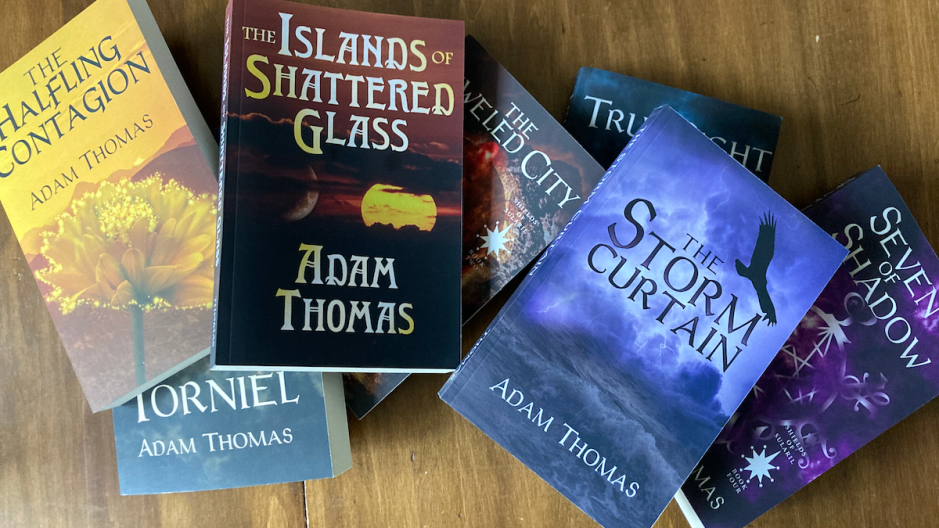
When I first started writing novels, I did not plan for writing fiction to become one of my primary spiritual disciplines. I had no idea my novels would help me better envision God’s relationship to all of creation. And I definitely did not expect my hours and hours and hours of fantasy world-building would grant me a deeper understanding of what we celebrate today, the Reign of Christ.
During the first six months of the pandemic, I wrote six new songs to be sung during the livestreamed worship at St. Mark’s Episcopal Church in Mystic, CT. I’ve collected them into this EP.
This week I helped my friend, the Rev. Adam Yates, and a group of other clergy in Connecticut craft a response to the Nashville Statement. Our first attempt was little more than a reactionary rebuttal of the Nashville Statement’s affirmations and denials. It turns out we needed to write that first draft in order for it to evolve into what we really wanted to say. The second draft is an expansive vision of God’s creation and the rich diversity of people who belong to that creation. Because it is still a response to the Nashville Statement, ours still focuses on sexual orientation and gender identity. But it goes further than that, because as we wrote it, we reveled in the rediscovery of just how wondrous and creative is our God. Continue reading “The Connecticut Statement”→
Sermon for Sunday, November 27, 2016 || Advent 1A || Matthew 24:36-44; Romans 13:11-14
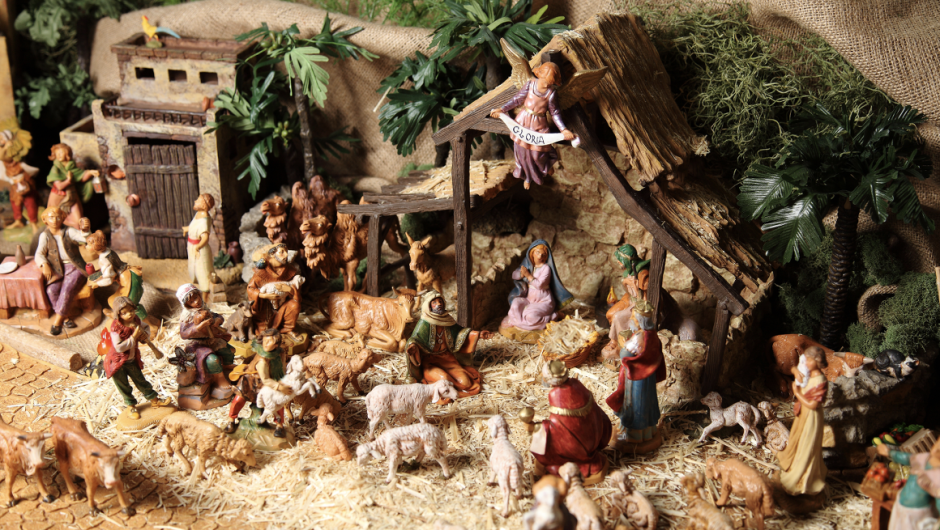
At the end of this sermon, remind me to tell you why “O come, O come, Emmanuel,” is a funny thing to say. I’ll get to that in a few minutes, but first I want to tell you about my parents’ Nativity scene.
During the season of Advent when I was growing up, my family placed a beautiful Nativity scene on the shelf above the TV. The wooden stable had a bark and moss covered roof, above which we suspended angels on fishing line. Inside the stable, a bearded Joseph leaned on a staff and a kneeling Mary pondered things in her heart, while a donkey and a cow looked on. Outside the stable, a pair of shepherds, a woman balancing a jug of water, and assorted townsfolk queued up like bridesmaids and groomsmen in a wedding photo. Each character was transfixed by something going on at the center of the stable, something that was obviously important if the painted expressions on their faces could be believed. The trouble was that nothing was going on at the center of the stable. An unassuming manger stood in between Mary and Joseph, who stared lovingly down into the empty box.
(Sermon for Sunday, October 16, 2011 || Proper 24A || 1 Thessalonians 1:1-10 )
Any spherical object! (that's me at age 2)
Did your parents ever tell you about the first word you ever spoke? More than likely, your first word was “Da,” which is short for, “Daddy, go get Mommy so I can have lunch.” Perhaps, your first word was “Ma,” though this is unlikely, considering the “M” sound is much more difficult to make than the “D” sound. Perhaps, your first word was “No,” which you probably heard your parents say many, many times when they asked each other if the other had slept last night. My first word was “ball.” And thus began a lifetime of me kicking, catching, and throwing any spherical object I could get my hands on.
Christianity has some first words, as well; at least, they’re the first words that we still have a record of today. They aren’t as hesitant or half-formed as are the first words of infants. Rather, they spring from the pages of the New Testament with remarkable (even uncanny) clarity, vitality, and comprehensiveness. We heard these words a few minutes ago when we listened to the first ten verses of Paul’s First Letter to the Thessalonians.
Now, before we get to some of Christianity’s first words, we need to clear up one spot of potential confusion and talk for just a minute about the similarities between Thessalonica in 50 AD and the United States in 2011. First, the potential confusion.
If you pull up the Bible on your smartphone, you will notice two things: number 1, the New Testament begins with the Gospel according to Matthew; and number 2, Paul’s First Letter to the Thessalonians is actually eighth on Paul’s depth chart, not first. So how could these ten verses from First Thessalonians possibly be the oldest recorded words in Christian history?
For starters, the folks who put together the New Testament put the four accounts of the Gospel up front because the rest of the pieces didn’t make a lot of sense without first hearing the story of Jesus’ life, death, and resurrection. But the people who wrote the Gospel didn’t start doing so until probably 15 to 20 years after Paul wrote to the Thessalonians. As for Paul’s depth chart (and this is a little strange) – his letters are actually in order by length, from longest to shortest, and First Thessalonians is one of the shorter letters. But if the New Testament were ordered chronologically by when the texts were written, our reading from Paul today would be on Page 1. Okay, confusion averted? Great. Let’s keep going.
Our modern moment shares several things in common with mid-first century Thessalonica, the community to which Paul writes the first words of Christianity. Like the modern United States, Thessalonica was a diverse, cosmopolitan place, with a plurality of religions and cultures all rubbing shoulders. As the capital of the region of Macedonia, there were plenty of things to do, not unlike the glut of stimulation that assaults us at every turn. And the Thessalonians had not received the good news of Jesus Christ before Paul arrived, just as people in modern America have lost contact with this great story of the Gospel.
To these people in Thessalonica and to us here on the Interwebs, Paul sends these first words. He, of course, had no idea we would consider them the first words of Christianity, which lends a special kind of authenticity to his message. These are words written to people who hadn’t read Matthew, Mark, Luke, or John. These are words written to people who lived in a society that knew very little about this faith that Paul brought with him. As such, these are words that can serve us as we practice sharing our faith, as the Thessalonians did, with people outside the walls of this church.
In these first ten verses of the first text of Christianity, there are six words in particular that shimmer for me: grace, peace, faith, love, hope, and joy. Notice how Paul uses each of these special words: “Grace to you and peace,” he writes. “We always give thanks to God for all of you and mention you in our prayers, constantly remembering before our God and Father your work of faith and labor of love and steadfastness of hope in our Lord Jesus Christ…You became imitators of us and of the Lord, for in spite of persecution you received the word with joy inspired by the Holy Spirit.”
These words are special because each has a meaning outside the church and a greater meaning inside the church. The secular understanding of these words can give followers of Christ like you and me a place to establish common ground as we share with others how God is present in our lives.
Let’s quickly look at each of these words to see how we can expand the secular definition to fit into the greater reality of following Jesus Christ.
“Grace” is a perfectly lovely word. We use this word to describe ballet dancers because they move with poise and precision. They throw their bodies into the air trusting that they will land on their feet, and if they don’t they get back up quickly and keep dancing. How easily can we take this understanding of grace and elevate the grace of the dancer to the Grace of God, this grace that picks us up when we fall and teaches us to find beauty in everything.*
We hear the word “peace” when conflict ends and “peacekeepers” enter the recently warring region to monitor the new situation. We use this word to describe a calm ocean after a storm or an infant who has finally dropped off to sleep. We can expand this to the Peace of God, which takes situations of conflict and infuses them with possibilities for unity, justice, and new beginnings.
“Faith” is the trickiest word on this list because all human attempts at “faithfulness” fall short. We put our trust in banks, in governments, in products, in each other, and sooner or later we are always let down. But when we expand the definition of faith to include the Faith of God, we find the one example in all of creation that will never fail. How wonderful to tell someone about this kind of faith!
“Love” is tricky, too, because we use the word in so many different circumstances, from our shoes to our spouses. But when we find that most authentic use of the word, when the word “love” springs unbidden from our lips and doesn’t describe an emotion but a state of being, a state that we entered unwittingly and never want to leave – then we begin to see the edge of the extraordinary Love of God. And we can celebrate that love with each other.
“Hope” is about the future. All people have used this word to talk about what they dream for the days and years ahead. I hope to have children and to teach them to play soccer. These human hopes are safe hopes, the kind that we can see in our mind’s eye five or ten years down the road. This understanding of hope elevates to the Hope of God when God releases us from the boundaries of the merely possible and shows us the realms of glory that exist far beyond our sight. And then we have a greater hope in which our everyday hopes can dwell.
Finally, we talk about “joy” most often when we have “enjoyed” a dinner party or a new film or a ballgame. We mean that we had a good time and might want to come over again. What we don’t realize is that this “joy” we feel is more than happiness. The Joy of God is a feeling of wholeness, of completion that comes when we discover that we are exactly the people who God created us to be.
Each of these words, these first words that Paul used when he wrote to the Thessalonians makes sense outside the context of the Christian faith. But within the greater reality of following Jesus Christ, these words shimmer with new facets of meaning.
I invite you this week to take these first words of Paul and try them out for yourself. Pray with this question in your heart: how has God encountered you when you have had an experience of grace, peace, faith, love, hope, or joy? Then find someone from within your own faith community and try out these words. Practice sharing with one another before you go out and share your Christian life with those outside your church.
Like the first words of an infant, our first attempts in sharing the first words of our faith will be halting. They will be hesitant. They will be half-formed. But they will be ours. And God will take them, shape them, and elevate them into God’s own words.
Note
*I wrote “Grace…teaches us to find beauty in everything” and then realized that I stole those words from U2. Thanks, fellas.






 Where the Wind...