Renewing Our Minds

Sermon for Sunday, August 23, 2020 || Proper 16A || Romans 12:1-8

When I was a kid, I was a know-it-all and proud of it. I spent two and a half years at Hillcrest Middle School in Tuscaloosa, AL, making sure everyone knew I was the smartest kid there. I mellowed a bit in high school, but my know-it-all nature still asserted itself all too often. One time in tenth grade, I got into an argument with my English teacher about the proper pronunciation of the word “conch,” as in “conch shell.” We were reading Lord of the Flies, and I was an idiot. (Turns out, both konk and contsh are correct.*)

It wasn’t until the summer of 2006 – between my first two years of seminary – that I understood that thinking you are a know-it-all is really dumb. First off, it’s never true. Second, thinking you know everything makes you completely impervious to new information and, for that matter, personal growth. Thanks be to God for a summer of hospital chaplaincy that showed me in excruciating detail the vast expanse of things I didn’t know. After that, I no longer conceived of myself as a know-it-all, but a lifetime of inhabiting that identity made it hard to shake. Nearly 15 years later, I find myself lapsing back into it all the time, and so I try constantly to inject myself with the viewpoints of people who differ from me in order to remember there’s always something more to learn.

I mention all this because of a verse we heard this morning, one of the most important sentences the Apostle Paul ever wrote. Paul says, “Do not be conformed to this world, but be transformed by the renewing of your minds, so that you may discern what is the will of God – what is good and acceptable and perfect.”

Continue reading “Renewing Our Minds”

The God Who Sees

Sermon for Sunday, June 21, 2020 || Proper 7A || Genesis 21:8-21

Today, I’d like to talk about Hagar. Specifically, I’d like to talk about Hagar’s vision and how God grants us the same capacity for faithful seeing that Hagar has. First, though, you might be wondering who Hagar is. Hagar is an Egyptian servant (or slave) in the household of Abram and Sarai (who during the course of the Genesis story have their names changed to Abraham and Sarah). When God promises Abram that God will give Abram countless descendants, the old couple don’t know what to do. They’ve never had children of their own, and now they’re way too old. Taking God’s promise into her own hands, Sarai offers her servant Hagar to Abram, saying, “It may be that I shall obtain children by her.” (If this sounds eerily like The Handmaid’s Tale, it is.)

Continue reading “The God Who Sees”

The Meaning in Stories

Sermon for Sunday, June 14, 2020 || Proper 6A || Genesis 18:1-15; 21:1-7

Today, I’d like to share a few stories and talk about how we use them to make meaning. The lessons and meanings of our own stories, our communal stories, and our biblical stories dwell inside us, and we can use what we learn from these stories to make sense of the story we currently find ourselves in. Today, I’m going to tell two and a half stories: first a personal one, then a biblical one. The half story at the end is the story of now, which isn’t finished being written yet.

First, the personal story. Twelve years ago today, I knelt in front of the bishop of West Virginia. He and a dozen or so priests laid their hands on my head, back, and shoulders. And they prayed for God to make me a priest in God’s church. The day of my ordination was a blur, but I remember the next day much more, the day I celebrated Holy Communion for the first time. I was so nervous on the day of my first Eucharist as a priest. I was convinced I was going to knock over the chalice because I had to make specific gestures while clothed beneath a baggy piece of outerwear. 

Continue reading “The Meaning in Stories”

Be My Witnesses

Sermon for Sunday, May 24, 2020 || Easter 7A || Acts 1:6-14

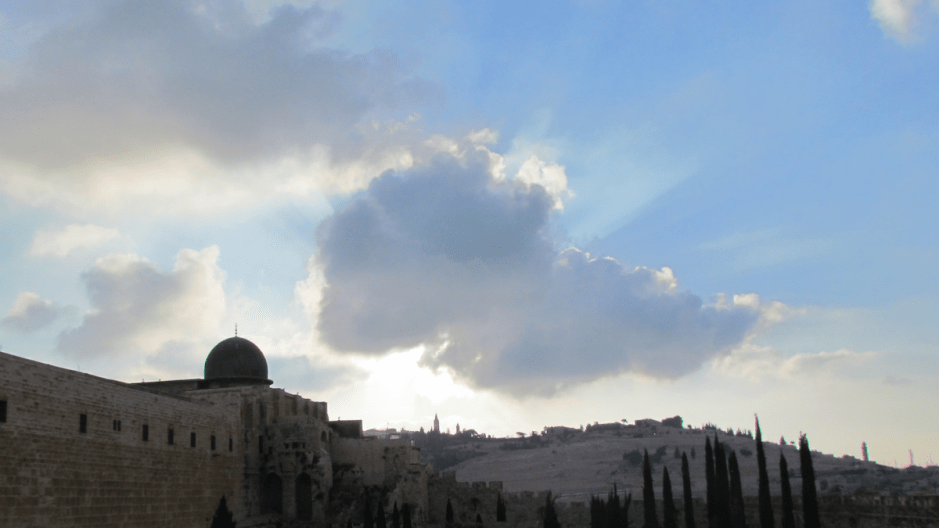
Early on a Wednesday morning last June, I stood in line at a checkpoint leading to the Western Wall below the Temple Mount in the old city of Jerusalem. Turning around, I watched the sun rise over the Mount of Olives, turning the distant tower of the Church of the Ascension into a dark silhouette against the thin clouds. And for a brief moment, my heart rose with the sun, and I was transported back to that spot 2,000 years ago. I watched with the disciples as Jesus was taken up into heaven. I gazed up at the sky and felt his final words settle in my gut: “You will receive power when the Holy Spirit has come upon you; and you will be my witnesses in Jerusalem, in all Judea and Samaria, and to the ends of the earth.”

Continue reading “Be My Witnesses”

The Impulse to Pray

Sermon for Sunday, May 17, 2020 || Easter 6A || John 14:15-21

Today, I’d like to talk about prayer: what prayer is, where it comes from, and why several people have told me recently how much more praying they are currently doing in these days of pandemic. As you listen to me speaking, listen also to yourself. If I mention a particular form of prayer that excites you or interests you or calms you, that might be the type of prayer the Holy Spirit is inviting you to try on right now.

We’ll start off with the fundamental question: what is prayer? The Book of Common Prayer tells us that prayer is responding to God in thought and deed, with or without words. That’s a pretty broad definition, so broad that we could really classify anything as prayer given that the action is motivated by God’s movement in our life. And that’s the key concept when trying to understand the nature of prayer. 

Continue reading “The Impulse to Pray”

Into Your Hands

Sermon for Sunday, May 10, 2020 || Easter 5A || Psalm 31

It really got to me this week – the isolation, the distance. One day, I got home a little before dinnertime. Leah gave me a hug, and I realized it was the first time that day someone had touched me. I had been feeling agitated all day, and in that moment I knew why. My primal need for physical contact had not been met. What a relief it was to go home to someone who would embrace me. Then I thought about all the people, those I know and love and those I don’t know and am still called to love, who haven’t touched another human being in two months. I couldn’t even make it a day! So when I read our lessons for today, one verse of the psalm leapt off the page:

Into your hands I commend my spirit,
for you have redeemed me,
O Lord, O God of truth.

Into your hands. I talk about God’s hands all the time. Every single time I pray for someone who is sick, I end the prayer with, “May God hold you in the palm of God’s hand.” I love to sing the Irish blessing, which ends in a similar fashion: “May God hold you in the hollow of God’s hand.” For a long time, I’ve been inviting other people to see themselves as being held in this loving grip. For some reason, I hadn’t seen myself as being held there. 

Continue reading “Into Your Hands”

The Threefold Voice

Sermon for Sunday, May 3, 2020 || Easter 4A || John 10:1-10

I imagine Jesus looking out over the fields beyond Jerusalem and seeing shepherds moving their flocks towards the sparse patches of green in the distance. He turns to his followers and says, “You see those shepherds out there. I am the Good Shepherd.” Then he begins spinning out his metaphor, telling a story as the people watch the grazing sheep beneath the big, open sky. The shepherd goes into the fold,” Jesus continues, and “the sheep hear his voice. He calls his own sheep by name and leads them out. When he has brought out all his own, he goes ahead of them, and the sheep follow him because they know his voice. They will not follow a stranger, but they will run from him because they do not know the voice of strangers.”

Continue reading “The Threefold Voice”

Why Are You Weeping?

Sermon for Sunday, April 12, 2020 || Easter Day A || John 20:1-18

Today is Easter Sunday, the feast of the Resurrection of our Lord Jesus Christ. Last Sunday, I invited you into the spiritual posture of lamentation, and now here we are on this most celebratory day of the church year. If you’re feeling a sense of emotional or spiritual whiplash because of this abrupt turn from lamentation to celebration, I completely understand, and I feel it too. That’s why I want to spend this sermon speaking not simply about the celebration of the resurrection, but about the complex emotion that results when lamentation and celebration coexist. In this time of global and personal crisis, we cannot leap from sadness to joy and leave sadness completely behind. And the good news is that we don’t need to. In a few minutes, I’m going to reference that great catalogue of modern day meaning making that is the movies of Pixar Studios. But first, let’s turn to the Gospel reading and the character of Mary Magdalene.

Continue reading “Why Are You Weeping?”

Why Jesus Wept

Sermon for Sunday, March 29, 2020 || Lent 5A || John 11:1-45

Here we are. Week three of our church dispersed to the four corners of our community. The pews that you normally inhabit are empty, but we still gather together in prayer and worship of God this day. When my daughter was smaller than she is now, she couldn’t quite make her fingers do the “This is the church, this is the steeple, open the doors, and see all the people.” Her fingers wouldn’t interlock inside the church, so when she did the motion along with the rhyme, the people were outside the doors of the church. Appropriate for today, I think. We are still the church, even when we are unable to gather in a particular building.

I’m reminded of our distance from each other today, not just because of the empty pews, but because of the beginning of our long Gospel story. Jesus receives a message from Martha and Mary about Lazarus being ill. Then Jesus waits where he is two days worth of social distancing for two days before heading to Bethany, where he finds Lazarus has been in the tomb four days. After meeting with Martha and then Mary, the Gospel says this: “When Jesus saw [Mary] weeping, and the Jews who came with her also weeping, he was greatly disturbed in spirit and deeply moved. He said, “Where have you laid him?” They said to him, “Lord, come and see.” Jesus began to weep.”

Continue reading “Why Jesus Wept”

Deep Breaths with Palestrina

Sermon for Sunday, March 22, 2020 || Lent 4A || Psalm 23; John 9:1-41

I usually listen to really upbeat music when I’m writing my sermons, often the Piano Guys, who do instrumental mash-ups of pop and classical music. Their driving rhythms mixed with familiar melodies propel me forward as I write. I’m sure I bop my head along, my fingers click-clacking across the keyboard in time with the percussion. When I sat down to write this sermon, I put on the Piano Guys like normal. But about thirty seconds into the first song, I had to switch to something else.

Because today is not normal. Today is about as far from normal as I can remember since the days following September 11, 2001. As I thought and prayed my way into today’s sermon, I noticed just how un-calm I was. I had not slept well in several nights. I had pain in my jaw, always a sign of stress. I had a thick knot of anxiety in my chest. I looked beyond the anxiety and felt a roiling mix of other emotions, which I’ll get into in a moment. Realizing my state on un-calm, I changed the music. I selected a setting of the mass in Latin by the Renaissance composer Palestrina, who never fails to help me take deep breaths.

Continue reading “Deep Breaths with Palestrina”