“He had a beard!”*

Have you ever noticed that none of the people who wrote the Gospel ever takes the time to describe what Jesus looked like? In Mark’s account of the Gospel, Jesus comes onstage nine verses in, ready for a dunk in the river. The text says simply: “In those days Jesus came up from Nazareth of Galilee and was baptized by John in the Jordan.” The next verse could read: Jesus, a strapping fellow, a shade over six feet with a ruddy complexion, a nest of a beard, and dark hazel eyes, was coming up out of the water when he saw the heavens torn apart and the Spirit descending like a dove on him. The next verse could read like this. But it doesn’t. The Evangelists (one term for the authors of the Gospel) seem singularly uninterested in offering up any details of Jesus’ physical appearance.
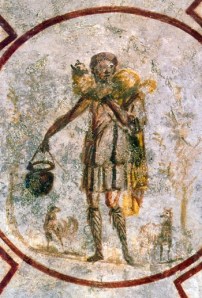
What! No Beard??? (A very early image of Jesus from the catacomb at San Callisto)

This, of course, has not stopped people throughout history drawing, painting, and sculpting images of Jesus. The earliest paintings we still have around come from ancient catacombs where worship services were held in secret. These pictures usually portrayed Jesus as the good shepherd, and they appear to modern eyes as cartoonish – obviously, the artists were not trying to go for physical accuracy. As the centuries progressed and Christianity became first tolerated, then acceptable, then (in some cases) compulsory, images of Jesus appeared in mosaics, frescoes, statues, illuminated manuscripts, and stained-glass windows. Artists depicted him as a king and a judge (and sometimes still as a shepherd). During the Renaissance, Jesus often wore period costume, making him look more like a gentleman of Verona than a first century Jew. At some point, it became fashionable for Jesus to wear a beard; at another point, a serene, starry-eyed expression.

Enter Warner Sallman, who in 1941 painted arguably the most famous portrait of Jesus ever: amber background fading into brown; Jesus in three-quarter profile shown from the shoulder up; the flowing locks, the beard, the serenity, the multiple light sources. For many people, especially American baby boomers, this is what Jesus looked like. The portrait was so ubiquitous for so long that it almost took on canonical significance, as if it were the authorized image of Jesus agreed upon at the Council of Nicaea. People have been cast to play Jesus in films based on this image – just look at Jim Caviezel in The Passion of the Christ. Honestly, what self-respecting casting director would hire an actor who couldn’t grow such a nice dark brown beard?

I know this sounds like I have a vendetta against Warner Sallman. I don’t…truly, I don’t. I think his painting is quite nice, though I personally think Jesus looks a bit dull, like he’s waiting for a traffic light to change. My opinion aside, the point is this: we, as a culture, have developed such a clear picture in our minds of how Jesus of Nazareth appeared. This clarity comes from centuries and centuries of images; from all the nauseatingly banal Tiffany stained glass in the windows of our churches; from a single authoritative, iconic portrait painted nearly seventy years ago. But this clarity, this consensus, is completely and utterly baseless. Our “clear picture” of Jesus was created ex nihilo, out of nothing.

More than anything else, aggregate historical imagination has contributed to the development of our enduring image of Jesus of Nazareth. This imagination has fed off of the racial and cultural markers of myriad societies, the political and economic status of the Christian religion during various periods, the value of visual art for disparate sects of Christianity, and the technology, proficiency, and goal of the artist or craftsman.

In one image Jesus may wear pantaloons and a feathered hat; in another, he may wear a jewel-encrusted tunic and crown; in a third, he may wear the ever-popular toga/sash/sandals combination. In the majority of images, there’s a high probability that Jesus “looks like me” – both “me” in the sense of the artist’s race and culture and “me” in the sense that the person writing this is white, male, of Anglo-Saxon heritage, with brown hair, who could probably grow a nice beard if he could get past the “itchy stage.”

Our penchant for recasting Jesus in our own images and for relying on the aggregate historical imagination should give us pause. There’s obviously no way a first century Jew looked like a guy whose ancestors hail from Kent, England. Nor does the simple fact that something is both aggregated and historical infuse it with validity.

I’m not saying that we need to throw away all our pictures of Jesus and smash all our stained glass. I’m far from an iconoclast. What I am saying is that we develop awareness of where we come from, not to discount or disconnect that past, but to integrate it fully into our interpretive arsenal. When we discover that no words in the Gospel ever describe what Jesus looked like, we can begin to ask why our images of him look the way they do. Then we can ask: What else have we taken for granted?

Footnote

* I take the title for this post from the film Talladega Nights, which has a wonderful scene about a dinner table prayer. That one scene alone gets at what I talked about above. It’s worth the price of admission for the whole movie.

The trapdoor in my gut

(Sermon for February 8, 2009 || Epiphany 5, Year B, RCL || Isaiah 40:21-31)

When I am engaged in a mundane activity—say, brushing my teeth or counting the bleary-eyed seconds until I hit snooze again or watching the digital numbers flick by on the counters at the gas station—the activity itself occupies only a tiny portion of my brain’s processing power. So the rest of my mind often wanders into other sections of my body. Sometimes, my mind meanders past my throat and lungs and finds its way down through that trapdoor in my gut. And I begin to ask those questions that make my gut twinge and pulse, like the feeling you get after narrowly avoiding a car accident.

I’ll be wrapping the floss around my fingers or anticipating the snap of the nozzle that signals a full tank of fuel, and I’ll look up at the sky and say, “Why do you care about me, Lord?” Then the cars will collide in my gut because, in that moment, everything I’ve ever believed is branded with a big red stamp of the word “FOOLISHNESS.”

Why do you care about me, Lord? This gut-twinging question doesn’t necessarily speculate on God’s existence. The question isn’t: “Do you exist, Lord?” There’s no reason to ask God if God exists. That would be like asking all the absent people in a classroom to raise their hands. Instead, the question acknowledges that God does, indeed, exist, but wonders why the heck God would ever care about an insignificant, messy, little thing like me. Of course, there’s no reason why God should care. This is truly first-rate foolishness.

The prophet Isaiah doesn’t help matters. He says, “It is he who sits above the circle of the earth, and its inhabitants are like grasshoppers; who stretches out the heavens like a curtain, and spreads them like a tent to live in; who brings princes to naught, and makes the rulers of the earth as nothing… To whom then will you compare me, or who is my equal? says the Holy One.”

There’s a tension in our scriptures — a twofold presentation — about how God relates to us that feeds the pulsing in my gut. The dual stories of creation in the opening chapters of the book of Genesis illustrate this tension. “In the beginning when God created the heavens and the earth…” says the first verse of Genesis. The narrative goes on to tell how God spoke creation into being. Creation was ordered: light separated from darkness, day from night, land from sea from sky. God orchestrated the emergence of life and proclaimed the creation “good” and, indeed, “very good.” This ordering, this filling the void with matter and energy and life and light, speaks of the Cosmic Creator, whose voice and arm stretch into the vast expanse of eternity. This is the understanding of God that Bette Midler promotes when she sings: “God is watching us from a distance.” This is the understanding of God that the Enlightenment era Deists caricatured as a great Watchmaker, who set the gears running and then left well enough alone.

The second chapter of Genesis presents another view of this same creative God. God is not standing at the podium, waving a baton as the performing forces of creation harmonize the music of life. In the second story, God, rather the being the conductor, is the instrumentalist: God plays each violin and French horn and clarinet. “In the day that the LORD God made the earth and the heavens,” says Genesis, God bent down in the dust and formed a human being. Then, into his nostrils, God breathed the “breath of life.” When the human became lonely, God put him to sleep, and out of the man’s own flesh God created another human being. As the story continues, the man and woman heard God “walking in the garden at the time of the evening breeze.” This movement and participation in the creation, this intimacy, speak of the God who eventually becomes incarnate as the word made flesh, Jesus Christ. This is the understanding of God that Joan Osbourne wonders about when she sings: “What if God was one of us…just a stranger on the bus trying to make his way home?” This is the understanding of God that the old hymn describes: “And he walks with me and he talks with me and he tells me I am his own.”

The tension between our understanding of God as “Cosmic Creator” and as “Intimate Companion” brings us back to the gut-twinging question: “Why do you care about me, Lord?” In those moments of existential angst, the Cosmic Creator easily trumps the Intimate Companion because the former seems so much bigger, holier, more powerful. When my gut compares the two, the latter seems somehow lessened by my own shabbiness.

And this misguided transfer of shabbiness is difficult to suspend. Human nature dictates that we narcissistically use ourselves as the measuring sticks by which other things are evaluated. Our ability to reason, manufacture tools, and put our thoughts into speech elevates us above other animals. We then use these factors to order other species by “intelligence.” Chimpanzees eat using rudimentary utensils. Dolphins communicate with their cackling code. Therefore, based on the anthropomorphic scale, these creatures are closer to our presumed preeminence.

But the scale works the other way, as well. Our penchants for betrayal, mistrust, indifference and our well-rehearsed disregard for the welfare of others knock a bleaker set of notches into the measuring stick. When the gut-twinging question surfaces – “Why do you care about me, Lord? – these regrettable attributes emigrate from our world and narcissistically modify our understanding of God.

Having thus remade God in my own lamentable image, the collision in my gut worsens. The Cosmic Creator looks down and sees a bunch of tiny grasshoppers, so why should that God be bothered? The Intimate Companion is probably just as apathetic and self-centered as I am, so why should that God care?

Do you see the twisted, oxymoronic reasoning that leads to these conclusions? The gut-twinging question appears when I notice my own laughable insignificance. At the same time, I use myself as the measuring stick for which to assess God’s motivation to care about me. This logic definitely deserves the red FOOLISHNESS stamp.

You see, when the prophet Isaiah expounds on God’s greatness and ineffability, he is not extolling God’s distance and isolation. Instead, he is warning people not to engage in the foolish business of looking for God in the mirror. The Holy One says, “To whom then will you compare me, or who is my equal?” The answer is quite obviously a resounding “NO ONE!” When you escape the twisted logic that seeks to anthropomorphize God, you are one step closer to resolving the gut-twinging question – “Why do you care about me, Lord?”

God as Cosmic Creator, who “stretches out the heavens like a curtain,” did not need a reason to speak creation into being. I might need a reason to build a bookcase or compose a letter, but God doesn’t need to share my motivations. If God did not need a reason to create, why would that same creator need a reason to care about us insignificant grasshoppers? God’s very greatness subsumes the “Why” question into God’s eternal being and renders it irrelevant. With the “Why” expunged, the gut-twinging question becomes a glorious statement of faith: “You care about me, Lord.”

You care about me, Lord. When I finally realize this, I notice that God as Intimate Companion has been whispering these words in my ear the whole time. Then I realize that God’s care for me (another word for which is grace) enables and enthuses me to care for others. The penchant for betrayal and disregard for others’ welfare, once unfairly plastered onto God’s being, now fall away as God continues to make me in God’s own image.

Our world is vast and full of questions. We are insignificant. We are messy. We are little things. But God’s vastness stretches into eternity. In staggering showers of grace-filled generosity, God both answers and removes the need to question. In those same showers falls the gift of sanctifying love, which removes our insignificance and scrubs us cleans. As we discern the Cosmic Creator and Intimate Companion in the same loving face of God, more words from the prophet Isaiah resound: “Those who wait for the LORD shall renew their strength, they shall mount up with wings like eagles, they shall run and not be weary, they shall walk and not faint.”

These inadequate hands (Davies Tales #1*)

The summer before Davies’s senior year of college, his bishop told him that he was going to work at summer camp. Davies raised a hand to his forehead in salute and said “yessir” without hesitation because he was several steps into The Process to become an Episcopal Priest. The amount of deference he was compelled to show the purple shirt equaled that of what he would show if he had a favor to ask of Don Corleone. This was the summer before the Red Sox won their first world series since 1918; the summer before he started looking over the stacks of polisci books to what his future held; the summer before he got himself into a two-year relationship, which eventually fizzled a few weeks before he planned to ask for her hand in marriage. It was the summer before all the real life stuff that college is so good at ignoring.

Davies had never been to summer camp as a child, so he didn’t know what to expect as a counselor. Until he googled “James Madison Conference Center,” he also didn’t know the camp was named after a bishop rather than a president. Nor did he know where it was located. As it happens, Madison is three miles down River Road from the no Starbucks town of Lucado, West Virginia. Lucado (pronounced LUCK-a-do) is in the Eastern panhandle of the state. Unless you are already in the Eastern panhandle, a geographical idiosyncrasy of West Virginia (called the Appalachian Mountains) means you pretty much have to leave the state to get to Lucado. A piece of the Potomac, in which Davies once learned to fly fish, gives River Road its name. If you are looking for nowhere on the map, three miles down River Road from Lucado, West Virginia is pretty close by.

Despite Madison’s lack of a cell tower within fifty miles, kids came to the camp. Davies could see their love for the place in their wide, expectant eyes as they queued up to turn in meds and decorate nametags. They loved the camp because it was out-of-doors; they loved it because it broke the monotony of what-do-you-want-to-do-I-don’t-know-what-do-you-want-to-do summer vacations; they loved it because they got to be themselves around other kids who also got to be themselves. In his own teenage years, Davies learned that places where teenagers are unafraid of coming out of their shells are few and sacred. Madison is one of them.

Senior high camp was the biggest week of the summer, with over five score hormone bombs flipping off the diving board, sneaking into the woods, crushing on each other, and complaining every day at breakfast because every day unfairly started in the morning. By midweek, Davies was one among many counselors with nerves fraying, ready to throw up his hands. The counselors used a code word to notify each other if they needed to be extracted from the clutches of a clingy/adoring/needy/smelly/nettlesome camper. As the days wore on, alert campers began wondering what “rich brownie candy bars” had to do with a pet rabbit or the athletic physique of that dreamy counselor.

On Friday morning, Davies thought his body was going to go on strike: he had never been so exhausted. But there was just one more day and night and then he could rest, mercifully. The camp shared Eucharist every day, and Friday’s included a special healing service. When the priests asked for counselors to assist with the laying on of hands, Davies volunteered because he had never done it before.

During the opening song, Davies noticed the new campers who were reticent at the beginning of the week singing with everyone else: You are my Prince of Peace and I will live my life for you! With the addition of those new voices, the camp’s volume went from ten to eleven. The peace took just as long as it usually did because, as usual, everyone tried to hug everyone else. They shared Communion, and then the campers settled into their seats for the laying on of hands. The usually boisterous crowd was quiet all of a sudden as if the mystery of God hit them all at once with the least awkward silence imaginable.

Davies walked to the back of the chapel with his priest friend Rick and a pair of sisters, Jennifer and Elise. The first camper stood up and turned towards them. Davies looked at his hands. He turned them over, saw the lines and the fingerprints and the dirt under his nails. What are these supposed to do?

The camper sat in a metal folding chair, and Rick leaned close. The boy had a pimple on his lip, which quivered as he spoke in a stage whisper: “My parents are divorced and I keep thinking it’s all my fault and I feel sad all the time.” Davies kept looking at his hands, his inadequate hands. Rick motioned for Davies and the sisters to touch the camper’s shoulders. Davies reached out one hand tentatively, lightly, like he was testing a bruise on the boy’s arm. Rick touched oil to the camper’s forehead and prayed. Davies found himself mouthing words that sprang unbidden to his lips.

Lord, make him whole, make him holy, make him wholly new.

This became his breath prayer. Over and over again, he breathed these words in and out. God, use my inadequate hands for healing, use my inadequate heart for loving, he prayed. Without thinking of the consequences, he prayed with fervor he didn’t know he possessed: Holy Spirit, fill me and flow out of me, down my arms, into my hands, and into these broken campers who keep coming and coming.

Their need for healing was so great. Who knew such young people could feel such pain: depression, suicidal thoughts, drug addiction, alcohol addiction, eating disorders, feeling the urge to cut themselves, feelings of abandonment, grief, loss.

Lord, make her whole, make her holy, make her wholly new.

Davies kept whispering this prayer with his fingertips and his breath. He kept asking the Holy Spirit to fill him so the campers could know the healing presence of God. The last camper stood up from the metal folding chair. Davies had forgotten his own exhaustion in the half hour of laying his hands on the campers. They trickled out of the chapel on the way to the dining hall. The counselors and priests who had participated in the healing gathered around the altar for a final prayer. They held hands and prayed. As they let go of each other, Davies felt that little squeeze of his hands from friends on either side.

He backed away from the altar. A tear rolled down his cheek, then another and another. Suddenly, Davies was crying. He sat down in the second pew. Just as suddenly, he was no longer crying—he was bawling, blubbering, sniffling, choking. He had no restraint. His chest heaved, his cheeks reddened. For twenty minutes, he sat with his head in his hands, weeping. As he wept, he felt in his gut and in the soles of his feet the truth: God, you granted me exactly what I asked for—an excess of Spirit, an overflowing of your healing power. The fat tears forming a puddle at his feet were the Holy Spirit spilling out of him. His ragged breath was the Holy Spirit releasing from his body, bringing him back to a level of Spirit that is safe for one human being.

As Davies began to calm, he noticed a hand on his back. Elise had stayed behind and sat silently with him. She had said nothing. She had not tried to hand him a tissue. She had let Davies weep, alone and yet not alone.

He rose to his feet, shakily, drained and full at the same time. They walked across the field to the dining hall. The campers had gone back to their lodges for rest time, and all the grilled cheese was gone. But one of the ladies at the dining hall saw them, fired the griddle back up, and cooked them a pair of sandwiches each. Elise thanked her for this small act of kindness and slid a plate across the table to Davies.

He munched on his grilled cheese for a few minutes. His head pounded with the exertion from crying, but a new feeling a peace was emerging between the throbs. He looked down at his hands again, sticky now with molten cheese. These hands, God? These inadequate hands?

Footnotes

* This is the first story in a series I’ve been meaning to write for a while now. Gordon Atkinson’s character “Foy” gave me the inspiration to begin my own series of autobiographical fiction. If you haven’t read the “Foy Stories,” read them because they are incredible. Since Gordon Atkinson originally  referred to “Foy Davis” as simply “Foy,” I didn’t realize the similarity of names until I wrote this footnote! (I hope you don’t mind, Gordon!)

Nets and new creations

(Sermon for January 25, 2009 || Epiphany 3, Year B, RCL || Mark 1:14-20)

In today’s Gospel, Jesus is out for a stroll along the shore of the Sea of Galilee. As he walks along, he notices the fishing boats tacking for deeper waters and trawling the shallows. He sees Simon and Andrew casting a net into the water. He sees James and John mending their nets in their boat. He calls out to them, “Follow me.” “And immediately,” says Mark, “they left their nets and followed him.” Immediately, they left their nets and followed him.

Now, I tend not to read the Bible metaphorically. Adding layers of interpretation to the words on the page usually serves to obfuscate rather than enlighten. This morning, however, I pray you indulge me one teeny-tiny metaphor. The four disciples Jesus calls in the Gospel leave their nets to follow him. They were fishermen, so working with nets came naturally to them. But, in landlocked West Virginia, we have little cause to handle fishing nets. So, I ask you, what are the “nets” to which we cling that prevent us from following Jesus? Put another way, what would be different about our lives if we left our nets and followed Jesus?

We could go into all the normal “nets” that ensnare us: grubbing for more stuff, distracting ourselves with the superficial glamour of the world, entering the wrong relationships. These certainly are nets, and they do trap us. But there is another, more insidious net that excels at holding us back from following Jesus.

This insidious net keeps us from practicing discipleship. The net entangles us when we confuse following Jesus with following the “idea of Jesus.” This is a strange turn of phrase, so let me unpack it. The “idea of Jesus” infiltrates our consciences when we forget that the events of the Gospel continue to play out today. The “idea of Jesus” disguises the person of the living Christ beneath layers of doctrine, history, and popular misconception, until he becomes a farcical shadow of himself, more akin to the Easter Bunny than the one true God. The “idea of Jesus” is so much easier to follow than the real Jesus because the “idea” makes far fewer demands on our lives and never asks us to become disciples. Dietrich Bonhoeffer says, “Discipleship is commitment to Christ. Because Christ exists, he must be followed. An idea about Christ, a doctrinal system, a general religious recognition of grace or forgiveness of sins does not require discipleship.”*

Think of it this way: A good portion of Americans love the “idea of soccer.”**  They love that there is a sport that the world plays together. They love seeing small foreign children running after a ball in the dust on TV. They love the big leg muscles and celebrity status of David Beckham. But very few Americans ever actually want to play soccer. There’s way too much running and way too little scoring for most of us.

In the same way, we often find ourselves taken with the “idea of Jesus.” There was once this cool guy who said some great stuff about love and acceptance. He collected a lot of enemies because he made friends with outsiders. He kept the wine flowing at this wild party. This “idea of Jesus” looks great on paper. But, like paper, the “idea” is flimsy and two-dimensional. The real Jesus, the living Christ, springs from the page, full of three-dimensional vigor, and he calls us to a life of true discipleship.

This is where the net comes in. If we are deluding ourselves into thinking we are following Jesus while we go about our lives as if nothing has or will change, then we are following the “idea of Jesus” instead. Following the Jesus who calls his disciples away from their nets necessitates change. Again, Bonhoeffer says, “Following Christ means taking certain steps. The first step, which responds to the call, separates the followers from their previous existence. A call to discipleship thus immediately creates a new situation. Staying in the old situation and following Christ mutually exclude each other.”**

We run back to our nets because this newness frightens us. When I moved to Alabama at age 12, no one could understand my thick Rhode Island accent, I called the water fountain a “bubbler,” a dusting of snow was a blizzard, the Red Sox weren’t on TV, and I didn’t know that saying “sir” and “ma’am” was integral to my survival. My life was different and uncomfortable and humid. I just wanted to go home. But, in the slow march of years, Alabama became home.

When we leave our nets and follow Jesus, we give up the trappings of the illusory homes we have built for ourselves. We step out of our comfort zones, and hopefully we never get too comfortable ever again. As we strive to follow Jesus, we may wonder why we never reach a new normal, why that initial feeling of discomfort persists. Then we realize that following Christ means continual renewal, constant reshaping. Paul says that if “anyone is in Christ, there is a new creation” (2 Cor. 5:17). As new creations, we are not new a single, solitary time, but every hour of every day. This newness keeps us from becoming complacent, keeps us from sitting in our boats as Jesus passes by. The discomfort propels us forward like dissonance in a Beethoven sonata. Indeed, a piece of music comprised of pleasing, consonant chords would be exceedingly boring. Likewise, following Jesus means dragging our comfort zones along behind us as we constantly step out of them.

Following Jesus is necessarily a nomadic existence. Our home is not a place, you see. Our home is a person. When we follow Jesus, we give up the trappings of our illusory homes for a true home by his side.

The flimsy “idea of Jesus” can only provide us a home built on the sand, which collapses whenever the winds and rains come. The “idea of Jesus” may bring us to church one day a week, but it will not instill in us the desire to seek Christ the other six. It will not demand that we encounter Christ in every person we meet. It will not motivate us to interrupt our net-mending to serve the poor or pray for guidance or praise God for the simple fact that we are marvelously made.

Because it makes no demands on us, the “idea of Jesus” causes us to mistake self-satisfaction for discipleship and comfort for salvation. But the real Jesus does not call us to be comfortable. He calls us to be free and invites us to use our freedom to choose a life of service in his name. If we do not actively seek to be Christ’s hands and feet in the world, if we do not take seriously our role as disciples, then we will be complicit in allowing our Lord and Savior to drift into the obscurity of legend or tall tale. As Søren Kierkegaard puts it, “Discipleship…really provides the guarantee that Christianity does not become poetry, mythology, and abstract idea.”****  Following Jesus means offering ourselves as conduits for turning the abstract into the concrete. Put another way, as the Letter of James says, “If a brother or sister is naked and lacks daily food, and one of you says to them, ‘Go in peace; keep warm and eat your fill,’ and yet you do not supply their bodily needs, what is the good of that?” (Jas. 2:15-16)

Jesus, the true Jesus, calls to us. He is not an idea or a design on a T-shirt or a cool guy who said some nice stuff once. Jesus, the living Christ, walks up to each one of us and invites us to a new life of hope and love and tears and pain and joy and freedom. He looks each one of us in the eye, says, “Follow me,” and radiates the abundant grace that allows us to do so. Join me in praying that each one of us will meet his gaze, leave our nets, and follow him.

Footnotes

* Bonhoeffer, Dietrich. Discipleship. Minneapolis: Fortress Press. 2001. p 59. (Italics mine)

** I borrowed this idea from the hilarious blog Stuff White People Like.

*** Ibid. 61-62

**** Ibid. 59 (in footnote)

Hope near the fourth jumbotron

We arrived on the Mall in the predawn chill after a two hour power walk from 24th and M. During the walk, we passed pairs of camouflaged soldiers at each cross street, a siren-blaring police car from the DC public library (?), and hundreds of vendors hawking T-shirts, hats, keychains, and copies of the Washington Post. Since we were ticketless, my friend and I walked west along Independence Avenue looking for a numbered street with access to the Mall. At 12th Street, we turned right. A block later, we spilled out onto the Mall with 1.8 million of our closest friends. Over the next hour, we threaded our way through the ever-growing crowd and staked our claim on a few square feet of dirt four jumbotrons back.themall

As dawn turned to frozen morning, the sun rose from behind the Capitol dome and shone on the sandstone tower of the Smithsonian Castle off to our right. As the morning wore on, we sang and danced to the recorded concert playing on the big screens, ate granola bars, contemplated trying to make it to the porta-johns and back again, listened to the conversations around us, and wondered just how many mobile phones were vying for the closest tower’s signal. 9:00am. 10:00am. We were cold, muscle-cramped, footsore, buffeted by the crowd. But we were there, and none of our discomfort mattered.

The Marine Corps band (whose brass players I’m sure had the coldest mouths in Washington) played march after march as important people trickled onto the Capitol steps. As their importance grew, so did the crowd’s excitement. My friend and I played a game of name-that-politician (we weren’t very good). Flag-wavers practiced their craft with Jimmy Carter and the Clintons. A few ungenerous souls in the crowd booed as the soon-to-be-former president made his way on stage. Most applauded, but out of respect or relief, I couldn’t tell.

As the moment of the Obamas’ arrival neared, the Mall fell nearly silent, as if all 1.8 million of us held our breath at the same time. They appeared, and the Mall erupted with cheering, whooping, weeping, and the outpouring of all the emotion of decades and centuries of indefatigable expectancy.

In that moment and the moments to follow, I discovered an untapped well of hope inside myself. Hope, Paul tells us, along with faith and love, abides. Hope catalyzes the imagination. Hope furnishes a future for faith and love. Hope is the expectation that the boundaries of possibility are always far wider than we can perceive. On Tuesday at 12:05pm, I felt those boundaries expanding, closed my eyes, and thanked God.

President Obama spoke of a “less measurable but no less profound” indicator of the crises we face: “A sapping of confidence across our land — a nagging fear that America’s decline is inevitable, and that the next generation must lower its sights.” As a member of that next generation, I’ve felt that nagging fear, I’ve sighed and shaken my head too many times, I’ve disengaged. Sure, I’ve done “my part” — recycled, used CFLs, donated food and clothing. But those acts always felt insignificant, tokenistic, like I was trying to take down an aircraft carrier with a .22 caliber pistol. I did “my part” not with hope, but with the memory of what hope once felt like.

After Tuesday, however, I feel like “my part” has transformed and grown and coalesced into “our part.” “On this day,” said President Obama, “we gather because we have chosen hope over fear, unity of purpose over conflict and discord.” Hope and unity. How fundamental to the fabric of our lives as God’s children are these things. God reveals the power of unity to us in the perfect, rhythmic dance of three person’s in one God. Jesus reveals the power of hope to us in the resurrection, by which he overcame the sting of fear and death.

After my friend and I escaped the mad press of people leaving the Mall, we circled back to 24th and M by way of the frozen Potomac River. I was still cold, muscle-cramped, and footsore. But that untapped well of hope was warming me, flooding me with renewed purpose and energy. I had forgotten how good it feels to hope, forgotten that there was a time before I was beset by that nagging suspicion of our deterioration. As we tramped up the last block from L to M, I remembered the closing moments of The Shawshank Redemption. Andy Dufresne, recently escaped after 19 years of incarceration in a Maine prison for a crime he did not commit, writes to his friend: “Remember Red, hope is a good thing, maybe the best of things, and no good thing ever dies.”

Graceful

At today’s weekly healing service, I forgot something rather important. “Today, we are using Eucharist Prayer B found on page 367,” I said, and then a moment later, “The Lord be with you.”

“And also with you” came the reply from seven chilly parishioners (unlike the abiding presence of God, the heat in our building is both scarce and unreliable). We then exchanged the rest of the sursum corda* and I prayed the proper preface for Epiphany. Together, we said the Sanctus, after which I began the rest of the Eucharistic prayer.

“We give thanks to you, O God…” O God, I thought. I looked down. I looked up. O God. I looked down again. My distorted reflection peered up at me out of an empty chalice. I stopped speaking, pulled my hands out of the orans position, and turned around. “It seems that I forgot to put the wine in the chalice. Um…one moment please.”

I finished setting the table, smiling in a mortified kind of way. Then we continued the Eucharistic prayer, and the rest of the service went as expected. As I was walking back to my office, I thought to myself: I can’t believe I forgot to fill the chalice. That wasn’t very graceful of me.

Then I remembered some of the words I heard at my friend’s ordination, which I attended this weekend in Denver. The bishop looked at my friend standing before him and said, “In all that you do, you are to nourish Christ’s people from the riches of his grace…”

Nourish Christ’s people from the riches of his grace. What a phrase. At my own ordination, these words passed right through my sternum and took up residency in the neighborhood of my left ventricle. They set me on fire and I never thought I’d stop burning. But in the last seven months, I somehow forgot the message of these words. I don’t know — maybe their house in my heart went into foreclosure. Maybe I wasn’t inhaling enough Holy Spirit with each breath to keep the fire going. I never forgot that it was my job to nourish. But I did forget whose meal was providing that nourishment.

You see, as a priest (heck, as a person) it is my job to say, “I have nothing of my own to offer. I have only what you, Lord, have given me.” Too often, I get caught up in succeeding at things that I forget that my success is not really mine at all. Too often, I try to nourish Christ’s people from the paucity of my grace, rather than from the riches of Christ’s. But doing that is like trying to water your lawn with the hose turned off.

When I forgot to put wine in the chalice, I remembered just how graceless I am. There I was with hands outstretched and prayer on autopilot, about to ask God to bless an empty cup. After filling the chalice with wine and a few drops of water, I realized that it was not the only empty cup in the room. I needed to be filled, too. I needed the riches of Christ’s grace to nourish me again because I — through inattentiveness and pride — had let his sustenance leach from my body.

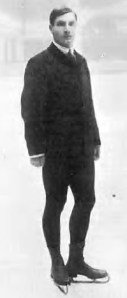
This guy invented the salchow. His name is Ulrich Salchow. What a coincidence!?!

We use the word “graceful” when we describe a dancer pirouetting or a figure skater performing a triple salchow. The word also applies to those people who suck every ounce of nutrition out of Christ’s nourishment and walk about with shimmering cascades of grace spilling over the tops of their heads. I know a few such people. You can tell them apart because they leave little puddles of grace behind them when they leave.

Lord, help me to remember that it is your grace with which you call me to nourish others. I can’t nourish them if I don’t allow you to nourish me. So please, fill this empty cup with the shimmering riches of Christ’s grace.

Footnotes

* Here’s a list of the technical words I used in this post:

Sursum corda: The three calls and responses at the beginning of the Eucharistic prayer, in which the congregation gives the priest the okay to go ahead and celebrate the Eucharist. The responsory nature of this prayer makes explicit that the Eucharist is a corporate event.

Epiphany: The twelfth day after Christmas, on which we celebrate the coming of the wise men to see Jesus. The coming of light into darkness and the call of the disciples are stressed during the season of Epiphany, which extends from January 6 to the day before Ash Wednesday.

Sanctus: “Sanctus” means holy and is the name for the prayer which begins “Holy, holy, holy Lord, God of power and might.” In Hebrew, there’s no way to make a word superlative (good, better, best); so, a three time repetition serves the same purpose.

Chalice: The cup we use at church. Remember that scene at the end of Indiana Jones and the Last Crusade? The room with the old knight is full of chalices. (“He chose…poorly”)

Orans position: “Orans” comes from the Latin word for “prayer” and is used when the priest is saying a prayer on behalf of the congregation. Think of a referee unethusiastically signaling touchdown and you’ve got it.

Ordination: The thing that happens to make someone who’s not a priest into a priest. The word comes from Latin and means something to the effect of “to put into order”; thus, ordination is when someone is set apart from others. There are four “orders” in the church: lay, deacon, priest, bishop — the latter three are “ordained” positions.

Run home, Jack

(Sermon for January 4, 2009 || Christmas 2, RCL)

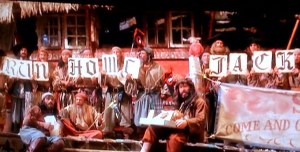
In the 1991 movie Hook, the nefarious captain who lends his name to the film abducts Peter Pan’s children and brings them to Neverland. Once there, the pirate attempts to condition Jack and Maggie into thinking that their parents don’t care about them and that they are better off away from home. Maggie resists Hook from the start, but Jack, who is angry at his father for always missing Jack’s baseball games, falls victim to Hook’s indoctrination. To show his feigned appreciation for Jack, Hook organizes a ballgame.  When Jack comes up to bat, it becomes apparent that none of the pirates knows a thing about the sport. Instead of cheering for Jack to hit a home run, the crowd mixes up the words and chants “Run home, Jack! Run home, Jack!” For an instant, Hook’s spell is broken, and Jack remembers who he is and where he belongs.runhomejack

We live in a world of dislocations and disenchantments, and too often we forget where home is. We are constantly on the move from here to there or are stuck in traffic on the way from here to there. We are constantly harvesting the disappointments of a world that makes rash promises and fails to deliver. We are constantly sprinting, speeding, gorging, guzzling – but we rarely stop to catch our breath. We rarely pause to find our bearings. We rarely go home.

Few undeniable truths remain in this world, but one is this: you’ve got to know where you are to figure out where you are going. Look at any map at a rest stop or fire safety plan on the back of a hotel room door, and you will find a dot and the words “You are here.” Your destination is 140 miles up I-81. Your nearest exit in case of emergency is the stairwell at the end of the hall. These maps come in handy when you are trying to find your physical location.

But there are so many other ways to become lost, for which “You are here” stickers are nowhere to be found. You used your credit card to make your mortgage payment last month and now the Visa bill is due. Your new relationship burned fast and hot for a few months and now you are wondering if there’s anything left to fuel the fire. Your job is eroding your will to exist, but there’s nowhere else to work. I doubt none of us has to dig too deeply into his or her own soul to find a similar situation. When we are lost, retracing our steps to home will help us find ourselves again.

But only in the narrowest definition of the word is “home” a physical place. More expansively, home is where we center ourselves. Home refreshes us and reintegrates us. Home propels us to where we are going next by being the one space that assures us of where we are now. Do you remember that old keyboard tutor, Mavis Beacon? She teaches you to type by keeping your fingers on the middle row of keys, the “home keys.” With your fingers on A-S-D-F-J-K-L-semicolon, you always have a reference point for finding the rest of the alphabet. Your left index finger knows to go up for “R” and “T” and right for “G.” You don’t have to look at the keyboard with your fingers centered on the home keys. When we find ourselves “at home,” we allow ourselves the space to breath, find our bearings, and achieve the quiet stillness that nurtures new possibilities.

The people of Israel have been in exile in Assyria and Babylon for a long time – decades stretching into centuries. Their home is their identity, an identity they lost when they were taken by force to their conquerors’ kingdoms. They weep by the rivers and hang up their harps. They cannot sing the songs of Zion in the strange land. But in this morning’s reading, we hear a note of hope from the prophet Jeremiah: “See, I am going to bring them from the land of the north, and gather them from the farthest parts of the earth…With consolations I will lead them back, I will let them walk by brooks of water, in a straight path in which they shall not stumble…They shall come and sing aloud on the height of Zion…I will turn their mourning into joy, I will comfort them, and give them gladness for sorrow.”

The prophet tells of the imminent return of the people to their own lands and homes, where they will reclaim their identity and sing once again on Zion’s height. Today’s psalm would not be out of place on that long journey back to their home: “How dear to me is your dwelling, O Lord of hosts! My soul has a desire and longing for the courts of the Lord.” The psalmist sees the sparrow and swallow making nests and reflects on the happiness of those who dwell in God’s house: “For one day in your courts is better than a thousand in my own room.”

The psalmist longs to be in God’s presence. In our world of dislocations and disenchantments, some deep, inexplicable energy drives us to seek this same presence. When we pause long enough to figure out where we are, we open ourselves up for an encounter with the presence of God. This presence constantly encounters us, but we rarely tear ourselves away from our sprinting and guzzling long enough to notice. But when we do, when we accept the God-given gift of stillness in our souls and embrace the encounter with God’s presence, we will find ourselves at home. St. Augustine says, “You have made me for yourself and my heart is restless until it finds rest in you.” We find that rest when we are at home in God’s presence, which refreshes us and creates in us the space to figure out where we are going next.

The wise men in this morning’s Gospel find this presence when they follow the star to Bethlehem. They enter the home of Mary and Joseph and find the Christ child with his mother. In the presence of the infant King, they offer their gifts. Like the wise men, when we notice the signs pointing to an encounter with Christ, we too can find ourselves at home with Jesus. In that shimmering moment of encounter, God gives us the opportunity to discern the gifts we can lay at Christ’s feet. Centered and nourished by God’s presence, we go out, use our gifts, and join in the work of building God’s home here on earth.

So run home, Jack. Run home and find Jesus Christ awaiting you there. Run home to God’s presence and find your rest. Come and sing aloud on the height of Zion. Let your heart and your flesh rejoice in the living God. Encounter that one day in the courts of the Lord that is better than a thousand elsewhere.

Unmuddying the waters (Bible study #9)

I know I’ve said this before, but it bears repeating: the hardest thing to do when studying the Bible is to read the words on the page without the baggage of tradition lending a hand. For the purposes of this Bible study, “tradition” has a lowercase “t.” (While it rhymes wimusicmanth “p,” it does not stand for “pool.”) This tradition is everything from the writings of the church fathers to the texts of songs in our hymnals. Now, I’m not saying that reading with a knowledge of tradition is a bad thing — far from it. Sometimes, however, tradition serves to muddy the scriptural waters to the point that we can no longer see our soggy selves floating around.

The opening of the second chapter of Matthew, one of the choices for this Sunday’s Gospel text, illustrates just how murky the waters can get. This is the bit where the wise men from the East come to see King Herod, and he sends them on a reconnaissance mission to find the newborn “king of the Jews.” Until a dream notifies them, the wise men are unaware of Herod’s malicious plans. They bring the infant Jesus some gifts he has no practical use for (does myrrh clear up diaper rash?) and then go home by another road.

Okay, now let’s bring in tradition. For years and years we have smooshed the beginnings of Matthew and Luke together so much that we have trouble separating them, even when reading them independently of each other. But this independent reading is so important for seeing how each evangelist is setting up his account of the Gospel of Jesus Christ. If you let the “no place in the inn” bit of the story (from Luke) fall away, you’ll notice that it certainly looks like Joseph, Mary, and Jesus live in Bethlehem — they relocate to Nazareth after their jaunt in Egypt. Indeed, the wise men come to Mary’s house, not a stable. So, while Luke uses the census to get the holy family to Bethlehem and back, Matthew uses Herod’s slaughter of the infants to get the holy family out of Bethlehem and eventually to Nazareth. But that’s not how we usually tell the story.

Now, bring in that hymn about the kings and everything gets even murkier. First, the wise men are “magi,” not “kings” — yes, these are entirely different words in Greek. Second, we have no way of knowing how many there were: we surmise three, but that’s because of the gifts. Maybe a couple went halfsies on the frankincense.

I acknowledge that using “We three kings of Orient are…” is a bit of a cheap shot, but it sure gets my point across. While these are small things that end up being mere distractions from what the text says, there are pieces of our tradition that amount to much more. Here’s one: Martin Luther’s “law/grace” dichotomy has colored readings of Paul’s letters for five hundred years. Luther’s viewpoint is so thoroughly embedded in biblical scholarship that it has taken on its own scriptural aura. But his is not the only reading.

Here’s another: one segment of Christian tradition — let’s call it the “rapture dispensationalist” segment (please read the footnote if those words are unfamiliar)* — sees the book of Revelation** as a script for what is going to happen during the “end times” (cue ominous music). This has led people (who would most likely — and ironically — call themselves “biblical literalists”) to speculate that the dragons and locusts symbolize things like atomic weapons and AK-47s. This reading of Revelation as a blueprint for the future has leaked into Christian tradition over the last two hundred years — so much so that the waters of Revelation (already murky by the difficult imagery of the text) are muddied even more by futile searches for modern analogs to biblical images. A more productive reading sees Revelation as an early Christian warning against complacency and the errors of  “the world,” a warning that transcends the time in which it was written.

Tradition helps us float in our biblical waters. But when we study the Bible, we should always take one swim unsupported by inner tubes or those floaties you wear on your upper arms. Perhaps, when we peer into that clear water, we will encounter God in new and fresh ways. Then we can add our encounters to that long story that is our Christian tradition.

Footnotes

* These are people who believe that the world will end in seven years of really gruesome carnage and destruction. Depending on which flavor of rapture dispensationalism you subscribe to, you will be brought bodily to heaven either before, in the middle of, or after these seven years.*** Again, depending on your flavor, Jesus comes back at some point in this time frame as well. As you can probably tell from this explanation, I am not a rapture dispensationalist.

** Please, please, please don’t say “Revelations” when you talk about this biblical text. There is just no “s” anywhere in that word.

*** A footnote inside a footnote! One term for the “middle of” way of thinking is this: “Mid-tribulation rapture dispensationalism.” See how smart you can sound with silly church words!

The bedtime story

(Sermon for Christmas Eve, 2008 || RCL || Luke 2:1-20)

Imagine with me the day after Jesus’ Ascension. His followers, including his mother Mary and Mary Magdalene, are sharing a meal and remembering all their favorite stories about the one who had died and risen again. The two Marys are sitting in a corner talking when Mary Magdalene asks Jesus’ mother to tell her something about Jesus’ childhood. Mary ponders for a moment and then begins:

As a boy, Jesus had trouble falling asleep. No, he wasn’t afraid of the dark or of monsters under his bed. He just had too much energy. Even a day full of running up hills and building rock forts and fetching water from the well couldn’t tire him out. When he couldn’t sleep, I would sing him a lullaby and run my fingers through his matted hair. Sometimes, after a few notes, he’d say, “Not tonight, Mama. Tell me the story instead.” The story. I was always glad when he asked me to tell him how he was born because, when the story remained silent in my heart, it always threatened to transform into a dream and vanish.

“Before you were born,” I would begin, “I was engaged to your father when an angel…”

Right then, he would interrupt: “You mean Joseph, Mama.” There were no secrets in Nazareth: the town was too small. Everyone knew that Joseph and I didn’t marry until after Jesus was born. Our neighbors knew the truth up to a point — that Joseph wasn’t Jesus’ father, but anything more was speculation. We didn’t want Jesus to hear some maimed version of the events. So, when he was old enough to understand, we told him that Joseph was Jesus’ father because he loved him not because he helped make him. But you know how literal children can be.

“Yes, dear, I mean Joseph. I was engaged to him when an angel from God named Gabriel came right into my room.”

Always a second interruption: “How’d you know he was an angel, Mama?” I’m convinced that he started studying Torah because I could never come up with a satisfactory answer for him. I would say, “Well, he looked like a man, but also like his feet never got dirty or his hair never needed to be combed. More than that, though: it was his voice. When he talked, I didn’t hear his words in my ears. I heard them in my heart. That’s how I knew.” Then Jesus would roll his eyes, the signal for me to continue telling the story.

“Gabriel told me that I was going to become pregnant with you and that I should name you ‘Jesus.’ Do you know what your name means?”

“Yes, Mama. It means ‘God saves.’ ” He would say it matter-of-factly, like there was no disputing such an obvious claim. Then he’d roll his eyes again, and I would continue.

“Even though Gabriel told me what was going to happen, I knew in my heart that it wouldn’t happen if I didn’t want it to. But the moment he said your name — I just knew. I said yes. After Gabriel left, I realized how much trouble I would get into if I got pregnant. I wasn’t married yet, and I thought your father (yes, Joseph) would disown me when he found out. But he was wonderful, and we got married after getting back from Bethlehem.”

Then I would tell Jesus about the journey from Nazareth to Bethlehem, leaving out the part about how uncomfortable it was to travel nearly nine months pregnant. Mary, I wouldn’t mind if that part of the story would transform into a dream and vanish.

Jesus would always sit up and lean in close when I got to the part about Bethlehem. “Because of the census, all the inns were full and we had no place to go. We were passing by a barn when my water broke. Joseph didn’t know what to do. We went into the barn, and he spread his blanket over the hay. I lay down and told him to go find a midwife. He didn’t want to leave me, but I said that the labor would last a long time and that he’d be back well before anything important happened. By some miracle, the wife of the man who owned the farm was a midwife, and she came with hot water, strips of cloth and no thought to turn us out of the barn.”

One time when I was telling the story, Jesus — he was maybe seven or eight — put his hand on my arm and said: “It was a miracle, Mama. She helped you even though she didn’t know you. I wish more people would do that.”

I remember crying after he fell asleep because his words were so true and yet so infrequently accomplished. The song I sang when I was pregnant with him came back to me that night: “God has cast down the mighty from their thrones, and has lifted up the lowly; he has filled the hungry with good things, and the rich he has sent away empty.” Was my son really the one to bring about these things, I thought?

After telling him about the midwife coming, I would get to the part where Joseph laid him in the manger. And I would hug him tight to show him what swaddling clothes felt like.

He was twelve years old the last time he asked me to tell the story. We had just gotten back from Jerusalem, and I had had the scare of my life when he wasn’t in the caravan home. I said, “Then your father… (He had stopped correcting me by that point.) Your father placed you in the manger.” When I reached to give him the swaddling hug, he stopped me. For a moment, I thought he was getting too old to hug his mother, but then he said:

“Mama. I know…I know now why I was born in that barn. It was a miracle. It all makes sense. At the temple I was reading the prophet Isaiah.” He jumped out of bed, still talking. “Right at the beginning of the scroll, Isaiah says, ‘The ox knows its owner and the donkey knows the manger of its lord; but Israel has not known me, and my people have not understood me.’ ”

He was so excited. He pulled me up and grabbed me into his own swaddling hug. “This is what I’m supposed to do. Israel, Mama! Israel will know God because of me. And not just Israel. Everyone everywhere will know God because of me. They will understand what they’re supposed to do. I will tell them to love each other and help each other, and when they do that, they will be loving God. They will be helping me. Everyone everywhere will know God when they see me. Mama!”

We held that embrace for a long time. I remember feeling his tears soaking through my dress. The words of Simeon — that old man in the temple — sprang to my lips and I whispered them into Jesus’ matted hair: “These eyes of mine have seen the Savior, whom you have prepared for all the world to see: a Light to enlighten the nations, and the glory of your people Israel.’ ”

We didn’t finish the story that night. The shepherds coming to see us – always his favorite part as a little boy – didn’t need repeating. When he slept, his countenance was different, older. Then I remembered what Simeon told me next: “A sword will pierce your own soul, also.” I wept that night, too, when I felt a premonition of the sword that wouldn’t pierce me for twenty years yet. But let’s not talk about that now, Mary. We were both there, and I still have no words even though he came back to us, thank God.

Well, I haven’t told the story of his birth to anyone since that night after we lost Jesus in the caravan. (Yes, I can tell you that one next if you like.) But first, my Mary of Magdalene, tell me a story of my son. What was he like when his mother wasn’t around? Has Israel come to know their God? Has everyone everywhere? If you don’t tell the story, it could transform into a dream and vanish. So tell me of my son. Tell me his story. And tell everyone everywhere.

Notes
*Special thanks to Raymond E. Brown, whose study An Adult Christ at Christmas unlocked this sermon for me.

My Pavlovian response to the word “evangelical”

There’s a good chance I’m about to get incredibly soap-boxy, but I’m going to try my best to fight that tendency.

Do you remember the WABAC (“way-back”) machine on The Rocky and Bullwinkle Show? You know, the segment with the professorial dog and the red-headed kid who asked inane questions. If I could join Peabody and Sherman for a jaunt in their time machine, I would go back to the very hour that the word “evangelical” started being synonymous with “conservative” and attempt to stop the connection. I would fail, of course, like the guy in the movie version of The Time Machine who tries to save his wife’s life because of the temporal paradox. (i.e. If I succeed peabodyand sever the connection between “evangelical” and “conservative” I’d never have to go back in time to make the attempt, thus the words would be connected, thus I’d go back in time and sever them, thus I’d not need to go back in time…you get the point. I’ve said it before — Harry Potter and the Prisoner of Azkaban is the only book I’ve ever read with a truly well-reasoned time travel plot.)

Okay, I apologize for that stunning example of my ability to digress. I could delete it, but then I’d have no reason to use the picture of Sherman and Peabody. Let’s begin again.

You know how some people say “taxi,” some say “cab” and some say “taxi-cab,” but they all mean those yellow cars that you have to pay to ride in? The same thing has happened with the words “evangelical” and “conservative.” The media combine these two words in various permutations when discussing moral, ethical, or religious issues, and they bank on quickly instilling in your mind the vague image of a bellowing reactionary picketing an abortion clinic with a sign that says “Jesus hates gays.” Some media outlets do this so you will know to disagree with such “evangelicals”; others do it so you’ll know to agree. I’m not sure about you, but the image of the sign-wielding picketer has reached Pavlovian proportions in my mind. The fact that the image is a caricatured worst-case scenario is lost on a population conditioned to react strongly (one way or the other) to the word “evangelical.”

The current connotations of the word “evangelical” could not be further from what the word once meant. Peabody and Sherman could jump into the WABAC machine and travel to Mark’s house in about the year 65 and find the word in the fresh ink of the first line of Mark’s account of the Gospel. “The beginning of the euangelion of Jesus Christ.” Euangelion — one etymological hop and a few millennia brings us to “Evangelical.” Do you see the word “angel” in the middle there? That’s the Greek word for news or message. And the “ev-” at the beginning used to be “eu-” as in “eulogy” (good word/speech) or “[e]utopia” (good place/land).  This beautiful word — this word that has been co-opted, dragged through the mud of bigotry, and associated with narrow-mindedness and hate — used to mean “good news.”

The beginning of the good news of Jesus Christ. Not “The beginning of the reactionary bigotry of Jesus Christ.” Not “The beginning of the messy-ideology-of-hate of Jesus Christ.” Good News. Gospel.

I want the word “evangelical” back. I wish I could call myself an “evangelical” without being handed a “Jesus hates gays” sign in someone else’s mind. Of course, I am not saying that everyone who self-identifies as an “evangelical” hates gay people or thinks Harry Potter is the most inherently evil thing since evolution. These are facile characterizations that discount the good that “evangelicals” do in the world. But, as I see it, there is a latent schizophrenia in the “evangelical movement” that leads to simultaneous digging of wells in African villages and campaigning for Prop 8. Mix in the media’s fostering of the image of the sign-wielding picketer and the blustering of certain conservative demagogues, and the rebranding of “evangelical” is complete.

I have no illusion that the word “evangelical” will ever mean what it once did.  Words are collections of sounds and signs by which we signify objects, thoughts, and feelings, and these significations can change over time. Did you know that “happy” used to mean “lucky?” Juliet’s line “O happy dagger” (as in “O lucky weapon that I happened to find lying next to me”) makes more sense that way, right?

But this is a cautionary tale. If “evangelical” can take on such a twisted meaning, what’s next?

Notes

* You may wonder what spurred me to write this today. Well, to be honest, I’m a little bummed that Barack Obama picked Rick Warren to do the invocation at the inauguration. (I know that The Purpose Driven Life has sold millions of copies and helped a lot of people. But I can get on board with very little that Warren preaches or stands for.) Because of this announcement, the word “evangelical” has been on the news about 917 since yesterday.

** I edited out several very snarky pieces of this entry before publishing it. I still think I got too soap-boxy, but what can ya do?