Twenty questions (Bible study #8)

In the last Bible study, I talked about reading the Bible out loud as a way to focus our interpretive endeavor. When we read aloud, we are forced to make interpretive choices that silent reading misses. This is especially true when reading dialogue. In the Gospel, narrators set scenes, but most of the important information is conveyed through characters’ interactions with one another. The evangelists* present these interactions in various ways, but each uses dialogue as the main vehicle of communication.

When you study the Gospel, pay attention to how the writers structure their dialogue. What is said? What is not said? What are the speaker’s preconceived notions? What are his motivations? What is her background?

Here’s one example. Every time someone calls Jesus “teacher” in the Gospel according to Matthew, that someone is not on Jesus’ side. They are scribes and Pharisees and people asking Jesus questions to test him. On the flip side, Jesus’ disciples and those asking for healing always call Jesus “Lord.” In this way, Matthew shows that the former group doesn’t get that there is so much more going on than an eccentric teacher wandering around spouting eccentric ideas. While “teacher” is not necessarily pejorative, Matthew uses it to show Jesus’ opponents attempting to stifle the rumors of his messiah-ship. With this simple comparison of title, Matthew communicates the struggle for influence between the establishment and Jesus’ disciples.

Matthew does all that with two little words: “teacher” and “Lord.” Across the Gospel, there is very little extraneous information, so we rarely get an explicit statement of a character’s mood or bearing. Besides Mark’s use of “immediately,” adverbs are in short supply in the Gospel. The dramatic force of characters’ interactions is driven by the dialogue itself; this dialogue is charged with intent, meaning, and suggestion, so descriptors are distracting at worst and ancillary at best. Read through all four accounts of the Gospel, and I bet you could count the number of times someone’s mood is described on one hand. (Check John 11 for a couple).

The narrators do not need to intrude into conversations because the evangelists are pretty darn good writers. How would it be if the text said: The woman said flirtatiously, “How can you get that living water?” Jesus, feigning ignorance of her advance, responded dispassionately, “You drink of this water…”

I know. Not the best writing ever. Rather than infesting their conversations with adverbs, good writers develop dialogue that suggests what I stated explicitly in the above example. Here’s how John writes the conversation: The woman said to him, “Sir, you have no bucket, and the well is deep. Where do you get that living water? Are you greater than our ancestor Jacob, who gave us the well, and with his sons and his flocks drank from it?” Jesus said to her, “Everyone who drinks of this water will be thirsty again, but those who drink of the water that I will give them will never be thirsty. (John 4:11-14)

Of course, I’m making an interpretive choice when I read flirtation into this conversation, but John’s dialogue leads me there. Pay attention to what the characters in the Gospel say and don’t say, especially the ubiquitous dialogical motif of a speaker failing to answer the question that is asked.

Try this one on for size. At the beginning of the Gospel according to John, some priests and Levites come to question John. They ask him: “Who are you?” Here’s what he doesn’t say: “I’m John from over yonder a bit. My parents are Zechariah and Elizabeth. I’m the crazy guy who eats locusts and wild honey and wears uncomfortable shirts.” Instead, he says, “I am not the Messiah.”** Now, correct me if I’m wrong, but this does not even come close to answering their question. If sobreadboxmeone came up to me and said, “Who are you,” then responding, “Well, I’m not a toaster oven,” doesn’t really narrow it down.

But John and the Levites keep playing twenty questions: “Are you Elijah?” I am not. “Are you the prophet? Nope. Obviously, because of John’s recent activity, both he and the Levites know that this little game is about more than who John is. If it were that simple, my answer about uncomfortable shirts would have been enough. They want to know what his significance is in the history of the salvation of Israel. With this in mind, his leap to downplaying rumors of messianism makes more sense. Rather than asking him if he’s larger than a breadbox, they try a new version of their original question: “What do you have to say about yourself?” And again, John doesn’t answer their question. He speaks not about himself but about the one to whom he points: “I am the voice of one crying out in the wilderness, ‘Make straight the way of the Lord.’ ” Even here, when they ask him a direct question about himself, John points to Jesus.

By structuring a conversation in which John answers different questions than the ones asked, the evangelist offers us insight into both parties. Watch out for this kind of conversation in the Gospel (especially John’s account).

Okay, I’m approaching a thousand words about this topic, so I think I’ll stop soon. When you read the conversations in the Bible, be sensitive to how the writers put the words together. Focus on the dialogue and let it speak to you. And know that Jesus is not just talking to the woman at the well or the crowd beneath the mount. He is speaking to you and to me.

Footnotes

* This is a handy shorthand for Matthew, Mark, Luke, and John, the authorities behind the four canonical accounts of the Gospel.

** Actually, according to the narrator, “He confessed and did not deny it, but confessed…” This is one of those odd places where the narrator does inject description into conversation. But it’s so rare that these few words take up lots of pages in commentaries.

Red sky in the morning…

In the Gospel, Jesus mentions that we can tell when summer is coming by the budding of the fig tree. He recognizes that we’re pretty good at figuring out what’s ahead. Arthritic knees feel the storm before it strikes. “We’ve got to talk” means Friday’s dinner date is off. Red sky in the morning, sailor take warning. If we humans are paying attention (even just a little bit), not much can slip by us.

And so, I pay attention to the signs: every retail store is trying to sell you a Garmin GPS system, pop singers are taking it in turns to butcher “O Holy Night” on the radio, and astronauts aboard the International Space Station can see your neighbor’s decorations. So this is Christmas, I echo John Lennon’s hopeful lament.garmin

Now, I promise this article isn’t going to degenerate into the generic, tired outrage about consumerism during the holiday season, so stick with me for a few minutes. I’m paying attention to the signs, and all I see are discounted LCD flat screens and all I hear is another cover of “Frosty the Snowman.” Ever since the commercial sector replaced black and orange with red and green, we have been living in a winter wonderland of perpetual Christmas Eve. And I’m telling you, I could have weight-trained with the circular-laden Thanksgiving edition of the newspaper.

I’m paying attention, but the luster and volume of perpetual Christmas Eve flash brighter and shout louder than the subtle, increasingly subversive current that charges this holiday with meaning. This subtle event is, of course, the birth of an infant. Not so newsworthy, right? Indeed, the Bethlehem Gazette would have only covered the event because of the odd behavior of a bunch of shepherds.

You see, the people of Israel weren’t looking for an infant born out in the barn. They were looking for a triumphant, well-muscled, military superhero to be their messiah, to be their exterminator of all things Roman. And so they missed the signs because they were paying attention to the wrong thing. They were so busy yearning for pomp and swagger that they missed love and humility. While we don’t have to worry about the Roman Empire, we often fall in the same trap of misplaced attention. By observing some mutated version of Christmas for weeks ahead of time we fail to recognize a truly wonderful season of preparation for Christmas, which the Church has been celebrating for centuries.

Today marks the sixth day* of that season of Advent, the four weeks leading up to the celebration of the birth (or Incarnation, if you want to be technical) of Jesus Christ. During the season of Advent, we pause, we notice our ragged breath, and we take time to catch it. We prepare a place in our hearts to receive once again the love of God in the presence of Jesus Christ and wonder how we let that place get so cluttered since last year. And as we prepare to celebrate the Incarnation, we realize just how badly our society has missed the point.

This Advent, drag your eyes and ears away from all that clamors for your notice, all that sound and fury. Pay attention to the true signs of the subtle, subversive event of the presence of Christ in our midst. Your neighbor’s decorations may sparkle and glitter, but they do not shine like the light of the world. That pop singer’s quivering ornamentations might adorn “O Holy Night,” but they do nothing for a world that still lays long in sin and error pining. And that GPS system you bought on Black Friday for $89.95 might give good directions, but it won’t show you the way.

The way, the truth, the life comes. Pay attention and see the signs of Christ’s presence in our midst. And don’t just notice those signs. Be one.

Footnotes

* This post began its life as an article in my local newspaper. Today is actually the ninth day of Advent, and the article actually appeared on the seventh day — so I’m wrong across the board.

Of sandwiches and second comings

(Sermon for November 30, 2008 || Advent 1, Year B RCL || Mark 13:24-27; 1 Corinthians 1:3-9)

At the end of this sermon, I’m going to explain why the phrase “O come O come Emmanuel” is a funny phrase. But first, I want to talk about my parents’ crèche.

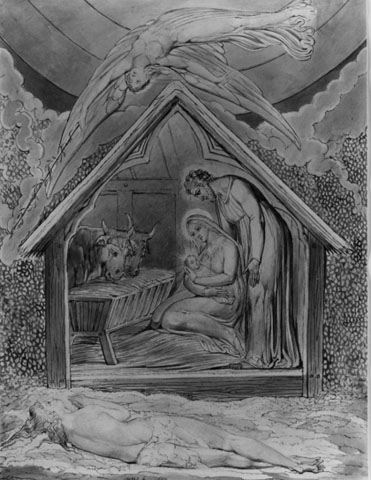
During the season of Advent when I was growing up, my family placed a beautiful Nativity scene on the shelf above the TV. The wooden stable had a bark and moss covered roof, above which we suspended angels on fishing line. Inside the stable, a bearded Joseph leaned heavily on a staff and a kneeling Mary pondered things in her heart, while a donkey and a cow looked on. Outside the stable, a pair of shepherds, a woman balancing a jug of water, and assorted townsfolk queued up like bridesmaids and groomsmen in a wedding photo. Each character was transfixed by something going on at the center of the stable, something that was obviously important if the painted expressions on their faces could be believed. The trouble was that nothing was going on at the center of the stable. An unassuming manger stood in between Mary and Joseph, who stared lovingly down into the empty box.

blakenativity
William Blake "The Descent of Peace"

You see, we waited until Christmas Eve to place the baby Jesus in the manger. (Confidentially, we hid him on the shelf behind the stable until our plastic Mary came to full term.) So, for the entire month of December, our crèche was incomplete. As a child, I might have laughed at the incongruity of the scene if I had known any other Advent tradition. Jesus hadn’t come yet, but the fishing line angels were already fingering their harps, the shepherds were already choosing which lamb to present, and the cattle were already lowing (whatever lowing is).

Without Jesus in the manger, none of these activities made sense. But putting the babe away in that manger a month before Christmas removed the period of expectant waiting that Advent is all about. This is the tension we acknowledge during these next four weeks. By preparing to celebrate Jesus’ Incarnation, we are also preparing for his second coming. To be able to come again, he had to leave. But even as we prepare for his coming again, we remember that Christ abides with us even now in the present.

This incongruity is quite confusing. How can Jesus be coming again and abiding with us at the same time? This makes no sense. If I say I’m going to the kitchen to make a sandwich, I can’t watch football on the couch in the living room at the same time. (I can, of course, pause the football game with the wonderful invention of DVR, but that’s beside the point.)

I can either make a sandwich or watch football. We are used to our world working in this either/or way. We exist in time and space. At this moment in time and at this place in space, I exist in this pulpit talking to you. I can neither make sandwiches nor watch football right here right now. Indeed, many years ago I gave up praying for the ability to teleport and succumbed to the reality of our either/or world.

But we get so caught up in “how things are for us” that we forget God lives outside and above and throughout this reality. We are bound by our either/or perceptions. Our God lives an expansive both/and kind of existence. Both three persons and One God? Yes. Both fully human and fully divine? You bet. Both coming again and abiding with us still? No problem.

The problem comes when we, in all our haste and distraction and busy work, forget that Christ abides with us still. Acknowledging the promise of “coming again” is much easier for us because it takes place in some amorphous future. Now, we humans have developed an awful routine of sloughing the future off on those people who will be alive in the future. This routine has spawned the byproduct of ignoring the consequences of our actions for those unfortunate future people. If we can push those consequences off into an amorphous future, surely we can install Jesus’ second coming there, too.

But when Jesus warns his disciples to “keep alert” and to “keep awake,” he reminds them that the future has a persistent habit of becoming the present. On some day that only the Father knows the Son of Man will come in the clouds with great power and glory. At some hour the master of the house will come, says Jesus. Don’t let the vague obscurity of the future lull you to sleep or you will miss the promise fulfilled in the present.

The Apostle Paul is aware that there are numerous sleepy followers of Christ in Corinth, the city to which Paul addressed this morning’s lesson. He reminds the Corinthians of Jesus’ promise to come again when he mentions “wait[ing] for the revealing of our Lord Jesus” and being “blameless on the day of our Lord Jesus Christ.” In the same breath that he speaks about the future, Paul also focuses on how Jesus Christ abides with the Corinthians and impacts their lives in the present. Christ has given them the “grace of God.” They have been “enriched in him in speech and knowledge of every kind.” They are “not lacking in any spiritual gift.” Christ will “strengthen” them even as they wait for the day of his revealing.

With these words, Paul teaches us that the best way to prepare for the coming of Christ is to realize that Christ continues to grace and enrich and strengthen us even now. Forgetting that Christ is present in our lives feeds the delusion that the future happens only to people yet unborn. On the other hand, setting all our desire on Jesus’ coming again blinds us to the presence of Christ in our midst. Thus, we can’t afford to let our either/or world dictate to which alternative we will subscribe. Only by keeping awake to the presence of Christ in our lives today will we be able to keep alert for the coming of Christ tomorrow.

When we come to the altar in a few minutes, we will share that presence of Christ in our midst. We will be nourished in the breaking of the bread and strengthened to go out and enrich the lives of all we meet. We will be given the opportunity to let our haste and distraction and busy work fall away, and for one shimmering moment, we will remember that the grace of God weaves our lives together. And as the body and blood of Christ fills us, the master of our internal houses will wake us up and set us by the door to watch for his coming again.

Okay, I promised that I would explain why the phrase “O come, O come, Emmanuel” is a funny one. Well, “Emmanuel” means “God with us.” So, when we chant that hauntingly beautiful melody, we are saying: “O come someone who is already here.” No matter how nonsensical our either/or world says this line of reasoning is, we still pray for “God with us” to come to us. By asking us to believe that Christ will come again even as Christ abides here, God invites us to join God in a moment of sweeping both/and reality. During the season of Advent, we cultivate the hope for this expansive existence. At the same time, God jostles our faith to make sure both our presents and our futures are full of the love of God. Keep alert for the coming of Emmanuel. And keep awake for the joy of God with us.

What is truth? — Pilate in three takes (take 3)

As mentioned in the footnote of the last Bible study (“Don’t just read it”), the following post is the last of three that explores different interpretations of Pilate’s question “What is truth.” Using the ancient Jewish practice of Midrash (in which scholars took the stories of scripture and expanded them to reach new insight and new interpretive depth), I have attempted to get into Pilate’s mind on that fateful day before the Passover. Think of these posts as “takes”  — a film director asking an actor for different emotions over the course of shooting a scene. These different angles help us interpret Pilate’s conversation with Jesus in John 18:33-38. After reading all three takes, decide which you think is persuasive. If none is, write your own!

Take Three

I shut the door behind me, and the noise of the crowd dies away. What do they expect me to do? They didn’t even offer an accusation, and they want this man dead. If they just wanted him dead, someone could have knifed him in the back. No, they don’t just want him dead. They want a spectacle. So they come to me. They think they can manipulate me into complying with the whims of their high priests. We’ll see about that.

I open the door again and motion for Jesus to be brought to me. He enters the chamber and immediately fills it with his presence. I feel the same way I do when my commander comes for an inspection. “Are you the king of the Jews?” I ask, and an ounce of wonder escapes my lips with the words.

He replies with his own question: “Do you ask this on your own, or did others tell you about me?”

I feel suddenly put on trial. I take a step back; indignation replaces wonder in my voice: “I am not a Jew, am I?”

He is really from a different kingdom, he says. His followers would be fighting if he were from here, he says. The nation I am governor of has no bearing on him, he says.

“So you are a king?” I am perplexed, but at the same time I am conscious that my office does not allow for vexation brought about by a local celebrity.

“You say that I am a king. For this I was born and for this I came into the world, to testify to the truth. Everyone who belongs to the truth listens to my voice.”

His words hold such power. They linger in the air, catching the morning light that is streaming in the window. I want to believe what he is saying, but a lifetime of orders and spears and pavement and paperwork and…holds me back.

He stands in front of me, hands clasped as if in silent prayer. I look into his eyes and they reflect the words, “Everyone who belongs to the truth listens to my voice.”

I slump down, back to my desk, knees bent. “What is truth?” I say. It is a plea more than a question. I bow my head, upset that I let my emotions show in front of this Jew. My vision begins to mist as tears build in the corners of my eyes.

Get a hold of yourself. You are the governor. You are in charge, not this delusional freak. I sling my head back and whack it on the desk. My head clears. The tears are gone. I look up and see a hand reaching down. My eyes narrow. I do not need your pity, I think. Knocking his arm away, I pull myself up and stalk out of the room, without a further glance back at those eyes or those hands.

What is truth? — Pilate in three takes (take 2)

As mentioned in the footnote of the last Bible study (“Don’t just read it”), the following post is the middle of three that explores different interpretations of Pilate’s question “What is truth.” Using the ancient Jewish practice of Midrash (in which scholars took the stories of scripture and expanded them to reach new insight and new interpretive depth), I have attempted to get into Pilate’s mind on that fateful day before the Passover. Think of these posts as “takes”  — a film director asking an actor for different emotions over the course of shooting a scene. These different angles help us interpret Pilate’s conversation with Jesus in John 18:33-38. After reading all three takes, decide which you think is persuasive. If none is, write your own!

Take Two

I slam the door open so hard that it crashes into the mantle, sending a vase toppling. I catch the vase in midair with both hands and look at my warped features in the curved, glazed surface. Red splotches have broken out on my cheeks and neck. I grit my teeth, spin, and fling the vase at the far wall. It shatters, satisfyingly.

My personal guard comes bolting into the room, sword drawn, at the sound of the crash. He stops and stands dumbly when he sees that I am alone. “Bring me the prisoner,” I say, chest heaving.

I stand with my back to the door. I lean with my knuckles on the desk, hands clenched in fists. I hear the door open slowly. Without turning, I say, “Are you the king of the Jews?” He answers insolently, questioning me when I am the one asking the questions.

“I am not a Jew, am I?” I say, half mocking, half enraged. I always have trouble with locals this time of year, but this is as bad as I’ve seen it. I feel justified in my rage and it feels good. When will they learn that we are in control? “Your own nation and the chief priests have handed you over to me. What have you done?”

I hear a sound and whip around to find Jesus bending over the broken vase. He is holding a flower. This is too perfect, I think, as my ire grows stronger. This dove thinks he can play with the lion. He has no idea who he is dealing with. I stride over to him, snatch the flower, and snap its head off. I can play with him and those meddlesome priests at the same time: I can expend my anger in sport.

Then he babbles something incoherent about his kingdom. “So you are a king,” I shout, throwing my hands in the air.

“You say that I am a king,” he says, quietly. His calmness threatens to diffuse my anger. I won’t let him. He continues, as I pace around him, stepping on the broken vase and flowers with each pass. “For this I was born and for this I came into the world, to testify to the truth. Everyone who belongs to the truth listens to my voice.”

He finishes. I grab him by the shoulder and spin him around, grasping his garment in my left hand and pulling him close. We are nose to nose. His expression is one of mild surprise. There is no fear, not even concern in his eyes. Why isn’t he afraid of me? Why is he so calm?

“What is truth?” I don’t shout it. I don’t scream in his face. It comes out as a bellow, almost a growl. I push him away and storm out of the room, slamming the door behind me.

What is truth? — Pilate in three takes (take 1)

As mentioned in the footnote of the last Bible study (“Don’t just read it”), the following post is the first of three that explores different interpretations of Pilate’s question “What is truth.” Using the ancient Jewish practice of Midrash (in which scholars took the stories of scripture and expanded them to reach new insight and new interpretive depth), I have attempted to get into Pilate’s mind on that fateful day before the Passover. Think of these posts as “takes”  — a film director asking an actor for different emotions over the course of shooting a scene. These different angles help us interpret Pilate’s conversation with Jesus in John 18:33-38. After reading all three takes, decide which you think is persuasive. If none is, write your own!

Take One

I beckon for Jesus to follow me inside, and then I ask him, “Are you the King of the Jews?” He won’t give a straight answer, but I can tell he believes what he says. There is no hint of fever or delusion, just honesty. But I have learned from long experience in the politics of the Empire that there is a difference between honesty and truth. “So you are a king?” I press.

He looks at me for a moment, considering his response. “You say that I am a king. For this I was born and for this I came into the world, to testify to the truth. Everyone who belongs to the truth listens to my voice.”

I lean back on my desk and cross my arms. This man really, honestly believes what he is saying. There is no trace of deception in his face. He is playing the game and playing it well; his answers are both vague and cryptic, but neither seditious nor treasonous. I try to keep my face from betraying my internal skepticism, but I am sure my right eyebrow rises.

“What is truth?” I say. I say it flatly, so that there is barely a question mark at the end of the phrase. I can’t help but add a bit of sneer to my raised eyebrow. What a ludicrous proposition. He thinks he is on a mission to testify—to die—for the truth?

The truth? I don’t even think there is such a thing as truth, let alone a singular, definite truth. There are too many lies masquerading as truths out there. There is a chain of command in this Empire and that means there is a chain of lies, as well. I can lie to everyone beneath me, and they have to believe what I say is truth. And I am sure my superiors lie to me, but what am I to do? Consider it truth: that’s all I can do. Yes, there are too many lies out there masquerading as truths to think I can nail down any one single Truth.

My skepticism leaks out of my raised eyebrow and my sneering mouth. He knows I couldn’t care less for his truth. I just need to make sure I still have a job tomorrow. Truth. Lies. These things don’t matter. Keeping my position and my head: those are my concerns.

Still, nothing he has said makes him guilty. I stand up straight, look Jesus in the eye for a long moment, and then sweep past him on my way to talk to the locals again.

Don’t just read it (Bible study #7)

If you take the vast sweep of Christian history into account, far fewer people have read the Bible than have heard it read. When the New Testament was still just a collection of letters and a few strange things called “Gospel” (say from about 50 to 325 CE), specially trained performers recited entire letters and books from memory during worship. In the middle ages, the majority of people never heard scripture read in a language they could understand and probably wouldn’t have recognized a book if it fell on them from a scriptorium window. Even as the Reformation gained steam and the printing press made vernacular versions of the Bible available, most people heard scripture, but never read it. The “family Bible” didn’t become fashionable until the 18th century, and even today churchgoers hear more scripture than they read (no matter the ubiquity of the Bible online and on store shelves).newsies

What’s this have to do with biblical interpretation? I’m glad you asked. The texts that make up the Bible were always meant to be read aloud. Acts 8 makes this quite clear: Philip approaches the Ethiopian eunuch and knows he’s reading the prophet Isaiah because he is reading out loud. To himself. Follow the eunuch’s example (no, not that example). Read your passage out loud. I know you are reading a translation, but the beauty and rhetorical power of the biblical text do not necessarily suffer in an English treatment. When you read aloud, you will notice oratorical patterns and cadences that the Biblical writers employed to make recitation easier and listening more captivating.

Try this one on for size: say the following two verses in your mind and then say them out loud. “For those whom he foreknew he also predestined to be conformed to the image of his Son, in order that he might be the firstborn within a large family. And those whom he predestined he also called; and those whom he called he also justified; and those whom he justified he also glorified” (Romans 8:29-30).

Notice the oratorical power in the repetitive cadence. This is called a “step argument”: each phrase builds on the previous one until the sentence climaxes on the word “glorified.” Paul obviously wrote this sentence to be spoken rather than read. So there’s no point in studying these verses as “written.”

Besides appreciating the oratorical flair of Biblical writers, reading aloud gives you the opportunity to engage the drama of the Bible. A good chunk of the text is narrative and a good chunk of the narrative is dialogue. Now, we have no audiovisual documentation of the conversations recorded in the narrative, so it falls to us to interpret how the dialogue sounds.

Let’s take Pilate’s response to Jesus as an example: “Jesus answered, ‘You say that I am a king. For this I was born, and for this I came into the world, to testify to the truth. Everyone who belongs to the truth listens to my voice.’ Pilate asked him, ‘What is truth?’ ” (John 18:37-38). How does Pilate say, “What is truth?” Is he angry? Is he skeptical? Is he desperate? Each of these readings offers a different insight into the mind of the Roman governor. If you take reading aloud seriously, the dialogue will force you to make interpretive choices of tone, emotion, and motive. I’m not going to lie. Practicing a text for performance is an awesome way to enter into an interpretive mindset.*

A trained musician may be able to “hear the music” when she looks at a score, but most of us cannot comprehend music’s beauty and power without hearing it played. Similarly, the Biblical text soars when it is read aloud. In Genesis, God speaks creation into being. When we read the Bible aloud, we access that creative voice within ourselves and use the breath and the bodies that God created.

So, read the Bible, yes. But don’t just read it. Speak it. And don’t just speak the Bible. Proclaim it.

Footnotes

* The next few posts on this blog will expand this discussion of exploring dialogue in the Bible by presenting a three part Midrash on Pilate’s statement “What is truth?” Stay tuned.

** I want to thank the writer of the first comment on this post. Reading scripture aloud during worship is the main way people are exposed to scripture. Knowing that, we’ve got to make sure our lectors are trained and know what they are reading ahead of time. Too often, (for various reasons) priests are running around five minutes before services looking for people to read. Reading scripture aloud is too important for that to be the norm.

Finding your voice

You may not believe me, but there is a severe malady that targets clergy. To my knowledge, there are no support groups for those with chronic cases and no medical advances from the pharmaceutical companies. Indeed, doctors can do nothing to diagnose or treat this malady. Attacks happen almost exclusively during worship when the cleric is praying aloud and cease only when he or she has stopped speaking.

Liturgical professionals have made great strides in diagnosing this debilitating affliction; after much research, they have discovered that clergy with high self-importance blast counts most often contract it. Once, in the crypt of a great English cathedral, I came across an ancient description, but my memory is now woefully incomplete. My mind’s eye sees a crumbling illuminated page filled with cramped Latin writing. As near as I remember, the recorder named the malady something to the affect of inficere fenestrae voce — what is now commonly called “Stained Glass Voice.”

National Stained Glass Voice Awareness Week

If you have never heard of this affliction, please permit me to raise your awareness. “Stained Glass Voice” happens when the cleric prays aloud in a vastly different voice than he or she uses when saying anything else. Indicators of Stained Glass Voice include, but are not limited to, the dramatic pause (especially in the middle of a phrase); syllable elongation (especially “O” as in “O Lord”); pitch augmentation (especially an affected deep voice); and unnatural stressing (especially on words such as “who has”).

Most often, clergy contract Stained Glass Voice because they start acting instead of praying. Usually, they don’t even realize it because the affliction spreads gradually. They say the same prayers over and over again. In subconscious attempts to assuage the encroaching dullness of the repetitive action, they begin to say the words differently. Over time, the Stained Glass Voice replaces the original fervor of prayer, and clerics start competing for Best Supporting Actor in a Collect or Blessing.

Ever since I began leading worship, I have attempted to monitor my own vocal patterns when I pray aloud in church. At first, I suffered from Stained Glass Voice because I had trouble combining authenticity with volume. My natural praying voice is quite quiet, so my own voice felt foreign when I raised it to be heard by the congregation. Since my ordination to the priesthood, I have been praying aloud more often and for longer periods at a time. And I am coming to a point where volume does not inhibit authenticity. Attacks of Stained Glass Voice are less frequent (I hope), and I give credit for my remission to a mentor who probably has no idea how much she has taught me.

A few weeks ago, I wrote about a foursome of women who attend Morning Prayer every single day. One of these women, a beautiful lady whose advanced years have not robbed her of what they called in her day “moxie,” adds a set of prayers near the end of our daily worship. She says the prayers in her normal voice, with the same tone and character she uses after the service when she wishes me a good day. For many weeks, I reflected about how wonderful it was that she prays the same way she speaks. Then I realized why her prayers affect me so. It is not that she prays the same way she speaks. She just never stops praying. In every syllable she utters, I hear her prayer for her friends and her community, whether she is talking about God or about all the doughnuts I need to eat to fatten up a bit.

The Apostle Paul instructs the Thessalonians to “pray without ceasing.” I’ve known few people in my life who live up to such a lofty charge, but my friend at Morning Prayer does. As I listen to her speak and pray at the same time, I am learning how to make prayer an integral part of my life —  to make prayer the studs inside the wall rather than the pictures hung to adorn it. As I continue to grow as a person and as a priest, I hope that my true voice rises to my lips, and that the only stained glass in the building is the windowpanes.

Footnotes

I totally made up the story about the crypt at a great English Cathedral because I couldn’t figure out how to say “Stained Glass” in Latin.

The Inlet

(I wrote the following piece in the Spring of 2008, and happened upon it when I was reorganizing some folders on my computer. Some of the temporal language is now dated, but I left the piece as is to preserve its integrity.)

Theologian Sallie McFague identifies the earth as “the new poor.”* The planet, once bursting with bounty and hiding secrets in great swaths of unexplored terrain, now groans under the weight of post-industrial consumption and post-common sense insatiability. The earth has become poor (and a victim of exploitation, rape, and mutilation) in much the same way people become poor: the rich deny access to resources and opportunities. The sense of entitlement over the earth’s riches has grown over the last several hundred years (along with our gluttonous appetites). The Western Christian view of the earth—which, during the medieval period, was full of awe, respect, and fear—has morphed into one of utility, ambition, and domination. We have made the earth poor because we see it simply as an object, argues McFague.

There is another way. Rather than objectifying the earth, rather than possessing the earth as a thing to be used, abused, and discarded, McFague pleads with us to see the world as we see our loved ones—as subjects. Seeing the earth as another subject just as we ourselves are subjects gives us the opportunity to enter into mutual, sustainable relationships with the earth based on love and respect. McFague calls this model “the loving eye.”

Last autumn, I changed the route I take when I drive to church and discovered what she means by this loving eye. A left at the Belle Haven Golf Course sends me a Par Five’s distance down a residential street toward the George Washington Parkway, where I turn right and follow the Potomac River for about five minutes until I reach my parish. Sun-polished leaves of every green hue dance on the branches of trees, which arch toward one another above the parkway, making a dappled, living tunnel. On my left, the river peek-a-boos every now and again when the trees thin, and groves of white masts, rooted in anchored sailboats, mingle with the tree trunks. I sit up a little straighter in my seat. My eyes drift to the trees and the river beyond. And then, for the briefest of moments, I see my spot.

A small inlet in the river reaches to the road. The water tiptoes in and out of the little cove, treading softly around the three or four dead trunks that still stand in the shallows. On cloudless mornings, dawn gilds the somersaulting waves with new light, and the overhanging trees reflect swaying twins in the water. These deep green reflections merge with the morning light, mixing the color of sparkling possibility. All the energy of the dawn and the river and the swaying trees infuses me as I pass by, and I silently thank the Creator for such potent imagination. That is spring.

In winter, the water still treads lightly in and out of the cove, but, on certain January Sundays, ice reaches out from the bank, halting the tumbling waves. The dead trunks hide behind a low fog, which crawls along the surface of the water. When the cold sun penetrates the clouds, it shines through the winter scaffolding and silhouettes the bare trunks and branches. All the deliberateness of the ice and the fog and the sleeping branches deepens me as I pass by, and I silently thank the Creator for such quiet solemnity.

In autumn, the trees shed their uniformity. The water exults to mirror the new apparel in swirling reflections of amber and crimson. Dropping leaves spiral down, catching the morning light. They float on the water and cluster at the bases of the dead trunks. Dawn ignites the trees, making their leaves shimmer and blaze. The wind ruffles the surface of the water—no tiptoeing this time, only cartwheels. The light glances off each wave’s crest and each yellow leaf, doubling the morning’s fervent brightness. All the elation of the wind and the light and the flaming leaves elevates me as I pass by, and I silently thank the Creator for such riotous innovation.

I have never driven past my spot in the summer, but I imagine the inlet displaying a worn, comfortable version of the sparkling possibility of spring. Soon, I will no longer be driving that way on Sundays. At times, I have contemplated pulling my car over to snap a picture of the spot. But each time I travel down the living tunnel, I decide to keep driving by. Deep down, I discover that I have no desire to capture the image of that blessed spot. How can I hope to tell the story of such a place in a photograph? Capturing its image truly would be a confinement. I would preserve one instant of two-dimensional facsimile when the original has such light and movement and possibility. The depth of reflection would flatten. The waves would no longer tumble. The wind would disappear. If I took that picture, I would cease to remember that spot in my imagination. I would lose what I had sought to preserve. In a sense, I would take the life from a place that has infused my life with such energy, such ardent joy.

So I leave my camera at home. I prefer to keep the ever-changing image of that spot in my heart. It continues to kindle within me the spontaneous thanks of a creature for all the potent imagination, quiet solemnity, and riotous innovation with which the Creator has blessed creation.

The spot brings out McFague’s loving eye in me, and I find myself asking the water and wind and trees for forgiveness—for myself and for our entire post-common sense establishment. During the same lecture in which we discussed McFague’s work, my seminary theology professor reached back to the medieval era and borrowed the idea of Haecceitas from thinker Duns Scotus. He was not content to know a forest or a species of tree or flower. He wanted to know each particular white oak, each individual daffodil. And in so knowing, rejoice that God also knows those trees and flowers for God created them. And in so rejoicing, praise God for the craft, detail, and unsurpassed beauty seen in the particularity of creation. I pray for these Haecceitas eyes. I pray that soon we will all see the earth as a subject, a poor subject in need of enriching relationships. And I pray that the inlet remains in my heart, urging me to look with love on God’s creation.

Footnotes

* Sallie McFague, Super, Natural Christians

Our better angels: The two things you’re not supposed to talk about (part 3)

Election day falls on the first Tuesday after the first Monday in November of every even-numbered year. That day happens to be today.* West Virginia has early voting and the polling place happens to be next door to my church, so I took advantage of that a few weeks ago. But I’ve been keeping on top of the political scene in the country: the campaign tactics, the exchanges, the (gotcha!) media, the blustering pundits and blundering surrogates. I’ve at times in the last weeks been both enthused and disgusted, hopeful and resigned. Every sign of progress I see shares the spotlight with the tired old prejudices of the past. I hope with all the fervor of my heart that, no matter the outcome of this election, the United States continues to strive for that “more perfect union,” to which our Constitution sets its lofty heights.

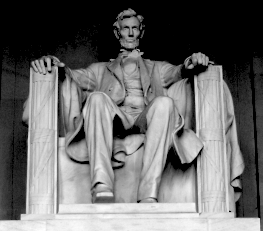
This hope stirs in me a refrain that has been playing in my head for days: “We are not enemies, but friends. We must not be enemies. Though passion may have strained it must not break our bonds of affection. The mystic chords of memory, stretching from every battlefield and patriot grave to every living heart and hearthstone all over this broad land, will yet swell the chorus of the Union, when again touched, as surely they will be, by the better angels of our nature.”lincoln

Abraham Lincoln spoke these words on March 4, 1861. The dust of 150 years has made these words no less relevant today. Chorus. Union. Bonds of affection. These are powerful words that tell of a truth, which these years of dust could never obscure: We can do great things when we come together, when we embrace the power of unity. This is Lincoln’s charge to us all. This is the truth which we entrust to our next president. And this is the prayer of Jesus for his disciples and for all of us: “All mine are yours, and yours are mine; and I have been glorified in them. And now I am no longer in the world, but they are in the world, and I am coming to you. Holy Father, protect them in your name that you have given me, so that they may be one, as we are one.” (John 17:10-11)

Jesus lived this prayer for unity when he welcomed everyone to come to him, and all those who were thirsty to drink. He lived this prayer when he ignored the racial barriers between Jews and Samaritans. He lived this prayer when, dying on the cross, he created a new family for his mother and his beloved disciple.

But uniting is not enough. Uniting is only the exposition of the story. We must unite for something. We must come together to fulfill those tasks which the better angels of our nature invite us to accomplish. Too often, the ingrained talking points that showcase the worst of partisan bickering shout down these better angels. Just last week, I was sitting at Panera bread and overheard a conversation between two businessmen — the gist of their chat simply rehashed the tired old stereotype that all people on welfare just sit at home watching Oprah. Surely, these two suits would have more political acumen than to recite such a line of attack, I thought. But no. In election years, by some strange alchemical process, saying something enough times makes it true, no matter the veracity of the claim. In the absence of any real hope, any real truth, whoever steps up to the mic to fill the dead air is the ruler of that fifteen second soundbyte.

But our better angels fill in that dead air. When we turn our attention inward, we will find those angels speaking the words of the only Truth out there worth subscribing to, the words of life that God writes on our hearts. These words will never fit into a soundbyte. They will never succumb to the tired old prejudices. They will only urge us to join together to accomplish God’s work on earth. The mystic chords of our better angels’ chorus echo with Jesus’ words: “Come, you that are blessed by my Father, inherit the kingdom prepared for you from the foundation of the world; for I was hungry and you gave me food, I was thirsty and you gave me something to drink, I was a stranger and you welcomed me, I was naked and you gave me clothing, I was sick and you took care of me, I was in prison and you visited me…Truly I tell you, just as you did it to one of the least of these who are members of my family, you did it to me.” (Matthew 25:34-36, 40)

We can feed the hungry and cloth the naked and shelter the homeless and nurse the sick. We can respond to that image of Christ in the faces of the least of Jesus’ family. Far be this from some misguided philanthropic diversion to the benefit of Oprah’s sweatpanted viewership. We are called, not just as Christians but as human beings, to help those who are suffering, to bring hope to those who are despairing. I ask you: how much better will we be, how much more unified, when today’s least of these are in the position to help tomorrow’s?

This is not the time for a bootstraps mentality. This is not the time to recline in the illusory comfort of self-interest. This is not the time to relapse into a tired old hoarding way. Be touched by the better angels of our nature.  Know that this is the time to give. This is the time to tug on your neighbor’s bootstraps. This is the time to enter into the kinectic delight of unity and labor for the kingdom of God on earth.**

Footnotes

* Incidentally, figuring out when Election day falls is similar to figuring out the date for Easter: the first Sunday after the first full moon after the vernal equinox. Fun times.

** Here is a list of links to help you get involved:

The ONE Campaign

The United Way

Habitat for Humanity

Heifer International

Episcopal Relief and Development

CNN: Impact Your World

Idealist.org