Sermon for Sunday, July 5, 2015 || Proper 9B || 2 Corinthians 12:2-10
The first weekend of June, I was doing some yard work with my father-in-law outside the rectory. While carrying some brush down the stone front steps, I slipped and fell backwards. I caught myself, but my lower back hit the edge of the step with enough force for me to feel it, go inside, and start icing. The ice helped, and I felt much better the next day. The day after that, I played soccer. I didn’t hurt my back during the soccer game, but running around for two hours at my age didn’t do me any favors. (Yes, yes, I know I’m young, but there’s a reason most professional athletes retire in their early thirties.) Put the soccer and slipping on the steps together with sleeping in a soft bed and picking up two babies for ten months, and Wednesday morning I could barely move. I spent the day lying on the floor, in a sizable amount of pain.
The next morning, I arrived at church to prepare for the 7 a.m. service. The pain was less than the day before but still considerable. I did my best to hide it during the first half of the service, but my acting job was unconvincing. After the peace, folks asked what happened, and I told them the story I just told you. When we came together around the altar for communion, I was about to start the prayer when Barbara Barrett asked: “Adam, can we lay our hands on you and say a healing prayer for your back?”
I looked around at the people circling the altar. They seemed eager to assist Barbara in her request. I had never considered asking for such a gift, but when it was presented, there was only one possible answer, a very thankful, “Yes, of course!”
The fifteen or so people present clustered around me and touched my back and arms and shoulders. Barbara prayed aloud. When she was finished, I exhaled and inhaled. As I breathed, I felt my insides expand and the stiffness in my back stretch out just a little bit. The pain remained, but it was lessened because fifteen people were now bearing it with me.
As I reflect back on that morning, two questions spring up for me. First, why had I never considered asking for the laying on of hands? And second, why did I feel it necessary to hide my obvious pain? I could answer each of these questions at length, but in the end, the answer to both questions boils down to a single word: weakness.
Something inside me convinced me not to show my weakness. That something might have been the myth of the tough guy: “Walk it off. Gut it out. No pain, no gain.” Or perhaps the myth of perfection: “You’ll only be loved if you always get straight A’s or fit in those jeans or never strike out.” Or perhaps the myth of individualism: “I can get on very well by myself, thank you. I don’t need help from anyone.”
Whatever it was that convinced me not to show my weakness, it worked; that is, until Barbara spoke up. Her invitation to healing silenced the myths, and in that silence, the words of Paul we heard today bubbled to the surface: “Three times I appealed to the Lord about [my thorn], that it would leave me, but he said to me, ‘My grace is sufficient for you, for power is made perfect in weakness.’ So, I will boast all the more gladly of my weaknesses, so that the power of Christ may dwell in me.”
My grace is sufficient for you, for power is made perfect in weakness. There are many countercultural things embedded in the Christian faith, and this is a prime example. In effect, God says, “Don’t look for power where the world looks for power: in the bank account, on the TV screen, at the point of a gun. No, my grace is enough for you to find fulfillment, if you allow my grace to infuse your weakness.”
In his own trials and tribulations, Paul has uncovered something that I personally (and I bet many of you) need to hear over and over again. The power of Christ dwells in us, and it dwells most effectively in the parts of us that the myths tell us to hide. These are the parts of us that need the most help, the parts we don’t want to show other people because we think this or that facet of ourselves is deficient or shameful. The grace of God and the power of Christ enliven our whole selves, but like an antibody targeting a disease, God’s grace heads straight for our weaknesses.
And since God’s grace meets us where we are weakest, we learn to rely on that grace to help us overcome our presumed deficiencies. God uses our weakness to gain a foothold within us. God trains us to rely on God when we think we need to (that is, our weaknesses) in order that we might just start relying on God when we think we don’t need to (that is, our strengths). In that way, we eventually rely on God all the time. If God tried to gain the foothold the other way around, I don’t think we’d ever let God in because our strength, our power, would be telling us we are okay on our own.
When Barbara spoke up about healing prayer, she reminded me that I’m really not okay on my own. I need God. And I need you. Priests can fall into the trap of serving their flock with such single-mindedness that they forget sometimes they need to accept service too. Being unwilling to accept the service of another is a debilitating weakness. I suffer from it. Maybe you do too. Too often I forget what a gift mutuality is. I forget that Christ washed his disciples feet and allowed certain women to wash his. On that Thursday morning, the power of Christ worked through my weakness, and, God met me in the hands of fifteen parishioners, who gave me the gift of healing and helped me bear a burden. My weakness kept me from asking for healing, but perhaps it was that weakness (and not my back), which found healing that day.
My grace is sufficient, for power is made perfect in weakness. I’ve experienced this truth. So did the Apostle Paul. So did the disciples when Jesus sent them out two by two with only a staff in their hands, but with the power of Christ dwelling in their hearts. So my questions for you are these: what weakness of yours might God’s grace be trying to shine forth from? What part of yourself are you hiding because of some myth or other? Pray these questions. Ask God to help you face that weakness, to live into it, to find grace in it, to use it to connect with someone else feeling the same weakness. After all, strength and power are not a universal human constant. But we are all weak in some way, somehow. We’ve all been in pain. We’ve all failed at something. So did Jesus. What else but a weak, painful failure was the cross in those few days before the resurrection?
But the good news is this: the power of God’s grace redeemed the cross when Jesus rose from the dead. And the power of God’s grace redeems our weaknesses when we don’t hide them, but instead use them to connect to each other. Thank you Barbara and the rest of the Thursday morning group for your gift to me: the gift of reminding me its okay to be weak because y’all are there to help bear my burdens and because God’s grace is not just sufficient – God’s grace is abundant, extravagant, more than we could ever ask for or imagine.
Sermon for Sunday, May 31, 2015 || Trinity Sunday B
Have you ever looked closely at the round window high up the wall in the back of the church? Go ahead – turn around and give it a good look. I love this window. I love the vibrant colors. I love that when the sun is shining through it, an afterimage gets imprinted on my eyes, so I see it when I close them. If you’ve never given the window much thought, I don’t blame you. The words on it are in Latin, after all. But let’s keep looking. The window presents a diagram of the Holy Trinity. “Deus” – God – is encircled in the center. Three smaller circles float around it: Patri, Filius, Spiritus Sancti – Father, Son, and Holy Spirit. Each of the smaller circles is connected to the others with the words “non est” (is not), and each smaller circle is connected to the large central one with the word “est” (is). The diagram is telling us that the Father, Son, and Holy Spirit are not each other but they are all One God. How does this work? Wisely, the window doesn’t tell us. The window just illustrates the reality, a theological blueprint in stained glass.
Likewise, I’m going to take my cue from the window and stay silent on the “How does this work?” question. Too many sermons over the years have tried to explain the mystery of the Trinity by talking about apples or flames. What those sermons didn’t understand is that you can’t explain a mystery without destroying the very quality that makes it mysterious. When Sherlock Holmes figures out that the bell rope used to call for the maid was replaced with a poisonous snake, which somehow slithered unnoticed out of the room in the ensuing hubbub over discovering the body, the mystery is solved. No more mystery. This Whodunnit? type mystery is the kind we’re used to: Gibbs and the NCIS team solve their mysteries within the length of the 45-minute episode. The light-hearted mystery novels my mother loves to read always wrap up the intrigue by the end of the story.
But here’s the difference between these small, ordinary mysteries we watch or read and the great mystery of the Holy Trinity. The small mysteries have answers to them, like the poisonous snake. But the mystery of the Holy Trinity is the answer – the fundamental answer that rests at the very core of existence. Here’s what I mean.
Before creation came into being, there was God. There was only God. Then God spoke, “Let there be light,” and creation erupted in a rush of dust and energy and far flung fire. And suddenly, there was something known as “not God.” Suddenly, there was an “other” for God to love. And yet, we believe that God’s essence is love, which means that God must have loved before there was a creation to love. Confusing, right? It is confusing until we realize there’s only one possible answer for whom God loved before there was anything else. God loved God. This may sound narcissistic or vain, but it’s not. Narcissism and vanity are distortions of love, but God’s love is perfect and unsullied. God loves God with such perfection that there is still only One God, even though a loving relationship exists.
That’s the keyword: relationship. To try to come close to the mystery of the Holy Trinity, we employ relational words: Father and Son, Parent and Child. We speak of the Holy Spirit as being the love that flows between them. This perfect relationship existed before creation, and thus serves as God’s blueprint for creation. Have you ever noticed that if you drill right down to the core of any subject whatsoever, you end up at relationship? At the most fundamental level, life, the universe, and everything are based on the relationships between things. Elemental particles vibrate next to other elemental particles, weaving the fabric of creation. Atoms repel and attract each other. Ecosystems thrive as complex series of relationships. Celestial bodies dance the precarious waltz of gravitational balance. Not to mention, the most important things in the lives of us humans on this fragile earth is our relationships with one another.
All of this grows from that blueprint God used from God’s own self – the perfect relationship of the Holy Trinity. In the act of creating something that was not God, God knew creation wouldn’t be perfect. And yet, God made it anyway. The reason the Holy Trinity remains a mystery is that our relationships – indeed, all relationships in creation – are not perfect, and thus we cannot fathom perfection.
But while we aren’t perfect, the idea of perfection lingers within us, an echo of our Creator’s own perfect love. We feel this echo as a longing for connection, for relationship with God and with each other. God loves us perfectly, even though we have the capacity to return a mere sliver of that love. But that sliver is more than enough to activate our ability to engage in loving relationships here and now. When we nurture such loving relationships in our lives, we come as close as our imperfection allows to the perfect relationship of the Holy Trinity.
Indeed, the Holy Trinity transcends our imperfection, draws us in, and strengthens our earthly relationships. The echo of God’s perfect love grows louder, more insistent, as we give ourselves over to be born again from above, to be remade closer to the blueprint than we were before. The blueprint calls for less domination and more mutuality, less prejudice and more generosity, less pride and more humility. The blueprint calls for less defending and more welcoming, less grasping and more embracing, less tearing down and more lifting up. And above all, the blueprint calls for love to spill forth in the forms of justice-seeking, mercy-granting, grace-sharing, hope-planting, and joy-singing.
And so you go home and do the dishes even though it was your brother’s turn. Or you tell your wife “thank you” for her poise in the middle of chaos and for putting up with you all these years. Or you introduce yourself to that bedraggled person you always seem to run into on your morning jog and ask if he needs assistance. Or you look those who are oppressed in the eye and say, “I’m sorry for not showing up sooner,” and then turn to stand with them.
Each of these is an expression of the blueprint of the perfect relationship of the Holy Trinity. And each of these will be done imperfectly. And yet, the mystery of the Holy Trinity rests at the core of all existence, of all we do and all we are. And so our imperfection is even now being redeemed by the perfect love of God, which somehow manages to fit all of itself into our mere slivers of love.
If in your life, the Holy Trinity has seemed no more than an abstraction, as clear as the Latin writing on the window back there, then I invite you to take a step back and look again. Reassign every single urge you have ever had to seek justice, to grant mercy, to share grace, to plant hope, to sing joy, and to love. Reassign all of them to the perfect love of the Trinity flowing, however imperfectly, through you. Notice now the Father, Son, and Holy Spirit catching you up in the ever-spinning dance of perfect love, and be thankful.
—
* The diagram of the Holy Trinity is the window on the back wall of St. Mark’s in Mystic, CT.
Sermon for Sunday, May 17, 2015 || Easter 7B || Acts 1:15-17, 21-26
Last week, we talked about trying to discern how and when to lean into the newness shimmering on the horizon of your life. I invited you to stop and pray the next time you are at the precipice of a decision; to take a deep breath and feel which way the wind of the Holy Spirit is pushing you; to ask God what new thing God is trying to birth through you with the decision. I know many of us, myself included, often have a hard time finding words to put to these prayers for guidance. Silent prayer – with lots of listening – is a beautiful alternative when there are no words, but if you have the urge to speak, then I have the first five words of the prayer, just to get you started. They come from this morning’s first reading. The eleven apostles want to round out their number, so they select two candidates and then pray about which one will take Judas’s spot. And they begin their prayer for guidance with these five words: “Lord, you know everyone’s heart.”
What a profound statement of faith – five words that speak to the apostles’ trust in God. Lord, you know everyone’s heart. This one, brief sentence guides their decision-making process in three substantial ways. They acknowledge God’s presence in their endeavor. They understand that making choices involves more than purely mental exercise. And they show humility in the face of a life-altering decision. Let’s take them in turn.
I’ve said it before and I’ll say it again: we routinely ignore God’s presence because God is always present. We forget that God is in the midst of not just the miraculous, but also the mundane. Now, our failure to recognize God’s presence is understandable. How many of us note the sound of the engine in the car until there’s an ominous sputtering? How many of us note the reliable glow of the bedside lamp until the transformer blows outside? We adapt to routine. We organize our lives into predictable patterns. But God’s movement in our lives is the very framework upon which our patterns hang, so that movement is often difficult to perceive. On the other hand, like the electricity, we’d notice if God weren’t there.
The apostles combat the tendency to ignore God’s foundational presence by invoking God’s knowledge of their hearts as they make a decision. Lord, you know everyone’s heart is shorthand for, “Lord, you are present in all that we do, and your presence sustains the world we live in and the life we live.” With these words, the apostles invite God into their decision-making process. This invitation may seem superfluous if you believe the assertion that God is ever-present. Indeed, God doesn’t need an invitation to be present in our lives. But we often need to invite God in to remind ourselves to be present to God. Our invitation functions, strangely enough, as an RSVP, as a response to God’s presence. The apostles know this. They know that the Lord is already present, but the invitation prepares their hearts to respond to God’s movement.
Lord, you know everyone’s heart, they pray. The apostles know that making a life-altering decision involves more than mental exercise. Every decision we make has both mental and emotional components, and we ignore the emotional at our peril. When the apostles pray these five words, they combine the mental verb “know” with the feeling word “heart.” They understand that God made separating heart from head so difficult precisely because our decision-making process should not attempt the separation. God gave us minds to interpret our emotions and hearts to provide our minds with the fuel of hope and imagination. God infused our biology with such checks and balances, so we tragically limit ourselves when we shelve our feelings in favor of our thoughts, or vice versa. Only by mingling the two can we make faithful decisions.
The apostles know they are in God’s presence. They employ both their hearts and minds as they make their choice. And they show humility in the midst of a life-altering decision. This humility is key to the whole decision-making enterprise. Every one of my choices affects more than just me, and those effects ripple into the future in permutations that my brain is unequipped to process. I don’t know how my decisions will affect others, let alone myself. Furthermore, I don’t even know myself well enough most of the time to make good decisions. Lord, you know everyone’s heart. If God knows what’s in my heart, then that makes one of us.
Humility comes in when we acknowledge our limited awareness of ourselves and the world around us. If our interior lives are clouded in mystery, how much less can we understand the trajectory of our decisions in the wider world? Inviting God into the decision-making process opens us up to the One who truly knows us. The humble prayer begins, “Lord you know my heart, and you know it much better than I do.” Confessing our shallow understanding of our own inner selves sets us on the path to faithful decisions.
Let’s say you are standing at the edge of a life-altering decision. You are trying to decide what college to go to; or whether to throw yourself fully into a budding relationship; or if you should change jobs. There’s newness shimmering on the horizon, so you stop and pray. You begin with a personalized version of these five words: “Lord, you know everyone’s one.”
Lord, you know my heart.With these words, you invite God into your decision-making process. You make yourself aware of God’s constant, yet elusive presence. You think back to your campus visits at your top three choices. You hadn’t been prepared to look for God’s presence at the time, being so overwhelmed by the experience. But now, looking back in prayer, you notice a flicker of rightness about one school. You imagine yourself there, setting up your dorm room, going to class. And you realize what that flicker of rightness feels like. It feels like home. That’s God’s presence inviting you to choose the best of all possible futures.
Lord, you know my heart. With these words, you allow your head and your heart to team up, mingling your rational mind with your emotions and imagination. A new relationship is budding, and you’re trying to decide whether or not to run with it. Your heart tells you yes, Yes, YES – how could you possibly feel any better than you do right now. You’re skin’s all tingly. You haven’t heard her voice in an hour, which is an hour too long. But here your rational mind breaks through the fog of passion: let’s not pick the china pattern yet. Let’s get to know each other. Let’s take it slow. Let’s test this and see if our nascent passion has what it takes to deepen into the bedrock of lifetime commitment.
Lord, you know my heart. With these words, you humbly acknowledge that alone you don’t have the depth of awareness necessary to make a faithful decision. You’ve been thinking about changing jobs for a while. Right now, the money’s good, but the hours are killer. You tell yourself that you’re sacrificing so that your family can have a good life. And that may be true, but still, you’ve missed a dance recital and three little league games this month alone. You have an offer on the table. It’s less money, but you’d be home most evenings. In humility, you ask for God’s guidance to help you see the future permutations of this decision.
Lord, you know my heart. “Lord, you know everyone’s heart.” When you are trying to discern how and when to lean into the newness shimmering on the horizon of your life, begin your prayer for guidance with these five words. With integrated heart and mind, kneel humbly in God’s presence. Unfurl your heart to God. Place yourself in the palm of God’s hand. And know that God will still be there whatever future unfolds.
—
*Several parishioners have asked me to preach slower, which I’ve been working on for a while now. Recently, I’ve been succeeding. But that means I need to start writing fewer words. This sermon came in about 1:30 longer than I like, so at the later service, I shortened it on the fly and it worked. But the one I recorded was the long one.
Sermon for Sunday, May 10, 2015 || Easter 6B || Acts 10:44-48; Psalm 98
“Sing to the Lord a new song, for he has done marvelous things.” Today’s psalm begins with these glorious words, and for me it begins with a question. Why does the song we sing have to be a new one? Why can’t the song be an old song, one that has stood the test of time? “Amazing Grace,” perhaps? Or how about “In the Garden?” While these songs are beautiful and wonderful and should never, ever be lost to the ages, I think the psalmist feels the urge to sing a new song because he or she has discovered a fundamental truth about God’s movement in God’s universe. God is always doing something new.
God’s ceaselessly creative hand did not stop molding and shaping the universe at the end of the sixth day of creation. God continues to breath new life into this ever-expanding cosmos: at the grand scale of galactic expansion and at the small scale of simple, daily interaction. In the playroom next door, the twins do something new seemingly every day. Amelia loves to eat real food. Charlie has started climbing. We have several parishioners who have recently moved from their homes into assisted living facilities or whose recent medical interventions have led to new lifestyle choices. They are faced with newness of a less joyful kind, but we still fervently hope that their new situations will lead to much better outcomes than they could have expected before.
The simple fact that spring has sprung reminds us that God is always doing something new. In my life. In your lives. In the life of the church. The world. Creation. We believe that God’s reign is constantly and continually reshaping existence, bringing all things into closer connection with God, as creation was always intended to be.
The newness that trumpets God’s closeness is borne on the wind of the Holy Spirit. Not all new things are of God, but the Holy Spirit helps us discern when and where God is birthing those new things that do lead to closer connection for all people. When we allow ourselves to be open to the newness dancing along in the Holy Spirit’s wake, we become people who are less afraid to try new things, to risk, perhaps to fail, but to know that in the attempt a new shoot of possibility has sprung up from the ground. When we do succeed in living into God’s reconciling newness, the result is deeper connection with God and a more expansive understanding of God’s love and God’s generosity.
One climactic example of this success happens in our tiny first reading today. It is the most extraordinary event in the history of the early days of the church. You might think it would be a dramatic conversion or a miraculous healing or a mystical vision or a memorable speech, but while each of these happens in the book of the Acts of the Apostles, none is the event I have in mind. No. The most extraordinary moment of reconciling newness in the early days of the church happens when one person simply realizes he is wrong and then changes his mind.
That person is Peter. And we might expect Peter to be a hardliner, sticking to all of his positions and presuppositions just because he had been with Jesus from the beginning. After all, Jesus did give Peter the figurative keys to the kingdom. What could be more human of a reaction than for Peter to lock out anything new that threatened the integrity of the in-crowd? As I’m sure we’ve all done from time to time, Peter could have stuck his head in the sand, ignored the promptings of the Holy Spirit, and resisted any opportunity for growth, for reconciliation, or for new possibilities.
But that’s not what happens. So here’s the story, beginning with just a bit of background. The society in which Peter grew up was divided between Jews and Gentiles. There wasn’t necessarily animosity between them, but there was indifference and a lack of connection. Society was just built in this divisive way, so no one really questioned the structure.
That is, until one day when Peter is hungry. While a meal is being prepared, Peter receives a vision from God. All of the animals that observant Jews aren’t supposed to eat appear before Peter, and a voice directs him to kill and eat. Peter balks at the command: “I’ve never eaten anything that’s profane or unclean.” But the voice counters: “What God has made clean, you must not call profane.” This happens three times until the vision has finally sunk into Peter’s bones.
When the vision ends, Peter meets a trio of Gentiles who invite him to meet a Roman named Cornelius, who has also had a vision from God concerning Peter. Never fearing that he might be walking into a trap, Peter goes with them and meets Cornelius and his whole household. And then Peter preaches a fabulous sermon that proclaims the good news of Jesus Christ.
This is where our passage for this morning picks up the tale. While Peter is still speaking, the Holy Spirit encounters all who hear him. Peter’s companions, who are Jewish believers in Jesus Christ, are astounded that the Holy Spirit of God would deign to manifest itself through unclean Gentiles. “But what about our in crowd,” they seem to protest. “We thought we were the special ones. We thought we were the ones that had the Holy Spirit.”
Then Peter remembers his vision of the now clean animals. And he finds himself standing at the precipice of a decision, at the precipice of something new trying to break into reality. His society, his upbringing, and everything he has ever known pulls him to reconfirm that Jews and Gentiles can never be united, that the good news of Jesus Christ is for Peter’s people alone. But that same Holy Spirit, which is even now dancing around Cornelius and his Gentile family, pulls Peter in a new direction toward unity and acceptance and radical welcome of the estranged other. And this time Peter doesn’t balk. He baptizes all the Gentiles present and charts a new course of acceptance in this new and nascent religion soon to be called Christianity.
This particular type of newness – welcome of the other, whatever makes that person other – keeps encountering the church again and again. Over the centuries, Christians have failed to be swept up by the wind of the Holy Spirit’s newness too many times to count, but every once in a while, we trim the sail just right and succeed in ushering in God’s reconciling newness. Just in our lifetimes, we have expanded opportunities in our church to many groups who had been shut out before – allowing women to be priests, for example; or blessing loving relationships of any orientation with the sacrament of marriage.
When you are trying to discern how and when to lean into the newness shimmering on the horizon of your life, how do you feel? Terrified? Excited? Saddened by what is fading away? Joyful for what is breaking in? All of the above, probably. In any case, like spring blooming in a riot of color every year, newness is just a part of life. In our own lives and in the life of the church or our nation or the world, the newness that comes from God will always lead to deeper connection, greater reconciliation, more hope – maybe not today or tomorrow. But the path will lead there someday.
The next time you are at the precipice of a decision like Peter, stop for a moment and pray. Take a deep breath and feel which way the wind of the Holy Spirit is pushing you. Ask God what new thing God is trying to birth through you with this decision. How will it lead you closer to God or another person? God is forever speaking words of reconciliation and renewal into this creation. Each day, we have the opportunity to hear them anew and to choose the course towards closer connection and to leap off the precipice and to soar on the wind of the Holy Spirit.
Sermon for Sunday, March 22, 2015 || Lent 5B || Jeremiah 31:31-34; Psalm 51:1-13
This is the last Sunday of the year in which we are worshiping according to the older, Rite I format of our liturgy. A few weeks ago, I mentioned that the reason we’ve been using the more traditional language was so we could say that beautiful line about inclining our hearts towards God. But there’s another reason, one that I didn’t mention then because I was fairly sure I was going to preach about it today. There’s a special prayer found in the traditional rite that is not duplicated in the modern one, a prayer we’ve been praying directly before communion for the last several weeks. Today, we will pray it one last time. The “Prayer of Humble Access” goes like this:
“We do not presume to come to this thy Table, O merciful Lord, trusting in our own righteousness, but in thy manifold and great mercies. We are not worthy so much as to gather up the crumbs under thy Table. But thou art the same Lord whose property is always to have mercy. Grant us therefore, gracious Lord, so to eat the flesh of thy dear Son Jesus Christ, and to drink his blood, that we may evermore dwell in him, and he in us. Amen.”
Before we dive deep on this prayer, let me tell you why I’ve been wanting to preach about it. For the longest time, I detested this prayer. I never wanted to attend a Rite I service because I did not want to say this prayer. I had my reasons: it felt too much like gratuitous self-flagellation; like I was groveling; like I had forgotten to put on my hair-shirt. It didn’t seem to mesh with the joyfulness of receiving Holy Communion. But, to be honest, those reasons were a smokescreen.
The real problem I had with this prayer was that my Pride* would not countenance me saying these words. The sin of Pride is the sin of forgetting who made you; the sin of reconstructing your life so that all of the good things that happen to you happen because of you. My Pride made me trust in my own presumed righteousness. My Pride generated a false sense of worthiness to sit at the Table. And so I never could get to the part of the prayer where we stop talking about ourselves and start talking about God. I’d be willing to bet, for one reason of another, that some of you have had similar issues with this or other prayers we say in the Episcopal Church.
Somewhere along the way, thanks in large part to my mentor and former rector Margot Critchfield, God engendered a change in me, so that, instead of embracing my Pride, I started to fight it. I still lose a lot of the time, but the Prayer of Humble Access has turned from a stumbling block into a reliable source of defense against my Pride.
So let’s take a look at what we are actually praying when we say this venerable old prayer, the words of which go all the way back to the first Book of Common Prayer of 1549.† What we will find are words that put us in right relationship with God and teach us about the mystery of this Holy Communion we share.
“We do not presume to come to this thy Table, O merciful Lord…” The first thing to notice is the owner of the table behind me. The altar does not belong to St. Mark’s Parish. It does not belong to the Episcopal Church in Connecticut. It does not belong to you or me. The table is God’s Table. Whether this is your first Sunday with us or you’ve been worshiping here forty years, you are still God’s guest when you come forward to receive Holy Communion. Therefore, when we do come forward, we are practicing our acceptance of God’s invitation again and again. This is one of God’s more obvious invitations, so accepting it each week helps train us to accept the less obvious invitations God sends us when we aren’t surrounding God’s Table.
“We do not presume to come to this thy Table, O merciful Lord, trusting in our own righteousness, but in thy manifold and great mercies.” These words answer the question: “Where do we put our trust?” My old prideful answer told me to trust in my own righteousness, but the prayer places our trust in much more secure hands – in God’s “manifold and great mercies.” So what we’re really saying with this first sentence of the prayer is that we cannot hear God’s invitation to the Table until we relocate the object of our trust away from ourselves. The invitation has nothing to do with how good or righteous we are. We come to the Table because God’s mercy draws us there.
This is good news, especially when we are mired in the darkness like the writer of today’s psalm. The poet cries out, “Have mercy on me, O God, according to your loving-kindness; in your great compassion blot out my offenses. Wash me through and through from my wickedness and cleanse me from my sin.” Even in the midst of the deepest darkness, God’s mercy and compassion can draw us back home. In Hebrew, the word translated here as “compassion” has the same root as the word “womb.”‡ Thus, God’s compassion can bring us back to a moment of glorious togetherness like when a mother feels when her baby kicks. We find this togetherness, this connection, when God’s mercy draws us to the Table for our sacred meal.
“We are not worthy so much as to gather up the crumbs under thy Table.” This is the sentence that always made me cringe so much in my Pride. But the next sentence turns the camera around: “But thou art the same Lord whose property is always to have mercy.” So what these words lay bare is not our unworthiness, but God’s great generosity in having us as guests at God’s Table. This is the same generosity God extends to the people of Israel through the voice of Jeremiah the Prophet in today’s reading. The people have strayed again and again and again, and still God calls them back, makes a new covenant with them, and writes God’s law on their hearts. Like those ancient people, we are unworthy, except that God’s grace makes us worthy to receive God’s gifts.
And what is the greatest of gifts? The last words reveal all: “Grant us therefore, gracious Lord, so to eat the flesh of thy dear Son Jesus Christ, and to drink his blood, that we may evermore dwell in him, and he in us.” We reach the crux of the prayer, the part my Pride never let me reach in days past. And just look what that Pride barred me from asking for! With these words, we reveal our deepest longing for a mutual indwelling with Christ. Dwelling in him means touching the peace that passes all understanding. And to have him dwell in us means feeling our hearts resonate with the yearnings of his heart, the yearnings that lead us to love and serve and sacrifice and rejoice.
In the end, this beautiful prayer that we will pray later in this service speaks to our longing for the deeper connection with God that Holy Communion offers. So today, when you come up to receive the gifts of bread and wine, which are the Body and Blood of Jesus Christ, keep the Prayer of Humble Access on your lips. And remember what it teaches: God has invited us to the Table. God’s compassionate mercy allows us to accept this invitation. God’s generosity grants us the grace to connect deeply with God. And this connection blossoms as a mutual indwelling between Christ and us. Praise God that we have the opportunity to connect with God so closely, so intimately. Praise God for the gift of such Holy Communion.
—
* I capitalize Pride here because I’m speaking of the word in its sinful connotation. There’s a reason that Dante placed Pride at the base of the mountain of purgatory in his The Divine Comedy. All other sins have their roots in Pride. That being said, of course it’s okay to say that you take “pride” in your children, and so on. That’s pride of a different order.
† The version of the prayer we use in the 1979 Book of Common Prayer has a few variations form the original form and the modified one still in use today in England. Check out this Wikipedia article to see the other wordings. http://en.wikipedia.org/wiki/Prayer_of_Humble_Access
Sermon for Sunday, March 15, 2015 || Lent 4B || John 3:14-21
We Christians often make the mistake of making God much smaller than God is. There are generally two major categories that this mistake falls under. First, the limits of our language make describing God in any accurate way impossible. No word or combination of words that has ever been invented can do justice to the sublime combination of power, grace, and harmony that is our God. Whenever we say something true about God, we always have to add, “Yes, and…,” lest we think we summed up God’s character with what we said.
Second, we tend to remake God in our own image and likeness instead of the other way around. It’s true that the Genesis creation story says God created humankind in God’s image and likeness, but turning the mirror the other way around doesn’t work. God is not an old white-haired man floating on a cloud in the sky, despite Michaelangelo’s depiction on the ceiling of the Sistine Chapel. God is not like our own fathers or mothers, no matter how good and loving they were…or weren’t. Whatever good qualities we see in those we associate with holy living, those qualities are but a pale shadow to their perfected forms in God’s nature.
So because of the limits of our language and our self-centered inclination to see a drab facsimile of God when we look in the mirror, we Christians often make the mistake of making God much smaller than God is. And nowhere is this mistake made more often than when folks interpret the most famous verse in the Bible. I read it just a few minutes ago. Do you remember what it is? “For God so loved the world that he gave his only Son, so that everyone who believes in him may not perish but may have eternal life.”
Growing up in the Deep South, I saw the citation for this verse all over the place. “John 3:16” was emblazoned on bumper stickers, T-shirts, billboards, and signs at football games. Always without the actual words of the verse, the citation alone was something of a brand or logo for certain expressions of Christianity around which I grew up. Throughout the years, many well-meaning friends asked me if I were saved and when I had asked Jesus to become my personal savior. At the time, I got quite irked whenever anyone asked me this because it made me feel like my Episcopal expression of Christianity was worth less than theirs. But looking back from a vantage point of 15 to 20 years in the future, I bless their efforts – they were concerned enough, after all, about the state of my soul to invite me to meet Jesus in the same way they had been taught to meet him.
One night at the Fifth Quarter, which was held at Valley View Baptist Church after high school football games as an alternative activity to the hedonism that resulted when the Patriots of Hillcrest High School won, the church’s youth minister invited all the attendees to sit down. He then talked to us about Jesus, quoting from several verses of John 3, including the famous 16th verse, and in the end, prompted each of us to pray, and to ask Jesus to enter our hearts. So I did. I asked Jesus to be my personal savior. I now had a satisfactory answer for those acquaintances seeking to save my soul.
But while it was satisfactory for them, it wasn’t satisfactory for me. It felt too small, somehow. It felt like I had asked Jesus to be mine, sort of like a divine version of a valet on Downton Abbey. My personal savior. What I didn’t realize at the time was that this ritual formulation of asking Jesus to enter my heart was one way to discover he had been in my heart all the time and was in fact the one prompting me to ask in the first place. Thus, he wasn’t my personal savior. He wasn’t mine at all. I was his. The gift was that he wanted me to be his.
But to understand this gift God has given us, I had to thinker bigger than my own personal salvation. I had to read John 3:16 with a greater scope. But it wasn’t until my first semester Greek class in seminary that I had the tools to do so. (We haven’t had an ancient Greek lesson in a long time. I’m so excited!) The key to the verse is in the first couple of words: “For God so loved the world…” When we read those words in English, it sounds like God loves this planet we find ourselves on, this “fragile earth, our island home,” as Eucharist Prayer C says. Sure this love encompasses more than just me and my personal salvation, but we’re still not thinking big enough.
The Greek word that’s translated in this verse as “world” is kosmos. Do you know what English word we get from this? Yes. “Cosmos.” Not just this rock 92 million miles from the sun, but the whole universe! Space, the final frontier! All that God has created or will ever create is wrapped up in this word, kosmos. The Gospel of John thinks big; that’s why it has the temerity to start, “In the beginning…” and continue with the founding of Creation.
To even begin to understand the depths or heights of God’s love, we first must understand what God loves. It’s everything that has ever existed or will ever exist. It’s every atom in every cell in every organ in every being on every planet in every solar system in every galaxy in this universe that is still rapidly expanding, for all time past, present, and future. Nothing at all would exist if the love of God were not animating existence.
For God’s love of the kosmos, God gave the supreme gift – God’s own self in the form of God’s own Son. Thus, the gift God gave included an experience of the perfect relationship, which we name the Trinity: the Parent, the Child, and the Love between them. By giving Creation this experience of perfect relationship, God repaired the broken relationship between God and Creation. This is the epic story being told in those first few words of John 3:16.
The second half the verse and the verses that come after invite our response. Will we walk in the light of this great love or in the darkness, where we can hide in self-imposed exile? Will we choose to do all that we do “in God?” Will we choose to acknowledge that we belong to Christ, that we wish to shine in the light of the perfect relationship of the Trinity? I pray the answer to each of these questions, for each of us, will, with God’s help, always be “Yes.”
I began this sermon saying that we often make the mistake of making God much smaller than God is. Even though I’ve tried to use as expansive language as I could since then, these words still fall pitifully short of their target. But the good news is this: no matter how small we make God, no matter how much we reduce God to our level, God is always and forever seeking to expand us, to excavate more space within us for God to fill. The kosmos exists because the love of God animates its existence. That existence includes you and me, who are made in the image and likeness of God. Therefore, the love of God causes us to exist. And the gift of God – God’s only Son – causes us to love.
Sermon for Sunday, March 8, 2015 || Lent 3B || Exodus 20:1-17
A few people have asked me recently why we are using Rite I during Lent. For those of you who aren’t familiar with the red Book of Common Prayer, it contains two versions of our normal Sunday worship. We usually use Rite II, which includes more modern language and more overall choices than Rite I. But during Lent this year, I chose to use the older rite, which is why we’ve been saying words like “thee,” “thou,” and “beseech” over the last few weeks. Some churches choose Rite I during Lent because they think it has a more penitential tone than Rite II, but that’s not why we’re using it. Honestly, I don’t agree with that reasoning. Rather, we are using Rite I because of a single beautifully written sentence that we repeat nine times at the beginning of each service. In our normal service, Rite II, that sentence is rendered: “Amen. Lord, have mercy.” But in Rite I, we have the opportunity to pray this beautiful sentence after all but the last of the Ten Commandments: “Lord, have mercy upon us, and incline our hearts to keep this law.”
Incline our hearts to keep this law. This is the prayer we pray upon hearing the commandments, which Moses brought down from his meeting with God on Mount Sinai. When we pray these words, we ask God to tilt us in God’s direction, to orient us toward God’s life-giving path. Incline our hearts to keep this law. This is not a Sunday-morning-worship-only type of prayer. This is an all-the-time type of prayer. This prayer takes our recitation of the Ten Commandments out of Sunday morning worship and puts them on our daily radar. When we incline our hearts to keep this law we intentionally lean towards God every single day, thus signaling our desire to participate in this most important relationship of our lives.
The trouble with the Ten Commandments, however, is that most of them are simple prohibitions. With two notable exceptions, they tell us what not to do. It’s hard for us, or at least it’s hard for me, to incline my heart towards keeping God’s commands when those commands mostly call for inaction. For example, there’s nothing I can do to accomplish the commandment: “You shall not steal.” Accomplishing this commandment is all about not doing something. On the other hand, one of the notable exceptions says, “Honor your father and your mother.” Now here’s a commandment that invites positive action.
By my count two of the commandments invite such positive action, while the other eight say, “You shall not [fill in the blank].” So if we desire to incline our hearts to keep these laws, we need to reframe all the commandments so they actively engage our imaginations, affect our priorities, and lead us to closer companionship with Jesus Christ. We’re not the first to do this positive spinning, by the way. Jesus himself did it when he gave his summary of the law, as influenced by Deuteronomy 6: “You shall love the Lord your God with all your heart, soul, mind, and strength; and love your neighbor as yourself.” So let’s join Jesus in imagining how to live out these commandments with positive action, as opposed to negative prohibition.
The first two commandments begin the list for a reason: they are the most important. “I am the LORD your God…you shall you no other gods before me. You shall not make for yourself an idol.” Inclining our hearts to keep these laws means ordering our priorities again and again to place God first. Because so many other things clamor for our attention, it’s easy for us to let God slip down the list. But when we keep God at the top, the other things have a way of shaking out into the right places. The more we focus on God, the more we allow God to shape our focus on the rest of life. By looking for God always, we end up discovering what God would have us see.
The third commandment: “You shall not make wrongful use of the name of the LORD your God.” I can’t tell you how many people have apologized to me for saying “Oh my God!” or “For Christ’s sake!” in my presence. They tend to be people who aren’t very comfortable around clergy. The way I look at this commandment is this: if ever “Oh my God!” escapes my lips, I better mean it. We can transform the oft-said “Oh my God!” from a thoughtless interjection into an authentic prayer. Whenever you say the Lord’s name, in any context, make it a prayer. Take that moment in time to pause and remember whom your life belongs to.
The fourth and fifth commandments are already formulated as positive actions. “Remember the Sabbath day, and keep it holy.” In other words, take time to rest in God’s presence in order to renew your devotion. Make a commitment to lie fallow so that, like uncultivated farmland, nourishment can seep back into your souls. “Honor your father and your mother.” In other words, commit to relationships that will last. Let the wisdom of age and experience speak. Allow tradition and memory to help shape the future. (And more mundanely, for our younger members, “Do what your parents say.”)
The last five commandments all prohibit certain egregious acts. So how do we incline our hearts to keep these laws with positive action?
Number Six: “You shall not murder” becomes “Make choices that promote the wellbeing of all life.” So many of our choices feed unconsciously into the broken systems of this world that deny this wellbeing to a substantial number of people. Therefore, this commandment compels us to make all our choices consciously, so we know how they affect other people as well as the planet we live on.
Number Seven: “You shall not commit adultery” becomes “Practice fidelity in all your relationships.” Be committed to your friends and loved ones through thick and thin. Be the person in whom others confide their hopes and fears. Be reliable. Be devoted. Be loyal. And in so doing, discover how much deeper your relationships can go.
Number Eight: “You shall not steal” becomes “Strive for justice in all circumstances.” Be a force for raising up those who have had their livelihoods stolen by the greed of others. Be an outspoken proponent of fairness and equal treatment. Live with integrity.
Number Nine: “You shall not bear false witness” becomes “Always tell the truth.” Be like the child at the end of The Emperor’s New Clothes, speaking the truth even when it’s unpopular. Be honest, no matter how hard it is or how disadvantaged you end up being in a world full of lies. In the end, the truth is easier to remember anyway.
And Number Ten: “You shall not covet” becomes “Cultivate a spirit of generosity.” Be welcoming. Be hospitable. Carry what you own lightly, neither grasping nor hoarding, but remembering that nothing really belongs to us in the long run.
With this exercise in turning the prohibitions around, my intent is not to discard the Ten Commandments as we have received them. Rather, I’m working to orient us toward living each day the positive actions which the commandments lead us to. So incline your hearts to keep these laws:
Love God. Focus on God. Make God’s name your prayer. Remember the Sabbath. Honor your parents. Promote the wellbeing of all life. Practice fidelity in all relationships. Strive for justice in all circumstances. Always tell the truth. And cultivate a spirit of generosity. I don’t know a better way to live. I don’t know a better path to follow. And so I pray in the words we said this morning after the final commandment: “Lord, write all these thy laws on our hearts, we beseech thee.”
Sermon for Sunday, January 11, 2015 || Epiphany 1B || Genesis 1:1-5; Mark 1:4-11
You may recall during a sermon last spring, I challenged you to choose six words to proclaim your faith. I remembered the “Six-Word Witness” challenge as I began to prepare for this new season after Epiphany, as there happen to be six Sundays between now and Lent. If you read my article in the recent issue of The Lion’s Tale, you got a sneak peak at a particular six-word witness, one that describes the trajectory of the next six weeks as we hear the story of the beginning of Jesus’ ministry. My plan during this season after Epiphany is to connect this sermon with the next five to tell a much larger story of our lives as followers of Jesus Christ.
Yes, you heard that right. Today’s sermon is the beginning of a six-part series. That means if you have plans to go skiing in a couple of weeks, I’m afraid you’re going to have to cancel.
We begin today with the first word: Affirmation. And we begin today, appropriately, at the beginning. What we find when we enter the story as early as we possibly can is the affirmation of goodness. “In the beginning when God created the heavens and the earth, the earth was a formless void and darkness covered the face of the deep, while a wind from God swept over the face of the waters. Then God said, ‘Let there be light’; and there was light. And God saw that the light was good.”
Right away, in the first verses of the first chapter of the first book of the Bible, God has already affirmed something as good. This pattern continues throughout the rest of the creation story. Each day God creates, and that which God creates God affirms as good. Thus the fundamental goodness of creation is built into the very fabric of creation. From the sweeping array of celestial bodies to the lowliest tadpole dwelling in the muck to us troublesome and ungainly humans, God affirms everything God makes with the seal of goodness.
(As an aside, God calls us humans “very” good while the rest of creation is merely good, but I think that has more to do with the fact that we humans we were the ones who wrote it all down.)
The reality that goodness entered creation on the ground floor is of utmost importance for the rest of the ongoing story. There have been folks in the past, notably in the early centuries of Christianity, who taught that the physical creation God made — the matter, the flesh, the stuff we can see and touch — was, in fact, inherently evil. They taught that only the spiritual realm held any goodness, and so they sought to divorce themselves from the flesh entirely. Of course, to make this heretical mental leap, they had to ignore the bulk of the Biblical witness, which they did with no qualms at all. Their path led to disengagement from the world; the founding of secretive, insular societies; and what I imagine was quite a lot of struggle against instincts that are totally normal, but which they decided were base and evil. Thankfully, the majority of Christians were not led astray by this faulty understanding of creation. And so we still have the witness of Genesis reminding us of God’s affirmation of the fundamental goodness of creation.
But now comes our own mental leap. Or call it a leap of faith. We move from one beginning to another, from the beginning of creation to the beginning of the good news of Jesus Christ. At the outset of Mark’s account of the Gospel, Jesus comes up out of the water of the River Jordan during his own baptism. He sees the heavens torn apart and the Spirit descending on him like a dove. And he hears a voice from heaven say, “You are my Son, the Beloved; with you I am well pleased.”
Notice the placement of this piece of the Gospel. Before Jesus has a chance to do anything of consequence; before his ministry gets off the ground; before any miracles or teachings or healings or his death or resurrection, God showers upon Jesus God’s love and pleasure. Just like God affirms creation as good right from the start, God affirms Jesus’ identity as God’s beloved Son before he has a chance to earn the right to such a name.
Now, you might be thinking: “Of course God affirms Jesus as God’s beloved Son — that’s who he is! What about me?!” Yes, what about the rest of us troublesome, ungainly, and yet “very” good humans? Well, to make our leap of faith, we need a little help from our friend the Apostle Paul. He writes to the church in Rome: “For all who are led by the Spirit of God are children of God. For you did not receive a spirit of slavery to fall back into fear, but you have received a spirit of adoption. When we cry, ‘Abba! Father!’ it is that very Spirit bearing witness with our spirit that we are children of God, and if children, then heirs, heirs of God and joint heirs with Christ” (8:14-17).
If the writers of Genesis were presumptuous to call us “very” good, then Paul must be doubly so to claim that we are joint heirs with Christ. Or is he? Perhaps, instead, Paul has seen into the truth of the matter, seen Jesus’ plan all along, a plan to show us what we have always been and to reaffirm our inherent goodness, our lovableness.
And here’s where our own version of the heresy I spoke of earlier comes to into play. While those folks taught the matter of creation was inherently evil, there is an overriding voice in our modern American society telling us that we aren’t exactly evil, but we sure are deficient. I’m of course referring to my favorite homiletical punching bag, the ubiquitous marketing department. Marketing campaigns work like this: they tell us ways we are defective, and then they try to sell us products designed to improve those defects. Truck commercials tell men they aren’t manly unless their vehicles can haul a couple tons of dirt. Toy commercials tell kids they won’t be happy unless they receive the hot new toy for Christmas. And don’t get me started on commercials aimed at women. Judging by the ads, women in this country have hair that isn’t shiny enough; bodies that aren’t the right shape; the wrong handbags, clothes, shoes, and earrings; too many wrinkles; and not enough diamonds.
All this must be true, right? I mean, we’re bombarded with our supposed deficiencies everywhere we turn. Then we repeat them over and over again until they seem like truth. And pretty soon, it’s not just the marketers, but everyone getting in on the fun. And that’s when the boy feels deficient because he hasn’t played the video game all his friends are talking about. That’s when the girl feels defective because she doesn’t quite fit the clothes her friends have started to buy. That’s when the parents feel substandard because they can’t afford the tuition at the “best” college. That’s when we forget our inherent goodness, the goodness God affirmed in the first rushing breath of creation.
Here our leap of faith continues, because the marketing department has convinced us of our utter worthlessness. And so we might not want to believe that Jesus has invited us — yes, even you and me — to be joint heirs with him of the love and pleasure of God. Jesus received this affirmation of his belovedness before his ministry even started. Likewise, you and I who are joint-heirs with Christ have never done anything in our lives, nor will we do anything in our lives, to earn God’s love and pleasure. They are ours intrinsically. They are ours because we are God’s. And because we cannot earn God’s love and pleasure, we cannot do anything to lose them either. They are part of what makes us who we are – the best part of what makes us who we are. God’s love and pleasure are nestled at the very core of our beings, nestled right next to the affirmation of goodness, which God breathes into all creation.
Archbishop Desmond Tutu summed this up in one dazzling sentence. He once said, “God does not love us because we are lovable; we are lovable because God loves us.” This love is the core of our identity, not something we earn, not something that can be dislodged due to our own presumed deficiencies. When we choose to believe this fundamental truth, we will be ready to listen — really listen — for God’s invitations in our lives. It is to these invitations we turn next week as our six-part series continues. But for today, feel this truth in your bones. Feel God say this to you: “You are my Son. You are my daughter, the beloved. With you I am well pleased.”
Sermon for Sunday, January 18, 2015 || Epiphany 2B || 1 Samuel 3:1-10; John 1:43-51
Last Sunday, we started our six-part sermon series about our lives as followers of Jesus Christ. And we began with the word “Affirmation.” God affirmed in the earliest moment of creation the fundamental goodness of that creation. And God affirmed Jesus – and by extension we who are also God’s children – as the beloved, in whom God is well pleased. The love and goodness of God form the core of our identity. They are not something we earn. They are not something that can be dislodged due to our own presumed deficiencies. When we embrace this fundamental truth, we are ready to listen — really listen — for God’s invitations in our lives.
That’s the second word: Invitation. As we move on, you’ll see how closely linked our two words are, and you’ll see why we had to start with affirmation in the first place.
Invitations offer specific, time-sensitive choices about how you are going to spend your time and resources. A friend may invite you to her birthday party. A head hunter may invite you to apply for a new job. A coach may invite you to join a club soccer team. Or God may invite you. Let me rephrase – God does invite you, me, each of us to join God in God’s mission of healing and reconciliation in this world.
We’ll get to that mission next week since “mission” is our third word. For now, let’s stay with “invitation” – God’s invitation. When God invites us to partner with God in mission, we always have a choice and the mission is always specific. Individual invitations may be time-sensitive due to the exigencies of what a particular mission is, but God’s invitations never expire. God renews them day by day, hour by hour. God is always inviting us into deeper relationship, into closer partnership, into greater service.
In our story this morning from the Hebrew Scriptures, God calls to the boy Samuel four times. No three strikes and you’re out here. On the fourth time, Samuel responds to God’s invitation, but I imagine God would have kept calling until Samuel and Eli figured out what was happening.
Sadly, unlike Samuel, we often turn away from the invitations God sends us. We ignore them or decline them because of where or why God delivers them. This is because, most often, God’s invitation intersects with our inadequacies, our pain, our brokenness. Each of us is broken in one way or another, or in many ways. Brokenness is part of the human condition because perfection is far from us and sin is near. We hurt each other. We hurt ourselves.
But when we allow God to move in our lives, we discover God redeeming this brokenness by offering us invitations to go to the center of our pain. Because only at the center of our pain can healing begin. And because only at the center of our pain will we find solidarity with others feeling the same pain as we. God’s desire to extend holy invitations is not the reason we are broken; rather, accepting a holy invitation is the best way to make our brokenness mean something for ourselves and to others.
I’d like to share with you a deeply personal story about my own brokenness to illustrate this point. I share this not to garner sympathy, but to demonstrate from my own experience God’s astonishing ability to redeem brokenness and refashion old pain into new possibility.
When I was eleven years old, the church broke me. My father was three years into his rectorship at his first church when everything started to fall apart. His misplaced enthusiasm and zealous naïveté collided with an intransigent establishment that said it wanted change and growth, but was not ready to face the consequences of such things. My father was the proverbial unstoppable force, and the establishment the immovable object. And my mother, sister, and I were caught in the middle.
I do not remember much about the conflict. But I do remember one Sunday morning. It is a fixed point in my life. I was acolyting at the 8 o’clock service. My father stood up to preach, but a few minutes into his sermon, a man in the congregation also stood up, a man who had been a friend to our family when we first moved. He spoke out sharply, telling my father to “sit down and shut up.” I had never heard anyone speak to my dad that way, let alone during a church service. I started to cry. My father came over and calmly asked if I’d like to go home. I nodded, and he hugged me and helped me back to the sacristy. Later that week, several parishioners accused my father of planning and then staging my tearful departure from the church.*
A few months after that, we moved to Alabama and were met by the most gracious and loving congregation a clergy family could ask for. But I didn’t trust them. I always wondered when the betrayal would happen. I was broken.
Where is God’s holy invitation in this story? How is God redeeming this brokenness? Let me tell you. The church that broke my family was also called St. Mark’s. It was here in New England, about sixty miles from this spot. It was my father’s first call as rector. We lived next door in the rectory. Our family had two young children, a boy and a girl. You might see a pattern here.
Somehow, by accepting God’s holy invitations throughout my life, my family has arrived at a place close to the center of my childhood pain. And I feel God redeeming that pain every day as I collaborate in ministry with the wonderful people at this St. Mark’s; and as I walk with people who have also been broken by the church.
Each of us is or has been broken in one way or another. But through God’s invitations, our brokenness can mean something. Perhaps alcohol ruined your life years ago, but you’re a dozen years sober, and now you sponsor new members of AA who are trying to turn their lives around. Perhaps the scourge of gun violence cruelly took the life of a loved one, and now you rally support to end such senseless killing. Perhaps you were in the closet in high school and know the pain of one living a lie, and now whenever you meet a gay teen you do all in your power to bring hope to that person’s life. “It gets better,” you say, and you mean it. These are God’s invitations, delivered to the heart of our own pain and brokenness.
And this is where affirmation re-enters our discussion. Since so many of God’s holy invitations originate in our brokenness, our pain can trick us into thinking the invitation is meant for someone else. But we err when we think that God can only use the whole parts of us, as there aren’t many of those anyway. That’s why we must remember that before anything else, God affirmed us as God’s good and beloved children. No amount of brokenness can keep God from inviting us into deeper relationship, closer partnership, and greater service.
We’ll pick up this greater service next week when we reach the third word: “Mission.” But for now, I’d like to share one last story of finding God’s invitation in our brokenness. It comes from Leo McGarry, the chief-of-staff on the fabulous TV show, The West Wing, and a recovering drug and alcohol addict. Leo tells the struggling Josh Lyman this parable:
“This guy’s walking down the street when he falls in a hole. The walls are so steep he can’t get out. A doctor passes by, and the guy shouts up, ‘Hey you, can you help me out?’ The doctor writes a prescription, throws it down in the hole, and moves on. Then a priest comes along, and the guy shouts up, ‘Father, I’m down in this hole, can you help me out?’ The priest writes out a prayer, throws it down in the hole, and moves on. Then a friend walks by. ‘Hey Joe, it’s me. Can you help me out?’ And the friend jumps in the hole. Our guy says, ‘Are you stupid? Now we’re both down here.’ The friend says, ‘Yeah, but I’ve been down here before, and I know the way out.’ ”
*I shared with my father, the Rev. Dr. William Carl Thomas, the few paragraphs concerning my experience as an eleven-year-old, and he asked me to share with you what happened after I left the church from his perspective. He writes: “This is a powerful part of your story. You should and must tell it. I would, however, ask you to consider adding what happened after you left the sanctuary (interesting word: not a place of safety for you at that time!). I resumed my sermon, the text was on the golden calf while Moses was on the mountain and the whining that accompanies unrealistic expectations: no wonder I was challenged. The most odd and graceful thing for me occurred as we shared holy communion. Everyone came to the altar rail, including my antagonist. The blessing (and irony) of offering him and the other antagonists the grace found within the sacrament still prompts a sense of wonder and joy when the hugeness of God’s love is made evident.
Sermon for Sunday, January 25, 2015 || Epiphany 3B || Mark 1:14-20
Two weeks ago, we felt God affirm us as God’s good and beloved children. Last week, that affirmation allowed us to accept God’s holy invitations, which most often originate in our own brokenness. This week, we ask where those invitations lead us, and we find our third word in this six-part series. That third word is Mission.
In church lingo, the word “mission” is usually followed by the word “trip.” Perhaps you went on a mission trip as a teenager to a Native American reservation or spent a week painting a church in a town in El Salvador. When I was in seminary I went on a mission trip to New Orleans a few months after Hurricane Katrina. The group went down with Habitat for Humanity thinking we were going to be rebuilding homes. Turns out it was too soon to begin rebuilding, so we spent much of the week mucking putrid, knee-deep mud and silt out of water-logged homes on streets, whose road signs had been ripped off their poles by hundred mile an hour winds. We wore white coveralls, masks, and plastic gloves, which we duct-taped to our wrists. We spent the days bent over our shovels, thinking of nothing more than the next scoop of muck, because if you tried to think bigger thoughts, you became suddenly and irreversibly overwhelmed by the sodden despair clinging to every surface. Everywhere you looked, the five-month old disaster was still raw, still fresh.
When we returned to Virginia, it felt like coming home from a trip to Mars. I woke up the morning after we got back, and I wondered if it had all just been a bad dream. Then I rose and felt the bone-deep ache in my muscles and knew it was no dream. We had been there. We had helped. A little.
For that week in January 2006, bending over a shovel in a house on the outskirts of New Orleans was my mission from God. I have no doubt about that. I bring up this particular, weeklong excursion, however, to point out just how atypical it is. Most people never go on mission trips. If you do regularly, you’ll go probably a single week a year. I’ve only been on one other since New Orleans. Surely, there’s more to mission than just the trips?
When Jesus invites those four unsuspecting fishermen on the shore of the Sea of Galilee, he doesn’t say, “Follow me for a week.” He just says, “Follow me.” And then he gives them their mission: “And I will make you fish for people.” What Jesus offers is not just a break from their nets, but a complete change in their lives as they know them. Simon, Andrew, James, and John do not sign up for a mission trip. They sign up for a mission life.
This is the opportunity Jesus offers us today. He offered it yesterday, too, and he will offer it again tomorrow. He doesn’t say, “Follow me for an hour and fifteen minutes on Sunday morning.” He doesn’t say, “Follow me only when you are around your church friends.” He doesn’t say, “Follow me only when it is convenient.” He just says, “Follow me.” The invitation embedded in those two words promises a life of meaning, of service, of sacrifice, and of joy; not an easy life, but a full life, a life of purpose.
And all Jesus wants in return is you. All of you. Everything that makes you, you: your gifts and talents, as well as your pain and brokenness; your hopes and dreams, as well as your fears and nightmares. Offering everything we are to Jesus helps God tailor our missions to our lives. God will only use the parts of us that we give back to God. So if we want our missions to be authentic outpourings of ourselves for God’s work in the world, then we have to be willing to give everything — and I mean everything — back to God. There may be a dark corner of your life that you don’t want anyone to see. But shining a light into that dark corner may be the exact mission God yearns for you to accomplish. It may be painful. It may lead you to places you never thought you’d go. But it will be your mission. And because you will be following Jesus, he will arrive there ahead of you.
Like the original disciples, when we sign up to follow Jesus, we sign up for mission lives. But before you cringe away from the level of commitment that Jesus calls forth from us, let’s consider those original disciples. For them, following Jesus was an immersive experience. They lived with him. They ate with him. They could tell us if he snored or which sandal he always put on first. And still they often misunderstood him, disbelieved his power, and even abandoned him in his own hour of need. And these were the fellows who knew him in person.
Living mission lives does not mean living perfect lives. Like I said, Jesus wants us – warts and all – to follow him. The brokenness the disciples exhibit in the Gospel is the same brokenness that leads us to God’s holy invitations and then on to our missions.
Jesus’ own mission led him to the cross, and it is the image of the cross that I’d like to dwell on for a moment. Think of the vertical plank of the cross as all the possible missions God could call you to, everything that leads to healing and reconciliation in this world. Now think of the horizontal plank as the entirety of yourself that you have to give to the one who invited you to follow him. The spot where the two planks meet is the center of your mission life. And it is also the spot where Christ gave up his life in order to give you yours.*
The center of the cross is not a pleasant place. Neither will be many of the places where we find ourselves engaged in our mission lives. But just as Jesus transformed the cross from a symbol of death and brokenness into a symbol of life and wholeness, Jesus has already gone ahead of us to our mission fields and prepared the way for us to participate in this same transformation. All we need do is leave our nets and follow him there.
As you contemplate the mission God is inviting you to accomplish with your life, remember these things: Because your authentic mission life resides at the center of the cross you have taken up, it will be something uniquely tailored for your gifts and passions. You will identify with it because it will recall something about you that is or was broken. And, though it might be the most difficult thing you have ever done, you will still feel the glow of rightness about it even when everything is going wrong.
A final story about my own awakening to a life of mission: about five months after the trip to New Orleans, I found myself in the pastoral care office of Children’s Medical Center in Dallas, Texas for a summer residency as a chaplain. There were eight of us, all young and zealous. We had just gotten our hospital badges, but surely there was a mistake. The badges said, “CHAPLAIN.” Not Chaplain Intern. Not Chaplain-in-Training. Just CHAPLAIN. You see, our advisors borrowed their teaching techniques from mother birds. On day one, they flung us out of the nest to see if we could fly. We had our mission: it was right there on the badge. We were chaplains, like it or not. But of course, we could not fly. Within a week, each of us had crash-landed. We had met children living with and dying from cancer. We had seen disease and trauma ravage these small bodies. I had witnessed my first death, a three-month-old baby boy. We brand-new chaplains had a mission: to care for and comfort these young patients and their families. But we could not fly. And so we plummeted. We hit rock bottom. And at rock bottom is where our mission truly began, where Jesus was calling us to follow him. Because when we hit rock bottom, we found our young patients and their families there.
*Thanks to the Rev. Tim Hodapp for reminding me of this image for mission at a recent meeting.
Sermon for Sunday, February 1, 2015 || Epiphany 4B || Mark 1:21-28
Over the last month we have been considering our walks as followers of Jesus Christ. God affirms us as God’s good and beloved children. God invites us to the center of our own brokenness, where we seek the missions God yearns for us to pursue. We trudge with Jesus to the cross and find those missions where the two planks meet, at the intersection of the world’s need and our passions. So what happens when we engage those missions on a personal level? What happens when we join together to accomplish those missions on a larger scale? What happens when we partner with God to bring God’s healing and reconciliation to this world? The answer is our fourth word. The answer is Confrontation. The world fights back. Those who profit from the status quo fight back. The spiritual uncleanness that festers in the dank recesses of everyone’s heart fights back.
Here’s a recent example from a part of the world most of my generation participates in: video games. (Before you scoff it off as kids’ stuff, know that in the United States, the video game industry now pulls in more revenue than the film industry.) In the last six months, many brave women have started speaking out about the truly disgusting way women are sexualized (and sometimes brutalized) in video games, as well as about the utter lack of women working in the Tech industry in general. While there has been good positive reaction to this burgeoning discussion, the bulk of the reaction that has been grabbing headlines is negative. Grossly negative. Horribly negative. A subgroup of truly vicious male gamers has taken upon itself to lash out at these women in the most demeaning and degrading ways: death threats, rape threats, constant harassment, hounding on social media with language that makes me sick to my stomach, and even disclosure online of the women’s home addresses and telephone numbers to make them fear for their safety. These brave women, and their many male allies, have a mission: to alter an industry badly in need of change, to make it safer for men and women alike. And they are even now confronting a demonic piece of that industry, which seeks to terrorize them into submission.
I use the word “demonic” here on purpose. Whenever we engage in the missions God has invited us to pursue, demonic forces, both interior and exterior to ourselves, confront us and try to dissuade us by any means necessary from following through. Just look at the Gospel lesson for today. We aren’t even done with the first chapter of Mark, Jesus has barely begun his mission, and already he confronts an unclean spirit. This unclean spirit seeks to expose who Jesus is before Jesus is ready to do so for himself. But Jesus rebukes the spirit, silences it, and drags it kicking and screaming from its victim. This confrontation typifies Jesus’ ministry: in each encounter, Jesus confronts something that stands in the way of people being reconciled to God and to each other; and in each encounter, Jesus conquers, though not always in the ways we might expect.
Now, I know that dismissing this kind of Biblical story is easy in our day and age. We look to psychology for a comfortable, modern lens with which to interpret unclean spirits. Demonic possession belongs to horror films and to fantasy worlds populated by vampires, zombies and werewolves. But for all the science and science fiction that we can use to explain away stories like today’s Gospel, the fact of the matter remains that we ourselves and the world at large are afflicted by spiritual uncleanness. We have voices inside us that coerce and cajole us away from the missions God sets before us – demonic voices like apathy, lethargy, fear, greed, dominance. Society has these same voices, and in society these voices are bankrolled.
To these many voices, Jesus says, “Be silent, and come out of him.” Be silent, so we can hear the deeper, more constant voice of Christ propelling us away from these unclean voices. Heeding the voice of Christ amongst the clatter within prepares us to confront the same unclean voices in their entrenched forms in society.
A week and a half ago, I was blessed to listen to Dr. Cornel West’s keynote address to the Trinity Institute, which we webcast at St. Mark’s. Quoting the great W.E.B. DuBois, Dr. West offered four questions that always surface when good people confront the entrenched demons of society. Number one: “How shall integrity face oppression?” Number two: “What does honesty do in the face of deception?” Number three: “What does decency do in the face of insult?” And number four: “How does virtue meet brute force?” *
With these questions Cornel West outlines the confrontation that we people striving to follow Jesus Christ encounter. Being part of God’s mission of healing and reconciliation means choosing, as often as we can in our brokenness, the first option in each of these questions. How do we confront oppression? By exhibiting enough integrity to stand with the oppressed, especially when it is inconvenient or unpopular. How do we confront deception? By holding steadfastly to the truth, especially when it gets mangled by extremism. How do we confront insult? By nurturing the dignity of all people, especially when injustice has strangled any notion of decency from the equation. How do we confront brute force? By not submitting to it all that is good and virtuous about us; by not fighting fire with fire.
Remember the ultimate confrontation, in which our savior defeated each of these demonic forces. Jesus took all the oppression, deception, insult, and brute force the world could muster with him to the cross. And in his resurrection, he exposed them for what they are: a sham. Whenever we are seduced by the demonic voices within, we are falling victim to all that is counterfeit about our fallen world. Whenever we side with the entrenched injustice of society we perpetuate the fraudulent narrative the world loves to tell. Confronting this narrative with the true one that God continues to tell takes all the integrity, honesty, decency, and virtue we can muster – and more. Confronting this narrative takes embracing the love of God and letting it shine through us to bring to light everything that would prefer to stay in darkness.
That’s why we confess our sins every single week. We don’t do it because of our individual, personal sins, though those are subsumed into the act of confession. No. We confess every week as a sort of inoculation against the demonic voices that seduce us away from God’s mission. We confess every week to remember that God calls us to be part of the solution, not part of the problem. We confess every week to announce to ourselves and to each other that we are willing (and with God’s help ready and able) to confront the entrenched sins of the world.
When we joined up with Jesus, this is what we signed on for. This was his mission, and he continues it through us. I don’t know about you, but oftentimes I think it’s too big. I quiver in fear. I find myself rigid with spiritual lethargy. I start to give in to the coercing and cajoling voices that seek to muzzle my witness. When this happens to you, remember that you are walking with Jesus. And hear his voice rise over the clatter and say, “Be silent, and come out of him.”
*Hear Cornel West’s keynote address here. (Scan to 1:00:28 for the speech.)
(No audio this week: I forgot at the early service,
and then I thought I pressed record at the later service, but didn’t. Sorry!)
Sermon for Sunday, February 8, 2015 || Epiphany 5B || Isaiah 40:20-31; Mark 1:29-39
Next week ends our Epiphany sermon series, which means today we have come to our fifth word. But let’s start with a recap. Our first word was Affirmation: Nothing can take away God’s affirmation of us as God’s good and beloved children. Our second word was Invitation: God’s holy invitations most often originate in the center of our brokenness. Our third word was Mission: When we pick up our crosses and follow Jesus, we find God’s missions for us where the plank of the world’s need intersects with the plank of our passions. Our fourth word was Confrontation: All the forces of this fallen world fight back when we embrace God’s mission of healing and reconciliation.
And this brings us to today, to our fifth word. And that word is Rejuvenation. When I was deciding on the six words to highlight during this series, today’s word was the most difficult to find. I read the Gospel lesson over and over again, but nothing stood out. The whole passage was just more confrontation. But then on the tenth or eleventh reading, I noticed a verse I had always skimmed over before. “In the morning, while it was still very dark, [Jesus] got up and went out to a deserted place, and there he prayed.”
How wonderful is it that Mark, in all his hurry to move the narrative forward, would stop for a brief moment and give us this insight into Jesus’ character. Jesus must have been bone weary after the day he had. He spent most of the day at the Sabbath assembly, where we heard last week’s story of casting out the unclean spirit. Then he went to Simon and Andrew’s house, presumably for some respite. But he was needed there, too, as Simon’s mother-in-law was abed with fever. That evening, perhaps Jesus was looking forward to a good night’s sleep. But no. The people of Capernaum heard tell of his power, and “the whole city” (Mark tells us) gathered around the door clamoring for healing. Who knows how late into the night Jesus spent confronting demons and diseases. It seems no one, not even Jesus, can keep the pace he set that bone weary day in Capernaum.
And so we find Jesus in the wee hours of the morning escape to a deserted place. “And there he prayed.” And there he found his own Sabbath rest. And there he took a deep breath and reconnected with God his father. And there he reflected on the events of today so he’s better equipped for the events of tomorrow. And there he was rejuvenated.
This rejuvenation lasts only a single verse. In the next, Simon and his companions hunt for Jesus, find him, and he’s right back in the melee again, confronting all that separates his people from God. But for this one indefinite moment of time early in the morning in the deserted place, Jesus teaches us the value of rejuvenation: of Sabbath rest, prayerful reconnection, and spiritual reflection. Let’s take these three pieces of rejuvenation in turn.
We live out our missions from God throughout our daily lives and during special times of confrontation with the entrenched sins of the world. But what most of us fail to realize most of the time is that Sabbath rest is part of our missions. We have been suckered in by the myth of the full calendar. In recent years, school-aged children have started getting scheduled to within an inch of their lives. When I was a child and adolescent, I played a lot of sports, but I still remember spending plenty of time just hanging out with my friends, too. Those days seem to be long gone. And the over-scheduling we are subjecting our young ones to is now infecting us all.
Taking time to pause when this maelstrom of activity is swirling around you is totally countercultural. Over-scheduling is a form of the sin of gluttony, to which society is addicted in the extreme. But when we take Sabbath rest, we resist the false claim that doing more leads to greater happiness. You don’t need to take this rest on the actual day of the Sabbath, but I urge you to carve some white space out on your full calendar. Start with an hour of rejuvenation and try over time to stretch it to a full day.
Our time of rejuvenation begins with rest, which then deepens into prayerful reconnection with God. Engaging in our God-given missions, confronting the demons of the world, and – for that matter – just living our lives tend to untether us from our moorings. The currents of entrenched sin pull us out to sea. And the farther we drift from the source of all goodness, the more our priorities rearrange themselves. Greed and self-preservation rise up the list even as love and self-sacrifice fall. But returning to God regularly in prayer helps us examine those priorities and order them in the way God desires us to do. We come together each week to share Holy Communion because the Eucharist both physically reconnects us to the nourishment of God in Christ and reminds us of our true priorities: gratitude, community, love, and service.
Our rejuvenation begins with rest, continues with reconnection, and concludes with reflection. When we intentionally make available enough free space and time for reflection, then everything we do becomes more effective. I can hear my father’s voice in my head saying over and over again as I was growing up: “You don’t learn from experience. You learn from reflection on experience.” The most productive form of reflection couples self-examination with counsel from a coach, mentor, or friend. The best athletes in the world still have coaches to help them reflect on their games, learn from the mistakes, and get better at sports they are already the best at. The same holds true in our walks with Jesus Christ. Each of us can follow more nearly when others help us to reflect on our experiences to learn what holds us back.
When Jesus sneaks off by himself to be alone in prayer, he rests for a few precious moments, away from the demands of his ministry. He reconnects in prayer with the source of his strength. And I imagine that he reflects on an action packed day so that the days ahead can be more effective. And in so doing, God rejuvenates him to continue his mission. Likewise, God offers us this same opportunity to retreat strategically from our confrontations, engage a different piece of our mission, and rediscover ourselves moored to God’s goodness and love. When we accept the invitation to this opportunity, we find ourselves rejuvenated to continue our journeys towards the sixth and final word. That word is Revelation. But that will have to wait until next week.
For now, I urge you to carve that white space out on your calendar so that you have the space to hear one of God’s great and enduring promises, which the prophet Isaiah proclaims in today’s reading: “Even youths will faint and be weary, and the young will fall exhausted; but those who wait for the LORD shall renew their strength, they shall mount up with wings like eagles, they shall run and not be weary, they shall walk and not faint” (40:30-31).
Sermon for Sunday, February 15, 2015 || Last Epiphany B || Mark 9:2-9
We’ve spent the last five weeks walking with Jesus during the first days of his ministry. We stood on the shore of the Jordan River as Jesus came up out of the waters of baptism. We also stood on the shore of the Sea of Galilee as Jesus called his first disciples and gave them their mission. We wandered into the Sabbath assembly and watched him confront an unclean spirit. And we escaped with him into the desert to rest, reconnect, and reflect with God. Today, in our last sermon in this series, we skip forward to the middle of the story, and we find ourselves following Jesus as he picks his way up the mountain path with Peter, James, and John. And at the top of the mountain, we find our sixth and final word: Revelation.
“Revelation” comes from the same root as the word “reveal.” A revelation is an unveiling, a pulling back of the curtain that separates the known from the unknown. You might say the difference between revelation and ordinary discovery is that we usually attribute revelation to an outside source, namely God, while discovery is the product of our own learning and experimentation. But I think this is a false dichotomy. Rather, God is always offering us the blessing of revelation; in fact, I believe God desires nothing more than for us to know God better. But we are not always in places that allow ready embracing of such revelation. Revelation is available to us, but we are not always available to revelation.
And this is where the process of ordinary discovery comes in. Think back to a time in school. You were in math class – say, geometry. And you had no idea what your teacher was talking about. You’d been taking math classes your whole life. You’d learned addition and subtraction and your multiplication tables. You’d struggled with long division, but got it in the end. Then came fractions. Yikes! But those too made sense in time. Algebra next – the slope of a line. Y=MX + B. No problem. But now you’re stuck. You see the formulas to find the areas of various shapes on the dry erase board, and the only sound in your brain is the dull buzz of incomprehension. But you like math, so you buckle down. You ask a friend who understands it to help you learn. You draw circle after circle, triangle after triangle, trying to figure out the material. Thankfully, your friend is patient with you, and one day in the library after school, you get it. You’ve put in the legwork. You’ve applied your elbow grease. And now you own that geometric discovery for yourself.
We can apply this same legwork and elbow grease when it comes to nurturing our faith. We call it discipleship. While revelation is always available to us, we make ourselves more and more available to revelation when we actively participate in our relationships with God, when we strive to follow Jesus with intention. In geometry class, we could have just let the material pass us by. We could have just limped along not really understanding the lesson. But that’s not what we signed up for. In the same way, when we make every effort to pair our drive for discovery with God’s desire to pull back the curtain, we find ourselves open to revelation. And we find ourselves on the mountaintop with the disciples.
Jesus stands before us in the darkness. But suddenly the light from within Jesus blazes forth, and the darkness flees. Or at least that’s what seems to happen. We perceive Jesus changing, and as Mark tells us, “his clothes became dazzling white, such as no one on earth could bleach them.” But I think something else is going on here, and to see it, we have to reorient our perspective. In the evening, we say the sun sets beneath the horizon. But what really happens is that our little plot of earth rotates away from the sun. Likewise, I don’t think anything at all changes about Jesus during the mountaintop visit. Rather, I think God gives the disciples the gift of revelation. God gives them transfigured eyes – eyes that, for a moment, are able to see Jesus as God sees him, as a luminous being from whom the darkness can do nothing but flee.
When we stumble into a moment of revelation – and it almost always is a stumbling in – we discover new or deeper truths about God’s movement in our lives and God’s mission of healing and reconciliation in this broken world. In these moments of revelation, our perspective shifts, deepens, and we catch a clearer glimpse of what God is up to.
And everything begins again.
We look back at where our feet have taken us, and we know we’ve moved along the path following Jesus. And yet, we find ourselves back at our first word, Affirmation. And we hear once again God say to Jesus the same words God spoke six weeks ago. “This is my Son, the beloved.” Once again, God affirms Jesus as God’s beloved child, and by extension God affirms us – warts and all – as fundamentally good children beloved by God. But the affirmation is deeper now because of the journey we’ve taken. We’ve gone to the center of our brokenness; we’ve taken up our crosses; we’ve confronted the entrenched demons of society; we’ve collapsed exhausted for a time of Sabbath rest – and now we discover God revealing to us that God loves us even more than we thought possible.
With that deeper affirmation of goodness and love resonating in our hearts, we are ready for new Invitations, to go even closer to the center of our brokenness than we were willing to go before. We are ready to embrace with even more zeal the authentic Missions that Christ offers us when we pick up our crosses. We are ready to trust God with ever-expanding reserves of courage and faith when we Confront all that stands in the way of creation reconciling at last to God. We are ready to drink even more deeply from the waters of Rejuvenation. And each time we walk this path as it spirals upwards, we are ready to embrace greater Revelation, to see more often with those transfigured eyes.
That’s the goal, really: seeing more and more often with transfigured eyes, seeing this world as God sees it, as broken and beautiful at the same time. And in seeing as God would want us to see, we begin to notice with greater regularity those whom God yearns for us to love. We begin to serve with greater passion those whom God yearns for us to serve. And we begin to live with greater vitality the abundant life that Christ offers to all.
Sermon for Ash Wednesday, February 18, 2015 || Isaiah 58:1-12; Psalm 103
The twins are six and half months old. They’re sleeping pretty well, waking either zero or once during the night. They’re beginning to crawl and sit up by themselves. Their hair is really coming in. And they have the absolute softest skin imaginable. I could spend all day kissing their cheeks and foreheads and want to do it again all day tomorrow. So when I think of offering them the imposition of ashes, when I imagine scraping two coarse lines of grit on those smooth foreheads, I shudder. I recoil. How could I sully such perfect skin?
As this question hangs in the air, I think back to last week, when I was blessed to go up the street to Mystic Healthcare and offer prayers by the bedsides of two women who were actively dying. They had lived long, long lives. Both passed away over the weekend, one in her mid-nineties and one who was 105 years old. I prayed by their bedsides as they breathed the short, staccato breaths of those who are living their final days. I touched and kissed their foreheads during the prayers, and I found them to be spotted and wrinkled and dry, more like wax paper than skin. Surely, these were the foreheads made to receive the imposition of ashes.
And yet the ashes are made to adorn the newborn infant and the dying elder both the same. No matter how much or how little of this life we have left, the ashes are made for us to wear. This thought might make you shudder, like it does when I think about offering them to my babies. But if we take another look at the ashes, we might come to a new understanding.
You see, more often than not we associate ashes with death. I think we make this association for two reasons. First, when a fire dies out, the ashes remain. Second the rate of cremations in the United States has risen from three and a half percent in 1960 to over forty percent in 2010.* And this number will continue to rise. We are closing in on half of all funerals in this country involving the deceased person’s ashes.
So it’s only natural to associate ashes with death. Even the words I will pray in a few minutes before the imposition of ashes speak of them being a “sign of our mortality.” Then when I scrape the ashes on your foreheads, I will say, “Remember that you are dust, and to dust you shall return.” All of this seems to be pointing to our deaths.
But I would suggest the ashes are not about our deaths at all, despite all this evidence to the contrary. The ashes are about our lives. The ashes remind us how transient this life is; how impermanent. The eighth century monk and historian known as the Venerable Bede compared this life to a sparrow fluttering into a brightly lit banqueting hall, flying the length of the room, and then disappearing into the night. The psalmist speaks the same truth in today’s psalm: “Our days are like the grass; we flourish like a flower of the field; When the wind goes over it, it is gone, and its place shall know it no more.”
If our lives are so transient, so fragile and brief, then we have to wonder why God would bother with us at all? We scratch our heads in wonder at the 105 years of the woman at Mystic Healthcare, but even that is less than a breath when we zoom out the camera to geologic time. So why would God bother with us? Why would the psalmist say, “As a father cares for his children, so does the LORD care for those who fear him?” It all seems a bit daft in the grand scheme of things.
But remember, I said the ashes were about our lives, not about our deaths. While this life is transient, yes, and while we aren’t more than vapor on the wind (as the Bible so often reminds us), there is more to the story. Because death is not the end, just as birth was not the beginning. Have you ever looked at an infant and seen a hidden wisdom hovering just behind his wide-eyed wonder? Have you ever held the hand of a dying elder and realized that she was excited to see what comes next? Both of these instances speak to the “something else” or “something more” that we feel in our gut when we meet the beginning or the end of life. We call this “something more” eternity. We call this “something else” the promises of God made real in the life, death, and resurrection of Jesus Christ. If God made us for eternity, then we can in all faithfulness zoom out the camera again and see geologic time fade away.
This is the true life that God invites each of us to live: the expansive, abundant, eternal life, which fuels the fires of our souls. This is the life we have, but it is rarely the life we live. And so we return to the ashes and our new understanding. When I burn last year’s palms to make the ashes, the fire gives off light and heat. The process changes the material of the palms into the energy of the fire. What’s left over when the fire goes out is the ashes. The keyword here is “change.” Each of us is on fire for God. We are burning our whole lives long, shining God’s light into the dark recesses of this world. But like the burning bush in the Exodus story, we are not consumed. The fire does not annihilate. It purifies. As we live, all that will not burn for God filters away. All that keeps us from shining with the love and grace of God filters away. All that separates us from God, what we call “Sin,” filters away. And becomes ash. When we are done burning and God has gathered us home like those two blessed women at Mystic Healthcare, the ash remains behind. All that separates us from God remains behind.
We scrape the ashes on our foreheads each year to remember that we are still burning. God is still calling us to shine the light of God’s reign on the darkness of the world. Today the prophet Isaiah gives us a blueprint for how to shine: “Loose the bonds of injustice…share your bread with the hungry…bring the homeless poor into your house…cover the naked when you see them…let the oppressed go free.” When we burn for God doing these things, our ashes filter away, and we live the promise Isaiah offers next: “Then your light shall break forth like the dawn.”
Sermon for Sunday, February 8, 2015 || Epiphany 5B || Isaiah 40:20-31; Mark 1:29-39
(No audio this week: I forgot at the early service, and then I thought I pressed record at the later service, but didn’t. Sorry!)
Next week ends our Epiphany sermon series, which means today we have come to our fifth word. But let’s start with a recap. Our first word was Affirmation: Nothing can take away God’s affirmation of us as God’s good and beloved children. Our second word was Invitation: God’s holy invitations most often originate in the center of our brokenness. Our third word was Mission: When we pick up our crosses and follow Jesus, we find God’s missions for us where the plank of the world’s need intersects with the plank of our passions. Our fourth word was Confrontation: All the forces of this fallen world fight back when we embrace God’s mission of healing and reconciliation.
And this brings us to today, to our fifth word. And that word is Rejuvenation. When I was deciding on the six words to highlight during this series, today’s word was the most difficult to find. I read the Gospel lesson over and over again, but nothing stood out. The whole passage was just more confrontation. But then on the tenth or eleventh reading, I noticed a verse I had always skimmed over before. “In the morning, while it was still very dark, [Jesus] got up and went out to a deserted place, and there he prayed.”
How wonderful is it that Mark, in all his hurry to move the narrative forward, would stop for a brief moment and give us this insight into Jesus’ character. Jesus must have been bone weary after the day he had. He spent most of the day at the Sabbath assembly, where we heard last week’s story of casting out the unclean spirit. Then he went to Simon and Andrew’s house, presumably for some respite. But he was needed there, too, as Simon’s mother-in-law was abed with fever. That evening, perhaps Jesus was looking forward to a good night’s sleep. But no. The people of Capernaum heard tell of his power, and “the whole city” (Mark tells us) gathered around the door clamoring for healing. Who knows how late into the night Jesus spent confronting demons and diseases. It seems no one, not even Jesus, can keep the pace he set that bone weary day in Capernaum.
And so we find Jesus in the wee hours of the morning escape to a deserted place. “And there he prayed.” And there he found his own Sabbath rest. And there he took a deep breath and reconnected with God his father. And there he reflected on the events of today so he’s better equipped for the events of tomorrow. And there he was rejuvenated.
This rejuvenation lasts only a single verse. In the next, Simon and his companions hunt for Jesus, find him, and he’s right back in the melee again, confronting all that separates his people from God. But for this one indefinite moment of time early in the morning in the deserted place, Jesus teaches us the value of rejuvenation: of Sabbath rest, prayerful reconnection, and spiritual reflection. Let’s take these three pieces of rejuvenation in turn.
We live out our missions from God throughout our daily lives and during special times of confrontation with the entrenched sins of the world. But what most of us fail to realize most of the time is that Sabbath rest is part of our missions. We have been suckered in by the myth of the full calendar. In recent years, school-aged children have started getting scheduled to within an inch of their lives. When I was a child and adolescent, I played a lot of sports, but I still remember spending plenty of time just hanging out with my friends, too. Those days seem to be long gone. And the over-scheduling we are subjecting our young ones to is now infecting us all.
Taking time to pause when this maelstrom of activity is swirling around you is totally countercultural. Over-scheduling is a form of the sin of gluttony, to which society is addicted in the extreme. But when we take Sabbath rest, we resist the false claim that doing more leads to greater happiness. You don’t need to take this rest on the actual day of the Sabbath, but I urge you to carve some white space out on your full calendar. Start with an hour of rejuvenation and try over time to stretch it to a full day.
Our time of rejuvenation begins with rest, which then deepens into prayerful reconnection with God. Engaging in our God-given missions, confronting the demons of the world, and – for that matter – just living our lives tend to untether us from our moorings. The currents of entrenched sin pull us out to sea. And the farther we drift from the source of all goodness, the more our priorities rearrange themselves. Greed and self-preservation rise up the list even as love and self-sacrifice fall. But returning to God regularly in prayer helps us examine those priorities and order them in the way God desires us to do. We come together each week to share Holy Communion because the Eucharist both physically reconnects us to the nourishment of God in Christ and reminds us of our true priorities: gratitude, community, love, and service.
Our rejuvenation begins with rest, continues with reconnection, and concludes with reflection. When we intentionally make available enough free space and time for reflection, then everything we do becomes more effective. I can hear my father’s voice in my head saying over and over again as I was growing up: “You don’t learn from experience. You learn from reflection on experience.” The most productive form of reflection couples self-examination with counsel from a coach, mentor, or friend. The best athletes in the world still have coaches to help them reflect on their games, learn from the mistakes, and get better at sports they are already the best at. The same holds true in our walks with Jesus Christ. Each of us can follow more nearly when others help us to reflect on our experiences to learn what holds us back.
When Jesus sneaks off by himself to be alone in prayer, he rests for a few precious moments, away from the demands of his ministry. He reconnects in prayer with the source of his strength. And I imagine that he reflects on an action packed day so that the days ahead can be more effective. And in so doing, God rejuvenates him to continue his mission. Likewise, God offers us this same opportunity to retreat strategically from our confrontations, engage a different piece of our mission, and rediscover ourselves moored to God’s goodness and love. When we accept the invitation to this opportunity, we find ourselves rejuvenated to continue our journeys towards the sixth and final word. That word is Revelation. But that will have to wait until next week.
For now, I urge you to carve that white space out on your calendar so that you have the space to hear one of God’s great and enduring promises, which the prophet Isaiah proclaims in today’s reading: “Even youths will faint and be weary, and the young will fall exhausted; but those who wait for the LORD shall renew their strength, they shall mount up with wings like eagles, they shall run and not be weary, they shall walk and not faint” (40:30-31).


 The first weekend of June, I was doing some yard work with my father-in-law outside the rectory. While carrying some brush down the stone front steps, I slipped and fell backwards. I caught myself, but my lower back hit the edge of the step with enough force for me to feel it, go inside, and start icing. The ice helped, and I felt much better the next day. The day after that, I played soccer. I didn’t hurt my back during the soccer game, but running around for two hours at my age didn’t do me any favors. (Yes, yes, I know I’m young, but there’s a reason most professional athletes retire in their early thirties.) Put the soccer and slipping on the steps together with sleeping in a soft bed and picking up two babies for ten months, and Wednesday morning I could barely move. I spent the day lying on the floor, in a sizable amount of pain.
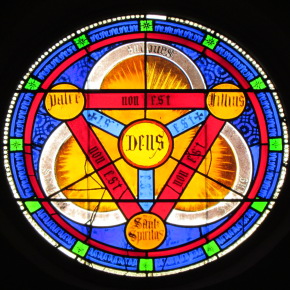 Have you ever looked closely at the round window high up the wall in the back of the church? Go ahead – turn around and give it a good look. I love this window. I love the vibrant colors. I love that when the sun is shining through it, an afterimage gets imprinted on my eyes, so I see it when I close them. If you’ve never given the window much thought, I don’t blame you. The words on it are in Latin, after all. But let’s keep looking. The window presents a diagram of the Holy Trinity. “Deus” – God – is encircled in the center. Three smaller circles float around it: Patri, Filius, Spiritus Sancti – Father, Son, and Holy Spirit. Each of the smaller circles is connected to the others with the words “non est” (is not), and each smaller circle is connected to the large central one with the word “est” (is). The diagram is telling us that the Father, Son, and Holy Spirit are not each other but they are all One God. How does this work? Wisely, the window doesn’t tell us. The window just illustrates the reality, a theological blueprint in stained glass.
 Last week, we talked about trying to discern how and when to lean into the newness shimmering on the horizon of your life. I invited you to stop and pray the next time you are at the precipice of a decision; to take a deep breath and feel which way the wind of the Holy Spirit is pushing you; to ask God what new thing God is trying to birth through you with the decision. I know many of us, myself included, often have a hard time finding words to put to these prayers for guidance. Silent prayer – with lots of listening – is a beautiful alternative when there are no words, but if you have the urge to speak, then I have the first five words of the prayer, just to get you started. They come from this morning’s first reading. The eleven apostles want to round out their number, so they select two candidates and then pray about which one will take Judas’s spot. And they begin their prayer for guidance with these five words: “Lord, you know everyone’s heart.”
 “Sing to the Lord a new song, for he has done marvelous things.” Today’s psalm begins with these glorious words, and for me it begins with a question. Why does the song we sing have to be a new one? Why can’t the song be an old song, one that has stood the test of time? “Amazing Grace,” perhaps? Or how about “In the Garden?” While these songs are beautiful and wonderful and should never, ever be lost to the ages, I think the psalmist feels the urge to sing a new song because he or she has discovered a fundamental truth about God’s movement in God’s universe. God is always doing something new.
 This is the last Sunday of the year in which we are worshiping according to the older, Rite I format of our liturgy. A few weeks ago, I mentioned that the reason we’ve been using the more traditional language was so we could say that beautiful line about inclining our hearts towards God. But there’s another reason, one that I didn’t mention then because I was fairly sure I was going to preach about it today. There’s a special prayer found in the traditional rite that is not duplicated in the modern one, a prayer we’ve been praying directly before communion for the last several weeks. Today, we will pray it one last time. The “Prayer of Humble Access” goes like this:


 A few people have asked me recently why we are using Rite I during Lent. For those of you who aren’t familiar with the red Book of Common Prayer, it contains two versions of our normal Sunday worship. We usually use Rite II, which includes more modern language and more overall choices than Rite I. But during Lent this year, I chose to use the older rite, which is why we’ve been saying words like “thee,” “thou,” and “beseech” over the last few weeks. Some churches choose Rite I during Lent because they think it has a more penitential tone than Rite II, but that’s not why we’re using it. Honestly, I don’t agree with that reasoning. Rather, we are using Rite I because of a single beautifully written sentence that we repeat nine times at the beginning of each service. In our normal service, Rite II, that sentence is rendered: “Amen. Lord, have mercy.” But in Rite I, we have the opportunity to pray this beautiful sentence after all but the last of the Ten Commandments: “Lord, have mercy upon us, and incline our hearts to keep this law.”




 The twins are six and half months old. They’re sleeping pretty well, waking either zero or once during the night. They’re beginning to crawl and sit up by themselves. Their hair is really coming in. And they have the absolute softest skin imaginable. I could spend all day kissing their cheeks and foreheads and want to do it again all day tomorrow. So when I think of offering them the imposition of ashes, when I imagine scraping two coarse lines of grit on those smooth foreheads, I shudder. I recoil. How could I sully such perfect skin?
 Next week ends our Epiphany sermon series, which means today we have come to our fifth word. But let’s start with a recap. Our first word was Affirmation: Nothing can take away God’s affirmation of us as God’s good and beloved children. Our second word was Invitation: God’s holy invitations most often originate in the center of our brokenness. Our third word was Mission: When we pick up our crosses and follow Jesus, we find God’s missions for us where the plank of the world’s need intersects with the plank of our passions. Our fourth word was Confrontation: All the forces of this fallen world fight back when we embrace God’s mission of healing and reconciliation.
 Where the Wind...