Sermon for Sunday, August 16, 2026 || Proper 15A || Matthew 15:10-28
This is going to be something of a slippery sermon. It’s going to be slippery because I’m going to be skating a very fine line when I talk about the difference between human rules and God’s commandments. I’ll make sure to warn you when I get to the slippery part, but first let’s talk about why this is our sermon topic today.
Sermon for Sunday, January 11, 2026 || Epiphany 1A || Isaiah 42:1-9
I wrote a version of this sermon on Tuesday, which is my normal sermon-writing day. Then the events of Wednesday happened – ICE agents shot and killed Renee Nicole Good in Minneapolis – and I knew I would be writing a new sermon on Saturday. But the more I reflected on what I had planned to say, the more the bulk of the words I wrote on Tuesday made sense to share this morning, not despite of the events of Wednesday but because of them.
During my sabbatical, I’m not writing new sermons, so on Mondays I am choosing one post from every year of WheretheWind.com to highlight. In 2012, I wrote a piece about the Pixar movie Brave, which presaged the Podcast for Nerdy Christians, which I started in 2019. This piece became the basis of an episode in Season 2.
Sermon for Sunday, August 14, 2022 || Proper 15C || Luke 12:49-56
There’s an old saying in church that Jesus came to “comfort the afflicted and afflict the comfortable.” We see this throughout the gospel when Jesus cares for and lifts up those on the margins of his society while at the same time denouncing the excesses and abuses of those in power. Jesus comforts and challenges in equal measure, depending on the needs and station of his subject.
Have you noticed that we’ve been reading the Book of Revelation ever since Easter? Every Sunday since Easter, the New Testament lessons have come from the Book of Revelation. You probably haven’t noticed this because we’ve only read from the few chapters that don’t sound like a cross between a science fiction movie and Dante’s Inferno.
Our schedule of readings trims down the Book of Revelation to “The Good Parts Version,” the parts that don’t make us either bewildered or squeamish. In all the bits we’ve read since Easter, not once did we hear about wars or plagues or bowls of wrath or the four horsemen. Not once did we hear about dragons with seven heads and ten horns and seven diadems on their heads or beasts with ten horns and seven heads and ten diadems on their horns.
Sermon for Sunday, May 1, 2022 || Easter 3C || John 21:1-19
I can only imagine the maelstrom of thoughts roiling in Simon Peter’s head in the weeks following Jesus’ resurrection. At the last supper, he promised Jesus: “I will lay down my life for you.” He was willing to draw blood when they came to arrest Jesus in the garden. He followed Jesus all the way to the gate of the high priest’s house. And then everything fell apart. People began recognizing him and he felt afraid and in his fear he did something he never dreamed he would do, not even in his worst nightmare.
Sermon for Sunday, April 21, 2019 || Easter Day C || JOHN 20:1-18
Here we are at long last: Easter Sunday, a long wait this year, two-thirds of the way through the month of April. But it could have been longer. April 25th is the latest Easter can be, but that hasn’t happened since 1943 and won’t happen again until 2038, which coincidentally is the year I’ll be eligible to retire. Unlike most holidays, which are fixed on a particular date or day of the month, the date of Easter (and the Jewish Passover) springs from something much grander – the motion of celestial bodies. We start with the vernal equinox, the day in March when the earth is tilted just so in relation to the sun to make day and night the same exact length. Then we find the next full moon, and the Sunday following is this day of Resurrection.
Sermon for Sunday, February 10, 2019 || Epiphany 5C || Luke 5:1-11
Today marks the beginning of a season of racial healing, justice, and reconciliation in the life of the Episcopal Church in Connecticut. This season, which will last at least two years, was initiated by the Annual Convention of our church, as delegates from over 160 parishes and worshiping communities voted together to share in this particular piece of God’s mission. Just like Jesus calls his disciples in today’s Gospel, God calls us to partner with God in working for healing, justice, and reconciliation across many systems that contribute to the broken state of this world. These systems of oppression and degradation overlap and intertwine, and they are all so big and entrenched into the machinery of the world that challenging them seems like an impossibility.
Sunday, September 17, 2017 || Proper 19A || Romans 14:1-12; Matthew 18:21-35
My best friend from seminary is a man named Bret. Back in 2005, Bret and I bonded over our shared love of both Star Trek and Jesus, and our friendship has remained solid all these years. But there’s one thing Bret and I have never agreed on. He’s a high church Anglocatholic, who loves all the smells and bells, all the pomp and circumstance he can stuff into a celebration of the Holy Eucharist. You probably know by now that I am…well…not that. I prefer simpler, unadorned worship.
Now such a difference of opinion could have led us to part ways because Bret could claim I didn’t care about the sacrament of Holy Communion. And I could claim he put so many trappings around the sacrament that its true meaning was lost.* Churches have broken away from each other for far less than this particular difference of opinion. Indeed, a few hundred years ago, people were burned at the stake for espousing one or the other viewpoint.Continue reading “Common Ground”→
Sermon for Good Friday, March 25, 2016 || John 19:25-27
The Passion narrative Stacey just read can be quite overwhelming. It is by far and away the longest reading we listen to all year, and there’s a lot going on. There’s Judas’s betrayal, Jesus’ arrest, Peter’s denial, the trial with the high priest, the interview with Pilate, the frenzy of the crowd, the crucifixion, and the last words from the cross. There’s so much going on, in fact, that we can easily lose sight of the overarching story of the Gospel when we find ourselves overloaded by this painful and heart-breaking narrative. So instead of talking about the entire Passion narrative, each year I like to focus on one little moment of it that speaks to the whole story. On this Good Friday, that moment happens between the soldiers gambling for Jesus’ clothes and Jesus drinking the sour wine.
“Meanwhile,” the Gospel tells us, “standing near the cross of Jesus were his mother, and his mother’s sister, Mary the wife of Clopas, and Mary Magdalene. When Jesus saw his mother and the disciple whom he loved standing beside her, he said to his mother, ‘Woman, here is your son.’ Then he said to the disciple, ‘Here is your mother.’ And from that hour the disciple took her into his own home.”
Have you ever noticed the beauty of this moment? Have you ever noticed how succinctly these three verses sum up Christ’s mission of reconciliation? I see in my mind’s eye these two people standing apart from each other. One weeps silently for his beloved friend, and his tears wash two clean lines on his dusty, grimy face. The other has no more tears; she has cried her eyes dry, and now she just stands there counting her son’s breaths, treasuring each one in case it’s his last. She always knew this day would come, but not like this. God, not like this.
A few other women comfort Jesus’ mother, but his beloved friend remains several paces away from them, perhaps not wanting to intrude on their stunned grief. He stands there alone, wondering how it all went wrong, wondering if he had been hoodwinked or if he had just gotten caught up in messianic hysteria. No, I believe. He doesn’t mean to, but he says the words out loud. Then he adds, I just don’t understand.
That’s when he looks up at Jesus, and his friend’s lips begin to move. He’s trying to speak, but he can’t catch his breath. After all, the cross kills by suffocation, not by loss of blood. With a monumental force of will, Jesus pulls himself up, using the nails for leverage. He sucks in a ragged breath and looks down first at his friend, then at his mother. His gaze connects them, and they stumble towards each other. With fleeting breath, Jesus manages to say, “Woman, here is your son.” His mother leans her head on his friend’s shoulder. Jesus inclines his head, “Here is your mother.” His friend wraps his arm around her and squeezes.
While dying on the cross, Jesus stitches together this new family. He creates a new relationship built on two people’s own relationships with him. Before Jesus redefined it, the cross was the ultimate symbol of domination and separation. The cross brutally demonstrated who was in charge and who was discarded, the human garbage of the empire. But even before the resurrection – even in this beautiful moment we are discussing here – Jesus is changing the meaning of those two planks of wood. No longer would they be the terrifying symbol of ruthless subjugation. Now the cross would be the symbol of the promise of eternal life, which is really the promise of eternal relationship with God.
By creating this new relationship between his mother and friend, Jesus reminds them and us that his mission is one of reconciling us to each other and all things back to God. Indeed, it’s no accident that the Gospel writer never names these two people. We know his mother’s name is Mary and tradition tells us that his beloved friend is John. But the Gospel steadfastly resists naming them as such, and does so for this purpose: So we can put ourselves in their place. So we can feel ourselves being called “beloved” by Christ. So we can feel in our relationships with Christ the unique closeness that a mother has for her child – the act of cherishing. And in feeling this intimacy with Christ, this belovedness, we might feel the call to create and engage in deep relationships with others, each one fostered by Christ’s love for all people.
This is the story of the Gospel: God came to us to bring us back into relationship with one another and with God. Good Friday marks the cliffhanger in that story, the moment when it all looks bleak. But even in this bleakest moment, even while struggling for breath on the cross, Jesus is still bringing people together, still performing miracles.








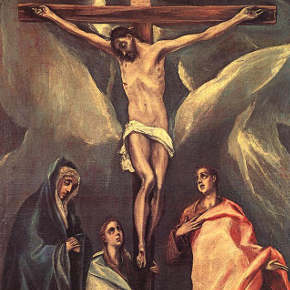 The Passion narrative Stacey just read can be quite overwhelming. It is by far and away the longest reading we listen to all year, and there’s a lot going on. There’s Judas’s betrayal, Jesus’ arrest, Peter’s denial, the trial with the high priest, the interview with Pilate, the frenzy of the crowd, the crucifixion, and the last words from the cross. There’s so much going on, in fact, that we can easily lose sight of the overarching story of the Gospel when we find ourselves overloaded by this painful and heart-breaking narrative. So instead of talking about the entire Passion narrative, each year I like to focus on one little moment of it that speaks to the whole story. On this Good Friday, that moment happens between the soldiers gambling for Jesus’ clothes and Jesus drinking the sour wine.
 Where the Wind...