Sermon for Sunday, May 25, 2025 || Easter 6C || John 5:1-9
Last week we talked about embracing new life and new ways of being. This embrace of newness aligns us with the God who says, “Look! I am making all things new.” I told you that I found the idea comforting – the idea that I was continually being made new; even at 42 years old, I am in the process of becoming the newest version of myself. And so are you, no matter your age. What I failed to talk about last week was why we so often don’t embrace new ways of being. And that’s where we are going to start today in this accidental sequel to last Sunday’s sermon.
Sermon for Sunday, March 16, 2025 || Lent 2C || Luke 13:31-35
The world is a heavy place right now, and my last several sermons have been quite heavy in response. So today, I’d like to return to an imaginative space with a story sermon, the kind that I offer once or twice a year. Please imagine with me a letter written by Simon the Pharisee some years after the events described in this morning’s Gospel reading.
Simon, a servant of the Lord God, to Judith, my dearest sister and confidant: Peace to you and your house.
I know you think I only write to you when I need advice, but in this case, I write with a more urgent need. Yesterday in the marketplace something happened that shook me to my bones and caused me to let go of a secret I have been holding onto so very tightly for years. I need to tell you the truth about myself before you hear others slander me. I hope after you read these words you do not think less of me; rather, I hope you might consider joining me in my new-found freedom.
Sermon for Sunday, September 15, 2024 || Proper 19B || Mark 8:27-38
My sermons are now available in podcast form. Click here for Apple Podcasts or search “WheretheWind.com Sermon” on your podcast app of choice.
The first novella, “Arrow Ten,” is finished! You can read or listen to the whole thing by clicking here.
In the age of the internet, identity theft is a prominent danger. Answering silly quizzes on Facebook, clicking innocuous links in emails, downloading attachments, falling victim to a data breach – all of these are ways that scammers can steal our identities, impersonate us to open credit cards, or empty our bank accounts. My identity was stolen once, years ago, and I had to assure my bank that I was definitely not renting limousines in Texas. We spend a lot of time, money, and worry protecting our identities, but I wonder how often we think about what our identities actually consist of. What are the most important facets of our identities, and how do they change over time? And how does “follower of Jesus” fit into the picture of our identities? That’s what we’re going to explore for the next ten minutes.
A single, solitary verb in today’s Gospel reading got stuck in my mind this week, and this entire sermon has spun out from this one verb. It’s a sermon about the spiritual life, a sermon about how the spiritual life is not walked in a straight line, but in a spiral.
I’ll get to this special verb in a minute, but first let’s talk about Godly Play, this beautiful way we introduce the life and language of faith to the children of this church. Rather than teaching didactic lessons, Godly Play shares stories. The children sit in a circle with the storyteller and pay attention to the words of the story; the motions; the physical elements like sand, felt, and wooden figures; and even the silence in the midst of the story. After the story is finished, the adult mentor leads the children in a round of wondering, asking open-ended questions that purposefully do not have single correct answers in order to invite the children to put themselves into the story.
Sermon for Sunday, August 21, 2022 || Proper 16C || Jeremiah 1:4-10
If you go back in my sermon archives on my website wherethewind.com, you will find several sermons like the one we are about to share. It’s a sermon about God using us, not in spite of our perceived shortcomings, but because of them. I find I need to preach this sermon to myself about once a year so that I can hear God’s promises anew. I need to preach this sermon because the marketing departments of the world are so good at targeting our perceived shortcomings and selling us things to make up for them. But that’s not how God works. So, to start off this version of the sermon, and inspired by Katy Roberts’s personal sharing a few weeks ago, I’d like to tell a little story about me and the Prophet Jeremiah.
I was in the middle of exercising late Wednesday afternoon when I received panicked texts from a friend and from my mother at the same time. Do you see what’s going on at the Capitol right now? We are very shaken.Are you all okay? I immediately switched over from YouTube to live coverage on CBS and left it on until well past sundown, unable to tear my eyes away from the ugly spectacle. In one way, the events of Wednesday were shocking: after all, a hostile force has not breached the Capitol since the War of 1812. But in all other ways, Wednesday was the natural outcome of years of lies, incitement, manipulation, demagoguery, and (most pertinent for this sermon) heresy. That’s not a word I use very often, but it is important, especially in tumultuous times like these, to use the right words for things. I’ve been thinking and praying for three days about how to address the events of Wednesday in this sermon, and the only way I can wrap my head around them after so little time is to begin with the heresy on display this week and then counter it with Gospel.
No sermon this week, as the intern at St. Mark’s had the reins for First Sunday of Advent. So I thought I’d share something I wrote a few weeks ago at a youth revival/retreat weekend. After hearing a talk given by one of the teens, we had about half an hour to compose a rap in response. This is the text of the one I shared with the group.
Sermon for Sunday, September 29, 2019 || Proper 21C || Luke 16:19-31
This sermon is about walking in love. But before I go there, I need to talk about Jesus the radical. Jesus shares a lot of radical stories in the Gospel. We might not realize how radical they are because they appear in the Bible. And the Bible over time has become such an established collection of writings that we don’t necessarily expect them to be radical. We hear the same stories over and over again, so their shocking nature is dulled both by repetition and the long march of history.
Sermon for Sunday, February 17, 2019 || Epiphany 6C || Luke 6:17-26
Imagine with me an entry from the journal of Caleb of Jerusalem, a fictional bystander in today’s Gospel story. The pen shakes in my hand as I begin to write. The hairs on the back of my neck are still standing up. My heart is still pounding in my chest. Today I was healed. I was healed and I didn’t even know I was sick.
This is what happened. I was returning to Jerusalem from a business trip in Sepphoris. I recently purchased a new quarry in that region, and I needed to oversee operations for a few days. My business is booming even though I only have one customer—the Romans procure my stone like the land might run out it tomorrow.
I was returning to Jerusalem from Sepphoris when my caravan got caught up in a huge crowd of people. I lashed out with my whip trying to clear a path, but to no avail. So I stopped fighting the current of people and turned my mount eastward with the flow. The crowd was making for a smaller group of people picking their way down the mountainside. My curiosity whetted, I spurred my mount toward them. One man seemed to be getting the most attention as the mass of people pressed in. He moved through the crowd touching them one by one.
Sermon for Sunday, September 13, 2015 || Proper 19B || Mark 8:27-38
This week has been a particularly tough one for our twins, Charlie and Amelia. At thirteen and a half months, we think they are cutting their molars, so their extreme fussiness is understandable. On Tuesday, I walked in the door of the kitchen, and before I had taken three steps, Charlie was toddling up to me as fast as his little legs and precarious balance would allow. He ran into me and buried his head between my knees, which is his way of saying, “Pick me up, Daddy.” I hefted him into my arms. He put his arms around my neck and his head on my shoulder. And for the next twenty minutes, I just walked around, holding him and speaking softly into his ear. It was a special moment, a physical heart to heart.
The next morning, I was preparing to write this sermon and reading Jesus’ question over and over again: “Who do you say that I am?” And this question about identity got me thinking about Charlie, about how he would answer the question if it were asked about me. Who does Charlie say that I am? I think Charlie’s answer and Peter’s answer share a lot in common.
You see, Charlie’s first word was “Dada.” Early on he used it for everything, so it wasn’t really my name, it was just what he said. Then, as the months progressed, Charlie’s collection of sounds increased, “Dada” became “Daddy,” and, for the most part, focused in on my personage. He says “Daddy” in the sweetest, high-pitched singsong that melts my heart like butter. And yet, I wonder what his toddler’s mind imagines when he identifies me.
Judging by the way he wanted to be held on Tuesday, the way he clung to me so fiercely, the way he calmed down immediately when he was safe in my arms, I think I have a lot to live up to. In his eyes, my identity must be larger-than-life. I am, quite literally, the largest person he sees regularly. And I’m not around as much as Mommy, so there’s an air of mystery to my presence, a rock star quality. I’m a super hero. I just don’t have any super powers. I can remember the exact, illusion-bursting moment in my own adolescence when I realized my parents were not the infallible super heroes I always took them for. And I wonder when Charlie and Amelia will figure that out about me.
Identity is a tricky, slippery thing. Our identities are multi-faceted. They are synthesized and refined and redefined throughout our lifetimes as we gain new skills and interests, as we adapt to new circumstances and relationships, as we deal with success and failure. For example, for nineteen years (about 60 percent of my life) “student” was the most important facet of my identity, but no longer is. The importance of one facet of identity might rise or fall in direct proportion to another. My identity as “sports fan” has fallen significantly with the rise of my identity as “father.” Identity is also a negotiation between what we think about ourselves and others’ expectations of us. If someone asks me, “Are you a golfer,” I always respond the same way. “I own golf clubs.” I don’t want that person to generate an undue expectation of me, as someone with a handicap less than the maximum.
The reality (or unreality) of expectation is where Charlie’s and Peter’s answer to the question converge. Who do you say that I am? You are the Daddy: bottle giver, tantrum calmer, crib rescuer, super hero! You are the Messiah. And while Peter doesn’t expand on this identity, his reaction to Jesus’ explanation of it shows us what Peter’s expectation is. You are the Messiah: Israel’s deliverer, Rome’s exterminator, mighty warrior, sure victor. It’s no wonder Peter takes Jesus aside to clarify things. Jesus is obviously mistaken. Had he heard Peter right? Peter had said “messiah,” not “sacrificial lamb,” not “victim.”
Bur Jesus had heard Peter. Jesus could sense the underlying expectation of such a baggage-laden identity as “messiah.” That’s why he starts speaking openly for the first time in the entire Gospel. He needs to clarify things. He needs to make sure his disciples know just what he thinks the identity of “messiah” means. If he had wanted to live into the militaristic expectation of “messiah,” he probably wouldn’t have recruited fisherman. “Look around,” he seems to say to his disciples. “I don’t have an army. I have you guys. I haven’t been fighting. I’ve been healing.”
We follow Jesus precisely because his expectation of “messiah” runs counter to Peter’s. We follow Jesus because he chose not to fight. We follow Jesus because he gloried not in destruction, but in resurrection, in new life, in deep relationship that lasts beyond death. That’s Jesus identity as “messiah.” He suffered not because suffering is good, but because suffering was the natural outgrowth of his taking on the isolating, dominating, death-dealing machinery of this world. We follow Jesus because we believe he won that fight by not fighting back, by not fighting fire with fire, but by clogging the machine with the love, grace, and peace of God.
And that brings us to our own identity as followers. “If any want to become my followers,” says Jesus, “let them deny themselves and take up their cross and follow me.” It’s quite possible this isn’t what we signed up for. It’s quite possible we expected more comforting words. Perhaps we expected Jesus to say, “Come to me, all you that are weary and are carrying heavy burdens, and I will give you rest.” Perhaps we expected Jesus to say, “Remember, I am with you always, to the end of the age.” Perhaps we expected Jesus to say, “I came that [you] may have life, and have it abundantly.”
Well, the good news is this: Jesus does say all those things. It is these promises of rest and relationship and abundant life that make us able to accept his strident expectation of identifying as his followers. Denying ourselves means letting go of our stranglehold on our own lives – our self-determination, our bootstraps mentality – in order to allow Christ to live in us. And when Christ lives in us, we find we can resist the machinery of this world. We take up the cross because from the cross Jesus beckoned everything that’s wrong with this world to come die with him. When we come to the cross, we come face to face with all the manifestations of evil, snarling in its death throes. It’s a scary place, teeming with poverty, racism, disease, violence. But this is the place our followers’ footsteps lead us because this is the place we partner with Christ to bring resurrection and new life.
Someday, Charlie is going to realize I’m not the super hero he thought I was. That expectation will crack, and our relationship will change. Some days, we follow Christ more closely than other days. Some days, the identity of follower takes us to dark places, despite our expectations. But that identity takes us there because part of being a follower is being a light-bearer to such darkness. The light we bear is the light of Christ, our healer-messiah. And our identity as followers is safe in his hands because no amount of evil or darkness will ever extinguish his light.









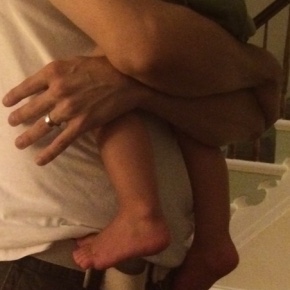
 This week has been a particularly tough one for our twins, Charlie and Amelia. At thirteen and a half months, we think they are cutting their molars, so their extreme fussiness is understandable. On Tuesday, I walked in the door of the kitchen, and before I had taken three steps, Charlie was toddling up to me as fast as his little legs and precarious balance would allow. He ran into me and buried his head between my knees, which is his way of saying, “Pick me up, Daddy.” I hefted him into my arms. He put his arms around my neck and his head on my shoulder. And for the next twenty minutes, I just walked around, holding him and speaking softly into his ear. It was a special moment, a physical heart to heart.
 Where the Wind...