Sermon for Sunday, February 8, 2026 || Epiphany 5A || Matthew 5:13-20
The last several sermons I’ve preached have dealt either directly or indirectly with the current issues affecting our country. I’ve talked about following Christ through truth-telling, community-building, and justice-seeking as we join others in standing against state-sponsored violence and fearmongering. While these issues are still present in the forefront of our minds, I’m not going to talk about them directly today. Rather, I’m going to talk about something foundational to our lives of faith that supports our daily following of Jesus as we work for truth, community, and justice.
Today we’re going to talk about something very simple: saying grace at dinner. This topic has been on my mind recently for three reasons. First, I’ve been aware of how much reacting we are all doing right now. We’re all playing defense against a swift-moving offense of violent action and rhetoric. Recentering ourselves through a simple practice like saying grace can help us find our footing. Second, saying grace is one of the ways to be salt and light in this world. It is a visible, though not ostentatious, participation in the presence of God. And third, last Monday my daughter literally asked me to talk about saying grace at meals, and she agreed it would be a good sermon topic.
Have you noticed that we’ve been reading the Book of Revelation ever since Easter? Every Sunday since Easter, the New Testament lessons have come from the Book of Revelation. You probably haven’t noticed this because we’ve only read from the few chapters that don’t sound like a cross between a science fiction movie and Dante’s Inferno.
Our schedule of readings trims down the Book of Revelation to “The Good Parts Version,” the parts that don’t make us either bewildered or squeamish. In all the bits we’ve read since Easter, not once did we hear about wars or plagues or bowls of wrath or the four horsemen. Not once did we hear about dragons with seven heads and ten horns and seven diadems on their heads or beasts with ten horns and seven heads and ten diadems on their horns.
Sermon for Sunday, February 13, 2022 || Epiphany 6C || Luke 6:17-26
There is a very silly scene in the very silly movie Life of Brian by Monty Python. Actually, the movie is fairly deep, but you have to dig through the silliness to find its depth. The movie follows Brian, a person unfortunate enough to have been born in the stable next to Jesus. In the silly scene near the beginning of the film, the camera pans away from Jesus speaking his famous Beatitudes; you know, blessed are the poor, blessed are the meek, blessed are the peacemakers, etc. The camera pans away from Jesus and settles on a group of people way at the back of the crowd, who are struggling to hear Jesus.
“What was that?” one man says.
“I think it was, ‘Blessed are the cheesemakers,’” another replies.
“What’s so special about the cheesemakers?” a third asks.
The first man responds, “Well, obviously, it’s not meant to be taken literally. It refers to any manufacturer of dairy products.”
There are many ways to describe the overarching narrative of the Bible, the connective tissue that weaves through the many and varied voices and genres that make up the library of our Holy Scriptures. One theme describes God’s love and grace restoring all of creation back to God. Another tells a family story and invites all who read it to share in that story. A third way of viewing the thrust of the biblical narrative is what I’d like to focus on today. This third way sees our holy texts speaking to an upside down world – speaking God’s yearning for justice and peace in order to empower people to partner with God to turn the upside down world right side up.
Sermon for Sunday, November 3, 2019 || All Saints’ Sunday || Luke 6:20-31
The only person you can change is yourself.
Recently, I began a practice of silent meditation every morning. For twenty minutes, I sit cross-legged on the center cushion of my couch, and I breathe the prayer-word “Maranatha,” which means “Come, Lord Jesus.” I decided to build this practice into my spiritual life because I felt myself changing for the worse. The culture of immediacy had captured me with its constant need for updating feeds. The tough subjects I was (and am) tackling in my person study didn’t have a space to go inside me because I was too cluttered with other, incompatible ideas. I talked about God so much that I had forgotten simply to dwell with God.
And most perniciously, with the rising tide of negativity, hate, indignity, and disrespect in our society, I could feel these evil chemicals starting to build up in my system. In silence, God and I can purge them together, and I can feel the treatment beginning to gain ground on the disease.
Sermon for Sunday, March 3, 2019 || Last Epiphany C || Exodus 34:29-35
There are people in our lives who so fully embrace the love of God that we can’t help but feel closer to God when we’re around them. They live and breathe the Way of Love so fully that half a smile or a touch on the shoulder or a quick word is more than enough for you to reorient yourself on that Way of Love as well. God has blessed me with relationships with a few such people over the years, and I’ve noticed they all have one thing in common – one thing that makes their connection to God’s love even more special. They have no idea just how amazing their connection is. If you compliment them for their incredible generosity of spirit or their welcoming manner, they will wave away the comment as undeserved. Or they will shine the compliment back on you because they have no desire to stand in the limelight.
Sermon for Sunday, February 11, 2018 || Last Epiphany B || Mark 9:2-9
Our spiritual lives are topographically interesting. Two of the most enduring images of walking with God are the mountain and the valley, the high place and the low. You’ve heard of the proverbial “mountain top experience,” which can spark faith for the first time or renew the well-trodden paths of faith. And you’ve prayed the immortal words of Psalm 23: “Yea, though I walk through the valley of the shadow of death…thou art with me.” The mountain and the valley: these are the peaks of our spiritual lives and the troughs.Continue reading “Spiritual Topography”→
Sermon for Sunday, January 29, 2017 || Epiphany 4A || Matthew 5:1-12
I thought I hit record this week, but I didn’t, and with only one service because of St. Mark’s Annual Meeting, I failed to capture the audio for this sermon. Apologies.
Three weeks ago, we began an Epiphany sermon series in which we are imagining our way into God’s eyes and trying to see ourselves as God sees us. What is God’s point of view? What does God see, name, and celebrate about us? And how can we incorporate that divine point of view into how we interact with God’s creation?
We began with Belovedness. God sees and names us and each person we meet as God’s Beloved. Living in this reality means affirming in word and deed the dignity and value of all people. Next we talked about God befriending us. God calls us into mission alongside God, not as subjects or employees, but as partners, friends. And this friendship leads us to create strong relationships of our own. Love leads to friendship, which leads us out into the world, participating in God’s mission of healing and reconciliation. Here we claim our giftedness, not to make ourselves feel special, but to use our gifts to make others feel so. We claim our giftedness, which helps us be blessings in the world.
With this word – “blessing” – we return for a fourth time to God’s point of view. God sees, names, and celebrates us as blessed. There are two parts to blessing: sustenance and mission, and neither is particularly well understood. Continue reading “Blessed (God’s Point of View, part 4 of 8)”→
Sermon for Sunday, January 1, 2017 || Feast of the Holy Name || Numbers 6:22-27
On this day the Western World calls “New Year’s” and the church calls the “Feast of the Holy Name,” I can think of nothing more appropriate than to have read God’s blessing delivered through Moses in the book of Numbers. Moses then gave it to his brother Aaron the priest, who spoke these words as a special priestly blessing:
“The Lord bless you and keep you; the Lord make his face to shine upon you, and be gracious to you; the Lord lift up his countenance upon you, and give you peace.”
These are familiar words, so familiar in fact that we probably don’t even realize they come from the Bible. In the Episcopal tradition, we hear them when we gather around a grave and bid our loved ones farewell. We hear these words in the context of death and resurrection; they are a promise and a hope for new life in closer communion with God beyond the gate of death.
But this morning, on the feast of the Holy Name and New Year’s Day, we hear them in a different context. These words are not just for those who have died; they are for us, as well. So this morning, I’d like to continue the sermon as a meditation on this priestly blessing. Continue reading “A Meditation on the Priestly Prayer”→
Sermon for Sunday, October 5, 2014 || Proper 22A || *
Because of my peculiar and very frustrating allergy, there’s one aisle of the grocery store I never travel down – the bread aisle. If you read the nutrition information on each and every plastic-wrapped and twist-tied loaf, you’ll find it contains soy flour, which means I can’t eat it. But there’s a happy byproduct of this limitation. Because I can’t eat the store bought loaves, Leah makes our bread from scratch. And, boy, is it good. I’ve watched her make it on several occasions. She starts by activating the yeast in warm water. She mixes the ingredients in the Kitchen Aid, counting the cups of flour aloud so she doesn’t put in too much. She let’s the dough hook work its kneading magic. She waits for the dough to rise, first in the mixer, and then, after forming the loaves, in the pans before putting them in the oven. The whole process takes the better part of a morning.
A group of dedicated women follows a similar process each week to make the bread we use for Holy Communion. What fascinates me about the process is how many steps there are between setting the ingredients on the counter and pulling the bread fresh from the oven. (And this doesn’t even take into account the number of steps needed to make the ingredients in the first place, such as milling the flour from grain or picking the grain from the field.)
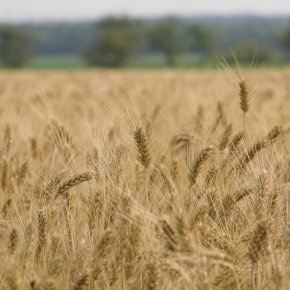
When we celebrate Holy Communion, the gifts, which we offer to God and then share with one another, derive from a combination of God’s bounty and human industry. The bread and wine both have their roots in…well…roots. Seeds planted in the ground send roots down and stalks up as the soil, sun, and rain nourish their growth. The grain grows tall and full. The grape grows fat and juicy. Up to this point, their growth has been in God’s hands, as the overarching gift of nature’s cycles, which God wove into creation, promotes their cultivation.
But then a farmhand (or, in today’s less romanticized world of big agribusiness, a mammoth combine) comes along and picks the grain. A vineyard worker picks the grape. And human ingenuity, creativity, and wisdom begin shaping this raw material, this God-given bounty into the bread and wine we share each week.
Do you see what’s happening here? When we offer the bread and wine to God in thanksgiving, we give back to God what was always God’s in the first place, but which changed shape as humans interacted with the raw material of God’s blessing. There are two vital ideas embedded in this thought. First, whenever we give to God, we are really giving back to God. And second, God invites us to partner with God – to use our own unique constellations of gifts – in order to turn the raw material of blessing into nourishment, into justice, into peace, into hope.
Thinking of our giving as giving back keeps us in right relationship with God. When we acknowledge that God is the source of our blessings, we are less likely to attribute the bestowal of a particular blessing to the blessing itself. This erroneous attribution is how idols are made. Idols happen whenever we worship the gift instead of the giver. This way ultimately leads to disappointment because the idol will never give more than itself. And you will find yourself serving it, and you will notice more and more of your life being taken up by trying to make the idol greater than it is. And in the end, you will live a very small life, confined to the goal of making the idol into something worthy of your worship.
You might notice this happening when our relationship with money starts becoming idolatrous. Instead of thinking of money as some of the raw material of God’s blessing, we mistakenly see money as the source of our blessing. Instead of seeing it as a resource, we mistakenly see the amassing of money as the goal. It’s easy to do. Money allows us to live comfortably, after all, and to afford the things we desire. But the more we bend our lives around the accumulation of money, the less time we have to enjoy the benefits it offers. You end up spending too much time in the office, and before you know it, you’ve missed four of your daughter’s soccer games in a row. Call it the Ebenezer Scrooge problem. He lived his life bent on increasing his wealth and by the time the three ghosts are done with him he realizes he never actually lived his life. That’s what idols do. They contort our lives around the wrong goals and reduce us to very small versions of ourselves.
But when we have a proper relationship with money, a non-idolatrous one, we see our financial resources as some of the raw material of God’s blessing. Remember, through human interaction, the grain of God’s bounty become bread. The grape of God’s bounty becomes wine. The same thing happens with our money. The dollar becomes half a dozen notebooks for a classroom at St. Luc’s school in Haiti. The check becomes a hundred juice boxes for WARM’s summer lunch program. The financial pledge becomes fuel for God’s mission happening here at St. Mark’s.
If you’re anything like me, you sometimes have trouble putting money in the same category as all the other gifts God has given us. I’ve always had trouble doing this because money has this ephemeral, transitory nature. We turn it into other resources and these are what we think of as our blessings instead. But when we have a right relationship with money, it goes in the same bucket as all of blessing’s other raw materials.
To symbolize this reality here at St. Mark’s, I’m going to start doing something that I should have been doing all along; indeed, something that most Episcopal churches have always done. During the offertory, the bread and wine come forward and a few minutes later, the money comes forward in the collection plates. Because there’s a delay between these two processions, we might not connect the two. But they are connected. We give the bread and wine back to God in thanksgiving for our interaction with the raw material of blessing. In the same way, we give our financial resources back to God in thanksgiving for and in support of God’s mission here in our midst.
So from now on, I plan to leave the collection plates on the altar as we celebrate Holy Communion in recognition that we give thanks for all the blessings of our lives. When you see me place them to the side of the other gifts we are giving back to God, I hope you will remember that God has given us all that we have and made us all that we are. And God delights in seeing all the unique ways we use the raw material of blessing to further God’s mission of healing and reconciliation.
We give back to God out of the myriad gifts God has showered upon us for two reasons. First, by giving back we stay in right relationship with God. We worship the giver instead of the gift. We live full lives enriched by multitudes of blessings instead of tiny lives in service to lifeless idols. And second, giving back offers us the opportunity to partner with God and use our unique constellations of gifts to turn the raw material of blessing into new and abundant life for all.
—
*It’s very strange for me not to reference any of the assigned readings for the day in the sermon itself. They were all there swirling around in my head as I wrote, but every time I tried to add them in, I felt like I was shoehorning them in. Perhaps this means I wrote the wrong sermon! Or perhaps it means the readings can influence the preaching without being directly quoted.









 Because of my peculiar and very frustrating allergy, there’s one aisle of the grocery store I never travel down – the bread aisle. If you read the nutrition information on each and every plastic-wrapped and twist-tied loaf, you’ll find it contains soy flour, which means I can’t eat it. But there’s a happy byproduct of this limitation. Because I can’t eat the store bought loaves, Leah makes our bread from scratch. And, boy, is it good. I’ve watched her make it on several occasions. She starts by activating the yeast in warm water. She mixes the ingredients in the Kitchen Aid, counting the cups of flour aloud so she doesn’t put in too much. She let’s the dough hook work its kneading magic. She waits for the dough to rise, first in the mixer, and then, after forming the loaves, in the pans before putting them in the oven. The whole process takes the better part of a morning.
 Where the Wind...