
Sermon for Sunday, May 24, 2015 || Pentecost B || Romans 8:22-27
 Today, on this day of Pentecost, I’d like to tell you a story about the Holy Spirit. It’s going to sound like a story about me, but if I tell it right, you’ll see that the Holy Spirit is the main protagonist of this little tale. The story takes place a stretch down River Road about three miles from the Middle of Nowhere, West Virginia.
The summer before my senior year of college saw me driving down this stretch of River Road toward Peterkin Camp and Conference Center, and my job as counselor. The first day of camp, about a hundred high schoolers descended on the camp, and strangely enough, their enthusiasm and laughter and hugs of reunion were unhindered by the lack of a cell phone tower within 50 miles. Right away I could see their love for the place in their wide expectant eyes as they queued up to turn in medications and decorate nametags. They loved Peterkin because they got to be themselves around other kids who also got to be themselves. Places where teenagers are unafraid of coming out of their shells are few and sacred. Peterkin was one of them.
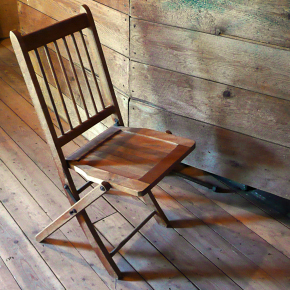
We shared Eucharist every day of camp, and with each day the volume of our singing increased as the more reticent campers started joining in. By Friday, the passing of the Peace had reached epic proportions because everyone tried to hug everyone else. The service that day included special prayers for healing, and I volunteered to assist with the laying on of hands because I’d never done it before. After communion, I walked to the back of the chapel with the priest Zach and a pair of sisters, Kenan and Leigh. We circled a metal folding chair, and Zach beckoned the first camper towards us. I remember looking down at my hands, seeing the dirty fingernails and calluses cut by guitar strings, and wondering: “What are these supposed to do?”
The boy sat down, and Zach leaned in close. “My parents are divorced and I keep thinking it’s all my fault and I feel sad all the time.” The truth of the boy’s words startled me out of my self-centered musings about my hands. Here was someone hurting profoundly, with his whole world crumbling around him and misplaced shame eating him away. And yet he trusted the four of us to place our hands on him, to whisper words of healing, which would never make everything all better again, but maybe just maybe might allow him to breath with a bit more space and by God’s grace start letting himself off the hook.
As Zach dabbed oil on the boy’s head, I touched his shoulder, lightly, like I was testing a bruise. Doubt gnawed at the back of my mind: how am I qualified even to be standing here, let alone be expected to participate in healing? The self-centered feeling of inadequacy threatened to wash over me again, but then a prayer blossomed in my mind and in my heart, a prayer that I had no hand in writing. I exhaled slowly, and the Holy Spirit carried her words on my breath: “Lord, make him whole, make him holy, make him wholly new.”
This became my breath prayer. As the campers kept coming and coming, the Holy Spirit kept speaking these words through me and I prayed with a fervor I didn’t know I possessed: “Holy Spirit, fill me and flow out of me, down my arms, into my hands, and into these broken, beautiful boys and girls. Make me your conduit. Make me your vessel.”
Their need for healing was so great, these young people in so much pain: depression, suicidal thoughts, drug addiction, alcohol addiction, eating disorders, the urge to cut themselves, feelings of abandonment, grief, loss… Lord, make her whole, make her holy, make her wholly new.
I kept asking the Holy Spirit to fill me to overflowing so she could spill out my fingertips and the campers could know the healing presence of God. When the service was over, the campers filed toward the dining hall, but we who had manned the three healing stations gathered around the altar and said a final prayer. As I backed away from the altar, I felt a tear moisten my cheek, then another and another. Suddenly, I was crying. I sat down in the second pew and just as suddenly, I was no longer crying. I was weeping. For twenty minutes, my chest heaved and fell, and I knew nothing but my ragged breaths and fat tears…and the truth.
God granted me exactly what the Holy Spirit had prompted me to I asked for – an abundance of that same Spirit, an excess, a proportion so much bigger than was meant for me alone. The tears puddling at my feet were the Holy Spirit spilling out of me. When the tears stopped, I noticed a hand on my back. Leigh, one of the sisters I had partnered with, had stayed behind and sat with me in silence. She had said nothing. She had not tried to hand me a tissue. She had let me weep, alone and yet not alone, laying her hand on me as we had done for the campers. Remembering that act of kindness still brings tears to my eyes.
I tell you this story because it taught me about the Holy Spirit. The Spirit does not come at our beck and call. We come at hers. We would be unable to ask for the Spirit’s help if she were not already helping us in the asking. Paul speaks this truth to the church in Rome: “The Spirit helps us in our weakness; for we do not know how to pray as we ought, but that very Spirit intercedes with sighs too deep for words.”
At Peterkin, the Holy Spirit made her presence known in my life, and I fervently hope in the lives of the campers as well. That experience was so overwhelming, I expect, because the Spirit knows me well enough to appreciate that I need to be whacked upside the head in order not to misunderstand my role in all of this. But even when the experience doesn’t leave us pooling tears on the chapel floor, the Spirit is still ever present, interceding for us, helping us in our weakness.
Remember when you stood on the beach at dawn, and the first rays of sun turned the ocean to liquid gold, and gratitude unbidden caused you to raise your arms to the heavens? Your prayer of thanks rose from the Holy Spirit prompting you to notice – to see with more than your eyes – God’s glory in creation.
Remember when you had to take your daughter to the emergency room because her stomach flu just wasn’t getting any better? The unimagined patience you showed in the hours of waiting rose from the Holy Spirit speaking peace into your panicked heart.
Remember when your mother died and you never thought you’d take another breath? And then you did. The breath that came when tragedy squeezed all the air from your lungs rose from the Holy Spirit leavening your agonized grief with a dash of hope.
Remember when the Holy Spirit showed you the person in need? Remember when the Holy Spirit stirred you to help? Remember? If you don’t remember something like this in your own life, I challenge you to look again. Ask the Spirit for help in the looking. The Holy Spirit doesn’t come to a lucky few or just to the people who ask for her intercession by name. The Holy Spirit has always been moving through your life like the wind through the trees. And she still is. I wonder what your next memory of the Holy Spirit will be.
 Last week, we talked about trying to discern how and when to lean into the newness shimmering on the horizon of your life. I invited you to stop and pray the next time you are at the precipice of a decision; to take a deep breath and feel which way the wind of the Holy Spirit is pushing you; to ask God what new thing God is trying to birth through you with the decision. I know many of us, myself included, often have a hard time finding words to put to these prayers for guidance. Silent prayer – with lots of listening – is a beautiful alternative when there are no words, but if you have the urge to speak, then I have the first five words of the prayer, just to get you started. They come from this morning’s first reading. The eleven apostles want to round out their number, so they select two candidates and then pray about which one will take Judas’s spot. And they begin their prayer for guidance with these five words: “Lord, you know everyone’s heart.”
 “Sing to the Lord a new song, for he has done marvelous things.” Today’s psalm begins with these glorious words, and for me it begins with a question. Why does the song we sing have to be a new one? Why can’t the song be an old song, one that has stood the test of time? “Amazing Grace,” perhaps? Or how about “In the Garden?” While these songs are beautiful and wonderful and should never, ever be lost to the ages, I think the psalmist feels the urge to sing a new song because he or she has discovered a fundamental truth about God’s movement in God’s universe. God is always doing something new.
 Twice last week, I got to wear a tie. I went to the MASH gala fundraiser and to the Eastern Connecticut Symphony concert, at which several of our parishioners sang their hearts out performing Carl Orff’s Carmina Burana. The benefit was fabulous, the concert was wonderful. And I went to both wearing a tie. This may sound like a strange thing for me to report to you, but I assure you, I am going somewhere with this. Whenever I’m getting dressed, I’m faced with a wardrobe decision. Do I wear my black shirt and collar or not? If I decide not to, then I leave the house incognito. I’m still a priest, of course, when wearing a coat and tie or jeans and flip flops, but people at the concert hall or grocery store won’t be able to spot that about me on first glance. (They probably think I’m a college sophomore home on break.)


 Stigma is not a happy word. If you use it in a sentence, more than likely the word “stigma” will be linked to something that people view as disgraceful or humiliating, whether that view is warranted or not. A couple of us recently read a book called The Rich and the Rest of Us by Tavis Smiley and Cornel West, who spoke of the need to lift the stigma associated with the word “poverty” if we are ever going to muster the societal will to lift those on the margins. In years past, society has stigmatized attributes of people who exhibit less capacity than most, using words like “retarded” and “crippled” to describe those with mental and physical challenges. Suffice to say that members of every minority group – no matter the difference used to justify labeling them as “those people” – have been stigmatized in one way or another. Stigmas lead to segregation and prejudicial behavior and animosity. “Stigma” is not a happy word.
 Good morning, and welcome to St. Mark’s on this glorious Easter Sunday. This morning we walk with Mary Magdalene to the tomb and find it empty. And yet our emptiness doesn’t last for long because Jesus, the Risen Christ, stands there, shining before us, as the dew glistens on the early spring flowers blossoming in the garden.
 It’s great to have a baptism scheduled for the Easter Vigil, but we didn’t this year at St. Mark’s. I still wanted to bless the water of baptism before we renewed our baptismal covenant, so my father suggested I build the blessing into my sermon. At the vigil, you can preach before or after the transition from darkness to light, and this year I chose before.
 Imagine with me the thoughts of the Pharisee Nicodemus on his way home from helping Joseph of Arimathea bury the body of Jesus. Nicodemus appears at the end of the Passion Gospel reading, as well as two other places in the Gospel according to John, both of which are referenced in what follows.
 Where the Wind...