Speaking in Parables

Sermon for Sunday, June 14, 2015 || Proper 6B || Mark 4:26-34
speakinginparablesI first learned how to tell Godly Play stories back in 2006 when I was interning as a hospital chaplain at Children’s Medical Center in Dallas, Texas. We chaplains had these miniature golden parable boxes, which we would bring to the patients’ rooms and lay out the stories on their beds. The first one I got my hands on comes from today’s Gospel lesson. The kingdom of God is “like a mustard seed, which, when sown upon the ground, is the smallest of all the seeds on earth; yet when it is sown it grows up and becomes the greatest of all shrubs, and puts forth large branches, so that the birds of the air can make nests in its shade.”

As I said these words, I unrolled a green piece of felt cut in the shape of a tree and affixed to it nests and birds illustrated on tiny pieces of wood. This parable is very short, and the Godly Play story did not embellish it at all. So I would say the words slowly, with lots of pauses to put more and more nests and birds in the tree. Now the Godly Play method, which we use in our children’s education program, does not direct the storyteller to explain the parable. Instead, when you’re done, you ask open-ended wondering questions so that the children can explore for themselves what the parable teaches. The storyteller facilitates the children’s own discovery, walking with them and pointing things out, but resisting the urge to explain.

Thus, in a way, Jesus himself was the first Godly Play storyteller. He knew the value of personal encounter with the holy. He knew that offering pat answers is never as fruitful as offering food for thought. He knew that teaching a man to fish was better than giving a man a fish.* And yet, we often find ourselves wishing that Jesus had made it all just a little bit easier. I mean, this being one of his followers isn’t exactly easy, right? And yet Jesus seems to have made it even harder by speaking so enigmatically. And so we ask: why did Jesus speak in parables?

For starters, Jesus knew that when you have to work at something, you really start to own it. My parents made me pay for my first car for two reasons. First, they couldn’t afford to buy me a car. And second, they knew what Jesus did: that if I put my hard-earned money into that automobile, I was much more likely to cherish it. I’ll tell you – I had that tan 1992 Mazda Protégé with the manual transmission from my sophomore year of high school until my second year of seminary. I took care of that car because I had made a long personal investment in it.** In the same way, Jesus’ parables – even the shortest ones like the mustard seed – give us plenty of fodder to work with.

Why did Jesus speak in parables? He knew that narrating a story is much more effective than giving a direct answer. Indeed, we make meaning by sharing stories. Humans have always been like this. When you sit around a campfire, the urge to tell stories is so great because you’re tapping into this primal instinct to speak of what’s most important.

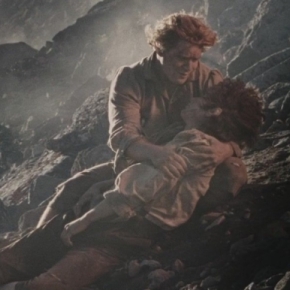
Or let me put it like this: I was pretty insufferable when I was in my early teens. I was an obnoxious know-it-all, and I wanted you to know it. And I wasn’t good at making friends because of the obnoxious thing and because my family moved around so much. Then in ninth grade, I read The Lord of the Rings. When I finally put the book down after 900 plus pages, I was different somehow. I had journeyed with Frodo Baggins and Samwise Gamge to Mount Doom, and dwelling page after page in their incredible friendship – friendship that literally stood the test of fire – changed me. People could have told me the answer to friendship is being loyal and giving of yourself. But I would not have understood until I read that story. In the same way, when we enter a parable, when we really live in the world Jesus creates in those few short sentences, we find so much depth of meaning.

This depth often comes not from one encounter with the parable but many. Why did Jesus speak in parables? He knew that using everyday images helps illustrate abstract concepts. The more ordinary the image, the more likely you are to encounter it day in and day out. Thus, Jesus shares images so that when we see them, the story triggers in us again. I guarantee you that at the parish picnic this afternoon, when you see birds flying around the trees, you will think about the parable of the mustard seed. And as you watch those birds nesting in those trees, you will connect more deeply to the kingdom of God.

And finally, Jesus spoke in parables because parables resist sound bite theology. He knew that his opponents were looking for evidence against him, and so instead of giving them ammunition, he told them stories: innocuous little stories, that, if you really let them get inside you and do their work, you realize that the kingdom has sprouted within you while you were sleeping. The problem is that these days we are so used to sound bites ruling public discourse that any speech, which calls for deep thinking, seems too difficult or time-consuming to wrestle with. We’ve lost the attention span necessary for stories to do their work. We are a people molded by story, who no longer seem to have time for them.

And that’s why Jesus’ parables are still so vital to our lives today. He invites us to slow down and place more and more nests and birds in that green felt tree. His stories sail to us on the wind of the Holy Spirit and impel us to dive in and swim around and make them our own. “With what can we compare the kingdom of God, or what parable will we use for it?” he asks. He says the kingdom of God is like a mustard seed that grows to be the greatest of all shrubs and puts for large branches so that the birds can nest. That’s the kingdom of God: Our true home that we might not be able to see at first, but which grows and grows and grows until it contains all the nests of all the birds. In Godly Play, we invite the children to name the birds, and we find that those birds’ names are the children’s names. Our names. The names of everyone, regardless of any ungodly reason – and I mean that literally – that we might discriminate. That’s what the kingdom of God is like.

Why did Jesus speak in parables? Because the kingdom of God is like a story, in which everyone has a role.

* Mark’s text does say that Jesus explains everything in private to his disciples. I would argue that might have done more harm than good, as you can see how they act for the rest of the Gospel.
** I did blow the head gasket about six months after getting the car. But that’s because I didn’t know what the Hot-Cold gauge was for. Oops. The repair cost about 2/3 what the car was worth. My parents did pay for that. Thanks, Mom and Dad!

12 Moments: An Instructed Eucharist

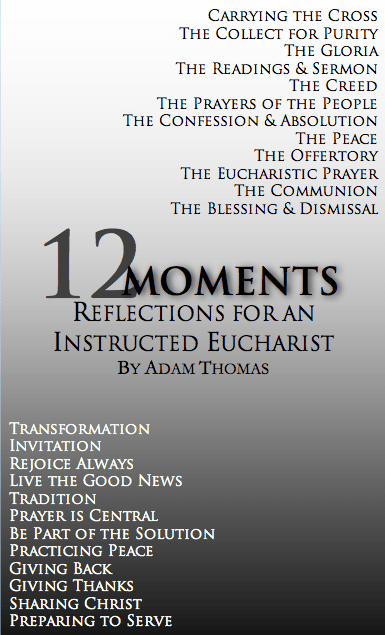
At St. Mark’s on Sunday, June 7th, we did an “Instructed Eucharist.” At four points during the service, we paused and I talked us through what was coming up. I based the instruction on something I wrote a few years ago and revised last week called 12 Moments: Reflections for an Instructed Eucharist. What I said during the service was a very abridged version of this pamphlet. Then I handed the full pamphlet out to folks at the end of the service. You can download the pamphlet by clicking the image below or clicking here.

12momentscover

The Blueprint

Sermon for Sunday, May 31, 2015 || Trinity Sunday B

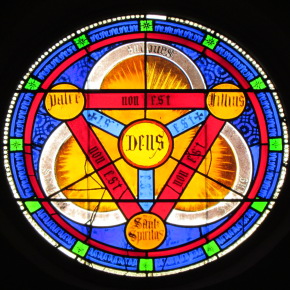
theblueprintHave you ever looked closely at the round window high up the wall in the back of the church? Go ahead – turn around and give it a good look. I love this window. I love the vibrant colors. I love that when the sun is shining through it, an afterimage gets imprinted on my eyes, so I see it when I close them. If you’ve never given the window much thought, I don’t blame you. The words on it are in Latin, after all. But let’s keep looking. The window presents a diagram of the Holy Trinity. “Deus” – God – is encircled in the center. Three smaller circles float around it: Patri, Filius, Spiritus Sancti – Father, Son, and Holy Spirit. Each of the smaller circles is connected to the others with the words “non est” (is not), and each smaller circle is connected to the large central one with the word “est” (is). The diagram is telling us that the Father, Son, and Holy Spirit are not each other but they are all One God. How does this work? Wisely, the window doesn’t tell us. The window just illustrates the reality, a theological blueprint in stained glass.

Likewise, I’m going to take my cue from the window and stay silent on the “How does this work?” question. Too many sermons over the years have tried to explain the mystery of the Trinity by talking about apples or flames. What those sermons didn’t understand is that you can’t explain a mystery without destroying the very quality that makes it mysterious. When Sherlock Holmes figures out that the bell rope used to call for the maid was replaced with a poisonous snake, which somehow slithered unnoticed out of the room in the ensuing hubbub over discovering the body, the mystery is solved. No more mystery. This Whodunnit? type mystery is the kind we’re used to: Gibbs and the NCIS team solve their mysteries within the length of the 45-minute episode. The light-hearted mystery novels my mother loves to read always wrap up the intrigue by the end of the story.

But here’s the difference between these small, ordinary mysteries we watch or read and the great mystery of the Holy Trinity. The small mysteries have answers to them, like the poisonous snake. But the mystery of the Holy Trinity is the answer – the fundamental answer that rests at the very core of existence. Here’s what I mean.

Before creation came into being, there was God. There was only God. Then God spoke, “Let there be light,” and creation erupted in a rush of dust and energy and far flung fire. And suddenly, there was something known as “not God.” Suddenly, there was an “other” for God to love. And yet, we believe that God’s essence is love, which means that God must have loved before there was a creation to love. Confusing, right? It is confusing until we realize there’s only one possible answer for whom God loved before there was anything else. God loved God. This may sound narcissistic or vain, but it’s not. Narcissism and vanity are distortions of love, but God’s love is perfect and unsullied. God loves God with such perfection that there is still only One God, even though a loving relationship exists.

That’s the keyword: relationship. To try to come close to the mystery of the Holy Trinity, we employ relational words: Father and Son, Parent and Child. We speak of the Holy Spirit as being the love that flows between them. This perfect relationship existed before creation, and thus serves as God’s blueprint for creation. Have you ever noticed that if you drill right down to the core of any subject whatsoever, you end up at relationship? At the most fundamental level, life, the universe, and everything are based on the relationships between things. Elemental particles vibrate next to other elemental particles, weaving the fabric of creation. Atoms repel and attract each other. Ecosystems thrive as complex series of relationships. Celestial bodies dance the precarious waltz of gravitational balance. Not to mention, the most important things in the lives of us humans on this fragile earth is our relationships with one another.

All of this grows from that blueprint God used from God’s own self – the perfect relationship of the Holy Trinity. In the act of creating something that was not God, God knew creation wouldn’t be perfect. And yet, God made it anyway. The reason the Holy Trinity remains a mystery is that our relationships – indeed, all relationships in creation – are not perfect, and thus we cannot fathom perfection.

But while we aren’t perfect, the idea of perfection lingers within us, an echo of our Creator’s own perfect love. We feel this echo as a longing for connection, for relationship with God and with each other. God loves us perfectly, even though we have the capacity to return a mere sliver of that love. But that sliver is more than enough to activate our ability to engage in loving relationships here and now. When we nurture such loving relationships in our lives, we come as close as our imperfection allows to the perfect relationship of the Holy Trinity.

Indeed, the Holy Trinity transcends our imperfection, draws us in, and strengthens our earthly relationships. The echo of God’s perfect love grows louder, more insistent, as we give ourselves over to be born again from above, to be remade closer to the blueprint than we were before. The blueprint calls for less domination and more mutuality, less prejudice and more generosity, less pride and more humility. The blueprint calls for less defending and more welcoming, less grasping and more embracing, less tearing down and more lifting up. And above all, the blueprint calls for love to spill forth in the forms of justice-seeking, mercy-granting, grace-sharing, hope-planting, and joy-singing.

And so you go home and do the dishes even though it was your brother’s turn. Or you tell your wife “thank you” for her poise in the middle of chaos and for putting up with you all these years. Or you introduce yourself to that bedraggled person you always seem to run into on your morning jog and ask if he needs assistance. Or you look those who are oppressed in the eye and say, “I’m sorry for not showing up sooner,” and then turn to stand with them.

Each of these is an expression of the blueprint of the perfect relationship of the Holy Trinity. And each of these will be done imperfectly. And yet, the mystery of the Holy Trinity rests at the core of all existence, of all we do and all we are. And so our imperfection is even now being redeemed by the perfect love of God, which somehow manages to fit all of itself into our mere slivers of love.

If in your life, the Holy Trinity has seemed no more than an abstraction, as clear as the Latin writing on the window back there, then I invite you to take a step back and look again. Reassign every single urge you have ever had to seek justice, to grant mercy, to share grace, to plant hope, to sing joy, and to love. Reassign all of them to the perfect love of the Trinity flowing, however imperfectly, through you. Notice now the Father, Son, and Holy Spirit catching you up in the ever-spinning dance of perfect love, and be thankful.

* The diagram of the Holy Trinity is the window on the back wall of St. Mark’s in Mystic, CT.

A Story About the Holy Spirit

Sermon for Sunday, May 24, 2015 || Pentecost B || Romans 8:22-27

astoryabouttheholyspiritToday, on this day of Pentecost, I’d like to tell you a story about the Holy Spirit. It’s going to sound like a story about me, but if I tell it right, you’ll see that the Holy Spirit is the main protagonist of this little tale. The story takes place a stretch down River Road about three miles from the Middle of Nowhere, West Virginia.

The summer before my senior year of college saw me driving down this stretch of River Road toward Peterkin Camp and Conference Center, and my job as counselor. The first day of camp, about a hundred high schoolers descended on the camp, and strangely enough, their enthusiasm and laughter and hugs of reunion were unhindered by the lack of a cell phone tower within 50 miles. Right away I could see their love for the place in their wide expectant eyes as they queued up to turn in medications and decorate nametags. They loved Peterkin because they got to be themselves around other kids who also got to be themselves. Places where teenagers are unafraid of coming out of their shells are few and sacred. Peterkin was one of them.

We shared Eucharist every day of camp, and with each day the volume of our singing increased as the more reticent campers started joining in. By Friday, the passing of the Peace had reached epic proportions because everyone tried to hug everyone else. The service that day included special prayers for healing, and I volunteered to assist with the laying on of hands because I’d never done it before. After communion, I walked to the back of the chapel with the priest Zach and a pair of sisters, Kenan and Leigh. We circled a metal folding chair, and Zach beckoned the first camper towards us. I remember looking down at my hands, seeing the dirty fingernails and calluses cut by guitar strings, and wondering: “What are these supposed to do?”

The boy sat down, and Zach leaned in close. “My parents are divorced and I keep thinking it’s all my fault and I feel sad all the time.” The truth of the boy’s words startled me out of my self-centered musings about my hands. Here was someone hurting profoundly, with his whole world crumbling around him and misplaced shame eating him away. And yet he trusted the four of us to place our hands on him, to whisper words of healing, which would never make everything all better again, but maybe just maybe might allow him to breath with a bit more space and by God’s grace start letting himself off the hook.

As Zach dabbed oil on the boy’s head, I touched his shoulder, lightly, like I was testing a bruise. Doubt gnawed at the back of my mind: how am I qualified even to be standing here, let alone be expected to participate in healing? The self-centered feeling of inadequacy threatened to wash over me again, but then a prayer blossomed in my mind and in my heart, a prayer that I had no hand in writing. I exhaled slowly, and the Holy Spirit carried her words on my breath: “Lord, make him whole, make him holy, make him wholly new.”

This became my breath prayer. As the campers kept coming and coming, the Holy Spirit kept speaking these words through me and I prayed with a fervor I didn’t know I possessed: “Holy Spirit, fill me and flow out of me, down my arms, into my hands, and into these broken, beautiful boys and girls. Make me your conduit. Make me your vessel.”

Their need for healing was so great, these young people in so much pain: depression, suicidal thoughts, drug addiction, alcohol addiction, eating disorders, the urge to cut themselves, feelings of abandonment, grief, loss… Lord, make her whole, make her holy, make her wholly new.

I kept asking the Holy Spirit to fill me to overflowing so she could spill out my fingertips and the campers could know the healing presence of God. When the service was over, the campers filed toward the dining hall, but we who had manned the three healing stations gathered around the altar and said a final prayer. As I backed away from the altar, I felt a tear moisten my cheek, then another and another. Suddenly, I was crying. I sat down in the second pew and just as suddenly, I was no longer crying. I was weeping. For twenty minutes, my chest heaved and fell, and I knew nothing but my ragged breaths and fat tears…and the truth.

God granted me exactly what the Holy Spirit had prompted me to I asked for – an abundance of that same Spirit, an excess, a proportion so much bigger than was meant for me alone. The tears puddling at my feet were the Holy Spirit spilling out of me. When the tears stopped, I noticed a hand on my back. Leigh, one of the sisters I had partnered with, had stayed behind and sat with me in silence. She had said nothing. She had not tried to hand me a tissue. She had let me weep, alone and yet not alone, laying her hand on me as we had done for the campers. Remembering that act of kindness still brings tears to my eyes.

I tell you this story because it taught me about the Holy Spirit. The Spirit does not come at our beck and call. We come at hers. We would be unable to ask for the Spirit’s help if she were not already helping us in the asking. Paul speaks this truth to the church in Rome: “The Spirit helps us in our weakness; for we do not know how to pray as we ought, but that very Spirit intercedes with sighs too deep for words.”

At Peterkin, the Holy Spirit made her presence known in my life, and I fervently hope in the lives of the campers as well. That experience was so overwhelming, I expect, because the Spirit knows me well enough to appreciate that I need to be whacked upside the head in order not to misunderstand my role in all of this. But even when the experience doesn’t leave us pooling tears on the chapel floor, the Spirit is still ever present, interceding for us, helping us in our weakness.

Remember when you stood on the beach at dawn, and the first rays of sun turned the ocean to liquid gold, and gratitude unbidden caused you to raise your arms to the heavens? Your prayer of thanks rose from the Holy Spirit prompting you to notice – to see with more than your eyes – God’s glory in creation.

Remember when you had to take your daughter to the emergency room because her stomach flu just wasn’t getting any better? The unimagined patience you showed in the hours of waiting rose from the Holy Spirit speaking peace into your panicked heart.

Remember when your mother died and you never thought you’d take another breath? And then you did. The breath that came when tragedy squeezed all the air from your lungs rose from the Holy Spirit leavening your agonized grief with a dash of hope.

Remember when the Holy Spirit showed you the person in need? Remember when the Holy Spirit stirred you to help? Remember? If you don’t remember something like this in your own life, I challenge you to look again. Ask the Spirit for help in the looking. The Holy Spirit doesn’t come to a lucky few or just to the people who ask for her intercession by name. The Holy Spirit has always been moving through your life like the wind through the trees. And she still is. I wonder what your next memory of the Holy Spirit will be.

You Know My Heart

Sermon for Sunday, May 17, 2015 || Easter 7B || Acts 1:15-17, 21-26

youknowmyheartLast week, we talked about trying to discern how and when to lean into the newness shimmering on the horizon of your life. I invited you to stop and pray the next time you are at the precipice of a decision; to take a deep breath and feel which way the wind of the Holy Spirit is pushing you; to ask God what new thing God is trying to birth through you with the decision. I know many of us, myself included, often have a hard time finding words to put to these prayers for guidance. Silent prayer – with lots of listening – is a beautiful alternative when there are no words, but if you have the urge to speak, then I have the first five words of the prayer, just to get you started. They come from this morning’s first reading. The eleven apostles want to round out their number, so they select two candidates and then pray about which one will take Judas’s spot. And they begin their prayer for guidance with these five words: “Lord, you know everyone’s heart.”

What a profound statement of faith – five words that speak to the apostles’ trust in God. Lord, you know everyone’s heart. This one, brief sentence guides their decision-making process in three substantial ways. They acknowledge God’s presence in their endeavor. They understand that making choices involves more than purely mental exercise. And they show humility in the face of a life-altering decision. Let’s take them in turn.

I’ve said it before and I’ll say it again: we routinely ignore God’s presence because God is always present. We forget that God is in the midst of not just the miraculous, but also the mundane. Now, our failure to recognize God’s presence is understandable. How many of us note the sound of the engine in the car until there’s an ominous sputtering? How many of us note the reliable glow of the bedside lamp until the transformer blows outside? We adapt to routine. We organize our lives into predictable patterns. But God’s movement in our lives is the very framework upon which our patterns hang, so that movement is often difficult to perceive. On the other hand, like the electricity, we’d notice if God weren’t there.

The apostles combat the tendency to ignore God’s foundational presence by invoking God’s knowledge of their hearts as they make a decision. Lord, you know everyone’s heart is shorthand for, “Lord, you are present in all that we do, and your presence sustains the world we live in and the life we live.” With these words, the apostles invite God into their decision-making process. This invitation may seem superfluous if you believe the assertion that God is ever-present. Indeed, God doesn’t need an invitation to be present in our lives. But we often need to invite God in to remind ourselves to be present to God. Our invitation functions, strangely enough, as an RSVP, as a response to God’s presence. The apostles know this. They know that the Lord is already present, but the invitation prepares their hearts to respond to God’s movement.

Lord, you know everyone’s heart, they pray. The apostles know that making a life-altering decision involves more than mental exercise. Every decision we make has both mental and emotional components, and we ignore the emotional at our peril. When the apostles pray these five words, they combine the mental verb “know” with the feeling word “heart.” They understand that God made separating heart from head so difficult precisely because our decision-making process should not attempt the separation. God gave us minds to interpret our emotions and hearts to provide our minds with the fuel of hope and imagination. God infused our biology with such checks and balances, so we tragically limit ourselves when we shelve our feelings in favor of our thoughts, or vice versa. Only by mingling the two can we make faithful decisions.

The apostles know they are in God’s presence. They employ both their hearts and minds as they make their choice. And they show humility in the midst of a life-altering decision. This humility is key to the whole decision-making enterprise. Every one of my choices affects more than just me, and those effects ripple into the future in permutations that my brain is unequipped to process. I don’t know how my decisions will affect others, let alone myself. Furthermore, I don’t even know myself well enough most of the time to make good decisions. Lord, you know everyone’s heart. If God knows what’s in my heart, then that makes one of us.

Humility comes in when we acknowledge our limited awareness of ourselves and the world around us. If our interior lives are clouded in mystery, how much less can we understand the trajectory of our decisions in the wider world? Inviting God into the decision-making process opens us up to the One who truly knows us. The humble prayer begins, “Lord you know my heart, and you know it much better than I do.” Confessing our shallow understanding of our own inner selves sets us on the path to faithful decisions.

Let’s say you are standing at the edge of a life-altering decision. You are trying to decide what college to go to; or whether to throw yourself fully into a budding relationship; or if you should change jobs. There’s newness shimmering on the horizon, so you stop and pray. You begin with a personalized version of these five words: “Lord, you know everyone’s one.”

Lord, you know my heart. With these words, you invite God into your decision-making process. You make yourself aware of God’s constant, yet elusive presence. You think back to your campus visits at your top three choices. You hadn’t been prepared to look for God’s presence at the time, being so overwhelmed by the experience. But now, looking back in prayer, you notice a flicker of rightness about one school. You imagine yourself there, setting up your dorm room, going to class. And you realize what that flicker of rightness feels like. It feels like home. That’s God’s presence inviting you to choose the best of all possible futures.

Lord, you know my heart. With these words, you allow your head and your heart to team up, mingling your rational mind with your emotions and imagination. A new relationship is budding, and you’re trying to decide whether or not to run with it. Your heart tells you yes, Yes, YES – how could you possibly feel any better than you do right now. You’re skin’s all tingly. You haven’t heard her voice in an hour, which is an hour too long. But here your rational mind breaks through the fog of passion: let’s not pick the china pattern yet. Let’s get to know each other. Let’s take it slow. Let’s test this and see if our nascent passion has what it takes to deepen into the bedrock of lifetime commitment.

Lord, you know my heart. With these words, you humbly acknowledge that alone you don’t have the depth of awareness necessary to make a faithful decision. You’ve been thinking about changing jobs for a while. Right now, the money’s good, but the hours are killer. You tell yourself that you’re sacrificing so that your family can have a good life. And that may be true, but still, you’ve missed a dance recital and three little league games this month alone. You have an offer on the table. It’s less money, but you’d be home most evenings. In humility, you ask for God’s guidance to help you see the future permutations of this decision.

Lord, you know my heart. “Lord, you know everyone’s heart.” When you are trying to discern how and when to lean into the newness shimmering on the horizon of your life, begin your prayer for guidance with these five words. With integrated heart and mind, kneel humbly in God’s presence. Unfurl your heart to God. Place yourself in the palm of God’s hand. And know that God will still be there whatever future unfolds.

*Several parishioners have asked me to preach slower, which I’ve been working on for a while now. Recently, I’ve been succeeding. But that means I need to start writing fewer words. This sermon came in about 1:30 longer than I like, so at the later service, I shortened it on the fly and it worked. But the one I recorded was the long one.

Precipice

Sermon for Sunday, May 10, 2015 || Easter 6B || Acts 10:44-48; Psalm 98

precipice“Sing to the Lord a new song, for he has done marvelous things.” Today’s psalm begins with these glorious words, and for me it begins with a question. Why does the song we sing have to be a new one? Why can’t the song be an old song, one that has stood the test of time? “Amazing Grace,” perhaps? Or how about “In the Garden?” While these songs are beautiful and wonderful and should never, ever be lost to the ages, I think the psalmist feels the urge to sing a new song because he or she has discovered a fundamental truth about God’s movement in God’s universe. God is always doing something new.

God’s ceaselessly creative hand did not stop molding and shaping the universe at the end of the sixth day of creation. God continues to breath new life into this ever-expanding cosmos: at the grand scale of galactic expansion and at the small scale of simple, daily interaction. In the playroom next door, the twins do something new seemingly every day. Amelia loves to eat real food. Charlie has started climbing. We have several parishioners who have recently moved from their homes into assisted living facilities or whose recent medical interventions have led to new lifestyle choices. They are faced with newness of a less joyful kind, but we still fervently hope that their new situations will lead to much better outcomes than they could have expected before.

The simple fact that spring has sprung reminds us that God is always doing something new. In my life. In your lives. In the life of the church. The world. Creation. We believe that God’s reign is constantly and continually reshaping existence, bringing all things into closer connection with God, as creation was always intended to be.

The newness that trumpets God’s closeness is borne on the wind of the Holy Spirit. Not all new things are of God, but the Holy Spirit helps us discern when and where God is birthing those new things that do lead to closer connection for all people. When we allow ourselves to be open to the newness dancing along in the Holy Spirit’s wake, we become people who are less afraid to try new things, to risk, perhaps to fail, but to know that in the attempt a new shoot of possibility has sprung up from the ground. When we do succeed in living into God’s reconciling newness, the result is deeper connection with God and a more expansive understanding of God’s love and God’s generosity.

One climactic example of this success happens in our tiny first reading today. It is the most extraordinary event in the history of the early days of the church. You might think it would be a dramatic conversion or a miraculous healing or a mystical vision or a memorable speech, but while each of these happens in the book of the Acts of the Apostles, none is the event I have in mind. No. The most extraordinary moment of reconciling newness in the early days of the church happens when one person simply realizes he is wrong and then changes his mind.

That person is Peter. And we might expect Peter to be a hardliner, sticking to all of his positions and presuppositions just because he had been with Jesus from the beginning. After all, Jesus did give Peter the figurative keys to the kingdom. What could be more human of a reaction than for Peter to lock out anything new that threatened the integrity of the in-crowd? As I’m sure we’ve all done from time to time, Peter could have stuck his head in the sand, ignored the promptings of the Holy Spirit, and resisted any opportunity for growth, for reconciliation, or for new possibilities.

But that’s not what happens. So here’s the story, beginning with just a bit of background. The society in which Peter grew up was divided between Jews and Gentiles. There wasn’t necessarily animosity between them, but there was indifference and a lack of connection. Society was just built in this divisive way, so no one really questioned the structure.

That is, until one day when Peter is hungry. While a meal is being prepared, Peter receives a vision from God. All of the animals that observant Jews aren’t supposed to eat appear before Peter, and a voice directs him to kill and eat. Peter balks at the command: “I’ve never eaten anything that’s profane or unclean.” But the voice counters: “What God has made clean, you must not call profane.” This happens three times until the vision has finally sunk into Peter’s bones.

When the vision ends, Peter meets a trio of Gentiles who invite him to meet a Roman named Cornelius, who has also had a vision from God concerning Peter. Never fearing that he might be walking into a trap, Peter goes with them and meets Cornelius and his whole household. And then Peter preaches a fabulous sermon that proclaims the good news of Jesus Christ.

This is where our passage for this morning picks up the tale. While Peter is still speaking, the Holy Spirit encounters all who hear him. Peter’s companions, who are Jewish believers in Jesus Christ, are astounded that the Holy Spirit of God would deign to manifest itself through unclean Gentiles. “But what about our in crowd,” they seem to protest. “We thought we were the special ones. We thought we were the ones that had the Holy Spirit.”

Then Peter remembers his vision of the now clean animals. And he finds himself standing at the precipice of a decision, at the precipice of something new trying to break into reality. His society, his upbringing, and everything he has ever known pulls him to reconfirm that Jews and Gentiles can never be united, that the good news of Jesus Christ is for Peter’s people alone. But that same Holy Spirit, which is even now dancing around Cornelius and his Gentile family, pulls Peter in a new direction toward unity and acceptance and radical welcome of the estranged other. And this time Peter doesn’t balk. He baptizes all the Gentiles present and charts a new course of acceptance in this new and nascent religion soon to be called Christianity.

This particular type of newness – welcome of the other, whatever makes that person other – keeps encountering the church again and again. Over the centuries, Christians have failed to be swept up by the wind of the Holy Spirit’s newness too many times to count, but every once in a while, we trim the sail just right and succeed in ushering in God’s reconciling newness. Just in our lifetimes, we have expanded opportunities in our church to many groups who had been shut out before – allowing women to be priests, for example; or blessing loving relationships of any orientation with the sacrament of marriage.

When you are trying to discern how and when to lean into the newness shimmering on the horizon of your life, how do you feel? Terrified? Excited? Saddened by what is fading away? Joyful for what is breaking in? All of the above, probably. In any case, like spring blooming in a riot of color every year, newness is just a part of life. In our own lives and in the life of the church or our nation or the world, the newness that comes from God will always lead to deeper connection, greater reconciliation, more hope – maybe not today or tomorrow. But the path will lead there someday.

The next time you are at the precipice of a decision like Peter, stop for a moment and pray. Take a deep breath and feel which way the wind of the Holy Spirit is pushing you. Ask God what new thing God is trying to birth through you with this decision. How will it lead you closer to God or another person? God is forever speaking words of reconciliation and renewal into this creation. Each day, we have the opportunity to hear them anew and to choose the course towards closer connection and to leap off the precipice and to soar on the wind of the Holy Spirit.

What is to Prevent Me?

Sermon for Sunday, May 3, 2015 || Easter 5B || Acts 8:26-40

whatistopreventmeTwice last week, I got to wear a tie. I went to the MASH gala fundraiser and to the Eastern Connecticut Symphony concert, at which several of our parishioners sang their hearts out performing Carl Orff’s Carmina Burana. The benefit was fabulous, the concert was wonderful. And I went to both wearing a tie. This may sound like a strange thing for me to report to you, but I assure you, I am going somewhere with this. Whenever I’m getting dressed, I’m faced with a wardrobe decision. Do I wear my black shirt and collar or not? If I decide not to, then I leave the house incognito. I’m still a priest, of course, when wearing a coat and tie or jeans and flip flops, but people at the concert hall or grocery store won’t be able to spot that about me on first glance. (They probably think I’m a college sophomore home on break.)

Sometimes when I’m not wearing my clergy clothes, I revel in the anonymity I have. I can take the twins to the pediatrician without people looking at me funny. Is he allowed to have kids? I can ride in an airplane and not freak out the other passengers when I white knuckle it through takeoff. (I’m not the best flier, and seeing a man of the cloth nearly hyperventilating while taxiing down the runway is not doing anyone any favors.)

The trouble is, when I consciously choose not to wear my black shirt and collar, I can fall into the trap of thinking I’m off the clock, I’m done for the day, my timecard is punched. But that’s not how it works. I get paid to be your rector and spiritual leader. That’s my job. But living as one of Jesus’ disciples, living out my baptism? That started long before I was ordained, long before I had the choice of attire. That started the moment I said, “Here I am,” when God called me into relationship. Living out my baptism, following Jesus – that’s not my job. That’s my life.

And it’s your life, too. You’re just not faced with the same wardrobe decisions. The question I have for you is this: Since your clothes don’t out you as a Christian like mine do, how do people know? What about your life is different because you signed up as a follower of Jesus? If you got into a conversation about the important stuff how long would you talk before mentioning your faith?

We share the Good News of Jesus Christ in many ways – both in word and deed. We tend to focus on the “deed” part, and I think we do it pretty well. But the “word” part is hard. The thing is, the word gives the deed context and shape. In a world as spiritually malnourished as ours has become, the interpretation of our God-inspired deeds with God-inspired words is critical. I know for a fact that people out there are hungry for some connection with something…deeper. Spiritual malnutrition leads to spiritual hunger, though most people don’t have the language to name the lack they feel. We do have that language, and it is our delight to share it.

This is what Philip does with the Ethiopian eunuch in today’s lesson. The Good News of Jesus Christ has just begun to spread, and Philip is on the vanguard. He runs up to the eunuch’s chariot and hears him reading the prophet Isaiah. The eunuch is hungry to know of whom the prophet speaks. Philip shares the good news, and then the eunuch asks my favorite question in the book of Acts: “Look, here is water! What is to prevent me from being baptized?”

What is to prevent me from being baptized? The answer is nothing. Philip baptizes him right there on the side of the road. For we who are already baptized, this question transforms. What is to prevent us from living out our baptism? The answer to this question should also be “nothing.” But it’s not that easy.

What prevents us from living out our baptism? What prevents us from sharing the Good News of Jesus Christ in word and deed? Many, many, many things. Let’s talk about four of them.

First up is apathy. If we don’t take the time to cultivate our part in our relationships with God, then sinking into apathy is a real consequence. Apathy results when we don’t take our faith seriously – when it lives in the topsoil rather than the bedrock, just one good rainstorm from eroding away. God showers us with the promises upon which faith rests, but it’s up to us to practice our faith and our discipleship so they become constant motivators in our daily lives. If we don’t, we might wake up one day and look out at the vista of all that God calls us to do and be, all whom God calls us to serve, and say, “I don’t care.”

But we aren’t going to sink into apathy because we do care. We live out our baptism by being engaged. But that brings us to our second item: lack of expertise. Once we care, we realize how dwarfed we are by the enormity of the history and tradition and biblical witness undergirding our faith. How could we possibly know enough to be able to share it correctly? Let me set your mind at ease. I studied this stuff for three years at school. I have another seven years as a priest. And I’m still not an expert. I never will be. God doesn’t call us to be experts. God calls us to be authentic versions of ourselves, sharing our faith as we have received it. Yes, we are molded by history and tradition and scripture, and that means we need to trust that God is shaping us using those instruments, whether or not we can read the Bible in its original Hebrew. When we share our faith, we don’t share a particular scholar’s view of faith. We share ourselves.

But again, this leads to our next item: fear of rejection. Sharing something as important as our faith with others makes us vulnerable. What if they stop being my friends? What if they think I’m a weirdo for my beliefs? If your faith is an integral part of who you are, then you have to be willing to risk this rejection. I’m not saying you have to launch into dissertations about Jesus apropos of nothing, but don’t hide your faith either. It’s a part of you. Who knows how you will affect the spiritually malnourished people around you if you show it, no matter the risk?

This leads us to our final item: politeness. Didn’t your parents teach you that the two things you aren’t supposed talk about are politics and religion? I say that’s nonsense. The loudest voices in the media espousing so-called Christianity are people whose brand of our religion makes me physically gag: people who seem to revel in excluding others, people who mangle scripture to suit their own twisted ideologies, people who hate in the name of God. The spiritually malnourished around us hear those voices, too. What kind of picture of Christianity do you think is forming in their minds? But imagine if you got into the conversation about the important stuff that I mentioned earlier with one of those people seeking something deeper. If you shared our wonderful, inclusive, loving expression of Christianity with him or her, what a beautiful image could replace the horrific one that’s probably there!

One of the calls to live out our baptism is to share the Good News of Jesus Christ. So many things prevent us from doing that – things like apathy, lack of expertise, fear of rejection, and misplaced politeness. But our faith matters. Our discipleship matters. Our relationship with God matters. These are the things that make us who we are. This is not just part of our lives. This is what undergirds our lives, gives them meaning. How could we not share something so wonderful, despite all that prevents us from doing so? I promise that the next time I have the opportunity to share my faith when I’m not wearing my black shirt and collar, when I’m wearing jeans and flip flops, I will, with God’s help. How about you?

As You Wish

Sermon for Sunday, April 26, 2015 || Easter 4B || 1 John 3:16-24

asyouwishMany of you met (or at least saw) my sister Melinda two weeks ago when we baptized Charlie and Amelia on this very spot. She’s one of the strongest and most loving people I’ve ever known, and I’m glad that my years spent being her “annoying little brother” didn’t damage our long term prospects of maintaining a close connection. This may sound funny, but I think one of the primary reasons we survived our young years with our friendship intact was the movie The Princess Bride. We both loved it, and no matter how long it had been since we last watched it, we would quote it to each other at every conceivable opportunity. And we still do sometimes. Rest assured, you can mute the film, and Melinda and I can supply the dialogue.

So it should come as no surprise to you that when I’m doing pre-marital counseling with couples preparing to be married, wisdom gleaned from The Princess Bride tends to slip in. As of last count, I’m officiating at ten weddings this year, so I’ve had the golden opportunity to give the “As you wish” talk to many couples, with many more to come.

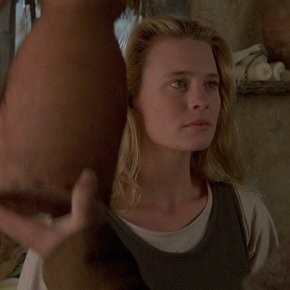
The film opens with a grandfather reading S. Morgenstern’s “classic” tale to his sick grandson. As he reads, the picture melts into a bucolic setting where we meet two beautiful people. Buttercup commands the farm boy, Westley, to do several menial tasks – polish her horse’s saddle, fill buckets with water, fetch a pitcher. Each time, he responds, “As you wish.” Then we hear the grandfather, voiced by Columbo himself, the inimitable Peter Falk, say, “That day, she was amazed to discover that when he was saying ‘As you wish,’ what he meant was, ‘I love you.’ And even more amazing was the day she realized she truly loved him back.”

This discovery, of course, leads to a sunset kiss, a leave-taking to seek fortune across the sea, a supposed death, and (eventually) a harrowing reunion, a second separation, another supposed death, a rescue, and (finally) an escape together from the homicidal schemes of the evil prince. (It’s a fantastic movie.)

I bring up Westley’s “As you wish” with couples preparing for marriage because I’ve found that often they don’t realize or haven’t processed the ways in which their partners show their love. Rarely do both members of a couple display their love in the exact same ways. Because our husbands or wives show love differently than we do, we have a tendency to miss it and thus fail to appreciate this love.

Our New Testament lesson this morning speaks to the “As you wish” exercise. “Little children,” says the writer of the first letter of John, “let us love, not in word or speech, but in truth and action.” Just before this, the letter gives an example from Jesus: “We know love by this, that he laid down his life for us – and we ought to lay down our lives for one another.”

The writer of First John knows that saying, “I love you,” is all too easy – just three little monosyllables. Subject, verb, object. Meaning it is the hard part. Too often, the abused wife returns to her husband because “he says he loves me.” Too often, the college freshman wakes up crying the next morning, after being duped by “I love you.” Too often, “I love you” hurts more than it heals. The abusive husband and the collegiate predator weaponize the phrase, with no thought to its destructive consequences.

But this is where action comes in. This is where service separates truth from manipulation. You may be tempted to say that action is needed to prove that a spoken “I love you” is real. If this were the case, however, there would still be regular jousting tournaments throughout Christendom. Rather, active service is a spontaneous symptom of love – one that makes the spoken words extraneous (even though they are still nice to hear).

Loving and serving – we really mustn’t separate the two. Love expresses itself not only in poetic protestations: “Shall I compare thee to a summer’s day? Thou art more lovely and more temperate…” No. Love expresses itself in holding the beloved’s hair back when she’s bent over the toilet with stomach flu. Love waits all night in the hospital room, visits the prisoner, builds affordable housing, donates mac & cheese. Love gets its uniform dirty.

We will be reaffirming our baptismal covenant in just a few minutes. One of the promises echoes Jesus’ great commandment: “Will you seek and serve Christ in all persons, loving your neighbor as yourself?”

Will you serve? Will you love? “I will, with God’s help,” you’ll say. How will you serve? What will your love propel you to do?

This week I invite you to talk to your spouse or child or sibling or friend. Ask them how they see you demonstrate love. What ways do you show it above and beyond the spoken “I love you?” To whom are these displays of love directed? How can you employ your unique set of gifts to become an even better version of the loving person that God made you?

Do the same thing for your spouse, child, sibling, or friend. Discover together the ways God is calling you to be God’s loving servant. Discover together how God prompts you to be servants of one another in the power of mutual love. And discover together where God is inviting you to turn that internal love into external service. The writer of First John continues on this theme: “How does God’s love abide in anyone who has the world’s goods and sees a brother or sister in need and yet refuses help?” How indeed?

In The Princess Bride, Miracle Max reminds us that “True love is the greatest thing in the world.”* But unless we display that true love through our service to one another and to our brothers and sisters in need, what good is it? After we share Holy Communion with each other this morning, we will orient ourselves away from the table and toward the door. And we will pray, “Send us now into the world in peace, and grant us strength and courage to love and serve you with gladness and singleness of heart.” God sends us out to love and to serve. I pray that we will respond, “As you wish.”

* “Except for a nice M.L.T. Mutton, lettuce, and tomato, where the mutton is nice and lean. They’re so perky. I love that.”

Stigmata

Sermon for Sunday, April 19, 2015 || Easter 3B || Luke 24:36b-48

StigmataStigma is not a happy word. If you use it in a sentence, more than likely the word “stigma” will be linked to something that people view as disgraceful or humiliating, whether that view is warranted or not. A couple of us recently read a book called The Rich and the Rest of Us by Tavis Smiley and Cornel West, who spoke of the need to lift the stigma associated with the word “poverty” if we are ever going to muster the societal will to lift those on the margins. In years past, society has stigmatized attributes of people who exhibit less capacity than most, using words like “retarded” and “crippled” to describe those with mental and physical challenges. Suffice to say that members of every minority group – no matter the difference used to justify labeling them as “those people” – have been stigmatized in one way or another. Stigmas lead to segregation and prejudicial behavior and animosity. “Stigma” is not a happy word.

And so we need to begin this sermon by acknowledging once again the countercultural irony of the Christian faith. Both last week and this week, our Gospel writers John and Luke have narrated the scene of the Risen Jesus meeting his disciples and their companions for the first time. In both narratives Jesus shows them the wounds he suffered during his crucifixion: the marks of the nails in his hands and his feet, the mark of the spear in his side. And in both narratives, his wounds lead them to recognize him and rejoice (though Luke reminds us that disbelief and wonder temper their joy). Christian tradition has given a name to those wounds: the “Stigmata,” which is just the plural form of the word “stigma.”

Here, stigma is a happy word. Or at least Jesus turns it into one. The act of being crucified was thought of as the most awful and degrading form of humiliation in addition to being a horrible way to die. In his letter to the Galatians, the Apostle Paul quotes a verse of scripture: “Cursed is everyone who hangs on a tree” (3:13). Talk about a stigma! And yet by virtue of his resurrection, Jesus turned the cross from an instrument of torture, domination and death into a symbol of redemption, selflessness, and new life. If Jesus hadn’t redefined the cross, I doubt you would wear crosses around your necks or I would have one tattooed on my back.

Jesus’ life and ministry were all about redefining what people thought was acceptable. He took the prejudices fueling certain stigmas head on and gutted them. He touched those society had stigmatized as worthless or unclean: people with leprosy, blindness, and paralysis. He ate with poor people. He befriended tax collectors vilified for being in cahoots with the Romans. He conversed with foreign women. Jesus left every town he visited having laid waste to the stigmas that separated people from one another, having done his best to show people the healing grace that reconciliation brings.

Jesus spent his life demonstrating that the stigmas, which separated people from the larger society, would never separate those same people from him. His own physical Stigmata, made by nails driven through his wrists and ankles, are a further sign that Christ was willing to go to any lengths to suffer with and for those who are humiliated, marginalized, and disgraced. But here we need to make sure we don’t get stuck on Good Friday. If we forget about or try to explain away his resurrection, then the story ends the day the nail holes were made.

That’s why Luke makes a big deal about Jesus eating a piece of broiled fish. He really was there! And the marks of the wounds – the marks of his compassion, his suffering with and for everybody – remain even in his resurrected body. But right here we can sink into a theological morass if we don’t think hard about what the wounds in Jesus’ hands and feet really mean. Here’s the problem. If we say that his Stigmata are only the marks of a humiliating death full of suffering and pain, then we are also saying that such humiliation and suffering leave their mark in the new life of the resurrection, that a legacy of disgrace can sully a new life of complete grace. Thankfully, we don’t need to go there because Jesus’ lifetime of reversing stigmas works on his own Stigmata, as well. Indeed, the fact that his resurrected self still bears the marks of his wounds gives us clues as to what our own resurrected life looks like.

On Friday, Jesus’ Stigmata are marks of failure. His blood drips from the nails, which keep his sagging body affixed to the humiliating cross. But on Sunday, those same wounds are marks of triumph. The nails are gone, but the blood remains, the blood of the Lamb that washes us clean. In the life of the Resurrection no failure is great enough on our part to swallow the enormity of the victory Christ invites us to share.

This triumph redefines his wounds so that they are so much more than simply the marks of his suffering. They are also the marks of his obedience and our redemption. And they are the marks by which his friends recognize him. In other words, he calls his friends back into relationship and back into belief by showing them these marks. Thus the life of the resurrection is one in which our relationship with Christ becomes perfect and complete. But we can begin to live this new life now, even though we are incapable of perfection or completion because, as we just said, our failures do not sully the ultimate triumph.

The Risen Christ is alive in us, propelling us toward culmination with God in the life of the resurrection. Therefore, we too are capable of demonstrating Jesus’ Stigmata. I don’t think we will actually bleed from our hands and feet as St. Francis of Assisi did, but the marks don’t need to be visible to be real. By virtue of our baptism, we have been marked as Christ’s own forever. This mark includes the promise to walk Jesus’ path as best we can. Jesus’ life and ministry reversed and gutted so many stigmas, so many flimsy reasons for separation. Jesus’ death and resurrection reversed and gutted the stigma of death with the promise of new life.

As we walk in Christ’s footsteps, hear him calling to you to continue his work. Do all in your power to reverse and gut the stigmas that continue to make people feel less than they are. Take a hard look at yourself and see what prejudices you hold. Ask where they come from. Ask who taught them to you. Ask if they are the kind of prejudices that Jesus would have blown right through. Chances are they will be. Because Jesus’ never met a stigmatized person he didn’t touch or talk to or embrace.

We are Jesus’ hands and feet in this world. I pray that when people look at you and me, they will see the mark of Christ on us.

The dogwood flower (pictured above) has traditionally been used as an image of Christ’s wounds, as the red tips of the petals evoke the Stigmata.

Behold How Good

Sermon for Sunday, April 12, 2015 || Easter 2B; Psalm 133

BeholdHowGoodEcce Quam Bonum! I first heard these three Latin words in the fall of the year 2000 when I was a senior in high school. I stepped out of the car and stared in awe at the soaring Gothic architecture of the buildings arranged around the quad of a little college tucked away in the mountains of Tennessee. Ecce Quam Bonum! As a prospective student, those words were words of welcome to me: “Behold how good!” they proclaimed. These are the opening words of our psalm today, Psalm 133: “Behold, how good and pleasant it is, when brethren live together in unity!” Walking towards the beautiful sandstone chapel on that visit, I knew beyond a shadow of a doubt that I wanted to experience living together in unity at the University of the South in Sewanee, Tennesee. The next fall I matriculated, and the four years I spent at Sewanee were years of friendship, formation, discernment of call, and lots and lots of singing.

Even though I didn’t know how to sing at the time, I still loved to do it, so I joined the University Choir my first month of college. That choir became my family for four years. The intensity of being in the choir at Sewanee matched that of playing a varsity sport. We did everything together. Several times a week, I got to sing with that special community. It was a gift to be able to add my voice to that group. The fellowship of the choir at Sewanee made real for me those three Latin words: Ecce Quam Bonum, Behold how good!

The words of Psalm 133, which we sang a few minutes ago speak of the desire for joyful, harmonious fellowship with our brothers and sisters. Three other readings join this psalm, and each speaks about community and fellowship. In the Acts of the Apostles, Luke paints a happily-ever-after picture of the apostles and their companions, in which the “whole group of those who believed were of one heart and soul” (4:32). In the First Letter of John, the writer says, “We declare to you what we have seen and heard so that you also may have fellowship with us; and truly our fellowship is with the Father and with his Son Jesus Christ” (1:3). In the Gospel, the Risen Christ appears to the disciples as a group, grants them peace, and breathes the Holy Spirit upon them. Thomas is not with the disciples at the time, so as a group they seek him out and tell him the good news. A week later, when Thomas has returned to their fellowship, Jesus once again appears, and Thomas believes.

In just a few minutes we are baptizing two eight-month-old babies (two wonderful, beautiful babies, if I say so myself), and I can’t think of better lessons to accompany such a joyous occasion. The sacrament of Baptism celebrates the inward movement of God in a person’s life by outwardly welcoming that person into God’s family the Church. We baptize infants because we believe God is moving in all people, regardless of their ability to recognize or verbalize such movement. We baptize infants so that their earliest memories will be ones of being loved and cherished by a community of faith.

The “outward sign of inward grace” definition of a sacrament is tried and true, but it is also well worn, so let’s expand our understanding of what’s going on in baptism with a less academic and more musical metaphor.

The music of God plays in each one of our hearts. You’ve heard the expression, “tugging on my heartstrings” to describe something that evokes compassion and sympathy. Well, God tuned those heartstrings to resonate with God’s music; that is, God’s desires, yearnings, hopes, and dreams for God’s creation. That’s why we feel a tug on our hearts when we see someone in need – because God is directing us to notice and help that person.

Within our hearts, sometimes the music of God is soft, a half-whispered lullaby, barely discernible over the din of the world. Sometimes the notes crescendo to a deafening fortissimo that knocks us, weeping, to our knees. Most often, the music sounds as the percussive TUB-thp of our hearts — a rhythm that, if you listen closely, beats in time with the rest of the performing forces of creation. I’m not a theoretical physicist, but what I’m describing might be considered a poetic version of some of the more modern theories of how the universe works – it’s all about vibration, right? That’s really all music is – collections of well-defined vibrations. We identify the source of that vibration – that resonance – as God.

Each one of us has the music of God resounding within, but the choir is incomplete until we have found each other, until we have joined together in fellowship as the chorus of God, so to speak. In Greek, this fellowship is called koinonia, but I’ve always thought that “fellowship” is a rather limp translation. For the sake of our metaphor, let’s translate koinonia as “harmony,” which lands much closer to the descriptive intent of the Greek word. Musical harmony is the collection of notes that add structure, color, tone, depth, and meaning to the main tune. This tune, called the “melody” is the music of God within us. The combination of our own unique passions and hardships; our successes and failures; our gifts and shortcomings; our hopes, our dreams, and our joys creates the harmony of the music of God.

In the sacrament of Holy Baptism, we welcome another soprano, alto, tenor, or bass into the choir. We await eagerly the subtle changes in timbre that these new lives will bring. Together, we sing the koinonia, the harmony, of the music of God to a world so accustomed only to noise and clatter. The sound of our anthems resonate with the movement of God in this world. This is the sacrament of Holy Baptism: new sound, new harmony, new resonance in the chorus of the music of God.

One of my favorite songs is called “One Voice,” by the band The Wailin’ Jennys. With each verse, another voice is added to the mix. By the third verse, each member of the band is weaving her voice with the other two. They sing:

This is the sound of voices three
Singing together in harmony
Surrendering to the mystery
This is the sound of voices three
 
This is the sound of all of us
Singing with love and the will to trust
Leave the rest behind it will turn to dust
This is the sound of all of us

So Ecce Quam Bonum! Behold how good it is when we all sing together in harmony and surrender to the mystery of God’s movement in our lives. Behold how good it is when we welcome new life into God’s family and embrace the new life the resurrection brings. Behold how good it is when we invite others to join us as we add our harmonies to the melody of the music of God.