
What is to Prevent Me?

Sermon for Sunday, May 3, 2015 || Easter 5B || Acts 8:26-40
whatistopreventmeTwice last week, I got to wear a tie. I went to the MASH gala fundraiser and to the Eastern Connecticut Symphony concert, at which several of our parishioners sang their hearts out performing Carl Orff’s Carmina Burana. The benefit was fabulous, the concert was wonderful. And I went to both wearing a tie. This may sound like a strange thing for me to report to you, but I assure you, I am going somewhere with this. Whenever I’m getting dressed, I’m faced with a wardrobe decision. Do I wear my black shirt and collar or not? If I decide not to, then I leave the house incognito. I’m still a priest, of course, when wearing a coat and tie or jeans and flip flops, but people at the concert hall or grocery store won’t be able to spot that about me on first glance. (They probably think I’m a college sophomore home on break.)

Sometimes when I’m not wearing my clergy clothes, I revel in the anonymity I have. I can take the twins to the pediatrician without people looking at me funny. Is he allowed to have kids? I can ride in an airplane and not freak out the other passengers when I white knuckle it through takeoff. (I’m not the best flier, and seeing a man of the cloth nearly hyperventilating while taxiing down the runway is not doing anyone any favors.)

The trouble is, when I consciously choose not to wear my black shirt and collar, I can fall into the trap of thinking I’m off the clock, I’m done for the day, my timecard is punched. But that’s not how it works. I get paid to be your rector and spiritual leader. That’s my job. But living as one of Jesus’ disciples, living out my baptism? That started long before I was ordained, long before I had the choice of attire. That started the moment I said, “Here I am,” when God called me into relationship. Living out my baptism, following Jesus – that’s not my job. That’s my life.

And it’s your life, too. You’re just not faced with the same wardrobe decisions. The question I have for you is this: Since your clothes don’t out you as a Christian like mine do, how do people know? What about your life is different because you signed up as a follower of Jesus? If you got into a conversation about the important stuff how long would you talk before mentioning your faith?

We share the Good News of Jesus Christ in many ways – both in word and deed. We tend to focus on the “deed” part, and I think we do it pretty well. But the “word” part is hard. The thing is, the word gives the deed context and shape. In a world as spiritually malnourished as ours has become, the interpretation of our God-inspired deeds with God-inspired words is critical. I know for a fact that people out there are hungry for some connection with something…deeper. Spiritual malnutrition leads to spiritual hunger, though most people don’t have the language to name the lack they feel. We do have that language, and it is our delight to share it.

This is what Philip does with the Ethiopian eunuch in today’s lesson. The Good News of Jesus Christ has just begun to spread, and Philip is on the vanguard. He runs up to the eunuch’s chariot and hears him reading the prophet Isaiah. The eunuch is hungry to know of whom the prophet speaks. Philip shares the good news, and then the eunuch asks my favorite question in the book of Acts: “Look, here is water! What is to prevent me from being baptized?”

What is to prevent me from being baptized? The answer is nothing. Philip baptizes him right there on the side of the road. For we who are already baptized, this question transforms. What is to prevent us from living out our baptism? The answer to this question should also be “nothing.” But it’s not that easy.

What prevents us from living out our baptism? What prevents us from sharing the Good News of Jesus Christ in word and deed? Many, many, many things. Let’s talk about four of them.

First up is apathy. If we don’t take the time to cultivate our part in our relationships with God, then sinking into apathy is a real consequence. Apathy results when we don’t take our faith seriously – when it lives in the topsoil rather than the bedrock, just one good rainstorm from eroding away. God showers us with the promises upon which faith rests, but it’s up to us to practice our faith and our discipleship so they become constant motivators in our daily lives. If we don’t, we might wake up one day and look out at the vista of all that God calls us to do and be, all whom God calls us to serve, and say, “I don’t care.”

But we aren’t going to sink into apathy because we do care. We live out our baptism by being engaged. But that brings us to our second item: lack of expertise. Once we care, we realize how dwarfed we are by the enormity of the history and tradition and biblical witness undergirding our faith. How could we possibly know enough to be able to share it correctly? Let me set your mind at ease. I studied this stuff for three years at school. I have another seven years as a priest. And I’m still not an expert. I never will be. God doesn’t call us to be experts. God calls us to be authentic versions of ourselves, sharing our faith as we have received it. Yes, we are molded by history and tradition and scripture, and that means we need to trust that God is shaping us using those instruments, whether or not we can read the Bible in its original Hebrew. When we share our faith, we don’t share a particular scholar’s view of faith. We share ourselves.

But again, this leads to our next item: fear of rejection. Sharing something as important as our faith with others makes us vulnerable. What if they stop being my friends? What if they think I’m a weirdo for my beliefs? If your faith is an integral part of who you are, then you have to be willing to risk this rejection. I’m not saying you have to launch into dissertations about Jesus apropos of nothing, but don’t hide your faith either. It’s a part of you. Who knows how you will affect the spiritually malnourished people around you if you show it, no matter the risk?

This leads us to our final item: politeness. Didn’t your parents teach you that the two things you aren’t supposed talk about are politics and religion? I say that’s nonsense. The loudest voices in the media espousing so-called Christianity are people whose brand of our religion makes me physically gag: people who seem to revel in excluding others, people who mangle scripture to suit their own twisted ideologies, people who hate in the name of God. The spiritually malnourished around us hear those voices, too. What kind of picture of Christianity do you think is forming in their minds? But imagine if you got into the conversation about the important stuff that I mentioned earlier with one of those people seeking something deeper. If you shared our wonderful, inclusive, loving expression of Christianity with him or her, what a beautiful image could replace the horrific one that’s probably there!

One of the calls to live out our baptism is to share the Good News of Jesus Christ. So many things prevent us from doing that – things like apathy, lack of expertise, fear of rejection, and misplaced politeness. But our faith matters. Our discipleship matters. Our relationship with God matters. These are the things that make us who we are. This is not just part of our lives. This is what undergirds our lives, gives them meaning. How could we not share something so wonderful, despite all that prevents us from doing so? I promise that the next time I have the opportunity to share my faith when I’m not wearing my black shirt and collar, when I’m wearing jeans and flip flops, I will, with God’s help. How about you?
As You Wish

Sermon for Sunday, April 26, 2015 || Easter 4B || 1 John 3:16-24

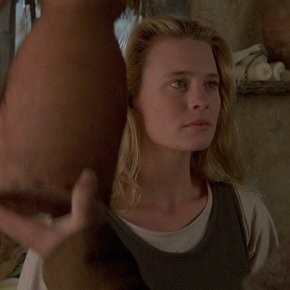
asyouwishMany of you met (or at least saw) my sister Melinda two weeks ago when we baptized Charlie and Amelia on this very spot. She’s one of the strongest and most loving people I’ve ever known, and I’m glad that my years spent being her “annoying little brother” didn’t damage our long term prospects of maintaining a close connection. This may sound funny, but I think one of the primary reasons we survived our young years with our friendship intact was the movie The Princess Bride. We both loved it, and no matter how long it had been since we last watched it, we would quote it to each other at every conceivable opportunity. And we still do sometimes. Rest assured, you can mute the film, and Melinda and I can supply the dialogue.

So it should come as no surprise to you that when I’m doing pre-marital counseling with couples preparing to be married, wisdom gleaned from The Princess Bride tends to slip in. As of last count, I’m officiating at ten weddings this year, so I’ve had the golden opportunity to give the “As you wish” talk to many couples, with many more to come.

The film opens with a grandfather reading S. Morgenstern’s “classic” tale to his sick grandson. As he reads, the picture melts into a bucolic setting where we meet two beautiful people. Buttercup commands the farm boy, Westley, to do several menial tasks – polish her horse’s saddle, fill buckets with water, fetch a pitcher. Each time, he responds, “As you wish.” Then we hear the grandfather, voiced by Columbo himself, the inimitable Peter Falk, say, “That day, she was amazed to discover that when he was saying ‘As you wish,’ what he meant was, ‘I love you.’ And even more amazing was the day she realized she truly loved him back.”

This discovery, of course, leads to a sunset kiss, a leave-taking to seek fortune across the sea, a supposed death, and (eventually) a harrowing reunion, a second separation, another supposed death, a rescue, and (finally) an escape together from the homicidal schemes of the evil prince. (It’s a fantastic movie.)

I bring up Westley’s “As you wish” with couples preparing for marriage because I’ve found that often they don’t realize or haven’t processed the ways in which their partners show their love. Rarely do both members of a couple display their love in the exact same ways. Because our husbands or wives show love differently than we do, we have a tendency to miss it and thus fail to appreciate this love.

Our New Testament lesson this morning speaks to the “As you wish” exercise. “Little children,” says the writer of the first letter of John, “let us love, not in word or speech, but in truth and action.” Just before this, the letter gives an example from Jesus: “We know love by this, that he laid down his life for us – and we ought to lay down our lives for one another.”

The writer of First John knows that saying, “I love you,” is all too easy – just three little monosyllables. Subject, verb, object. Meaning it is the hard part. Too often, the abused wife returns to her husband because “he says he loves me.” Too often, the college freshman wakes up crying the next morning, after being duped by “I love you.” Too often, “I love you” hurts more than it heals. The abusive husband and the collegiate predator weaponize the phrase, with no thought to its destructive consequences.

But this is where action comes in. This is where service separates truth from manipulation. You may be tempted to say that action is needed to prove that a spoken “I love you” is real. If this were the case, however, there would still be regular jousting tournaments throughout Christendom. Rather, active service is a spontaneous symptom of love – one that makes the spoken words extraneous (even though they are still nice to hear).

Loving and serving – we really mustn’t separate the two. Love expresses itself not only in poetic protestations: “Shall I compare thee to a summer’s day? Thou art more lovely and more temperate…” No. Love expresses itself in holding the beloved’s hair back when she’s bent over the toilet with stomach flu. Love waits all night in the hospital room, visits the prisoner, builds affordable housing, donates mac & cheese. Love gets its uniform dirty.

We will be reaffirming our baptismal covenant in just a few minutes. One of the promises echoes Jesus’ great commandment: “Will you seek and serve Christ in all persons, loving your neighbor as yourself?”

Will you serve? Will you love? “I will, with God’s help,” you’ll say. How will you serve? What will your love propel you to do?

This week I invite you to talk to your spouse or child or sibling or friend. Ask them how they see you demonstrate love. What ways do you show it above and beyond the spoken “I love you?” To whom are these displays of love directed? How can you employ your unique set of gifts to become an even better version of the loving person that God made you?

Do the same thing for your spouse, child, sibling, or friend. Discover together the ways God is calling you to be God’s loving servant. Discover together how God prompts you to be servants of one another in the power of mutual love. And discover together where God is inviting you to turn that internal love into external service. The writer of First John continues on this theme: “How does God’s love abide in anyone who has the world’s goods and sees a brother or sister in need and yet refuses help?” How indeed?

In The Princess Bride, Miracle Max reminds us that “True love is the greatest thing in the world.”* But unless we display that true love through our service to one another and to our brothers and sisters in need, what good is it? After we share Holy Communion with each other this morning, we will orient ourselves away from the table and toward the door. And we will pray, “Send us now into the world in peace, and grant us strength and courage to love and serve you with gladness and singleness of heart.” God sends us out to love and to serve. I pray that we will respond, “As you wish.”

* “Except for a nice M.L.T. Mutton, lettuce, and tomato, where the mutton is nice and lean. They’re so perky. I love that.”

Stigmata

Sermon for Sunday, April 19, 2015 || Easter 3B || Luke 24:36b-48

StigmataStigma is not a happy word. If you use it in a sentence, more than likely the word “stigma” will be linked to something that people view as disgraceful or humiliating, whether that view is warranted or not. A couple of us recently read a book called The Rich and the Rest of Us by Tavis Smiley and Cornel West, who spoke of the need to lift the stigma associated with the word “poverty” if we are ever going to muster the societal will to lift those on the margins. In years past, society has stigmatized attributes of people who exhibit less capacity than most, using words like “retarded” and “crippled” to describe those with mental and physical challenges. Suffice to say that members of every minority group – no matter the difference used to justify labeling them as “those people” – have been stigmatized in one way or another. Stigmas lead to segregation and prejudicial behavior and animosity. “Stigma” is not a happy word.


And so we need to begin this sermon by acknowledging once again the countercultural irony of the Christian faith. Both last week and this week, our Gospel writers John and Luke have narrated the scene of the Risen Jesus meeting his disciples and their companions for the first time. In both narratives Jesus shows them the wounds he suffered during his crucifixion: the marks of the nails in his hands and his feet, the mark of the spear in his side. And in both narratives, his wounds lead them to recognize him and rejoice (though Luke reminds us that disbelief and wonder temper their joy). Christian tradition has given a name to those wounds: the “Stigmata,” which is just the plural form of the word “stigma.”

Here, stigma is a happy word. Or at least Jesus turns it into one. The act of being crucified was thought of as the most awful and degrading form of humiliation in addition to being a horrible way to die. In his letter to the Galatians, the Apostle Paul quotes a verse of scripture: “Cursed is everyone who hangs on a tree” (3:13). Talk about a stigma! And yet by virtue of his resurrection, Jesus turned the cross from an instrument of torture, domination and death into a symbol of redemption, selflessness, and new life. If Jesus hadn’t redefined the cross, I doubt you would wear crosses around your necks or I would have one tattooed on my back.

Jesus’ life and ministry were all about redefining what people thought was acceptable. He took the prejudices fueling certain stigmas head on and gutted them. He touched those society had stigmatized as worthless or unclean: people with leprosy, blindness, and paralysis. He ate with poor people. He befriended tax collectors vilified for being in cahoots with the Romans. He conversed with foreign women. Jesus left every town he visited having laid waste to the stigmas that separated people from one another, having done his best to show people the healing grace that reconciliation brings.

Jesus spent his life demonstrating that the stigmas, which separated people from the larger society, would never separate those same people from him. His own physical Stigmata, made by nails driven through his wrists and ankles, are a further sign that Christ was willing to go to any lengths to suffer with and for those who are humiliated, marginalized, and disgraced. But here we need to make sure we don’t get stuck on Good Friday. If we forget about or try to explain away his resurrection, then the story ends the day the nail holes were made.

That’s why Luke makes a big deal about Jesus eating a piece of broiled fish. He really was there! And the marks of the wounds – the marks of his compassion, his suffering with and for everybody – remain even in his resurrected body. But right here we can sink into a theological morass if we don’t think hard about what the wounds in Jesus’ hands and feet really mean. Here’s the problem. If we say that his Stigmata are only the marks of a humiliating death full of suffering and pain, then we are also saying that such humiliation and suffering leave their mark in the new life of the resurrection, that a legacy of disgrace can sully a new life of complete grace. Thankfully, we don’t need to go there because Jesus’ lifetime of reversing stigmas works on his own Stigmata, as well. Indeed, the fact that his resurrected self still bears the marks of his wounds gives us clues as to what our own resurrected life looks like.

On Friday, Jesus’ Stigmata are marks of failure. His blood drips from the nails, which keep his sagging body affixed to the humiliating cross. But on Sunday, those same wounds are marks of triumph. The nails are gone, but the blood remains, the blood of the Lamb that washes us clean. In the life of the Resurrection no failure is great enough on our part to swallow the enormity of the victory Christ invites us to share.

This triumph redefines his wounds so that they are so much more than simply the marks of his suffering. They are also the marks of his obedience and our redemption. And they are the marks by which his friends recognize him. In other words, he calls his friends back into relationship and back into belief by showing them these marks. Thus the life of the resurrection is one in which our relationship with Christ becomes perfect and complete. But we can begin to live this new life now, even though we are incapable of perfection or completion because, as we just said, our failures do not sully the ultimate triumph.

The Risen Christ is alive in us, propelling us toward culmination with God in the life of the resurrection. Therefore, we too are capable of demonstrating Jesus’ Stigmata. I don’t think we will actually bleed from our hands and feet as St. Francis of Assisi did, but the marks don’t need to be visible to be real. By virtue of our baptism, we have been marked as Christ’s own forever. This mark includes the promise to walk Jesus’ path as best we can. Jesus’ life and ministry reversed and gutted so many stigmas, so many flimsy reasons for separation. Jesus’ death and resurrection reversed and gutted the stigma of death with the promise of new life.

As we walk in Christ’s footsteps, hear him calling to you to continue his work. Do all in your power to reverse and gut the stigmas that continue to make people feel less than they are. Take a hard look at yourself and see what prejudices you hold. Ask where they come from. Ask who taught them to you. Ask if they are the kind of prejudices that Jesus would have blown right through. Chances are they will be. Because Jesus’ never met a stigmatized person he didn’t touch or talk to or embrace.

We are Jesus’ hands and feet in this world. I pray that when people look at you and me, they will see the mark of Christ on us.

The dogwood flower (pictured above) has traditionally been used as an image of Christ’s wounds, as the red tips of the petals evoke the Stigmata.

Behold How Good

Sermon for Sunday, April 12, 2015 || Easter 2B; Psalm 133

BeholdHowGoodEcce Quam Bonum! I first heard these three Latin words in the fall of the year 2000 when I was a senior in high school. I stepped out of the car and stared in awe at the soaring Gothic architecture of the buildings arranged around the quad of a little college tucked away in the mountains of Tennessee. Ecce Quam Bonum! As a prospective student, those words were words of welcome to me: “Behold how good!” they proclaimed. These are the opening words of our psalm today, Psalm 133: “Behold, how good and pleasant it is, when brethren live together in unity!” Walking towards the beautiful sandstone chapel on that visit, I knew beyond a shadow of a doubt that I wanted to experience living together in unity at the University of the South in Sewanee, Tennesee. The next fall I matriculated, and the four years I spent at Sewanee were years of friendship, formation, discernment of call, and lots and lots of singing.

Even though I didn’t know how to sing at the time, I still loved to do it, so I joined the University Choir my first month of college. That choir became my family for four years. The intensity of being in the choir at Sewanee matched that of playing a varsity sport. We did everything together. Several times a week, I got to sing with that special community. It was a gift to be able to add my voice to that group. The fellowship of the choir at Sewanee made real for me those three Latin words: Ecce Quam Bonum, Behold how good!

The words of Psalm 133, which we sang a few minutes ago speak of the desire for joyful, harmonious fellowship with our brothers and sisters. Three other readings join this psalm, and each speaks about community and fellowship. In the Acts of the Apostles, Luke paints a happily-ever-after picture of the apostles and their companions, in which the “whole group of those who believed were of one heart and soul” (4:32). In the First Letter of John, the writer says, “We declare to you what we have seen and heard so that you also may have fellowship with us; and truly our fellowship is with the Father and with his Son Jesus Christ” (1:3). In the Gospel, the Risen Christ appears to the disciples as a group, grants them peace, and breathes the Holy Spirit upon them. Thomas is not with the disciples at the time, so as a group they seek him out and tell him the good news. A week later, when Thomas has returned to their fellowship, Jesus once again appears, and Thomas believes.

In just a few minutes we are baptizing two eight-month-old babies (two wonderful, beautiful babies, if I say so myself), and I can’t think of better lessons to accompany such a joyous occasion. The sacrament of Baptism celebrates the inward movement of God in a person’s life by outwardly welcoming that person into God’s family the Church. We baptize infants because we believe God is moving in all people, regardless of their ability to recognize or verbalize such movement. We baptize infants so that their earliest memories will be ones of being loved and cherished by a community of faith.

The “outward sign of inward grace” definition of a sacrament is tried and true, but it is also well worn, so let’s expand our understanding of what’s going on in baptism with a less academic and more musical metaphor.

The music of God plays in each one of our hearts. You’ve heard the expression, “tugging on my heartstrings” to describe something that evokes compassion and sympathy. Well, God tuned those heartstrings to resonate with God’s music; that is, God’s desires, yearnings, hopes, and dreams for God’s creation. That’s why we feel a tug on our hearts when we see someone in need – because God is directing us to notice and help that person.

Within our hearts, sometimes the music of God is soft, a half-whispered lullaby, barely discernible over the din of the world. Sometimes the notes crescendo to a deafening fortissimo that knocks us, weeping, to our knees. Most often, the music sounds as the percussive TUB-thp of our hearts — a rhythm that, if you listen closely, beats in time with the rest of the performing forces of creation. I’m not a theoretical physicist, but what I’m describing might be considered a poetic version of some of the more modern theories of how the universe works – it’s all about vibration, right? That’s really all music is – collections of well-defined vibrations. We identify the source of that vibration – that resonance – as God.

Each one of us has the music of God resounding within, but the choir is incomplete until we have found each other, until we have joined together in fellowship as the chorus of God, so to speak. In Greek, this fellowship is called koinonia, but I’ve always thought that “fellowship” is a rather limp translation. For the sake of our metaphor, let’s translate koinonia as “harmony,” which lands much closer to the descriptive intent of the Greek word. Musical harmony is the collection of notes that add structure, color, tone, depth, and meaning to the main tune. This tune, called the “melody” is the music of God within us. The combination of our own unique passions and hardships; our successes and failures; our gifts and shortcomings; our hopes, our dreams, and our joys creates the harmony of the music of God.

In the sacrament of Holy Baptism, we welcome another soprano, alto, tenor, or bass into the choir. We await eagerly the subtle changes in timbre that these new lives will bring. Together, we sing the koinonia, the harmony, of the music of God to a world so accustomed only to noise and clatter. The sound of our anthems resonate with the movement of God in this world. This is the sacrament of Holy Baptism: new sound, new harmony, new resonance in the chorus of the music of God.

One of my favorite songs is called “One Voice,” by the band The Wailin’ Jennys. With each verse, another voice is added to the mix. By the third verse, each member of the band is weaving her voice with the other two. They sing:

This is the sound of voices three
Singing together in harmony
Surrendering to the mystery
This is the sound of voices three
 
This is the sound of all of us
Singing with love and the will to trust
Leave the rest behind it will turn to dust
This is the sound of all of us

So Ecce Quam Bonum! Behold how good it is when we all sing together in harmony and surrender to the mystery of God’s movement in our lives. Behold how good it is when we welcome new life into God’s family and embrace the new life the resurrection brings. Behold how good it is when we invite others to join us as we add our harmonies to the melody of the music of God.

Whom are You Looking For?

Sermon for Sunday, April 5, 2015 || Easter Sunday, Year B; John 20:1-18


2015easterdayGood morning, and welcome to St. Mark’s on this glorious Easter Sunday. This morning we walk with Mary Magdalene to the tomb and find it empty. And yet our emptiness doesn’t last for long because Jesus, the Risen Christ, stands there, shining before us, as the dew glistens on the early spring flowers blossoming in the garden.

But before we get to this beautiful encounter, I want to talk to you for a moment about my favorite comic strip. Calvin and Hobbes and I grew up together. Bill Watterson’s impeccable creation began its run about two months before my third birthday and ended just before I turned thirteen. I wouldn’t be exaggerating if I told you I learned to read so I could consume Watterson’s genius. What attracted me to Calvin and Hobbes turns out to be the same element that makes our Christian faith so beautiful. The comic strip is all about the adventures of a young boy and his stuffed tiger. Yet while Calvin’s parents see only a stuffed tiger when they look at Hobbes, Calvin sees a living, breathing beast who might hug him or pounce on him depending on the tiger’s mood. For Calvin’s parents, the stuffed tiger is a “what.” It’s just another thing, a toy. But for Calvin, Hobbes is so much more than a “what.” Hobbes is a “who.”

In the same way, our Christian faith is based not on a “what,” but on a “who.” Yes, we have doctrine and catechism and creed, but none of those trappings matter if we forget the answer to the “who” question that undergirds them all. In the garden this morning, the Risen Christ asks Mary Magdalene this “who” question. Whom are you looking for? At first, Mary answers with a “what” response. She’s wondering what has happened to the body of her Lord. But when Jesus says her name, she recognizes him for who he is – he’s still Jesus, and yet he’s more somehow, as if the power of the resurrection made him a truer version of himself. I imagine Mary launching herself into his arms and their embrace lingering because she thought she had lost him – she had lost him – and yet here he is. You can try embracing a “what,” but only a “who” will embrace you back. The Risen Christ is the answer to this “who” question our faith asks.

Throughout the last two chapters of the Gospel according to John, Jesus appears to his friends five times. In each encounter, something could keep the disciples from recognizing the Risen Christ in their midst, but his presence dispels those barriers. The same barriers often stand in our way and keep us from embracing the Risen Christ in our midst. These barriers trick us into seeing just a stuffed tiger, so to speak, when Hobbes is standing there grinning with a pile of snowballs at the ready. I’d hazard to guess we’ve all known each of these barriers. But today, on this feast of the Resurrection, Jesus gives us the opportunity to answer his question anew and dispel those barriers once again. So whom are you looking for?

The second half of our Gospel reading this morning begins with tears. “But Mary stood weeping outside the tomb.” Her sorrow could be a barrier keeping her from seeing the Risen Christ. Indeed, when she sees him, she thinks he’s the gardener. She even accuses him of stealing her Lord’s body. She’s hurting, and not even a vision of angels staunches her pain. In moments of sorrow, the Risen Christ asks us: “Whom are you looking for?” Responding with his name won’t necessarily make the sorrow go away. But it will help us notice his presence in our midst, suffering with us, and offering us strong arms to carry our burdens when they become too heavy to bear alone.

Later that evening, “The doors of the house where the disciples had met where locked for fear of the Jews.” The disciples have hidden themselves away because they’re afraid they will be next for the cross. The fear is so palpable that it hangs in the room like fog, silencing all attempts at conversation and isolating each man with his own dark thoughts. But a locked door and fog of fear cannot stop the Risen Christ from appearing in their midst. He dispels their terror with a word of peace. In moments of fear, the Risen Christ asks us: “Whom are you looking for?” As we breathe out his name, we breathe in this same peace, the peace that passes all understanding.

The next week, Thomas is with them. He wasn’t in the house the last time, so he still hasn’t seen the Risen Christ. “I need to see him and touch to know you are telling the truth,” he says to his friends. His doubt is understandable. How could he possibly believe a story so incredible without some shred of proof? And yet when the Risen Christ stands before him, he falls to his knees and utters the most resounding declaration of faith in the whole Gospel: “My Lord and my God!” And all without ever touching Jesus. In moments of doubt, the Risen Christ asks us: “Whom are you looking for?” And in those moments, even the smallest, most doubtful voice we can muster is enough when we say, “You, Lord.”

Some time later, seven of Jesus’ friends are out on the Sea of Tiberias fishing. Or should I say trying to fish. They’re out all night and they catch nothing. You can imagine their frustration mounting as the morning sun gilds the clouds. But then someone on the beach beckons to them and tells them to cast the net one more time. And the bulging net is so full they can’t haul it in. In moments of frustration, the Risen Christ asks us: “Whom are you looking for?” Saying his name helps us reorient ourselves to what matters and let go of our frustration long enough to try again, this time with Jesus’ posture of abundance replacing our frustrating and shriveled posture of scarcity.

Once on the beach, with the fish grilling away on a charcoal fire, the Risen Christ takes Simon Peter aside. He knows Peter feels ashamed for the way he acted on that terrifying night when Jesus was arrested. Three times Peter denied knowing Jesus. So three times Jesus asks Peter, “Do you love me?” With each affirmation – “Yes, Lord; you know that I love you” – Jesus replaces Peter’s shame with a new sense of worth. And with this new sense of worth comes a mission: “Feed my sheep.” In moments of shame, the Risen Christ asks us: “Whom are you looking for?” Shame has a way of making us feel unworthy to say his name. And so he asks again and again until we know that his concern for us makes us worthy to respond: “I’m looking for you, Lord.” And for him to say, “Well, you found me, and no amount of shame will ever make you unworthy of my love.”

Sorrow. Fear. Doubt. Frustration. Shame. These are just a few of the barriers that can keep us from being aware of the Risen Christ in our midst. But in each case, Jesus does not let those barriers keep him from coming near, embracing us, and never letting us go. Never letting anyone go. This is the power of the Resurrection: the barrier is temporary, but the embrace is eternal. The “who” at the center of our faith outlives and outshines all of the “what” that we clutter our lives with. So when you leave this church today, go out into the world with Jesus’ question to Mary on your lips: “Whom are you looking for?” Today, tomorrow, every day, and on into eternity, make this your answer: “You, Lord. I’m looking for you.” And here the Risen Christ say to your soul, “You found me. And you have been found.”

Art: Detail from “Mary Magdalene in Meditation” by Le Nain Brothers

The Waters of Baptism

Sermon for the Easter Vigil, Saturday, April 4, 2015


2015eastervigilIt’s great to have a baptism scheduled for the Easter Vigil, but we didn’t this year at St. Mark’s. I still wanted to bless the water of baptism before we renewed our baptismal covenant, so my father suggested I build the blessing into my sermon. At the vigil, you can preach before or after the transition from darkness to light, and this year I chose before.
Tonight, we began with fire. We kindled a new flame and processed the Light of Christ into the church. We gave “this marvelous and holy flame” to God during the chanting of the Exsultet, saying: “Holy Father, accept our evening sacrifice, the offering of this candle in your honor. May it shine continually to drive away all darkness. May Christ, the Morning Star who knows no setting, find it ever burning––he who gives his light to all creation.”

Then we heard the first words ever spoken in that creation; indeed, the Word spoken to call creation forth: “Let there be light!” Creation erupted from this Word and God flung wide the fiery fusion of the stars and billions of years later, here we sit. (I skipped a little bit of the story there.) Our worship this night returns to such primal origins to make sure we know the infinite and eternal reach of the event we are about to celebrate. As I said, tonight, we began with fire.

And now we move from one primal element to another – from fire to water.

(I pour the water into the baptismal font.)

“We thank you, Almighty God, for the gift of water. Over it the Holy Spirit moved in the beginning of creation.” (These are the first words of our baptismal rite’s blessing of the water. The rest are contained throughout this sermon.) The fiery fusion of the stars is there a moment after the beginning, a moment after the blazing creativity of the Holy Spirit dances over the face of the deep. When we give thanks to God for the gift of water, we show our gratitude for one of the fundamental things that makes life possible. We might not normally thank God for water, especially where we live and in this day and age, because water is so plentiful and constant. But tonight we acknowledge the gift of this building block of life, which helps us focus on those things that sustain life.

“Through [water] you led the children of Israel out of their bondage in Egypt into the land of promise.” We heard this story a few minutes ago, too. Moses, Aaron, Miriam, and all the people of Israel stand at the edge of the sea with their enemies bearing down on them. The sea could be a barrier, but God causes it to be their protector and rearguard. They arrive on the other side, but the sea swallows up the Egyptians and all their trappings of war. As the water delivered the people from slavery in a foreign land, for us the water symbolizes freedom from all that enslaves us.

“In [water] your Son Jesus received the baptism of John and was anointed by the Holy Spirit as the Messiah, the Christ, to lead us, through his death and resurrection, from the bondage of sin into everlasting life.” Jesus’ baptism began his public ministry of healing and bringing people closer to God. You might wonder why Jesus himself was baptized since John’s baptism was a path to repentance. What would Jesus need to repent if he knew no sin? With his baptism, Jesus foreshadows his death on the cross. He did not need to be baptized, not for the reasons the others coming out to the Jordan River did. But he chose baptism in order to wash in the same muddy water and to be in solidarity with his people. In the same way, he chose the cross, not because of his own guilt, but because of ours. In the river, Jesus swims in the sin of the people. And on the cross, the same sin hangs there with him.

“We thank you, Father, for the water of Baptism.” We show our gratitude again, this time for specific water, the special water of Baptism. This water is like any other, except that we set it apart with prayer and blessing and ask the Holy Spirit to make it holy.

“In [the water of Baptism] we are buried with Christ in his death. By it we share in his resurrection. Through it we are reborn by the Holy Spirit.” We borrow these words from the Apostle Paul, who wrote the church in Rome: “Do you not know that all of us who have been baptized into Christ Jesus were baptized into his death? Therefore we have been buried with him by baptism into death, so that, just as Christ was raised from the dead by the glory of the Father, so we too might walk in newness of life” (Romans 6:3-4). A baptism is so much more than a ritual washing away of sin, says Paul. Indeed, in baptism we recognize that we have died and risen with Christ. Paul continues, just to make sure we understand his point: “For if we have been united with him in a death like his, we will certainly be united with him in a resurrection like his” (Romans 6:5).

“Therefore in joyful obedience to your Son, we bring into his fellowship those who come to him in faith, baptizing them in the Name of the Father, and of the Son, and of the Holy Spirit.” How could we not invite others into Christ’s fellowship after we have known the supreme gift of the Risen Christ being alive in us? But just in case we think that this new life is too precious to share, but must be hoarded like other precious things, Jesus himself commanded us to “Go… and make disciples of all nations, baptizing them in the name of the Father and of the Son and of the Holy Spirit” (Matthew 28:19).

“Now sanctify this water, we pray you, by the power of your Holy Spirit, that those who here are cleansed from sin and born again may continue for ever in the risen life of Jesus Christ our Savior.” We ask the Holy Spirit to infuse this ordinary water with the presence of God just like we will do later with ordinary bread and wine. We set the rite of baptism at this point in our service because it serves as the perfect hinge between death in the gloom of Friday and new life at dawn on Sunday. When you feel this water touch your skin in a few minutes after we renew our baptismal covenant, remember that you have died and risen with Christ. You belong not to the old things that are passing away. You belong to the new creation.

“To [Christ], to you (Lord), and to the Holy Spirit, be all honor and glory, now and for ever. Amen.”

Art: Detail from “Creation of the World” by Ivan Aivazovsky, 1864

The New Version of Me

A Good Friday Meditation; John 19:31-42


2015goodfriImagine with me the thoughts of the Pharisee Nicodemus on his way home from helping Joseph of Arimathea bury the body of Jesus. Nicodemus appears at the end of the Passion Gospel reading, as well as two other places in the Gospel according to John, both of which are referenced in what follows.
Two years ago, I knocked on a door. I waited until nighttime and wrapped myself in a traveling cloak with a deep hood so no one would recognize me. Was I afraid to be seen with Jesus, who my colleagues branded as a dangerous radical? Yes, but fear was not the main reason for my caution. I was ashamed. I was ashamed to admit that I didn’t have all the answers, ashamed that someone else’s words could make me feel so infantile, like a newborn baby. So I hid myself in darkness, not to protect against prying eyes, but to conceal me from myself. I hid from myself. I hid from the version of me that Jesus was beckoning to emerge from some long forgotten exile.

I used to relish my position on the council, my authority as an arbiter. I took pleasure in the blank looks of acceptance on the faces of my litigants. They invested me with the power to judge, and I failed to notice when that power mutated into self-assured complacency. Predictability became my idol. There was never a new problem to be solved, never something I couldn’t explain or interpret or analyze. Over the years, I forgot how to ask questions because I was always the person with the answers.

Until that night. Until my vestigial curiosity awoke that night. When I first opened my mouth, my council voice came out, and I made a grand statement about knowing who comes from God. I could tell immediately that Jesus was not one to be cowed by my position or impressed by my stature. “I tell you the truth,” he said, “no one can see the kingdom of God without being born from above.”

I didn’t know what to say. I remember opening and closing my mouth several times. I remember Jesus smiling at me – patient, eager. Then my breath forced an “H” sound from my throat, and I was surprised when the word “how” came to my lips. I was asking a question. “How can anyone be born after having grown old?” The floodgates opened, and for the rest of the conversation, all I did was ask questions: “Can one enter into the mother’s womb a second time and be born? How can these things be?”

Ever since that night, I have heard his words carried on the wind. Since the wind blows where it chooses, my idolatrous reliance on predictability has vanished. Since I don’t know where the wind comes from or where it goes, my fantasy that I have all the answers has disappeared, as well. On my way to see Jesus, I was hiding from a new version of me. But everyday, I felt Jesus’ words drawing that new version out of me.

Last year, I reminded my colleagues to obey their own rules. No one on the council had discovered my secret meeting with Jesus, so my position was safe. The two versions of me occupied the same body, and, at that time, the familiar one dominated still. But I had begun to question and look past the veneer of institutional banality.

Jesus had shown up at the festival of booths and caused quite a stir. The chief priests had sent the temple police to arrest him, but they came back empty handed saying: “Never has anyone spoken like this!” I suppressed a smile. He escaped again. The rest of the Pharisees were outraged. One of them shouted: “Surely you have not been deceived, too, have you? Has any one of the authorities or of the Pharisees believed in him?”

A small voice inside me murmured: “I do.” Then a louder voice: “Careful. Careful.” When I spoke, I tried to defend Jesus without giving myself away. “Our law does not judge people without first giving them a hearing to find out what they are doing, does it?” But they were implacable. That’s when I noticed something I would never have seen had Jesus not awakened my curiosity. These colleagues of mine, the keepers of tradition, the self-proclaimed protectors of the Law, were breaking their own rules. I could no longer be party to such bankrupt ideals and blind action. That day, the small voice grew louder, the voice attached to the new version of me.

Today, I buried my Lord. Two years ago, I went to see him at night to cloak my own shame. But today, the sun shines down, unaware that its brightness mocks the darkness in my soul. The sun shines down, and I walk out under its beams so the world can see where my allegiance lies. When first we met, Jesus said to me, “Those who do what is true come to the light, so that it may be clearly seen that their deeds have been done in God.” It took two years, but here I am. Here I am in the light.

See, all you who pass by: I am one of his. I am not the person you knew. I am a new version of me, the version Jesus called out of me. See, all you who pass by: I am not ashamed any more. I feel the wind on my face, and I know his words are true. See, all you who pass by: is there any sorrow like my sorrow. My Lord is dead. It took his death for the old version of me to die. But will my new version survive with him gone? Will I have another chance to walk in the light? Has the darkness won? When will the light return?

Updated from a piece I wrote for Good Friday, 2009.
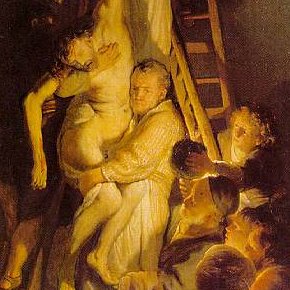
Art: Detail from The Descent from the Cross by Rembrandt, 1634

He Loved Them to the End

Sermon for Maundy Thursday, April 2, 2015 || John 13:1-17, 31b-35

2015maundythurs“Before the festival of the Passover, Jesus knew that his hour had come to depart from this world and go to the Father. Having loved his own who were in the world, he loved them to the end.” Thus begins the second half of the Gospel according to John. We’ve walked with Jesus for three years since he called his first disciples, since he miraculously turned water into wine, since he drove the businesspeople out of the temple. We’ve overheard his conversations with the Pharisee Nicodemus and the Samaritan woman at the well. We’ve seen him heal a man suffering from paralysis and a man born blind. We’ve eaten the bread broken to feed 5,000 people. We’ve listened to Jesus call himself all sorts of names: the bread of life, the light of the world, the good shepherd. Recently, in an act that probably sealed his fate with his enemies, he raised his friend Lazarus from the dead.

That’s what happens in the first half of the Gospel. In the second half, we sit down with Jesus at dinner as he washes his disciples feet and talks with them late into the night. We follow him as he is arrested, tried, convicted, and crucified. And with Mary Magdalene and Thomas and the rest of the disciples, we see him risen again.

In between the two halves of the Gospel according to John, we have these two verses serving as a hinge. “Before the festival of the Passover, Jesus knew that his hour had come to depart from this world and go to the Father. Having loved his own who were in the world, he loved them to the end.”

He loved them to the end. This is one of my favorite verses in the Gospel because it is deliciously ambiguous. The ambiguity raises this question: What end does he love us to? The obvious answer is his own death: the end about to be narrated, the end that happens at Golgotha. But this “end” is an unsatisfactory choice because we who live on the other side of Easter know that the cross was emphatically not the end.

So what other “end” is there? There’s our own, individual ends. Surely, he loves us to that point. But this too is an unsatisfactory answer, because our own earthly deaths are not the end either. They are a gateway to the larger and fuller life of consummation in God. The most famous hymn ever written reminds us there’s no end to that life, ever. “When we’ve been there ten thousand years, bright shining as the sun, we’ve no less days to sing God’s praise than when we’d first begun.”

Then there’s the end of the planet we live on. That will happen at some point, whether we humans cause it or the star we call the sun loses its light. But even then, we believe the words St. Paul shares with the church in Rome: “Neither death, nor life, nor angels, nor rulers, nor things present, nor things to come, nor powers, nor height, nor depth, nor anything else in all creation, will be able to separate us from the love of God in Christ Jesus our Lord.” That’s pretty definitive, if you ask me.

Having loved his own who were in the world, he loved them to the end. I honestly can’t think of an “end” final enough for the love of Jesus Christ to move from the present tense to the past tense. That’s what this week we begin tonight is about. Each day there is another end. Jesus is arrested and everyone flees. That sounds like an end. Jesus is convicted to die. Another ending. Jesus dies on the cross. The story is over. The stone rolls shut on the tomb. The End.

And yet none of these is the end. There is no end where the love of Christ is concerned. The love of Christ is bigger than the end. In the first half of the Gospel, this love heals the broken and raises the dead. This love opens the minds and hearts of those who hear Jesus speak. This love perseveres through the invective of his enemies. And now this love brings him to his knees with a basin and towel to serve his friends. This love expands out from Jesus as he gives his followers a new commandment: to love each other as he loves them. As he loves you. Me. Us.

In another letter, Paul speaks about love. And among those well-trod words, three of them ring out: “Love never ends.” So whether you are at the end of life or simply at the end of your rope, know this. Jesus loves you to the end. And because there is no final end, no end of ends, we can in all faith shorten that sentence to this: Jesus loves you. Always has. Always will. Because there is no end to his love.

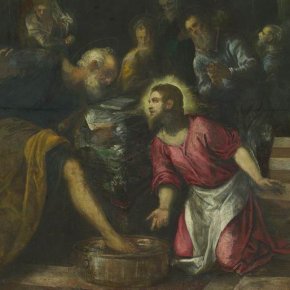
Art: Detail from Christ Washing the Feet of the Disciples by Tintoretto (late Ren.)

Two Horrible Words

Sermon for March 29, 2015 || The Sunday of the Passion: Palm Sunday Year B || Mark 14:32 – 15:47

twohorriblewordsUsually the sermon follows the reading of the Gospel, but on this particular day – The Sunday of the Passion: Palm Sunday – I prefer to preach first in order to help us orient ourselves towards the lengthy and powerful story we are about to hear. And because I think anything I would add after reading the Passion Gospel would serve only to lessen its impact. Also, this sermon will be unusually short since today’s service has a lot of extra parts, and so I’m going to limit myself to talking about two words. Only two words out of the 1,837 that make up today’s Passion Gospel. Those two words are: “Crucify him.” Those are your words. Three of us will be standing up here reading the rest of the characters, but you have a part to play, as well. Yours is the part of the crowd. Your part has one line, spoke twice. “Crucify him.”

I know many people who are so uncomfortable about saying this that they decline to join in, and I respect that. But I also think it invites further examination. When we shout, “Crucify him,” we place ourselves amongst Jesus’ opponents. We are given this opportunity – within the context of the liturgy – to join the crowd clamoring for Jesus’ death. This serves two purposes.

First, it serves as a corrective measure against the millennia old fallacy that “the Jews killed Jesus.” This mistaken outlook has led to ferocious atrocities perpetuated against Jews by Christians over the course of history, and it is unconscionable. That this malicious viewpoint still exists today among some Christians shows the worst side our religion is capable of. The Jews only killed Jesus in so far as everyone in the story besides Pilate and his soldiers is Jewish – including Jesus. Jesus was not the first Christian, and it was a couple generations before Jewish followers of Jesus stopped identifying themselves as Jewish. By putting ourselves in the group that shouts, “Crucify him,” we acknowledge that we, too, are part of the legacy of those people swept up in the bloodlust of the chief instigators of Jesus’ arrest. And by standing in that group, we liturgically atone for the sins of past Christians who persecuted Jewish people for “killing Jesus.”

The second purpose is this: by shouting, “Crucify him,” we give voice – if only for a moment – to the worst pieces of ourselves that want to have nothing to do with Jesus. If they wanted something to do with him, they wouldn’t be our worst pieces. Each of us has within us – hidden or not so hidden – these worst pieces. Pride. Envy. Hypocrisy. The desire to dominate. Separate. Isolate. And our fate hangs on our ability to recognize these shadowy pieces. To acknowledge them. To allow voice to the worst of what makes us, us. And once we’ve acknowledged them, we can confront them. Jesus is on his way to the cross, where he confronts the worst of the worst of the human condition. When we shout those two painful, horrible words – “Crucify him!” – the worst of the worst bubbles to the surface. And once on the surface, we can skim it off, like a layer of fat from a broth. With the fat skimmed off, we give it to Jesus. Jesus takes it to the cross. And there it is nailed with him. And there it dies with him.

I hope you will speak those two words today, despite how painful they are to voice aloud. Saying, “Crucify him,” is another way we make our confession. It is another way we acknowledge that sometimes we stand on the wrong side. And it is another way for us to realize the depths of love Christ has for us. Even though we ignore him and deny him and abandon him and crucify him, he does not stop loving us back into right relationship with God. He does not stop sweeping away the worst of our pieces and reconstructing us only using the good parts. So today, when you say those two painful words, “Crucify him,” remember that you have already been forgiven. And remember that next week, you’ll have the opportunity to replace these two ugly, horrible words with shouts of joy.

Humble Access

Sermon for Sunday, March 22, 2015 || Lent 5B || Jeremiah 31:31-34; Psalm 51:1-13

HumbleAccessThis is the last Sunday of the year in which we are worshiping according to the older, Rite I format of our liturgy. A few weeks ago, I mentioned that the reason we’ve been using the more traditional language was so we could say that beautiful line about inclining our hearts towards God. But there’s another reason, one that I didn’t mention then because I was fairly sure I was going to preach about it today. There’s a special prayer found in the traditional rite that is not duplicated in the modern one, a prayer we’ve been praying directly before communion for the last several weeks. Today, we will pray it one last time. The “Prayer of Humble Access” goes like this:

“We do not presume to come to this thy Table, O merciful Lord, trusting in our own righteousness, but in thy manifold and great mercies. We are not worthy so much as to gather up the crumbs under thy Table. But thou art the same Lord whose property is always to have mercy. Grant us therefore, gracious Lord, so to eat the flesh of thy dear Son Jesus Christ, and to drink his blood, that we may evermore dwell in him, and he in us. Amen.”

Before we dive deep on this prayer, let me tell you why I’ve been wanting to preach about it. For the longest time, I detested this prayer. I never wanted to attend a Rite I service because I did not want to say this prayer. I had my reasons: it felt too much like gratuitous self-flagellation; like I was groveling; like I had forgotten to put on my hair-shirt. It didn’t seem to mesh with the joyfulness of receiving Holy Communion. But, to be honest, those reasons were a smokescreen.

The real problem I had with this prayer was that my Pride* would not countenance me saying these words. The sin of Pride is the sin of forgetting who made you; the sin of reconstructing your life so that all of the good things that happen to you happen because of you. My Pride made me trust in my own presumed righteousness. My Pride generated a false sense of worthiness to sit at the Table. And so I never could get to the part of the prayer where we stop talking about ourselves and start talking about God. I’d be willing to bet, for one reason of another, that some of you have had similar issues with this or other prayers we say in the Episcopal Church.

Somewhere along the way, thanks in large part to my mentor and former rector Margot Critchfield, God engendered a change in me, so that, instead of embracing my Pride, I started to fight it. I still lose a lot of the time, but the Prayer of Humble Access has turned from a stumbling block into a reliable source of defense against my Pride.

So let’s take a look at what we are actually praying when we say this venerable old prayer, the words of which go all the way back to the first Book of Common Prayer of 1549. What we will find are words that put us in right relationship with God and teach us about the mystery of this Holy Communion we share.

“We do not presume to come to this thy Table, O merciful Lord…” The first thing to notice is the owner of the table behind me. The altar does not belong to St. Mark’s Parish. It does not belong to the Episcopal Church in Connecticut. It does not belong to you or me. The table is God’s Table. Whether this is your first Sunday with us or you’ve been worshiping here forty years, you are still God’s guest when you come forward to receive Holy Communion. Therefore, when we do come forward, we are practicing our acceptance of God’s invitation again and again. This is one of God’s more obvious invitations, so accepting it each week helps train us to accept the less obvious invitations God sends us when we aren’t surrounding God’s Table.

“We do not presume to come to this thy Table, O merciful Lord, trusting in our own righteousness, but in thy manifold and great mercies.” These words answer the question: “Where do we put our trust?” My old prideful answer told me to trust in my own righteousness, but the prayer places our trust in much more secure hands – in God’s “manifold and great mercies.” So what we’re really saying with this first sentence of the prayer is that we cannot hear God’s invitation to the Table until we relocate the object of our trust away from ourselves. The invitation has nothing to do with how good or righteous we are. We come to the Table because God’s mercy draws us there.

This is good news, especially when we are mired in the darkness like the writer of today’s psalm. The poet cries out, “Have mercy on me, O God, according to your loving-kindness; in your great compassion blot out my offenses. Wash me through and through from my wickedness and cleanse me from my sin.” Even in the midst of the deepest darkness, God’s mercy and compassion can draw us back home. In Hebrew, the word translated here as “compassion” has the same root as the word “womb.” Thus, God’s compassion can bring us back to a moment of glorious togetherness like when a mother feels when her baby kicks. We find this togetherness, this connection, when God’s mercy draws us to the Table for our sacred meal.

“We are not worthy so much as to gather up the crumbs under thy Table.” This is the sentence that always made me cringe so much in my Pride. But the next sentence turns the camera around: “But thou art the same Lord whose property is always to have mercy.” So what these words lay bare is not our unworthiness, but God’s great generosity in having us as guests at God’s Table. This is the same generosity God extends to the people of Israel through the voice of Jeremiah the Prophet in today’s reading. The people have strayed again and again and again, and still God calls them back, makes a new covenant with them, and writes God’s law on their hearts. Like those ancient people, we are unworthy, except that God’s grace makes us worthy to receive God’s gifts.

And what is the greatest of gifts? The last words reveal all: “Grant us therefore, gracious Lord, so to eat the flesh of thy dear Son Jesus Christ, and to drink his blood, that we may evermore dwell in him, and he in us.” We reach the crux of the prayer, the part my Pride never let me reach in days past. And just look what that Pride barred me from asking for! With these words, we reveal our deepest longing for a mutual indwelling with Christ. Dwelling in him means touching the peace that passes all understanding. And to have him dwell in us means feeling our hearts resonate with the yearnings of his heart, the yearnings that lead us to love and serve and sacrifice and rejoice.

In the end, this beautiful prayer that we will pray later in this service speaks to our longing for the deeper connection with God that Holy Communion offers. So today, when you come up to receive the gifts of bread and wine, which are the Body and Blood of Jesus Christ, keep the Prayer of Humble Access on your lips. And remember what it teaches: God has invited us to the Table. God’s compassionate mercy allows us to accept this invitation. God’s generosity grants us the grace to connect deeply with God. And this connection blossoms as a mutual indwelling between Christ and us. Praise God that we have the opportunity to connect with God so closely, so intimately. Praise God for the gift of such Holy Communion.

* I capitalize Pride here because I’m speaking of the word in its sinful connotation. There’s a reason that Dante placed Pride at the base of the mountain of purgatory in his The Divine Comedy. All other sins have their roots in Pride. That being said, of course it’s okay to say that you take “pride” in your children, and so on. That’s pride of a different order.
The version of the prayer we use in the 1979 Book of Common Prayer has a few variations form the original form and the modified one still in use today in England. Check out this Wikipedia article to see the other wordings. http://en.wikipedia.org/wiki/Prayer_of_Humble_Access
Webb, Elizabeth. Commentary on Psalm 51:1-12. http://www.workingpreacher.org/preaching.aspx?commentary_id=2408 [accessed: 18 March 15]