Sermon for Sunday, September 20, 2015 || Proper 20B || Mark 9:30-37
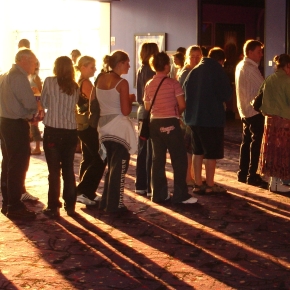
 Every day of my fourth grade year, my class lined up at the end of recess to go back inside. The bell rang, and we raced to our spots in the line. But the race was in vain because no matter who arrived at the door first, we always lined up alphabetically by last name. By last name. What I wouldn’t have given to line up by first name. Then (Oh happy day!) I would have been at the very front of the line. No Aarons or Abigails in my class. No. Adam would have been the first name on the list. But those days were cruel. Every morning, I stood on tiptoes to see over the twenty-three heads in front of me, and only one boy – Shane Yellin – was worse off than I.
Then, on the day when all the mothers began insisting their fourth graders wear winter coats to school, something happened. Mrs. Ida Hughes, my math teacher, challenged us to line up in reverse alphabetical order. And for one cold, drizzly, glorious day, I stood at the front of the line and only one head obstructed my view of the playground doors.
Standing at the front of the line feels good and the benefits are numerous. Being in front means the concert tickets aren’t sold out. The first baseman hasn’t tired of signing autographs. The bucket of fried chicken at the church potluck retains its full complement of chicken legs. Certainly, perks abound for those in front. Go to any shopping center in the wee hours of the morning on the day after Thanksgiving and witness the millions of Americans attempting be first in line simply to purchase new TVs for “doorbuster” prices.
Of course, these benefits are all about me. I get the tickets and the autograph and the preferred piece of chicken. I get the deal on the television. I get all these things because I got in line before you. You are behind me and someone else is behind you and countless faceless others line up behind that someone else. So we stand in our line and stare at the backs of the heads in front of us. In this linear configuration, no one can converse. No one can relate. No one can do anything more than slowly shuffle forward, both surrounded and isolated at the same time.
This isolation is the danger Jesus envisions when he places a little child among his disciples. They’ve been arguing about which one of them is the greatest (in other words, which one of them should be first in line). The prevailing linear culture has thoroughly molded the disciples. They only understand relationships in terms of hierarchy based on class, gender, and age. But they’ve been hanging around Jesus long enough to know that Jesus is thoroughly countercultural. He talks with women. He eats with outcasts. He touches the unclean. And so the disciples lapse into embarrassed silence when Jesus asks them about the content of their argument. They know they’ve provided Jesus with what would now be called a “teachable moment.”
The disciples expect something countercultural and that’s exactly what Jesus gives them: “Whoever wants to be first must be last of all and servant of all.” To illustrate the revolutionary nature of this statement, Jesus brings a small child and places the child among the disciples – not before them or after them, but among them. In Jesus’ day, this child was the last of the last. The hierarchy of the society placed children just below farm animals because you could get a lot more out of a goat than a toddler, and the goat would probably live longer. Children had no rights or protections. They weren’t even considered people until they were old enough to work.
But Jesus ignores this cruel stratification when he says: “Whoever welcomes one such child in my name welcomes me.” Jesus commands his disciples and us to welcome those whom society deems lowest of all. With this welcome comes the opportunity to see the faces and learn the stories of those who until now were at the end of the line, too far removed from us to register on our radar. And as we hear the stories of the lowest and the last, we seek ways to serve them and serve with them.
But one of the greatest mistakes of our time has been the Western presumption that we know what’s best for the people we serve: “You might not have said you need a well in your village, but we’re going to come and build one anyway.” This imperialistic attitude only perpetuates the linear model, which our service should be attempting to supplant. However, with his command to welcome, Jesus doesn’t allow us to develop a “serve first and ask questions later” mentality. Welcoming provides the framework through which service leads to the building up of relationships.
With his emphasis on relationships, Jesus changes the existing linear model into a circular one. In the line, you can’t welcome anyone because all you see are the backs of heads. You can’t serve anyone because the implied hierarchy of the line makes isolation the norm. You can only count the number of people ahead of you and nurse your own indignation over your rotten place in line. But in the circle, there is no first and no last. We can grasp hands in welcome precisely because we will be unable to quantify our position in the continuous round. And relationships have a chance to flourish because we look not at backs but at each other’s faces.
This circular model of welcome and service stands in laughable contrast to the current situation in this country. Too many incidents to count show that the tired old scourge of racism is alive and well. The drive to produce leads to longer hours, more work, and more money, but assuredly less happiness, less camaraderie. The gap between the rich and the poor grows ever wider. Each of these examples depends on the linear model continuing to thrive. And it is. So here we sit with our Lord challenging us to do something, which the loudest voices on the other side of those doors claim is utter nonsense.
To be first you must be last of all and servant of all, he says. Let go of linear relationships based on power and ambition and embrace circular relationships based on welcome and service. If you are standing near the front of the line now, start walking to the back. Grab the hand of the last person in line and form the circle. Welcome the least among us. Listen to their needs, their desires, their dreams. Form new relationships. Partner with them in service because we are only as strong as our weakest members. Jesus invites us over and over again to accomplish these things. And Jesus never issues an invitation without simultaneously offering the gifts needed to embrace it.
So to every fourth grader lining up after recess and to every businessperson lining up at Starbucks and to everyone whose ambition blinds him or her to those standing on tiptoes in the back: Give up your place in line.
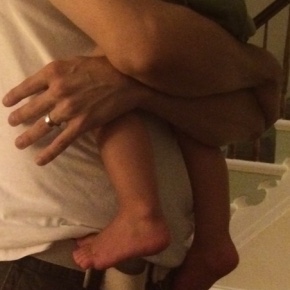
 This week has been a particularly tough one for our twins, Charlie and Amelia. At thirteen and a half months, we think they are cutting their molars, so their extreme fussiness is understandable. On Tuesday, I walked in the door of the kitchen, and before I had taken three steps, Charlie was toddling up to me as fast as his little legs and precarious balance would allow. He ran into me and buried his head between my knees, which is his way of saying, “Pick me up, Daddy.” I hefted him into my arms. He put his arms around my neck and his head on my shoulder. And for the next twenty minutes, I just walked around, holding him and speaking softly into his ear. It was a special moment, a physical heart to heart.
 You might be wondering if I accidentally read two weeks worth of Gospel lessons just now. The story of Jesus and the Syrophoenician woman ended satisfactorily, and at that point I could have said, “The Gospel of the Lord.” But the appointed lesson for today barrels forward into the next story, as well, and we read about Jesus healing a man who cannot hear and can hardly speak. We could focus on either half of this Gospel reading: there surely is enough in each to fill out a sermon. But today, I’m going to break a rule of preaching and bite off more verses than I normally do because I think the Gospel writer Mark places these two stories side-by-side for a reason. And this reason centers on the strangest word in the passage, a word that itself needs to be translated because Mark chose to preserve Jesus’ original language when he wrote it down. That word is “Ephphatha”: Be opened. Openness is the key to these two encounters. And openness is one of the keys to our lives as followers of Jesus Christ.
 My tenth grade English teacher, Mrs. Lewis, disliked linking verbs – passionately disliked linking verbs. She disliked linking verbs so much that she would count the number of times we students used the words “is” and “was” (and all the others) in our papers and deduct points if we exceeded more than one or two per paragraph. She nursed a particular vendetta against the word “become,” if memory serves. Do you know how hard it is to write a paper with next to no linking verbs? (I just used one in the last sentence, and you probably didn’t even notice.) Now we students grumbled about this strict grading procedure every time we wrote an essay, but Mrs. Lewis stuck to her guns. And God love her for it, because I count Mrs. Lewis as one of the teachers that made me the writer I am today. (Dang! I just used another linking verb.)
 Today we complete our long, five-week march through the sixth chapter of the Gospel according to John. We read every last word, some of them multiple times. Jesus fed the crowds – five thousand strong – with one person’s groceries. He walked on water to meet his companions across the sea. He spoke to the crowds at length, hoping to move them past their rumbling tummies to the deeper craving for the “bread of life”; that is, the sustenance of abiding relationship with him. But the people don’t get it. They aren’t ready to hear what he has to say. And yet, Jesus keeps pushing. He keeps extending the metaphor, making it more explicit, until he’s talking about eating and drinking his own flesh and blood.
 Homo sapiens. That’s what Carl Linnaeus, the 18th century biologist, called the human species. All living organisms in his influential system of taxonomy are given two Latin names, a genus and species. There’s Canis lupus – dog.* There’s Felis catus – cat. There’s Macropus rufus – red kangaroo. And then there’s Homo sapiens – modern day human. The “sapiens” distinguishes us from other extinct species of hominid like Homo habilis and Homo erectus. Carl Linnaeus used the word “sapiens” to describe our species because, like any good Enlightenment thinker, he prized the human abilities to gain and retain knowledge, to question and understand, to solve problems, and to discern. Sapiens, after all, comes from the Latin word that means “wisdom.”
 It’s great to be back with you after three weeks away. I spent much of my vacation traveling to Massachusetts, North Carolina, and Tennessee. I visited a friend going through an agonizing medical issue and reconnected with an old friend from college. I got to shoot a bow and arrow, which I haven’t done since I earned the archery merit badge about twenty years ago. And I got to hang out with the now one-year-old twins and their mother a lot. It was a good vacation. But I’m glad to be back with you ready to preach a sermon about six of my favorite words in the Gospel. Those six words are: “I am the bread of life.” Embedded in these words are three things that so often dance beneath the surface of what Jesus says: a promise, an invitation, and a mission.
 I’ve never liked horror movies. I don’t understand the appeal of being scared out of my wits by things that go bump in the night or by gory chainsaw-driven bloodbaths. I don’t want to be afraid or disgusted, so why would I ever pay eleven dollars to subject myself to those emotions at the movie theater? I know that a lot of people out there enjoy horror movies, but if you’re anything like me in this regard, then the story I just finished reading possibly stirred in you the same feelings of fear and disgust that A Nightmare on Elm Street or Friday the Thirteenth might. The plot is truly dreadful: Herod throws a party to celebrate his birthday, but in the end, it is John the Baptizer’s death that is mourned. But even in the midst of these discomfiting emotions, I think we can still find something of value in this story.