Right and Right

Sermon for Sunday, July 12, 2015 || Proper 10B || Mark 6:14-29
rightandrightI’ve never liked horror movies. I don’t understand the appeal of being scared out of my wits by things that go bump in the night or by gory chainsaw-driven bloodbaths. I don’t want to be afraid or disgusted, so why would I ever pay eleven dollars to subject myself to those emotions at the movie theater? I know that a lot of people out there enjoy horror movies, but if you’re anything like me in this regard, then the story I just finished reading possibly stirred in you the same feelings of fear and disgust that A Nightmare on Elm Street or Friday the Thirteenth might. The plot is truly dreadful: Herod throws a party to celebrate his birthday, but in the end, it is John the Baptizer’s death that is mourned. But even in the midst of these discomfiting emotions, I think we can still find something of value in this story.

To start, we must remember that Herod is a bad guy in the Gospel, so we shouldn’t be surprised that this flashback doesn’t end well. But we might be surprised that the story begins at least in shouting distance of the realm of good. Herod arrests John, it seems, for John’s own safety. We might call it “protective custody.” After all, Herod’s wife, Herodias, has a grudge against John and wants him dead. But Herod is intrigued by John. He thinks John has guts, and while what John says often bewilders Herod, the petty king likes having the prophet around.

Such is the status quo until Herod makes an ill-advised promise to his daughter (whose name is also Herodias, to make matters more confusing). “Whatever you ask me, I will give you, even half my kingdom,” Herod proclaims. The girl conspires with her mother and then asks for something really grisly: the head of John the Baptizer on a platter. What happens next is what I find especially interesting.

“The king was deeply grieved,” Mark narrates, “yet out of regard for his oaths and for the guests he did not want to refuse her.”

This is the moment of decision for Herod. I can hear in Herod’s mind, the petty king telling himself: “I have no choice. I don’t want John to die, but I gave my word!” However, Herod does have a choice. He can keep his promise or break it. Breaking a promise seems to me like a small price to pay to save a life, but Herod disagrees. He chooses to keep his word, despite the fact it means John will die. (Just so you know, for the sake of argument, I’m ignoring right now the fact that the promise Herod made was stupid and uninformed.)

Let’s dwell here for a few minutes and put ourselves in Herod’s shoes. Herod has a choice to make, and both options uphold a “good” of one type or another. Both can be defended as “right.” On the one hand, there is the good of keeping a promise. On the other, there is the good of saving someone’s life.

Now choosing between right and wrong is fairly easy in most cases. If you throw your baseball through the living room window just to see what breaking glass sounds like and then lie about it to your father, you’ve made two wrong choices. In general, if you have to keep your actions secret, you’ve done the wrong thing. So choosing between right and wrong is fairly easy. But choosing between right and right is much harder.

Here’s an example I used at a forum on this topic earlier this year. It’s 3 a.m. You’re on your way home from the airport, bone tired from a day of travel. You pull to a stop at a red light. No one’s coming. Do you run the light? Convenience may tell you to put the car in gear and keep on going. But, respect for the law keeps you waiting for the light to change. Here we have two goods in conflict, and I hope you’ll agree the good of respecting the law overrides the good of expediency.

Let’s add a wrinkle. It’s 3 a.m. Your wife’s contractions are only a few minutes apart. You hear her groaning and panting in the back seat. The baby is coming any minute now! You pull to a stop at a red light. No one’s coming. Now do you run the light? The good of respecting the law is in conflict with the good of protecting the safety of your family.

Choosing between right and right has a way of helping us clarify our values. Our values define us and guide us on the path of our moral lives. Each of us has a particular hierarchy of values instilled in us by our families and society at large, and our own life experience molds those values into certain shapes. Being followers of Jesus adds another dimension, as we seek to conform our values to the ones he displays in the Gospel. We’ll get to some of those in a minute, but first, we need to get back to Herod.

Herod has two goods in conflict: keeping a promise and saving a life. The narrator clues us in on Herod’s hierarchy of values: “Out of regard for his oaths and for the guests” he acquiesces to his daughter’s grisly appeal. For Herod, protecting John’s life ranks lower in his list of values than both upholding a promise and saving face. In the end, Herod cares much more about his own image than whether John lives or dies.

But remember, Herod is the bad guy. Let’s substitute Jesus in for Herod and see what happens to our hierarchy of values. While Herod was supremely concerned with his own image and standing, Jesus routinely ignored his image because rubbing shoulders with the least and the lost was more important to him. While Herod made outrageous oaths, Jesus said simply, “Let your ‘Yes’ be ‘Yes’ and your ‘No’ be ‘No.’ ” And while Herod was willing to let John die to save face, Jesus himself was willing to die to save us.

We can start to see Jesus’ hierarchy of values unfold here: Humble service over popular image. Simple honesty over dramatic protestations. Self-sacrifice over self-aggrandizement.

If we are paying attention, even just a little bit, during our day to day lives, we’ll start to notice how often we make choices between right and right. Do you read the whole book for class or do you take a break to keep from burning out? Do you work longer hours to put more money away for your kid’s college or do you make sure to see all your daughter’s dance recitals? Do you keep a friendship intact by not speaking up or do you risk the friendship by letting your friend know you’re concerned about his alcohol consumption?

If all our decisions were between what’s right and wrong, life would be so much easier. But that’s not the way it works. The path of our moral lives stretches before us. Our values are guideposts along the path. And Jesus is walking that path with us, pointing out which values he believes are most important. This sermon’s almost over, so I’m not going to tell you which values those are. Instead, I invite you to spend some time this summer reading the Gospel. Pick Matthew, Mark, Luke, or John – or read all four. They won’t take you too long. As you read the stories about Jesus, write down what he values. And ask yourself how his values fit into your hierarchy. What is his highest good? What is Jesus prompting you to shift around?
Perfect in Weakness

Sermon for Sunday, July 5, 2015 || Proper 9B || 2 Corinthians 12:2-10

The first weekend of June, I was doing some yard work with my father-in-law outside the rectory. While carrying some brush down the stone front steps, I slipped and fell backwards. I caught myself, but my lower back hit the edge of the step with enough force for me to feel it, go inside, and start icing. The ice helped, and I felt much better the next day. The day after that, I played soccer. I didn’t hurt my back during the soccer game, but running around for two hours at my age didn’t do me any favors. (Yes, yes, I know I’m young, but there’s a reason most professional athletes retire in their early thirties.) Put the soccer and slipping on the steps together with sleeping in a soft bed and picking up two babies for ten months, and Wednesday morning I could barely move. I spent the day lying on the floor, in a sizable amount of pain.

The next morning, I arrived at church to prepare for the 7 a.m. service. The pain was less than the day before but still considerable. I did my best to hide it during the first half of the service, but my acting job was unconvincing. After the peace, folks asked what happened, and I told them the story I just told you. When we came together around the altar for communion, I was about to start the prayer when Barbara Barrett asked: “Adam, can we lay our hands on you and say a healing prayer for your back?”

I looked around at the people circling the altar. They seemed eager to assist Barbara in her request. I had never considered asking for such a gift, but when it was presented, there was only one possible answer, a very thankful, “Yes, of course!”

The fifteen or so people present clustered around me and touched my back and arms and shoulders. Barbara prayed aloud. When she was finished, I exhaled and inhaled. As I breathed, I felt my insides expand and the stiffness in my back stretch out just a little bit. The pain remained, but it was lessened because fifteen people were now bearing it with me.

As I reflect back on that morning, two questions spring up for me. First, why had I never considered asking for the laying on of hands? And second, why did I feel it necessary to hide my obvious pain? I could answer each of these questions at length, but in the end, the answer to both questions boils down to a single word: weakness.

Something inside me convinced me not to show my weakness. That something might have been the myth of the tough guy: “Walk it off. Gut it out. No pain, no gain.” Or perhaps the myth of perfection: “You’ll only be loved if you always get straight A’s or fit in those jeans or never strike out.” Or perhaps the myth of individualism: “I can get on very well by myself, thank you. I don’t need help from anyone.”

Whatever it was that convinced me not to show my weakness, it worked; that is, until Barbara spoke up. Her invitation to healing silenced the myths, and in that silence, the words of Paul we heard today bubbled to the surface: “Three times I appealed to the Lord about [my thorn], that it would leave me, but he said to me, ‘My grace is sufficient for you, for power is made perfect in weakness.’ So, I will boast all the more gladly of my weaknesses, so that the power of Christ may dwell in me.”

My grace is sufficient for you, for power is made perfect in weakness. There are many countercultural things embedded in the Christian faith, and this is a prime example. In effect, God says, “Don’t look for power where the world looks for power: in the bank account, on the TV screen, at the point of a gun. No, my grace is enough for you to find fulfillment, if you allow my grace to infuse your weakness.”

In his own trials and tribulations, Paul has uncovered something that I personally (and I bet many of you) need to hear over and over again. The power of Christ dwells in us, and it dwells most effectively in the parts of us that the myths tell us to hide. These are the parts of us that need the most help, the parts we don’t want to show other people because we think this or that facet of ourselves is deficient or shameful. The grace of God and the power of Christ enliven our whole selves, but like an antibody targeting a disease, God’s grace heads straight for our weaknesses.

And since God’s grace meets us where we are weakest, we learn to rely on that grace to help us overcome our presumed deficiencies. God uses our weakness to gain a foothold within us. God trains us to rely on God when we think we need to (that is, our weaknesses) in order that we might just start relying on God when we think we don’t need to (that is, our strengths). In that way, we eventually rely on God all the time. If God tried to gain the foothold the other way around, I don’t think we’d ever let God in because our strength, our power, would be telling us we are okay on our own.

When Barbara spoke up about healing prayer, she reminded me that I’m really not okay on my own. I need God. And I need you. Priests can fall into the trap of serving their flock with such single-mindedness that they forget sometimes they need to accept service too. Being unwilling to accept the service of another is a debilitating weakness. I suffer from it. Maybe you do too. Too often I forget what a gift mutuality is. I forget that Christ washed his disciples feet and allowed certain women to wash his. On that Thursday morning, the power of Christ worked through my weakness, and, God met me in the hands of fifteen parishioners, who gave me the gift of healing and helped me bear a burden. My weakness kept me from asking for healing, but perhaps it was that weakness (and not my back), which found healing that day.

My grace is sufficient, for power is made perfect in weakness. I’ve experienced this truth. So did the Apostle Paul. So did the disciples when Jesus sent them out two by two with only a staff in their hands, but with the power of Christ dwelling in their hearts. So my questions for you are these: what weakness of yours might God’s grace be trying to shine forth from? What part of yourself are you hiding because of some myth or other? Pray these questions. Ask God to help you face that weakness, to live into it, to find grace in it, to use it to connect with someone else feeling the same weakness. After all, strength and power are not a universal human constant. But we are all weak in some way, somehow. We’ve all been in pain. We’ve all failed at something. So did Jesus. What else but a weak, painful failure was the cross in those few days before the resurrection?

But the good news is this: the power of God’s grace redeemed the cross when Jesus rose from the dead. And the power of God’s grace redeems our weaknesses when we don’t hide them, but instead use them to connect to each other. Thank you Barbara and the rest of the Thursday morning group for your gift to me: the gift of reminding me its okay to be weak because y’all are there to help bear my burdens and because God’s grace is not just sufficient – God’s grace is abundant, extravagant, more than we could ever ask for or imagine.

Name the Stars

Sermon for Sunday, June 28, 2015 || Proper 8B || Mark 5:21-43

namethestarsImagine with me the thoughts of Jairus, the leader of the synagogue, in the aftermath of his encounter with Jesus.

I have been afraid my whole life. When I was little, a scorpion stung my friend, and he died drooling and thrashing in his crib. So I feared scorpions. When I was thirteen, my father had a run in at the local garrison and came home a week later all black and blue. So I feared the Romans. When I met my wife, I feared I wouldn’t be able to provide for her. When I became leader of the synagogue, I feared I would have no wisdom to share. And when my little girl was born, I feared for her safety every minute of every day. I have been afraid my whole life.

And so when my daughter showed me the tiny puncture on her forearm, and when she bit her bottom lip to keep from crying out in pain, my world ended. I found the culprit and stomped its hard, scaly body into the dirt, and then I collapsed to the ground. My wife came around the corner and saw me rocking back and forth, the dead scorpion in pieces next to me. She dropped the washing and began checking me for signs of a sting. I could only find two words to say: “Not me.” She launched herself into the house to find our daughter.

Twelve years old, my little girl. On the verge of womanhood. My wife cataloging potential suitors. Me practicing my menacing glare for those same suitors. Twelve years old, and not so little anymore. She and I used to climb the hill at night, lie down in the scrub grass so that the tops of our heads touched, and name the stars. She always named them after the heroes of the great stories: David and Gideon and Deborah and Esther. “And that one’s you, Daddy.” She always named the brightest one after me. But at the

indefinable moment when she began her adolescence, she stopped wanting to climb the hill. I asked her why. “That’s kid stuff, Daddy.”

The night the scorpion stung her, I climbed the hill alone and screamed names at the sky – not the names of heroes, but blasphemous names I never thought I could utter. The darkness swallowed my rage, and I don’t know if my obscenities reached their intended target.

I stalked back home. The candle threw swaying shadows on the wall as I entered the room. All my fears were confirmed when I looked at my little girl. She was drenched in sweat, her neck twitched, and her eyes darted from corner to corner. I wrapped my arms around her and put my head on her chest. I could barely distinguish one heartbeat from the next. My wife wrapped her arms around me. Thus I spent the remainder of the night – embraced by and embracing the ones I love, but feeling only the heavy grasp of fear.

I awoke with a curse on my lips for having fallen asleep. I bent my ear to my daughter’s mouth, but the sounds of a commotion outside drowned out the low rasping of her breath. “Vultures,” I spat, and my wife woke up. I stabbed a finger at the window: “Here, no doubt, to console us with their wailing performance.”

I looked down at my little girl. I couldn’t just sit there and watch her die. I had to do something. I decided first to run the vultures off. I had enough grief of my own. I didn’t need to pay someone else to manufacture it. I squeezed my wife’s hand and kissed my daughter on the forehead. So clammy. I banged open the front door ready to unload on the would-be grievers. But the commotion was something else entirely. People were running up the street toward the shore. “Jesus of Nazareth is sighted off the beach. He’s coming here.”

Without thinking, I joined the throng. People recognized me as the leader of the synagogue and let me through. I reached the shore in time to see a fishing boat bump into the shallows. The crowd swelled around the vessel. Jesus’ disciples muscled a hole in the multitude and the man himself stepped off the boat. “Jesus, Jesus,” I cried. But mine was only one voice in a thousand. I feared there was no way he heard me.

But he turned and looked right at me. His disciples opened a path for him. I fell at his feet. “My little daughter, my little one is at the point of death.” I swung my arm back in the direction of my house. “Come and lay your hands on her, so that she may be made well, and live.” I didn’t know where the words came from. My fear was grasping at the words in my chest, but something stronger than fear ripped them out of me.

We walked back towards my house, but the great crowd slowed our progress. I wanted to run, to sprint home with Jesus keeping up beside me. But then, he stopped. “Who touched my clothes?” he said. I looked at him in disbelief. I wanted to scream: “There’s a thousand people trying to touch you right now. My daughter is about to die.”

A woman fell down at his feet and started speaking. She probably spoke for less than a minute, but it was a lifetime to me. As Jesus responded to her, my eyes found my brother pushing his way through the crowd. “No. No. No.” I backed away, but he caught me in a tight embrace. “I’m afraid your daughter is dead.” I thrashed about in my brother’s arms. He let go but kept a grip on my hand. “Why trouble the teacher any further?”

I turned back to the woman who delayed me, who kept the teacher from coming to my house on time, and curses curled on the edge of my lips. But Jesus stepped in between us and grabbed my shirt in both hands. “Do not fear,” he said. “Do not fear, only believe.” The stronger something that earlier had ripped words from my chest reflected in his eyes. “Trust me,” he said. The curses died on my tongue, and I let myself be dragged home to face my own death in the still body of my little girl.

The vultures had come while I was out, but I had no ears for their wailing. Jesus looked around at everyone. “Why do you make a commotion and weep?” he said. “The child is not dead but sleeping.” A laugh erupted from my chest, but it felt utterly foreign in this house of death. Jesus echoed my laugh, and his sounded perfectly at home. I laughed again. It was not a laugh of disbelief, but of recognition. Did he really speak the truth?

Jesus took my daughter by the hand, brushed a stray lock of hair behind her ear, and said, “Little girl, get up.” And she did. She walked up to my wife and me and we picked her up and the three of us held each other and turned in circles, laughing and crying at the same time. I looked at Jesus and realized what had ripped the words from me at the beach. Trust. Something about this man radiated trust. No. Not something about him. He, himself, radiated trust. Jesus stared back at me, and in his dark eyes I saw myself on the hill the night before. And I saw him standing there next to me. And I knew that hurling blasphemies at God meant that somewhere deep down I still believed. I knew that trust is something entirely stronger than fear. I knew that trust and belief are the antidotes for fear.

“She’s had a rough day,” said Jesus. “Give her something to eat.” He smiled at my daughter, who reflected it back at him, then at my wife, and then her smile rested on me. I dropped to one knee and pulled her tight. Twelve years old and still my little girl. “Daddy,” she said, “Can we go up the hill tonight and name the stars?”

“Of course,” I said, and I gathered her into my arms again. I had been afraid my whole life. But not anymore.

Image: detail from NASA’s astronomy image of the day, June 2, 2015: http://apod.nasa.gov/apod/ap150602.html

Four Faiths

Sermon for Sunday, June 21, 2015 || Proper 7B || Mark 4:35-41

fourfaithsTwelve years ago today, I preached my very first sermon. Delivering a sermon was a requirement of my internship at St. Michael and All Angels Church in Dallas, Texas. So when the other four interns and I received the readings we’d all be preaching on, we dove right in, determined to preach the best sermons the great state of Texas had ever heard. That didn’t happen. But we each managed to say something coherent about Jesus calming the storm, and none of us fainted in the pulpit, so I call that a win. I have a muffled recording of the sermon I preached. I made the mistake of listening to it earlier this week. Wow, it’s really bad. There was something about complacency and faith and God shaking us up and Isaac Newton’s first law of motion, but I didn’t real say anything to take home with you.
The thing is, at the time, I thought it was a pretty good attempt at preaching. I felt pretty good when I sat down. So why do I shake my head when I listen to it now? Well, my understanding of faith has changed quite a lot in the last twelve years, so what I hear in the sermon rings a bit hollow. But I expect my understanding of faith to change quite a lot in the next twelve years, too.

The question is this: if I’m no longer where I was faith-wise twelve years ago, does that make my earlier faith false? The answer to this question must be a resounding, “No!” Surely God is able to work through the most tentative faith or the most hardened faith or even the most erroneous faith. God makes use of any raw materials we bring to the table, however clumsy they happen to be.

I’d hazard to guess that your understanding of faith has changed quite a lot over the course of your lifetimes, as well. This isn’t a bad thing. Rather, if your faith has changed over time, you’ve probably been wrestling with it, questioning it, wondering how it impacts your life. A faith that does not undergo some kind of change over time is more than likely an unexamined faith or just a cosmetic one.

I’d like to share with you four understandings of faith that I have gone through since I preached that sermon twelve years ago. I don’t claim that any of these are wrong; rather, where I am now in faith happens to be the most helpful understanding for the current stage of my following Jesus. As you listen to these four descriptions, see if you can locate how you experience faith. Is another description beckoning you? Or is there a completely different understanding of faith that I know nothing about? This exercise is important because an unexamined faith often becomes a stagnant one.

First up: my understanding of faith during that sermon in Dallas. At that time, faith was a quantity. It was something I could measure. This makes sense: after all, in today’s Gospel reading, after Jesus calms the storm, he says to his disciples, “Why are you afraid? Have you still no faith?” If they have zero faith, then presumably they could also have a little faith or some faith or much faith.

The challenge to this understanding comes when something happens to tip the scales: a tragedy that takes a loved one’s life, an unexpected diagnosis, a relationship in tatters. You might beat yourself up, saying, “If only I had a little more faith, I could get through this.” When tragedy strikes, we forget the blessing that comes with this understanding of faith as a quantity. Jesus says that faith the size of a mustard seed (that is, the smallest amount possible) is enough to weather the storm.*

When I was in seminary, my understanding of “faith as a quantity” morphed into something else. For a long time, I swapped “faith” with a word that’s almost a synonym. That word was “trust.” For some reason, I couldn’t find the active component of faith that seemed to be missing from the “quantity” definition, so I replaced it with something I felt I could do. I could trust God. When Jesus calms the storm, he might as well have said, “Why are you afraid? Don’t you trust me?”

The most common expression of this understanding is the proverbial “leap of faith.” The shadowy unknown spreads out in front of you, and yet you walk on, trusting that God will guide you. Your faith is like the headlights on your car, which only illuminate the patch of road in front of you but still somehow manage to get you home.**

Over the first few years of ordained ministry, this view of “faith as trust” broadened. The act of trusting was not big enough to contain all that faith was. This is when “faith” became a verb for me. Faith was the active component of my relationship with God, the thing that spurred me to love God and serve God’s people. While Jesus might say the disciples have no faith, they still woke him up, thinking he could do something about the storm. As I said in a sermon for you all last year, this understanding of faith “borrows the best parts of trust, confidence, humility, and zeal and molds them into our response to God’s presence in our lives.”

The word “presence” carries over from this understanding of faith to the one that is alive for me today. And that is faith as direction or orientation. Faith is the mysterious something inside us that always and forever points to God’s presence, like a compass needle pointing due north. But we are not always facing the right way, and so the compass of faith prompts us to turn around. The technical word for this turning is “repenting,” which can lead to a renewal of our relationships with God.

Sometimes we have blinders on our eyes that make us look straight ahead through a narrow field of vision.*** God might be calling us to unimagined possibilities dancing just out of sight. Our faith invites us to widen those blinders until we can once again see what’s pointing to God. When we are overwhelmed by tragedy or grief or doubt, the blinders can snap tight again. But faith beckons us to open wide so we can find our true orientation towards God’s presence. Do you think Jesus halting the storm with a word was even close to a possibility on the disciples’ minds when they woke him? No. And yet what little faith they had still pointed to him as their refuge.

This is where my understanding of faith currently stands. I learned it from my father and from talking with many of you as you’ve sat on the couch in my office and spoken of your secret hopes and deepest fears and gnawing doubts and strangling griefs. I don’t know what my understanding of faith will be twelve years from now, but for today, this is it. Faith is the internal compass needle pointing to God’s presence. And since God’s presence happens to be everywhere, the blinders on my eyes serve no purpose at all.

I hope you will take some time this week to take stock of how your faith expresses itself. If faith is a quantity, how much do you need for it to guide your life? If faith is trust, into what unknown is God calling you to leap? If faith is a verb, the active component of your relationship with God, what are you and God doing together this afternoon, this week, this year? And if faith is your orientation towards to God’s presence, where and to whom is it pointing? What possibilities are dancing just out of sight?

*Actually, it’s enough to uproot the mulberry tree and have it throw itself in the sea, but I’m working with the storm metaphor here.
 **I first heard this metaphor during a seminary class, but I have no idea where it originated.
***Thanks to my father, the Rev. Dr. William Carl Thomas, for this image.

Speaking in Parables

Sermon for Sunday, June 14, 2015 || Proper 6B || Mark 4:26-34

speakinginparablesI first learned how to tell Godly Play stories back in 2006 when I was interning as a hospital chaplain at Children’s Medical Center in Dallas, Texas. We chaplains had these miniature golden parable boxes, which we would bring to the patients’ rooms and lay out the stories on their beds. The first one I got my hands on comes from today’s Gospel lesson. The kingdom of God is “like a mustard seed, which, when sown upon the ground, is the smallest of all the seeds on earth; yet when it is sown it grows up and becomes the greatest of all shrubs, and puts forth large branches, so that the birds of the air can make nests in its shade.”
As I said these words, I unrolled a green piece of felt cut in the shape of a tree and affixed to it nests and birds illustrated on tiny pieces of wood. This parable is very short, and the Godly Play story did not embellish it at all. So I would say the words slowly, with lots of pauses to put more and more nests and birds in the tree. Now the Godly Play method, which we use in our children’s education program, does not direct the storyteller to explain the parable. Instead, when you’re done, you ask open-ended wondering questions so that the children can explore for themselves what the parable teaches. The storyteller facilitates the children’s own discovery, walking with them and pointing things out, but resisting the urge to explain.

Thus, in a way, Jesus himself was the first Godly Play storyteller. He knew the value of personal encounter with the holy. He knew that offering pat answers is never as fruitful as offering food for thought. He knew that teaching a man to fish was better than giving a man a fish.* And yet, we often find ourselves wishing that Jesus had made it all just a little bit easier. I mean, this being one of his followers isn’t exactly easy, right? And yet Jesus seems to have made it even harder by speaking so enigmatically. And so we ask: why did Jesus speak in parables?

For starters, Jesus knew that when you have to work at something, you really start to own it. My parents made me pay for my first car for two reasons. First, they couldn’t afford to buy me a car. And second, they knew what Jesus did: that if I put my hard-earned money into that automobile, I was much more likely to cherish it. I’ll tell you – I had that tan 1992 Mazda Protégé with the manual transmission from my sophomore year of high school until my second year of seminary. I took care of that car because I had made a long personal investment in it.** In the same way, Jesus’ parables – even the shortest ones like the mustard seed – give us plenty of fodder to work with.

Why did Jesus speak in parables? He knew that narrating a story is much more effective than giving a direct answer. Indeed, we make meaning by sharing stories. Humans have always been like this. When you sit around a campfire, the urge to tell stories is so great because you’re tapping into this primal instinct to speak of what’s most important.

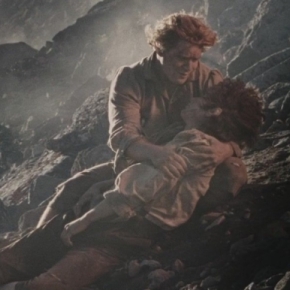
Or let me put it like this: I was pretty insufferable when I was in my early teens. I was an obnoxious know-it-all, and I wanted you to know it. And I wasn’t good at making friends because of the obnoxious thing and because my family moved around so much. Then in ninth grade, I read The Lord of the Rings. When I finally put the book down after 900 plus pages, I was different somehow. I had journeyed with Frodo Baggins and Samwise Gamge to Mount Doom, and dwelling page after page in their incredible friendship – friendship that literally stood the test of fire – changed me. People could have told me the answer to friendship is being loyal and giving of yourself. But I would not have understood until I read that story. In the same way, when we enter a parable, when we really live in the world Jesus creates in those few short sentences, we find so much depth of meaning.

This depth often comes not from one encounter with the parable but many. Why did Jesus speak in parables? He knew that using everyday images helps illustrate abstract concepts. The more ordinary the image, the more likely you are to encounter it day in and day out. Thus, Jesus shares images so that when we see them, the story triggers in us again. I guarantee you that at the parish picnic this afternoon, when you see birds flying around the trees, you will think about the parable of the mustard seed. And as you watch those birds nesting in those trees, you will connect more deeply to the kingdom of God.

And finally, Jesus spoke in parables because parables resist sound bite theology. He knew that his opponents were looking for evidence against him, and so instead of giving them ammunition, he told them stories: innocuous little stories, that, if you really let them get inside you and do their work, you realize that the kingdom has sprouted within you while you were sleeping. The problem is that these days we are so used to sound bites ruling public discourse that any speech, which calls for deep thinking, seems too difficult or time-consuming to wrestle with. We’ve lost the attention span necessary for stories to do their work. We are a people molded by story, who no longer seem to have time for them.

And that’s why Jesus’ parables are still so vital to our lives today. He invites us to slow down and place more and more nests and birds in that green felt tree. His stories sail to us on the wind of the Holy Spirit and impel us to dive in and swim around and make them our own. “With what can we compare the kingdom of God, or what parable will we use for it?” he asks. He says the kingdom of God is like a mustard seed that grows to be the greatest of all shrubs and puts for large branches so that the birds can nest. That’s the kingdom of God: Our true home that we might not be able to see at first, but which grows and grows and grows until it contains all the nests of all the birds. In Godly Play, we invite the children to name the birds, and we find that those birds’ names are the children’s names. Our names. The names of everyone, regardless of any ungodly reason – and I mean that literally – that we might discriminate. That’s what the kingdom of God is like.

Why did Jesus speak in parables? Because the kingdom of God is like a story, in which everyone has a role.

* Mark’s text does say that Jesus explains everything in private to his disciples. I would argue that might have done more harm than good, as you can see how they act for the rest of the Gospel.
** I did blow the head gasket about six months after getting the car. But that’s because I didn’t know what the Hot-Cold gauge was for. Oops. The repair cost about 2/3 what the car was worth. My parents did pay for that. Thanks, Mom and Dad!

12 Moments: An Instructed Eucharist

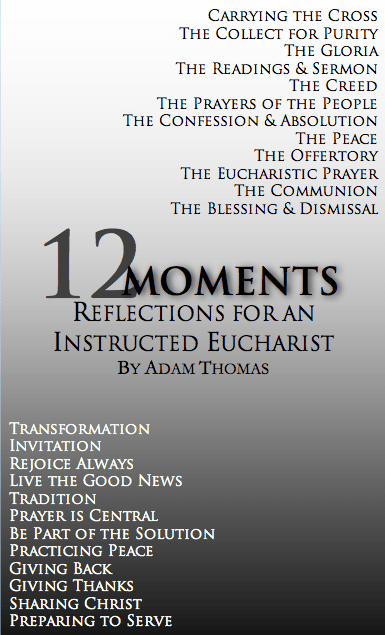
At St. Mark’s on Sunday, June 7th, we did an “Instructed Eucharist.” At four points during the service, we paused and I talked us through what was coming up. I based the instruction on something I wrote a few years ago and revised last week called 12 Moments: Reflections for an Instructed Eucharist. What I said during the service was a very abridged version of this pamphlet. Then I handed the full pamphlet out to folks at the end of the service. You can download the pamphlet by clicking the image below or clicking here.

12momentscover

The Blueprint

Sermon for Sunday, May 31, 2015 || Trinity Sunday B

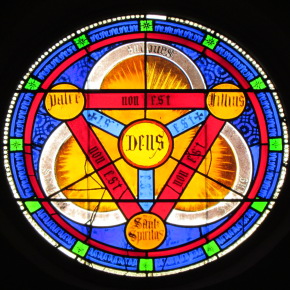
theblueprintHave you ever looked closely at the round window high up the wall in the back of the church? Go ahead – turn around and give it a good look. I love this window. I love the vibrant colors. I love that when the sun is shining through it, an afterimage gets imprinted on my eyes, so I see it when I close them. If you’ve never given the window much thought, I don’t blame you. The words on it are in Latin, after all. But let’s keep looking. The window presents a diagram of the Holy Trinity. “Deus” – God – is encircled in the center. Three smaller circles float around it: Patri, Filius, Spiritus Sancti – Father, Son, and Holy Spirit. Each of the smaller circles is connected to the others with the words “non est” (is not), and each smaller circle is connected to the large central one with the word “est” (is). The diagram is telling us that the Father, Son, and Holy Spirit are not each other but they are all One God. How does this work? Wisely, the window doesn’t tell us. The window just illustrates the reality, a theological blueprint in stained glass.

Likewise, I’m going to take my cue from the window and stay silent on the “How does this work?” question. Too many sermons over the years have tried to explain the mystery of the Trinity by talking about apples or flames. What those sermons didn’t understand is that you can’t explain a mystery without destroying the very quality that makes it mysterious. When Sherlock Holmes figures out that the bell rope used to call for the maid was replaced with a poisonous snake, which somehow slithered unnoticed out of the room in the ensuing hubbub over discovering the body, the mystery is solved. No more mystery. This Whodunnit? type mystery is the kind we’re used to: Gibbs and the NCIS team solve their mysteries within the length of the 45-minute episode. The light-hearted mystery novels my mother loves to read always wrap up the intrigue by the end of the story.

But here’s the difference between these small, ordinary mysteries we watch or read and the great mystery of the Holy Trinity. The small mysteries have answers to them, like the poisonous snake. But the mystery of the Holy Trinity is the answer – the fundamental answer that rests at the very core of existence. Here’s what I mean.

Before creation came into being, there was God. There was only God. Then God spoke, “Let there be light,” and creation erupted in a rush of dust and energy and far flung fire. And suddenly, there was something known as “not God.” Suddenly, there was an “other” for God to love. And yet, we believe that God’s essence is love, which means that God must have loved before there was a creation to love. Confusing, right? It is confusing until we realize there’s only one possible answer for whom God loved before there was anything else. God loved God. This may sound narcissistic or vain, but it’s not. Narcissism and vanity are distortions of love, but God’s love is perfect and unsullied. God loves God with such perfection that there is still only One God, even though a loving relationship exists.

That’s the keyword: relationship. To try to come close to the mystery of the Holy Trinity, we employ relational words: Father and Son, Parent and Child. We speak of the Holy Spirit as being the love that flows between them. This perfect relationship existed before creation, and thus serves as God’s blueprint for creation. Have you ever noticed that if you drill right down to the core of any subject whatsoever, you end up at relationship? At the most fundamental level, life, the universe, and everything are based on the relationships between things. Elemental particles vibrate next to other elemental particles, weaving the fabric of creation. Atoms repel and attract each other. Ecosystems thrive as complex series of relationships. Celestial bodies dance the precarious waltz of gravitational balance. Not to mention, the most important things in the lives of us humans on this fragile earth is our relationships with one another.

All of this grows from that blueprint God used from God’s own self – the perfect relationship of the Holy Trinity. In the act of creating something that was not God, God knew creation wouldn’t be perfect. And yet, God made it anyway. The reason the Holy Trinity remains a mystery is that our relationships – indeed, all relationships in creation – are not perfect, and thus we cannot fathom perfection.

But while we aren’t perfect, the idea of perfection lingers within us, an echo of our Creator’s own perfect love. We feel this echo as a longing for connection, for relationship with God and with each other. God loves us perfectly, even though we have the capacity to return a mere sliver of that love. But that sliver is more than enough to activate our ability to engage in loving relationships here and now. When we nurture such loving relationships in our lives, we come as close as our imperfection allows to the perfect relationship of the Holy Trinity.

Indeed, the Holy Trinity transcends our imperfection, draws us in, and strengthens our earthly relationships. The echo of God’s perfect love grows louder, more insistent, as we give ourselves over to be born again from above, to be remade closer to the blueprint than we were before. The blueprint calls for less domination and more mutuality, less prejudice and more generosity, less pride and more humility. The blueprint calls for less defending and more welcoming, less grasping and more embracing, less tearing down and more lifting up. And above all, the blueprint calls for love to spill forth in the forms of justice-seeking, mercy-granting, grace-sharing, hope-planting, and joy-singing.

And so you go home and do the dishes even though it was your brother’s turn. Or you tell your wife “thank you” for her poise in the middle of chaos and for putting up with you all these years. Or you introduce yourself to that bedraggled person you always seem to run into on your morning jog and ask if he needs assistance. Or you look those who are oppressed in the eye and say, “I’m sorry for not showing up sooner,” and then turn to stand with them.

Each of these is an expression of the blueprint of the perfect relationship of the Holy Trinity. And each of these will be done imperfectly. And yet, the mystery of the Holy Trinity rests at the core of all existence, of all we do and all we are. And so our imperfection is even now being redeemed by the perfect love of God, which somehow manages to fit all of itself into our mere slivers of love.

If in your life, the Holy Trinity has seemed no more than an abstraction, as clear as the Latin writing on the window back there, then I invite you to take a step back and look again. Reassign every single urge you have ever had to seek justice, to grant mercy, to share grace, to plant hope, to sing joy, and to love. Reassign all of them to the perfect love of the Trinity flowing, however imperfectly, through you. Notice now the Father, Son, and Holy Spirit catching you up in the ever-spinning dance of perfect love, and be thankful.

* The diagram of the Holy Trinity is the window on the back wall of St. Mark’s in Mystic, CT.

A Story About the Holy Spirit

Sermon for Sunday, May 24, 2015 || Pentecost B || Romans 8:22-27

astoryabouttheholyspiritToday, on this day of Pentecost, I’d like to tell you a story about the Holy Spirit. It’s going to sound like a story about me, but if I tell it right, you’ll see that the Holy Spirit is the main protagonist of this little tale. The story takes place a stretch down River Road about three miles from the Middle of Nowhere, West Virginia.

The summer before my senior year of college saw me driving down this stretch of River Road toward Peterkin Camp and Conference Center, and my job as counselor. The first day of camp, about a hundred high schoolers descended on the camp, and strangely enough, their enthusiasm and laughter and hugs of reunion were unhindered by the lack of a cell phone tower within 50 miles. Right away I could see their love for the place in their wide expectant eyes as they queued up to turn in medications and decorate nametags. They loved Peterkin because they got to be themselves around other kids who also got to be themselves. Places where teenagers are unafraid of coming out of their shells are few and sacred. Peterkin was one of them.

We shared Eucharist every day of camp, and with each day the volume of our singing increased as the more reticent campers started joining in. By Friday, the passing of the Peace had reached epic proportions because everyone tried to hug everyone else. The service that day included special prayers for healing, and I volunteered to assist with the laying on of hands because I’d never done it before. After communion, I walked to the back of the chapel with the priest Zach and a pair of sisters, Kenan and Leigh. We circled a metal folding chair, and Zach beckoned the first camper towards us. I remember looking down at my hands, seeing the dirty fingernails and calluses cut by guitar strings, and wondering: “What are these supposed to do?”

The boy sat down, and Zach leaned in close. “My parents are divorced and I keep thinking it’s all my fault and I feel sad all the time.” The truth of the boy’s words startled me out of my self-centered musings about my hands. Here was someone hurting profoundly, with his whole world crumbling around him and misplaced shame eating him away. And yet he trusted the four of us to place our hands on him, to whisper words of healing, which would never make everything all better again, but maybe just maybe might allow him to breath with a bit more space and by God’s grace start letting himself off the hook.

As Zach dabbed oil on the boy’s head, I touched his shoulder, lightly, like I was testing a bruise. Doubt gnawed at the back of my mind: how am I qualified even to be standing here, let alone be expected to participate in healing? The self-centered feeling of inadequacy threatened to wash over me again, but then a prayer blossomed in my mind and in my heart, a prayer that I had no hand in writing. I exhaled slowly, and the Holy Spirit carried her words on my breath: “Lord, make him whole, make him holy, make him wholly new.”

This became my breath prayer. As the campers kept coming and coming, the Holy Spirit kept speaking these words through me and I prayed with a fervor I didn’t know I possessed: “Holy Spirit, fill me and flow out of me, down my arms, into my hands, and into these broken, beautiful boys and girls. Make me your conduit. Make me your vessel.”

Their need for healing was so great, these young people in so much pain: depression, suicidal thoughts, drug addiction, alcohol addiction, eating disorders, the urge to cut themselves, feelings of abandonment, grief, loss… Lord, make her whole, make her holy, make her wholly new.

I kept asking the Holy Spirit to fill me to overflowing so she could spill out my fingertips and the campers could know the healing presence of God. When the service was over, the campers filed toward the dining hall, but we who had manned the three healing stations gathered around the altar and said a final prayer. As I backed away from the altar, I felt a tear moisten my cheek, then another and another. Suddenly, I was crying. I sat down in the second pew and just as suddenly, I was no longer crying. I was weeping. For twenty minutes, my chest heaved and fell, and I knew nothing but my ragged breaths and fat tears…and the truth.

God granted me exactly what the Holy Spirit had prompted me to I asked for – an abundance of that same Spirit, an excess, a proportion so much bigger than was meant for me alone. The tears puddling at my feet were the Holy Spirit spilling out of me. When the tears stopped, I noticed a hand on my back. Leigh, one of the sisters I had partnered with, had stayed behind and sat with me in silence. She had said nothing. She had not tried to hand me a tissue. She had let me weep, alone and yet not alone, laying her hand on me as we had done for the campers. Remembering that act of kindness still brings tears to my eyes.

I tell you this story because it taught me about the Holy Spirit. The Spirit does not come at our beck and call. We come at hers. We would be unable to ask for the Spirit’s help if she were not already helping us in the asking. Paul speaks this truth to the church in Rome: “The Spirit helps us in our weakness; for we do not know how to pray as we ought, but that very Spirit intercedes with sighs too deep for words.”

At Peterkin, the Holy Spirit made her presence known in my life, and I fervently hope in the lives of the campers as well. That experience was so overwhelming, I expect, because the Spirit knows me well enough to appreciate that I need to be whacked upside the head in order not to misunderstand my role in all of this. But even when the experience doesn’t leave us pooling tears on the chapel floor, the Spirit is still ever present, interceding for us, helping us in our weakness.

Remember when you stood on the beach at dawn, and the first rays of sun turned the ocean to liquid gold, and gratitude unbidden caused you to raise your arms to the heavens? Your prayer of thanks rose from the Holy Spirit prompting you to notice – to see with more than your eyes – God’s glory in creation.

Remember when you had to take your daughter to the emergency room because her stomach flu just wasn’t getting any better? The unimagined patience you showed in the hours of waiting rose from the Holy Spirit speaking peace into your panicked heart.

Remember when your mother died and you never thought you’d take another breath? And then you did. The breath that came when tragedy squeezed all the air from your lungs rose from the Holy Spirit leavening your agonized grief with a dash of hope.

Remember when the Holy Spirit showed you the person in need? Remember when the Holy Spirit stirred you to help? Remember? If you don’t remember something like this in your own life, I challenge you to look again. Ask the Spirit for help in the looking. The Holy Spirit doesn’t come to a lucky few or just to the people who ask for her intercession by name. The Holy Spirit has always been moving through your life like the wind through the trees. And she still is. I wonder what your next memory of the Holy Spirit will be.

You Know My Heart

Sermon for Sunday, May 17, 2015 || Easter 7B || Acts 1:15-17, 21-26

youknowmyheartLast week, we talked about trying to discern how and when to lean into the newness shimmering on the horizon of your life. I invited you to stop and pray the next time you are at the precipice of a decision; to take a deep breath and feel which way the wind of the Holy Spirit is pushing you; to ask God what new thing God is trying to birth through you with the decision. I know many of us, myself included, often have a hard time finding words to put to these prayers for guidance. Silent prayer – with lots of listening – is a beautiful alternative when there are no words, but if you have the urge to speak, then I have the first five words of the prayer, just to get you started. They come from this morning’s first reading. The eleven apostles want to round out their number, so they select two candidates and then pray about which one will take Judas’s spot. And they begin their prayer for guidance with these five words: “Lord, you know everyone’s heart.”

What a profound statement of faith – five words that speak to the apostles’ trust in God. Lord, you know everyone’s heart. This one, brief sentence guides their decision-making process in three substantial ways. They acknowledge God’s presence in their endeavor. They understand that making choices involves more than purely mental exercise. And they show humility in the face of a life-altering decision. Let’s take them in turn.

I’ve said it before and I’ll say it again: we routinely ignore God’s presence because God is always present. We forget that God is in the midst of not just the miraculous, but also the mundane. Now, our failure to recognize God’s presence is understandable. How many of us note the sound of the engine in the car until there’s an ominous sputtering? How many of us note the reliable glow of the bedside lamp until the transformer blows outside? We adapt to routine. We organize our lives into predictable patterns. But God’s movement in our lives is the very framework upon which our patterns hang, so that movement is often difficult to perceive. On the other hand, like the electricity, we’d notice if God weren’t there.

The apostles combat the tendency to ignore God’s foundational presence by invoking God’s knowledge of their hearts as they make a decision. Lord, you know everyone’s heart is shorthand for, “Lord, you are present in all that we do, and your presence sustains the world we live in and the life we live.” With these words, the apostles invite God into their decision-making process. This invitation may seem superfluous if you believe the assertion that God is ever-present. Indeed, God doesn’t need an invitation to be present in our lives. But we often need to invite God in to remind ourselves to be present to God. Our invitation functions, strangely enough, as an RSVP, as a response to God’s presence. The apostles know this. They know that the Lord is already present, but the invitation prepares their hearts to respond to God’s movement.

Lord, you know everyone’s heart, they pray. The apostles know that making a life-altering decision involves more than mental exercise. Every decision we make has both mental and emotional components, and we ignore the emotional at our peril. When the apostles pray these five words, they combine the mental verb “know” with the feeling word “heart.” They understand that God made separating heart from head so difficult precisely because our decision-making process should not attempt the separation. God gave us minds to interpret our emotions and hearts to provide our minds with the fuel of hope and imagination. God infused our biology with such checks and balances, so we tragically limit ourselves when we shelve our feelings in favor of our thoughts, or vice versa. Only by mingling the two can we make faithful decisions.

The apostles know they are in God’s presence. They employ both their hearts and minds as they make their choice. And they show humility in the midst of a life-altering decision. This humility is key to the whole decision-making enterprise. Every one of my choices affects more than just me, and those effects ripple into the future in permutations that my brain is unequipped to process. I don’t know how my decisions will affect others, let alone myself. Furthermore, I don’t even know myself well enough most of the time to make good decisions. Lord, you know everyone’s heart. If God knows what’s in my heart, then that makes one of us.

Humility comes in when we acknowledge our limited awareness of ourselves and the world around us. If our interior lives are clouded in mystery, how much less can we understand the trajectory of our decisions in the wider world? Inviting God into the decision-making process opens us up to the One who truly knows us. The humble prayer begins, “Lord you know my heart, and you know it much better than I do.” Confessing our shallow understanding of our own inner selves sets us on the path to faithful decisions.

Let’s say you are standing at the edge of a life-altering decision. You are trying to decide what college to go to; or whether to throw yourself fully into a budding relationship; or if you should change jobs. There’s newness shimmering on the horizon, so you stop and pray. You begin with a personalized version of these five words: “Lord, you know everyone’s one.”

Lord, you know my heart. With these words, you invite God into your decision-making process. You make yourself aware of God’s constant, yet elusive presence. You think back to your campus visits at your top three choices. You hadn’t been prepared to look for God’s presence at the time, being so overwhelmed by the experience. But now, looking back in prayer, you notice a flicker of rightness about one school. You imagine yourself there, setting up your dorm room, going to class. And you realize what that flicker of rightness feels like. It feels like home. That’s God’s presence inviting you to choose the best of all possible futures.

Lord, you know my heart. With these words, you allow your head and your heart to team up, mingling your rational mind with your emotions and imagination. A new relationship is budding, and you’re trying to decide whether or not to run with it. Your heart tells you yes, Yes, YES – how could you possibly feel any better than you do right now. You’re skin’s all tingly. You haven’t heard her voice in an hour, which is an hour too long. But here your rational mind breaks through the fog of passion: let’s not pick the china pattern yet. Let’s get to know each other. Let’s take it slow. Let’s test this and see if our nascent passion has what it takes to deepen into the bedrock of lifetime commitment.

Lord, you know my heart. With these words, you humbly acknowledge that alone you don’t have the depth of awareness necessary to make a faithful decision. You’ve been thinking about changing jobs for a while. Right now, the money’s good, but the hours are killer. You tell yourself that you’re sacrificing so that your family can have a good life. And that may be true, but still, you’ve missed a dance recital and three little league games this month alone. You have an offer on the table. It’s less money, but you’d be home most evenings. In humility, you ask for God’s guidance to help you see the future permutations of this decision.

Lord, you know my heart. “Lord, you know everyone’s heart.” When you are trying to discern how and when to lean into the newness shimmering on the horizon of your life, begin your prayer for guidance with these five words. With integrated heart and mind, kneel humbly in God’s presence. Unfurl your heart to God. Place yourself in the palm of God’s hand. And know that God will still be there whatever future unfolds.

*Several parishioners have asked me to preach slower, which I’ve been working on for a while now. Recently, I’ve been succeeding. But that means I need to start writing fewer words. This sermon came in about 1:30 longer than I like, so at the later service, I shortened it on the fly and it worked. But the one I recorded was the long one.

Precipice

Sermon for Sunday, May 10, 2015 || Easter 6B || Acts 10:44-48; Psalm 98

precipice“Sing to the Lord a new song, for he has done marvelous things.” Today’s psalm begins with these glorious words, and for me it begins with a question. Why does the song we sing have to be a new one? Why can’t the song be an old song, one that has stood the test of time? “Amazing Grace,” perhaps? Or how about “In the Garden?” While these songs are beautiful and wonderful and should never, ever be lost to the ages, I think the psalmist feels the urge to sing a new song because he or she has discovered a fundamental truth about God’s movement in God’s universe. God is always doing something new.

God’s ceaselessly creative hand did not stop molding and shaping the universe at the end of the sixth day of creation. God continues to breath new life into this ever-expanding cosmos: at the grand scale of galactic expansion and at the small scale of simple, daily interaction. In the playroom next door, the twins do something new seemingly every day. Amelia loves to eat real food. Charlie has started climbing. We have several parishioners who have recently moved from their homes into assisted living facilities or whose recent medical interventions have led to new lifestyle choices. They are faced with newness of a less joyful kind, but we still fervently hope that their new situations will lead to much better outcomes than they could have expected before.

The simple fact that spring has sprung reminds us that God is always doing something new. In my life. In your lives. In the life of the church. The world. Creation. We believe that God’s reign is constantly and continually reshaping existence, bringing all things into closer connection with God, as creation was always intended to be.

The newness that trumpets God’s closeness is borne on the wind of the Holy Spirit. Not all new things are of God, but the Holy Spirit helps us discern when and where God is birthing those new things that do lead to closer connection for all people. When we allow ourselves to be open to the newness dancing along in the Holy Spirit’s wake, we become people who are less afraid to try new things, to risk, perhaps to fail, but to know that in the attempt a new shoot of possibility has sprung up from the ground. When we do succeed in living into God’s reconciling newness, the result is deeper connection with God and a more expansive understanding of God’s love and God’s generosity.

One climactic example of this success happens in our tiny first reading today. It is the most extraordinary event in the history of the early days of the church. You might think it would be a dramatic conversion or a miraculous healing or a mystical vision or a memorable speech, but while each of these happens in the book of the Acts of the Apostles, none is the event I have in mind. No. The most extraordinary moment of reconciling newness in the early days of the church happens when one person simply realizes he is wrong and then changes his mind.

That person is Peter. And we might expect Peter to be a hardliner, sticking to all of his positions and presuppositions just because he had been with Jesus from the beginning. After all, Jesus did give Peter the figurative keys to the kingdom. What could be more human of a reaction than for Peter to lock out anything new that threatened the integrity of the in-crowd? As I’m sure we’ve all done from time to time, Peter could have stuck his head in the sand, ignored the promptings of the Holy Spirit, and resisted any opportunity for growth, for reconciliation, or for new possibilities.

But that’s not what happens. So here’s the story, beginning with just a bit of background. The society in which Peter grew up was divided between Jews and Gentiles. There wasn’t necessarily animosity between them, but there was indifference and a lack of connection. Society was just built in this divisive way, so no one really questioned the structure.

That is, until one day when Peter is hungry. While a meal is being prepared, Peter receives a vision from God. All of the animals that observant Jews aren’t supposed to eat appear before Peter, and a voice directs him to kill and eat. Peter balks at the command: “I’ve never eaten anything that’s profane or unclean.” But the voice counters: “What God has made clean, you must not call profane.” This happens three times until the vision has finally sunk into Peter’s bones.

When the vision ends, Peter meets a trio of Gentiles who invite him to meet a Roman named Cornelius, who has also had a vision from God concerning Peter. Never fearing that he might be walking into a trap, Peter goes with them and meets Cornelius and his whole household. And then Peter preaches a fabulous sermon that proclaims the good news of Jesus Christ.

This is where our passage for this morning picks up the tale. While Peter is still speaking, the Holy Spirit encounters all who hear him. Peter’s companions, who are Jewish believers in Jesus Christ, are astounded that the Holy Spirit of God would deign to manifest itself through unclean Gentiles. “But what about our in crowd,” they seem to protest. “We thought we were the special ones. We thought we were the ones that had the Holy Spirit.”

Then Peter remembers his vision of the now clean animals. And he finds himself standing at the precipice of a decision, at the precipice of something new trying to break into reality. His society, his upbringing, and everything he has ever known pulls him to reconfirm that Jews and Gentiles can never be united, that the good news of Jesus Christ is for Peter’s people alone. But that same Holy Spirit, which is even now dancing around Cornelius and his Gentile family, pulls Peter in a new direction toward unity and acceptance and radical welcome of the estranged other. And this time Peter doesn’t balk. He baptizes all the Gentiles present and charts a new course of acceptance in this new and nascent religion soon to be called Christianity.

This particular type of newness – welcome of the other, whatever makes that person other – keeps encountering the church again and again. Over the centuries, Christians have failed to be swept up by the wind of the Holy Spirit’s newness too many times to count, but every once in a while, we trim the sail just right and succeed in ushering in God’s reconciling newness. Just in our lifetimes, we have expanded opportunities in our church to many groups who had been shut out before – allowing women to be priests, for example; or blessing loving relationships of any orientation with the sacrament of marriage.

When you are trying to discern how and when to lean into the newness shimmering on the horizon of your life, how do you feel? Terrified? Excited? Saddened by what is fading away? Joyful for what is breaking in? All of the above, probably. In any case, like spring blooming in a riot of color every year, newness is just a part of life. In our own lives and in the life of the church or our nation or the world, the newness that comes from God will always lead to deeper connection, greater reconciliation, more hope – maybe not today or tomorrow. But the path will lead there someday.

The next time you are at the precipice of a decision like Peter, stop for a moment and pray. Take a deep breath and feel which way the wind of the Holy Spirit is pushing you. Ask God what new thing God is trying to birth through you with this decision. How will it lead you closer to God or another person? God is forever speaking words of reconciliation and renewal into this creation. Each day, we have the opportunity to hear them anew and to choose the course towards closer connection and to leap off the precipice and to soar on the wind of the Holy Spirit.