Sermon for Sunday, May 1, 2016 || Easter 6C || John 5:1-9
 At the beginning of The Hobbit, Bilbo Baggins leads a comfortable, if unexciting life in his home at Bag End in the town of Hobbiton in the idyllic land called the Shire. Bilbo had never left the Shire, nor had any but a few hobbits, whom the rest of hobbit society thought a bit addled in the head. Bilbo contented himself with a leisurely life of eating, walking about town, relaxing with a good pipe, and eating some more.
Even if you’ve never read The Hobbit, you know it’s an adventure story, so obviously something needs to happen to Bilbo, something known in the study of literature as “the inciting incident.” JR.R. Tolkien has a whole world to show Bilbo, a world that starts at his doorstep and leads to a solitary mountain where Bilbo bandies words with a terrifying dragon.
Well, such an inciting incident happens when Bilbo hears a knock on his round front door. The wizard Gandalf has come to invite Bilbo on an adventure with a dozen dwarves. Their tale of the dragon seizing and laying waste to their homeland sends Bilbo’s imagination soaring off to distant places. But when dinner is over and the dwarves have finished their hauntingly beautiful song, Bilbo’s good sense reasserts itself. He thanks them for their offer but politely declines. Tolkien has presented his protagonist with the perfect inciting incident, but for the moment, Bilbo doesn’t bite.
The next day Bilbo begins going about his day as usual, but something has changed within him. He has awoken to the wider world beyond his door, and suddenly he realizes he simply cannot miss this chance. He dashes out of his house in such a rush that he leaves his pocket-handkerchief. He catches up with the dwarves and the adventure sweeps him away. The inciting incident has happened, and Bilbo’s life is forever changed.
Every story, both fiction and nonfiction, has an inciting incident. Sometimes the character has no choice in the matter; events conspire in such a way to make the path inevitable. Sometimes, as in The Hobbit, the character does have a choice as to whether he or she wants to remain in the relative security of the normal or risk the adventure of the unknown. Harry Potter chooses to step with Hagrid into the wizarding world. Katniss Everdeen chooses to take her sister’s place in the Hunger Games. Like Bilbo and Harry and Katniss, you and I have a choice. An inciting incident presents itself to us this morning. We can choose to stay home. Or we can dash off without our pocket-handkerchiefs.
This inciting incident comes in the form of Jesus walking up to you and me and asking us the same question he asks the man by the pool of Beth-zatha: “Do you want to be made well?” It seems like a question with such an obvious answer, doesn’t it? “Do you want to be made well?” Yes! is the answer you’d expect, right? But that’s not what the man says. Rather, he gives a resigned speech about why he’s never made it into the legendary healing waters of the pool. It’s been 38 years, and by now, he seems resigned to his lot in life as the one who never makes it to the water on time.
In response to the man’s resignation, Jesus skips the preliminaries and goes straight for the command: “Stand up, take your mat and walk.” Perhaps the man thinks Jesus is having a bit of fun at his expense. But the tone is all wrong. This was an invitation, not a joke. The inciting incident is here, and the man has a choice. He can stay put and not realized he has been given the gift of healing. Or he can get up: he can make the choice that will change his life for the better. And still, the choice is not as obvious as we might first think. Change for the better is still change. And change is scary, no matter if it’s for good or for ill.
The man by the pool chooses to engage his inciting incident. He chooses to stand up. When he does, he realizes Jesus healed him, and his life takes a sharp turn from the paralytic monotony of the last 38 years. In light of this, my questions for you this morning are these: when have you responded to an inciting incident in your life? How did your life change when you took the risk to venture into the unknown? How was God present to you as you walked from security into uncertainty? As you ponder how you’ve responded to inciting incidents in the past, pray with this one final question from Jesus himself: “Do you want to be made well?”
Perhaps you’re in a toxic work environment, and the personalities you work with have made you dread stepping through the doors of the office. Your physical and emotional health have both declined precipitously because of the stress your workday puts on you, but you need a paycheck. When you hear Jesus say, “Do you want to be made well,” you realize the choice before you boils down to how much your own health is worth to you.
Perhaps your family has a history of diabetes, and you’ve started noticing lately that you get pretty sluggish when you eat sugar. It makes you feel awful, but you crave it just the same. When you hear Jesus say, “Do you want to be made well,” you realize the choice before you pits immediate gratification against long-term health.
Perhaps a close friend has confided in you a concern that you drink more than you should. At first, you ignore the concern, then you get defensive about it, then angry, and suddenly you start to wonder why you’re upset. It’s because you really do have a problem, you realize. And that’s when you hear Jesus say, “Do you want to be made well?”
Jesus’ question exposes the fact that we all have choices to make that will lead to better health. The status quo may be comfortable, if unexciting, but in the end it leaves us paralyzed by the pool. Jesus’ question is a new inciting incident in each of our lives. Each of us can make a choice to lead a life that promotes wellness, for ourselves and those around us.
For me personally, the inciting incident began when I went to the CREDO conference a few weeks ago. I was introduced to a concept called “margin.” Margin is the space in our lives between the loads we carry and the limit to our carrying capacity. I realized I spend too much of my life with my load and my limit being equal, which means collapse is a real possibility whenever my load increases. At the conference, I heard Jesus ask me his inciting question. My response was “Yes!” followed by the obvious question: “But how?” A simple answer came to me: “You are not alone.”
We’re all in this together, and Christ is here, both calling us to greater health and giving us the gifts to achieve the changes we need to make in our lives. In whatever way Jesus calls you to a life of better wellness, know that you are not alone. You have us to support you when you respond to that inciting incident; when you dash off without your pocket-handkerchief; when you hear Jesus ask, “Do you want to be made well,” and you answer, “Yes!”
 I need to warn you right off the bat: if I had a soapbox I would stand on it right now. And on the spectrum between personal and academic, the sermon I’m about to preach is so far to the academic side that it might as well be called a lecture. But I think it’s important to take this opportunity, while we are reading the book of Revelation this Easter season, to talk about this strange and scary and sorely misunderstood piece of ancient writing. You may have read some or all of it yourself at one time or another. (My money’s on “some of it.”) Or you may be aware of popular media that references it, such as the Left Behind series. Or you may know a thing or two about some of the stranger doctrines of certain forms of Christianity: doctrines that use words like “rapture” and “dispensation” and “tribulation.” Or you may have had no contact with Revelation whatsoever, so you’re wondering why I seem so worried about it.
 Every year on the Fourth Sunday of Easter we read Psalm 23. We affectionately call today “Good Shepherd Sunday,” since we always pair the shepherd of the beloved psalm with the Good Shepherd, which Jesus describes in the tenth chapter of John’s Gospel. And yet I doubt it has escaped your notice that we read Psalm 23 more often than once a year. We read it yesterday, in fact; and two weeks before that at the funerals of Ed Carlson and Barbara Noonan. We’re not quite a third of the way through 2016, and we’ve already had six funerals this year. Sometimes the grave seems too close. Sometimes the bitter taste of loss overwhelms all the other sensations we could be feeling. Sometimes the promise of the resurrection seems to lose its luster in comparison to the stark reality of death.
 No sermon from me this week, since I was at a conference called CREDO in North Carolina. Instead, here’s something I wrote during a silent Saturday morning, when I was able to get quiet enough to write poetry.
 Both my first and last names come from the Bible. To be sure, a large portion of names used in the United States do, but many if not most of them do not share the dubious pedigree of mine. Every Hannah out there gets to claim as her namesake a woman of complete devotion to God. Every Matthew and Mark and Luke and John out there gets to share a name with a writer of the Gospel. But me? I get the guy who ate the fruit he wasn’t supposed to eat and then shifted the blame to his wife. And I get the Doubter – and that’s Doubter with a capital “D.”
 Good morning, and welcome to St. Mark’s Church on this Feast of the Resurrection. You know, every Sunday is a Feast of the Resurrection, but today is special. Do you know why? Because today is the first Sunday after the first full moon after the vernal equinox – and that makes today Easter. So if a late night talk show host ever jumps out of a cab and asks you how to calculate the date of Easter, now you know.
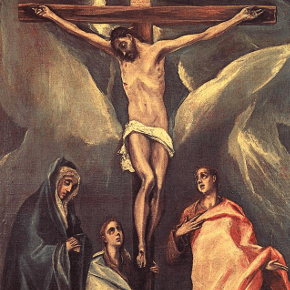 The Passion narrative Stacey just read can be quite overwhelming. It is by far and away the longest reading we listen to all year, and there’s a lot going on. There’s Judas’s betrayal, Jesus’ arrest, Peter’s denial, the trial with the high priest, the interview with Pilate, the frenzy of the crowd, the crucifixion, and the last words from the cross. There’s so much going on, in fact, that we can easily lose sight of the overarching story of the Gospel when we find ourselves overloaded by this painful and heart-breaking narrative. So instead of talking about the entire Passion narrative, each year I like to focus on one little moment of it that speaks to the whole story. On this Good Friday, that moment happens between the soldiers gambling for Jesus’ clothes and Jesus drinking the sour wine.
 In our lovely, little town of Mystic, today is a day of parades. There’s one this afternoon that will get all the press – the St. Patrick’s Day parade will attract throngs of green-clad people to Main Street to watch and revel at a charming small town spectacle. The Highland Pipe Band will set the tone as they march off from Mystic Seaport towards downtown. Hundreds of people on floats, in cars, and on foot will follow, not to mention the real reason to go to parades, which is the fire engines. They say everyone is Irish on St. Patrick’s Day, and the same extends to Mystic’s parade four days later.