Four Bags of Saline

I first posted this Advent reflection on the site Day1.org, which is having a Advent/Christmas Blog tour.

* * *

On Tuesday afternoon, I contracted a viral infection that systematically began evacuating the contents of my stomach, intestines, gall bladder, and liver as quickly as possible. Every half hour I scurried from my fetal position on the couch back to the restroom where I’m sure the neighbors and the folks in the next county could hear my wretched retching. After about four hours of agony, my fiancé finally convinced me to go to the Emergency Room. Severely dehydrated, I accomplished the weak-kneed feat of maneuvering down the stairwell and out to the car, all the while clutching a white, plastic wastebasket like a shipwreck survivor clinging to a life preserver.

With my fiancé supporting me, I stumbled into the ER at about eleven at night. The woman behind the counter took my information and fitted me with a bar-coded bracelet. Another woman took my vital signs and then told me to take a seat in the waiting area. I don’t know how long we waited. My sense of time was reduced to half-hourly dashes to the restroom followed by several, sweat-drenched minutes sitting on the tile floor heaving with exhaustion. Sometime after my fourth trip to the restroom, a nurse mercifully called me back. I sat in a wheelchair as an orderly navigated me to a bed in the hallway of the overcrowded emergency department.

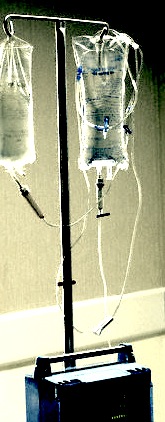
The nurse poked an IV tube into the back of my right hand and fed into my bloodstream the same anti-nausea medicine they give to chemotherapy patients. Then she hooked up a bag of saline, and I watched through half-lidded eyes as the saline began dripping from its elevated place into the tube. My fiancé read the words on the machine to me: 500 milliliters per hour. The equipment was making the saline drip at a proscribed rate – the bag would be empty in two hours. With the anti-nausea medicine suppressing my urge, I now had a new way to measure the time.

One empty bag of saline later, I was showing marked improvement. A little color had returned to my cheeks, and I was thirstier than I had ever been. The nurse allowed me ice chips and promised a popsicle later on if I continued to feel better. I crunched down a Styrofoam cup’s worth of ice and then collapsed back on the bed in the hallway. While I sucked on the ice chips, the nurse hung another bag of saline, and sped up the distribution of the liquid into my body. Now I was receiving 1000 milliliters an hour, or one full bag.

A second empty bag of saline later, I received the promised popsicle, and my fiancé correctly guessed the punch line to the truly horrendous joke stamped on the popsicle stick (How does thread get to school? On a spool bus). After I finished the popsicle, the nurse propped me back in the wheelchair for a ride to the radiology department for a chest x-ray. The doctor wanted to make sure that my gastric pyrotechnics hadn’t torn my esophagus. The short trip wore me out, and I dozed off and on through my third bag of saline, also pushed into me at 1000 milliliters an hour.

By the end of bag three, I just wanted to go home and crawl into my own bed away from the bright fluorescence and constant beeps and blips of the ER. My doctor had other plans, however, and instructed the nurse to hang a fourth bag of saline. This time, she turned off the machine controlling the dispersal of the IV into my arm. The bag would finish not in one hour or two like the other bags, which were “pushed” into me, but at the undefined rate of gravity.

I knew that eventually the fourth bag of saline would empty. I knew that I would be allowed out of the ER for the blissful comfort of my own bed and sleep uninterrupted by illness or beeping monitors. I just didn’t know when. This is the same quandary that the season of Advent invites us to explore. We don’t know when Jesus will return, but we know that he will return. Now, we live in a culture dependent on the constant, steady, and unwavering march of time. We punch in time cards at work. The train leaves the station at 7:12 sharp. The firm expects so many billable hours. Time is money. So when Jesus himself says, “But about that day and hour no one knows, neither the angels of heaven, nor the Son,* but only the Father,” his words run smack into our conception of time. How could we not know when something will happen? How could we not know when to begin our preparation for the big day?

By not putting a date and time on his return, Jesus pushes us to celebrate the much more important fact that his return will happen. He understands human nature too well. By initiating the expectation of return without a time frame, he delivers us the perfect set of variables to make us practice constant vigilance. When I knew the saline bag would run out in one hour, I had no need to watch it. The 1000 milliliters ticked by one after another in predictable, rhythmic progression. But when the nurse turned off the machine during the fourth saline bag, I had to keep looking up at it to see how quickly gravity was doing its work.

I knew the bag would empty, but I wanted to be sure I knew exactly when those last drops would fall so that I could leave the hospital. In the same way, during the season of Advent, we practice our awareness of God’s presence in our lives so that we can more readily identify the signs of Christ’s reign breaking into the world. During the season of Advent, I invite you to turn off the machines that push the IV. Let gravity take over. Know that the “when” is less important than the “what.” Jesus is coming; indeed, Jesus is always here, as well. When we worry less about the when, we can begin to see the presence of God happening all around us. So turn off your clocks. Forget marking off days in your Advent calendar. And just live with the grace-filled knowledge that Christ is coming.

What a Good Boy, What a Smart Boy, What a Strong Boy

The following post appeared Tuesday, November 2nd on Episcopalcafe.com, a website to which I am a monthly contributor. Check it out here or read it below.

* * *

When you listen to the Gospel, you might notice the trend that folks rarely answer questions directly. Instead, the responder either completely ignores the question or says something so profound that the question ceases to matter. Most things Jesus says in the Gospel fall into one of these two categories. Think about how often someone asks a question, and Jesus responds, “Well, let me tell you a story about that. Once there was a farmer…” Before Jesus enters the scene, however, John the Baptizer finds himself under interrogation, and he does just a good a job as Jesus in not answering questions with the expected answers. His unexpected responses to the folks interviewing him (as recorded in John 1) show John’s understanding of his identity, which helps us understand ours, as well.

The priests and Levites come to John and ask him a series of questions, the first being “Who are you?” This question seems to have an obvious answer: I’m John from over yonder, my parents are so-and-so. But that’s not what John says. Instead of saying who he is, he explicitly says who he is not. “I am not the Messiah.” And what’s more, he’s quite emphatic about it: “He confessed and did not deny it, but confessed…” By his answer, John seems to know what they are getting at, so he makes sure with his first response that any gossip about his messiah-ship is highly overrated.

So they try again: “What then? Are you Elijah?” He says, “I am not.” They try once more: “Are you the prophet?” “Nope.” John steadfastly refuses to play into any expectations these priests and Levites have about his identity.

I wonder to what degree our identities are based on the expectations of others? It’s not necessarily a bad thing for others to have expectations for us, of course. A community (family, church, team, circle of friends) plays a significant role in the development of our identities, and expectations are a natural part of that role. But if those expectations begin to suffocate us or make us begin to dislike the people we are becoming, then there is something wrong.

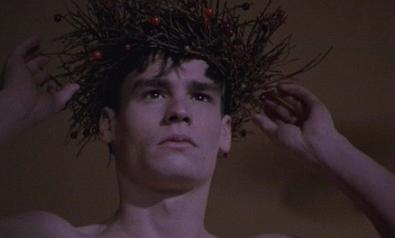
In the film Dead Poets Society, Neil Perry has a passion for acting. When he sees the flyer for auditions for A Midsummer Night’s Dream, he says, “For the first time in my life, I know what I want to do. And for the first time, I’m going to do it!” He throws himself into the role of Puck, and he’s good, he’s really good. But his father expects him to be a doctor and thinks this acting business is nothing more than a dangerous whim. Neil defies his father’s wishes and continues rehearsing for the play. After Mr. Perry discovers him at the theatre, he furiously tells Neil that he is not going to let Neil ruin his (Neil’s) life. Neil feels suffocated and trapped: he has found his calling as an actor, he has found himself. But Mr. Perry is stifling this identity with his expectations for Neil’s future. That night, Neil commits suicide.

Expectations like Mr. Perry’s can smother us. They can make us feel less worthy, less capable, less adequate because our worth and capability and adequacy fall outside the limits defined by those expectations. In their song “What a Good Boy,” the Barenaked Ladies lament:

When I was born, they looked at me and said,
‘What a good boy, what a smart boy, what a strong boy.’
When you were born, they looked at you and said,
‘What a good girl, what a smart girl, what a pretty girl.’
We’ve got these chains hanging round our necks,
People want to strangle us with them before we take our first breath.

When we feel smothered, stifled, or strangled by expectations, troubling questions form in our minds. What if I’m not a smart girl? What if I’m not a strong boy? What if I don’t measure up? Then another question compounds these: Will they still like/love/accept/welcome me? These expectations that help shape our identities now morph into ultimatums. They signal the possible breaking of a relationship: This is who I am, and if you don’t like it then fine. And the door slams shut. In this scenario, we begin to define our identities by focusing negatively on the rebellion against expectations rather than by stating positively who we are.

Expectations themselves are neutral things. They surely can be used to spur us to excellence or to inspire us to continue to grow and discover who we are. But they can also be used to deny our self-worth or sense of belonging. When John the Baptizer refuses to be defined by the expectations of the priests and Levites, he is holding onto the identity he has as the voice crying out in the wilderness.

The priests and Levites are unable to pin their expectation on John, but they can’t go back to their bosses empty-handed, so they press John asking: “What do you have to say about yourself?” The Baptizer answers with a quotation from the prophet Isaiah: “I am the voice of one crying out in the wilderness, ‘Make straight the way of the Lord.’ ” Even here, when they ask him deliberately about himself, he answers by pointing ahead of himself. Their concern is based on his seeming lack of authority to baptize, for he is not the Messiah or Elijah or the prophet. But such trifles don’t worry John. He states dismissively: “I baptize with water.” And then he points ahead of himself again: “Among you stands one whom you do not know, the one who is coming after me.” Everything John says about himself, he is really saying about Jesus. He only speaks in terms of Jesus; he deflects questions about himself, preferring to point to the one “who ranks ahead of me because he was before me.”

Rather than playing into their expectations, John flourishes in his identity as an arrow pointing to Jesus. To change the metaphor, he shines because he lives fully into his own particular, God-given identity. Like the moon, he has no light of his own, but he reflects the light of Jesus who is coming after him. Even as we struggle with the expectations of others and with discovering our own identities as God’s children, I can think of no greater joy than to be a moon to Jesus’ sun, reflecting the light of Christ.

Vision and Action

Sermon Notes for Sunday October 3, 2010 || Proper 22, Year C, RCL || Luke 17:5-10

(This Sunday was our first family service, at which I preached a sermon without notes. I gleaned the sermon out of the following brainstorm, which also made for the basis of the sermon for the early service.)

I’m really glad I got to preach this Sunday because the prospect of preaching makes me sit down and think long and hard about the words I am going to say, about the words I believe God is calling me to say. This week I sat down with our Gospel passage from Luke and thought long and hard about faith. And very quickly, I realized that – even with all my schooling and sermons and work in the church – I hadn’t really thought all that much about faith. I knew I had faith. I knew that my doubts didn’t cancel out my faith. I knew that God’s faith in me gave me the ability to have faith in God. But when I dug a little bit deeper, I found myself at a loss for words about how faith works in my life.

My confusion mirrored that of the disciples in this morning’s Gospel. Right before the passage we read today, Jesus tells them that if someone wrongs them seven times in the same day, they should forgive all seven times. The disciples don’t think they have enough faith to do something like that, so they say: “Increase our faith!” Jesus’ responds that a tiny amount of faith is enough to do amazing things. I must confess that the words about the mustard seed and mulberry tree have always seemed rather quaint and comforting, but with no real applicable meaning – like words your great aunt cross-stitches into pillows. But this week, the statement vexed me.

Jesus seems to be saying that an increase in the quantity of faith is not necessary – you can’t get much smaller than a mustard seed, after all. By using such an exaggeratedly small thing, Jesus says that measuring the amount of faith is unimportant. Indeed, thinking of faith as a unit of measure makes no sense. I wouldn’t say, “Last year I had 25 faith, but this year I have 27.” Faith isn’t a statistic.

So when the disciples ask for an increase in faith, I think that Jesus makes the hyperbolic statement about the mustard seed in order to make the disciples see that it’s not an increase in the quantity of faith that matters, but an increase in what faith does. When my thinking brought me away from the static notion of quantity of faith, I realized that I needed to bring my focus back to two simple concepts having to do with faith. First, faith in God sharpens our vision. Second, faith in God motivates our action.

I’ve had blurry vision since middle school. My parents brought me to the optometrist, who noticed my nearsightedness right away. He prescribed glasses, which I hated wearing, as any eighth grader would. Indeed, my desire to keep people from knowing I needed glasses was so great that I skipped trying out for the high school baseball team. I couldn’t see fly balls without my glasses, but I was unwilling to put them on.

You’ve probably noticed that at some point during the fourteen years since my original diagnosis of myopia, I’ve gotten comfortable wearing glasses. And now I finally have a pair that, thanks to Doctor Who, I know are pretty fashionable. But there is another sort of lenses that I fail to put on just as often as I did with my glasses in middle school. These are the lenses of faith. My glasses sharpen my vision of objects in the world around me. The lenses of faith sharpen our vision of the God who is present in and around all things.

Indeed, my glasses don’t give me the ability to see; rather, they give me the ability to see well. When we put on the lenses of faith, we see the world with clearer eyes. Our sharp vision allows us to see God’s directing movement between us and those people, places, and things with which we interact. We stand forever in God’s presence and God moves with us down the paths of our lives. Faith sharpens our vision to catch glimpses of this movement.

Here’s an example. I was standing in Boston’s North Station not too long ago during morning rush hour. I was trying to figure out from which track my train would depart. As I stood there looking up at the departures board, several trains unloaded their passengers at once. I watched as hundreds of people queued up on the platforms and, as one, began trudging toward the glass doors of the station. As they reached the doors, I was spellbound. The intricate, random choreography of the morning commuters was beautiful. They crisscrossed and hurried and meandered and loped along. And not one person ran into another. They passed me as I stood still, and I felt like I was watching a slow motion scene from a film. Each of these people was connected to me and to one another. I could all but see the wispy threads of a tapestry linking us. Faith sharpens our vision. That morning at North Station, the lenses of faith helped me see clearly the reality that God connects each of us to one another.

But sharp vision isn’t quite enough. When we see the world through the eyes of faith, we become aware of how we can participate in God’s work in the world. When I saw clearly my connection to all the people at North Station, I remembered once again that I am called to serve God in all people. Thus, the first thing that faith does – sharpen our vision – leads directly into the second thing that faith does. Faith in God motivates our action.

In many of the stories about Jesus healing various people, Jesus speaks of their faith making them well. Now if we subscribe to the “quantity” notion of faith, we might be tempted to think that Jesus healed these folks because they reached a certain statistical threshold on the faith scale, which qualified them for healing. But the mustard seed reminds us that the quantity of faith is less important than the action of faith. The healing stories, therefore, are really about people whose faith motivated them to the action of seeking out Jesus in the first place. The Gospel writers recorded those healings because of the sometimes heroic, sometimes simple action of faith.

Again, when Jesus says, “If you had faith the size of a mustard seed,” he is not speaking about quantity. We do not have a collection of faith in the same way that we have collections of baseball cards or teapots or old comic books. Faith is not something we can store up in a safe deposit box. Rather, we have faith the same way we have energy. Energy propels us to run and work and play; faith propels us to love and serve and forgive. Indeed, faith is the energy that motivates us to participate in God’s work in the world.

And like energy, faith unused can begin to fade away. Like Langston Hughes’s “Dream Deferred,” unused faith can “dry up like a raisin in the sun.” This is why we come to worship. This is why we meet one another at the table for the nourishing food of Christ’s Body and Blood. This is why we do spiritual practices that keep us in contact with God and with other faithful people. God gave us faith to motivate us to love and serve God. As exercise is to energy, our participation in God’s work is to faith. And the more we allow our faith to motivate our action, the more resilient is our faith when we are confronted with difficult and demanding situations.

Faith in God sharpens our vision. Viewing the world through the lenses of faith shows a deeper layer of reality, the eternal reality of God’s presence. Then faith in God motivates us to act, to live lives full of God’s love and grace, to bring God’s gifts to other people and call God’s gifts forth from those people. Faith in God motivates us to participate in God’s healing and reconciling work in the world. Faith is not a static thing. Faith is not a statistic. Faith is the great gift from God that shows God’s faith in us. Faith is the catalyst that kindles all of our other God-given gifts to shine. Thanks be to God for faith.

Happy Dancing Ewoks

(Sermon for September 5, 2010 || Proper 18, Year C, RCL || Luke 14:25-33)

The rain is so heavy that I feel like I’m driving through a carwash. I can barely see out the windshield, and I keep thinking that I’ve missed Furnace Brook Parkway. But just when I decide I need to turn around, I spot the sign reflecting green in the dim glow of my headlights. I turn left and five minutes later I park across the street from the Coffee Break Café. I make a mad dash for the dryness and warmth of the shop, but the rain still manages to soak my jeans during the ten seconds I’m out in the elements.

The moment I step into the café, however, I forget the dangerous drive. I forget the torrential downpour. I forget the soaked jeans and the English language and my name and how to walk correctly. The woman, whom I planned to meet at the café, stands before me wearing patterned rain boots, holding a steaming cup of tea, and smiling. And I forget everything about myself except for the fact that she is there to meet me – me of all people.

That was a little over five months ago. A little over five months from now, she and I will be married about ten feet over and four feet down from where I’m standing right now – right over there. Leah and I will hold hands, and Margot will direct us to look at one another and speak our vows. I will say, “In the name of God, I, Adam, take you, Leah, to be my wife, to have and to hold from this day forward, for better for worse, for richer for poorer, in sickness and in health, to love and to cherish, until we are parted by death. This is my solemn vow.”

In February, I will promise to love and to cherish Leah for the rest of my life. You might have guessed that I’m pretty excited by that prospect. And so, when I listen to this morning’s Gospel reading and hear Jesus say that to be his disciple I have to hate my wife, I’m just downright confused.

Return of the Jedi (1983) 20th Century Fox

Ever since I was a little kid, I’ve known that hate is a bad thing. In fact, I learned this lesson during my daily viewing of Return of the Jedi. Near the end of the film, Luke Skywalker finds himself standing before the twisted and evil Emperor Palpatine. The Emperor doesn’t want to kill the Jedi; he desires Luke to fall under the seductive power of the dark side of the Force. Palpatine has Luke’s lightsaber, and he tempts the young Jedi saying: “I am defenseless. Take your weapon. Strike me down with all of your hatred, and your journey towards the dark side will be complete.”

Even as a young child, I knew that Luke could not give in to his hate because then he would have been corrupted. He would have joined the dark side, and the film would not have ended with smiles and embraces and happy dancing Ewoks. I learned the lesson well. Hate is a bad thing. If you are anything like me, you were brought up learning the same lesson. So how do we encounter these words of Jesus? He says, “Whoever comes to me and does not hate father and mother, wife and children, brothers and sisters, yes, and even life itself, cannot be my disciple.” How do we obey a command that just seems so wrong?

The first thing we need to do is to make sure that we don’t ignore Jesus when his words sound wrong to our ears. When he says something that makes us uncomfortable, there is a tendency to skip over the offending words. The trouble is, skipping those bits is exactly the opposite reaction than Jesus is going for. When Jesus turns to the crowds and says these words, he employs shocking rhetoric in an attempt to make the crowd understand just what life following him looks like. In Jesus’ day, following spiritual gurus around was something of a pastime, akin today to following the Grateful Dead on tour. Most of the people making up the large crowds were following him because he was a local celebrity. When Jesus tells them that they can’t be his disciples unless they hate life itself, I imagine many of them left to find a less demanding guru.

So we shouldn’t ignore Jesus’ words when they sound wrong. But this still leaves the fact that they sound wrong. Now, please don’t interpret the rest of this sermon as an attempt to explain away Jesus’ tough words. Rather, permit me to reinterpret the word “hate,” and hopefully, when I’m done, the toughness of Jesus’ words will have remained intact.

In between last week’s passage from Luke 14 and this week’s, several verses fell through the cracks. Just before Jesus turns to the crowds and speaks today’s Gospel, Luke narrates Jesus telling a parable. In the story, all the people invited to a great dinner make excuses and fail to attend: “I have bought a piece of land, and I must go out and see it”; “I have bought five yoke of oxen, and I am going to try them out”; “I have just been married, and therefore I cannot come.” The host of the dinner becomes angry with these no-shows and sends his servants out into the streets to fill his house with all the people who wouldn’t normally be invited to a party.

Right after this parable, Jesus tells the crowds that to be his disciple they must hate father and mother and wife and children and life itself. The three people in the parable who made excuses were obviously not following this difficult command. Instead, they decided that land and livestock and spouse were more important than the great dinner. The word “hate” jolts us with its emotional connotation; but, based on the parable, I’m far from convinced that Jesus desires us to indulge in the emotion of hate. Rather, he uses the word “hate” to show that every person who isn’t Jesus is never meant to take the place of Jesus. Unlike the three people in the parable, those who come to Jesus cannot be his disciples unless they make him more important than everything else. Therefore, becoming Jesus’ disciples means putting Jesus ahead of all the other people in our lives.

Of course, this is incredibly difficult. But the incredibly difficult things that Jesus asks of us also turn out to be incredibly important. With his tough words about hating life itself, Jesus offers us protection from the most common sin in the book: idolatry. In the parable, the would-be guests make excuses to avoid the great dinner. The land, livestock, and spouse are their idols. In our lives, idols are those things that we turn to when we should turn to God. We let our parents, spouses, children, jobs, cars, computers, smartphones, and addictions invade the territory that should be God’s alone. We begin to look to something other than God for salvation. We mistake the creation for the Creator.

This is not bad just because our idolatry breaks one of the Ten Commandments. This is bad because when I set up another person as my god, my idolatry will eventually destroy both the other person and myself. If I made Leah into an idol, I would rely on her for everything. I would run her ragged trying to see to my needs. I would suck the life and the love out of her. And when there is nothing left, I would starve. Sooner or later, every idol ceases to be enough, and it’s usually not until this time that we realize our idolatry.

So let’s go back to those words that Leah and I will say to each other at our wedding in February. In all the good and bad times, I will promise to love and to cherish her. There is absolutely no way to fulfil this promise without the very first phrase I will say during my vows: “In the name of God.” God is the foundation of every healthy relationship. Loving God first is the only way to be able to love another. Cherishing God first is the only way to cherish another. We can only be Jesus’ disciples when we finally rid ourselves of any idea or notion that our ability not only to love, but to exist, comes from nowhere but God alone.

When I wed Leah, I will strive to remember that God formed us in our mothers’ wombs and God brought us into each other’s lives and God knit us together and God will continue to sustain us. God is the beginning, the middle, and the end. Cutting God out of our relationship – indeed, out of any relationship – simply ignores the reality that God is the foundation of all relationships. Cutting God out allows the sin of idolatry to creep in.

Jesus tells us that we must hate life to become his disciples. With this, he sets us the difficult task of putting him before all else. Accomplishing this difficult task means that when we cherish our loved ones, we remember that we are capable of that action because God cherishes us. When we love them, we draw upon the unrelenting outpouring of God’s love. And if we forget everything else – the English language and our names and how to walk correctly – we still remember that God somehow puts each one of us first. And so we thank God and ask for the grace to put God first. Everything else will find its proper place atop God’s sure and steady foundation.

Sermon Reconstruction: Luke’s Lord’s Prayer

A few weeks ago, I preached* a sermon on Luke’s version of the Lord’s Prayer, but I never wrote it down. The sermon existed in my mind as a skeletal structure of six or seven keywords, but with no meat or movement. So during the preaching moment, I wove in the muscles and tendons, and (as she so often does) the Holy Spirit animated the whole thing with breath. All that to say, my fingers never hit the keys on this particular sermon, so when a dear, dear lady at my church asked for a copy, I had none to give her. So what follows is not exactly what I preached, but a rough approximation of the sermon based on a reconstruction of my initial skeletal thought processes.

Jesus is praying in a certain place when his disciples approach him and say to him, “Lord, teach us to pray.” I imagine Jesus looking at them with bemused surprise and thinking: “Took you guys long enough. I called you six chapters ago!” Then he teaches them his own prayer:

Father, hallowed be your name.
Your kingdom come.
Give us each day our daily bread.
And forgive us our sins,
for we ourselves forgive everyone indebted to us.
And do not bring us to the time of trial.

You might look at these words and say, “Hey, wait a second. Where’s the rest of it? Is this the Cliff’s Notes version or something?” True, the version of the Lord’s Prayer in Luke’s account of the Gospel is not quite as long as the one found in Matthew and there are also a few differences in word choice (“sin” instead of “debt/trespass,” for example). Most scholars agree that Luke’s version is the older one, citing the fact that shorter versions of similar passages tend to be older because phrases tend to get added over time rather than subtracted. For our purposes, just remember that we’ll be talking about Luke’s version during this sermon and not the one we’ll pray later on in the service.

Jesus begins his prayer with the expectation of close relationship with God. Rather than saying something like “Almighty God, Lord of the Universe,” Jesus starts with a familial word. By addressing God as “Father,” Jesus tacitly shows himself to be in the role of child. And because he is teaching his prayer to his friends, he lets them and us know that we, too, are God’s children. With one word, Jesus sets up the relationship between God and us. We are both closely connected to the Father, and we occupy the position of dependent in the relationship.

With the words “Your kingdom come,” Jesus introduces hope into the prayer. Hope is about the future. When we hope, we begin to expect that the boundaries of possibility are far wider than we once supposed. When we pray for the coming of the kingdom, we show our willingness to participate in the advent of that kingdom here on earth, both in its current, unfinished manifestation and in its future culmination. The mere act of hoping for a better future can begin to change the present, which is the subject of the next phrase.

While scholars aren’t quite sure of the meaning of the word translated into English as “daily,” the fact that two words in this next sentence have to do with “today” stands out. Jesus teaches us to pray for the nourishment that sustains us just for this day – not yesterday, which is past, nor tomorrow, which is yet to come, but right now. When we pray for sustenance today, we remain grounded in the present moment, the moment in which we can encounter God moving in our lives. Nourishment today helps us hope for tomorrow, and sustains us to continue walking the path with Christ.

More than anything else, this path is about reconciliation, which is the subject of the next sentence. We ask for forgiveness, and at the same time we make a commitment to forgive others. I’m reminded of that great Anne Lamott line, in which she says that not forgiving is like drinking rat poison and then waiting for the rat to die. A quick recap: forgiveness is the action we take in the present to participate in the coming of the kingdom. Nourishment sustains us in the present. Hope drives us to the future. And a close relationship with God allows us to pray. One more sentence to go.

With the final phrase, Jesus gives voice to the fear that crops up in each of us. We do not like to think about coming into a time of trial. But by saying the words aloud, we permit ourselves to give that fear up to God. And the thing that occupies the space left by that fear is peace. This peace frees us from the worry that might keep us from praying in the first place.

And Jesus says that we must never stop praying. The disciples asked him to teach them to pray, but he’s interested in more than just the words they use. Like the person who keeps knocking and knocking to get his friend to come to the door, Jesus tells us that persistence is the key to prayer. Just like improvement in sport comes through constant training, practicing prayer makes the act of praying second nature (or perhaps, even first nature).

This persistence in defining a close relationship with God, hoping for the future, finding nourishment for the present, reconciling and asking for forgiveness, and discovering peace leads us into deeper faith in God. Through prayer, we participate in God’s movement in our lives, and our persistence helps us notice God’s blessing in our lives.

Relationship, hope, nourishment, reconciliation, peace, persistence, blessing. Jesus teaches us to pray these things. I pray that God may grant us these so that we can continue to be blessings in this world.

The sermon went something like this, though I know there was a line from The Shawshank Redemption in there somewhere. Mrs. E, I hope this is what you were looking for!

Footnotes

* Perhaps you’ve never given this much thought, but I’ve always wanted the past tense of “preach” to be “praught.”

Jesus throws me out

The following post appeared Friday, August 13th on Episcopalcafe.com, a website to which I am a monthly contributor. Check it out here or read it below.

* * *

When he played for the Sox, Johnny Damon had the Jesus thing going, though he wasn't terribly effective at throwing people out.

On a certain Saturday in late July of 2006, I found myself sitting in the pastoral care office of Children’s Medical Center in Dallas, Texas, waiting for a ten-year-old boy to die. I had sat with his mother by his bedside earlier in the day. We had cried the Rosary together. We had held hands and gazed upon the face of the little boy. When his mother asked for some private time with her son, I returned to the office and waited for the pager to ring. And as I waited, I jotted down the first verse of a song that took me the next three years to write. The words of John 10 echoed in my mind as I wrote the lyrics because for weeks I had been telling the Godly Play story of the Good Shepherd with children on my floor of the hospital.

Almost four years to the day, I sit at my computer. None of the urgency or the heartbreak of that day remains, and I am aware of the complacency that has crept in over the years. And once again, the words of John 10 return to my mind: Jesus is the good shepherd who calls his sheep by voice. They hear their names and he leads them out of the sheepfold. But a closer look shows that Jesus doesn’t necessarily lead them out (as many English translations say). Rather, he throws them out of the sheepfold. Here’s what I mean.

Jesus begins his discussion with something as close to a parable as the Gospel according to John gets. In the other accounts of the Gospel, Jesus often speaks in parables, but not in John. Instead, Jesus himself is the parable of God — the way God is made known in the world (John 1:18). Here in chapter 10, Jesus speaks in a “figure of speech” about shepherding and sheep and wolves and bandits. Jesus identifies himself as the good shepherd who calls his sheep by name and “leads them out” (NRSV). The word for “lead out” is one of my favorite Greek words: ekballo. This is a fairly prevalent verb in the Gospel according to John and in the other accounts, as well. In the Synoptics (Matthew, Mark, and Luke), when Jesus casts out demons, he ekballo-s them. In John 2, when Jesus drives out the moneychangers and animal sellers from the temple, he ekballo-s them. The man born blind is ekballo-ed from the synagogue at the end of chapter 9. And finally, in chapter 12, Jesus mentions that the “ruler of this world” will be ekballo-ed from it.

In each of these cases, the connotation of ekballo is to drive out or cast out or throw out. But in John 10, according to, say, the NRSV, the shepherd calls his sheep by name and “leads them out.” While Greek words definitely have ranges of meaning, I suggest that we should translate the instance of the word ekballo in chapter 10 not as “lead out,” but as “throw out.” Here’s why.

The first character Jesus introduces in chapter 10 is a thief and a bandit. This person climbs into the sheepfold rather than entering through the gate. The thief comes only to “steal and kill and destroy.” Furthermore, outside the sheepfold there are wolves waiting to snatch up the sheep and scatter them. Hired hands are no help because they run away when they see the wolves coming. With thieves, bandits, and wolves roaming outside the sheepfold, leaving the fold can be frightening and dangerous.

In contrast, the sheepfold is safe and secure — shepherds bring their flocks to these enclosures at night for safety. But the sheep can’t live their whole lives in the sheepfold, no matter how safe and secure they may feel. They must go out into the world beyond the gate to graze for food (which, as far as I can tell, is all sheep do). So the shepherd ekballo-s them. The shepherd throws the sheep out of the fold so they can eat and drink and run.

The sheepfold is a safe place, but everything outside the sheepfold is dangerous. Who would not want to stay in the fold? Being led out into the world can feel like being thrown out. What is my fold? What do I use to shelter myself from the world? Where do I feel comfortable to the point of intransigence? The answer to these questions is the thing from which Jesus throws me out.

Contemporary sheepfolds come in all shapes, sizes, and disguises. Perhaps my family is my sheepfold, or my work, or, yes, even my church. For me, my complacency is the fold from which Jesus constantly throws me. The fold of complacency is slippery and amorphous because it has no walls, no group of people with whom to identify, no action of its own. And complacency leads to complicity with all the bad things in the world. I am so entrenched in my complacency that Jesus has to throw me out of it. It is the demon in me that Jesus casts out, the ruler of my world that Jesus drives out.

And he throws me out of this fold with one simple word: my name. Jesus calls me by name and I hear his voice and I know that I have been in the fold too long. By calling my name, Jesus brings me into an intimate relationship with him. (Remember in middle school when you found out your crush actually knew your name? It’s a good feeling, isn’t it?) By calling my name, Jesus tells me he knows me, knows that I struggle with complacency, knows that I need a swift kick in the trousers (a new translation of ekballo, perhaps?) to prompt me to act in the world on his behalf.

When I listen for Jesus calling my name, I feel his hands continually throwing me out of the fold of complacency. When I hear Jesus calling my name, I know that he has given me life and given it abundantly. This abundance of life is made possible by the intimate relationship Jesus has founded with me by knowing my name. When I venture out of my sheepfold into the frightening, dangerous world, I know that Jesus, my shepherd, is guiding me with his voice. And I know that he will continue to throw me out of the comfortable folds I find myself in so I can, with his help, continue to do God’s work in the world.

Facing Fear

(Sermon for August 8, 2010 || Proper 14, Year C, RCL || Luke 12:32-40)

The Bene Gesserit test Paul Atreides at the beginning of Dune. (1984)

Many years ago in a dusty volume, I read an old Bene Gesserit litany against fear, and this prayer has stuck with me every since. “I must not fear,” says the litany. “Fear is the mind-killer. Fear is the little-death that brings total obliteration. I will face my fear. I will permit it to pass over me and through me. And when it has gone past I will turn the inner eye to see its path. Where the fear has gone there will be nothing. Only I will remain.”

Now that dusty volume was Frank Herbert’s Dune, the best selling science-fiction novel of all time, but the words of the litany ring true nonetheless. “I must not fear… Fear is the little-death… I will face my fear.”

From the time we are young children, our parents echo these words and tell us to face our fears. Perhaps you were afraid of the dark. So you mother let you sleep with the lights on for a while. Then she turned the lights off and left the bedside lamp on. A few days later, she turned off the bedside lamp and plugged a nightlight into the wall near the door. Pretty soon, you didn’t even need the nightlight. Your mother helped you face your fear of the dark, and you overcame it.

Or perhaps you were afraid of the monsters under your bed. There they were: always lurking, rumbling, slurping, ready to pounce – until you summoned up enough courage to dangle your head over the side of the bed and chase the monsters away. You faced your fear, and you overcame it.

We look back on these childhood fears and chuckle at how intangible worries grew into monstrous fears. The shadow of your own feet under the covers cast a winged creature on the wall, and the creature moved the more you shook. Under your bed, a pair of shoes and a couple of tennis balls made the ears and eyes of a monster peering up through the floorboards. The fears were nothing really. Our imaginations ran away with us, that’s all.

At least, this is how we adults dismiss those childhood fears. We dismiss them as fanciful or as attention-seeking or as the fruits of overactive imaginations. But hidden within this easy dismissal is also a tacit dismissal of our parents’ advice. “Face your fear,” they said, and we did, and everything got better.

But those were our intangible, childhood fears. That advice couldn’t possibly work on our concrete, grown-up fears. Our fears are too immediate, too relentless, too real. Of course, we forget that this is exactly how our childhood fears felt, as well. Perhaps our parents’ advice, the same advice that I learned reading science fiction, really might work in our lives today. In this morning’s Gospel, Jesus asks his disciples to take our parents’ advice. He asks them to face their fears.

But before we get to that, we first need to address where fear comes from. The root of fear is deprivation. We fear when something has the potential to become scarce. We fear when we perceive that there is not enough of a certain something. Supply and demand economic theory is based squarely on this reality. The root of fear is deprivation. You can trace all fears to this specific cause, even though specific fears may appear quite differently. Fears manifest themselves one way or another depending on the nature of the deprivation. If you are afraid of the dark, you fear a scarcity of light. If you are afraid of contracting a terminal illness, you fear being deprived of a long, healthy life. If you are afraid of how you will live when you retire, you fear that you will not have enough income to sustain your manner of living.

You can trace all fears to specific deprivations, and by confronting the sources of scarcity, you can face your fears. Jesus identifies the disciples’ source of fear when he says to them, “Do not be afraid, little flock, for it is your Father’s good pleasure to give you the kingdom. Sell your possessions, and give alms.” Jesus assures them that their fears are baseless because their accumulation of stuff will not help them enter the kingdom of God. This assurance runs counter to the fashionable reasoning of the day, which stated that the more stuff you owned, the more blessed you were. “God obviously favors that person,” ran this line of thinking. “Just look at all the stuff he has.” Not too much different from today, I’m sad to say.

But Jesus changed the rules. Remember last week’s Gospel? Jesus told us the parable of the rich fool. His land produced more than his barns could hold, so he decided to tear down those barns and build larger ones. The more stuff the rich man had, the more secure and comfortable he would feel, he told himself. Surely, this man would have been considered blessed in his society. But he died the very night he planned to erect larger storehouses, and he surely couldn’t take his barn-loads of stuff with him. The rich man’s folly shows the misguided lengths to which people will go to ward off deprivation, the root cause of fear.

But Jesus shows his disciples another way to face their fear. Rather than accumulating stuff, give it away, he says. Face deprivation by depriving yourself of the things you think you can’t live without. And you’ll discover pretty quickly that you can, in fact, live without those things.

I’m sure that you’ve heard this interpretation before, perhaps so many times that you tune it out now. And if you’re like me, you really aren’t any closer to facing the root of fear than you were the last time you heard someone talk about this. I know for myself that I used to be able to fit all my possessions in a 1992 Mazda Protégé. When I moved to Massachusetts, I needed every square inch of a 14-foot U-Haul. With more stuff comes more fear of loss, more fear of that stuff not being enough.

And the more fear that we have, the more we deprive ourselves of fear’s antidote. That antidote is trust. When we were children, we faced our fears because we trusted our parents’ advice. We believed that they would not lead us astray, and they didn’t. The darkness did not frighten us to death. The monsters did not pounce.

So how come we have so much trouble trusting in God? How come fear tends to trump trust more often than not? I think the answer is this. Trust takes energy. While fear creeps along, keeping us from action, trust derives from the kind of sustained relationship, which establishes and nourishes fidelity. God always keeps God’s promises. God is always trustworthy. The trouble is we have to trust that God is trustworthy. We have to practice the faith that God has given us in order to maintain our ability to trust in God.

And fear constantly diverts this ability. But when we practice trust, when we believe that God’s keeps God’s promises, we can face our fears, we can keep at bay the gnawing dread of deprivation. Our grown-up fears may be concrete and relentless. But I am convinced that they are no match for the power of trusting in God.

This week, I ask you to take some time to be silent and to turn your thoughts inward. What do you fear? What kind of deprivation is at the root of that fear? And how will practicing trusting God help you face that fear? In your reflection, remember this good news. When Jesus says, “Do not be afraid,” he is not just giving a command. He is giving a promise that when we face our fears, we will not be alone. When we face our fears, they will pass through us, and when they are gone, only God, holding us in the palm of God’s hand, will remain.

Pocketing the Sunglasses

During the summer, I am preaching without notes or a text; as such, what follows is the unraveling of my thought processes for a sermon, not the actual words I spoke.

I was riding the T on my way to Mass General when I noticed a young fellow across from me pick up a pair of sunglasses that had fallen out of the pocket of the man sitting next to him. The man was reading a crumpled edition of the free newspaper that seems to germinate in subway stations and hadn’t noticed his glasses fall. The fellow looked at the sunglasses for half a minute and then spent the rest of the minute attempting to get the attention of the man with the free paper. Finally, he poked the man in the knee with the glasses, and the man pocketed them with a grateful smile to the young fellow.

The fellow could have easily put the sunglasses into his own pocket, the complimentary bounty of the inattentive man. Rather, he confirmed my sometimes flagging faith in the human race and handed the glasses back. Of course, there is a clear right and clear wrong in this situation, and to his credit, the fellow chose the right.

Now (and this is for posterity, so be honest) how many of you would have taken the glasses for yourself? How many of you would have seen the (perhaps expensive) shades and decided that the man with the paper didn’t really need them anymore? Finders Keepers, right?

Owing to what were (I am sure) fine upbringings, I hope none of you raised your hands. We spend a goodly amount of time teaching our children the difference between right and wrong. “Emily, I’m glad you’re sharing your jelly beans with your brother. That’s the right thing to do.” “Jimmy, stop hitting your sister. That’s wrong!” Distinguishing between right and wrong is easy. If you have to keep your action a secret – say, for example, you cut the hair off all of your sister’s Barbie dolls – then you’ve probably chosen the wrong thing to do. From an early age, we learn right from wrong, and we hopefully also learn to choose the right, although the actions of recent Wall Street executives disprove the unanimity of this childhood lesson.

While we spend a good deal of time on this lesson, we spend much less time teaching our children the much trickier ability of choosing between right and right. How do we decide when the choice is not between a good and a bad, but between a good and another good?

Let’s look at an example. At 1:30 in the morning, you are driving down the street and you see the light ahead turn red. You roll to a stop and look both ways. No one is coming. Do you wait for green or do you run the light? Convenience may tell you to put the car in gear and keep on going. But, respect for the law keeps you waiting for the light to change. It’s only 35 seconds after all. So, what do you do? In this case, the good of respecting the law should override the good of you arriving at your destination a few seconds sooner.

Now let’s add a few more variables. At 1:30 in the morning, you are driving down the street and you see the light ahead turn red. Your wife is in the backseat; her contractions are only a few minutes apart. The baby is coming any minute now! You roll to a stop and look both ways. No one is coming. Do you wait for green or do you run the light? Respect for the law tells you to wait, but the biological instinct to protect your wife and unborn child by getting to the hospital as soon as humanly possible tells you to go Go GO. So, what do you do? In this case, the good of respecting the law falls short of the good of getting your wife to a medical professional.

Choosing between right and right is a tricky business because both choices are good. So, how do we followers of Jesus make these choices? This past Sunday’s Gospel lesson provides some clarity. Martha welcomes Jesus into her home and then goes about her tasks. Her sister Mary sits at Jesus’ feet and listens to him speak. When Martha asks Jesus to tell her sister to help her, Jesus says that Mary has chosen the better part.

Does this mean that Martha has chosen the wrong thing? Has she done something bad? Of course she hasn’t. This isn’t a zero-sum game with a winner and a loser. Martha has done the same thing that Abraham does in the accompanying reading from Genesis. Abraham bustled around preparing a meal for the three men, who tell him that he and Sarah are finally going to have a child of their own. This bustling isn’t right in the Hebrew scripture and wrong in the Gospel. Martha does the right thing: she provides hospitality for the gathering, which is arguably the highest good in the Hebrew law.

But Jesus says that Mary does a better right thing. She listens to Jesus when she is in his presence. She is not distracted or worried, but attentive to his words. This is the better good, which does not erase Martha’s attempt to do the right thing. Rather, Mary displays the fundamental action, of which Martha’s welcome and hospitality are secondary outcomes.

When I am worried and distracted by many things, how often do I actually stop, take a deep breath, and listen? Not often enough, I’ll tell you. Even when I am engaged in good things, my busyness often drowns out that voice, for which I should be listening. Choosing between right and wrong is easy, but choosing between right and right is difficult. When I have so many good things clamoring for my attention, I first must sit down at the feet of Jesus Christ and listen.

Why I Love Camp

The following post appeared Friday, July 16th on Episcopalcafe.com, a website to which I am a monthly contributor. Check it out here or read it below.

* * *

I love camp. I love being surrounded by more trees than buildings. I love singing Grace to John Williams’ theme from Superman. I love seeing the half-exhausted, half-excited faces of the campers at breakfast. And I love conversing with children and teenagers because every once in a while they will say something unexpected and profound amidst all the buzzwords and canned phrases that they know will be considered “correct” answers during afternoon Bible studies. Invariably, the profundity of their unexpected contributions comes in the form of the simplest, most direct response to a question.

Here’s why this practice is so profound. Over the years, we adults learn to hedge, to inject some wiggle room into everything we say in order to maintain some deniability later on. We prevaricate, deflect, and obfuscate because we’ve learned from the incessant 24-hour news cycle that a juicy sound byte can tank a career. We’ve learned that a verbal defense mechanism is a necessity for survival.

And with our deniability glands working at full capacity, we say, “Well, that’s not exactly what I meant,” or “I’m not sure you heard me correctly” (when, of course, I purposefully didn’t say exactly what I mean). But the problem with speaking equivocally creeps in over time: prevarication erodes the truth that has been in each of us since God knew us in our mothers’ wombs. When we hedge, we atrophy the muscles that store the truth, and we cut ourselves off from bits of the truth that is within us.

Now I’m not saying that we shouldn’t monitor our words to make sure we always speak hospitably and graciously. Hedging is simply a cheap and ultimately ineffective way to achieve what hospitality and grace achieve naturally – namely, speaking in a way that keeps conversation open and kind. Hedging achieves this end by leading us to speak obscurely so that no meaning can quite be pinned down. Hospitality achieves the same end by leading us to speak truth uncoupled from judgment. One of the epic failures of our time is the withering of this graceful truth when we bury it under our own insecurity and our need to conform to society’s agreed upon level of appropriate vagueness.

Okay, let me get back to why I love camp. I love camp because for a week I get to ascend into the clean and invigorating air of youthful wisdom. The young people just haven’t lived long enough to acquire toxic levels of prevarication. They say all the things that were the first to erode in us adults. God will always be with me. You are my friend. Jesus is awesome. And after a few days of rubbing elbows with the young people, I remember the need to nourish the root system within myself that keeps the truth from eroding.

Thankfully, I didn’t have to preach until Tuesday. I had enough time to drink in the campers’ wisdom, so that when it came time for me to speak I was in less danger of hedging and wiggling. (This was a good thing, too, because children can spot phony commitment a mile away.) I had five minutes to talk about Moses and Aaron, and I had played with several ways to approach the story as I thought about speaking to the campers. When I stood up to speak, I knew my direction of travel, but I was unsure where I would end up.

I began to talk about how Moses was making excuses to God, about how he’s no good at public speaking, about how God might as well get someone else. I looked out at the campers, and then I told them to look at each other. Just then, I realized where the direction of travel was taking me. “God gave everyone special gifts,” I said. “A few of those gifts are within us, but most gifts come wrapped in the people around us. Just because we aren’t good at something doesn’t mean we’re off the hook. It just means we have an opportunity to invite a friend to help us.” These words rang true as I said them, but I didn’t feel them within myself before speaking them. I felt like I was absorbing these words from the young people staring up at me. What a gift.

Of course, as usually happens, I spoke the words aloud, but I’m probably the one who benefited from them more than anyone else. I needed the injection of youthful wisdom to find that truth again, the fundamental truth that I forget more than any other. I am not alone. I am with God. And I am with other people. We are God’s gifts to each other. This is the truth, and it leads to another true statement.

I love camp.

The Last Prayer in the Bible

(Sermon for Sunday, May 16, 2010 || Easter 7, Year C, RCL || Revelation 22:20)

Words can help and words can harm. Words can enlighten and words can confuse. Words can dull the mind and words can infuse the soul with joy. Recently, I spoke some words to someone that wounded that person, and I continue to work to repair that relationship. Recently, I also spoke words to someone else that brought her a bit of peace, a quarter cup of hope for the recipe of her daily walk with Christ.

Words by themselves are innocuous little things, like bullets rattling around safely in the box. Then we employ these innocuous little words to order our thoughts. We combine them into phrases, sentences, speeches, lullabies, poems, diatribes. We use them to teach and to welcome and to express deep emotions that rarely fit neatly into our vocabulary. We also use them to manipulate and to control and to stoke our own fragile egos. Knowing that words surround and define us, the fact that we spend so little time choosing our words is startling. The fact that we spend so little time examining the repercussions of what we say is quite disturbing.

This is true at home, where a conversation can end in a tearful embrace or a slammed door. This is true at school, where teachers use words to encourage, and bullies use words to demean. And this is especially true at church, where we say collections of words used nowhere else in our lives. These words inspire humility and invite transformation, and yet we rarely take the time to notice the power of the words we speak here in this building.

This morning, we heard the final prayer in the Bible, the literal last words in the last book of the library that chronicles God’s interactions with all those grimy, messed up, beautiful people. “Come, Lord Jesus,” prays John of Patmos at the end of the Book of Revelation. Come, Lord Jesus. No prayer in the Bible is more fervent or more concise or more powerful. These three little words pass us by in the midst of another reading on another Sunday morning. But these three little words illustrate the fact that we rarely notice the power of the words we speak in church. We’ll get back to this final prayer in a few minutes. First, let’s explore this power that we tend to overlook.

In her book Teaching a Stone to Talk, Annie Dillard diagnoses this blissful ignorance that affects lay people and clergy alike. She asks, “Does anyone have the foggiest idea what sort of power we so blithely invoke? Or, as I suspect, does not one believe a word of it? The churches are children playing on the floor with their chemistry sets, mixing up a batch of TNT to kill a Sunday morning. It is madness to wear ladies’ straw hats and velvet hats to church; we should be wearing crash helmets.”

In her colorful prose, Dillard reminds us all that worshiping the Creator-Of-All-That-Is has never been an altogether safe or predictable proposition.  In our worship, we consciously commune with the foundation of our very existence, the God who transcends all thought and who, at the same time, moves within and around each of us, breathing life into our bodies and purpose into our souls. The church is not a museum for us to tour with amused and sleepy detachment; there is no frozen exhibit of doves in midair, no taxidermied Holy Spirit. Our God is no divine watchmaker who wound the universe and then left well enough alone. We worship the God who was and who is and who will be. God continues to speak creation into existence every moment of every day. But one of the things God never created is the box in which we often try to stick God, so that we can go about our daily lives secure in the knowledge that God is collecting dust on a shelf in the cupboard.

This box doesn’t exist. Any attempt to domesticate God is a severe delusion of grandeur, one that I know I’m guilty of. We worship a God who moves through our lives like the wind, uncontrollable and yet ever visible in the dancing of leaves and the billow of sails. This is the God whose name we toss about in frustrated oaths when we’re stuck in traffic. This is the God we rail at when the pain of loss wallops us in the gut. And this is the God to whom we address our praise and our prayers.

We ask God for forgiveness in the words of the confession. We invoke God’s name when we offer each other Peace. We recite the poetry of God’s grace in the words of the Eucharistic prayer. We pray for the coming of God’s kingdom in the words that Jesus taught us. After communion, we tell God of our plans to go out and serve God in the world, and we ask for strength and courage.

But how often do we stop and realize that God actually hears these words of ours. How often do we take stock of our conviction that God listens to our pitiful, halting, inadequate, wonderful prayers. Our words are powerful and transformative because we speak them to the God who empowers and transforms us. When we speak words like “Come, Lord Jesus,” are we really prepared for the transformation into which these words draw us?

This is why we need those crash helmets, of which Annie Dillard spoke. God calls us to participate in our own transformation. When we pray, “Come, Lord Jesus,” we signal our readiness to become a part of our own remaking. We discover the arduous path of discipleship, a path which Jesus never promised would be safe or easy. Rather, he promised that he would always be with us on the path, no matter the danger or difficulty. When we pray, “Come, Lord Jesus,” we notice that Christ is already here with us.

This is a comforting and a disturbing thought. Christ is already here with us guiding us and holding us up. But Christ is also here pushing us to step into new encounters that will transform us and, at the same time, transform the world. I know I can’t speak for all of us so I’ll speak for myself. Sometimes, I’m afraid to say, “Come, Lord Jesus,” because I know I might hear Jesus echo my prayer and send me where I don’t want to go. “Come, Lord Jesus,” I’ll say, and then Jesus will say: Come, Adam. Come to me here. Come to me at the prison, at the slum. Come to me when I rattle a Dunkin Donuts cup at you on Tremont Street. Come to me when I hold up a cardboard sign at the intersection. Come to me when I’m alone at the table in the soup kitchen.

Our transformations take place in those moments when we cry out “Come, Lord Jesus,” and Jesus hears us and echoes our cry with one of his own. The more conviction we have in saying those three little words, the easier will be our reception of Jesus’ call in our lives. The more often we pray, “Come Lord, Jesus,” the less often will we be tempted to sequester Jesus in the upper room or to stash him in the manger where he can’t do too much to stir our lives. In The Lord of the Rings, old Bilbo Baggins used to say to his nephew: “ ‘It’s a dangerous business, Frodo, going out of your door. You step into the Road, and if you don’t keep your feet, there is no knowing where you might be swept off to.’ ” Likewise, when we pray, “Come, Lord Jesus,” we step into the Road of our own discipleship, and Jesus sweeps us off to those places where our own transformation intersects God’s transforming of the world.

Words by themselves are innocuous little things until you combine them into phrases and invest those phrases with meaning and conviction. The last prayer in the Bible is just three little words: “Come, Lord Jesus.” With these words, we accept Christ’s invitation to participate in our own remaking. We open ourselves up to hearing Christ’s call to go to those places and to those people who are in need of change themselves. And when we arrive, we’ll find that the Lord Jesus has come there first, and that he will continue to strengthen us in our ministry with his grace.