The Midnight Letter

Sermon for December 22, 2013 || Advent 4A || Matthew 1:18-25


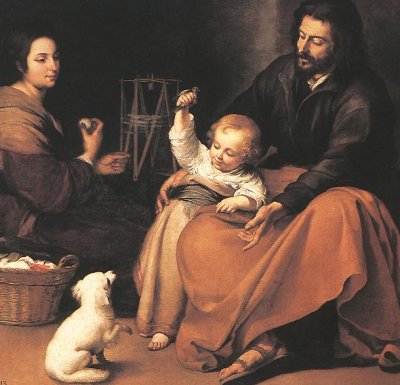
Imagine with me a letter written by Joseph to his father on the night Joseph had the dream of the angel that today’s Gospel reading narrated.
HolyFamilyJoseph, eldest son and protégé, to Jacob, my father, mentor, and confidant: Blessings and peace to you, my mother, and my brothers and sisters.

By the time you read this letter, I will have left home. I awoke in the still hours of the night to write it, and I imagine that when I leave, the sun will be many hours from rising. I hope someday you will welcome me back into this house. I know it will not be tomorrow or the next day. But someday, I hope.

By the fact that you have found this letter on my workbench instead of finding me there, you will have concluded that I changed my mind. You are correct in that deduction. I know we agreed on my course of action. I know what you said yesterday – what you’ve been saying for weeks, really – is still the correct decision. But now, as I sit watching the swaying light of a guttering candle, as my mind empties of all the noise and my heart fills with every new possibility, I find that our agreement is not the correct decision. It is simply a correct decision. But there is another, and this is the one I choose.

I know, father, that reading those words will make you want to tear up the rest of this letter at once, but I beg you to keep reading, because I must explain myself. I need you to understand how my heart has come to change. I need you to understand that disgrace is a small price to pay to do what I feel God is calling me to do. I need you to understand how my agony has turned to joy. In the simple of act of choosing the better of two right answers, I find a weight I didn’t even know I was bearing has lifted. I feel free. I feel like I am making the choice that truly reflects the man I want to be, the man God dreams for me to be.

Let me start at the beginning. I know I came of age years ago, but until the day you entered into terms with Mary’s father and she and I got engaged, I never knew the weight of true responsibility. What I didn’t expect was to discover my duty to wed Mary deepen into the love I now have for her. Though from that first meeting, we’ve never been alone, just Mary and me – still, whenever we’re together, I feel like we’re the only two people in the world. Everything fades except her strong, sturdy, quiet presence. When I think about the prospect of life without her, all I can feel is the absence, the ragged hole her disappearance would leave.

And now I can hear in my mind your argument begin again, father. What about you duty to your family? What about your love and respect for your mother and me? What about the marriage prospects of your own brothers and sisters, your own flesh and blood, if you ruin our reputation? Believe me, I am aware of the implications of my choice, hence my decision to leave home and spare you the humiliation. Nazareth is a week’s journey from our home in Bethlehem. When Mary and I move there, we will be far enough away to keep you from public disgrace. Disavow me as your son and make my brother your heir. Then your legacy will be safe.

As for me, I will take Mary for my wife. I do this not despite her pregnancy, but because of it. I now know my life’s purpose – to take care of Mary and her child. To love them, cherish them, and provide for them, come what may. The boy – yes, it’s a boy – will call me father, but he will know who his true father is. No matter what I said to you yesterday, I now believe Mary’s story. I’ve always wanted to believe it. I had been trying to believe it since she first told me because I knew in my heart a false word has never escaped her lips. But now I truly believe.

You once said to me, father, that believing means setting your heart on something. It’s not just thinking or acknowledging something is right or true. Believing means taking all that’s precious within yourself, all that makes your blood flow and your lungs fill, all that keeps you alive, and placing it in other, worthier hands. I learned that from you, and I’ve found something worthy of my belief – the unborn child in Mary’s womb and the power who placed him there when she said “yes” to the angel.

You might be wondering what changed my mind. You had convinced me yesterday, after all. I was ready to have the hardest conversation of my life. But something told me to sleep on it, to give it another day. You know I’ve always been a heavy sleeper; I’ve never remembered a dream in my life. I didn’t think I had them, which is ironic considering whom you named me for. That Joseph could interpret dreams. He saved Egypt from famine. He saved the family who had sold him into slavery. And all because he listened to the special way God spoke to him.

Tonight I discovered I’m more like our ancestor than I imagined. I had a dream, but before you say it was “only” a dream, know that it was realer than anything I’ve ever experienced in my waking years. The angel who stood before me, the brilliance of his gown, the fire in his wings, the music in his voice – they made the real world seem dull and counterfeit by comparison. The angel gave me permission to make the choice my heart has longed to make, the choice that you and our neighbors and this society says is wrong.

Again, I can guess your mind, father. What makes you so sure of yourself? How can you discount your family and your culture so blithely?

Please know there has been nothing casual about this decision. I have been in agony since Mary first told me, and I know she has too. The decision I was going to make yesterday – to dismiss her as you wished – is correct by any measure available. But so is standing with her, remaining faithful, being true to myself and to my promises. Surely, you can see that, father. Choosing between right and wrong is simple for the most part. But choosing between right and right? That’s the harder challenge.

In making this choice, I listened to Mary, whose honesty even you once said is beyond reproach. I listened to my own heart, which lifted from agony to joy the moment I changed my mind. And I listened to God, whose power and presence has been weaving in and out of this mess from the beginning. I can do no more than try to follow where these promptings are leading me.

I hope you can see that, father. I hope when the scandal dies down, you will be able to welcome us back home. Know that you will always be welcome at our home in Nazareth. Know that Mary and I desire with all our hearts for Jesus – that’s what we’re going to call him – to meet his grandparents. My prayer for you, father, is that you will do the same soul-searching I have been doing this night by the light of this nearly spent candle. Listen to those you love. Listen to your own heart. Listen to God. And perhaps you will find that what you believe, that thing you set your heart on, has shifted without you realizing it.

This is my hope for you. In the meantime, know that Mary and I are safe. We await the coming of our son with joy (not to mention some anxiety). He’s not even born yet, and Jesus has already saved me from walking down the wrong path. Perhaps the right path will lead us all back together again someday.

With sadness and joy, I remain

Your loving son,

Joseph

Turn Around

(Sermon for Sunday, December 8, 2013 || Advent 2A || Matthew 3:1-12)

InconceivableAbout ten minutes into The Princess Bride (one of my favorite movies), we meet Vizzini, Fezzek, and Inigo, who kidnap Princess Buttercup and set sail across the sea to another country. Once there, the giant Fezzek scales the imposing Cliffs of Insanity with the other three strapped to him. All the while, the Man in Black has been chasing them, but Vizzini, the leader of the thieves, dismisses their pursuer, saying it would be “inconceivable” that anyone would have known they kidnapped the princess in the first place. And yet the Man in Black starts climbing the cliffs after them. “Inconceivable” says Vizzini again. So Vizzini cuts the rope, and the Man in Black hangs onto the rocks. “He didn’t fall? Inconceivable!” Vizzini says a final time. Then the Spanish blademaster Inigo looks at Vizzini and says one of the more quotable lines in a film full of quotable lines: “You keep using that word. I do not think it means what you think it means.”

Well, friends, Inigo’s gentle rebuff finds a second target in a certain word that John the Baptist says three times in our Gospel reading for today. We also say this word every single week during our worship services. The word is “repent,” and I can hear Inigo saying to us what he says to Vizzini: “You keep using that word. I do not think it means what you think it means.”

See if this popular misunderstanding of repentance resonates with you. You’re walking toward Fenway Park for a game or you’re about to board the T at Government Center and you see a man standing before you wearing a sign. The sign is decoupaged with dire warnings about the end times, the largest of which says in big black letters on an orange background: “Repent! The end is near.” The man would be easier to dismiss if he were shouting at the top of his lungs on the street corner, because then he would be reduced to a silly caricature of himself. But this man’s solid, disconcerting silence makes you take him more seriously. I see him often when I’m in the city, and every time I do, I have to remind myself that I disagree with his sign’s version of repentance.

You see, the misunderstanding the sign promotes is that repentance is only relevant at the end, whichever end you might be thinking of – the end of life or the end of time. This misunderstanding reduces the act of repentance to a last minute bargain with God – a “Get out of jail free” card, if you manage to time your repentance at just the right moment. This misunderstanding is like repentance at gunpoint; it’s a “repent or else” threat that reduces the meaning of true repentance nearly to invisibility. Indeed, I would wager that when you hear the word “repent,” you have a negative visceral reaction because this misunderstanding runs rampant in popular culture and in certain very loud expressions of Christianity.

So let’s see if we can remove some of the negative reaction, because true repentance energizes our walks with God in ways few other spiritual concepts can. True repentance is concerned less about the future and more about the present. The word “repent” literally means “to turn around.” A recent translation of the Bible adds a layer of interpretation every time “repent” appears in the Gospel. “Change your hearts and lives” it reads instead. Change your hearts and lives. This is a good rendition of the original Greek because true repentance is both an active, kinetic force and a spiritual orientation.

When we repent, we reorient our lives in God’s direction. We bend toward God as a tree bends towards the sun, knowing that God is the source of our sustenance. Repentance begins with our acknowledgement that we live most of our lives facing the wrong direction: we ignore the need around us and we catch God’s glory only out of the corner of our eyes. Repentance helps us face head-on the need God yearns for us to notice. Repentance gives us the opportunity to rejoice in God’s glory, distraction free. When we participate in God’s work of changing our hearts and lives to resonate more fully with God’s movement, we discover the true meaning of repentance. True repentance is about turning to face God fully – with every facet of our lives – and to accept the truth that we can hide nothing from God, no matter how hard we try. When we repent, when we turn to face God fully, we discover new faculties for seeing and responding to God’s call in our lives, Christ’s presence in the lives of others, and the Holy Spirit’s surprising movement throughout all of creation.

Sure sounds like a different understanding of repentance than we’re used to, doesn’t it? Speaking of things we’re used to, let’s turn to the place in our worship in which we repent every week, and see if we can inject it with our better definition. You know that part I’m talking about? That’s right, the Confession of Sin:

Most merciful God, we confess that we have sinned against you in thought, word, and deed, by what we have done, and by what we have left undone. We have not loved you with our whole heart; we have not loved our neighbors as ourselves. We are truly sorry and we humbly repent. For the sake of your Son Jesus Christ, have mercy on us and forgive us; that we may delight in your will, and walk in your ways, to the glory of your Name. Amen.

Repentance is right there at the center of the confession. We begin by stating how we have separated ourselves from God. Then we repent. And then we ask for the fruits of repentance: forgiveness, delight in God’s movement, and a closer walk in God’s ways. Notice how our better definition energizes our confession.

“We are truly sorry and we humbly turn to you, we humbly seek to change our hearts and lives.” When we turn to face God fully, we find the mercy and forgiveness that we usually catch only out of the corner of our eyes. When we turn to face God, we find God’s delight in us reflecting on us fully, granting us the ability to delight in God. When we turn, we find the life-affirming paths that lead us to walk in God’s ways. This is what our repentance accomplishes here and now. The future ramifications for our souls that the sign-wielding man touts are byproducts of how our repentance leads us to closer relationships with God in the present.

So why are we talking about repentance during the season of Advent? Because Advent is a time for noticing. Advent is a time for changing our hearts and lives so they resonate more fully with the promises of God. Advent is a time for turning around and seeing the glory of God here now and the glory that is coming. This glory was easy to miss on that night in Bethlehem, which we will celebrate in a few weeks. No one expected the messiah to come in the manner Jesus did. No one, that is, except for those who noticed, for those who turned to see the promise of God fulfilled: shepherds who looked up at the right time to catch the angels’ song, magi who saw a star and knew to follow it, and a loving couple who changed their hearts and lives to make room for the Christ child to enter their midst.

A Thanksgiving Day Meditation

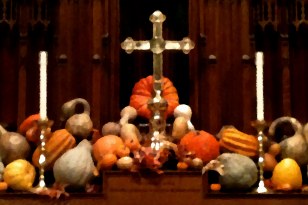
harvestcrossI would like to lead you in a guided meditation for the next several minutes. This meditation is about various aspects of thanksgiving, of gratitude. We will give thanks for things that have always been and things that have never been; we’ll give thanks for the past and the future; we’ll give thanks to God, who is always showering upon us reasons to be thankful. So I invite you to close your eyes, get as comfortable as you can without falling asleep, and take a few deep breaths.
***

Dinner at a new restaurant. Seeing old friends. Getting my slippers out of storage. I have given thanks for each of these things in recent days, and each has been something new – a change from an earlier condition or a recent addition to the world at large.

Now, I don’t know about you, but for me giving thanks for new things or for things that have recently changed takes up most of gratitude time. The new things jump out at us. They vie for our attention. The things that have always been there remain in the background, quietly making our lives comfortable or joyful or meaningful. Because the things that have always been don’t call attention to themselves, we fail to give thanks to God for them as often as we should.

For the next few moments, I invite you to think of something that you can’t remember doing without: it can be as basic as breath or your dog’s earnest affection. It can be the simple fact that you’ve always had clean clothes in your drawers or a hot meal on the table. Think of something you’ve never given thanks for because it has silently endured throughout your life, never calling attention to itself and never failing to make your life better. Give thanks to God for this something-that-has-always-been.

***

Now we’ll take a look at the opposite – thanking God for things that have never been. This type of gratitude is possibly even more difficult than the previous kind because it involves stepping into other people’s shoes in order to appreciate your gifts and blessings.

When we stand in another’s shoes, we gain the capacity for perspective. Sometimes, it’s difficult to see things when you’re right up close to them and seeing them from the same angle you always do. To give thanks for something you’ve never had, you might need to view your life from that other perspective. Perhaps you’ll give thanks because diseases that have affected people all over the world for hundreds of years won’t affect you because you were inoculated as a baby. Perhaps you’ll give thanks because you’ve never known a time when your stomach was so empty for so long that you forgot how to be hungry. Perhaps you’ll give thanks because every time you slept outside in your life, you did so because you chose to – and you always had s’mores as the campfire died down.

For the next few moments, I invite you to think of something you’ve never experienced, something you don’t want to experience because it is unhealthy or degrading or worse. Now thank God that this thing has never happened to you. But don’t stop there. Recognize that the thing-that-has-never-been always is happening somewhere in the world – maybe next door, or a few blocks away, or across an ocean. How can you help make that thing change from an always is to a never again?

***

Sometimes, blessings are hidden within moments of our past that sure didn’t seem like blessings at the time. When we were living through those times, we never expected to give thanks for them one day. But what we forget is that God doesn’t comprehend our lives in the limited linear fashion that we do. God, I think, comprehends our lives as a whole – not as a series of events. We view our lives as though flipping through the pages of a magazine, one to the next. God sees our lives as collages, in which all the pages are pasted together.

So for the next few moments, I invite you to give thanks for something in your past that didn’t seem like a cause for gratitude at the time. Reflect on how this event fits into the overarching narrative of your life. What did you learn from it? How did God support you as you went through it? What do you know now that God knew then?

***

When we take the long view of events in our pasts, we find the ability to thank God for difficult and challenging times that have led our lives in directions we never imagined. This sort of gratitude accomplishes more than simple thanks to God. By acknowledging that we have no idea how our lives are going to turn out, we practice humility in the face of the expansive unknown that we benignly call “future.”

So for our final few moments, I invite you to give thanks for the vast expanse of possibility the future holds. This sort of thanksgiving is the birthplace of hope – which is the willing expectation that the boundaries of possibility are far wider than we perceive. So give thanks to God for possibility, for newness, for adventure. And then take a step with God into the untamed wilderness that is tomorrow, knowing all the while that God has already explored this jungle and will lead you through.

***

The next time you go to the table at your church to celebrate the Great Thanksgiving – better known by its Greek name “Eucharist” – I invite you to hold onto these things for which you have given thanks. As you receive the presence of Christ in the bread and wine, offer your thanksgivings back to God. And in the exchange, know that God is always and forever giving thanks for you.

Three Words

 (Sermon for Sunday, November 24, 2013 || Christ the King Year C || Luke 23:33-46)

Today, on this final Sunday of the church’s year, we celebrate the “kingship” of Christ or (put another way) the “reign of Christ.” I prefer this second word because “kingship” conjures up for me images of thrones and jousting and ladies bestowing tokens on knights who catch their eye. Possibly, I’ve read too many novels in the “historical fantasy” genre. But more than that, the word “reign” just feels broader and more energetic. The eternal “reign of Christ” stretches out from Christ the King and supplants the lesser things that attempt to reign in this world and in our lives. When we turn our attention away from these lesser (yet louder) things – power, money, fame, and the like – we can see and participate in the greater (yet quieter) reality of Christ’s reign.

The territory over which Christ reigns encompasses the whole of Creation, and yet we tend to cede our personal territory to the lesser things that seek to rule because it seems like the normal and acceptable thing to do. But there’s the rub: Jesus never did the normal or the acceptable thing, so, of course, his reign subverts the expectations of the world.

Speaking of expectations – show of hands – how many of you expected to hear the story of Jesus’ crucifixion when you came to church this morning? Yeah, I didn’t think so. A little jarring, wasn’t it? We’re about as far from Good Friday as we can get on the calendar, and yet we read this story today. So my question is: why?

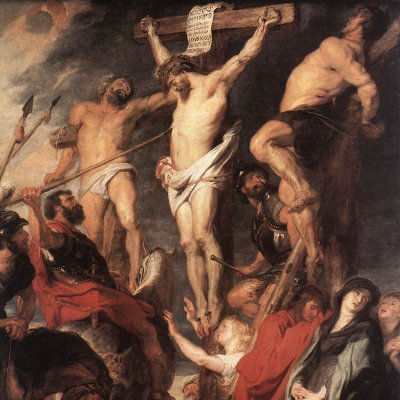
RubensCrucifixion Well, the easy answer is that the reading speaks of Jesus being a king and today is Christ the King Sunday. But this sermon has about seven minutes left in it, so I should probably say more than that, right?

While reading this story may seem strange, no other passage of the Gospel sheds more light on Christ’s reign than this one which recounts his torturous crucifixion. On the cross, Jesus was expected to succumb to the agony of the nails driven through his wrists and feet. He was expected to be ashamed of his nakedness. He was expected to cry out for pity’s sake and beg for mercy even as his breath came short and ragged because of the slow asphyxiation the cross delivers.

The normal and acceptable thing to do on the cross was to whimper your way to your last pitiful breath, all for the pleasure of Rome. But remember, Jesus never did the normal or the acceptable thing.

He was expected to show agony and shame and to cry out for mercy to an empire that never showed any. But instead, in the midst of his torture, he spoke three kind, generous words, words that echo through history and come to us and show us what Christ’s reign is really about. The cross magnifies the power of these three words because they stand in stark contrast to what the cross represents. The cross represents domination, separation, and fear. And yet, while nailed to its wood, Jesus spoke words of forgiveness, relationship, and trust. When we live into the reality dreamt by these three words, we cede our personal territory back to the reign of Christ and the lesser things slink off in defeat.

First, forgiveness. The sound of the hammer’s echo is still reverberating when Jesus speaks his first word. He looks down from the cross, sees his captors gambling for his clothing, grubbing over bloody scraps of cloth, and he says, “Father, forgive them; for they do not know what they are doing.” Forgive them: my betrayers, my torturers, my murderers. Forgive them. I have trouble forgiving the guy who cuts me off in traffic, and here’s Jesus choosing to use his last breaths to forgive those who numbered those breaths. What does he know that we forget all the time? What about forgiveness places it squarely in the center of Christ’s reign?

Jesus knows that forgiveness is a much larger concept than mere pardoning of misdeeds. Forgiveness is both an action and a state of being. When we forgive, we choose not to let anger, isolation, and vengeance reign in our lives. Forgiveness allows us to let go of these lesser things that, in the long run, can damage us irreparably. Writer Anne Lamott puts it this way: “Not forgiving is like drinking rat poison and then waiting for the rat to die.” Forgiveness releases us from the damaging power of brooding malice, of getting even. In their place, we find Christ’s reign, and with it the healing of brokenness and the bestowing of generosity of spirit.

Second, relationship. The sound of the thief’s request hangs hopeful in the air. And Jesus says, “Truly I tell you, today you will be with me in Paradise.” You will be with me. I can’t think of a more wonderful promise for Jesus to make. With these words, he reminds us that the cross, which dominates the scene, is just a passing thing. The separation it stands for is one of those lesser things that tries to rule, but which will ultimately fail.

Death seems so final, the pinnacle of separation, but in Christ’s reign, death is just another passing thing. In his resurrection, Jesus demonstrates the utter lengths he goes to be with us forever. He proclaims this promise to the thief on the cross and he fulfills this promise in our lives when he claims our personal territory as part of his reign. The thief himself speaks of his just condemnation as a criminal, and yet Jesus doesn’t see this as a barrier to relationship. Rather, Jesus sees the thief’s sin as a reason for relationship. In the reign of Christ, our sin separates us from God; but, in a mysterious cosmic paradox, our sin does not separate God from us. We may cede our personal territory to such a lesser thing as sin, but the territory, in the end, belongs to Christ. He’s not going to let passing things like sin and death defeat his presence and relationship in our lives.

Third, trust. With his last breath, Jesus cries out, “Father, into your hands I commend my spirit.” Another translation says, “Father, into your hands I entrust my life.” With these words, Jesus once and for all destroyed the power of the cross, which is a symbol for the power of fear. The Romans used this torture device precisely because it struck fear into the hearts of those living under Roman rule. But Jesus knows that trust is the antidote for fear.

The reign of Christ is a place where fear finds no foothold. Fear reduces us to selfish hoarders, whose lives are scarred always by the thought of “never enough.” But trust expands us, makes us generous givers, and vaults us into the reign of Christ, where the “never” of “never enough” falls away. When we trust God, we let go of the fear that grips us. Indeed, the act of simply attempting to trust God is in itself an act of trust. So even when we are bad at trusting, each attempt is a little skirmish that God wins over fear. Trust allows us to see past the deserted island of fear and view the ocean of God’s presence surrounding it. When we step off the island and into the water, we find ourselves floating in God and trusting God to keep us from sinking.

Forgiveness. Relationship. Trust. These are the words on the lips of Jesus as he hangs on the cross. Forgiveness. Relationship. Trust. These are the ways Jesus invites us to participate in his reign. We might be tempted to cede our personal territory to the lesser things that seek to rule us. But in the end that secession is a mere illusion because our personal territory has never been ours to cede. We belong to Christ. We live in his reign. By the standards of the world, Christ’s reign is neither normal nor acceptable. But Jesus never did the normal or the acceptable thing. And nor should we.

God’s Point of View

(Sermon for Sunday, November 10, 2013 || Proper 27C || Luke 20:27-38)

Today, I’d like to speak with you on a topic I’m entirely unqualified to talk about. No, it’s neither mortgage-backed securities nor the sport of cricket, though I’m definitely unqualified to talk about each. Nor is the topic the mysterious reasons for why my wife’s apple pie is so much more delicious than the ones I used to make. I know that one has something to do with butter, but that’s as far my understanding takes me. No, today I’d like to speak with you on a topic that no one besides Jesus has ever been qualified to talk about. I’d like to speak with you today about God’s point of view.

Because I’m unqualified to talk about this topic, you’ll have to take everything I say with a grain of salt. In the next few minutes I might say something that is true, but if I do, it will have been by accident because what I’m really going to do is talk about Adam’s point of view about God’s point of view. But maybe, just maybe, the Holy Spirit will help us glimpse the corner of the edge of the majesty of how God sees things.

So with those caveats aside, let’s listen in to the end of Jesus’ conversation with those wily Sadducees in today’s Gospel reading. They thought they could embarrass Jesus with a trick question, but in characteristic fashion, Jesus answers the question he wishes they had asked, not the one they’d actually asked. He finishes with these words: “The fact that the dead are raised Moses himself showed, in the story about the bush, where he speaks of the Lord as the God of Abraham, the God of Isaac, and the God of Jacob. Now he is God not of the dead, but of the living; for to him all of them are alive.”

Here Jesus references the third chapter of the book of Exodus, in which God says, “I am the God of your father, the God of Abraham…Isaac, and…Jacob.” Jesus notices that God doesn’t say, “I was the God of your father…” From our limited point of view, Abraham, Isaac, and Jacob are long dead – somewhere in the neighborhood of three thousand years ago, or about a thousand years in Jesus’ day. But God, says Jesus, sees things differently, as his emphatic end to the conversation demonstrates: “Now he is God not of the dead, but of the living; for to him all of them are alive.”

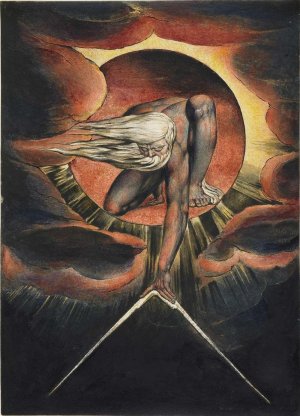
blakesGod
William Blake, Ancient of Days

This is our first glimpse into God’s point of view: “to God all of them are alive.” Can you imagine what that must be like for God? All of creation from the moment that moments began alive all at once. Every star that died billions of years ago, but whose light is just reaching us now; every single-celled organism gliding through the primordial ooze; every person we have ever loved and every person we have never known; all of them alive to God, all of it happening now for God.

I don’t know about you, but I get a little dizzy just trying to comprehend this thought – the riot of color and sound, the collision of what we see as the past and future, the unmeasured light years of space and uncounted eons of time all seen now by God, all spoken into being now by God, all loved and cherished now by God.

We can’t ever hope to comprehend this thought because we live our lives in linear fashion, moving moment to moment. We have memories of the past, and we have hopes for the future. Yesterday happened yesterday. It’s not still happening today. This linear model is like flipping through the pages of a magazine. Once I’ve flipped from page 35 to 36, I’m no longer looking at page 35. But from God’s point of view, the magazine is a collage of all the pages, with each picture cut out and arranged just so, like an elementary school art project.

This thought comforts me. From God’s point of view, I’m not simply Adam as I stand here before you: two months until his 31st birthday, his mother visiting from North Carolina, his sermon moving along apace. No. From God’s point of view, I am the totality of myself: everything that has ever happened, everything that will ever happen, every joy, every regret, every skinned knee, every embrace, every relationship, every failure, every triumph – everything that makes me the person I am, God sees and God speaks into being. This totality of myself includes my death and whatever there is in what we would call “After,” but what God still sees as “Now.”

The apostle Paul understands the difficulty of speaking about God’s point of view, and he says what I’m trying to say much better than I ever could. He says these words to the church in Corinth: “For now we see in a mirror, dimly, but then we will see face to face. Now I know only in part; then I will know fully, even as I have been fully known” (1 Cor. 13:12).

To be fully known. This is how God’s point of view works. God knows us fully. God knows the totality of each of us, just like God sees the entirety of creation happening now.

Speaking about God’s point of view has the unfortunate byproduct of making us feel so small, even insignificant. It’s only natural in the face of the idea that all of creation is always present to God to think that we don’t matter, that in the grand cosmic scale our lives are worthless.

But from God’s point of view, nothing could be farther from the truth. God couldn’t care less about the “grand cosmic scale” because the notion of a “scale” of any kind is meaningless to our eternal and infinite God. God speaks every subatomic particle into being and celebrates it as if it were the only speck in existence. Each speck has God’s full attention; if it didn’t, it would cease to be.

We may look up at the night sky and see ourselves as small, insignificant specks on a small, insignificant planet orbiting a small, insignificant star. But to do so is to deny the truth not just about ourselves, but about all of creation. All of creation is present to all of God. This includes you and me. If God weren’t constantly and continuously speaking each of us into existence, we would cease to be.

So if we are anywhere in the ballpark of the truth of God’s point of view, what does this all mean for us? Too many things, of course, to close this sermon with, so we’ll look at three – what we call past, present, and future, but each of which is always now to God.

First, the past and our grief over people dying: From our perspective, the sun sets below the horizon. But in reality, we are spinning away from the sun. Likewise, we grieve when someone dies because, from our perspective, that loved one is gone. But we know in a place deeper than normal knowing that, in reality, our loved one is still alive to God. Ultimately, grief is a way to express our frustration that we have a severely limited ability to perceive reality. But for anyone who has ever had a loved one die, you know that every now and again, you catch glimpses of true reality when you feel the presence of that loved one alive in a different way.

Second, the present: Since God is fully present to every particle of creation, which includes each of us, we have no business thinking of ourselves or anybody else as insignificant. Everyone matters, so we must affirm this in our actions.

Third, the future: Those we perceive as future generations are as alive to God as we are. Therefore, it is our duty to honor their significance in the same way we are called to honor those we meet today. This means making choices in our personal and communal lives that sustain our world, which, in the end, is another piece of creation fully present to God and therefore worthy of our honor.

So there you have it. I have now talked for more than ten minutes on a topic I’m entirely unqualified to speak about. However, being unqualified does not mean that we shouldn’t strive to see creation through the eyes of God. When we do this, we become better stewards, better servants, better followers. And we see deeper into the heart of what it means to be a child of God.

Our Response

(Sermon for Sunday, October 20, 2013 || Proper 24C || Luke 18:1-8 )

“Jesus told his disciples a parable about their need to pray always and not to lose heart.” So Luke tells us before sharing the story of a woman whose primary attribute is her unflagging persistence. But I wonder how many of us might like to tiptoe past Jesus’ reason for telling the story in the first place – his desire for his followers (then and now) to pray with dogged persistence, to pray always.

We might like to tiptoe past this notion because it seems so unrealistic. How could we possibly pray all the time? Surely Jesus is engaging in hyperbole. Perhaps he’s thinking that if he starts as high as “always,” then when we bargain him down, we’ll still be praying sometimes.

Or perhaps not. After all, Jesus doesn’t seem to be one for haggling. Perhaps he really does yearn for us to pray always, to pray with the same unflagging persistence as the widow in the parable demonstrates in her quest for justice. If that’s the case, then the popular understanding of prayer isn’t going to cut it; that is, an understanding of prayer as simple wish fulfillment. We need a bigger definition of prayer.

silverchair
Pauline Baynes (c) C.S. Lewis Pte. Ltd.

And so I submit as Exhibit A my yearly dive into C.S. Lewis’s Chronicles of Narnia. This time around, the beginning of Book Four, The Silver Chair.

Eustace Scrubb and Jill Pole are trying to escape a mob of bullies at the Experiment House, their ghastly boarding school. Jill has been crying, and the bullies can smell tears from hundreds of yards away. From their hiding spot, the two targets hear the angry shouts of the searchers. Eustace looks at Jill and wonders aloud if they might be able to escape to That Place. He begins calling out, “Aslan, Aslan, Aslan!” Even though she doesn’t know what he’s saying, Jill follows his example: “Aslan, Aslan, Aslan!” The bullies draw near, and Eustace and Jill scramble through the laurels and up a steep slope. The weathered old door in the wall is always locked, but this time – miraculously – the knob turns. And the two children step into Aslan’s country.

Immediately after they arrive, Eustace falls off a cliff, but a lion arrives just in time and blows him to safely to Narnia. The lion – naturally – frightens Jill Pole. She tries to slip away, but the lion begins questioning her. Her showing off caused Eustace’s fall, she confesses. For that display of pride, the lion gives her a task to perform. “Please, what task, Sir?” asks Jill.

“The task for which I called you and him here out of your own world,” says the lion. This response puzzles Jill. Nobody called them. They called out to – Somebody – a name she wouldn’t know. Wasn’t it she and Eustace who asked to come?

“You would not have called to me unless I had been calling to you,” says the lion, Aslan, the Christ-like figure of Lewis’s fiction.

This exchange between Aslan and Jill Pole illustrates most vibrantly the foundational principle of our bigger definition of prayer. You would not have called to me unless I had been calling to you.

The Catechism in the back of the Book of Common Prayer states the same thought like this: “Prayer is responding to God, by thoughts and by deeds, with or without words.” Years ago, when I first read this definition, I was flabbergasted. I had never thought of prayer as anything more than asking God for stuff. God, please give me a kitty that doesn’t scratch me. God, please help us win our soccer game. God, please make Grammy not sick anymore. Now, please don’t misunderstand, I’m in no way condemning these prayers of intercession and petition. Rather, every kind of prayer fits into a larger framework. Petition and intercession, which popular culture misunderstands as “wish-fulfillment,” are several bricks up from the foundation of prayer.

That foundation is, of course, God. More precisely, the foundation of prayer is God’s presence in our lives and God’s call upon our hearts. “Prayer,” says the Catechism, “is responding to God.” We never initiate a prayer. Our prayer is always a response because God has always been active, has always been breathing our lives into being.

Think of prayer as a phone call. You and I never dial the number: we only have the option to answer the phone when it rings. You would not have called to me unless I had been calling to you. When we choose to answer, we affirm our desire to participate in our relationships with God. Prayer, then, is the inclination of our lives towards God, our response to what God is already doing in our lives.

How full of light and love would those lives be if we took seriously Jesus’ desire for his followers to pray always? How much light and love would we bring to those around us if we strove with unflagging persistence to respond to God in every situation?

If prayer is everything we do in response to God, then Jesus’ call to “pray always” seems a little more realistic – still challenging, still demanding discipline and rigor, but more realistic just the same.

Monastics down through the ages have practiced this bigger definition of prayer. Even the lowliest jobs at the monastery – peeling potatoes or weeding fields – were prayer. Monks prayed many times a day in their chapels, but the labor they performed in the meantime was prayer, as well. They “prayed always,” because they saw everything they did in their lives as a response to God’s presence. While we don’t have strict priors delegating our labors, we can still import the monastic example into our lives.

Look at your day, your week, your year. How do your engagements and actions display your response to God’s movement in your life? As a member of a family, God calls you to love and enjoy and forgive your spouses, children, parents, and siblings. As a person made in God’s image, God calls you to discover your authentic self, the version of yourself that God sees and celebrates. As a servant of God, God calls you to perform that one way in which you can bring light and love to the lives of those around you. When we respond to God in all these areas of our lives, we pray. We affirm our relationships with God. We live the abundant lives that Christ offers to all.

The prayers we pray this morning in our worship service, the lessons we hear, the music we sing, the meal we share, all nourish us for a life of prayer between now and next Sunday. Jesus yearns for us his followers to pray always, to respond to God’s movement at all times. This brand of unflagging persistence surely is challenging. But the good news is this: even attempting to pray always is a response to God. Even realizing that we aren’t praying always is a response to God. Every impulse towards generosity, welcome, hope, joy, love, and service is a response to God. As are the cries of our hearts when all is dark. Each day of our lives, we are met with myriad opportunities to pray, to be responsive to God’s movement. And this same movement gives us the grace to respond.

“You would not have called to me unless I had been calling to you,” says Aslan to Jill Pole. “We love because he first loved us,” says the writer of the First Letter of John. Likewise, we pray because God first called us – called us into expansive, abundant relationship with God. What will our response be?

The Gospel’s Only Thanks-Giver (Besides Jesus)

(Sermon for Sunday, October 13, 2013 || Proper 23C || Luke 17:11-19)

Sometimes when I sit down to study a passage of the Gospel such as today’s, I wonder what Luke chose not to include in his text. After all, we don’t have a minute-by-minute account of Jesus’ life. The Gospel writers weren’t following behind Jesus taking dictation. Decades after the events of the Gospel, they collected material – certainly more than they ended up using – and put together their accounts. In those accounts, the writers bounce around, crafting their narratives with stories and themes and progressions that make the most sense to their various audiences. Asking “What did Luke leave out” prompts another set of questions: “Why did Luke put this in? What about this specific story makes it special enough to include in something as important as the greatest story ever told?

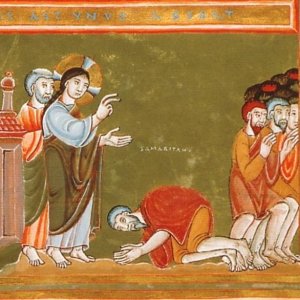
CodexAureusThese questions surfaced for me this week when I read today’s Gospel lesson. At face value, this story is quite simple. Ten diseased outcasts petition Jesus for mercy, he heals them, and one returns to say, “Thank you.” Seems like a pretty ordinary healing story, doesn’t it? Boilerplate, even. (Well, as ordinary as a miracle can get.) So why would Luke choose to include another healing story? He healed someone with a skin disease way back in Chapter Five, not to mention plenty of people with plenty of other maladies in between.
So what makes this story special? In such a short piece of writing as the Gospel, why this narrative? Turns out there is something extra special in this story, but it’s hidden. There’s one element in the story – the last element I mentioned earlier, the “Thank you” from the Samaritan – that pushes today’s lesson into the extraordinary. I did a quick survey of the rest of the Gospel – all four accounts (Matthew, Mark, Luke, and John) – and this Samaritan is the only person Jesus heals who then says “Thank you” to him. This hidden thanksgiving makes this story special. We remember this Samaritan ex-leper because he said “thank you” to Jesus.

Giving thanks is fundamental to our lives as followers of Jesus Christ. Each week, when we gather to worship God, we engage in the special event known as the Holy Eucharist. This strange word comprehends both our hearing of God’s Word of Holy Scripture and our sharing God’s meal of Holy Communion. Do you know what this strange word – Eucharist – means in its original language of Greek? It means “thanksgiving.”

So each and every Sunday we gather here to give thanks to God for all the blessings God has given us. We do this not to relegate the act of thanksgiving to an hour on Sunday morning, but so that we begin each week with the right frame of mind and heart: a mind aware of blessing and a heart inclined toward gratitude. Giving thanks here on Sunday morning propels us along a trajectory in which we continue thanking God over the course of the week.

With that being said, why engage in the act of thanksgiving in the first place? Right off the bat, giving thanks makes us more generous people. Generosity blossoms in an environment where fear of scarcity holds no sway. Earlier in the Gospel, Jesus and his disciples are looking out over a sea of hungry faces. There’s more than five thousand of them, and they haven’t eaten all day. Jesus and his friends have nothing more than one family’s lunch – five loaves of bread and two fish – but he tells them to feed the crowd anyway. Their supplies are laughably meager, and yet Jesus takes the bread and gives thanks to God for it. And somehow all the people in the crowd eat their fill. In the act of giving thanks, Jesus dismisses the fear of scarcity. When we give thanks to God – in times of scarcity and in times of abundance – we move away from fear and toward generosity. The more generous we are, the more apt we are to rely on God’s grace, which continues moving us away from fear. With this movement, a virtuous cycle develops, and the act of giving thanks starts making generosity a defining characteristic of our identities.

And yet giving thanks does so much more. God is always present in our lives, but we are not always present to God. Giving thanks offers us an opportunity to participate and deepen our relationships with God. When we are simply glad, our gladness has no target. We say we are glad about something, but not that we are glad to something. Not so with gratitude. When we are grateful, we can say we are grateful about something and grateful to someone. The Samaritan man in today’s Gospel lesson returns to Jesus to express his gratitude, to give thanks. The other nine are presumably glad they were healed, but they do not show their gratitude. By returning to Jesus, the Samaritan signals his desire to remain in relationship with Jesus, who blesses him again saying, “Your faith has made you well.” When we give thanks to God, we show our gratitude to our creator, who in turn blesses us with deeper relationship.

And yet giving thanks does even more. When Jesus sat at table with his friends on the night before died, he took bread, and gave thanks to God for them and for the time they were sharing together. He implored them not to forget him, and he gave them his presence in the bread, which he called his body. Then he shared the bread with them, and ever since his followers have been doing the same. Thus the act of giving thanks – especially in the meal we will share together in a few minutes – gets us outside ourselves and wards off the illusion of self-sufficiency. We give thanks together. We share Christ’s presence as a community. Giving thanks, then, makes the community stronger.

Because Jesus calls us to give thanks as a community, we can find one more reason (among the thousands we don’t have time to discuss) to engage in thanksgiving. Giving thanks propels us to use our gifts. The best way to give thanks to God for a gift God has given is to use it for God’s greater glory. I can thank God for my singing voice by saying, “Thank you God for the gift of music.” Or I can sing. When we serve one another and the world by using our gifts, then we have truly thanked God for them.

Giving thanks is fundamental to our lives as followers of Jesus Christ. We remember the Samaritan man today precisely because he did what no one else in the entire Gospel does. He returns to thank the one who healed him. I wonder what you are thankful for today? I wonder when was the last time you felt generous or when you felt your relationship with God deepen or when you shared in a community or when you used a gift? I invite you this week to reflect on how natural it is for you to give thanks to God throughout your day. If you find it uncommon, pray for more awareness and generosity. If you find it common, give more thanks for that joyful conclusion. No matter what, know that whenever you find yourself in a position to give thanks to God, God is giving thanks for you.

Ten Things I’ve Learned About Preaching

pulpitThis post also appears on MinistryMatters.com here.

I recently realized something that astounds me: this summer I passed the century mark for sermons preached. Since my first incoherent ramblings about the Letter to the Hebrews during a Homiletics class in seminary to the sermon I’m giving this Sunday, the Holy Spirit (along with my mentors and parishioners) have taught me so much about the craft of preaching. As I look toward the horizon of my next hundred sermons, I’d like to share with you ten things I’ve learned during the first hundred.

1. More than anything, preaching a sermon is an act of trust. I have discovered that the sermons I think are home runs don’t generate nearly as much “press” as the ones that I think are only okay. But every time I give what I think is a mediocre sermon, multiple people come up to me afterwards and tell me how much it spoke to them. Could this possibly be because I decided I needed to trust God more in the preaching of the mediocre sermon than the home run? And in that act of trust I was more open to the movement of the Holy Spirit during delivery? And in that openness I connected more intimately with my listeners? If so, I can conclude one of two things: either I can strive to write only mediocre sermons (nope!), or I can strive to find the place of openness and trust each time I mount the steps to the pulpit. As I move into my next hundred sermons, I ask God to bless me with an ability to trust God’s movement that is independent of my perceived skill.

2. Preaching is not about showing expertise. I learned this lesson thanks to the Rev. Dr. David Lose and the Biblical Preaching Project I participated in at Luther Seminary in St. Paul. Showing yourself to be an “expert” in the pulpit might seem like a good thing to do; after all, your listeners want to know that you know what you’re talking about. But be careful taking this too far. If you actively try to demonstrate your expertise or your fluency with biblical interpretation and theology (or worse, discipleship), then you run the very real risk of causing a complete disconnect between yourself and your listeners. Your demonstration will reinforce in their minds that they aren’t good enough or knowledgeable enough to study the Bible or think theologically (or worse, be disciples). It is not your job as the preacher to be the rock that they hang their faith on. (That’s someone else’s job and he’s way more important than you.) If you’ve been in a congregation long enough, they’ll know you know what you’re talking about. They’ll trust you. Use this trust to show your own vulnerability, the shaky times you’ve had, the moments when God surprised you from an unexpected trajectory. Not displaying expertise does not mean not having any. It just means that it shouldn’t be the takeaway from the sermon. Be vulnerable and you will connect even more with God and with the people.

3. The best sermons are about exactly one thing. I learned this the first month of college when my first three-page paper was returned to me without a grade and the words “too many ideas” scrawled in barely legible professor-script. That semester, Dr. Huber taught me the value of presenting one thought and developing it deeply. Moving this practice to preaching is the best advice I can give. Whether your sermons are ten minutes like mine or forty minutes like the ones my in-laws hear every Sunday, the sermon should still be about one thing. Every sentence should support the main thought. If it doesn’t, cut it. Your listeners will stay with you, and you’ll have more room to say what you need to say. Keeping your sermon to exactly one thing will protect you from the dreaded “greatest hits” sermon; that is, a sermon which says everything a passage of scripture could be about but expands on none of them. Pick an idea and work with it. “Turn the crystal,” to quote my Homiletics professor. After all, you’ll get another crack at the readings in three years.

4. The more specific the more universal. This might seem antithetical, but I assure you it’s not. If your sermon is full of generalities or ideas with no examples to back them up, then your words are more likely to sail over the heads of your listeners. So be specific. Illustrate your point with an example that could very well happen to some of your listeners. Even if the example doesn’t hit home, it will hit closer to home than a bland generalization ever will. For example, a few weeks ago I preached about God finding us (inspired by the parable of the lost sheep). At one point, I said this:

“Perhaps you are holding your mother’s hand as she lies dying. She holds your hand back…until she doesn’t. You don’t think you have any more tears, but you are wrong. Your deep grief reveals not how deeply you loved her, but how deeply you love her, and you realize your love will never become a past tense thing. And God finds you in the continued connection between the living and the dead.”


Preaching through real world examples helps connect to the listeners, but it also serves another important purpose. It gives listeners a model by which to reflect spiritually and theologically about their own experience. Modelling this practice from the pulpit is a good end in itself.

5. Every sermon is about the preacher. You might not think that your sermon is about you because you never mention yourself, but every sermon is about the preacher, no matter the content. Even if you did only a minimal amount of self-reflection, every sermon springs from a mingling of prayer, study, examination, and experience. Oftentimes, my sermons will touch on something I’m wrestling with even if I don’t realize it’s on my mind. In the end, if the sermon doesn’t “preach” (in the sense of resonate) to the preacher, then it won’t preach to anyone else. That being said, I don’t advocate having the preacher be the “hero” of the sermon. Just remember that every sermon is about you whether you want it to be or not.

6. Every sermon should be about the listener. The sermon might be about you, the preacher, but it should also be about the people you’re preaching to. The hardest group to whom to preach is a group you’ve never met before. Once you’ve been in a worshipping community for a while, your sermons will start resonating more and more because you will have gotten to know the people. You’ll know their particular struggles. You’ll know what they’re hungry for. You’ll know how to talk to them. Once you know your listeners, there’s no excuse for a “boilerplate” sermon. Hit them where they live. Offer them enough comfort in your words that they will accept your challenge. Offer them enough challenge so they can grow spiritually. But above all, offer them the Gospel in the way they are most likely to hear it. (That’s what Matthew, Mark, Luke, and John did, after all.)

7. Every sermon should proclaim the Gospel. This one seems really obvious, but it’s harder to accomplish than you might think. I do not mean here that every sermon needs to be specifically about the lesson from the Gospel you read just before preaching. What I mean is that every sermon must proclaim the good news of the love of God made known in Jesus Christ our Lord. This good news might come in the form of encouragement or comfort or hope; it might come through pointing out God’s presence in the midst of challenging times; it might come from telling the story in a new, enlightening way. No matter from where you take your text, the Gospel can shine from it. As I said, however, it’s harder than you might think. I wrote a story sermon once that ended up being just a story. There was no sermon in it. But I didn’t notice until too late. When you’re done writing your sermon, look back at it, and ask the “Where’s the beef?” question. If you can’t find the “beef” then you’re not done.

8. There’s a difference between a sermon and preaching. A written sermon is like a musical score: the notes are there ready for the orchestra to play them, but until they put bow to string or lips to mouthpiece, the notes are just little black marks on paper. If written sermon is to musical score, then preaching is to making music. The preacher gives life to the words by speaking them. We call it a sermon “delivery” on purpose; God calls preachers to deliver the good news directly to where people “live and move and have their being,” just as the UPS guy delivers packages to your front door. This happens most successfully when spoken aloud. Not only that, but the preaching moment is sacred because during it the Holy Spirit rides the preacher’s breath to the listeners’ ears and down into their hearts.

9. Preaching is theatre. Imagine two preachers have written the same sermon text. One reads it in a drowsy monotone. His head is down, and he’s giving off the general air that he just wants to get through it so he can get on with his day. There’s a good chance half the congregation is checking their smartphones. The other has the text in front of her, but she’s looking up way more than she’s looking down. Her voice rises and lowers in volume; she hammers some words and lets silences linger between thoughts so they can sink in. Perhaps she uses the pulpit as a prop or gestures with her hands at appropriate times. She is engaged in the preaching moment and her whole body is part of the delivery. There’s a good chance the smartphones are safely in pockets and purses. You can hear a pin drop. The congregation is hanging on every word. Delivery matters. I’m not telling you to try to win an Oscar every time you mount the pulpit; just remember that how you speak is just as important as what you say.

10. Preaching is a gift. Have you ever stopped to think just how blessed you are to have an opportunity to proclaim God’s eternal presence, Christ’s love, and the Holy Spirit’s inspiration to a group of willing listeners week in and week out? The next time you are stuck in the middle of sermon preparation, think what a gift God has given you with this opportunity. Then remember God has also given you the gifts to preach the Gospel through words. Thank God for all the gifts in your life, and then get back to work using them.

Confronting Need

 Sermon for Sunday, September 29, 2013 || Proper 21C || Luke 16:19-31; 1 Timothy 6:6-19)

This story takes place on a brisk afternoon in mid-December of 2007. I was one week away from being ordained a deacon and six months away from graduating seminary. Margot was my spiritual director back then, and she and I decided it would be a good idea for me to give a formal confession in preparation for ordination. I wrote out everything I could think of on several yellow sheets of paper, and Margot listened to my confession up at the altar rail of St. Alban’s church in D.C. When I was done, she pronounced my forgiveness. I can’t tell you how good I felt afterwards. I was exhausted but overjoyed. I felt completely empty, but in a good way – like all this brush had been cleared away ready for new construction; like there was so much more room within me for God to fill.

I got in my car, drove down Rock Creek Parkway, and turned onto Memorial Bridge on my way back to Alexandria. As I pulled up to a traffic light in Arlington, I saw a sight familiar to the area: a person standing on the curb with a cardboard sign in hand. But as I got closer, the sight became less familiar. The person was, in fact, a young woman, beautiful beneath a layer of dirt on her face. She wore tattered jeans, and a duffel bag lay by her feet. My car came to a halt about fifteen feet from her. And this part I remember with crystal clarity. She looked right at me. Her gaze was neither plaintive, nor hopeful, nor condemning. She just looked at me as anyone with mild curiosity might do. And yet, for the flash of a moment that our eyes met, I felt her gaze pierce me down to the depths of the happy emptiness I had experienced after my confession.

And then I looked away. I couldn’t bring myself to meet her eyes. I willed the traffic light to turn green so I could drive away, so I could leave that place, so I didn’t have to choose not to look at her. After a small piece of eternity, the light did change. I did drive away. I did leave that place. But this young woman with the tattered jeans and cardboard sign hovered in the corner of my vision like when you look at the sun and then look away. And I burst into tears.

Less than fifteen minutes since my confession, since I heard the glorious news that God had forgiven me, would always forgive me, and I committed a brand new, heartbreaking sin. God was staring out at me through the eyes of the young woman. Her gaze pierced me to the depths of my happy emptiness, which God yearned to fill with compassion and solidarity and the fervent desire to answer the call to help people in her position. But I looked away. I did not engage.

My sin that day in 2007 (and my sin many, many times since then) was the sin of the rich man in today’s parable. The need at his gate is so visible that this man must actively choose not to see Lazarus lying there. If a film were shot from the rich man’s perspective, Lazarus would always be a bit to the side and out of focus. The man chooses to ignore the need at his gate, and thus his sin is the sin of non-engagement.

His wealth allows him to live inside the illusion of self-sufficiency; he needs no one’s help, and so he never offers to help. His wealth has led him to total isolation. When he dies, his self-chosen isolation follows him to the grave. The “great chasm” between himself and Abraham is of his own making.

The sin of non-engagement runs throughout this entire section of the Gospel according to Luke, all the way back to when Jesus sets his feet toward Jerusalem. The priest and the Levite commit the sin of non-engagement when they cross to the other side of the road upon being confronted with the beaten man. The Good Samaritan, on the other hand, engages him and tends to his wounds. The foolish man who desires to build bigger barns for his wealth commits the sin of non-engagement when he turns inward and decides to hoard his assets. Both brothers in the Parable of the Prodigal Son commit the sin of non-engagement: the younger when he takes his inheritance and runs away, and the older when he won’t come to the party honoring his brother’s return. When their father goes out to meet them in their isolation, he seeks to heal the gashes made by this sin. And now we have the rich man and Lazarus. Like in each of these other parables, today Jesus seeks to shake up how the establishment has been living, to indict how it has been ignoring the need around it, and to offer a new model for engaging with those whom they would rather not see.

Or should I say those whom we would rather not see, whom I would rather not see. This week at the Wednesday Bible study, Sheri Anderson saw right through my excuses as to why I rarely engage with people on the street. “I don’t carry cash,” I said (a thin defense, I know).

“And you couldn’t offer them a prayer or a blessing instead?” asked Sheri. I quibbled for a few minutes, but she was right. Too often, I have left Park Street station and walked the hundred yards to the cathedral wearing dark sunglasses and headphones. Too often, I have set my eyes straight ahead and chosen to ignore the need around me – because acknowledging that need makes me feel so small, so helpless.

But as Bill Viscomi said at the Haiti Ministry Night, “We can’t do everything, but that shouldn’t stop us from doing something.” Every week, we confess the things we have done and the things we have left undone. The enormity of the need around us has led me to respond by backing away, by disengaging, by allowing so many things to be left undone. But this week, Jesus’ words, along with Sheri’s challenge and Bill’s hope, have convicted me.

Next week, when I go to the cathedral for a meeting, I will be prepared. By the grace of God, I promise not to ignore the need around me. I promise to engage it in my own small way. I hope you will join me in this promise. As Paul says today to Timothy: “Command [the rich] not…to set their hopes on the uncertainty of riches, but rather on God who richly provides us with everything for our enjoyment. They are to do good, to be rich in good works, generous, and ready to share.”

Compared to the enormity of the need around us – in our communities and in this world – we are the rich ones whom Jesus and Paul speak to today. We can’t do everything, but that shouldn’t stop us from doing something. When we promise God that we will participate in God’s good work among the least of those in our society, we can be assured that God will be with us in our efforts, that God will push and prod us toward facing the need rather than looking away. With God’s help, we can start small: a promise to pray with a man on the street, to pass out small gift cards to the grocery store, to sit with guests at the Long Island Shelter and talk with them.

The more we do these “somethings,” the fewer things we leave undone. And as we trust God enough to engage with those in need, God will confront us with greater and greater opportunities to serve God in this world at both the personal and systemic levels. So I challenge you today, and I challenge myself: trust God enough to keep from being overwhelmed by the needs of the world. Find a corner of the need, and start working on it. And God will bless our engagement. We can’t do everything, but, by the grace of God, that will not stop us from doing something.

* You can hear my song “Miserere Mei,” the first verse of which recounts the story at the beginning of this sermon, here.

Being Found

Sermon for Sunday, September 15, 2013 || Proper 19C || Luke 15:1-10 )

Have you ever been found before? I know this is an unusual question. A more normal one might be: “Have you ever been lost before?” but I’m pretty sure I know the answer to that one. I want to know if you’ve ever been found. I have. Let me share with you a quick story from the “Stupid Things Adam Did as a Child” file.

dad and adam at campMoundville, Alabama is so named for the Native American burial mounds that dot the landscape. The mounds are both eerie and fascinating, which makes Moundville a great place for Boy Scouts to go camping. Well, the camping trip ended, and I was waiting for my father to pick me up. I was twelve or thirteen at the time. We had agreed he would meet me at the parking lot closest to our campsite, so that’s where I waited. And then I waited some more. He was running late, so I decided we could save a few minutes if I met him at the entrance to the park instead. (This was in the days before cell phones by the way. Ancient history, I know.)

I walked for a few minutes to the front of the park and perched myself on a stone sign with a good view of the road so I could flag down my dad’s car. But unbeknownst to me, he had already entered the park from a different direction. An hour later, I still had my eyes on the road when my father’s car came screeching to a halt behind me. He jumped from the car and ran to me, yelling my name all the while. Suffice it to say, he was not happy.

Where were you…Didn’t we agree to meet…You scared me half to…I’ve been looking everywhere…

All of this spilled from him as he approached me. His eyes blazed with anger – I don’t think I’ve ever seen him so upset, before or since. But then his hand touched my arm, and everything changed.

Now, parents out there, you might be able to identify with what happened next. When he touched me, it was as if he confirmed that I was really, truly there, that I wasn’t merely a figment he had been chasing through the mounds for the last heart-pounding hour. All the scenarios of kidnapping or being mauled by a wild animal or getting lost in the forest – all these scenarios that had been shuddering though his mind vanished when he touched me. And with the touch came relief. And with relief came joy. And with joy came an embrace brimming with all the spoken and unspoken love of father for son.

I was still in trouble. I was chastened for my foolhardiness. But above and beyond that, I was found. Have you ever been found before?

In today’s Gospel lesson, Jesus responds to his opponents’ critique of his unsavory dinner companions. “He told them this parable: ‘Which one of you, having a hundred sheep and losing one of them, does not leave the ninety-nine in the wilderness and go after the one that is lost until he finds it? When he has found it, he lays it on his shoulders and rejoices. And when he comes home, he calls together his friends and neighbors, saying to them, “Rejoice with me, for I have found my sheep that was lost.” Just so, I tell you, there will be more joy in heaven over one sinner who repents than over ninety-nine righteous persons who need no repentance.’ ”

Now, for Jesus’ opponents it was quite easy to separate the sinner from the righteous. The system of sacrifice and purification allowed people to proclaim themselves blameless before God – indeed, even Paul does this in his letter to the Philippians. This system created an in-group and everyone else. But by eating with “tax collectors and sinners,” Jesus proclaims that God doesn’t just move in the lives of the so-called “in-group.” In fact, God is present in the lives of all people. God seeks out and finds all people. Let me assure you, this was a radical claim in Jesus’ day.

And I think it remains a radical claim. How many of us have heard one religious group or another claim that God is on their side and no other? How many of us have been jealous of other people, who we assume God has favored because, darn it, everything seems to go their way? In our fallen state, we have a kneejerk reaction to exclude, to isolate, to create cliques and in-groups just to make ourselves feel better. But when Jesus sits down with all the wrong people, he punctures the false assumptions that God belongs to any one group and that God seeks to find only one type of person, the kind with white teeth and perfect cheekbones.

In truth, each and every person on this earth is the sheep who has gone astray. We have all wandered off alone and gotten lost. The path is there – perhaps a bit overgrown, but there. And yet, something shiny catches our eye and we strike out for it. But it’s just a trick of the light, and now it’s growing dark and the path is away to the left somewhere but good luck finding it. We stagger around in the gathering gloom, hoping against hope we are going in the right direction.

Into this gathering gloom, the light of Christ shines. Into the underbrush, Jesus tramps. Onto his shoulders, he lifts us up and carries us back to the path. And guess what? Tomorrow he’ll do the same thing again. Last week, Margot invited us each to go deeper in our commitment to God’s work in our lives. This week, Jesus invites us to celebrate God’s commitment to do whatever it takes to remain in relationship with us, no matter how often God has to find us and return our meandering feet to the path.

This commitment is no idle tale. God’s presence in the lives of all of us lost sheep gives us the hope that we are being found each day. And in being found, being nourished. And in being nourished, being molded into the people God calls us to be.

Now being found takes on all shapes and sizes, so I invite you to be aware of the unique ways God is actively finding you. Perhaps you are sitting in your pew and the choir’s anthem pierces your heart with the truth of God’s majesty. And God finds you in a moment of pure delight.

Perhaps you are holding your mother’s hand as she lies dying. She holds your hand back…until she doesn’t. You don’t think you have any more tears, but you are wrong. Your deep grief reveals not how deeply you loved her, but how deeply you love her, and you realize your love will never become a past tense thing. And God finds you in the continued connection between the living and the dead.

Perhaps you are waiting for your father to pick you up and you wander off and when he finally reaches you, you feel his desperation and anger melt into relief and joy. And God finds you in the fervent embrace of father and son.

God finds us every single day of our lives, no matter how far we have strayed from the path. We participate in this reality when we notice God finding us, when we realize just how God is weaving the strands of our lives together, and when we act as the vehicles of God’s finding in the lives of others.

After the service, I invite you to go to the Bartow Room and look at Ann Musto’s beautiful painting hanging over the fireplace. In the foreground, sheep gambol on a sun-drenched field bisected by a dusty path. In the background, there is a small, red figure walking up the path, walking towards the viewer. He’s small enough to miss unless you’re really looking at the painting, unless you’re paying attention, unless you really take the time to notice. Jesus is walking towards us from the back of the painting. He’s walking toward us, his lost sheep. He will seek until he finds us. He will find us wherever we are. And wherever we are, he is there already, inviting us to open our eyes and find him, even as we are being found.