
Sermon for Sunday, April 27, 2014 || Easter 2A || John 20:19-31
 Today we are going on a journey to the center of a word. This word happens to be one of the most misused words in the English language, and it happens to be an important word in our Gospel lesson today. This word is “believe.”
For several years now, I’ve tried to use the word “believe” only when talking about God. This is tricky because practitioners of modern English rarely treat the word with that kind of discretion. The word “believe” has become commonplace. How often have you heard a question like this: “Do you believe in [fill in the blank with a hot button issue of the day].” Somehow, the word “believe” has become synonymous with “think something is okay.” This watered down understanding is a far cry from how the word is used in our Gospel lesson today: “Now Jesus did many other signs in the presence of his disciples, which are not written in this book. But these are written so that you may come to believe that Jesus is the Messiah, the Son of God, and that through believing you may have life in his name.” Here “belief” is synonymous with life and relationship with God, not with mere assent to a particular position. As we journey to the center of the word “believe,” let’s try to recapture an undiluted definition.
The best way to talk about the word “believe” is to tell a story. Here’s a version of one that I heard a priest friend of mine tell several years ago (and he heard it from someone, too, so there’s no telling to whom this story belongs).
A Bible scholar trekked deep into the heart of the Amazon River basin, and there he found an indigenous tribe that had barely had any contact with the outside world. Like any decent Bible scholar would do, he set about learning the language of the people in order to translate the Good Book into the local tongue. While staying in the village, he lived with a farmer and his wife. For months, the scholar worked and worked: he listened to the people talking, made notes, slowly built a lexicon, and then set to the task of translation. He spread his papers out over the rough wooden table in the kitchen of the hut and put pen to paper.
But soon he stopped. He was stuck. In all his study, he had never heard the villagers use a word that seemed to him synonymous with “belief,” which was, after all, an important word in the Bible. He put his pen down and sat there, just thinking and feeling sorry for himself. Just then, the farmer came in from the fields all hot and sticky from a hard day’s labor. He sat down in the chair opposite the scholar, leaned back on two legs, propped his feet on the table, and let out a grateful sigh. In halting words, the scholar asked the farmer what his word for “believe” was. The farmer didn’t understand. The scholar tried to explain using other words, and comprehension dawned on the farmer. “Do you see me sitting here,” he said in his own language. “I am leaning back in this chair after a hard day’s work. My feet are up. I am resting all my weight on these two legs.” And the scholar found his word.
So to believe in something is to rest all of your weight on that something. Think about the first time you ever went to the pool. The older kids who knew how to swim were doing cannonballs into the deep end and playing Marco Polo in the shallows. The teenage boys were staring at the lifeguard in her red one-piece and layers of tanning lotion. The adults were laying in reclining lawn chairs around the edge of the pool, far enough away to be out of the splash zone.
But you took no notice of any of this. You were too busy contemplated your next action. You were standing by the edge of the pool, your toes curled over the cement lip of the shallow end. You had your arms crossed in front of you and your knees bent in. Your teeth chattered – from either fear or cold, you couldn’t tell. And there was your Dad standing three feet from you. He was standing waist deep in the water like a titan, impervious to Poseidon’s attempts to plunge him under. And he was extending his arms out to you, beckoning you to jump. He would catch you, of course, he said. You would not drown. You would be safe. You would have fun once you got used to the water. All you needed to do was jump into his arms.
You had a choice to make. You could waddle back to the safety of the towels and the bag with your sister’s change of clothes in it. Or you could jump, believing with all your might that your Dad would catch you, that you could rest all of your weight in his embrace. That’s belief.
But recall, I mentioned that belief is a tricky concept. It’s tricky for several reasons. Here’s one. When you decided to jump into your Dad’s arms on your first visit to the pool, you took the leap because you believed what he said. He would catch you, no matter what. You could rest your weight in his arms. Equating this belief with belief in God is where everything gets tricky. Here’s the problem.
There is a chance, however slim, that your Dad would fail to catch you.
No matter how earnestly we believed in a parent’s omnipotence or a coach’s perfection or a teacher’s omniscience, those people turned out to be…well, people. They were all stricken with the gene for human fallibility. Of course, not being perfect didn’t make them bad people. It just made them people. When we equate our belief in humans with our belief in God, we often make the mistake of hedging our bets were God is concerned. We apply to God the expectations we have when we believe in other people, thus unwittingly reducing God’s power and glory to the levels that fit comfortably in a fallible human body.
Now, please don’t misunderstand. I’m not telling you to repel all human contact because those fallible humans are not to be trusted. Human beings are fundamentally good. We usually do the right thing. We usually live up to the trust others have in us. What I am saying is this: there is no “usually” with God. God always does the right thing. God always lives up to the trust we place in God, else God wouldn’t be God.
So when you speak of belief, remember that God is the One in whom you can always rest your weight. God is the One who never fails to keep a promise. Therefore, God is the one whom we can always believe. When we reserve the word “believe” for God alone, we can begin to recapture the majesty that the concept of belief has lost through overuse in unworthy situations.
If believing is about resting your weight on something, then belief means knowing and trusting the something that takes your weight. This is your foundation. Every foundation that is not God is not a foundation at all, but a structure built on God, who is the ultimate foundation. God is, so to speak, the ground upon which everything rests. Believing in God is all about not being content until you find that ground, that deepest foundational level, upon which to rest your weight.
In our Gospel lesson today, Thomas discovers this foundation when he sees the Risen Christ’s wounds and says, “My Lord and my God!” Thomas’s journey has led him to rest his weight on the Risen Christ – to believe. The next time you use the word “believe,” ask yourself if the context surrounding that word is your foundation, something you can truly rest your weight on. If not, try a different word. We rest our weight on the One who is our foundation. For we believe in God.
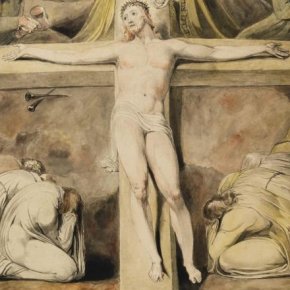
 If you’ve spent any length of time in the Episcopal Church, you know the sermon comes after the Gospel reading. But because of the nature of our Gospel reading today, I hope you will allow me to flip that convention around. The Passion Gospel we will read in a few moments has the lyric substance of an epic poem; the depth of one of the works of a Russian master – Dostoyevsky, say; and the emotional weight of the entire book of Psalms: all in the space of an average magazine article. So rather than preaching after we listen to the performance of this momentous work of faith and story-telling, I thought I’d talk with you now, before we listen. I plan, in the next few minutes, to give you something of a listening guide: a few keys to listening faithfully, and a few things to listen for.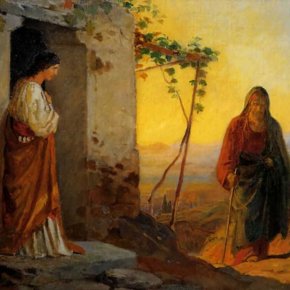
 The prayers have all been prayed. The farewells to the deceased have all been said. The dirt has been cast on the shining, glossy coffin. The low murmur of voices mingles with the whisper of the wind through the long, cemetery grass. The new widow rises from the velvet-covered folding chair, the triangle of the blue field and white stars of the American flag peeking out from under her arm. A line of black-clad people forms, and they begin to file past her. You watch her receive with grace each well-meant, but well-worn sentiment. You join the line, and soon it’s your turn. You grasp her hand in both of yours and wait for the words to come.
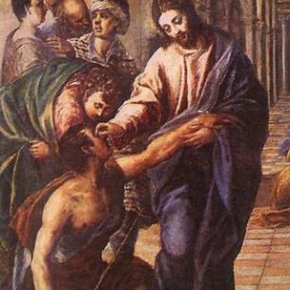 “Let me see some I.D.”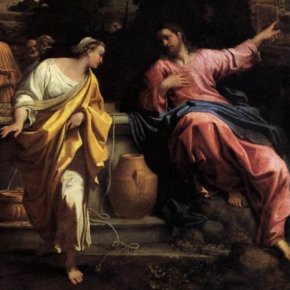
 Last week I talked about the fact that we crave certainty, but in this life we will never achieve it. Jesus knows this, and so he offers us something even better than certainty. He offers us the gift of himself. Today, I’d like to talk about that gift. I’d like to talk especially about what we think we need in order to accept such a gift. Specifically, I’d like to talk about four things we think we need and the one thing we actually need. We’ll use Jesus’ wonderful conversation with the Samaritan woman to explore these things we think we need to accept the gift of Jesus.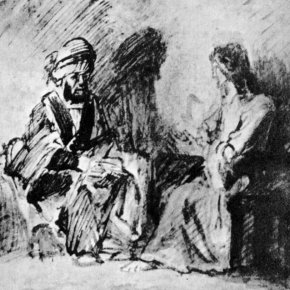
 Full disclosure: the chapter of the Gospel I just read to you easily makes my Top 5 list of favorite passages of scripture. Nicodemus is my favorite recurring character in the entire Bible. Even the name of my website – wherethewind.com – has its roots in this chapter. I love John 3; I’ve read these words many hundreds of times over the years. I barely needed to look at the Gospel book while reading just now, because these words have carved out a space within me. I know them by heart. I knew what they said before I even sat down to work on this sermon. I was certain of their content; just as certain of their content as Nicodemus is of his knowledge at the outset of his conversation with Jesus.
 We consume about a quarter of the world’s energy, and yet we make up only one twentieth of the world’s population. Several of our most popular ways to die involve over-consumption of food or drink or drugs. I mean, have you seen how they deliver French fries at the restaurant Five Guys? They fill a cup with a fairly generous, but not outrageous, serving and then dump three or four more scoops into your bag! Who could possibly eat all those fries?
