Three Lines of Salt

Sermon for Sunday, April 17, 2016 || Easter 4C || Psalm 23; Revelation 7:9-17

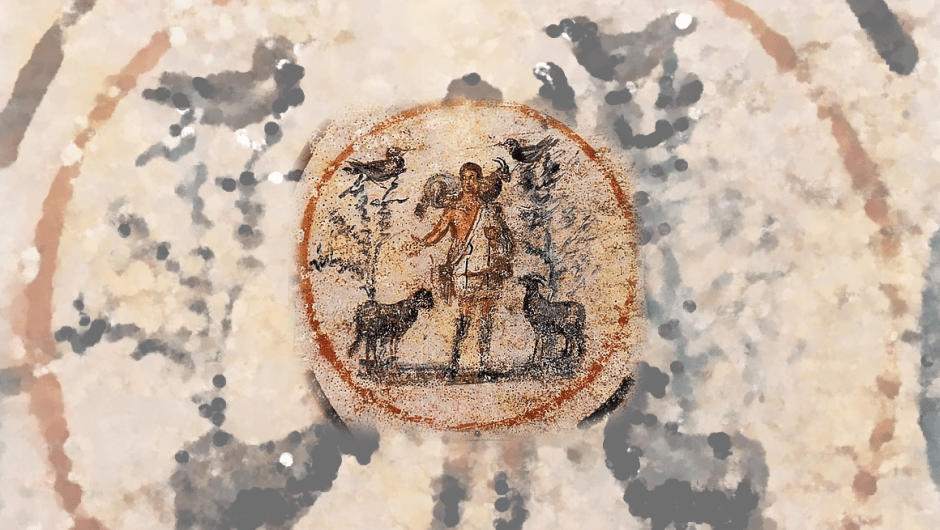
threelinesofsaltEvery year on the Fourth Sunday of Easter we read Psalm 23. We affectionately call today “Good Shepherd Sunday,” since we always pair the shepherd of the beloved psalm with the Good Shepherd, which Jesus describes in the tenth chapter of John’s Gospel. And yet I doubt it has escaped your notice that we read Psalm 23 more often than once a year. We read it yesterday, in fact; and two weeks before that at the funerals of Ed Carlson and Barbara Noonan. We’re not quite a third of the way through 2016, and we’ve already had six funerals this year. Sometimes the grave seems too close. Sometimes the bitter taste of loss overwhelms all the other sensations we could be feeling. Sometimes the promise of the resurrection seems to lose its luster in comparison to the stark reality of death.

And still we believe that death is an end, but not the end. We believe that the new and superlative life of the resurrection treats death as a threshold through which we walk, not as a tomb at which we stop. A cynic might say that we believe in this way just to make ourselves feel better when a loved one dies. But what the cynic doesn’t understand is that our belief does not make death hurt any less. Our belief enwraps our grief in the warm folds of hope. And hope helps us spread our pain out over the long haul, so that it doesn’t strike us all at once, which would surely kill us. Instead, the pain nestles in our depths and mixes with faith, hope, and memory. And in time, one ingredient in the recipe of grief begins standing out above the rest. And that ingredient is love. So we respond to the cynic: our belief doesn’t make us hurt less, but it does help us love more. In fact, our belief helps us love forever, which is what the resurrection is all about.

Psalm 23 ends with the word “forever.” And in Hebrew it begins with the holiest of God’s names, the “I Am Who I Am” name, the eternal name, the forever name. In between these two mentions of eternity are several promises: promises about sustenance, peace, revival, guidance, companionship, protection, abundance, goodness. We tend to read Psalm 23 at funerals because, in the first days of ragged grief, we need to be reminded of these promises, since we more than likely are having trouble finding ourselves at home in them.

The promises of God continue in our second lesson this morning, from the book of Revelation. Most of this final book of the Bible is strange and scary and sorely misunderstood, but every few chapters, the clouds break and we see the Son shining through. During Easter season, we are reading these shining moments of promise from Revelation. Today, we listen to a promise concerning ones who have “washed their robes and made them white in the blood of the Lamb.” The elder says to John,

They will hunger no more, and thirst no more;
the sun will not strike them,
nor any scorching heat;
for the Lamb at the center of the throne will be their shepherd,
and he will guide them to springs of the water of life,
and God will wipe away every tear from their eyes.

Sounds a lot like Psalm 23, right? The promises are the same because the promises of God are eternal. They existed in the early days, when people were first waking up to the presence of God, were first writing down their experiences, some like King David, poetically. The promises continued to exist hundreds of years later when John of Patmos wrote his prophecy in the book of Revelation. And we know these promises still operate now, for we live our lives in their sway.

And yet, it would be folly to think that our lives as followers of the Good Shepherd are complete when we accept these promises for ourselves. No. Stopping there leads to self-centeredness and isolation. Believing God’s promises about sustenance, peace, guidance, abundance, and all the rest compels us to live outside ourselves, to accept our piece of God’s great mission of healing and reconciliation. There are people who have never met a promise that wasn’t broken. And God calls us to them.

Reading this week the promise from Revelation that “God will wipe away every tear from their eyes” reminded me of a young boy I met when I was a hospital chaplain at Children’s Medical Center in Dallas, Texas ten summers ago. I was assigned to the tenth floor, which housed the neurological and plastic surgery units. Many of my patients were in for cleft palette procedures, some for brain cancers, and every once in a while a crash victim. Derrick* was one such case. His entire family had been involved in a horrible motor vehicle collision, which killed one of his siblings, sent two others to my hospital, and his parents to neighboring ones.

I don’t remember exactly which bones or vertebrae Derrick had broken in the crash, but when I walked into his room the first time, he couldn’t move his head to see who was at the door. His head and neck were braced in what they call a “halo.” He sat motionless because he literally was unable to move. I babbled out my nervousness for a few ineffectual minutes until the weight of Derrick’s loss pummeled me into silence. My usual chaplain’s patter was not going to work in this case. (And I would discover later that patter of any kind never works.)

I visited him everyday while he was on my floor. Some days we talked a bit – stilted conversation punctuated by long silences. Mere words could not reach the depths of his loss or his loneliness. So we watched TV – the types of shows eleven-year-olds like. The World Cup was that summer, so we watched soccer too. I think Derrick found a teeny tiny morsel of comfort in my visits, but it was utterly apparent that I was a poor substitute for what he really needed, which was his family, who were all still hospitalized themselves. Grandparents came and did what they could. The nurses arranged for his sister, who wasn’t injured as badly, to visit him from her floor occasionally. But his parents could not come.

One morning, I visited him first thing. His eyes flicked over and tracked me as I came around and sat down by his bedside. And that’s when I noticed them: Three perfectly straight lines of salt running from his eye down his dark cheek. Now Derrick couldn’t move because of the halo. This meant that during the night, his bed had been raised and lowered to three different positions, and he had cried at each one. And no one was there to wipe away his tears.

That was the day I finally understood what God was calling me to do. To be. I had been in the process to become a priest for years, but didn’t really know why until I saw those three perfect lines of salt on this broken and devastated child. I couldn’t replace his parents. I couldn’t make him feel better. I couldn’t bring his brother back to life. But I could be there. Just be there…to wipe away his tears.

When you look out over this broken world full of broken promises, I hope you will not let this brokenness overcome you. We who believe God’s promises have a mission to help extend those promises to people who have never met a promise that wasn’t broken. And in this mission, we are not alone. We have a Good Shepherd guiding us to those people, and then guiding us together with them to the springs of the water of life, where God will wipe away every tear from their eyes.

*Derrick’s name is changed for this sermon.

Lake Logan

lakeloganNo sermon from me this week, since I was at a conference called CREDO in North Carolina. Instead, here’s something I wrote during a silent Saturday morning, when I was able to get quiet enough to write poetry.

If a tree were unable to sway
It would break
At the first puff of air
Strong enough to ruffle its branches.
So it is with me.
The wind whips and howls here
In this valley between two mountains,
All sound and fury, signifying everything.
The water in the narrow lake ripples,
Then whitecaps leap and curl,
And the trees bend.
How is it possible?
How can they grow straight and tall,
Spindled columns connecting earth and sky,
And yet sway when the wind blows?
I watch them now – evergreens mostly,
With branches high up their trunks –
And a hypnotic peace breathes itself into me.

I notice a finch –
Or some other tiny bird
(I don’t know the difference) –
Land halfway up the bare trunk
Of the largest tree in front of me.
This one’s not an evergreen,
And the first promises of new growth
Are visible at the tips of its branches.
The finch (do they have finches in North Carolina?)
Starts climbing the trunk.
It doesn’t fly up, but hops little hops skyward –
Twenty or thirty feet, a few inches at a time.
Why doesn’t it fly?
Perhaps the wind is too strong,
Would blow the tiny bird off course
If it let go the trunk.
I wonder what its course is.
Where is it going
That a climb up the trunk would suffice?
Whenever I walk in the wind,
I imagine being lighter than I am,
Imagine floating off to God knows where.
God knows where:
Where the finch is traveling,
Where I am traveling.

Seeing the finch reminds me:
I heard tell that a bald eagle patrols Lake Logan,
And suddenly my only desire is to see him,
See him glide through the valley,
Not fighting the wind, nor hiding from it,
But soaring on it.
I stare out past the swaying trees,
Hoping my desire might resonate
Along one of the strings of creation
(The eternal music that God began
With the opening consonance of light)
And twinge the soul of the eagle
To take flight and give me something truly memorable
To treasure in my heart.
But this desire is selfish – I know –
And selfishness does not resonate,
But plays a discordant note,
A quarter-tone flat
And expects the rest of the orchestra
To re-tune their instruments accordingly.

Instead of the eagle,
I am blessed to witness a pair of geese
Skim the surface of the lake
And land atop the water
Sending ripples ahead of them,
Announcing their arrival.
If I had not been looking for the eagle
I would not have noticed the geese,
And they, too, are a gift.
I thank God that my selfish desire
Did not blind me to the gift of the geese,
The ripples catching the mid-morning light,
The water returning to relative calm,
Moved now only by the wind.

Another gust pummels the trees,
And they bend dutifully,
And again I marvel at their swaying.
How is it possible?
The answer comes to me on the wind,
Breathes into me,
Nestles in my heart:
The treasure I receive
Rather than the one I desired.
“You see only part of the tree,” says the wind.
Yes, of course, I had forgotten.
The tree began in the dark earth,
Playing its nascent notes,
A piccolo trill,
A rat-a-tat of the snare.
And then it began to grow –
Both up and down.
The roots reach deeper and deeper;
Stretch through the soil;
Brush the bedrock;
Hold fast.
The trunk above sways in the gale
And does not break,
But moves where the wind directs.
Oh God, I pray,
Make it so with me.

After sharing this with a few people at the conference, I was informed that the tiny bird I saw was in all likelihood a Carolina Wren. But I wanted to preserve the authenticity of my wonderings (this is a stream-of-consciousness poem after all), and I personally know exactly zero about birds.

The Recipe for Doubt

Sermon for Sunday, April 3, 2016 || Easter 2C || John 20:19-31

recipefordoubtBoth my first and last names come from the Bible. To be sure, a large portion of names used in the United States do, but many if not most of them do not share the dubious pedigree of mine. Every Hannah out there gets to claim as her namesake a woman of complete devotion to God. Every Matthew and Mark and Luke and John out there gets to share a name with a writer of the Gospel. But me? I get the guy who ate the fruit he wasn’t supposed to eat and then shifted the blame to his wife. And I get the Doubter – and that’s Doubter with a capital “D.”

And while I don’t have much energy to defend Adam’s poor decision-making, I do get a bit revved up whenever I hear someone label the disciple Thomas as “Doubting,” as if it’s his first name. As if he’s one of the seven dwarfs: “I know you’ve met Grumpy and Happy and Bashful, but have you met Doubting?” This really irks me – and not simply because Thomas and I share a name. No. Calling him the Doubter is not just unfair (why single him out?); calling him the doubter is actually a complete misunderstanding of the Gospel. So let’s unpack Thomas a bit, and hopefully by the end of this sermon we will see that doubt is not an evil thing.

Once we move past the caricature of Thomas as the Doubter, we see a fuller picture of him form. He is one of the more visible disciples in the Gospel of John; indeed, after Peter, he is tied with Philip for most lines of dialogue. When we look at his interactions with Jesus as a whole, we discover a man of deep faith, deep convictions, and deep questions.

We see his deep faith in today’s lesson. When the other disciples find him, he sets this condition: “Unless I put my finger in the mark of the nails and my hand in his side, I will not believe.” Then when he meets Jesus, he never actually follows through. He sees Jesus there in the flesh, and then makes the most startling claim of Jesus’ divinity in the entire Gospel: “My Lord and my God.” Yes, Thomas is a man of deep faith.

Earlier, about halfway through the story, Jesus receives news that his friend Lazarus is dying. The trouble is that Lazarus lives only about two miles from Jerusalem, and things are pretty hot for Jesus there. In fact, the immediate result of Jesus raising Lazarus was to confirm in the chief priest’s mind the necessity that Jesus be put to death. The disciples know how dangerous it is for Jesus to head towards Jerusalem. But it’s Thomas who persuades them, saying: “Let us also go, that we may die with him.” Yes, Thomas is a man of deep convictions.

Soon after, Jesus is having that famous meal with his friends in the upper room. His arrest is imminent, but before they go out to Gethsemane, Jesus speaks many words of truth to his friends. We often quote some of these words at funerals: “In my father’s house there are many dwelling-places…You know they way to the place where I am going.” Here Thomas interrupts Jesus: “Lord, we do not know where you are going. How can we know the way?” To this Jesus responds: “I am the way, and the truth, and the life.” A deep answer to a deep and desperate question. Yes, Thomas is a man of deep questions.

When you combine faith, convictions, and questions, do you know what often results? It’s the recipe for Doubt. Our faith gives us a reason to ask deep questions about God and life and what it all means. These deep questions do not have readily apparent or digestible answers; if they did, they wouldn’t be deep questions. Conviction gives us perseverance, which allows faith to exist within the sphere of uncertainty. This is actually where faith thrives. Certainty is the enemy of faith because it leads to stagnation, or worse, fundamentalism. Doubt, on the other hand, gives us the fuel to push on our beliefs, examine them, strengthen them.

And yet, our Gospel passage today seems to set doubt up as the enemy of belief, to put them on opposite sides of a dichotomy. After all, Jesus chastises Thomas: “Do not doubt but believe.” Except that’s not what he says. Our English translation takes some liberties to get the word “doubt” out of the Greek word that’s on Jesus’ lips. Another translation reads like this: “No more disbelief. Believe!” (CEB). In English, when we add the prefixes “un–” or “dis–” to something, we give it the opposite meaning, right? Kind and Unkind. Belief and disbelief. That’s exactly what happens in Greek when you add the letter “a–” to the front of a word.* In today’s passage, Jesus says just such a pair of opposites. Belief and unbelief. Not belief and doubt.

So what he’s really saying to Thomas is this: “Don’t jettison your belief all in one go. I know you have deep questions, but you have deep conviction too. Your faith is still there in the midst of your doubts. But here I am. It’s really me.” And that’s when Thomas drops to his knees and proclaims: “My Lord and my God.”

We all have our doubts. I can’t tell you the number of times I’ve been brushing my teeth or pumping gas and been stricken by a wave of doubt. What if this is all just a bunch of hokum? Even if there is a God, why would God care about lil’ ole me? And those are just the entry level doubts, the nagging ones that don’t really have a particular trigger. Bigger ones surface when we confront egregious disappointment or untimely death or heinous acts of evil like what took place in Pakistan on Easter Day.

But remember, doubt is not something to be feared. Doubt is not something to ward off at all costs. In fact, doing everything in your power never to doubt is the way to dangerous fundamentalism. Jesus never said not to doubt. He said simply: “Believe!” And belief in the Risen Christ – the One who overcame the power of death itself – can survive an onslaught of doubt. In the power of the resurrection, eternal life swallowed up death. In the same way, belief fueled by the enduring promises of God swallows doubt into itself. Just as death is part of life, doubt becomes a part of belief – the part that keeps it moving and growing and alive.

Thomas was a man of deep faith, deep convictions, and deep questions. He desired to follow Jesus no matter the cost; he wanted so fervently to know the way; and in the end he proclaimed Jesus for who he really is: “My Lord and my God.” I’m sure Thomas had his doubts. After all, he was off wandering on his own during those frightening days. I’m sure he was processing his confusion, wondering how it all went wrong. But in the midst of his confusion, his teetering belief, the Risen Christ comes and calls him back: “No more disbelief. Believe!”

When you are struggling with your own doubts – about God, about yourself – remember that doubt is a part of belief, not the opposite. And remember that you’re not alone in your doubts. Don’t be afraid to be like Thomas, who heads back to the upper room even though he hasn’t seen Jesus yet. Ask your deep question. Share your struggle with us. I guarantee you someone else will say, “Oh, me too.” And together, with God’s help, we will find deeper wells of faith and conviction, which will compel us to drop to our knees in front of the Risen Christ and proclaim: “My Lord and my God.”

* Some of these survive in English: atheism (NOT God), anaerobic exercise (NOT exercise that gets your heart pumping).

The Living Among the Dead

Sermon for Easter Sunday, March 27, 2016 || Easter C || Luke 24:1-12

thelivingamongthedeadGood morning, and welcome to St. Mark’s Church on this Feast of the Resurrection. You know, every Sunday is a Feast of the Resurrection, but today is special. Do you know why? Because today is the first Sunday after the first full moon after the vernal equinox – and that makes today Easter. So if a late night talk show host ever jumps out of a cab and asks you how to calculate the date of Easter, now you know.

Today is also special because of the week we’ve just had here at St. Mark’s. We’ve walked with Jesus from his triumphant entry into Jerusalem, to the last supper with his friends to his agony in the garden, to his betrayal and arrest and trial, to his crucifixion, to his burial in the tomb. We’ve been through the darkness of Good Friday; we’ve been to the foot of the cross. Now the dawn breaks on Sunday morning, and once again we set off, walking this time with the women and their spiced ointments.

I doubt they slept much the last two nights, Mary Magdalene and the other women who rose early on the first day of the week to minister to their dead Lord. Every time they shut their eyes, I’m sure they saw the silhouette of Jesus’ cross in the distance, his limp body barely recognizable because of his torturous hours hanging there. No, I doubt these women slept much, though if they did finally fall into fitful slumber, it was because they cried themselves to sleep. When all you have left is your tears, you’d want to hoard them; but that’s when they flow all the more freely.

I’m sure the tears began again when they awoke early Sunday morning. New grief is like that. Each morning you wake and remember again that your loved one is gone, and again the pain stabs you anew, just as fresh as the first time. They bear the rawness of their grief by taking on a mission; after all, staying busy is one way to soften the blow. And so the women take up their burden of fragrant spices and trudge out into the darkness in order to arrive at the tomb at first light.

Out of deep troves of love and compassion, these brave women are ready to care for the body of their Lord and to prepare it for proper burial. It turns out Mary and her friends are making the happiest mistake in the history of mistakes. They are ready to wash and anoint a lifeless body, but what they find is no body at all. They find an empty tomb. For a horrible moment, their grief threatens to overwhelm them because the mission they were planning to perform – the one they had been clinging to since his death – is gone now, too. They didn’t think they could be more desolate, but they are wrong. For this horrible moment, the empty tomb magnifies their desolation.

But into this scene of despair and grief comes the sudden presence of two gleaming messengers. They enlighten the woman as to their happy mistake: “Why do you look for the living among the dead? He is not here, but has arisen.”

The messengers continue talking, but the women have ears only for that last word: “Arisen!” For the first time since Friday, they remember Jesus’ words, and first one, then another, then another breaks out into a tentative smile. “Could it be true?” they ask each other.

“Yes, yes, yes it could.”

“Jesus never lied to us.”

“How could we forget his words?”

Then one repeats the messengers’ question: “Why are we looking for the living among the dead?”

This question echoes down through the centuries, and we find ourselves asking it when we read the beginning of the final chapter of Luke’s account of the Gospel. Why do you look for the living among the dead? How often in our day-to-day lives could we hear the gleaming messengers ask us this question? How often do we trudge down our own well-worn paths to life-defeating things hoping this time – maybe this time – something life-affirming will happen?

Perhaps you’ve had a string of boyfriends who were real losers. Your friends tell you so at every opportunity, but you’ve got a blind spot for the proverbial bad boy. They treat you with no respect. From time to time they’ve even called you a name that I can’t say during this sermon. And yet you meet another one and all the signs are there, but you dive in headfirst anyway. To you the gleaming messengers say, “Why do you look for the living among the dead?”

Perhaps you’ve been sober for three months. Your sponsor hands you your chip and slaps you on the back. You’ve got a couple of other three-month chips in a drawer somewhere, but that’s not on your mind right now. On your way home from the meeting, you run into an old buddy from back in the day. The next morning, you stagger to the drawer and toss the newest chip in. Maybe you’ll get another one in a few months time, but for today your salvation is at the bottom of a bottle. To you, the messengers say, “Why do you look for living among the dead?”

Perhaps you work through your family vacation because you’ve got too many projects on your plate. Or you’ve given into the tiny fearful voice that says you’re too old or too sick or too broken to make a difference in someone else’s life. Or you spend every waking hour mindlessly surfing YouTube and Facebook and Instagram. Or…or…or… Every one of us has a few life-defeating paths that we have no trouble finding. To each of us, the messengers say, “Why do you look for the living among the dead?”The Resurrection of Jesus Christ spurred this question all those centuries ago. The women made the happy mistake of looking for a dead messiah, when the Risen One was alive again. Our life-defeating paths lead to tombs, as well, but they are not empty, for our dead messiahs are there waiting to suck the life from us. But the tomb of the Risen Lord is empty, and a new, life-affirming path stretches from that tomb and reaches into eternity.

Today, on this first Sunday after the first full moon after the vernal equinox, on this special Feast of the Resurrection, we see most clearly this new, life-affirming path stretching from our feet off to the sun-drenched horizon. As we walk it together and with our Risen Lord, we will pass by so many people going the opposite way down the life-defeating paths. This may be due to their own choices or because they are caught up in systems that will never produce anything but defeat; systems of poverty, injustice, racism, apathy.

But as we walk this life-affirming path, we have the opportunity to be apostles like those brave women, to show people the power of the Risen Christ in our lives, to hook arms with folks going the other way and help turn them around. We have the opportunity to be the gleaming messengers who ask one simple question. “Why do you look for the living among the dead?”

And then we have the glorious opportunity to share the heart of the Good News. “He is not here, but has arisen.”

*I preached a version of this sermon at Easter in 2013. The old version had a lot of problems (mostly, it was two or three sermons smushed into one, which is a sign of lazy thinking and writing on my part). I think this rewrite fixes those things. Of course, in a few years time I might think the same thing about this version, too. And so it goes…

Here is Your Son

Sermon for Good Friday, March 25, 2016 || John 19:25-27


HereisyoursonThe Passion narrative Stacey just read can be quite overwhelming. It is by far and away the longest reading we listen to all year, and there’s a lot going on. There’s Judas’s betrayal, Jesus’ arrest, Peter’s denial, the trial with the high priest, the interview with Pilate, the frenzy of the crowd, the crucifixion, and the last words from the cross. There’s so much going on, in fact, that we can easily lose sight of the overarching story of the Gospel when we find ourselves overloaded by this painful and heart-breaking narrative. So instead of talking about the entire Passion narrative, each year I like to focus on one little moment of it that speaks to the whole story. On this Good Friday, that moment happens between the soldiers gambling for Jesus’ clothes and Jesus drinking the sour wine.

“Meanwhile,” the Gospel tells us, “standing near the cross of Jesus were his mother, and his mother’s sister, Mary the wife of Clopas, and Mary Magdalene. When Jesus saw his mother and the disciple whom he loved standing beside her, he said to his mother, ‘Woman, here is your son.’ Then he said to the disciple, ‘Here is your mother.’ And from that hour the disciple took her into his own home.”

Have you ever noticed the beauty of this moment? Have you ever noticed how succinctly these three verses sum up Christ’s mission of reconciliation? I see in my mind’s eye these two people standing apart from each other. One weeps silently for his beloved friend, and his tears wash two clean lines on his dusty, grimy face. The other has no more tears; she has cried her eyes dry, and now she just stands there counting her son’s breaths, treasuring each one in case it’s his last. She always knew this day would come, but not like this. God, not like this.

A few other women comfort Jesus’ mother, but his beloved friend remains several paces away from them, perhaps not wanting to intrude on their stunned grief. He stands there alone, wondering how it all went wrong, wondering if he had been hoodwinked or if he had just gotten caught up in messianic hysteria. No, I believe. He doesn’t mean to, but he says the words out loud. Then he adds, I just don’t understand.

That’s when he looks up at Jesus, and his friend’s lips begin to move. He’s trying to speak, but he can’t catch his breath. After all, the cross kills by suffocation, not by loss of blood. With a monumental force of will, Jesus pulls himself up, using the nails for leverage. He sucks in a ragged breath and looks down first at his friend, then at his mother. His gaze connects them, and they stumble towards each other. With fleeting breath, Jesus manages to say, “Woman, here is your son.” His mother leans her head on his friend’s shoulder. Jesus inclines his head, “Here is your mother.” His friend wraps his arm around her and squeezes.

While dying on the cross, Jesus stitches together this new family. He creates a new relationship built on two people’s own relationships with him. Before Jesus redefined it, the cross was the ultimate symbol of domination and separation. The cross brutally demonstrated who was in charge and who was discarded, the human garbage of the empire. But even before the resurrection – even in this beautiful moment we are discussing here – Jesus is changing the meaning of those two planks of wood. No longer would they be the terrifying symbol of ruthless subjugation. Now the cross would be the symbol of the promise of eternal life, which is really the promise of eternal relationship with God.

By creating this new relationship between his mother and friend, Jesus reminds them and us that his mission is one of reconciling us to each other and all things back to God. Indeed, it’s no accident that the Gospel writer never names these two people. We know his mother’s name is Mary and tradition tells us that his beloved friend is John. But the Gospel steadfastly resists naming them as such, and does so for this purpose: So we can put ourselves in their place. So we can feel ourselves being called “beloved” by Christ. So we can feel in our relationships with Christ the unique closeness that a mother has for her child – the act of cherishing. And in feeling this intimacy with Christ, this belovedness, we might feel the call to create and engage in deep relationships with others, each one fostered by Christ’s love for all people.

This is the story of the Gospel: God came to us to bring us back into relationship with one another and with God. Good Friday marks the cliffhanger in that story, the moment when it all looks bleak. But even in this bleakest moment, even while struggling for breath on the cross, Jesus is still bringing people together, still performing miracles.

Art: Detail from “Christ on the Cross with Two Maries and St. John” by El Greco (1588)

Three Parades

Sermon for Sunday, March 20, 2016 || Palm/Passion Sunday C || Luke 19:28-40; Luke 23

ThreeParadesIn our lovely, little town of Mystic, today is a day of parades. There’s one this afternoon that will get all the press – the St. Patrick’s Day parade will attract throngs of green-clad people to Main Street to watch and revel at a charming small town spectacle. The Highland Pipe Band will set the tone as they march off from Mystic Seaport towards downtown. Hundreds of people on floats, in cars, and on foot will follow, not to mention the real reason to go to parades, which is the fire engines. They say everyone is Irish on St. Patrick’s Day, and the same extends to Mystic’s parade four days later.

In addition to our town’s parade, we here at St. Mark’s remember not one, but two more parades today. In the first parade, a baby donkey walks down the Mount of Olives towards Jerusalem. A man rides on its back, and people hail him as the “king who comes in the name of the Lord.” In the second parade, the same man staggers out of Jerusalem under the weight of the cross, and people deride him with mocking shouts: “If you really are the king, then save yourself.”

These two parades – separated by less than a week’s time in Luke’s Gospel – couldn’t look more different. In the first, Jesus rides triumphantly into Jerusalem with “the whole multitude of the disciples” praising God. In the second, Jesus stumbles his way to the place called The Skull, whipped and beaten, too exhausted to carry his own cross the entire distance.

But if we take a deeper look at these two parades, we discover they aren’t as different as they appear on the surface. In both parades, Jesus subverts expectations. He could have ridden into Jerusalem on the back of many a more respectable beast, but he chose a baby donkey. Why? Well, for starters there was Zechariah’s prophecy to fulfill:

“…Shout aloud, O daughter Jerusalem! Lo, your king comes to you; triumphant and victorious is he, humble and riding on a donkey…” (9:9)

But beyond prophetic fulfillment, Jesus chose this humble farm animal to show the incongruity inherent in people’s expectations of their king. They wanted a warrior. They got a healer.

Jesus’ walk to Golgatha continues this subverting of expectation. “Save yourself,” people jeer. “If you are who you say you are, then break out of here and dispatch these Roman soldiers as you go!” What they don’t realize, however, is that Jesus has no interest in saving himself. He wants to save them.

In both parades, a vulnerable Jesus turns his face towards danger and death instead of running the other way. He had been saying for the entire journey south that Jerusalem was where everything was going down. This was high noon, and Jesus purposefully left his six-shooter at home. He rides into the city weaponless, with his deputies cringing and looking for likely hiding places. He chooses this utter vulnerability because it illuminates his innocence, the fact that he is put to death for no just reason. The second parade, the one to The Skull, happens because he continues defenseless. Pontius Pilate is just looking for an excuse to release him, and surely Jesus could have provided one. But no. Jesus is staring down the power of death itself, and he’s not about to blink.

Indeed, in both parades, Jesus has a grander agenda than anyone realizes. He is a king, but of a realm so much bigger than any physical location. He is locked in battle, but his enemy is so much larger than an intransigent religious establishment or even the entirety of the Roman Empire. He is going to die, but new life that triumphs over death will be the ultimate conclusion. The Pharisees want him to quiet his disciples. But Jesus says: You’re setting your sights too small. “If they were silenced, the very stones themselves would shout out.” The thief on the cross just wants to be remembered. But Jesus says: You’re setting your sights too small. “Truly I tell you, today you will be with me in Paradise.”

These two parades show the beauty and glory of Jesus for who he is: the messiah who fulfills God’s promises in unexpected ways; the healer-king who puts himself squarely between us and the power of death; the savior who yearns for us to stop setting our sights so small.

There was a fellow way back in the fifth century who did just that. Like his Savior, he set his sights big – like entire island big. He had been captured and taken to that island in his youth and he had been made a slave. After many years in servitude, he escaped and returned to his homeland. He might have expected to live out his days in comfort after the trials of his youth, but Jesus is in the business of upending expectations. What’s incredible and beautiful is that this man listened to Christ’s call, and went back to the place of his captivity. Just like his Savior, he turned his face towards danger and death, despite his vulnerability. And he enlightened an entire island with the Good News of Christ. His name was Patrick, and a parade in his honor happens at one o’clock today. Hmm. Maybe all three parades have more in common than I thought.

Art: Mashup of “Entry of the Christ into Jerusalem” by Jean-Leon Gemore (1897) and “Jesus Falling Beneath the Cross” by Gustave Dore

Reaching Into Eternity

Sermon for Sunday, March 13, 2016 || Lent 5C ||  John 12:1-11

reachingintoeternity

Imagine with me a letter written by Lazarus, the friend whom Jesus brought back to life after four days in the tomb.

To my dear sisters, Martha and Mary, by the hand of a trusted friend:

I have written and re-written this letter in my mind, and still any words I hope to scratch here will pale in comparison to the anguish I have in my heart for you. I love you both. My spirit wilts to contemplate putting you through grief yet again. You already passed from grief to joy, as I passed from death to life. But I fear we will reverse this cycle again before long.

Indeed, if you are reading this letter, then I have died once again: not from illness this time, but from malice. I am writing this to help you understand what has happened, and I’m sorry if my thoughts seem like fragments. Fragments are all I have right now. After dinner tonight, Jesus confirmed the fear that has been growing in my mind. His words shattered the innocence I wrapped myself in since coming out of the tomb.

He drew me aside after his confrontation with Judas. I could smell the perfume you anointed him with, Mary. I will remember that scent for the rest of my days. I will remember, too, his eyes set on mine, full of love and agitation. “Beloved,” he said, “I’m sorry.”

I didn’t know what to say. What did he have to apologize to me for?

“I’m sorry for what may be coming soon. I’m sorry that you may suffer on my account. I’m sorry I drew you into all this.”

He looked to be on the verge of tears. “Into what, Lord?” I asked.

“I brought you back from death, only to make you a target for death again. There are powers in Jerusalem who seek my life, and now they seek your life as well. These crowds that come to hear me—they also come to see you, to see with their own eyes proof of the words I speak. And now those who seek to kill me have added you to their list.”

I had sensed this—in the roving eyes of some in the crowd, in the growing sense of foreboding in my gut—but hearing it from Jesus’ own mouth made it real. I hadn’t named the fear I was feeling. I had feigned innocence, hoping that ignoring reality would change it. But Jesus’ words set reality in front of my eyes, and I could not turn away.

Will I die tomorrow? Will I be stoned in a public square or dispatched by an assassin’s blade? Will there be blood? Will it hurt? My sisters, I know you are reading this after I’m gone, so these thoughts must seem wild and misplaced in such a letter. But I beg you: keep reading, for I have not said all.

He kept his eyes on me as I took in his words. I didn’t know whether to run away or to weep on his shoulder. I felt faint. I looked around for something solid to lean on. The walls and chairs looked flimsy somehow. So I reached out and steadied myself on his arm. Finally, words came. “Why did you restore my life if I’m just going to be murdered weeks later?”

“Lazarus,” he said, “I wish I could spare you the prying eyes that have hounded you since that day. I wish I could spare you the pain that may be ahead of you. I cannot. But I can tell you this…”

Dear sisters, coming from any other person, what he said next would have rung pitifully hollow, but the light in Jesus’ eyes held the promise that his words are truth. “I came that you may have life,” he said, “and have it in abundance. This life that I give, beloved, is more than just your ability to move or think or breathe. This life includes those things, just as it includes pain and grief. But ever so much more, this life includes those wonderful gifts from God that reach into eternity: love and joy and grace and justice and peace. You are mine, and I have taught you how to love others as I love you. You are mine, and I make your joy complete. You are mine, and I offer the grace to strive for justice and peace everyday, no matter how many days are left to you.”

I was captivated. I looked him in the eye, and again that light of truth danced behind brimming tears that now began to trace silent streams down his face. “I shed tears now,” he said, “knowing that you may suffer for my sake. But I shed them also for the joy of knowing that such suffering cannot diminish the life I give you. Yes, you will die again. Do not let that keep you from living. And yes, you will live again after you die. Do not let that keep you from living now, either.”

His words washed over me, like clear water from a living spring. I drank them in, and they filled me. The life that he gives is more than life. The life that he gives is more than death. It does not begin when I die, nor did it begin when he brought me from the tomb. His life endures, for I am his whether I live or whether I die.

Dear sisters, while I pray to be spared from pain and suffering, I am not afraid of death. I am afraid that I do not have the strength to live as one who has this abundant life that reaches into eternity. I am afraid that I will live as though I were dead again.

But Jesus chose his words well the day he brought me back to life. Yes, he knew my fears even before I did. Do you remember what he said that day? I do, and those words are imprinted on me like the smell of tonight’s perfume. “Lazarus, come out.” He never spoke a word of resuscitation, never said, “I raise you from the dead.” He just commanded me to leave the tomb. And the gift of life came back to me in order to obey this command.

So until the day I pass through the gate of death again – and I sense it will be soon – Jesus’ command to stay out of the tomb still rules my life. This life he has given me – given each of us – reaches into eternity, so whatever ways we show forth his love now are burnished with the sheen of heaven. Whatever ways we show forth his love now will last long after we are gone, will ripple out to touch more lives than we can possibly imagine.

Mary, Martha: if you are reading this, I have died again. But know that my death will not stop the abundant life that Jesus revealed to me when I was still with you. Do not wait for death to begin your abundant, eternal life. It is yours now. Laugh and dance and sing and serve and love. And rejoice that Jesus continues to give you—and me—the gift of himself, the gift of abundant life that reaches into eternity.

With all the love in my heart,

Your Brother,

Lazarus

Healing Brokenness

Sermon for Sunday, March 6, 2016 || Lent 4C || 2 Corinthians 5:16-21; Luke 15:1-3, 11b-32

HealingBrokennessWe live in a broken world: broken homes, broken promises, broken government, broken ecosystems. We’re used to brokenness. We learn to live with it. We hear about another mass shooting or another intractable political standoff or another couple dissolving their marriage, and we might shake our heads for a minute and sigh and say, “Boy, I don’t know.” And then we go back to whatever we were doing. And yet, even in the midst of this listless response to brokenness, something niggles and naggles at us, unsettles us; something deep within reminds us that “broken” is not the way things are supposed to be. We believe that God created everything and called Creation “good” and never made a thing called “brokenness.” And yet, brokenness crept into Creation. Separation and division soon followed. Today, we see a broken world, and we know that it could be, that it should be – better.

And in that seeing, in that knowing, God invites us to participate in God’s mission to repair this brokenness. In today’s lesson from his Second Letter to the Corinthians, Paul tells us that God “has given us the ministry of reconciliation.” He continues, “In Christ, God was reconciling the world to himself, not counting their trespasses against them, and entrusting the message of reconciliation to us. So we are ambassadors for Christ, since God is making his appeal through us.”

Did you hear that? We are ambassadors for Christ – representatives of Jesus bringing his message of reconciliation to this broken world. Reconciliation is the healing of brokenness. When Jesus welcomes and eats with “tax collectors and sinners” in this morning’s Gospel, he models the ministry of reconciliation. The scribes and Pharisees like their society just fine the way it is. They’ve learned to live with the brokenness, profit from it even. And so they grumble when Jesus upsets the status quo and shows them what wholeness can look like. Jesus tells them a story about a family, a family marred by brokenness, a family in need of reconciliation.

The younger of two sons basically says to his father, “I wish you were dead so I could have my inheritance.” His father acquiesces, and the younger son takes his portion and travels to a distant country where he squanders his fortune in what the King James Version calls “riotous living.” At first glance, the younger son’s sin sure seems to be his debauchery, given his status as a decadent wastrel. But I don’t think his prodigality takes the top seed.

Instead, his major sin is the rift caused by his separation from his family. Jesus makes a point to say that the father divides his household to fulfill his son’s wish. And then the son doesn’t settle nearby, but in a “distant” country. With the division and separation complete, all that’s needed is a famine for the younger son to notice his folly. When he comes to himself sitting in the filth among the pigs, he realizes the brokenness his departure caused. He no longer feels worthy to be called a son, so he prepares himself to live with the brokenness and to be considered a hired hand rather than a member of the family.

At this point in the parable, I imagine the scribes and Pharisees nodding their heads in approval. The younger son defiled himself. He is unclean after touching all those pigs. Of course, he mustn’t be welcomed home. But Jesus isn’t finished telling the story yet.

The younger son travels back to his father’s house, prepared for the sad reality that it will never be home again. But when he is still a vaguely human shape on the twilit horizon, his father sees him and runs out to meet him and embraces him and kisses him. The young man begins his prepared speech: “I am no longer worthy to be called your son.” But his father will not tolerate the separation, the brokenness any longer. “This son of mine,” he says, “was dead and is alive again; he was lost and is found.” This son of mine. With these words, the father repairs the broken relationship, and the two are reconciled.

At this point in the parable, I imagine the scribes and Pharisees raising incredulous eyebrows. Now the father is unclean, as well, because he touched the younger son before he purified himself with the appropriate rituals. What kind of family is this? But Jesus isn’t finished telling the story yet.

When the elder brother hears the revelry coming from the house, he learns of his brother’s return, and he will not enter the house or join the party. The elder son echoes his brother’s sin by separating himself from the celebration. When the father comes out to plead with him, the elder son shows his own division from the family. He calls his brother “this son of yours,” thus ignoring the fraternal relationship. And rather than working like a son, he says, “For all these years I have been working like a slave for you.” Like a slave. Like the hired hand the younger son was prepared to be.

But the father continues to repair the brokenness in his family. “Son,” he calls his eldest. There is no division between us because “you are always with me, and all that is mine is yours.” Then the father attempts to heal the fraternal separation by emphasizing the sons’ relationship to one another: “This brother of yours was…lost and has been found.”

I imagine the scribes and Pharisees noticing that they themselves look an awful lot like the elder brother. I bet their own irritation with Jesus deafens them to the reconciling nature of the father in the parable. But while the parable ends, Jesus still isn’t finished telling the story yet.

Both sons separate themselves from the family, but their father goes out and meets both sons in their brokenness. He runs up to the younger when his son is still far off. He leaves the party to be with the elder. Jesus continues his ministry by mirroring the action of the father in the parable. He doesn’t just wait for people to come to him. He seeks people out where they are, eating with tax collectors and sinners, healing the sick, touching the unclean, standing with the marginalized, dying with the criminals in the refuse dump on the outskirts of the city.

That’s our savior, the one who will never let any barrier or rift or division – not even death – separate us from his love. Our savior leaves the 99 sheep to search for the one that is lost. Our savior seeks out and finds the man born blind after he’s thrown out of the synagogue. Our savior reconciles Peter to him after Peter’s triple denial of ever knowing him. Our savior left his home in order to bring us to it. And we are his ambassadors.

Today, we see a broken world, and we know that it could be, that it should be – better. We know in that deep place within that the world is not supposed to be broken. Participating in God’s mission of reconciliation begins when we listen to this deep place within, the voice of Christ our Savior telling us that we can make a difference. We can make a difference when we react to brokenness not with listlessness, not with apathy, not with indifference. We can make a difference when we react to brokenness with compassion, with the desire to be like the father in the parable and go out and meet our broken world head on.

It may seem like a fool’s errand, participating in God’s mission of reconciliation when the brokenness of the world is so great. It may seem insurmountable. But remember, Jesus isn’t finished telling the story yet.

*There’s a stealthy nod to The West Wing in this sermon. First person to figure it out gets five points.
Art: Detail from “The Return of the Prodigal Son” by Rembrandt.

The Grace of the Fig Tree

Sermon for Sunday, February 28, 2016 || Lent 3C || Luke 13:1-9

graceofthefigtreeThis is a sermon about grace. I’ve been wanting to share with you my definition of grace for a while now, but the time didn’t seem right. Then after spending time with Megan Palmer’s family two weeks ago, preparing for and leading Megan’s service last weekend, and having the stomach flu most of this past week, the time to talk about grace has finally come. Maybe I was waiting for a moment when I was sure I had recently experienced it. But before we talk about grace, I need to tell you about my dad’s sense of humor.

Growing up, my favorite movie was Return of the Jedi. I watched it about once a week, except for the year I was six when I watched it once a day. VCRs were still relatively recent inventions, and none of us realized you could wear out a VHS tape until I wore out Return of the Jedi. Whenever I finished watching the movie and the iconic John Williams score started blasting throughout our house, my father would turn up in the living room doorway and ask, in all seriousness, “Did the rebels win this time?”

Whenever my sister or I got hooked on a particular movie, this same joke would resurface, notably in the late 90s. “Did the Titanic sink this time?” And after I got my Lord of the Rings Special Edition DVDs: “Was the ring destroyed this time?” Now when it comes to senses of humor, mine is a chip off the old block, for better and worse. And so when my kids start watching the same movie over and over again, I will never in a million years be able to resist the urge to ask: “Did they find Nemo this time?”

I tell you all this because, believe it or not, it impacts the way I interpret today’s Gospel lesson. You see, I think the Gospel writer Luke and my dad share this bit humor. Luke narrates Jesus telling this parable: “A man had a fig tree planted in his vineyard; and he came looking for fruit on it and found none. So he said to the gardener, ‘See here! For three years I have come looking for fruit on this fig tree, and still I find none. Cut it down! Why should it be wasting the soil?’ The gardener replied, ‘Sir, let it alone for one more year, until I dig around it and put manure on it. If it bears fruit next year, well and good; but if not, you can cut it down.’”

Do you get the joke yet? It’s pretty subtle (and not exactly haha funny), and maybe you had to grow up with a dad like mine to see it. The joke is this: that fig tree is never getting cut down. Luke preserved it in his Gospel. Luke knew this great story he was writing would be shared and he hoped it would be shared until the sun stopped putting forth its light. Every time someone read this parable, the fig tree got another chance. Luke wrote these words down about 1,936 years ago, which is 1,935 more years than that fig tree had to produce. And the fig tree is still standing. Every time we read it, there is the tree still standing. Yes, the rebels win at the end of Return of the Jedi – every time – because that’s how movies work. And yes, the fig tree is still standing because that gardener is taking care of it and always will. I told you this is a sermon about grace. Do you see it yet? We’re getting there.

Now you might quibble here and say Luke’s joke doesn’t work because, even though the fig tree is never going to be cut down, it’s also never going to bear fruit. It’s stuck in this in-between time, a time of potential but no results. Yes, this is true, and we’ll get back to that in a minute.

But first, one more word about why I think Luke is playing with his readers here. Matthew, Mark, and Luke share a lot in common, so much in fact that we often refer to them as the “synoptic” Gospels. “Synoptic” means “with the same eyes.” But Luke’s version is the only one with this parable about the fig tree. There’s a fig tree in Matthew and Mark, which Luke does not include, and their fig tree fares much worse. In Matthew and Mark, the fig tree withers and dies when Jesus gets a bit petulant that it doesn’t have any figs on it. But Luke doesn’t share that story. Luke shares this one, the one about the fig tree that always has another chance to bear fruit whenever the story is read.

The key words here are “another chance.” That’s grace. “If it bears fruit next year, well and good; but if not, you can cut it down.” Next year. Another chance. We read the parable again. Next year. Another chance. That’s grace.

Growing up, I always heard my dad define the concept of grace together with the concepts of justice and mercy, as a way to distinguish between them. His version went like this: “Justice is getting what you deserve. Mercy is not getting what you deserve. Grace is getting what you don’t deserve.” I’ve always loved that, and these definitions have guided me my whole life. But recently, I’ve added this: “Justice is having a chance. Mercy is having a second chance, or a third, or a fourth. Grace is not having your chances numbered.”

Grace is not having your chances numbered. Grace is being the fig tree that will always have the gardener tending to it, no matter how long it takes to bear fruit. Grace keeps us moving ever on, especially when we are stuck in the in-between time, the time of potential but no results. Grace gives us another breath when grief has knocked the wind from us. Grace gives us another chance when disillusionment or apathy sap our will to seek for justice and peace. Grace gives us another bit of rope when we think we’ve come to the end of ours.

Grace is the sublime consequence of a God who will never give up on us. That’s pretty good news, right? And yet, while God will never give up on us, we still have every opportunity to give up on God. Our chances are not numbered except by how many we are willing to take, by how often we are willing to trust God to be with us, come what may. That’s God’s promise to Moses in today’s reading from the Hebrew Scriptures, by the way. “I will be with you,” says God. No matter how often you fail, no matter how many chances you need, I will be with you. That’s grace.

It’s true that our chances are only numbered by how many we are willing to take. It’s also true that another chance is always shimmering on the horizon of possibility. And so grace beckons us to take more chances, to lead more expansive lives, to trust more deeply in the God who will never give up on us. And to bring that God to people who have never even been given one chance, who have never experienced the blessing of justice, let alone mercy or grace.

Yes, the rebels win at the end of Return of the Jedi. Every time. Yes, the Titanic sinks. Yes, the ring is destroyed. Yes, they find Nemo. Yes, the fig tree still stands. And yes, grace abounds in limitless chances to trust in a God who never gives up.

Citizenship in Heaven

Sermon for Sunday, February 21, 2016 || Lent 2C || Philippians 3:17–4:1

CitizenshipinHeavenLast fall, I had to renew my passport before my trip to Haiti with Tim Evers. I had originally gotten my passport in advance of a choir trip to England back in college in 2003, and that first document was still valid when Leah and I went to South Africa for our honeymoon in 2011. But they’re only good ten years, so in the fall of 2015, I found myself stapling an unsmiling picture to an application I picked up at the post office. I filled in all the information – name, address, social security number. I checked the box marked “U.S. Citizen,” dropped the package in the mail with the processing fee, and a few weeks later, received my new passport.

The trip back and forth to Haiti went swimmingly. The government agents stamped my shiny new document and welcomed me to Port-au-Prince and New York City, respectively. All was well until this week when I read the lessons for today. All was well until I realized that I lied on my passport paperwork. I checked the box marked “U.S. Citizen.” I checked that box because I was born in the great state of Maine, and I have the birth certificate to prove it. But the Apostle Paul claims something else for me: “Our citizenship,” he says, “is in heaven.”

Reading those words this week knocked my socks off. Our citizenship is in heaven. Not some time in the future. Not after we die. Paul doesn’t say, “Our citizenship will be in heaven.” No. Our citizenship is in heaven. Take a few breaths to let that sink in.

If we believe our passports our wrong; if we believe we are citizens of heaven, then we can take this imagery one of two ways. First, we can extend the metaphor and claim to be resident aliens here on earth. We have green cards, but this isn’t really our home. Our home is in heaven, and we’ll get there someday and be reunited with those we love who have gone home before us. This idea of heaven brings comfort and hope and peace, especially when life here on earth lurches towards the intolerable.

This idea of heaven finds expression in so many African-American spirituals, which have their roots in the horror of slavery. “Deep river, my home is over Jordan.” “I’m goin’ home to be with Jesus, since I laid my burden down.” “Swing low, sweet chariot, coming for to carry me home.” What better way to combat the misery of enslavement than to sing about one’s true home, a home that can never be bought or sold or taken away? What a sense of power enslaved people must have felt to be able to claim citizenship in heaven?

This legacy of hope and consolation – this balm in Gilead, so to speak – is the positive side of thinking of heaven as a home we are heading towards. But there is a negative side, as well. During the Industrial Revolution, the notion of heavenly citizenship began meandering down a long path towards environmental apathy. “We don’t really belong here on this planet,” this thinking goes, “so we need not take care of it.” This poor judgment had little effect on the environment until we got really good at polluting. But now the idea of heavenly citizenship is oftentimes weighed down by indifference for the earth and for generations yet to come. This is especially true in the United States where heavenly citizenship and American individualism collide.

Both the positive balm in Gilead and the negative environmental apathy find their roots in the idea of heaven as somewhere else. Somewhere better and new, and often “up.” Along with this idea of heaven as a home over Jordan, we can also think of our heavenly citizenship in another way. Here we must think of heaven not as a place, not as a location, but as the full and all-encompassing presence of God.

Now suddenly heaven is not just somewhere we go when we die; heaven is the kingdom of God breaking into this reality. Heaven is the name for the reality we strive for when we pray the Lord’s prayer, a prayer that is decidedly about now, today. “Thy kingdom come, thy will be down, on earth as it is in heaven.” In other words, “May thy reign, O Lord, be so present and so participatory that we can’t tell the difference between heaven and earth.” This is our prayer, and we pray it everyday to remember where our citizenship lives: in the full and all-encompassing presence of God. That’s our true home.

And that home is here. The full and all-encompassing presence of God is all around us, within us, permeating and sustaining creation. You may have felt this presence in your life. You may have stumbled into it one day when you least expected it and needed it most. You may have encountered this presence and not known what to name it. Its name is heaven, and it happens more than we realize.

When you see someone in need, and your heart trembles, urging you to reach out with open arms, then heaven is close by, the presence of God is calling you home – this home that is not up or away, but deeper in. Deeper in relationship. Deeper in solidarity. Deeper in love.

When you look out at an eagle in flight, and for a moment you are struck by the incredible closeness of your son who has passed away, then heaven is close by. Your loved one is awash in the full and all-encompassing presence of God. And for an elusive minute you realize you are there, too. And so you two are close again, and the barrier of death seems ever so flimsy.

When you fall to your knees in thanksgiving or in fear or in mourning or in joy, and your soul whispers to you that you are not alone and that you are loved beyond measure, then heaven is close by. It’s only our frail and limited perception that keeps us from seeing the home of our true citizenship breaking in all around us.

Living into our heavenly citizenship combines these two understandings of heaven: first our hope of future consummation and bliss in our home across the Jordan, and second our awareness of the immediate presence of God, which through us, continues to bring heaven closer to earth. There will never be true heaven on earth until all people and all things are fully reconciled to God. Put another way, there is no way for some of us to experience true heaven in the here and now. Either everyone does or no one does. If there is even one person living in hell on earth, then heaven is not fully realized this side of the Jordan.

These may seem like abstractions, like pie-in-the-sky theology that will never, ever in a million years become a reality. And yet, as followers of Jesus Christ, we live each day with the willing expectation that heaven on earth will come to fruition. And in so doing, we make it more real. We live our heavenly citizenship. Thy kingdom come, thy will be done. We pray this daily because we are a people of hope.

And if there’s one thing I hope for more than any thing else, it is this. That every person on this planet, when their earthly journeys are done, might swim across the Jordan, back home to the full and all-encompassing presence of God, and have this one thought on their minds: “I think I’ve been here before.”