
Ever wonder where all that stuff in the Christmas pageant comes from? Haven’t seen a felt board since you were six? Well, then look no further than this third installment of the Moving Picture Bible Study.
Author: Adam Thomas
Fully human
The following post appeared in the Advent issue of Episcorific (a ‘zine for and by the 20s and 30s of the Episcopal Church). You can download the full magazine in .PDF form here.
* * *
 The trouble with being human is that most of us aren’t very good at it. We are way better at being couch potatoes or social butterflies or unique snowflakes or chickens. We explain the very act of making more humans by referring to the birds and the bees. A frightened human is a scaredy cat; an insufferable one is a less polite term for donkey. We may exist as humans, but we spend a lot of time filling the roles of other species.
And these other species are darn good at being themselves. Bees fly around collecting nectar and pollinating flowers. Trees keep soil from eroding. Grass scrubs the air of carbon dioxide. Cockroaches allow husbands to feel manly. If evolution teaches us one thing it’s that species thrive when they don’t try to fill the role of some other species.
While we are busy being butterflies and potatoes, we forget that in reality we are human. And who really wants to be human? Our skin isn’t very well adapted to our climates. Our young can’t fend for themselves for at least twenty-two years. Our bodies break down with alarming frequency. And to top it off, I can’t think of another species on this planet that kills its own kind with as much regularity and aplomb as we humans.
But somehow we have survived down through the ages amidst the dangers of saber-toothed tigers, drought, pestilence, war, and deficit spending. We have survived, but, as Tennyson writes, “We are not now that strength which in old days / Moved earth and heaven.” I’m not even convinced that we’ve ever been that old strength. I don’t think that we’ve ever lived into our humanity to the greatest extent possible.
And here’s where Jesus comes in. Jesus didn’t come to show us a new way to be human. Jesus came to show us how to be fully human. The Gospel makes a big deal about Jesus’ own humanity. Matthew and Luke talk about Jesus’ birth. John shows Jesus tired, angry, and sad. In all four accounts of the Gospel, he is brutally murdered. And why present God the Son as such a frail collection of bones and tissue and synapses? Well, he couldn’t be the “Word made flesh” without flesh. And he couldn’t be our hope and our salvation without fully identifying with our lives, however “nasty, brutish, and short” they may be (thanks to Thomas Hobbes for those appropriate adjectives).
So Jesus is fully human – not some ghost or apparition or hologram. And he’s fully divine. 100% of both. This 100% of humanity is the real miracle here. It’s impossible for God not to be 100% divine (God wouldn’t be God without the perfect batting average). But it’s very possible (indeed, likely) to be less than fully human. Jesus succeeded in realizing this unlikely full humanity, and that’s one of the reasons he’s so special. His life and his example teach us to be fully human.
If we aren’t fully human now, what takes up the rest of the space? In Mere Christianity, C.S. Lewis explains this question well. Lewis calls us “toy soldiers.” We begin as automatons – clockwork beings in need of winding and direction. But God doesn’t want toy soldiers. God wants sons and daughters to love and adopt as God’s children. Jesus’ example and his grace enable us to move through the messy, painful, joyous process of outgrowing our clockwork. Only by becoming fully human, can we fully embrace God’s love for humanity. If we can recognize God’s love for humanity, perhaps we can love other humans, as well.
Food (namely herbs and stewed rabbit) for the journey
The following post appeared Wednesday, December 9th on Episcopalcafe.com, a website to which I am a monthly contributor. Check it out here or read it below.
* * *
The hobbits Frodo Baggins and Samwise Gamgee arrive in a heather-strewn woodland between the River Anduin and the mountains that border the dreaded land of Mordor. After some walking around and griping about the knavish Gollum, who is their deranged hostage and guide, they sit down for a meal, as hobbits often do. They eat herbs and stewed rabbit and then…
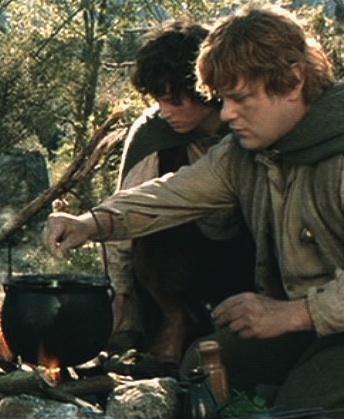
…I have no idea what happens next.
I’m twelve years old, and I have made it nearly two-thirds of the way through The Lord of the Rings. But I can no longer bear it, and I shelve the book. It’s just so boring. All they do is walk! They start in one place, walk for a bit, meet someone and chat, and then walk some more! I just want them to get somewhere! I want to yell, “Get to your destination, Frodo – don’t stop to eat herbs and stewed rabbit, which the author has described in painstaking detail! Just get to the mountain and be done with the ring! Enough of this walking…”
A year later, I’m thirteen (a much wiser and more mature age), and once again I pick up The Lord of the Rings. Maybe this year, I’ll finish it. I begin at the beginning, and they walk and meet folks and chat and run away from enemies and Frodo and Samwise reach the heather-strewn woodland and eat herbs and stewed rabbit and then…
…I have no idea what happens next.
My wisdom and maturity are no match for the walking. Again, I stop reading. The quest is just too long and arduous and their destination is still on the other side of the mountains and several hundred pages away.
A year later, I’m fourteen, and I pick up The Lord of the Rings again. On page 641, Frodo and Samwise sit down for a dinner of herbs and stewed rabbit and then…
…I keep reading. They find themselves in the middle of an ambush, Sam sees an oliphaunt, the hobbits are captured by people who are supposed to be on their side, and the story goes on and on. A few days later, I finish it. And I’ve read it at least eight more times since.
Finally, at fourteen, I could appreciate the journey, and let the destination take care of itself. Tolkien understood that a destination is more than a physical place. A destination is the culmination of all the shaping events of the journey that brings you to that ultimate location.
Every year, after the tryptophan has worn off, we begin just such a journey in our walks with God. While secular Christmas disgorges itself out of shipping containers every year the day after Thanksgiving, we have the opportunity to let Christmas happen only after the four weeks of Advent have run their course. Christmas is the destination. And Advent is about not arriving at your destination before you are shaped by the journey.
Have you ever had the soup du jour at a restaurant? It’s not some fancy French dish. It’s just the soup made for that particular day. Likewise, my journey happens every day. Every encounter, every decision, every road taken or not shapes me. The season of Advent gives me a dedicated four weeks to notice the shaping influence each day has on my journey with God.
On the first Sunday of Advent, we heard the psalmist pray, “ Show me your ways, O Lord, and teach me your paths…All the paths of the Lord are love and faithfulness” (25:3, 9). This Advent, I’m adopting this prayer because I’ve always had trouble not skipping to the end of the story. Every year of my childhood, I wanted to open the windows of my Advent calendar all at once. I just couldn’t wait to open tomorrow’s window tomorrow. Now, at twenty-six (a much wiser and more mature age) I pray for God to give me the patience to notice each day’s impact on my life. When I ask God to “teach me your paths,” I’m not hoping for some inside knowledge about the destination. I’m simply asking for guidance along the road.
Some time ago, I heard this illustration (the origin of which no longer resides in my brain). Have you ever noticed that headlights only show you thirty or forty yards ahead of your car on a dark night? But they still get you to your destination. Likewise, God teaches me God’s path even as I am struggling to stay on it. As I walk towards Christmas on this particular Advent journey, Christ walks a few steps ahead of me, illumining the road to his own nativity, to his own unique and wonderful expression of love and faithfulness.
Despite my opening description, my love for Tolkien’s works of fiction is deep and abiding. They taught me the lesson of Advent: don’t arrive at your destination before being shaped by the journey. I pray that, during this season of Advent, God teaches us God’s paths, which are love and faithfulness. And I pray that we may meet someday on the road, about which Tolkien’s Bilbo Baggins rhymes:
The Road goes ever on and on
Down from the door where it began.
Now far ahead the Road has gone,
And I must follow, if I can,
Pursuing it with weary feet,
Until it joins some larger way,
Where many paths and errands meet.
And whither then? I cannot say.
Baby Boy (Davies Tales #4)
During the summer between his first and second years of seminary, Aidan Davies grew up all at once. The summer began with a breakup and ended with a baptism, but those are pieces of a larger story. This story is about a baby boy.
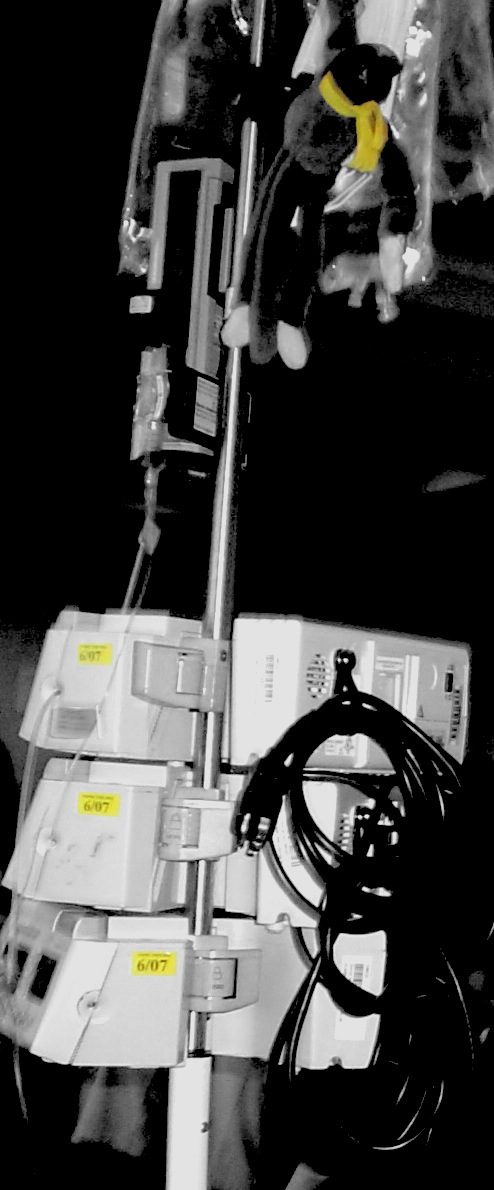 Davies was a chaplain only because his badge said he was. For that first month, he didn’t particularly feel like one. I’m not a chaplain, but I play one at this hospital, he often thought. His clinical pastoral educators – the hospital’s professional chaplains – had borrowed their teaching style from mother birds. On the third day of the summer, they pushed Davies and the seven other interns out of the nest and watched as eight pairs of arms, flapping wildly, disappeared in a downward spiral. The wingless interns crashed into the rocky bottom, and, miraculously, found their patients there.
Rock bottom was on the top floor of the hospital, but Davies had no patients on that level considering another intern had chosen the ICU as his normal beat. However, that night, Davies was on-call, and the on-call pager had beckoned him to Intensive Care, and he stared at the message on the little screen the whole elevator ride to the twelfth story.
From the moment he stepped off the elevator, the next several hours blurred together in Davies’s mind. Attending physician speaking…parents deciding to take their baby off the machines…Baby Boy Rodriguez breathing on his own…and then not…wailing…holding…silence. Davies walked the parents to their car. He had very little Spanish, so no one spoke. But grief, it turns out, is a universal language. The car pulled away, with fewer passengers than it should have been carrying, and Davies watched it turn a corner to the lower levels of the parking deck.
He arrived back in the ICU room to find Mary Ann, one of the baby’s nurses, silently wiping down a machine. Cords lay in neat stacks on a rolling table, and a small pile of dirt and bits of candy wrapper filled a dustpan near the door. Davies allowed his gaze to find the tiny bed, upon which the body of Baby Boy Rodriguez still lay. He walked over and looked down at the baby – a perfect porcelain sculpture in a clown-adorned onesie. “He looks so peaceful,” said Davies.
“Yeah,” said Mary Ann, and she came to stand by Davies at the bed.
“When I first saw him this evening, he had all these tubes in him. He looked like he was…but now…” Davies’s voice trailed off.
“He was in a lot of pain,” said Mary Ann, and Davies suddenly realized that this nurse had known the Baby Boy as long as his parents had. Three months in this room, but never alone.
“I’m glad that he was able to take a few breaths on his own,” said Davies. Mary Ann continued as if finishing his sentence, “And his mother could hold him while he was still alive.”
Davies stayed by the bed while Mary Ann continued cleaning the equipment, and the silence renewed. Davies stared down at Baby Boy Rodriguez. He reached out a hand, and with the lightest pressure, placed it on the baby’s forehead. He tried to pray. He moved his hand and took the little balled up fist into his own palm. He imagined God holding the Baby Boy and his parents and Mary Ann and Davies himself in the same way.
A noise made him look up. A small machine had fallen to the floor. “What does that do?” Davies asked.
“It helps with respiration,” said Mary Ann.
It kind of looks like a belt sander, thought Davies. And they were quiet again. Theirs, however, was not a conversation broken by silence, but a silence broken by conversation. The noises of the padding of feet, the pulse of machines, the typing on computers all happened in the obscurity outside the room. But this room was a different world, an in-between world. Between Baby Boy Rodriguez’s own anguished writhing and that of the next patient was peace and stillness and silence.
Davies’s tears traced pathways down his cheeks and fell to the floor. Mary Ann looked up from her cleaning. “The first time is hard,” she said.
“It doesn’t get any easier though, does it?”
“No, it doesn’t. Every time is hard.”
Davies wiped his eyes on his sleeve. “It would be easier if you didn’t care for these children so much.”
Mary Ann looked down at Baby Boy Rodriguez. Davies realized that before she started cleaning the room, she had cleaned and dressed his body. “The moment you stop caring is the moment you have to stop doing this job,” she said.
And the silence renewed. Mary Ann finished her cleaning. Davies continued to hold the hand of the dead Baby Boy. A few minutes passed, and then the glass door slid open. Another nurse carried a folded piece of plastic with a zipper running through it. “I didn’t realize it would be white,” Davies said, as he watched the nurses unfold the body bag. Mary Ann affixed a toe tag to Baby Boy Rodriguez’s ankle and then gently lifted him, as the other nurse slid the bag underneath. Davies touched the baby’s forehead once more, and then the nurse zipped the bag closed. Mary Ann covered it with a sheet, and picked it up, like any mother carrying her child.
Davies and Mary Ann processed to the elevator and rode down to the main level. Several turns through labyrinthine passages brought them to a nondescript door. Davies punched in the code, which only pathologists and chaplains knew. The morgue had four cold chambers. Davies opened one. Mary Ann laid the bag containing the body of Baby Boy Rodriguez on the metal shelf. Davies shut the freezer door and mouthed a whisper of gratitude to Mary Ann. She placed a hand on Davies’s arm for a moment, echoed his thanks, and walked from the morgue – back to the living and the dying. Davies turned and saw his fuzzy reflection in the four, shining metal doors.
And the silence renewed.
Encountering the Examen
The following post appeared Wednesday, November 18th on Episcopalcafe.com, a website to which I am a monthly contributor. Check it out here or read it below.
* * *
Three Novembers ago, I was a recluse in my seminary dormitory, I ate meals alone at tables with seven other people, and the light had gone out in my eyes. Heartbreak six months old continued to ferment within me. I had no way to deal so I drank deep of my own depression. I was a wretched creature, cast from the pages of Dickens or Dostoyevsky. To borrow from the psalmist, the water had risen up to my neck: I was sinking in deep mire and there was no firm ground for my feet.
In this state, I drove to St. Alban’s in Northwest DC to meet with my spiritual director. The month before, in our first meeting of the new school year, she could tell right away that something was different about me. I was waiting to be buzzed into the office, and she saw me through the little window in the locked door. The door opened, and without a word, she took my arm and pulled me into an embrace. The tears would have come if I had had any left.
A month after that first meeting, I had slipped even lower in the mire. The only thing that could have made the situation worse had happened, and I was struggling to go an hour without wallowing in the future that would have been. I sat down in the rocking chair in my spiritual director’s office. She lit the candle, and we sat in the relative silence of the intersection of Wisconsin and Mass Ave.
Over the next hour, I talked about how difficult it was not to dwell on the woman who left me. In that special way spiritual directors have of eliciting responses by being quiet at the right times, my director helped me discover something. During the nearly two years that we were together, I prayed for this woman every day. I lifted her up to God, and thanked God for her presence in my life. But the prayer dissolved with the relationship, which, of course, was the exact wrong time to stop praying. “When your mind starts to spiral to thoughts of her,” my spiritual director said, “pray for her instead. You are still connected through the love of God, even if you are no longer together.”
The guidance helped, but I don’t think I would have ever recovered if a new spiritual practice hadn’t accompanied the counsel. That same session, my director handed me a sheet of paper entitled “Ignatius’ 5 Step Daily Consciousness or ‘Awareness’ Examen.” “Pray these steps every night for the next month,” she said, “and write them down if writing makes you focus better.” This was a prescription for soul medicine, and, in my desperation, I saw it as a cure. She might have said, “Take two Examens and call me in the morning.” Of course, that’s not how spiritual practices work.
On the first night, I placed a red, five-subject notebook on my pillow so I wouldn’t forget. In the top right corner of the first page, I wrote “1,” and on the first line, “November 6, 2006.” Feeling a bit silly and wondering if I should get a little lock for my new diary, I took out the Examen.
“Step One,” I read: “Be Mindful.” I scratched the words, “Yes, Lord, you are here” under the date and took a deep breath. Something detached from my consciousness with that breath and I wrote it down. Yes, Lord, you are here in the presence of my friends. (My friends whom I have abandoned because I’m sure that none of them has ever felt the way I feel right now. How presumptuous.)
“Step Two. Be Thankful.” A roast beef sandwich, spiritual direction, sweater weather. When I thought about it, I found that I was thankful about some things. How wonderful.
“Step Three. Be Humble.” Ah, here’s the tough one, I thought. Humility and I have never been close; cards at Christmas – that’s about it. What is God teaching me through the lesson of today? How has God illumined me today without me realizing it? How uncomfortable.
“Step Four. Be Reflective.” What’s that one encounter from today that has stuck with me? Did the encounter bring me closer or push me away from God? Can’t think of one? How distracted.
“Step Five. Be Responsive.” I read over what I had written, and breathed deeply again. And again, something detached and I wrote it down. So this is where God is leading me. How revealing.
Three years later, the Examen has become a part of my life. I make mental notes during the day about what I want to write. I’m on my sixth notebook, and I switch between blue and black pens, so I can tell when they have run out of ink. The woman, who initially appeared in every entry, no longer stars in its pages. New thanksgivings and desolations and encounters and hopes abound. They are all parts of my story, which God already knows, but which I am discovering every day. I pray to be mindful, thankful, humble, reflective, responsive. I pray for the courage to live a life that can fill dozens of more notebooks. And I pray that God continues to guide my hand as I spill my soul onto those college-ruled pages.
Make believe
(Sermon for November 15, 2009 ||Proper 28, Year B, RCL || 1 Samuel 1:4-20; Hebrews 10:11-25)
Inigo Montoya, the Spanish hired sword who helped kidnap Princess Buttercup, is losing his duel with the Man in Black. The fight has ranged all over the rocky terrain at the precipice of the Cliffs of Insanity. The two swordsmen had both begun left-handed, but have switched to their dominant hands when they recognized the masterful fencing of the other. Thrust. Parry. Riposte. The Man in Black acrobatically flips off the ruins. Inigo stares at him, clearly amazed: “Who are you?” he asks.
 “No one of consequence,” replies the Man in Black.
“I must know,” pleads the Spaniard.
“Get used to disappointment.”
The fight continues, only to end a minute later with an increasingly flustered Inigo receiving a knock to the back of the head. And the Man in Black sprints off to track down the title character of The Princess Bride.
Get used to disappointment. Sounds like quite sensible advice. Sounds like the Man in Black has been around the block a few times. Sounds like he knows something about the ways of the world. However, this worldly wisdom is often counterproductive to a life of faith. The Letter to the Hebrews urges us this morning to “hold fast to the confession of our hope without wavering, for he who has promised is faithful.” In a world that teaches us to “get used to disappointment,” holding fast to our hope can be so very difficult.
Our inoculation begins at an early age. Children enter life with bright, wide eyes and unbounded, unfettered imaginations. Every couch cushion is a stone in a castle under siege by the invading hordes who desire nothing more than to pillage your kingdom. Every bath is a deep-sea expedition to find the lost city of Atlantis. Every day is another chance to see a unicorn. But before long, we start getting used to disappointment. We are told that couch cushions are for sitting, baths are for bathing, and there’s no such thing as unicorns.
I remember my mother shouting: “Young man, there are no dinosaur bones in the backyard. Stop digging up my flowerbeds.” But what she didn’t know was that my imagination was equipped with ground-penetrating sonar and that there was an intact velociraptor skeleton just underneath the gardenias. It was the find of the century. Any moment, Richard Attenborough was going to land in a helicopter and whisk me off to Jurassic Park. (I don’t mean to rag on my mother – she always cultivated her children’s imaginations as long as we left her flowers alone.)
But in the grand scheme of things, from the moment we are born, our imaginations do nothing but shrink as our understanding of so-called reality grows. Only a few people make it to the major leagues or become astronauts or famous singers. But children always start out dreaming about these things. Do you know anyone at age six who wanted to be a CPA?
As we get used to disappointment, our ability to imagine new worlds wanes. The trouble is that hope exists in the imagination’s ability to frustrate the enclosing nature of the so-called “real” world. We are made in the image of God; therefore, our imagination connects us to the creative spark of our Creator within each of us. And hope resides in this spark. As mounting disappointment attempts to snuff out our imaginations, we encounter great difficulty in accessing the hope, which our Creator installed in us.
In this morning’s lesson from the Hebrew Scriptures, Hannah has gotten used to disappointment. She has no children, and her husband’s other, very fertile wife, provokes her on this account. Every year, when the family goes up to the house of the Lord to sacrifice, Hannah weeps and does not eat because of her situation, which is made all the more humiliating by Penninah’s taunting.
But Hannah does not let her disappointment snuff out the hope she has in the Lord. Hannah goes to the temple and asks God to remember her. She pours out her soul before the Lord. She prays so fervently that Eli, the priest, supposes she’s drunk. But no: Hannah is only anxious and vexed. She still believes that God continues to be present in her life, despite the worthlessness, which the world tells her she should be feeling. Hannah combats her own disappointment with the hope that she still has in God to act in her life. Soon God remembers Hannah. She bears a son named Samuel, and he grows up to be the prophet of the Lord.
Hannah’s devotion and perseverance serve as a model for the words of the Letter to the Hebrews. Hannah approaches God “with a true heart in full assurance of faith.” And she “hold[s] fast to the confession of our hope without wavering,” for she knows that “he who has promised is faithful.”
We, too, hold fast to the confession of our hope because he who has promised is faithful. Too often, we think that our faith in God needs to sustain us. We think that if we had been just a bit more faith, everything would turn out the way we want and there’d be no more disappointment. But our faith is a wavering, sporadic thing. If we had to feed on our faith alone, we would have starved long ago.
But Hebrews urges us to reorient our understanding of faith. Our wavering, sporadic faith in God pales in comparison with the ultimate reality that God is the faithful One. God keeps God’s promises. God is the rock upon which our disappointments shatter. We do not manufacture our faith. Faith is not self-centered. Faith is God-centered, and God invites us to step into the reality where our faith is as constant as God’s. The confession of our hope proclaims that this reality exists and that we will encounter its utter joy when we finally and fully enter God’s eternal presence.
We believe that this happens in the power of the resurrection when we pass from life through death to new life. But the confession of our hope does not merely cast our thoughts to the life beyond death. Remember, hope exists in the imagination’s ability to frustrate the enclosing nature of the so-called “real” world. This real world is full of disappointments, but it doesn’t have to be. While we may never find the lost city of Atlantis or see a unicorn, concrete disappointments, which may be better termed “crises,” abound in our world.
But God has blessed us with hope-fueled imaginations. God has blessed us with the mission, as Hebrews says, “to provoke one another to love and good deeds.” God has blessed us with the resources to feed and clothe everyone in this world. We must only provide the will. We must only get over our own disappointments and harness the hope that God’s own faith makes real in our lives.
When we were children, the magical words “Once upon a time” lost their luster when we heard their counterparts: “Sweetheart, it’s only make-believe.” But I say to you that we have the opportunity, we have the imagination, we have the will to change this world for the better. Because God keeps God’s promises, we are able to keep our promises. We are able to make a difference in people’s lives. We are able because God’s own faithfulness makes us believe.
Total loss
On Sunday, I was driving home from a soccer tournament — a bit worse for wear and sore, but in the good way. We were losing light quickly as the game drew to a close, and by the time I was on the road, dusk had suddenly become full darkness. The darkness didn’t bother me, because I’ve driven back and forth on Route 9 dozens of times since I moved to West Virginia. Every time, I lament the fact that the the DOT hasn’t finished the bypass (and probably never will). On Sunday, my lamentation was justified.
A tenth of a second before the deer hit my car, I saw it flash in the headlights. I heard the impact before I felt it — the sound of someone beating the dust out of an oriental rug, except the rug was metal. The deer collided with the front, left edge of the car, and the force of the impact pushed me off the road. Pumping the brake, I drove through several lawns before coming to a halt. The deer skidded off in the other direction — a rag doll carcass — and came to rest on the shoulder on the far side of the road.
A sheriff’s deputy, who happened to be driving by a minute after the collision, stopped to help me. The driver’s door would not open, so I crawled out the passenger’s side. I was limping, but, I assured the deputy, the limp was a preexisting condition from the soccer tournament. He walked around the car, shining his flashlight and making official sounding grunts. Another officer unceremoniously dragged the deer fully off the road and left it there. I called Triple-A. An hour and fifteen minutes after the collision, a tow truck driver loaded up the car and took me home. Country music played on his radio.
The next day, I called the claims representative. He read through the online report I had filed when I got home the night before. “There’s a better than good chance that this will be a total loss,” he said. A total loss, he explained, happens when the cost of repair outstrips the value of the vehicle. If a total loss is filed, I’ll never see the car again. The insurance company will send me a check, less my deductible. “So take all your stuff out of the car and remove the license plate just in case,” he advised. Apparently, most deer strikes end in total losses. I’ll find out in the next few days.
The phrase “total loss” keeps ringing in my mind. I can’t help but think of Paul’s writing to the Philippians: “Yet whatever gains I had, these I have come to regard as loss because of Christ. More than that, I regard everything as loss because of the surpassing value of knowing Christ Jesus my Lord” (3:7-8). Paul is talking about his position before becoming a follower of Christ. He was a Pharisee, blameless under the law, a prime specimen of the people of Israel. And he gave it all up when the scales fell from his eyes after being struck blind on the road to Damascus.
I regard everything as loss because of the surpassing value of knowing Christ Jesus my Lord. Notice the use of the word “regard.” The surpassing nature of Christ reorients Paul’s perception of himself and the world. Jesus changes Paul’s attitude and outlook, in order that Paul might not mistake the insignificant for the consequential. The world around Paul has not changed, but he no longer views it as he once did.
This reorientation is such a wonderful part of being a follower of Christ. If we keep our eyes and hearts open long enough, we might just notice Jesus pointing us towards the right path, the most effective service, the best attitude. On Sunday, as the car came to a rest and my heart kept right on beating down Route 9, I found myself unexpectedly overcome by my own reoriented spirit. I might have adopted a why me, God? attitude. I might have raised my fist and cursed God’s apparent punitive capriciousness. But, by the grace of God I didn’t. I closed my eyes and thanked God that I was not injured. I thanked God that no one else was involved in the collision. I thanked God for the presence of the deputy.
It is so difficult, in a world that stumbles over itself attempting to remind us of the scarcity that supposedly dominates our lives, to notice Jesus reorienting us towards the abundance that marks the truth of our existence. But the surpassing knowledge of Jesus Christ opens our eyes to the beauty of this abundance. Everything else is loss. Total loss.
—
Note: I’m still dealing with the fact that I killed a deer. I’ve never been hunting, never shot a gun, and I never want to. I am aware that, as part of humanity, I am responsible for the deaths of countless innocent animals. I’m not sure what to do with this greater context. But the immediate incident keeps replaying in my mind. It’s just different because there’s blood and fur on the mangled hood of my car It’s different because I saw the deer alive one split second and utterly dead the next. I keep seeing it out of the corner of my eye. I keep seeing it tumble away, limbs flailing without purpose, glinting in the glow of my smashed headlight.
Forgetting the groceries
Practicality often gets in the way of noticing the glory of God. Don’t misunderstand, there is nothing wrong with being “down to earth”; indeed, a healthy dose of practicality is downright necessary. If my practical side didn’t assert itself, I don’t think I’d ever remember to buy groceries.  But a life governed by “the practical” misses the better portion of what makes life worth living—that is, rejoicing in the glory of God that perpetually surrounds me. This Sunday is All Saints’ Day, and I’m really excited that I get to preach because the Gospel text comes from perhaps my favorite chapter of the Bible. I talked about the first half of the chapter a few weeks ago on Episcopalcafe.com. Go read the second part of John 11 before continuing this post.
Jesus commands the onlookers to remove the stone, but before they can start rolling, Martha jumps in. Notice that the narrator, with odd redundancy, reminds the reader that Martha is the sister of the dead man. The oddity of this reminder makes it stand out. Martha, who had just made one of the strongest statements of Jesus’ divinity in the entire Gospel, once again has her mind on the practicalities of death. And this is made clear in her comment, which the NRSV makes slightly more sanitary than it is. The NRSV translation sounds rather like a member of the British House of Lords: Already there is a stench. Another reading gives this statement the earthier quality of, say, a West Texas ranch hand: It’s been four days; he stinks! With unpolished directness, her practical side asserts itself and comments on the absurdity of the scene that’s taking place.
Before coming to the tomb, Martha was ready to believe everything that Jesus said to her. But, now, confronted with the stone covering her brother’s tomb, this belief seems so small and silly compared to the reality of Lazarus’s death. The practical notion that the dead body of Lazarus smells is so much more palpable than the rather dodgy notion that Jesus can possibly bring him back to life. For a moment, she clings to this practicality because the alternative drove past the exit for Impracticality miles back and is stopping at a rest area over the border in Impossibility.
But Jesus turns the car around: “Did I not tell you that if you believed you would see the glory of God,” he says to Martha. In other words, don’t focus on reasons why what I’m about to do won’t work. Instead, remember that you believe in me, which gives you the ability to discover the one reason why it will work—because I AM. There are plenty of practical reasons why Lazarus’s stench, rather than Lazarus himself, will come out. But Jesus trumps all these reasons with a helping of delightful divine unreasonableness, which reminds me of some of Paul’s words: “For God’s foolishness is wiser than human wisdom, and God’s weakness is stronger than human strength” (1 Corinthians 1:25). When Jesus calls for the stone to be rolled away, the olfactory practicality of human decomposition is insignificant compared to the divine impracticality of raising someone from the dead.
Belief in God is impractical because (unlike my groceries) it can’t be seen or touched or bought or sold. However, when God integrates belief into my practical life, I notice the incompleteness of a life full of practicalities. The unreasonableness of belief in God becomes my reason to live. And the impracticality of putting my faith in an impalpable being infuses all parts of my practical life. Martha’s probably right in the end: when Lazarus comes out of the tomb, I doubt he smells like one of those little trees you put on your rearview mirror. But he comes out all the same.
Humor in the Bible (Bible study #12)
After a two month hiatus, the Moving Picture Bible Study is back. The second installment concerns humor in the Bible. There’s a good chance you never realized these passages are funny. Also, Renaissance scholarship and a text message from an unlikely source. Hope you enjoy.
From arrogance to obedience
(Sermon for Sunday, October 18, 2009 || Proper 24, Year B, RCL || Mark 10:35-45)
Here we go again. A month has passed since my last sermon delivered to you. A chapter has passed in the Gospel According to Mark. And Jesus has passed through Capernaum on his way to Jericho and then on to Jerusalem for his final days. In the Gospel lesson four weeks ago, the disciples argued about which one of them was the greatest. In response, Jesus placed a small child in their midst and said to them, “Whoever wants to be first must be last of all and servant of all.” In today’s Gospel lesson, two of Jesus’ disciples, James and John, get a little more specific in their quest for greatness: “Grant us to sit, one at your right hand and one at your left, in your glory.” In response, Jesus repeats himself (I imagine, with some exasperation), “Whoever wishes to become great among you must be your servant, and whoever wishes to be first among you must be servant of all.” And so I say, here we go again.
The disciples exhibit the eminently human habit of forgetting everything Jesus has been teaching them. And we love them for their poor memories because we can relate. But Jesus matches their eminently human forgetfulness with eminently divine patience. Jesus could say, “Didn’t you take notes last month? No?! Well, then get them from someone who was paying attention.” Instead, Jesus reiterates his message and offers us the opportunity to dive more deeply into his words.
Don’t worry: I’m not going to repeat my sermon about the linear model turning into the circular one, and I’m not going to use any examples from fourth grade. Rather, today’s Gospel lesson, in conjunction with the other lessons, helps us explore the roots of the two models. The linear model, in which hierarchical disparity perpetuates a “me first, you last” attitude, finds its roots in presumptive arrogance. The circular model, in which relational expectations lead to a “you before me makes us better” attitude, finds its roots in unassuming obedience. Thus, the giving up of the linear model for the circular necessitates a move from arrogance to obedience.
Let’s look at arrogance first. James and John, the sons of Zebedee, preface their request with these words: “Teacher, we want you to do for us whatever we ask of you.” Right away, we know something is out of joint. The brothers attempt to get Jesus’ consent before they make their appeal known. Every parent out there knows that a child only employs this tactic if the request is unlikely to garner agreement. Earlier in the Gospel According to Mark, Herod makes the rookie mistake of swearing to his daughter to give her whatever she asks, and John the Baptizer turns up minus one head.
But Jesus makes no such mistake. He’s on to James and John from the start. “What is it you want me to do for you,” he says. Foiled in their search for premature commitment, the brothers soldier on and ask to sit on either side of Jesus in his glory. And here, Jesus exposes their arrogance by saying, “You do not know what you are asking.” In other words: You have no clue what you are talking about. Haven’t you been listening to me? Are you read to drink my cup? I’m about to die a gruesome death. This isn’t a Sunday stroll. If you knew what you were getting yourselves into, you would never have asked.
In their arrogance, James and John expect their request will be fulfilled on their terms. Sitting on Jesus’ right and left hands is as easy as asking him. The brothers do not contemplate the consequences of their appeal because, in their arrogance, they see none. Arrogance is a delusion of grandeur, a state of mind borne out of misplaced, narcissistic superiority. Arrogance assumes that the world works according to the expectations of the arrogant. But Jesus attempts to puncture the brothers’ delusion by reminding them of the very real consequences of their request. “Are you able to drink the cup that I drink,” he asks. Their terse reply of “We are able” shows more deluded arrogance – they are able to say the words, but their comprehension of the weight of those words leaves much to doubt.
The arrogant worldview, which conforms to the reality of narcissistic desire, has contributed to most, if not all, of the world’s worst sins: the enslavement and degradation of other races; the destruction of the environment for purposes of insatiable consumption; the apathy for the plight of others masked as laudable self-interest; the horror of war. In all of these, arrogance leads to the objectifying of some nebulous other in order to maintain the narcissistic reality. Everything is fodder, every person a pawn.
In today’s reading from the Hebrew Scriptures, God reminds Job that this deluded, arrogant worldview is far from reality. The writer does this in a rather snarky way, by having God interrogate Job on subjects, about which Job can know nothing. God says, “Where were you when I laid the foundation of the earth? Tell me, if you have understanding. Who determined its measurements – surely you know!” This continues for a few pages, but you get the picture. God reminds Job that reality and Job’s delusion of reality are two different things. The implication is this: only the arrogant assume they know enough about creation to substitute for the Creator.
God’s interrogation of Job calls us out of our arrogance. Of course, we weren’t there when God laid the foundation of the earth. Much like James and John, who arrogantly assume their own primacy, we often forget that we aren’t the centers of our own universes. When we accept the grace from God to look past our delusions, we begin to grasp the other way to live. We begin to see that our own narcissistic realities pale in comparison to the harmony, radiance, and joy of God’s reality. And we begin to realize that obedience to God is our participation in this reality.
The word “obedience” is much maligned, so we must quickly reassemble its meaning. Banish from your minds the thought of canine “obedience” school or the memory of a ruler to the back of your hand to teach “obedience.” Obedience relies neither on the carrot nor the stick because obedience exists on a plane apart from reward and punishment. True obedience comprehends listening for God’s call and having the courage to act on that call. Obedience is shorthand for “resonance with God’s movement.” When we are tuned to God’s presence, we vibrate with all the vibrancy that God’s love could offer to us.
But obedience is difficult because arrogance beckons and pulls us back to our easy, little realities. According to the Letter to the Hebrews this morning, Jesus had to learn “obedience through what he suffered.” Because of his suffering, because of his obedience, “he became the source of eternal salvation for all who obey him,” for all who desire to resonate with him.
This obedience, this resonance, finds its deepest expression in Jesus’ words to his disciples following James and John’s request. First, he reminds them of the arrogance of the world: the rulers of the Gentiles “lord it over them, and their great ones are tyrants over them.” The tyrant is the prime example of the arrogant worldview. “But,” Jesus continues, “it is not so among you; but whoever wishes to become great among you must be your servant, and whoever wishes to be first among you must be servant of all.” Then, he uses himself as a paradigm: “For the Son of Man came not be served but to serve.”
We serve because Jesus served. We resonate with Christ most readily when we are serving others, when we are looking upon that nebulous other and seeing not a pawn, but a companion. We move from arrogance to obedience when we include in our realities the people who don’t fit and the consequences that we ignore. As the shells of our realities fade to reveal God’s greater reality, we realize how small were the lives we lived in our arrogance. We discover, somewhat paradoxically, how much more freedom exists in our obedience.
In that freedom, we will find joy and suffering, especially as we look with love upon the other. In that freedom, we will find grief and hope, because both are antidotes for narcissism. In that freedom, we will find the faith of the One who calls us to obedience. And we will walk in the confidence of that faith as God continues to peal away our arrogance to reveal beautiful, resonant, radiant children of God.

