Sermon for Sunday, February 1, 2026 || Epiphany 4A || Micah 6:1-8
This sermon is about telling the truth. But to enter into a discussion about truth-telling, we first have to talk about words. Specifically about how our words can both curtail and expand our thoughts, and about how those in power can create societal narratives based on the words they choose. Language is a tool of creativity. The way we tell our creation story begins with God speaking creation into existence: “God said, ‘Let there be light,’ and there was light.” In the Hebrew language the “word” happens to people like the prophet. The Word of God is an encounter that compels the prophet to action. Likewise, the Gospel of John identifies the person of Jesus as the Word of God, the ultimate happening of the Word as it becomes flesh and dwells among us as a human being.
Sermon for Wednesday, December 24, 2025 || Christmas Eve || John 1:1-14
Good evening and Merry Christmas. It is a great joy to celebrate this Feast of the Nativity with you tonight. We’ll start this sermon with a little trivia. Did you know there are two Nativity stories among the four accounts of the Gospel? There’s the one everyone remembers: the familiar story from Luke’s Gospel about Mary giving birth to Jesus and laying him in a manger in Bethlehem. You might think the other is the story in Matthew’s Gospel about the magi coming to bring Jesus presents, but that’s not a Nativity story. Jesus isn’t born in that story. The story of the magi literally begins “After Jesus was born…”
No, the second Nativity story happens in the Gospel reading we heard tonight, what scholars call the “prologue” to the Gospel According to John. In these beautifully poetic verses, the gospel writer presents the entire sweeping history of God’s creation in just a few short lines. The prologue begins just like the Book of Genesis: “In the beginning…”
Sermon for Sunday, October 12, 2025 || Proper 23C || 2 Timothy 2:8-15
There is a line from today’s reading from Paul’s Second Letter to Timothy that struck me this week. The line is: “The word of God is not chained.” Paul is contrasting his own imprisonment because of the Gospel with the overarching truth that the word of God can never be imprisoned. That’s what we’re going to talk about this morning: the unchained nature of the Word of God.
Sermon for Sunday, August 27, 2023 || Proper 16A || Matthew 16:13-20
I want to start today’s sermon off with a preemptive apology. I’m pretty sure it’s too early in the morning and too hot in here for the amount of heavy thinking I’m about to ask you to do. But I hope you will forgive me for the possible confusion I am about to place in your brains. This confusion has to do with what we mean when we say the word: “God.”
There are two big challenges that we must confront when we talk about what we mean when we say “God.” First, God, as a concept, is too big for us to define in a way that does not limit that which is, by definition, limitless. And second, we can only speak about God from our own perspective, which is narrowed by our particular identities and socialization. There is no way to speak about God without speaking from our collective stockpile of metaphors and stories.
Out of all the characters in the Gospel, Peter has got to be the most relatable. At various points in the story, Peter is impetuous and confused and terrified and insightful and ignorant and, in today’s story, waterlogged. Across the narrative, Peter rarely comes off as a hero. I’ve always found Peter’s characterization fascinating because Peter was one of the most powerful people in the early church. If he had wanted to, he could have rewritten his own history to make himself appear more heroic. But he didn’t. He let the record stand, warts and all. This most powerful person in the early church shows up in the story of the Gospel as a regular guy, who’s stumbling around trying to follow Jesus, just like the rest of us.
This sermon is about emptying ourselves of all the junk inside us so there is more room for God to fill. And boy do I have a good example to start with. My family moved this week. We bought a house here in Mystic and moved out of the rectory. Our new house is quite a bit smaller than the rectory, so we needed to downsize in a hurry. Every Tuesday and Friday for the last few weeks, we have filled the garbage and recycling cans and watched the truck’s grabber arm scoop up all our accumulation. We’ve made several trips to Goodwill with books and toys and games and clothes. We’ve put pieces of furniture up on Facebook Marketplace. And still our new house is full.
How did we end up with so much stuff?! When I moved out of my dorm after grad school, I could fit everything I owned in my compact car. But I needed the 17-foot U-Haul for the move out of my townhouse in West Virginia, then the 20-foot U-Haul for the next move, then Leah and I needed the 26-foot U-Haul when we moved to Mystic. Then the kids were born, and our stuff, you know, **Explosion Noise**.
Sermon for Saturday, December 24, 2022 || Christmas Eve || John 1:1-14
Tonight, I’d like to share with you a great mystery. It is the mystery of God’s movement in creation in the singular way that we call the Incarnation; that is, the presence of God coming among us in the flesh and blood person of Jesus of Nazareth. Notice, I said I’d like to share this mystery with you. I’m using the verb “share” on purpose, because it is way above my paygrade to try to “explain” this mystery.
This isn’t the type of mystery one can explain. This isn’t like the kinds of mysteries my mother loves to read – Whodunnits. In those books, a mystery is set forth: say, how does the killer manage to murder someone in a room locked from the inside? The plot revolves around the detective attempting to solve the puzzle. In the end, the detective figures out that the bell rope used to call for the maid is replaced with a poisonous snake, which somehow slithered unnoticed out of the room in the ensuing hubbub of discovering the body. Mystery solved. No more mystery.
The mystery of God’s presence in creation is not this kind of mystery. The mystery of God cannot be solved. It cannot be grasped. But the mystery of God can be embraced. My prayer for all of us this Christmas is that we embrace this mystery of God’s movement, even as God embraces us with God’s love.
Sermon for Sunday, June 6, 2021 || Proper 5B || Mark 3:20-35
At the end of the Gospel story I just read, Jesus broadens his family to include everyone who does God’s will. His relatives either think he is in danger or think he has gone mad, so they come to collect him. But Jesus won’t go with them. Instead of hewing to his blood relatives, Jesus looks out at the crowd and says, “Who are my mother and my brothers? …Here are my mother and my brothers! Whoever does the will of God is my brother and sister and mother.”
Whoever does the will of God. Jesus expands his family to include everyone who does the will of God. When I read that this week, I found it extremely unhelpful. I found it unhelpful for two reasons that have nothing to do with the reality of God’s will, but with our all-too-fallible human use of God’s will as a concept. Let’s talk about God’s will this morning. We’ll start with the two reasons I find it unhelpful, and then we’ll take a stab at how we might conceive of God’s will as a way to enliven our walks with Jesus.
In her last sermon with us Pastor Stacey Kohl reminded us that stories are powerful things. Sharing stories helps us make meaning, pass on tradition, teach lessons, deepen relationships, learn from one another’s experience, and grow closer to God. Today, I’d like to share with you three stories, all sparked by a single verse from today’s reading from the Letter to the Hebrews: “Jesus Christ is the same yesterday, today, and forever.” I’d like to share with you a story about Jesus Christ yesterday, a story about Jesus Christ today, and a story about Jesus Christ forever. Each of these stories is about Jesus and about me, and if I do my job right, each will also be about you.
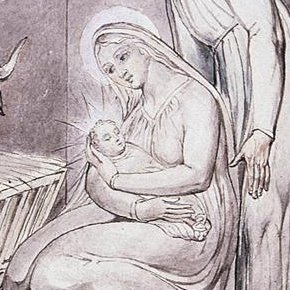
Right now, you might be thinking, “Wait a second…where are the baby and the manger and the shepherds and the angels? I know it’s late, but I don’t think I nodded off during the Gospel reading.” Now, I don’t know whether or not you nodded off, but I can assure you that I didn’t say anything about the baby or the manger or the shepherds or the angels. Tonight, I read a different version of the story of Jesus’ Nativity. Allow me to explain in brief, and then we’ll get to what I really want to talk about on this most Holy Night, which is God making a home here.
But first: yes, we are used to the Christmas Pageant version of the story of the Nativity. Most of that story is found in the Gospel according to Luke. I say “most” because a few bits come from the Gospel of Matthew and a few others bits are made up entirely. Tonight we read another take on that same story, a take so vastly dissimilar that it seems to be a different story entirely. But it’s not. The story is just condensed. The story of the Nativity is distilled down to a single, yet powerful verse of scripture: “And the Word became flesh and lived among us, and we have seen his glory, the glory as of a father’s only son, full of grace and truth.”
That’s it. That’s the Gospel of John’s Nativity story. That one verse; half a verse really. “And the Word became flesh and lived among us.” Pretty concise, right? But even in their brevity, these words pack in a whole lot of meaning. They are pregnant words, so to speak.
The Word that becomes flesh is the main character of this prologue to John’s account of the Gospel. In just eighteen verses, John explores some pretty weighty theological ideas, and he does so using poetry. Indeed, these verses are best understood as a poem: John uses special words and rhythm and imagery in an attempt to get to the very heart of God’s making of and presence in Creation. The weightiest of these special images is the word “Word.”
This is the Greek word logos. We get the English suffix “-ology” from it; you know, biology, zoology, paleontology. We also get the word “logic” from it. When something is “logical,” it is orderly, organized, it makes good sense. So when John claims that Creation “came into being through [the Word],” he’s stating that God was organized about the act of creating, that God had a plan for the universe and wasn’t just creating all willy-nilly. You can see how John’s poem goes all the way back to before anything existed, all the way back to when there was only God. John needs this cosmic perspective in order to demonstrate the extraordinary specialness of what happens next.
This organizing principle, this logic behind Creation, this giver of all life, this Word became flesh. This Word took on the very meat and bones and skin and breath and soul that had evolved over untold millennia within the Word’s own orderly Creation. This Word became flesh in the person of Jesus of Nazareth, a man of seemingly humble origin who had a knack for helping people live better, fuller, and more authentic lives, serving one another in love. This Word became flesh, which means he got dirty and tired; he grieved and wept and sought comfort; he ate and drank and laughed with his friends. He was homeless at times; he was also a refugee. He was welcomed and excluded; he was loved and hated. He touched and healed so many people, but sometimes he needed to go off by himself to recharge. He took a first, newborn breath. He took a last dying breath. All this to say: he was one of us.
In fact, he was the best one of us. He was the best one of us because he was so much more than simply one of us. He was the Word. He was life as life is meant to be lived, as God dreams for life to be. As so many theologians have said, this Word became like us, so that we could become more like him.
And this thought brings us to the last important word in John’s brief Nativity story: “And the Word became flesh and lived among us.” Lived among us. I don’t like this translation. It’s about as weak a translation of the original language as you can get. I prefer this: “And the Word became flesh and made his home among us.” Made his home among us. This gets much closer to the intent of John’s original poetry. The Word didn’t just live here for a time. The Word settled here. The Word made a home here.
I think this second translation impacts me so much because I have lived quite a nomadic existence. In my nearly thirty-three years on this planet, I’ve lived in ten different states. The longest I lived anywhere was six years in Tuscaloosa, Alabama. The second longest was four years at college. I’ve lived a lot of places. But I never, ever felt like I was making my home anywhere. Until now. I live in a real house with my wife and two children. We brought the twins home to that house. In their short lives, they have never lived anywhere else. That is their home. We have made a home.
The Word became flesh and made his home among us. God made a home here. The Nativity we celebrate this night marks not a brief dalliance with Creation, not simply a passing through, but a commitment to be present, to be active, to be here. And through the power of the Holy Spirit, this commitment continues long ages past the Word’s earthly walk. The home God made is no longer just in Bethlehem or Nazareth or Jerusalem. The home God makes is here, in each beating heart. And the home God makes is also out there, within the whole of Creation. As the Godly Play stories so aptly put it: “All of God is in everyplace.” That’s God’s home. We are God’s home. And God is our home, now and into eternity.
So this night, we celebrate not only the first, newborn breath of the babe in the manger. We celebrate the deep reality that God made a home here in order that we might have a home in God.








 Right now, you might be thinking, “Wait a second…where are the baby and the manger and the shepherds and the angels? I know it’s late, but I don’t think I nodded off during the Gospel reading.” Now, I don’t know whether or not you nodded off, but I can assure you that I didn’t say anything about the baby or the manger or the shepherds or the angels. Tonight, I read a different version of the story of Jesus’ Nativity. Allow me to explain in brief, and then we’ll get to what I really want to talk about on this most Holy Night, which is God making a home here.
 Where the Wind...