After a midsummer hiatus, here’s the final part in a six part video series produced to accompany the book Digital Disciple. This video series is designed to be used in a class setting to introduce the material and spur discussion. Of course, watching it by yourself is fine too!
Don’t forget to head over to the Facebook page and participate in a little quiz about this video. We’ll pick a random winner from those who participate and he or she will receive an autographed copy of the book, the DVD, and the t-shirts that Adam wore in the video (again, not the actual shirt but one just like it). Check it out!
(Sermon for Sunday, September 4, 2011 || Proper 18A || Matthew 18:15-20 )
Near the end of the film Shakespeare in Love, the crowds who have just witnessed the first performance of Romeo and Juliet sit stunned into silence. Then one person begins clapping and soon the playhouse is shaking to thunderous applause. But in the midst of the cast’s curtain call, a group of soldiers storms into the theatre led by Mr. Tilney, the Queen’s Master of the Revels. “I arrest you in the name of Queen Elizabeth,” shouts Tilney.
When asked why he is attempting to arrest everyone present, he says that they all “stand in contempt of the authority vested” in him by Her Majesty because they just participated in a display of public lewdness – because (and here he points to Gwyneth Paltrow who is playing Lady Viola who, in turn, is playing Juliet) “that woman is a woman!” Then he employs the Queen’s authority a third time: “I’ll see you all in the clink in the name of Her Majesty Queen Elizabeth.”
“Mr. Tilney,” thunders a voice from the audience. Then the Queen reveals herself and says, “Have a care with my name or you will wear it out.” And stepping regally to the stage (as only Dame Judi Dench can), she takes charge of the situation.
Now the monarch happened to be at the play, but neither Mr. Tilney nor anyone else knew that. Mr. Tilney was doing what was expected of him as the person in charge of public performances in the Queen’s realm. The Queen, of course, could not possibly attend to all matters of governance alone, and so she appointed all sorts of people to handle affairs in her name. These people, like Mr. Tilney, used the Queen’s name to generate the authority they needed to do their jobs, which in the big picture always meant looking after the Queen’s affairs. Apparently, in Mr. Tilney’s case, he has traded on her name one too many times.
This is the model that first comes to my mind when the Gospel references doing something in Jesus’ name, as so happens in today’s reading from Matthew. I think of the absent monarch delegating to an underling some portion of her authority so that some minor affair of state runs smoothly. In this model, the name of the monarch functions as a badge or a seal, some sort of official statement that the underling is speaking for the monarch because the monarch is elsewhere.
Now I want you to time travel with me back about three minutes. I climbed into this pulpit, crossed myself, and said, “In the name of the Father and the Son and the Holy Spirit.” You said, “Amen,” and then you sat down while I took a sip of water. And then I started talking about Shakespeare in Love. Okay, back to the present.
How is my invocation of God’s name any different than Mr. Tilney wearing out Queen Elizabeth’s? If Mr. Tilney invokes the Queen’s name primarily because she is absent, what am I saying about God’s presence here with us at St. Stephen’s? Could I possibly be implying that God is an absent sovereign, and I am speaking on God’s authority because God couldn’t quite get here this morning?
I surely hope not. And here is where we disciples of Jesus Christ diverge from the underlings of Queen Elizabeth. Notice what Jesus says at the end of today’s Gospel reading: “For where two or three are gathered together in my name, I am there among them.” Whenever we invoke the name of Jesus, we do not do so in order to stand in for an absent savior; rather, we invoke Jesus’ name to awaken ourselves to the ultimate reality of Christ’s very presence in our midst.
Jesus expresses this ultimate reality when he says, “I am there among them.” In Greek, this phrase literally means, “I am there in the middle of them.” In other words, the presence of Christ forms the invisible connective tissue in our relationships. We make this connection visible when we love one another, when we serve one another, when we respect the dignity of one another, and when we reach out to those who we might not think are all that connected to us.
And we make this connection visible when we gather intentionally in Christ’s name to share Christ’s presence with each other. Later in this service, we will turn our attention to the table. And the very first words out of our mouths will demonstrate that a gathering of at least two is necessary to celebrate God’s connection to us and to each other. I will say, “The Lord be with you.” And you will respond, “And also with you.” We will engage in this short conversation in order to notice that we are gathered together in God’s presence.
During the ensuing prayer, we will thank God for all the gifts God has given us. And because this thanksgiving comes attached to the sharing of something, namely bread and wine, we will be reminded that the best way to thank God for our gifts is to share them with others. At the end of the prayer, I will break the bread so we all can partake in this act of sharing. And through the praying, thanking, breaking, and sharing, we will participate in the presence of God among us. We will celebrate the connective tissue of Christ in each of our relationships.
But this is not the end of our awareness of the connecting power of God. This is the training, the exercise for the real work of disciples of Jesus Christ. When we walk out through those doors, we will bring with us the desire and the ability to make visible the connective tissue of Christ’s presence in all of our relationships. The final dialogue of this service will be, “Let us go forth in the name of Christ,” to which you will respond, “Thanks be to God” (plus a few “Alleluias”).
We go forth in the name of Christ, not to divide, but to gather. We go forth in the name of Christ, not rejecting the chance to form a bond, but rejoicing that the connective tissue of God’s presence stretches forth from us, seeking the lost and the lonely. We go forth in the name of Christ, not as delegates of an absent savior, but as beacons of the light of Christ, which fills the space between people and pulls them closer together.
(Sermon for August 28, 2011 || Proper 17A || Exodus 3:1-15)
Eustace Scrubb had read only the wrong books. The books he had read had “a lot to say about exports and imports and governments and drains, but,” says C.S. Lewis, “they were weak on dragons.” And so when Eustace accidentally accompanies his cousins Edmund and Lucy on a voyage aboard the ship Dawn Treader, you might imagine that he is, shall we say, out of his element. The further the ship sails from Narnia, the more ghastly becomes Eustace’s behavior. He is truly a horrible boy – lazy, selfish, dishonest, self-centered, and his attitude only goes from bad to worse.
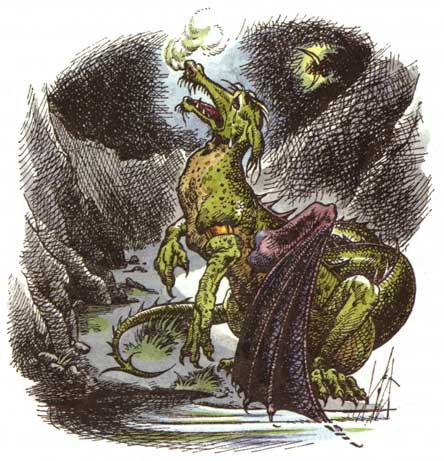
So you won’t be surprised to hear that, when the ship finally comes ashore after a brutal storm, Eustace slips off by himself to avoid a day of hard work. And because he’s read only the wrong books, you also won’t be surprised to hear that, when he stumbles into a cave full of treasure, he has no idea that he has trespassed into a dragon’s lair. He has no idea that falling asleep on a dragon’s hoard turns one into a dragon. And he has no idea that he has become a dragon until he realizes that he’s running on all fours and that the reflection in the pool is his own. Now that he has become a dragon, “an appalling loneliness” comes over him, and he begins to see in himself the monster that his cousins and the crew of the Dawn Treader had tolerated for the entire voyage. How could Eustace possibly undo the enchantment? How could he shed the dragon’s skin?
Consider that your cliffhanger until later in the sermon. Before we return to Eustace the dragon, let’s turn our attention to this morning’s lesson from the Hebrew Scripture. Moses grazes the flock of his father-in-law far afield. At Mount Horeb, he sees a bush blazing merrily, but the bush isn’t turning to coals and ash. Intrigued, Moses turns aside to look more closely. And God encounters him there. “Come no closer,” God calls to Moses. “Remove the sandals from your feet, for the place on which you are standing is holy ground.”
Remove the sandals from your feet. On the surface, this command reminds Moses that he and God don’t share the same position. Moses is a supplicant, and he comes into God’s presence unshod to show the vast disparity between the two. Okay, show of hands – which of you took off your shoes when you settled into your pew this morning? Yeah, neither did I. From a cultural point-of-view, removing our footwear signals informality rather than respect. So, we need to look at God’s command here from a different perspective.
On a deeper level than the simple removal of a garment, God’s command to Moses to take off his sandals presents a challenge to each of us who hears this story. This challenge begins with a question. What is God commanding you and me to remove from ourselves when we enter into God’s presence?
Our answers to this question build the wardrobe of costumes we wear all the time without realizing that we are dressed up. We wear these invisible costumes and affix invisible masks to our faces in order to set up buffers between ourselves and other people. If other people get too close, then they might impel us to change, to see the world differently than we desire, to remove ourselves from the centers of our existence. Our costumes are our first line of defense to remain the people we’ve always told ourselves we want to be. The trouble is that the costumes also disguise us from ourselves.
And so we stumble into God’s presence wearing carefully crafted costumes and masks that create barriers between us and everything that is not us. And just as God commands Moses to remove his shoes, God tells us to take off the costume.
What is God commanding you and me to remove from ourselves when we enter God’s presence? What makes up our costumes? Here I can only speak for myself, so listen for where your experience connects with mine. After praying with the question, I decide that the first piece of my costume to remove is Fear. This is the fear that forestalls any type of change. This is the fear that keeps me from entering into any kind of relationship because the other will cause some sort of transformation in me. This is the fear that keeps me from diving into a pool, not because I’m afraid of diving, but because I don’t want to get wet.
The second piece of the costume is Ignorance. When fear keeps relationships from beginning, ignorance is the necessary byproduct. I am blind to the situations of those I don’t take the time and energy to know. Again, this is part of the buffer. If I actively keep myself from developing an understanding of another’s plight, I won’t be putting myself in the position to have to decide whether or not to help, to relate, to get my hands dirty.
The third piece of the costume is Apathy. When ignorance fails, and I do find myself in the position to make a choice – to be in relationship or not – apathy sings the siren’s song. Apathy is the inertial force that keeps me complicit and complacent to the woes of others because I just can’t quite dig up enough empathy to care.
There are many more pieces of the costume, too many to talk about in this sermon, but there’s still the mask. My mask is Pride. When fear and ignorance and apathy all fail to keep me from being in an authentic relationship with another, there’s always pride to keep me living a disguised life. This is the pride that takes all the credit for my giftedness and assumes that I can get along quite well on my own because I seem to have done so thus far.
And this is where we return to Eustace, the horrible boy of C.S. Lewis’s The Voyage of the Dawn Treader. After he becomes human again, Eustace relates to his cousin Edmund how he left the dragon behind. A lion had come to him in the night and bade him undress. Since he had no clothes, he began shedding his skin like a snake. He scraped off his scales and stepped out of the skin. But then he looked down and saw another layer was there. He peeled this off as well. And “exactly the same thing happened again,” said Eustace.
And I thought to myself, oh dear, how ever many skins have I got to take off? …So I scratched away for the third time and got off a third skin, just like the two others, and stepped out of it. But as soon as I looked at myself in the water I knew it had been no good.
Then the lion said… ‘You will have to let me undress you.’
The desperate Eustace lay down and
The very first tear [the lion] made was so deep that I thought it had gone right into my heart… Well, he peeled the beastly stuff right off – just as I thought I’d done it myself the other three times, only they hadn’t hurt – and there it was, lying on the grass: only ever so much thicker, and darker, and more knobbly-looking than the others had been.
When we stumble into God’s presence, God invites us to remove our costumes. Like Eustace, we might be able to slough off some pieces ourselves, but the real costume only comes off when God intervenes and pulls the invisible garments away. When we pray, “I will, with God’s help,” we acknowledge that we cannot take off our disguises until we stand before the God who is the only one who truly knows what we look like. We cannot remove our costumes until we ask God to take them away, to leave them lying next to us, thick and dark and knobbly-looking.
And when we participate with God in this removal, there is just so much room to fill. Hope takes the place of Fear. Awareness fills in the gap left by of Ignorance. Engagement replaces Apathy. And Humility settles in where Pride once kept the disguise wrapped around us so tight. Shedding the costume is hard work that takes a lifetime. But we are not alone. We are in God’s presence, and God is forever helping us shed the dragon’s skin.
My lovely wife surreptitiously recorded the song from my sermon yesterday. I wrote it last Thursday and played it a lot on Friday and Saturday to prepare for singing it during church. This is only my second sung sermon in the five-ish years I’ve been preaching, so I probably won’t do one again for quite a while, but every so often you’ve just got to pull out the ol’ guitar. (Check out the previous blog post for the lyrics.)
Aidan Davies and his father walked out of the sacristy. “Wait a moment,” said Alastor. “Let me look at you.”
Aidan stopped and turned in a circle. He had on more layers of clothing than any sane person would wear in the month of June. But he always joked that the psychological testing that candidates went through before becoming priests was done to make sure you were crazy. On top of his suit trousers and black shirt, Aidan wore a white alb, a garment which he used to pretend was a toga when his childhood fantasies built ancient Rome in the churchyard. On top of the alb, he wore a green stole, which more than a handful of people had called a “scarf” when they paid him compliments for its subtle patchwork design. And on top of the stole, he wore a green and gold chasuble, which weighed on his shoulders like a down comforter. Aidan flapped his arms to move the chasuble off of his hands. Of course I’m going to spill wine on it today, he thought. It’s a good thing, then, that it cost more than my first car. Aidan smiled ruefully and gave the chasuble a quick once over, looking for previous stains. There weren’t any.
Alastor stepped to his son and straightened the neckline of the ornate garment. Then his hands suddenly went to Aidan’s shoulders and his father gathered him into a strong embrace. “I remember when you wore a chasuble on Halloween. Your mother had to pin it to keep it from dragging.” He pushed Aidan back to arms length. “Now look at you.”
Alastor choked off the last words, seemingly as surprised as Aidan at his sudden show of emotion. Alastor kept his hand on Aidan’s shoulder as they walked to the back of the church where the early service crowd was trickling in. Churches fill up like movie theaters, Aidan thought.
His father stuck his head outside and clucked good-naturedly at a few stragglers. As they settled in to their pew, Aidan made a quick head count. Two dozen or so. Pretty standard for an early service in the summer. Well, if I do trip and hit my head on the altar only a few people will see it. He glanced at his watch and gave a thumbs up to his father. Alastor led the way as they entered the nave and processed down the center aisle. Aidan had never walked behind his father in procession. This is something new, indeed.
The first half of the service came and went. Aidan kept stealing glances at the altar, wondering how something he used to play under could seem so imposing now. At the Peace, he shook hands with the two-dozen parishioners and embraced his father once again. Then he turned to face the altar and his parents’ advice from earlier that morning came to him. Go to the bathroom before you put your chasuble on. Check. Remember that God’s there too. Aidan looked at the cross and out the window to the misty morning sky. He looked back at the altar and at the people assembled. His mother’s advice had seemed so obvious when he sat perched on the edge of her bed. She might have said, “Remember that gravity will keep you from floating away.” But here in the church, with that special table in front of him, Aidan could not remember, could not see how he could go and stand behind that table and invoke God’s presence.
Aidan pulled his father to one side. “I don’t think I can do this,” he said. He tugged at the collar of his alb. “I don’t think I can consecrate communion.”
Alastor steadied his son with a look. It was the look the veteran paratrooper might give the new recruit before pushing him bodily from the plane. “And what makes you think that you’re the one doing anything,” he said simply.
Aidan stared blankly at his father. “You’re just the hands and the mouth,” said Alastor. “No delusions of grandeur. God’s doing the heavy lifting.” Aidan nodded and turned back to the altar. Alastor stepped up behind him and whispered, “And God does the heavy lifting whether or not you realize God is here.”
Once again Aidan let out a breath he didn’t know he was holding. God is here. God is here and that truth has nothing to do with me. No delusions of grandeur. “Okay. I’m really ready this time,” he said.
He mounted the steps to the altar and unwrapped the chalice. He folded the veil and laid it aside. He put the burse on top of the veil. He dumped a few dozen wafers onto the paten. He took the two silver cruets from the credence table and set them next to the chalice. Then he froze and his eyes went wide. He looked at the two containers: they were identical and they were solid metal. One held wine and one held water, but there was no earthly way to tell them apart. He pulled the stopper from one and glanced inside. Too dark. The liquid could have been either. He checked the other. Looks the same. He picked them up to feel the weight, hoping the cruet containing the wine would be fuller. No such luck. He put them down and gave his father a sidelong glance, along with a half grimace that he hoped communicated, “Help me!”
Perhaps, his father didn’t understand his attempt at telepathy. Perhaps, his father was trying to loosen him up some more before the Eucharistic prayer began. Perhaps, his father was getting him back for all those times that Aidan held up his watch to signal that a sermon had gone on too long. Whatever the reason, Alastor Davies gave his son a shrug, and not just any shrug, a comically expansive shrug, like one you might use while playing charades.
Aidan did his best to hide a scowl. Then he did the last thing he could think of. He tipped just a bit out of one cruet. Water. Of course. He switched cruets and poured. A more experienced priest wouldn’t have panicked. A more experienced priest would have known that less than ten percent of the congregation would have any clue that something was amiss at the altar. But Aidan had been a priest for less than twenty-four hours.
And yet, as his panic subsided, Aidan noticed something else filling its place. What is it? Aidan searched within himself before beginning the prayer. Ah, there it is. Peace. And what’s that next to it? Yes. Joy. Aidan lifted his head and smiled at the two-dozen people scattered around the church. “The Lord be with you,” he said.
In the end, he didn’t spill wine on the chasuble. He didn’t trip and bang his head on the altar. He didn’t have a panic attack. All he had to do was jump and pull the ripcord. And the wind caught his chute and brought him safely to ground.
Back at the kitchen table later that day, Aidan paused in the middle of eating his grilled cheese sandwich. Aquinas was curled up on his lap, sleeping soundly. Lucy and Alastor sat across from their son. They hadn’t stopped beaming at him since they arrived home. “So, Dad, I have a question,” he said.
“The Sox have a day game. Starts in about half an hour,” Alastor said.
“No, that’s not it.” He took a bite. The cheese stretched as he pulled the sandwich from his mouth. “How do you tell which cruet holds wine and which holds water?”
Alastor smiled at his wife, who reflected it back at him. He put on his best professorial tone and said to his valedictorian, Bachelor of Arts summa cum laude, Master of Divinity, seminary-trained new priest of a son, “You smell them, of course.”
On the third Sunday in June, Aidan Davies woke up in the bed in the guest room of his parents’ house. This was not his room, though it featured several artifacts from his childhood like a haphazardly designed display at the natural history museum. This is where young Aidan struggled to open the broken drawer of his bureau for his entire childhood, he mused, looking at the dingy piece of furniture. If you’ll direct your eyes above the dresser, this is where he simply had to own a poster from each Star Wars film, even The Phantom Menace. And now, if you’ll look to your right…
Davies’s thought trailed off as he examined another cheap piece of furniture that had been in his room for as long as he could remember. Since his contact lenses were bathing in solution in the bathroom, he couldn’t really see the squat shelving unit. But he could tell you exactly how much the middle shelf bowed under the weight of old books and how many CD cases would fit up top. However familiar the furniture was to him, though, the room itself was not his. His parents had moved when he was a junior in college, and he had needed directions to find his own house when he came home for Christmas that year. The move had happened five summers ago, and during that interval, most of Aidan had stopped grieving the loss of his bedroom. But the part of him, the part that would rather root around in the closet under the stairs for his old LEGO sets rather than go through with the events today held in store for him, still cherished the memory of the sky blue walls and beanbag chair reading nook of his old house.
Today. Sunday. He glanced at the clock on the bedside table. He didn’t have to get up for another hour, but he was restless. Today was an important day. He rose, brushed his teeth, and showered. He pulled the dark suit off the hanging bag and laid it on the bed. He donned his black shirt and snapped the white collar in place around his neck. He looked in the mirror. Yesterday morning, he was a deacon; today, he was a priest. A dozen other priests and Davies’s bishop had laid hands on him and prayed to God to make Aidan a priest, too. I suppose it took, he thought as he reached around and touched his left shoulder blade. His father had laid a firm, yet trembling, hand there yesterday, and Aidan could still feel a faint echo of the blessing held in Alastor Davies’s touch. He traced the lines of a cross, imagining he could feel the relief carving of his tattoo through his clothing. Then, picking up his jacket, he padded out of the room.
“Aidan?” The door to his parents’ room was cracked to let the cats in and out and his mother had spotted him.
“Morning,” he said as he poked his head around the doorframe. Lucy Davies was up to her chin in sheets and blankets, despite the early summer warmth rising with the sun. Anselm had annexed most of Lucy’s pillow, while Aquinas staked his claim to the foot of the bed.
Aidan’s father began the tradition of naming the family’s cats after medieval theologians during his time in seminary. Lucy took Aidan and his older sister Brigid to the animal shelter, and they argued all the way home over what to call their new pet. The argument continued inside the house, making Alastor look up from his reading. He tapped the cover of the book: “How about Bernard?” he suggested.
“But it’s a girl kitty, daddy,” Brigid said.
“No problem, dear. Bernard was from Clairvaux, so we can call her “Clair.”
Brigid beamed at him. Aidan, at age three and a half, hadn’t followed the conversation very well, and he thought his father had said “éclair,” which Aidan had recently discovered to his delight, so he beamed too. Clair was with the Davies family until the summer before Davies himself began seminary, but she had succumbed to a combination of old age and fear of the vet’s office. Six months later, Lucy and Alastor brought home two new cats. “Who are you studying in systematic theology right now?” Alastor asked Aidan over the phone.
“Anselm. Aquinas is next,” came his son’s reply. Luckily, the cats were both boys.
Aidan sat on the corner of the bed and scratched Aquinas behind the ears. “Nervous?” his mother asked.
He looked at her. When his mother asked him about his emotional state, she was usually reflecting her own feelings. What does she think is going to happen? Maybe that I’ll trip on my vestments and bang my head on the altar, he thought. Lucy had always had a fairly vivid imagination about how his various sporting engagements could end in brain damage or missing fingers. Perhaps, she’s confusing church with soccer. “Mom, the words are printed, I took a class in this, and I’ve been watching Dad do it my whole life,” he said. “I’ll be fine.”
The last three words sounded hollow, even to him. Lucy eyed him appraisingly. “If you say so, dear. Just don’t forget that God is there, too. That’s the whole point.”
She spoke the last words in the middle of a yawn, rolled over, and began rhythmically breathing a little too convincingly to be properly asleep. Aidan took that as his cue and left the room while Anselm resettled himself on Lucy’s pillow. As Aidan shut the door, Lucy’s breathing slowed, and Aidan wondered if anyone in the history of the world had ever feigned realistic sleep. It’s like wondering if the refrigerator light stays on when you close the door, he thought.
He moved down the hallway, passing the collages of his and Brigid’s infancy, of his childhood athletics and Brigid’s recitals, of their prom pictures and graduations. He arrived in the kitchen to find his father sitting down to his ritual bowl of oatmeal. You could set your watch to his Sunday morning routine. Aidan sliced off two thick pieces of the banana bread Lucy had made yesterday and sat down opposite his father. Always the sports section first. “Did the Sox win?” Aidan asked.
“Walk off double in the tenth. Hit the top of the scoreboard just out of reach of the left fielder’s glove,” said Alastor without looking up from the paper. “But they blew the save in the ninth so the extra inning heroics shouldn’t have been needed.”
“So the musical chairs at closer continues,” Aidan said. During the spring and summer (and into autumn if the Red Sox made the playoffs), baseball accounted for about eighty percent of the conversations between Aidan and his father. Even on a day like today we’re talking baseball. Aidan picked up the discarded sports section as Alastor moved on to the comics. I find that oddly comforting. Aidan’s hand strayed once again to his left shoulder blade. Alastor looked up. “Nervous.”
The word wasn’t a question as it had been when Lucy had asked. It was a statement, one that a veteran paratrooper might say to a new recruit before his first jump. It was the kind of statement that gives permission to feel the emotion but withholds permission to remain safely in the aircraft. “A little, I guess.”
“Just remember,” Alastor began.
“I know, I know,” Adain cut him off. “Mom already reminded me. God is there, too.”
“That’s true.” Alastor suppressed a smile, the crinkles around his eyes growing heavy. “But that’s not what I was going to say.” Aidan put down the sports section. “What I was going to say was: don’t forget to go to the bathroom before you put on the chasuble.”
Aidan let out a breath he didn’t realize he had been holding and started laughing, first quietly to himself and then louder and louder. Alastor joined in, and soon they were laughing just for laughter’s own sake.
An hour later, Aidan left the restroom at the church. He thought he might vomit like he had before many a high school soccer game. But he didn’t. His father was waiting for him, an ornate poncho draped over one arm. Aidan took the chasuble, put his head through its hole, and smoothed out the sleeves over his alb. He turned to the mirror in the sacristy. Well, you look like a priest, he told himself. You’re first celebration of Holy Communion. Are you ready?
Aidan put a hand on his father’s shoulder and pushed him toward the doorway. “I’m ready,” he said.
(Sermon for Sunday, July 17, 2011 || Proper 11 Year A || Genesis 28:10-19a; Psalm 139:1-11, 22-23)
What would your life be like if you had to think consciously about every breath you take? What would your life be like if your brain had to work your lungs like your hands might work a bicycle pump? What would your life be like if you needed to be aware of each of those millions of oxygen atoms that squeeze their way into your red blood cells for their continual circuit around your body? Well, for starters, you would never be able to sleep. You might be able to get a little work done by holding your breath for thirty seconds at a time and then concentrating furiously at the task at hand. You certainly wouldn’t be able to pay attention to this sermon. But that’s okay because I wouldn’t be able to preach in any coherent fashion either.
We are blessed, therefore, that God created us with “an autonomic nervous system,” which removes breathing from the list of bodily functions that require conscious thought. Of course, you might notice your breathing after walking up a particularly long flight of stairs or during a brisk run or when you are in labor. But for the vast majority of our lives, we simply breathe and never give the miracle of respiration a second thought.
I bet your high school anatomy class covered the wonder of the autonomic nervous system. Our bodies do so many things involuntarily, and the autonomic nervous system takes care of each one of them. What I’m sure the anatomy class didn’t cover, however, is the fact that, in addition to our bodily ones, every person here also has an autonomic spiritual system. God’s presence is even more constant than breathing, and so each of us has developed an autonomic spiritual system in order to handle our relationship with God during the vast majority of our lives when we are not consciously responding to that relationship.
Unlike the autonomic nervous system, which controls breathing and other things, none of us is born with an autonomic spiritual system. When you see a child’s eyes go wide at the splash of a stone in a pond or at the scurry of a squirrel on a branch, the child is experiencing God’s presence unfiltered by the involuntary sifting of the autonomic spiritual system. As we grow up, we develop this involuntary filtration, preferring the concrete stuff of the world over the spiritual substance of God’s presence. This is why the children in C.S. Lewis’s Chronicles of Narnia cannot return to Aslan’s domain once they’ve reached a certain age. The cares of the world keep them from wishing to go back to Narnia, and so they never find another gateway.
In today’s reading from the Hebrew Scriptures, Jacob demonstrates that even someone a mere two generations removed from Abraham has developed the problem of the autonomic spiritual system, this involuntary sifting of God’s presence from our daily experience. Jacob is on the run from his brother Esau, whose birthright and blessing Jacob has stolen. On his way to Haran, Jacob beds down in a certain place, which must have been quite rustic considering he uses a rock for a pillow. During the night, Jacob dreams of a ladder filled with angels going back and forth between earth and heaven. The Lord stands next to Jacob in this dream and says to him, “Know that I am with you and will keep you wherever you go.”
Jacob wakes up and proclaims to the sky and to the rocks: “Surely the Lord is in this place – and I did not know it!” Jacob’s involuntary filtration had prevented him from noticing that presence when he went to sleep, but his dream alerts him to override his autonomic spiritual system. Just like during the brisk run when you notice your breathing, Jacob wakes up dazzled by God’s presence.
And then, as so often happens, Jacob makes a common mistake that turns the autonomic spiritual system back on. He says, “How awesome is this place! This is none other than the house of God, and this is the gate of heaven.” Jacob’s mistakes his physical location as the catalyst for his spiritual awakening. By assigning spiritual meaning to that particular rock-strewn piece of ground, Jacob fails to remember the words that God spoke to him in his dream: “Know that I am with you and will keep you wherever you go.” God doesn’t say: “Know that I am here.”God will bring Jacob back to that land, but in the meantime, Jacob will be in God’s presence wherever he goes.
The psalmist may have had Jacob’s mistake in mind while writing Psalm 139:
Where can I go then from [God’s] Spirit?
where can I flee from your presence?
If I climb up to heaven, you are there;
if I make the grave my bed, you are there also.
If I take the wings of the morning
and dwell in the uttermost parts of the sea,
Even there your hand will lead me
and your right hand hold me fast.
The psalmist understands that God’s presence is everywhere we might go because God’s presence is everywhere. These verses, then, are the psalmist’s way of remembering that God’s hand leads us, that God’s right hand holds us fast, no matter how often we might forget to search for God. The good news is that our autonomic spiritual systems do not define our spiritual existence. We can override them by accepting the ever-present help of God. There have been people throughout time who never developed the involuntary filtration: the Church calls them saints. I’m sure you know someone the church hasn’t canonized who lives a life fully present to God, a life without an autonomic spiritual system.
But for those of us who have difficulty overriding the system, we can take solace and strength in holding fast to an essential truth: God’s presence is not dependent on our awareness of God’s presence. Our awareness only matters insofar as we are present to God. We practice this awareness by taking on disciplines that slowly wean us from our reliance on the autonomic spiritual system: counting blessings, praying at times we might otherwise not pray, appreciating the majesty of the simplest created things, loving each other without thought of reciprocation, serving those in need.
Think about the last time you were stressed out – I mean really stressed out – I mean “I have four papers due on Monday and I washed a red shirt with the whites and I’ve been stuck on the tarmac at Logan for two hours for no discernible reason” stressed out. What did your friends do? They took you for coffee or for ice cream or, perhaps, for coffee ice cream. They told you to take a couple deep breaths. They told you to focus on breathing. Everything will be alright, they said. They knew that breathing, like God’s presence, is a constant in our lives. They knew that we don’t have to focus on constant things in order for those constant things to continue happening. But they also knew that when we do focus on those constant things, we often find peace – peace and new beginnings.
(Sermon for Sunday, May 1, 2011 || Easter 2A || John 20:19-31)
Imagine with me the Apostle Peter, who is in Rome near the end of his life, talking to a friend about the day when Jesus rose from the dead and appeared to the disciples in the locked house.
"Aslan Breathes" by Melissa Carter. Click the picture to see more of her paintings.
I wish I could tell you that seeing the empty tomb was enough. I went inside the tomb and saw the linen cloths lying there and the cloth that had covered Jesus’ face folded up in a corner. Thinking back now, surely grave robbers would not have folded his ceremonial burial garments while stealing his body! But in the semi-darkness of that early morning, I wasn’t thinking rationally. I wasn’t thinking at all. I was numb on the outside, immune to the sliver of hope that the empty tomb brought.
I was numb on the outside, but on the inside, I was at war. I always thought of myself as his most faithful disciple, but at the time of his greatest need, I abandoned him, I lied about knowing him to save my own skin. In the garden, I had been ready to fight to the death for Jesus. But the moment he took away my sword, I crumbled. I wasn’t strong enough to remain by his side without a weapon in my hand. I wasn’t strong enough to trust him, to trust that his plan included death without fighting. I was at war within myself, and I could not access a single crumb of the peace that Jesus had always radiated.
I saw the empty tomb, but the conflict within kept me blind to what the emptiness might mean. The war inside of me – with fresh reinforcements of guilt – was still raging when I returned to the house we had used a few nights before, on the night when I didn’t want Jesus to wash me feet. Nine of the others were there; they had been locked in the room since the mob had formed three days before. As I was shutting the door, Mary Magdalene rushed up and squeezed her way into the room. “I have seen the Lord,” she shouted.
She was breathing hard. I had left her standing outside the tomb, so she must have raced all the way to the house to catch up with me. I looked at Mary: her face glistened with sweat, her eyes were bright. If the conflict within had not been blinding me, I might have identified the brightness in her eyes as “joy,” but how could there ever be joy again after what had happened? The other disciples barely looked up when she burst in shouting. She looked around the room, then back at me. “He has risen from the dead,” she said, defiantly.
I took a step toward her. “Just because the tomb was empty,” I began, but my voice trailed off. She backed away, and now her voice was very small, small and wounded. “But I did see him,” she said. And I shut the door with Mary on the other side.
Sliding the bolt home, I slumped against the door and slid to the ground. Oblivious to Mary’s pounding on the door, I looked around the room. Judas was gone, of course, but everyone else was there, I was sure. We had escaped the mob and the authorities. Would they be content with the death of our leader or would they be coming after us, too? I counted the others. Nine, and I made ten. Someone else was missing. “Where’s Thomas,” I called out.
Philip looked up for a moment and managed a one-word response. “Gone,” he said, and he put his head back into his hands. I sat with my back to the locked door. Eventually Mary gave up her pounding. I could hear her sobbing, her breath coming in great heaves. She was, no doubt, sitting against the other side of the door. Three inches of wood separated us: three inches of wood and my disbelief and the war raging within me.
Inside the room, we might have been statues. I couldn’t even hear the others breathing. Hours passed and no one noticed. No one spoke. No one ate or drank. We were entombed in the locked house, alive but acting like dead men. And all the while the war raged on while numbness froze my body against the bolted door.
The ten of us were still frozen in place when evening fell. I had been staring at nothing in particular when I began unconsciously counting the others again. “Eight. Nine. Ten.” I counted aloud, and then I put my finger to my own chest. “Eleven.” I counted again. Eleven again. I leapt up and stared at the man in the center of the room. He was slowly spinning in a circle, studying each statue in turn. I looked where he was looking: at the hollow eyes, at the sunken cheeks, at the dried up streams of tears that had washed clean lines on dirty faces.
As far as I could tell, I was the only one who had noticed his presence. Since my rational mind was still turned off, I didn’t even wonder how someone else had entered the room while I was sitting against the locked door. I just stared at him, uncomprehending, but the sliver of hope that lay dormant in me since the tomb was beginning to glow. Then he said, “Peace be with you.”
They were the first words spoken since Philip’s one-word response to my question hours earlier. The words rang out, and the others began to stir. They raised their heads. Some stood up. The man walked over to me, gripped my arm in a firm grasp, and I noticed fresh wounds that cut through both of his wrists. He went around the room clasping the others’ shoulders and lifting their chins with his fingers. “He can’t be,” I said, as the war of guilt and pain and loss continued to rage within me, stronger now that the faint glow of hope was illuminating the battlefield.
The man heard me and turned to face my direction. “Peace be with you,” he said again. We were all standing now. The room, so empty a moment before, seemed full now, but not full enough for him. He gestured to me. I turned, unbolted the lock, and opened the door. Mary, still slumped against the other side, fell into the room. I helped her to her feet. “Is he?” I whispered to her. She looked from the man to me, and she beamed at me through brimming eyes.
“As the Father sent me, so I am sending you,” he continued. With these words, we, who had been as still as statues mere minutes before, all leaned in, like trees bending toward the sunlight. And he exhaled a deep, cleansing breath, then another and another. As he breathed out, I breathed in. I breathed in his breath, the wind of his life. I breathed in the words he had spoken twice since his arrival, the very peace that he proclaimed, that he radiated. This was Jesus, and he was alive, and he was breathing life back into us, into the ones who had entombed ourselves in that locked house.
As we leaned closer, Jesus said, “Receive the Holy Spirit.” And his breath washed over me, into me, through me. His Spirit brought peace to the war raging within. His breath blew across the faint glow of hope, turning the glow into a spark, and the spark into a flame, and the flame into a fire. And the fire set my heart alight with all the fervor of rekindled belief in this Jesus, this risen Lord, this one who would not abandon me to the grave even after I had abandoned him to die.
I tell you, friend, that in the years since that day, my daydreams have often brought me back to that moment when Jesus breathed his Spirit into me. When I am in distress, when I am in grief, when I forget that I believe that I am with God, I can take a breath. And I will remember that I am breathing in the peace that our Lord has given to each of us, the peace that passes all my ability to understand and lodges where I need that peace the most – in the secret places within where the war still rages from time to time. You see, every time I take a breath, and, for that matter, every time you take a breath, we are not only filling up our lungs with air. We are filling up our souls with the Holy Spirit of God, who continues to breathe into us the new life of the Risen Christ.
(Sermon for Sunday, January 30, 2011 || Epiphany 4, Year A || Matthew 5:1-12)
I preached this sermon on a Sunday in which the church had Morning Prayer for the first half of the service. We timed the service a little long, so my rector encouraged me to shorten the sermon, hence this 900 word piece rather than my normal 1200-1400 word ones.)
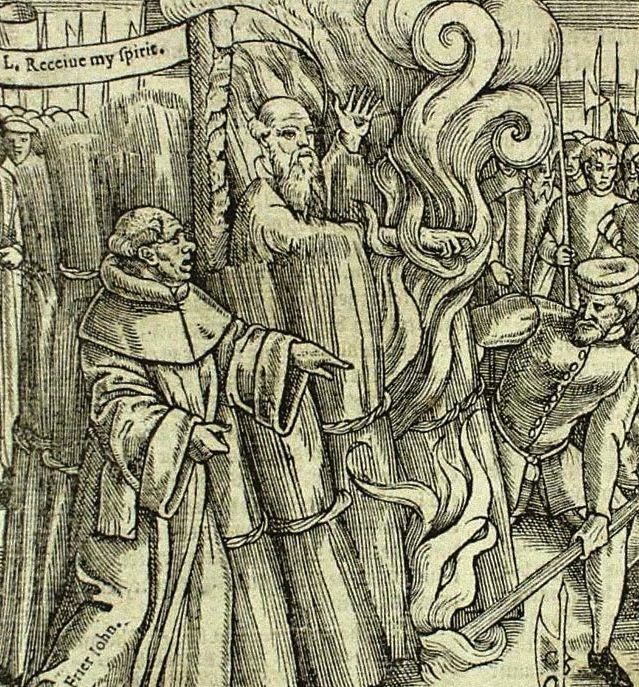
Four hundred and sixty-two years ago, the first edition of a certain book went to the printing press. The year was 1549, the author was Archbishop Thomas Cranmer, and the book was the Book of Common Prayer. In this original Book of Common Prayer (or BCP for short), Cranmer compiled, crafted, codified, and composed the prayers that became the central structure of a new expression of Christianity known as Anglicanism. A decade and a half before this publication, the King of England, Henry VIII, had officially broken away from the Roman Catholic Church. However, in the years immediately following the split, very little changed about the English church besides the pope no longer being the supreme earthly authority. Two years after Henry’s death, Archbishop Cranmer published the first BCP and ushered in the unique expression of Christianity that we at this church continue to practice today.
Queen Mary (Henry's daughter) didn't like Cranmer much. She had him burned at the stake.
This unique expression of following the way of Jesus Christ creates a structure, a framework of prayer, around which we organize our lives. Cranmer borrowed from the monastic example when he created this framework. Benedictine monks framed their days around an eightfold worship cycle; they prayed formally in church with one another about once every three hours. Cranmer wanted all people, not just monks, to frame their days with prayer, so he took the monastic practice and synthesized the eightfold structure into a twofold one. In his new structure, people prayed formally in the morning, then they went to work, and then they prayed formally again in the evening. Thus, the uniquely Anglican worship experience of Morning and Evening Prayer was born.
Every morning and every evening to this very day, Anglicans around the world have gathered to observe these two rituals. During them, we sing psalms and songs of praise to God. We read scripture. We pray and confess our sins. I would be willing to bet that, thanks to time zones, there is a service of Morning or Evening Prayer happening at every hour of every day all year long. When Cranmer developed this dual service, he did so in order to give his flock a method by which to order their lives around prayer and praise to God. This morning, we are participating in a cycle of worship that envelopes the whole world in constant prayer, a prayer that runs all the way back 462 years.
Whether or not we personally practice Morning and Evening prayer ourselves, the example, which Cranmer set, still guides us. Episcopalians prize the order behind our worship because the structure gives us a way to organize our lives around the things that are most important. The framework of prayer allows us to participate in God’s movement not just when we remember to or when we need to, but at all times.
When we adopt this structure and begin to practice our awareness of God’s presence, we can also begin to access another structure, a framework that lies beneath the one we normally witness with our eyes. This deeper structure is the one that Jesus speaks about to his disciples in this morning’s Gospel reading. The beatitudes, or statements of blessing, give us a glimpse of the deeper framework of reality that exists beneath the misplaced priorities and distorted vision of the world at large. This deeper reality is the one that God infused into creation from the beginning, a reality in which communion overrides isolation, peace quells domination, and love bests fear. Of course, humanity has ignored this deeper reality from the word go, preferring instead to set ourselves up as petty lords of our own destinies, oblivious to the fact that we have never really been in control of anything. Humanity’s greatest sin throughout history has always been setting up structures and systems that bury the deeper reality of God’s presence in all and through all. The ordered life of prayer gives us access to this reality.
Jesus’ beatitudes show us how the deeper structure of creation works. The poor in spirit, the grieving, and the persecuted are blessed. The meek, the merciful, the pure in heart, and those passionate about peace and righteousness are blessed. These are not mere moral platitudes spoken to console a downtrodden people. They are not future promises that will be fulfilled someday in heaven if you can just endure long enough to get there. They are not hopes for what could be coming down the road. These statements of blessing are ways in which the deeper reality of God’s presence breaks through the distortions of the world – then and there on the mountainside with Jesus and here and now in our midst.
When we participate in an ordered life of prayer like the one that Archbishop Cranmer developed, we practice the presence of God every day, not just when we remember to or need to, but every day. This practice is a spiritual workout, which strengthens not our muscles, but our vision and our ability to respond to God’s call to serve. When we take on the framework of daily prayer, we train ourselves to see the deeper reality of God’s movement, to which the beatitudes point us. And then we leave this room, our spiritual gym, and we go out into the world to begin uncovering that reality and showing that God’s presence is, indeed, here.
(Sermon for Sunday, January 16, 2011 || Epiphany 2, Year A || John 1:29-42)
The hospital was a maze. Children’s Medical Center had several buildings, and they were all connected somehow, but getting from one part of this building to another part of that building always involved multiple corridors and elevators. During the summer of 2006 between my first and second years of seminary, I was learning how to be a chaplain at this sprawling medical complex. One of the first things I learned was the hospital policy of refraining from giving directions to visitors. The hospital was just too confusing. Instead, if little Jimmy’s grandmother asked me how to get to the oncology unit, the hospital policy directed me to take her there myself and to make sure she knew her way back to the parking garage (which happened to be two elevators, three corridors, a skywalk, and two Starbucks away). In effect, hospital employees said, “Come and see” to their visitors and then accompanied them all the way to their destinations. These words – “Come and see” – make up Jesus’ second line of dialogue in the entire Gospel according to John. We’ll get to them in due time. But right now, let’s talk about Jesus’ first line of dialogue.
His first five words would not have been out of place in the labyrinthine hospital: “What are you looking for?” You might hear this question at any hospital elevator as any lost visitor stares helplessly at the building schematics printed on the wall. What are you looking for? Jesus speaks these words to two of John the Baptizer’s disciples after he notices them following him. At this point in the Gospel, Jesus has no followers of his own. He is the new guy in town. John the Baptizer owns the market on charismatic fellows who say compelling, challenging things. But John knows who Jesus is, so John encourages his disciples to begin following Jesus. Right away, Andrew and an unnamed person – quite literally – begin following Jesus.
When Jesus turns around and challenges them with his question –“What are you looking for?” – his words speak on two levels. This dual-layered dialogue is a common occurrence in the Gospel according to John. The first layer speaks to superficial, surface meaning. This layer is easy for Jesus’ listeners to access, and so they become drawn in. Then the second, deeper layer of meaning presents itself. Many of Jesus’ listeners resist this deeper level. But those who do dive deeply find rich, life-giving substance in his words.
With Jesus’ first words in the Gospel, he challenges Andrew, the unnamed disciple, and us to dive deeply to this second level of meaning. At the first level, John’s two disciples probably interpret Jesus’ question as a straightforward query into their present intentions. Do they happen to be going his way by chance or are they following him purposefully? But at the second level, Jesus’ five words penetrate to the deepest places of the human heart. What are you looking for? His question beckons an answer from those same deep places within us. The trouble is there are so many potential answers to this question that digging through them to find the ones that exist in those deep places can become problematic to say the least. Here’s what I mean.
What are you looking for?
A mid-sized sedan with good gas mileage and a high safety rating.
A doctor who understands my symptoms and actually seems to care for my wellbeing.
An assisted living facility for my parent whose mind is rapidly deteriorating.
What are you looking for?
The right greeting card to express my feelings.
A college that’s not too big but still has my major.
A quick hit to forget the day.
What are you looking for?
A boyfriend I can bring home to mom.
A scrap of meaning in a dead end job.
My car keys.
What are you looking for? John’s two disciples seem to understand that the “car key” type of answers will not suffice because Jesus’ words penetrate right into their hearts. So instead of answering his question, they ask one of their own: “Teacher, where are you staying?” Now, Jesus apparently does not hold a monopoly on dialogue with dual layers. At the first level, they want to know just what the question appears to ask: “In what house are you going to rest your head tonight?” But on that deeper second level, their question seeks a much more profound answer. Where are you staying? In Greek, the word that is translated as “staying” means quite a bit more than the English equivalent. Rather than the connotation of “staying at a hotel” or “staying on a friend’s futon,” the Greek word means to “abide” or to “continue to be present.” Thus, at the deeper level, the disciples ask Jesus where he dwells, where he abides, where he is present.
Their question, then, is the best response to Jesus’ own question. What are you looking for? Lord Jesus, I’m looking for where you abide. I’m looking for where you are present in my life. I’m looking for where you dwell in this particular situation I’ve gotten myself into.
When we receive Jesus’ question at the deeper second level, we can feel his words penetrating our hearts. We can hear his voice whispering up from the very depths of our beings: What are you looking for? Paying attention to his words rising from those depths helps us locate our own responses, the ones that originate in the same deep places of our beings. The transient, daily, car key type answers to the question fall away when we search deep within.
The best way to begin this search is with the disciples’ question: “Where are you staying?” When we ask this question, we open ourselves to finding Jesus dwelling somewhere in every facet of our lives. We open ourselves to hearing his voice whispering his presence into and out from our souls. We open ourselves, and in doing so, we turn the depths of our beings outward. The hidden deep places, where our responses to Jesus’ question lie dormant, become the pieces of ourselves that we display to the world. These pieces of ourselves are our callings from God. They are our personal, individual discoveries of Jesus beckoning us to find him in everything we do, in everything we say, and in everyone we meet.
And this brings us back to Jesus’ second line of dialogue in the Gospel according to John: “Come and see.” What are you looking for? Teacher, where are you staying? Come and see. Jesus invites us to see where he abides, where he is present in our lives. He invites us to dwell with him, no matter the situations we find ourselves in. Finding his presence means we have found those deep places within ourselves. Abiding in his presence gives us the grace to be vulnerable and to show the world the deepest yearnings that God has put in our hearts, the callings that God has blessed us to follow.
And the good news is this: “Come and see” means that Jesus will be with us, to take us where we need to go, to show us what we need to see. Just like the hospital employees accompanying a lost visitor to her destination, Jesus remains with us throughout our journeys. He dwells in our hearts whispering his question: “What are you looking for?” And when we ask him in return where he is staying, where he is abiding in our lives, he walks one step before us, saying, “Come and see.”





 Where the Wind...