During my sabbatical, I’m not writing new sermons, so on Mondays I am choosing one post from every year of WheretheWind.com to highlight. In 2021, nearly a year into the pandemic building closure I wrote this sermon about Noah’s ark.
This morning’s sermon is really two mini sermons stuck together – the first is a teaching about the way we read the Bible in church and the second is a look at today’s lesson from Paul’s Letter to the Romans. They teach you in seminary only to preach about one thing per Sunday, but I’m breaking that rule today because these two things fit together pretty well.
Sermon for Sunday, February 21, 2021 || Lent 1B || Genesis 9:8-17
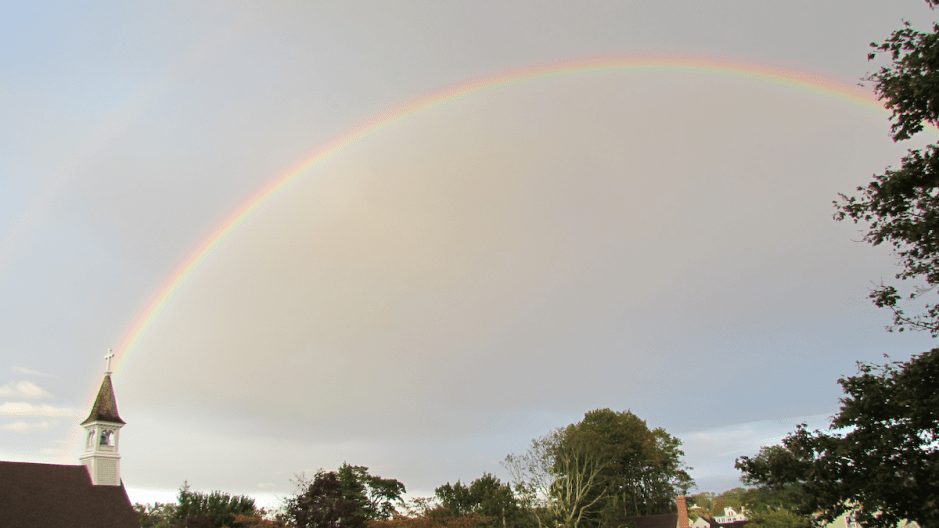
There’s nothing quite like a rainbow to make us stop what we’re doing and look up at the sky. A few years ago, a rainbow appeared off to the east of St. Mark’s, and from my perspective, it caught the cross of the church directly in the path of its spectrum of colors. The first thing I did was take about a hundred pictures. But then I remembered that day on our honeymoon – right around ten years ago today – when Leah and I left our cameras in the room, went out on our safari, and just took in God’s glorious creation with our own eyes. So I put my camera down and gazed at the rainbow hovering over the steeple of the church. And I thanked God for the sign of the rainbow, an ancient symbol of God’s identity as a keeper of promises.
Sermon for Sunday, September 20, 2020 || Proper 20A || Exodus 16:2-15
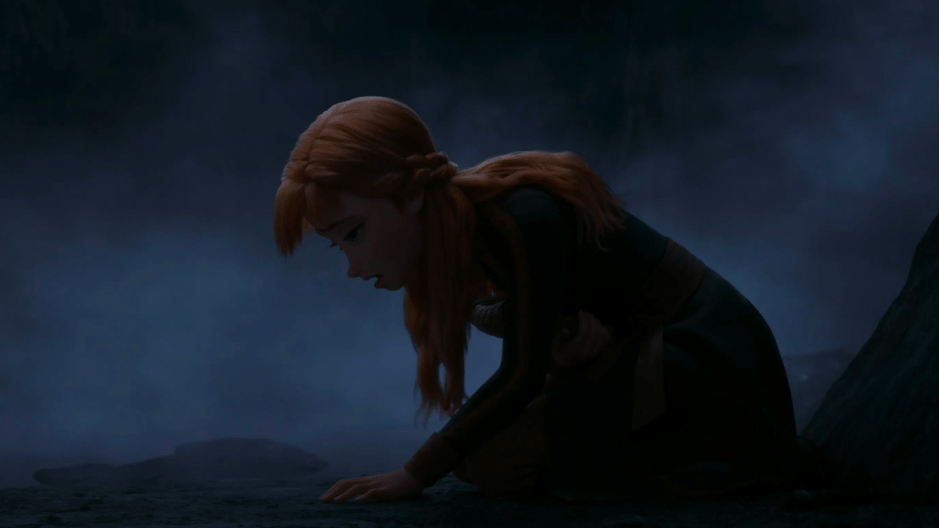
At the end of this sermon, I’m going to talk about the prophetic voice of the movie Frozen II, but first let me talk about the church hymn board affixed to the wall to my left. This is the attractive wooden rack into which our altar guild slides in the numbers that correspond to particular songs in our hymnal. At the top of the rack, we display the particular Sunday of the church year. I haven’t touched the hymn board since the last time we used it. I’ve left it alone as a memento from our last in-person gathering. Right now the hymn board reads the “3rd Sunday in Lent.” Half a year ago.
I remember the anguished discussion the vestry had about closing the church building back in March. We had no idea how bad the pandemic would get, but the writing was on the wall. Thankfully, the vestry made the hard choice in that moment of uncertainty. Now, six months later, we are faced with the opposite hard choice: how and when to invite people back to in-person services as we balance our need for physical proximity with our collective goal of deterring the spread of the virus.
Sermon for Sunday, September 13, 2020 || Proper 19A || Romans 14:1-12
Today’s sermon is a meditation. In a minute, I’m going to invite you to find a relaxing sitting position, which will be easier on your couch than if you were here sitting on a hard pew. I decided to offer a meditation today because recently I’ve been feeling my jaw clenching more and more. Sleep isn’t restful. I’m on edge all the time. I’d wager you are responding to the abnormally high level of stress in our society in similar ways. A friend of mine has a newborn in the NICU whom he says is there because he has to “remember to breathe.” I think that goes for all of us right now.
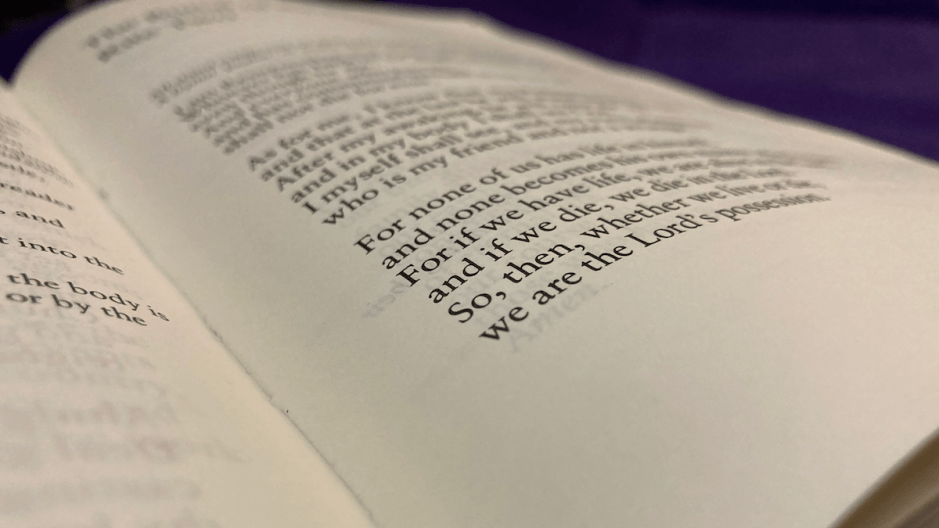
So, in lieu of my regularly scheduled sermon, I’d like to lead us all through a meditation designed to bring our ultimate future into this present moment. This is a meditation about God’s presence and promise when death is an ever-present reality. I’m offering it because today’s reading from Paul’s letter to the Romans includes a paragraph that we read as the third stanza of the opening anthem at the beginning of every Episcopal funeral. All four stanzas are quotations from scripture, and I’d like to meditate on them with you this morning. This might seem like a strange thing to do – focus on words spoken after someone has died. But these words are shared with those who remain, and I believe these scriptural truths actually help to bring us more fully alive.
Sermon for Sunday, March 29, 2020 || Lent 5A || John 11:1-45
Here we are. Week three of our church dispersed to the four corners of our community. The pews that you normally inhabit are empty, but we still gather together in prayer and worship of God this day. When my daughter was smaller than she is now, she couldn’t quite make her fingers do the “This is the church, this is the steeple, open the doors, and see all the people.” Her fingers wouldn’t interlock inside the church, so when she did the motion along with the rhyme, the people were outside the doors of the church. Appropriate for today, I think. We are still the church, even when we are unable to gather in a particular building.
I’m reminded of our distance from each other today, not just because of the empty pews, but because of the beginning of our long Gospel story. Jesus receives a message from Martha and Mary about Lazarus being ill. Then Jesus waits where he is two days worth of social distancing for two days before heading to Bethany, where he finds Lazarus has been in the tomb four days. After meeting with Martha and then Mary, the Gospel says this: “When Jesus saw [Mary] weeping, and the Jews who came with her also weeping, he was greatly disturbed in spirit and deeply moved. He said, “Where have you laid him?” They said to him, “Lord, come and see.” Jesus began to weep.”
Sermon for Sunday, April 22, 2018 || Easter 5B || John 15:1-18
My family moved around a lot when I was a kid. Before the age of twelve I had lived in eight different houses in five states. When we arrived in Alabama right after Christmas in 1994, my parents promised my sister and me that we wouldn’t move again until I finished high school seven years on. I smiled and nodded, but the whole time I was thinking, “Yeah, right. I’ll believe that when I see it.”
I simply had no frame of reference for remaining in one place more than three years, which was my previous best. I wasn’t great at making friends because my experience told me I would be leaving them soon, so what was the point. I had to adapt to numerous new cultures and speaking patterns. Notably, when I moved to Alabama I had to amend every statement with the words “sir” or “ma’am.” If I had said either in my prior home of Rhode Island, adults would have thought I was sassing them. It was very confusing.Continue reading “God’s Abiding Presence”→
Sermon for Sunday, April 1, 2018 || Easter B || Mark 16:1-8
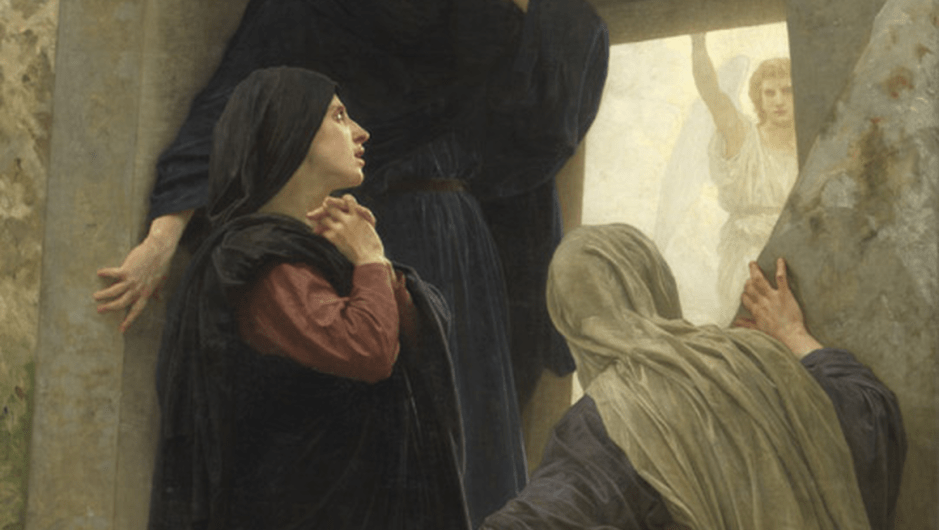
Good morning. I am so glad to be worshiping with you on this Easter morning. And I’m so glad that I got to read the last eight verses of Mark’s Gospel a minute ago because they hold some good news I never noticed before this week. Unlike the other accounts of the Gospel, Mark focuses entirely on the women’s walk to the tomb and their conversation with the young man in the white robe. The Risen Christ doesn’t actually appear in these verses, and we’re left in that unsettling moment when the women run off and don’t tell anybody because they’re afraid. Of course, they must have said something eventually or else this story wouldn’t have made it into the Gospel.
I can imagine Mary and Mary and Salome recounting their story to the disciples later on. “We got up early that morning and bought some spices to anoint his body. We had no idea how we were going to move the stone, but we went anyway, and when we got there –”Continue reading “Rolling Away the Stone”→
Sermon for Sunday, February 25, 2018 || Lent 2B || Genesis 17:1-7, 15-16
History is full of turning points – those moments when one event or one decision alters the fabric of the future. The turning points we remember happened on the world’s stage: the sinking of the RMS Lusitania on May 7, 1915, which contributed to the United States entering World War I; or the bombing of Pearl Harbor, which did the same 26 years later; or more happily, the moon landing on a summer night in July 1969, which spurred the scientific dreams of a generation.
In my 35 years, I have witnessed some world changing turning points. I was six years old when the Berlin Wall fell, too young to appreciate what its destruction symbolized, but old enough to remember just the same. On a Tuesday morning in September of my freshman year of college, I was waiting for an appointment in the admissions office when I heard a tinny voice on the radio announce that a horrible accident had happened at the World Trade Center. This was before the second plane, before we grasped the horrible reality of terrorism. Today’s teenagers do not remember this event, just as I do not remember, say, the Kennedy assassination or the fall of Saigon.
Sermon for Sunday, April 17, 2016 || Easter 4C || Psalm 23; Revelation 7:9-17
Every year on the Fourth Sunday of Easter we read Psalm 23. We affectionately call today “Good Shepherd Sunday,” since we always pair the shepherd of the beloved psalm with the Good Shepherd, which Jesus describes in the tenth chapter of John’s Gospel. And yet I doubt it has escaped your notice that we read Psalm 23 more often than once a year. We read it yesterday, in fact; and two weeks before that at the funerals of Ed Carlson and Barbara Noonan. We’re not quite a third of the way through 2016, and we’ve already had six funerals this year. Sometimes the grave seems too close. Sometimes the bitter taste of loss overwhelms all the other sensations we could be feeling. Sometimes the promise of the resurrection seems to lose its luster in comparison to the stark reality of death.
And still we believe that death is an end, but not the end. We believe that the new and superlative life of the resurrection treats death as a threshold through which we walk, not as a tomb at which we stop. A cynic might say that we believe in this way just to make ourselves feel better when a loved one dies. But what the cynic doesn’t understand is that our belief does not make death hurt any less. Our belief enwraps our grief in the warm folds of hope. And hope helps us spread our pain out over the long haul, so that it doesn’t strike us all at once, which would surely kill us. Instead, the pain nestles in our depths and mixes with faith, hope, and memory. And in time, one ingredient in the recipe of grief begins standing out above the rest. And that ingredient is love. So we respond to the cynic: our belief doesn’t make us hurt less, but it does help us love more. In fact, our belief helps us love forever, which is what the resurrection is all about.
Psalm 23 ends with the word “forever.” And in Hebrew it begins with the holiest of God’s names, the “I Am Who I Am” name, the eternal name, the forever name. In between these two mentions of eternity are several promises: promises about sustenance, peace, revival, guidance, companionship, protection, abundance, goodness. We tend to read Psalm 23 at funerals because, in the first days of ragged grief, we need to be reminded of these promises, since we more than likely are having trouble finding ourselves at home in them.
The promises of God continue in our second lesson this morning, from the book of Revelation. Most of this final book of the Bible is strange and scary and sorely misunderstood, but every few chapters, the clouds break and we see the Son shining through. During Easter season, we are reading these shining moments of promise from Revelation. Today, we listen to a promise concerning ones who have “washed their robes and made them white in the blood of the Lamb.” The elder says to John,
They will hunger no more, and thirst no more;
the sun will not strike them,
nor any scorching heat;
for the Lamb at the center of the throne will be their shepherd,
and he will guide them to springs of the water of life,
and God will wipe away every tear from their eyes.
Sounds a lot like Psalm 23, right? The promises are the same because the promises of God are eternal. They existed in the early days, when people were first waking up to the presence of God, were first writing down their experiences, some like King David, poetically. The promises continued to exist hundreds of years later when John of Patmos wrote his prophecy in the book of Revelation. And we know these promises still operate now, for we live our lives in their sway.
And yet, it would be folly to think that our lives as followers of the Good Shepherd are complete when we accept these promises for ourselves. No. Stopping there leads to self-centeredness and isolation. Believing God’s promises about sustenance, peace, guidance, abundance, and all the rest compels us to live outside ourselves, to accept our piece of God’s great mission of healing and reconciliation. There are people who have never met a promise that wasn’t broken. And God calls us to them.
Reading this week the promise from Revelation that “God will wipe away every tear from their eyes” reminded me of a young boy I met when I was a hospital chaplain at Children’s Medical Center in Dallas, Texas ten summers ago. I was assigned to the tenth floor, which housed the neurological and plastic surgery units. Many of my patients were in for cleft palette procedures, some for brain cancers, and every once in a while a crash victim. Derrick* was one such case. His entire family had been involved in a horrible motor vehicle collision, which killed one of his siblings, sent two others to my hospital, and his parents to neighboring ones.
I don’t remember exactly which bones or vertebrae Derrick had broken in the crash, but when I walked into his room the first time, he couldn’t move his head to see who was at the door. His head and neck were braced in what they call a “halo.” He sat motionless because he literally was unable to move. I babbled out my nervousness for a few ineffectual minutes until the weight of Derrick’s loss pummeled me into silence. My usual chaplain’s patter was not going to work in this case. (And I would discover later that patter of any kind never works.)
I visited him everyday while he was on my floor. Some days we talked a bit – stilted conversation punctuated by long silences. Mere words could not reach the depths of his loss or his loneliness. So we watched TV – the types of shows eleven-year-olds like. The World Cup was that summer, so we watched soccer too. I think Derrick found a teeny tiny morsel of comfort in my visits, but it was utterly apparent that I was a poor substitute for what he really needed, which was his family, who were all still hospitalized themselves. Grandparents came and did what they could. The nurses arranged for his sister, who wasn’t injured as badly, to visit him from her floor occasionally. But his parents could not come.
One morning, I visited him first thing. His eyes flicked over and tracked me as I came around and sat down by his bedside. And that’s when I noticed them: Three perfectly straight lines of salt running from his eye down his dark cheek. Now Derrick couldn’t move because of the halo. This meant that during the night, his bed had been raised and lowered to three different positions, and he had cried at each one. And no one was there to wipe away his tears.
That was the day I finally understood what God was calling me to do. To be. I had been in the process to become a priest for years, but didn’t really know why until I saw those three perfect lines of salt on this broken and devastated child. I couldn’t replace his parents. I couldn’t make him feel better. I couldn’t bring his brother back to life. But I could be there. Just be there…to wipe away his tears.
When you look out over this broken world full of broken promises, I hope you will not let this brokenness overcome you. We who believe God’s promises have a mission to help extend those promises to people who have never met a promise that wasn’t broken. And in this mission, we are not alone. We have a Good Shepherd guiding us to those people, and then guiding us together with them to the springs of the water of life, where God will wipe away every tear from their eyes.




 Every year on the Fourth Sunday of Easter we read Psalm 23. We affectionately call today “Good Shepherd Sunday,” since we always pair the shepherd of the beloved psalm with the Good Shepherd, which Jesus describes in the tenth chapter of John’s Gospel. And yet I doubt it has escaped your notice that we read Psalm 23 more often than once a year. We read it yesterday, in fact; and two weeks before that at the funerals of Ed Carlson and Barbara Noonan. We’re not quite a third of the way through 2016, and we’ve already had six funerals this year. Sometimes the grave seems too close. Sometimes the bitter taste of loss overwhelms all the other sensations we could be feeling. Sometimes the promise of the resurrection seems to lose its luster in comparison to the stark reality of death.
 Where the Wind...