The Waters of Baptism

Sermon for the Easter Vigil, Saturday, April 4, 2015


2015eastervigilIt’s great to have a baptism scheduled for the Easter Vigil, but we didn’t this year at St. Mark’s. I still wanted to bless the water of baptism before we renewed our baptismal covenant, so my father suggested I build the blessing into my sermon. At the vigil, you can preach before or after the transition from darkness to light, and this year I chose before.

Tonight, we began with fire. We kindled a new flame and processed the Light of Christ into the church. We gave “this marvelous and holy flame” to God during the chanting of the Exsultet, saying: “Holy Father, accept our evening sacrifice, the offering of this candle in your honor. May it shine continually to drive away all darkness. May Christ, the Morning Star who knows no setting, find it ever burning––he who gives his light to all creation.”

Then we heard the first words ever spoken in that creation; indeed, the Word spoken to call creation forth: “Let there be light!” Creation erupted from this Word and God flung wide the fiery fusion of the stars and billions of years later, here we sit. (I skipped a little bit of the story there.) Our worship this night returns to such primal origins to make sure we know the infinite and eternal reach of the event we are about to celebrate. As I said, tonight, we began with fire.

And now we move from one primal element to another – from fire to water.

(I pour the water into the baptismal font.)

“We thank you, Almighty God, for the gift of water. Over it the Holy Spirit moved in the beginning of creation.” (These are the first words of our baptismal rite’s blessing of the water. The rest are contained throughout this sermon.) The fiery fusion of the stars is there a moment after the beginning, a moment after the blazing creativity of the Holy Spirit dances over the face of the deep. When we give thanks to God for the gift of water, we show our gratitude for one of the fundamental things that makes life possible. We might not normally thank God for water, especially where we live and in this day and age, because water is so plentiful and constant. But tonight we acknowledge the gift of this building block of life, which helps us focus on those things that sustain life.

“Through [water] you led the children of Israel out of their bondage in Egypt into the land of promise.” We heard this story a few minutes ago, too. Moses, Aaron, Miriam, and all the people of Israel stand at the edge of the sea with their enemies bearing down on them. The sea could be a barrier, but God causes it to be their protector and rearguard. They arrive on the other side, but the sea swallows up the Egyptians and all their trappings of war. As the water delivered the people from slavery in a foreign land, for us the water symbolizes freedom from all that enslaves us.

“In [water] your Son Jesus received the baptism of John and was anointed by the Holy Spirit as the Messiah, the Christ, to lead us, through his death and resurrection, from the bondage of sin into everlasting life.” Jesus’ baptism began his public ministry of healing and bringing people closer to God. You might wonder why Jesus himself was baptized since John’s baptism was a path to repentance. What would Jesus need to repent if he knew no sin? With his baptism, Jesus foreshadows his death on the cross. He did not need to be baptized, not for the reasons the others coming out to the Jordan River did. But he chose baptism in order to wash in the same muddy water and to be in solidarity with his people. In the same way, he chose the cross, not because of his own guilt, but because of ours. In the river, Jesus swims in the sin of the people. And on the cross, the same sin hangs there with him.

“We thank you, Father, for the water of Baptism.” We show our gratitude again, this time for specific water, the special water of Baptism. This water is like any other, except that we set it apart with prayer and blessing and ask the Holy Spirit to make it holy.

“In [the water of Baptism] we are buried with Christ in his death. By it we share in his resurrection. Through it we are reborn by the Holy Spirit.” We borrow these words from the Apostle Paul, who wrote the church in Rome: “Do you not know that all of us who have been baptized into Christ Jesus were baptized into his death? Therefore we have been buried with him by baptism into death, so that, just as Christ was raised from the dead by the glory of the Father, so we too might walk in newness of life” (Romans 6:3-4). A baptism is so much more than a ritual washing away of sin, says Paul. Indeed, in baptism we recognize that we have died and risen with Christ. Paul continues, just to make sure we understand his point: “For if we have been united with him in a death like his, we will certainly be united with him in a resurrection like his” (Romans 6:5).

“Therefore in joyful obedience to your Son, we bring into his fellowship those who come to him in faith, baptizing them in the Name of the Father, and of the Son, and of the Holy Spirit.” How could we not invite others into Christ’s fellowship after we have known the supreme gift of the Risen Christ being alive in us? But just in case we think that this new life is too precious to share, but must be hoarded like other precious things, Jesus himself commanded us to “Go… and make disciples of all nations, baptizing them in the name of the Father and of the Son and of the Holy Spirit” (Matthew 28:19).

“Now sanctify this water, we pray you, by the power of your Holy Spirit, that those who here are cleansed from sin and born again may continue for ever in the risen life of Jesus Christ our Savior.” We ask the Holy Spirit to infuse this ordinary water with the presence of God just like we will do later with ordinary bread and wine. We set the rite of baptism at this point in our service because it serves as the perfect hinge between death in the gloom of Friday and new life at dawn on Sunday. When you feel this water touch your skin in a few minutes after we renew our baptismal covenant, remember that you have died and risen with Christ. You belong not to the old things that are passing away. You belong to the new creation.

“To [Christ], to you (Lord), and to the Holy Spirit, be all honor and glory, now and for ever. Amen.”

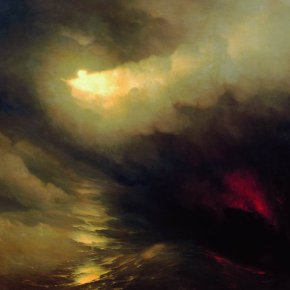
Art: Detail from “Creation of the World” by Ivan Aivazovsky, 1864

First Words

(Sermon for Sunday, October 16, 2011 || Proper 24A || 1 Thessalonians 1:1-10 )

Any spherical object! (that's me at age 2)

Did your parents ever tell you about the first word you ever spoke? More than likely, your first word was “Da,” which is short for, “Daddy, go get Mommy so I can have lunch.” Perhaps, your first word was “Ma,” though this is unlikely, considering the “M” sound is much more difficult to make than the “D” sound. Perhaps, your first word was “No,” which you probably heard your parents say many, many times when they asked each other if the other had slept last night. My first word was “ball.”  And thus began a lifetime of me kicking, catching, and throwing any spherical object I could get my hands on.

Christianity has some first words, as well; at least, they’re the first words that we still have a record of today. They aren’t as hesitant or half-formed as are the first words of infants. Rather, they spring from the pages of the New Testament with remarkable (even uncanny) clarity, vitality, and comprehensiveness. We heard these words a few minutes ago when we listened to the first ten verses of Paul’s First Letter to the Thessalonians.

Now, before we get to some of Christianity’s first words, we need to clear up one spot of potential confusion and talk for just a minute about the similarities between Thessalonica in 50 AD and the United States in 2011. First, the potential confusion.

If you pull up the Bible on your smartphone, you will notice two things: number 1, the New Testament begins with the Gospel according to Matthew; and number 2, Paul’s First Letter to the Thessalonians is actually eighth on Paul’s depth chart, not first. So how could these ten verses from First Thessalonians possibly be the oldest recorded words in Christian history?

For starters, the folks who put together the New Testament put the four accounts of the Gospel up front because the rest of the pieces didn’t make a lot of sense without first hearing the story of Jesus’ life, death, and resurrection. But the people who wrote the Gospel didn’t start doing so until probably 15 to 20 years after Paul wrote to the Thessalonians. As for Paul’s depth chart (and this is a little strange) – his letters are actually in order by length, from longest to shortest, and First Thessalonians is one of the shorter letters. But if the New Testament were ordered chronologically by when the texts were written, our reading from Paul today would be on Page 1. Okay, confusion averted? Great. Let’s keep going.

Our modern moment shares several things in common with mid-first century Thessalonica, the community to which Paul writes the first words of Christianity. Like the modern United States, Thessalonica was a diverse, cosmopolitan place, with a plurality of religions and cultures all rubbing shoulders. As the capital of the region of Macedonia, there were plenty of things to do, not unlike the glut of stimulation that assaults us at every turn. And the Thessalonians had not received the good news of Jesus Christ before Paul arrived, just as people in modern America have lost contact with this great story of the Gospel.

To these people in Thessalonica and to us here on the Interwebs, Paul sends these first words. He, of course, had no idea we would consider them the first words of Christianity, which lends a special kind of authenticity to his message. These are words written to people who hadn’t read Matthew, Mark, Luke, or John. These are words written to people who lived in a society that knew very little about this faith that Paul brought with him. As such, these are words that can serve us as we practice sharing our faith, as the Thessalonians did, with people outside the walls of this church.

In these first ten verses of the first text of Christianity, there are six words in particular that shimmer for me: grace, peace, faith, love, hope, and joy. Notice how Paul uses each of these special words: “Grace to you and peace,” he writes. “We always give thanks to God for all of you and mention you in our prayers, constantly remembering before our God and Father your work of faith and labor of love and steadfastness of hope in our Lord Jesus Christ…You became imitators of us and of the Lord, for in spite of persecution you received the word with joy inspired by the Holy Spirit.”

These words are special because each has a meaning outside the church and a greater meaning inside the church. The secular understanding of these words can give followers of Christ like you and me a place to establish common ground as we share with others how God is present in our lives.

Let’s quickly look at each of these words to see how we can expand the secular definition to fit into the greater reality of following Jesus Christ.

“Grace” is a perfectly lovely word. We use this word to describe ballet dancers because they move with poise and precision. They throw their bodies into the air trusting that they will land on their feet, and if they don’t they get back up quickly and keep dancing. How easily can we take this understanding of grace and elevate the grace of the dancer to the Grace of God, this grace that picks us up when we fall and teaches us to find beauty in everything.*

We hear the word “peace” when conflict ends and “peacekeepers” enter the recently warring region to monitor the new situation. We use this word to describe a calm ocean after a storm or an infant who has finally dropped off to sleep. We can expand this to the Peace of God, which takes situations of conflict and infuses them with possibilities for unity, justice, and new beginnings.

“Faith” is the trickiest word on this list because all human attempts at “faithfulness” fall short. We put our trust in banks, in governments, in products, in each other, and sooner or later we are always let down. But when we expand the definition of faith to include the Faith of God, we find the one example in all of creation that will never fail. How wonderful to tell someone about this kind of faith!

“Love” is tricky, too, because we use the word in so many different circumstances, from our shoes to our spouses. But when we find that most authentic use of the word, when the word “love” springs unbidden from our lips and doesn’t describe an emotion but a state of being, a state that we entered unwittingly and never want to leave – then we begin to see the edge of the extraordinary Love of God. And we can celebrate that love with each other.

“Hope” is about the future. All people have used this word to talk about what they dream for the days and years ahead. I hope to have children and to teach them to play soccer. These human hopes are safe hopes, the kind that we can see in our mind’s eye five or ten years down the road. This understanding of hope elevates to the Hope of God when God releases us from the boundaries of the merely possible and shows us the realms of glory that exist far beyond our sight. And then we have a greater hope in which our everyday hopes can dwell.

Finally, we talk about “joy” most often when we have “enjoyed” a dinner party or a new film or a ballgame. We mean that we had a good time and might want to come over again. What we don’t realize is that this “joy” we feel is more than happiness. The Joy of God is a feeling of wholeness, of completion that comes when we discover that we are exactly the people who God created us to be.

Each of these words, these first words that Paul used when he wrote to the Thessalonians makes sense outside the context of the Christian faith. But within the greater reality of following Jesus Christ, these words shimmer with new facets of meaning.

I invite you this week to take these first words of Paul and try them out for yourself. Pray with this question in your heart: how has God encountered you when you have had an experience of grace, peace, faith, love, hope, or joy? Then find someone from within your own faith community and try out these words. Practice sharing with one another before you go out and share your Christian life with those outside your church.

Like the first words of an infant, our first attempts in sharing the first words of our faith will be halting. They will be hesitant. They will be half-formed. But they will be ours. And God will take them, shape them, and elevate them into God’s own words.

Note

*I wrote “Grace…teaches us to find beauty in everything” and then realized that I stole those words from U2. Thanks, fellas.

To an Unknown God

(Sermon for Sunday, May 29, 2011 || Easter 6A || Acts 17:22-31)

I wonder what Paul was thinking as he walked the streets of Athens. I’m sure that the many-columned Parthenon was looking down on him from atop the Acropolis, as this temple of Athena had for nearly five hundred years. But no matter the goddess Athena’s appeal, down every street, Paul sees another crumbling monument to one deity or another. He studies them carefully. I imagine he finds statues of all the Greek gods and perhaps other ones from far off places, considering Athens’ booming tourism trade.

At one point on his walk, however, Paul comes across something he doesn’t expect. He stumbles upon an altar with an odd inscription: “To an unknown god.” Now, Paul is no stranger to being run out of town, but he is also never one to sit quietly in a corner and listen. So, after seeing the inscription, Paul stands up at a gathering of the local scholarly elite and proclaims to them just who this unknown God is.

God, he says, is not like the gods of these gold, silver, and stone monuments. God is Lord of heaven and earth. God isn’t bound to set roles like your local gods. God breathes life into all things. God doesn’t live in a special house somewhere. God is not far from each one of us everywhere. And yet, while Paul’s sermon is full of stirring and magnificent images of God, I can’t help but wonder if the phrase “unknown God” still applies more than any other.

Now, I’m going to warn you that we are about to wade into particularly deep and boggy theological waters. I confused myself thoroughly trying to write all of this down, so if your brain starts to hurt, you’re not alone. However, I have confidence that with some help from our friend C.S. Lewis and a stiff breeze from the Holy Spirit, whom Jesus talked about in today’s Gospel, we will all come out on the other side of the bog with our minds intact. Are you with me? Good.

The Mythbusters try to pull apart two interlocked phonebooks

So two extremes play tug-of-war with this concept of our “knowledge of God.” In the case of the first extreme, I claim to have captured God, strapped the Divine to the operating table, and figured out what makes God tick. When I’m done with the exploratory surgery, I stuff and mount God on the wall just like a prize twelve-point buck. With my experimentation complete, I know just what button to push to make God act in my favor, and oddly enough, God disagrees with all the same people I do. This is the extreme where I have God pegged. Now, you might have spotted the flaw in this point of view. (Remember – we’re talking about extremes, so flaws are more common out here.) The flaw here is, of course, the delusion that God is small or mundane enough for me to figure out what makes God tick.

The other extreme is, naturally, the complete opposite of the first. In the case of the second extreme, I claim to have absolutely no ability to comprehend a God who exists for eternity in infinity. When I try to get a handle on God, I am at a complete loss for words and I must conclude that God is so unsearchably unknowable that I might as well give up. I’m an amoeba trying to read Shakespeare. But I make peace with my teeny-tinyness, and I go about my day trying not to have delusions of grandeur, in which I might rise to a level of intelligence that allows me to comprehend even a shred of what God is about. Of course, there’s a flaw here, too. The flaw in this extreme is the faulty thinking that God is too big and majestic to bother with an amoeba like me, no matter the evidence that God has been surprising humanity for millennia by encounters with the Divine, including one in which God sent his only Son to be an amoeba like me.

Now, each of us exists somewhere along the spectrum between these two extremes. When I really need something to happen – to get a job or pass a test or receive successful treatment – I might trend toward the first extreme, in which God comes at my beck and call. When something really terrible happens in the world – a huge earthquake or massive flooding or a category five tornado – I might trend toward the second extreme, in which God may exist in the ether of eternity but surely can’t be bothered with things here on lil’ ol’ Earth.

Do you see what’s happening here? My experience of God changes depending on my needs in the moment. I slide along the spectrum between the two extremes. The unique mixture of my appetites, yearnings, successes, failures, doubt, and faith paints a picture of the God to whom I address my prayers. And whatever else that painting may be, there is one thing that the picture surely is not. And that is an accurate portrait of God. This is why I wonder if the phrase “unknown God” still applies more than any other.

Now, as I tried to wade out of my confusion while writing this sermon, two questions struck me after that whole bit about the extremes. They might be on your mind right now, as well. First, if the God I’m worshiping isn’t really God, but rather my conception of God, then what’s the good of praying? And second, if I’m not really worshiping God, doesn’t that make me an idolater? This is when we need to call in one of the heavyweights.

C.S. Lewis wrote an incredible poem called “A footnote to all prayers.” He begins:

He whom I bow to only knows to whom I bow
When I attempt the ineffable name, murmuring thou,
And dream of Pheidian fancies and embrace in heart
Symbols (I know) which cannot be the thing thou art.

These Pheidian fancies are works of the Greek sculptor Phidas, the very statues of gods and goddesses that Paul saw in Athens. Lewis knows that, even when he tries to call upon God, the best he can do is some symbol that could never do God justice. He continues:

Thus always, taken at their word, all prayers blaspheme
Worshipping with frail images a folk-lore dream,
And all men in their praying, self-deceived, address
The coinage of their own unquiet thoughts…

Lewis poetically describes the same predicament we were in a minute ago: in prayer, we address the gods of our own “unquiet” thoughts and thus we blaspheme. But the poem is only half over, for Lewis continues: [we blaspheme]

…unless
Thou in magnetic mercy to thyself divert
Our arrows, aimed unskillfully…

Even someone of C.S. Lewis’ verbal skill aims his prayer-arrows unskillfully, always at some conception of an “unknown” god than at the one, true God. But, in the end, our story isn’t really about you and me. Our story is always and forever about God working in, around, and through us, no matter how unknown God may be to us. And God’s story is all about God’s “magnetic mercy,” by which God pulls our prayers to God, even though we shoot them far wide of the target. Lewis concludes:

Take not, oh Lord, our literal sense. Lord, in thy great,
Unbroken speech our limping metaphor translate.

As we slide along the spectrum between the two faulty extremes of our conception of God, we can only speak in “limping metaphor.” But the true God, according to Lewis, speaks in “great, unbroken speech.” This is the speech that voiced light in the beginning and continues to sustain creation. This is the speech that speaks each one of us into being everyday, no matter the degree to which the speaker is unknown to us.

To tell you the truth, this unknown quality of God will be with us until God takes us fully into God’s glorious presence. Indeed, the unknown quality will keep us searching and reaching out and finding God in even the unlikeliest of places. And I believe that God redeems our lack of knowledge through God’s magnetic mercy. God translates our limping metaphor into the leaping speech of abundant life (even the words I’m speaking right now). Here’s the good news. In the end, our knowledge of God places a far distant second to God’s knowledge of us. As Paul says to the church in Corinth: someday “I will know fully, even as I have been fully known.”

Total loss

On Sunday, I was driving home from a soccer tournament — a bit worse for wear and sore, but in the good way. We were losing light quickly as the game drew to a close, and by the time I was on the road, dusk had suddenly become full darkness. The darkness didn’t bother me, because I’ve driven back and forth on Route 9 dozens of times since I moved to West Virginia. Every time, I lament the fact that the the DOT hasn’t finished the bypass (and probably never will). On Sunday, my lamentation was justified.

A tenth of a second before the deer hit my car, I saw it flash in the headlights. I heard the impact before I felt it — the sound of someone beating the dust out of an oriental rug, except the rug was metal. The deer collided with the front, left edge of the car, and the force of the impact pushed me off the road. Pumping the brake, I drove through several lawns before coming to a halt. The deer skidded off in the other direction — a rag doll carcass — and came to rest on the shoulder on the far side of the road.

A sheriff’s deputy, who happened to be driving by a minute after the collision, stopped to help me. The driver’s door would not open, so I crawled out the passenger’s side. I was limping, but, I assured the deputy, the limp was a preexisting condition from the soccer tournament. He walked around the car, shining his flashlight and making official sounding grunts. Another officer unceremoniously dragged the deer fully off the road and left it there. I called Triple-A. An hour and fifteen minutes after the collision, a tow truck driver loaded up the car and took me home. Country music played on his radio.

The next day, I called the claims representative. He read through the online report I had filed when I got home the night before. “There’s a better than good chance that this will be a total loss,” he said. A total loss, he explained, happens when the cost of repair outstrips the value of the vehicle. If a total loss is filed, I’ll never see the car again. The insurance company will send me a check, less my deductible. “So take all your stuff out of the car and remove the license plate just in case,” he advised. Apparently, most deer strikes end in total losses. I’ll find out in the next few days.

The phrase “total loss” keeps ringing in my mind. I can’t help but think of Paul’s writing to the Philippians: “Yet whatever gains I had, these I have come to regard as loss because of Christ. More than that, I regard everything as loss because of the surpassing value of knowing Christ Jesus my Lord” (3:7-8). Paul is talking about his position before becoming a follower of Christ. He was a Pharisee, blameless under the law, a prime specimen of the people of Israel. And he gave it all up when the scales fell from his eyes after being struck blind on the road to Damascus.

I regard everything as loss because of the surpassing value of knowing Christ Jesus my Lord. Notice the use of the word “regard.” The surpassing nature of Christ reorients Paul’s perception of himself and the world. Jesus changes Paul’s attitude and outlook, in order that Paul might not mistake the insignificant for the consequential. The world around Paul has not changed, but he no longer views it as he once did.

This reorientation is such a wonderful part of being a follower of Christ. If we keep our eyes and hearts open long enough, we might just notice Jesus pointing us towards the right path, the most effective service, the best attitude. On Sunday, as the car came to a rest and my heart kept right on beating down Route 9, I found myself unexpectedly overcome by my own reoriented spirit. I might have adopted a why me, God? attitude. I might have raised my fist and cursed God’s apparent punitive capriciousness. But, by the grace of God I didn’t. I closed my eyes and thanked God that I was not injured. I thanked God that no one else was involved in the collision. I thanked God for the presence of the deputy.

It is so difficult, in a world that stumbles over itself attempting to remind us of the scarcity that supposedly dominates our lives, to notice Jesus reorienting us towards the abundance that marks the truth of our existence. But the surpassing knowledge of Jesus Christ opens our eyes to the beauty of this abundance. Everything else is loss. Total loss.

Note: I’m still dealing with the fact that I killed a deer. I’ve never been hunting, never shot a gun, and I never want to. I am aware that, as part of humanity, I am responsible for the deaths of countless innocent animals. I’m not sure what to do with this greater context. But the immediate incident keeps replaying in my mind. It’s just different because there’s blood and fur on the mangled hood of my car It’s different because I saw the deer alive one split second and utterly dead the next. I keep seeing it out of the corner of my eye. I keep seeing it tumble away, limbs flailing without purpose, glinting in the glow of my smashed headlight.

Viral papyri (Bible study #10)

In the middle of the second century, a guy named Marcion took his Bible and tore out most of the Gospel according to Luke and some of Paul’s letters. He stapled these together and chucked the rest in the dumpster. Marcion had decided that the “god” who created the world was evil because the world sure wasn’t doing him any favors. The other god, the real “God,” was Lord of the “spirit world,” totally alien from our world, except for that thing about sending his son here. The trouble was, that’s not what the Bible said. So, Marcion, with a stockpile of misplaced entrepreneurial zeal, made up a new one.

Well…that’s not actually what happened. You see, the “New Testament” as we now have it wasn’t compiled yet. Christians and various derivative groups had been writing letters and gospels and stories and strange things called “apocalypses” for a hundred years. Some circulated widely, like the ancient equivalent of viral YouTube videos. Others stayed put in the community which produced them. Some were attributed to Jesus’ apostles or their associates. Others were written by that guy with the hair and the thing. Some espoused doctrine that both created and helped support the emerging theological position of the “Church.” Others claimed “secret knowledge,” known only to the few who could get into the metaphysical country club.

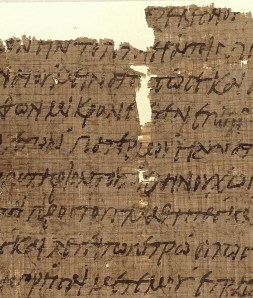
papyrusThe viral papyri attributed to an associate of Jesus and espousing sound theological views eventually became what we now call the “New Testament.” The other stuff — the classified documents, location-specific texts, and the ones written by that guy — predictably faded into obscurity.*


Okay, let’s go back to Marcion. Since there was no list (or “canon”) of authoritative texts, Marcion felt entitled to make one up that suited his own viewpoints. When he threw the Hebrew Scriptures and many of the viral papyri into the rubbish bin, the leaders of the Church said something to the effect of, “Hey, you can’t do that!” And Marcion shot back, “Too bad, suckers.”

At that point, those leaders decided that a list of their own would probably be a good idea. But, things moved slowly in the ancient world, so the top 27 texts were not finalized until the end of the fourth century (and even then, there was still some dispute between the Eastern and Western churches). But, I get ahead of myself. Let’s back up a bit.

With Marcion’s heresy forcing the Church to respond with its own canon of authoritative texts, scholars began compiling lists. Certain texts were shoe-ins. First and foremost, the Hebrew Scriptures (which became known as the “Old” Testament) were never in question because these texts were the Bible for the people who wrote the rest of the Bible. Second, the letters of Paul (the most virulent of all the viral papyri) and the three synoptic gospels, Matthew, Mark, and Luke, along with the Acts of the Apostles (which is sort of the Godfather II of Luke’s Gospel). The Gospel of John was on the bubble at times because some of the heretical groups loved it. But, it made the cut partly because its “high Christology” helped the Church’s position on the divinity of Christ.

Over time, the New Testament canon solidified with 27 texts.** The four accounts of the Gospel came first, as they narrated the reason why the rest of the texts exist. Then the Acts of the Apostles propels the canon into the letters of Paul (strangely enough, appearing in descending order by length). After Paul, Hebrews begins the section of various texts addressed to a wider audience (the “catholic” epistles). Appropriately, the Revelation to John ends the canon.

The compilation of the New Testament from viral papyri to authoritative text speaks to us today of the value of various viewpoints within a larger structure. Unlike Marcion, who depleted the message until it said only what he wanted it to say, the 27 canonical texts present myriad experiences that coalesce into the great message of the love and grace of God. From an early time, the Church valued several different expressions of the Gospel of Jesus Christ because it realized that one text could not contain such overwhelming truth and beauty. What is striking about the compilation of the canon is that the Church exhibited pretty startling ecumenism over a long period of time as the churches from both far-flung places and major cities shared their experience of the God made flesh in Jesus Christ.

I wonder when we Christians decided to stop valuing the experience of our fellows. The viral papyri tell a different story. Would that we could live that story again.

Footnotes

* Well, until a sensationalist media program digs up a “gnostic gospel” and decides that “everything we know about Christianity is about to change.” Honestly, give it a rest. That story lost the lead to the Battle of the Milvian Bridge.

** In the mid-1700s, an Italian named Ludovico Antonio Muratori stumbled upon an ancient fragment stuck in a book in a library in Milan. The “Muratorian fragment,” which could be dated anywhere from the second to the fourth centuries is the oldest extant list of the texts of the New Testament. What’s most interesting about the fragment is the short justifications it gives for why certain texts were either chosen or not.

Nets and new creations

(Sermon for January 25, 2009 || Epiphany 3, Year B, RCL || Mark 1:14-20)

In today’s Gospel, Jesus is out for a stroll along the shore of the Sea of Galilee. As he walks along, he notices the fishing boats tacking for deeper waters and trawling the shallows. He sees Simon and Andrew casting a net into the water. He sees James and John mending their nets in their boat. He calls out to them, “Follow me.” “And immediately,” says Mark, “they left their nets and followed him.” Immediately, they left their nets and followed him.

Now, I tend not to read the Bible metaphorically. Adding layers of interpretation to the words on the page usually serves to obfuscate rather than enlighten. This morning, however, I pray you indulge me one teeny-tiny metaphor. The four disciples Jesus calls in the Gospel leave their nets to follow him. They were fishermen, so working with nets came naturally to them. But, in landlocked West Virginia, we have little cause to handle fishing nets. So, I ask you, what are the “nets” to which we cling that prevent us from following Jesus? Put another way, what would be different about our lives if we left our nets and followed Jesus?

We could go into all the normal “nets” that ensnare us: grubbing for more stuff, distracting ourselves with the superficial glamour of the world, entering the wrong relationships. These certainly are nets, and they do trap us. But there is another, more insidious net that excels at holding us back from following Jesus.

This insidious net keeps us from practicing discipleship. The net entangles us when we confuse following Jesus with following the “idea of Jesus.” This is a strange turn of phrase, so let me unpack it. The “idea of Jesus” infiltrates our consciences when we forget that the events of the Gospel continue to play out today. The “idea of Jesus” disguises the person of the living Christ beneath layers of doctrine, history, and popular misconception, until he becomes a farcical shadow of himself, more akin to the Easter Bunny than the one true God. The “idea of Jesus” is so much easier to follow than the real Jesus because the “idea” makes far fewer demands on our lives and never asks us to become disciples. Dietrich Bonhoeffer says, “Discipleship is commitment to Christ. Because Christ exists, he must be followed. An idea about Christ, a doctrinal system, a general religious recognition of grace or forgiveness of sins does not require discipleship.”*

Think of it this way: A good portion of Americans love the “idea of soccer.”**  They love that there is a sport that the world plays together. They love seeing small foreign children running after a ball in the dust on TV. They love the big leg muscles and celebrity status of David Beckham. But very few Americans ever actually want to play soccer. There’s way too much running and way too little scoring for most of us.

In the same way, we often find ourselves taken with the “idea of Jesus.” There was once this cool guy who said some great stuff about love and acceptance. He collected a lot of enemies because he made friends with outsiders. He kept the wine flowing at this wild party. This “idea of Jesus” looks great on paper. But, like paper, the “idea” is flimsy and two-dimensional. The real Jesus, the living Christ, springs from the page, full of three-dimensional vigor, and he calls us to a life of true discipleship.

This is where the net comes in. If we are deluding ourselves into thinking we are following Jesus while we go about our lives as if nothing has or will change, then we are following the “idea of Jesus” instead. Following the Jesus who calls his disciples away from their nets necessitates change. Again, Bonhoeffer says, “Following Christ means taking certain steps. The first step, which responds to the call, separates the followers from their previous existence. A call to discipleship thus immediately creates a new situation. Staying in the old situation and following Christ mutually exclude each other.”**

We run back to our nets because this newness frightens us. When I moved to Alabama at age 12, no one could understand my thick Rhode Island accent, I called the water fountain a “bubbler,” a dusting of snow was a blizzard, the Red Sox weren’t on TV, and I didn’t know that saying “sir” and “ma’am” was integral to my survival. My life was different and uncomfortable and humid. I just wanted to go home. But, in the slow march of years, Alabama became home.

When we leave our nets and follow Jesus, we give up the trappings of the illusory homes we have built for ourselves. We step out of our comfort zones, and hopefully we never get too comfortable ever again. As we strive to follow Jesus, we may wonder why we never reach a new normal, why that initial feeling of discomfort persists. Then we realize that following Christ means continual renewal, constant reshaping. Paul says that if “anyone is in Christ, there is a new creation” (2 Cor. 5:17). As new creations, we are not new a single, solitary time, but every hour of every day. This newness keeps us from becoming complacent, keeps us from sitting in our boats as Jesus passes by. The discomfort propels us forward like dissonance in a Beethoven sonata. Indeed, a piece of music comprised of pleasing, consonant chords would be exceedingly boring. Likewise, following Jesus means dragging our comfort zones along behind us as we constantly step out of them.

Following Jesus is necessarily a nomadic existence. Our home is not a place, you see. Our home is a person. When we follow Jesus, we give up the trappings of our illusory homes for a true home by his side.

The flimsy “idea of Jesus” can only provide us a home built on the sand, which collapses whenever the winds and rains come. The “idea of Jesus” may bring us to church one day a week, but it will not instill in us the desire to seek Christ the other six. It will not demand that we encounter Christ in every person we meet. It will not motivate us to interrupt our net-mending to serve the poor or pray for guidance or praise God for the simple fact that we are marvelously made.

Because it makes no demands on us, the “idea of Jesus” causes us to mistake self-satisfaction for discipleship and comfort for salvation. But the real Jesus does not call us to be comfortable. He calls us to be free and invites us to use our freedom to choose a life of service in his name. If we do not actively seek to be Christ’s hands and feet in the world, if we do not take seriously our role as disciples, then we will be complicit in allowing our Lord and Savior to drift into the obscurity of legend or tall tale. As Søren Kierkegaard puts it, “Discipleship…really provides the guarantee that Christianity does not become poetry, mythology, and abstract idea.”****  Following Jesus means offering ourselves as conduits for turning the abstract into the concrete. Put another way, as the Letter of James says, “If a brother or sister is naked and lacks daily food, and one of you says to them, ‘Go in peace; keep warm and eat your fill,’ and yet you do not supply their bodily needs, what is the good of that?” (Jas. 2:15-16)

Jesus, the true Jesus, calls to us. He is not an idea or a design on a T-shirt or a cool guy who said some nice stuff once. Jesus, the living Christ, walks up to each one of us and invites us to a new life of hope and love and tears and pain and joy and freedom. He looks each one of us in the eye, says, “Follow me,” and radiates the abundant grace that allows us to do so. Join me in praying that each one of us will meet his gaze, leave our nets, and follow him.

Footnotes

* Bonhoeffer, Dietrich. Discipleship. Minneapolis: Fortress Press. 2001. p 59. (Italics mine)

** I borrowed this idea from the hilarious blog Stuff White People Like.

*** Ibid. 61-62

**** Ibid. 59 (in footnote)

Don’t just read it (Bible study #7)

If you take the vast sweep of Christian history into account, far fewer people have read the Bible than have heard it read. When the New Testament was still just a collection of letters and a few strange things called “Gospel” (say from about 50 to 325 CE), specially trained performers recited entire letters and books from memory during worship. In the middle ages, the majority of people never heard scripture read in a language they could understand and probably wouldn’t have recognized a book if it fell on them from a scriptorium window. Even as the Reformation gained steam and the printing press made vernacular versions of the Bible available, most people heard scripture, but never read it. The “family Bible” didn’t become fashionable until the 18th century, and even today churchgoers hear more scripture than they read (no matter the ubiquity of the Bible online and on store shelves).newsies

What’s this have to do with biblical interpretation? I’m glad you asked. The texts that make up the Bible were always meant to be read aloud. Acts 8 makes this quite clear: Philip approaches the Ethiopian eunuch and knows he’s reading the prophet Isaiah because he is reading out loud. To himself. Follow the eunuch’s example (no, not that example). Read your passage out loud. I know you are reading a translation, but the beauty and rhetorical power of the biblical text do not necessarily suffer in an English treatment. When you read aloud, you will notice oratorical patterns and cadences that the Biblical writers employed to make recitation easier and listening more captivating.

Try this one on for size: say the following two verses in your mind and then say them out loud. “For those whom he foreknew he also predestined to be conformed to the image of his Son, in order that he might be the firstborn within a large family. And those whom he predestined he also called; and those whom he called he also justified; and those whom he justified he also glorified” (Romans 8:29-30).

Notice the oratorical power in the repetitive cadence. This is called a “step argument”: each phrase builds on the previous one until the sentence climaxes on the word “glorified.” Paul obviously wrote this sentence to be spoken rather than read. So there’s no point in studying these verses as “written.”

Besides appreciating the oratorical flair of Biblical writers, reading aloud gives you the opportunity to engage the drama of the Bible. A good chunk of the text is narrative and a good chunk of the narrative is dialogue. Now, we have no audiovisual documentation of the conversations recorded in the narrative, so it falls to us to interpret how the dialogue sounds.

Let’s take Pilate’s response to Jesus as an example: “Jesus answered, ‘You say that I am a king. For this I was born, and for this I came into the world, to testify to the truth. Everyone who belongs to the truth listens to my voice.’ Pilate asked him, ‘What is truth?’ ” (John 18:37-38). How does Pilate say, “What is truth?” Is he angry? Is he skeptical? Is he desperate? Each of these readings offers a different insight into the mind of the Roman governor. If you take reading aloud seriously, the dialogue will force you to make interpretive choices of tone, emotion, and motive. I’m not going to lie. Practicing a text for performance is an awesome way to enter into an interpretive mindset.*

A trained musician may be able to “hear the music” when she looks at a score, but most of us cannot comprehend music’s beauty and power without hearing it played. Similarly, the Biblical text soars when it is read aloud. In Genesis, God speaks creation into being. When we read the Bible aloud, we access that creative voice within ourselves and use the breath and the bodies that God created.

So, read the Bible, yes. But don’t just read it. Speak it. And don’t just speak the Bible. Proclaim it.

Footnotes

* The next few posts on this blog will expand this discussion of exploring dialogue in the Bible by presenting a three part Midrash on Pilate’s statement “What is truth?” Stay tuned.

** I want to thank the writer of the first comment on this post. Reading scripture aloud during worship is the main way people are exposed to scripture. Knowing that, we’ve got to make sure our lectors are trained and know what they are reading ahead of time. Too often, (for various reasons) priests are running around five minutes before services looking for people to read. Reading scripture aloud is too important for that to be the norm.

Emptying

(Sermon for September 28, 2008 || Proper 21, Year A RCL || Philippians 2:1-13)

For the first several weeks after moving into my townhouse, about half my stuff littered the living room floor. I had put away my clothes and shelved my books. I had arranged my furniture and replaced the light bulbs with those curlicue ones. I had set up my TV and hung a handful of pictures. But this mass of extraneous stuff persisted. There were sealed boxes and boxes whose contents had thinned as I randomly put things away. But even these boxes lingered, some with single items remaining in their depths. Every time I came home I dodged the crate of office supplies, stepped over the plastic filing cabinet, and wished everything would gain just enough sentience to find a place to go that wasn’t the middle of my living room. The objects of my wish, of course, remained stubbornly inanimate.

The number of times I’ve moved has reached the double digits now, and I have discovered a universal law: for every five boxes you pack, one will remain unopened until your next move. These extra boxes are (a) shoved unceremoniously into the closet under the stairs or (b) stacked in the garage where the car should go or (c) pushed next to the couch with decorative afghans thrown over them and turned into end tables. Currently, my one-in-five-boxes, so recently cluttering my living room, are now lined up against the wall in the guest room awaiting their fate.

I have all this stuff. I can’t possibly need it all. I can’t possibly use it all — the nearly empty boxes, the still sealed boxes, the hanging bags, duffel bags, laundry bags, garbage bags, trunks, suitcases — not to mention all the stuff that used to be in these containers that I did unpack. Most of the stuff seems to exist simply to take up space.

So, when I read in today’s lesson from Philippians that the same mind that was in Christ Jesus should be in me, I find I’m in a bit of a bind. Paul praises Jesus for doing something that my accumulation of stubborn inanimate objects shows I’m unwilling to do. “Jesus,” says Paul, “who, though he was in the form of God, did not regard equality with God as something to be exploited, but emptied himself, taking the form of a slave, being born in human likeness.”

The Greek word translated “something to be exploited” might be better translated as “something to be grasped” or even “something to be hoarded.” Even though he was in the form of God, Jesus let go of his station. Even though he was part of all the might and majesty and magnificence of God, he did not hoard them. Even though he shared the most precious thing in the universe — equality with God — he shared himself with us by emptying himself. By taking on the form of a slave. By being born in human likeness.

Then he humbled himself, and became obedient to the point of death — even death on a cross. Then God exalted him and gave him the name that is above every name. All this happened because Jesus was willing to let go of his grasp on his divine form. All this happened because Jesus refused to hoard the incomprehensible harmony of light and love and grace that is our God. All this happened because Jesus emptied himself.

And I am supposed to have the same mind that was in Christ Jesus? Surely, Paul, you ask too much this time.

If I am unwilling to relinquish my stuff, even the stuff in the boxes that won’t see the light of day until I move again, how much more unwilling am I to empty my heart and mind of all the stuff that diverts me from following the Lord. Indeed, the boxes and bags and furniture function merely as physical reminders for all the clutter encumbering my soul. If one in five boxes remains unopened after a move, what percentage of my soul remains sealed off after moving through life? How much of my heart is unusable because of all the stuff piled so high? With my mind distracted by the detritus of the day, when will I have time to contemplate the works of God?

Where is this mind of Christ Jesus that neither grasps nor hoards, but seeks to empty? How do we obtain this mind? How do we grasp it? Right here. Right here is where the imitation of the mind of Christ begins. We can’t obtain it. We can’t grasp it. We can only resonate with Jesus’ self-emptying by beginning to empty ourselves. We can only come to some lowly analog of the mind of Christ when our own minds let go of the persistent accumulation of distractions. This emptiness is unlike any other instance of emptiness out there. This is not the emptiness of a bare pantry or the emptiness of thirty miles after the fuel light comes on. This is expectant emptiness, purposeful emptiness, holy emptiness. This holy emptiness makes room for the grace of God to expand within us. Our internal houses, once the storage depots for the stuff of the world, transform into the sanctuaries they were always meant to be. The emptier we become, the greater is our opportunity to discover true fullness.

This wonderful paradox is at the heart of our life of faith. Paul says that God is at work in us, enabling us both to will and to work for God’s good pleasure. As we begin the slow process of self-emptying, we realize that God has been at work in us all along: rearranging our internal furniture, removing the clutter, and unsealing those parts of our souls we packed away. Truly, we’d never have been able to start emptying ourselves without God first tidying up the place. When we empty ourselves, we are ready to respond to God. We are eager to serve others. We are prepared to give of ourselves because we know the fullness of God expanding within us has no bounds.

I invite you to join me in an experiment this week. Each night before you go to sleep, focus your mind and heart in prayer. Identify something in your life that is taking up too much space within you, that is cluttering up your internal living room. Perhaps this something is trouble at work or doubt about your financial future or concern for a loved one. Give this something to God in prayer. Ask God to inhabit the space vacated by this offering. Do this every night. Each time give something else to God. Allow more space for God to move in your life. Soon you will empty yourself of enough clutter to notice that God has been at work in you all along, enabling you both to will and to work for God’s good pleasure. Thanks be to God.

For once I didn’t disengage

Detachment. Recently, I’ve been giving in to the feelings of this my most famous and well-documented coping mechanism. Friends will tell you that I barely left my room during my second year of seminary except to go to classes and meals. Some days were better than others. I could stomach watching a football game in the common room or going to a birthday dinner at the Mexican restaurant. But on the worst nights — ones in which I had been invited out and had even made a vague commitment to going — I got dressed in going out clothes, laced up my going out shoes, paced the room, argued with myself, grasped the door handle half a dozen times, manufactured some phantom nausea, and put my pajamas back on. I hated myself for those nights. Back then I was coping with the loss of a long-term relationship; I dealt with the decoupling by detaching myself from everyone else, too. I know — not the healthiest of coping mechanisms. Indeed, I needed a coping mechanism for my coping mechanism. But more on that in a moment.

Before you start calling in a crack squad of psychotherapists, this recent bout with detachment is nowhere near as severe. Like Spinal Tap’s amps, the detachment a few years ago went up to eleven. This time, the severity is at about a two or three. But enough of the shadow of that previous time hovers in my memory, making me all too aware of the dangers of detachment. Back then, a loss of relationship made me pull away. Ironically, a similar set of responses is happening as I form new relationships at my new parish. Of course, with the new relationships come the ending or transforming of other relationships. Suffice to say, the constellation of relationships in my night sky is changing, and something in that change is causing me to fall back on my erstwhile coping mechanism.

Enter this week’s lesson from Paul’s letter to the church in Rome. Paul discusses various practices that some find objectionable and others find completely acceptable. Each group thinks they are the ones who are truly honoring God. Paul tells them that both sides are giving thanks to God by different actions, so neither has a right to pass judgment on the other. In this context, Paul writes a verse of surpassing beauty and profundity: “We do not live to ourselves, and we do not die to ourselves. If we live, we live to the Lord, and if we die, we die to the Lord; so then, whether we live or whether we die, we are the Lord’s.”

As I contemplate my recent relapse into old patterns of detachment, I realize that these words have been with me from my first week at my new parish. Since the beginning of August, I have been a part of three memorial services — liturgies during which people come together to mourn and laugh and grieve and celebrate the life of a loved one who has died, and in so doing, celebrate the resurrection of Jesus Christ. At the beginning of each service, the priest intoned these same words from Paul’s letter to the Romans. Each time I heard these words in the last month, I got that spine-tingling feeling that happens when God drops an ice cube down your back to remind you that God’s still there.

These words of Paul speak the beautiful and profound truth that we belong to God, or as the Episcopal burial office puts it: “We are the Lord’s possession.” This reminds me that however much I may feel the need to detach, to disentangle myself from life or friends or responsibilty, God never severs the relationship with me. Hearing Paul’s words during those special memorial services kept me from disengaging in the midst of all the changes and chances my life had been through in recent months.

This is why “church” is so important. In the context of the community of faith, the Lord spoke words of renewed invitation to me. I’m sure you’ve heard the popular epithet that describes someone as “spiritual, but not religious.” I think I understand some of the cultural and sociological forces that have contributed to the emergence of this category. One of these forces, sadly, is a misunderstanding on the societal level of what “religion” means. In the modern era, the terms “religion” and “church” took on the connotation of “edifice” — of imposing structure and immutable establishment.

But “church” has very little to do with a building and much to do with a people gathered. While structure and doctrine have their necessity, “religion” does not mean structure and doctrine. When you get right down to it, “religion” means “reconnection.” Re-ligio. Just look at the word and think of all the football players (most recently Tom Brady of my beloved Patriots) who have had surgery for torn ACLs.  An ACL tear is repaired by reconnecting the torn ligaments to the muscle and bones of the knee. Likewise, “religion” is all about reconnecting us to the One who holds us all in possession. And “church” is all about celebrating that reconnection with one another.

The musical Rent offers a stark view of the reality of our society and shows the utter need for these resources of connection and relationship. Near the end of the show, after the characters have dispersed and gone their separate ways, Roger and Mark sing about that special Christmas Eve last year when their group of friends came together to celebrate life and love. They sing: “What was it about that night? Connection in an isolating age. For once the shadows gave way to light. For once I didn’t disengage.” Opening themselves up to that connection with others leads them to joy and pain and life and death and the grittiness of a love that has survived all the assassination attempts by the forces of isolation.

When I begin to let myself detach from those around me, I must remember that God has already repaired the torn ligament and banished the shadows of isolation. I am the Lord’s possession. I am the Lord’s when I die. And I am the Lord’s while I live. I just need to make sure I’m living while I am alive, to make sure that I stay connected to those around me and celebrate the love of the God who knits us all together.

A living sacrifice

Paul says to the church in Rome: “I appeal to you, therefore, brothers and sisters, by the mercies of God, to present your bodies as a living sacrifice, holy and acceptable to God, which is your spiritual worship. Do not be conformed to this world, but be transformed by the renewing of your minds, so that you may discern what is the will of God—what is good and acceptable and perfect.” These two sentences are so packed with key words that we can’t possibly take them all in at one go. I’m going to talk about four of them: bodies, living, sacrifice, and transform. We’ll start with “bodies.”

One of the great heresies that the early church battled stated that Jesus Christ wasn’t really human, wasn’t really flesh and blood. He didn’t really suffer and die. He just appeared to be flesh. He just appeared to suffer and die. He was a spirit or a ghost, not a person like you or me. A modern day expression of this heresy might say Jesus was a divine holographic projection.

You can see the problem here. We are an Incarnational people, meaning we believe that God makes God known in all the beauty and particularity of creation. This includes us, in our embodied, fleshy selves. And this especially includes Jesus, who took on the fleshiness and particularity of humanity in order to bring us back into a right relationship with God. The theologian Irenaeus frequently wrote against these heretics. He summed up his arguments with this theological zinger, “Jesus became like us to make us like him.” We aren’t divine holographic projections. We have bodies— hairy, ungainly, perspiring, cellulite-padded, beautiful bodies. And Jesus became one of those bodies to show us how to use them in the love and service of God.

Paul appeals to the Romans and to us to present these bodies to God as a “living sacrifice.” This phrase is, of course, an oxymoron. In the Jewish tradition, in which Paul and the rest the New Testament writers were raised, sacrifice was an indispensable part of the worship of God. And an indispensable part of sacrifice was killing the animal being offered. You couldn’t get at the blood to dash against the altar without the unfortunate byproduct of a dead sheep or goat or bull. The sacrifice (however bloody and gory to modern Western eyes) was one way Israel affirmed and strengthened its relationship with God. Paul grabs onto this effect of sacrifice—this affirmation and strengthening—while dispensing with the business about dead animals. And for good reason. Earlier in his Letter to the Romans, he says: “We have been buried with [Christ] by baptism into death, so that, just as Christ was raised from the dead by the glory of the Father, so we too might walk in newness of life” (6:4). We have already passed through death, says Paul; therefore, if we are going to be a sacrifice, we must be a living one.

Being a living sacrifice means using those bodies of ours for action. We are built to move and run and hold and high-five and embrace and serve. I love the Olympic games because they showcase some of the amazing things we can do with the bodies God has given us: a smiling wide-eyed teenager flipping and spinning in the air; a sprinter running faster than anyone ever has. Look at Michael Phelps if you need some proof. I mean, really. Of course, we don’t need his 93 abdominal muscles to be a living sacrifice. What we need is a desire to serve. When we present our bodies as a living sacrifice to God we offer back to God all the good gifts God has bestowed upon us. We ask God how we can use these gifts to serve in our community and in the world. We listen for that still, small voice calling us to a ministry, a ministry which matches our deep gladness with the world’s deep hunger.*  And then we act, asking God to make our bodies into vessels of God’s light bound for a darkened world.

This darkened world asks us for our conformity to its misplaced values and desolating agendas. But conformity with these values and agendas leads to the deformity of our actions as God’s living sacrifice. Paul says, “Do not be conformed to this world, but be transformed by the renewing of your minds, so that you may discern what is the will of God.” We make mistakes. We sin. We put lesser things in God’s place. But Paul knows this doesn’t have to be the whole story: be transformed, he says. Allow change and grow. Remember that we are a living sacrifice, and living things continue to renew, to grow new skin, to flower again next year. Our transformation takes place in the renewing of our minds, in the reorienting of our priorities so they resonate with the will of God. The transformation is possible because we are living. The transformation happens when we realize we are a sacrifice. And the transformation affects the world when we present our bodies to God for action.

Now, that old nagging, itchy feeling crops up. “I’m just one person and this all seems so big—what can I do?” We are all individuals, that’s true—remember the beautiful particularity of the Incarnation—but there is a vast chasm of difference between being an individual and being just one person. None of us is just one person. None of us is alone. C.S. Lewis says, “[Human beings] look separate because you see them walking about separately…If you could see humanity spread out in time, as God sees it, it would not look like a lot of separate things dotted about. It would look like one single growing thing—rather like a very complicated tree. Every individual would appear connected with every other.”**

Notice that throughout this whole sermon, I have quoted Paul saying that we “present our bodies as a living sacrifice,” not living sacrifices. Paul is not botching his grammar here. Paul intentionally says that we are a singular living sacrifice, meaning we present our bodies collectively to God. Paul continues: “For as in one body we have many members, and not all the members have the same function, so we, who are many, are one body in Christ, and individually we are members one of another” (12:4-5). In the one body of Christ, our individual identities and personalities and gifts find their most perfect expressions. The living sacrifice happens when we affirm and strengthen our relationship with God by sharing our gifts with one another. When the collective body galvanizes into action to do the work of God in the world, transformation and renewal have already begun.

So, “Present your bodies as a living sacrifice, holy and acceptable to God.” Whether you have 4% body fat or a couple of replacement hips, remember that each of our bodies is built for action, for service, for love. Each of our bodies is designed to fit into the one body of Christ. And this body is alive. This body of Christ knits us together as a living sacrifice, offered up to God to bring transformation to the world.

(Sermon for August 24, 2008 || Proper 16, Year A RCL || Romans 12:1-8 )

Footnotes

* Frederick Buechner, Wishful Thinking

** C.S. Lewis, Mere Christianity