

Sermon for Sunday, October 26, 2014 || Proper 25A || Matthew 22:34-46
 English is a strange language. We have thousands upon thousands of words – more than most languages – and more get added every year. And still there are plenty of instances in the English language where we employ the same word to speak about multiple concepts. I can’t bear to be in the same room as him. The apple trees are about to bear fruit. Yikes, there’s a bear in our campsite! Now bear with me. This idiosyncrasy of English often leads to confusion, especially among non-native speakers. What’s worse is that it can also lead to a concept being watered down, diluted when the various understandings of the word start to merge.
Such is the case with the English word “love.” We use the word “love” in so many contexts and in so many ways that we hardly know what the word means anymore. When I say, “I love you,” to my wife, I mean something wildly different than when I say, “I love that movie!” And yet, I use the same verb in both sentences.
So when Jesus answers the lawyer’s question about the greatest commandment, we find ourselves in a bind. Jesus chooses two commandments and both begin with the imperative to “love.” Love the Lord your God with all your heart, and with all your soul, and with all your mind. Love your neighbor as yourself. How we go about living into these commandments has everything to do with what we think “love” means.
But before we go there, I find myself needing to scratch my Greek itch, as it has been months since I talked about Greek words in a sermon. So, if you’ll indulge me for a minute. While the English language has thousands upon thousands more words in it than ancient Greek, the Greeks of the first century had at least four different words that we translate as “love.” First, there’s eros, which is the love of attraction and desire. We get the word “erotic” from it. Then there’s philia, which is the love expressed in comradeship. A city in Pennsylvania bears this word in its name: Philadelphia. Then there’s sturgia, which is the love of a homeland as expressed in patriotism. And finally there’s agape, which is the love we’ll spend the rest of this sermon defining. This last word for “love” is the one Jesus uses in his answer to the lawyer’s question. And this last word for “love” inspires our fulfillment of Jesus’ two great commandments: Love God with all that you are and love your neighbor as yourself.
Because of the diluted nature of the word “love” in English, we might find it difficult to obey Jesus’ command to love. We might protest: “I can’t decide whom I love and whom I don’t. How can I help feeling the way I do?” The first problem we run into, then, is defining love primarily as an emotion. We get into trouble when we think of “loving” as a more intense version of “liking.” We all fall victim to this line of thought sooner or later, usually for the first time in high school. “Well, I like her but I don’t love her.” Or perhaps, “I like this top but I love those shoes.” When we mistake “love” for “liking a lot” we remove nearly all of the weight of the word, as Jesus uses it. Indeed, the Gospel according to John tells us that God so loved the world that he sent his only begotten Son. If God only “liked the world a whole lot,” I don’t know where we’d be.
When we move past this high school version of love, we find the deeper territory that our last word for love – agape – exists in. Far from being a simple emotion, love opens the door to the whole universe of emotion. Because God loves each of us, we each have the ability to love in turn. Shutting the door to love means shutting the door to the entire emotional realm and replacing it with indifference and isolation. But God does not desire this for us. God desires us to open the door, the same door God opened when God sent the only begotten Son to this sin-soaked world.
When we love, we invest ourselves. We become vulnerable. We may be hurt. Or we may be filled with joy. The ability to love is the ability to look past yourself, to see the heart of God burning in the chest of another, reflecting the burning in your own heart. And to have that burning move you to trust, to connect, to sacrifice. This burning may or may not kindle affection within you – that is, the emotion of “liking a lot” – but you will be “loving” just the same.
So the love that Jesus commands us to show for God and neighbor begins, not with the emotion of “liking,” but with a posture of openness, selflessness, and vulnerability. This is a scary way to live because it means living without a mask and without the protective armor we so often don unconsciously. This unconscious armor implores us to keep our heads down, to disengage, to do everything we can not to be spotted.
Going back to examples from school, how many of us had the opportunity to help a kid who was being bullied, but chose not to; chose instead to hover in the back of the pack, not laughing and jeering like the others, but not standing with the victim either. This bully-victim model stretches from school into all facets of life where there are power differentials. If we take seriously Jesus’ command to love, we will always choose to stand with the victim, to risk being tarred and feathered, to risk coming to the cross.
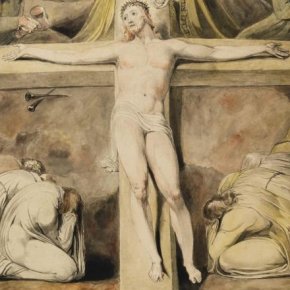
Yes, the kind of love Jesus commands us to live out is the very love that brought him to Golgotha. He could have sunk under the waves of uncertainty in the garden. He could have shrunk back into obscurity after causing a stir in Jerusalem. He could have slunk home, only to have his followers drift off in search of new messiahs. But love would not let him take that path. Out of love, he chose the path of selflessness and sacrifice. On the cross, naked, with his arms spread wide, the openness and vulnerability of love was exposed. But only with his arms spread wide could he reach out and touch everyone with his loving embrace.
The last word for love – agape – is not an emotion. This love is a state of being. This love is the word we use for the voluntary conviction that propels us to step outside of our selfish selves and to discover the riches of building up one another, of finding mutuality, of respecting difference, of speaking out against intolerance and hate, of standing with the victim until enough of us do to remove the label of victim forever.
This is the kind of love Jesus commands us to live. This is the kind of love Jesus died to express. And this is the kind of love that rose with him from the dead. You see, the love that Jesus commands us to live does not turn us into victims, although that’s what we’ve learned from years of wearing our unconscious protective armor. Rather, the love Jesus commands us to live moves us with him through death to resurrection. As we walk this road, Jesus strengthens us to live like he died: shed of our protective armor, with arms spread wide, ready to embrace the victims of this sin-soaked world and walk hand in hand toward the coming kingdom of God.

 If you’ve spent any length of time in the Episcopal Church, you know the sermon comes after the Gospel reading. But because of the nature of our Gospel reading today, I hope you will allow me to flip that convention around. The Passion Gospel we will read in a few moments has the lyric substance of an epic poem; the depth of one of the works of a Russian master – Dostoyevsky, say; and the emotional weight of the entire book of Psalms: all in the space of an average magazine article. So rather than preaching after we listen to the performance of this momentous work of faith and story-telling, I thought I’d talk with you now, before we listen. I plan, in the next few minutes, to give you something of a listening guide: a few keys to listening faithfully, and a few things to listen for.
 “Be perfect, therefore, as your heavenly Father is perfect.” Sounds like a tall order, doesn’t it? Sounds like naïve idealism at worst and hopeless hyperbole at best. Sounds like one more command of Jesus that we could never live up to. I mean, it’s hard enough turning the other cheek and walking the extra mile and loving our enemies, but now he wants us to be perfect on top of all of that? Doesn’t he understand that to be perfect there could never have been a time when one wasn’t already perfect? Doesn’t he understand that one cannot become perfect? Either you are or you’re not…and we’re…not.
 But Jesus is only half done with Peter and with us, because Jesus takes this reconciliation one step further. Jesus doesn’t just heal Peter’s brokenness and leave it at that. If he had, then Peter would have no direction to travel, nowhere to bring his healed heart. So Jesus renews their relationship and then gives Peter a mission. “Do you love me?” Yes, Lord, you know that I love you. “Feed my lambs… Tend my sheep… Feed my sheep.”
 We got trouble. Right here in Corinth. With a capital “T” and that rhymes with “P” and that stands for “pool.” Wait a sec. That’s the trouble in River City in The Music Man. Let me try again. We got trouble. Right here in Corinth. With a capital “T” and that rhymes with “G” and that stands for “gifts.” Spiritual gifts, that is. And while the con artist Harold Hill makes up the trouble in River City in order to sell marching band instruments, the Apostle Paul is intensely earnest in his diagnosis of the trouble in Corinth. The trouble in Corinth was certainly Trouble with a capital “T.”
 Last Monday evening, I sat down to watch a very entertaining football game. Now, I know up here is Pats’ country, so many of you probably didn’t even realize the college football championship game was going on. But I grew up in Tuscaloosa, Alabama, so I was ready for my Crimson Tide to take it to the Notre Dame Fighting Irish. (Which they did, by the way.) Because I was watching a live sporting event, I didn’t have the opportunity to fast forward through the commercials. One commercial aired several times, and I became more and more uncomfortable every time I watched it.

 Where the Wind...