
(Sermon for Sunday, September 1, 2013 || Proper 17C || Hebrews 13:1-8, 15-16)
Stories are powerful things. Sharing stories helps us make meaning, pass on tradition, teach lessons, deepen relationships, learn from one another’s experience, and grow closer to God. You may have read in the Carillon that this year at St. Stephen’s we are going to practice sharing our stories, so I thought I’d get a jump start – a sneak preview, if you will – during this sermon. I’d like to share with you three stories, all sparked by a single verse from today’s reading from the Letter to the Hebrews. I’d like to share with you a story about Jesus Christ yesterday, a story about Jesus Christ today, and a story about Jesus Christ forever. Each of these stories is about Jesus and about me, and if I do my job right, each will also be about you.
We’ll start with Jesus Christ “yesterday,” and we’ll start as many Godly Play stories do. Once there was someone who said such amazing things and did such wonderful things that people followed him. This someone was called Jesus of Nazareth, and he came from seemingly humble beginnings, though his mother knew better. At his birth a disreputable cadre of outcasts claimed him as their savior, and that’s what he was. His very name means “God saves.” When he grew up he left his mother’s house as sons often do, but that was perhaps the last normal thing he ever did.
“Change your hearts and your lives,” he preached to any who would listen. “Because the kingdom of God is so close you can taste it.” This was his good news, his Gospel. But that was not all. Every day he revealed what it was like to live in God’s kingdom, God’s dream for all creation. He healed those who were sick and those who couldn’t walk or see. He renewed the broken to wholeness, he gave hope to the despairing, and he welcomed everyone, especially those no one else would bother with, to his table. His words provoked peace, joy, and courage in some, but, sadly, malice in others.
Jesus told his friends to love and serve others, come what may. He stood against the machinery of the world that enslaves people with false promises and misplaced priorities. He desired with every fiber of his being to replace the machine with a life lived fully in God, a life of blessing and abundance derived from God’s promises, God’s priorities. In the end, the machinery of the world felt threatened by this man, who was also so much more than a man. And for good reason. He was a threat. By putting Jesus to death – and a shameful death at that – the machine thought it had won. But on the cross, Jesus gathered to himself all the brokenness the world wrought, all that separates us from God – sin, shame, guilt, death – and their power died with him.
This is the story of Jesus Christ yesterday. When I read this story in the Gospel, I feel his words penetrate my skin. They delve into my heart and take up residence, and they urge me to live the life Jesus invited his followers to live. As I read Jesus’ story, I long to make it my story. And this is where the story of Jesus Christ “today” begins.
Three days after Jesus died, he rose again. Before dawn that Sunday morning, God the Father returned God the Son to us, resurrected as Jesus himself, yet more than himself. He couldn’t bear to break the promise to be with us always to the end of the ages, so he conquered death itself in order to stay in relationship with us into eternity. He breathed the peace of his Holy Spirit onto his friends, and we are still breathing those breaths even today.
We are still breathing those breaths not just because the two thousand year old air still remains, but because Jesus’ resurrection has no use for the concept of time. While we mark that Sunday morning as the hinge of history, the resurrection did not happen just on that one morning in that one garden. The power of the resurrection emanates out from that moment into every moment, filling all moments with the possibility of entering fully into God’s eternal presence. Jesus’ resurrection ushered in the deeper reality of God’s dream, a dream that each of us can participate in, a dream of bringing God’s reign into the hearts of all people and all people into the heart of God’s love. Jesus’ resurrection is happening now, today, in this place, in our hearts, at our table, in our service, in our love. When I remember the startling truth of this wonderful story, I take the time to look for signs of Jesus’ resurrection in my life. And I try to be a sign of that resurrection in the lives of others.
But there is still one more story, the story that undergirds all the others, the story of Jesus Christ forever. Our first story began with God the Son emptying himself, taking on the form of a human being, and becoming like us so we could become more like him. The Gospel writer John resorts to poetry to enter even the edge of the mystery of this emptying. The Word, says John, was in the beginning with God and was indeed God. This Word became flesh and dwelled among us and we have seen his glory, the glory of God spilling from the person known as Jesus of Nazareth.
But as the Word, he is forever. This Word is the order, the logic behind all of creation. “All things came into being through him,” John’s poem continues, “and without him not one thing came into being. What has come into being in him was life.” Whenever we look up and try to count the stars, whenever we appreciate the beauty and richness of evolving plants and animals, whenever we smell the coming rain, we encounter the artistry of the Word, the foundation of all things, visible and invisible. This eternal Word was in the beginning with God and abides with God and is God forever. This is the story upon which all others hang, and this is the story that Jesus invites us into. This is the story of God’s presence in and through creation.
This is my story. And this is your story. We read Jesus’ words. We feel them come alive in us through the power of the resurrection. We join God in the great story of bringing all God’s creation back to God. These stories are grand, and sometimes they seem so big and daunting that entering them feels impossible. But its in those moments when Jesus Christ – the same yesterday, today, and forever – takes us by the hand and reminds us that each normal day of our lives is part of the story whether we realize it or not. He takes us by the hand and invites us to follow one step behind him as he opens our eyes to all the ways we are already part of the story. And he takes us by the hand to guide us to all the new ways the story is still unfolding.





 To get to this unvarnished truth, we first have to understand how people in Jesus’ time would have heard the word “peace.” One version of the word was a simple greeting: “Shalom.” Another use was for the cessation of upheaval: “Peace, be still.” But a third use was more sinister – peace as propaganda. You’ve heard of the “Pax Romana,” the “Peace of Rome.” This was the glorious gift of Rome to the peoples fortunate enough to come under the Roman banner and Roman “protection.” Well, that’s how the Romans would have sold it. The Pax Romana really spread by the edge of the sword, and conquered peoples lived in fear and distrust of their occupiers.


 The smells of sweat and fried dough hung in the air, mixing with the burned oil of the tractor pull. He was sitting with hands clasped, wearing a plaid shirt with the sleeves rolled up and a challenge on his deeply lined, leathery face. She was standing, looking all the world like a Grant Wood painting, and thrusting matchbook-sized pamphlets into the hands of passersby. I walked by out of reach, but I couldn’t help looking at the booth, one of many at the county fair. “How sure are you of going to heaven? Are you 50% 75% 100% sure?” read the banner. My friend wondered aloud about how one arrives at a 75% surety of heaven. I chuckled, but I was unable to keep walking by the booth. On the table, a wooden contraption with three small doors read: “Do you know the three things God CANNOT do?”




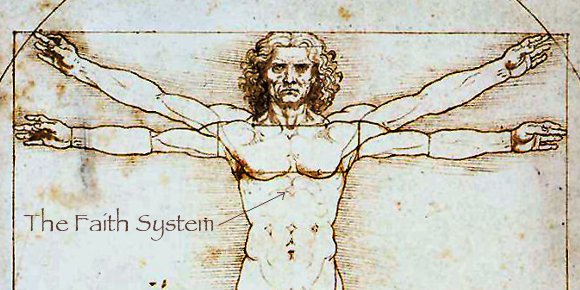
 Because of this difficulty, I’d like to invite you to imagine with me a reality that we don’t often think about. When God created animals, God gave us all sorts of biological systems that allow us to live. The respiratory system lets us breath, the circulatory system cycles our blood through our bodies, the digestive system turns food into nutrients. There’s the nervous system, the endocrine system, the lymphatic system and so on. But we were made in God’s image and likeness, which means we have one more system that other animals don’t have. We have a spiritual one to go along with all our biological ones. We have a faith system.
