

Sermon for Sunday, November 22, 2015 || Christ the King Year B || John 18:33-37
 I find it ironic that the framers of our lectionary chose the Gospel lesson I just read as the one for today. Today is the feast we call “Christ the King” or “Reign of Christ.” And yet, for the entire length of his conversation with Pontius Pilate, Jesus specifically dodges Pilate’s questions about his kingship. “Are you the king of the Jews?” Do you ask this on your own, or did others tell you about me? “So you are a king?” You say I am a king. But if Jesus is king of anything, if Jesus claims to reign over anything in this passage, his kingdom would not include land or crops or livestock or resources. His reign would be over “the truth.” For this I was born, and for this I came into the world, to testify to the truth.
A truth kingdom. I like the sound of that. Would that we lived in one of those. But for anyone who’s ever heard a joke about politicians, you know the punch line always involves untruthfulness of some sort. We might give them the benefit of the doubt and say they don’t out and out lie most of the time, but they are masters of prevarication, obfuscation, and equivocation, that’s for sure. We’re used to this behavior from our political leaders; so used to it, in fact, that when a politician stumbles into a genuine moment, we’re amazed and we start asking if it were staged.
In our Gospel passage today, Jesus seems to be engaging in just such an impressive display of political obfuscation. Perhaps he’s trying to meet Pilate where Pilate is. Perhaps Jesus is using Pilate’s own tactics to get through to him. Or perhaps Jesus is simply telling the truth, but we’re so used to prevarication that even the truth sounds false. If that’s the case, I’d like to try something this morning. I’d like to try to rehabilitate the truth simply by speaking Jesus’ truth to you. Truth has a special ring to it, and I hope you hear its crystal clarity this morning. There will be no prevarication or obfuscation. But there will be mystery; after all, the truth is too big for us to understand completely. Jesus says, “Everyone who belongs to the truth listens to my voice.” So close your eyes now and listen for Jesus’ invitation to you to enter his kingdom. Listen for Jesus’ truth.
Are you hungry for more? Not for more stuff, more possessions, more things to clutter your house. Not for prosperity at the sake of others’ poverty. Not for more empty calories, the white starch of idolatry and self-deceit. There are so many idols out there scheming to fill you up, but you’ll only be left craving. There’s so much fear to gorge on, but fear will just leave you hollow. Are you hungry for more? For more meaning? For deeper connection? For sustenance that truly sustains? Then listen to Jesus: “I am the bread of life. Whoever comes to me will never be hungry, and whoever believes in me will never be thirsty” (John 6:35).
But I still have dry times, Lord. I believe, but I still feel empty more often than I’d like. How can I trust your words when I feel like this?
I know how you feel, says Jesus. I felt desolate in the garden of Gethsemane. I felt abandoned on the cross. I know it can be so hard to hear my invitation when you feel lost in the desert. But I’ve been lost there, too. I’m lost there with you right now, so that you may be found. Listen again to my invitation: “Come to me, all you that are weary and are carrying heavy burdens, and I will give you rest” (Matthew 11:28).
The desert I can handle, Lord. At least it’s bright there. But sometimes I look out at the world and all I see is darkness. There’s so much darkness, and I’m afraid there’s a shadow growing over my soul, too.
One time, says Jesus, I was looking out over the city of Jerusalem, and the tears just started flowing. Another time, my beloved friend died, and all I could do was weep. I know what it means to be a light shining in the darkness: a flickering flame that might snuff out at any moment. But have you ever seen a ray of darkness? There’s no such thing. Have you ever seen the darkness of a hallway flood into a bright room when the door opens? No. The light wins every time. The light will always win. As for the shadow growing over your soul, make sure it listens to my words: “I am the light of the world. Whoever follows me will never walk in darkness but will have the light of life” (John 8:12).
The light of life, Lord? How could I ever be worthy of such a prize? I spend too much time in darkness to deserve the light of life.
Nonsense, says Jesus. Do you think anyone has ever been worthy of the gifts God gives them? Do you remember that story I told about the son who takes his inheritance and squanders it? He came home penniless and ashamed, and what did his father do? His father ran out to him! His father could not wait another second to rekindle their relationship even though the son didn’t deserve it. Don’t be paralyzed by unworthiness. My love makes you worthy of my love. So listen to my truth, “Remember, I am with you always, to the end of the age” (Matthew 28:20).
But it can’t be all about me, Lord, can it? You helped so many people in your life, but up to now I’ve just been concerned with myself? There’s got to be more.
Oh, there is more, says Jesus. So much more. When you realize I am with you, you’ll also realize I’m with everyone else. And with that realization will come the desire to serve others as you serve me, especially those who are poor and lost, those who are my special project. You’ll find joy in feeding the hungry and giving drink to the thirsty. You’ll find joy in welcoming the stranger. You’ll find joy in clothing the naked and visiting the sick and imprisoned. Do you want to know the truth? Listen to this: “Just as you [served] one of the least of these who are members of my family, you [served] me” (Matthew 25:40).
Okay, Lord, so I live my life serving others, being a light in the darkness, and finding refreshment in your arms. But I’m still going to die someday. And I’m afraid.
I understand, says Jesus. I was, too. I even prayed to be spared, to let the cup pass from me. I can’t promise you a life free of pain. I can’t promise you a death free of pain, either. But I can promise to be with you in the pain of life and death. If you love others as I love you, then pain is inevitable. But so is joy. In the end, there is nothing but love and joy. Or should I say the new beginning? Listen to my truth: “I am the resurrection and the life. Those who believe in me, even though they die, will live, and everyone who lives and believes in me will never die. Do you believe this?” (John 11:25-26)
Yes, Lord, I believe. Please help my unbelief.
A truer prayer has never been uttered, says Jesus. “Everyone who belongs to the truth listens to my voice.” So listen for my word in your life. Listen for my truth. Live my truth: For “if you continue in my word, you are truly my disciples; and you will know the truth, and the truth will set you free” (John 8:31-32).

 I’ve been preparing recently for Confirmation class, which begins later today. We have four tenth and eleventh graders and their sponsors ready to begin a five-month journey through their faith: learning, discussing, sharing stories. The next time the bishop visits, these four will have the opportunity to make a mature profession of faith if they so desire, and I am really excited to get to walk with them these next several months. Because I’ve had Confirmation on my mind, I’ve been thinking and rethinking some of the “nuts and bolts” of the way we express our faith as Episcopalians. Every once in a while, I like to preach on these “nuts and bolts” because in my job I get asked the same dozen or so questions about our practice all the time, and exploring such questions can help us all deepen our engagement in worship and in mission.
 Today’s sermon is about practicality and belief. I don’t have time for a fancy intro about when I was in fourth grade or about how something my children did reminded me of the Gospel. We’ve got too much to do in this All Saints’ Day service for that – most importantly, getting to the baptism, which is up next. Since today’s sermon is in part about practicality, I thought I’d be practical in my time-management and just skip the intro. So to reiterate, today’s sermon is about practicality and belief.
 Imagine with me the beggar Bartimaeus. He is remembering the fateful day when a large crowd passed his perch beside the road from Jericho. It started like every other day, with a certain memory dancing before his sightless eyes.

 Jesus feels drawn to the man kneeling in front of him. His heart is warmed, and he feels the stirrings of love and compassion for this frightened soul in the midst of an existential crisis. Perhaps the man recently had a parent or friend die, or perhaps he himself had experienced an accident or illness that brought death near. Whatever the trigger, the man comes to Jesus with a serious question that has obviously been plaguing him because of some unspoken dread roiling within him.
 “Those whom God has joined together let no one put asunder.” By the end of this year, I will have said these words eleven times after hearing the marriage vows of eleven couples. Jesus says these words in today’s Gospel lesson. And he says many other words about marriage and divorce, about fidelity and desire, and about relationships with the most vulnerable. Beneath these words, no matter how hard they are to hear or to speak, beneath these words shimmers Jesus’ surpassing dream for all creation – that none of us and no part of that creation will ever truly be alone.
 Every day of my fourth grade year, my class lined up at the end of recess to go back inside. The bell rang, and we raced to our spots in the line. But the race was in vain because no matter who arrived at the door first, we always lined up alphabetically by last name. By last name. What I wouldn’t have given to line up by first name. Then (Oh happy day!) I would have been at the very front of the line. No Aarons or Abigails in my class. No. Adam would have been the first name on the list. But those days were cruel. Every morning, I stood on tiptoes to see over the twenty-three heads in front of me, and only one boy – Shane Yellin – was worse off than I.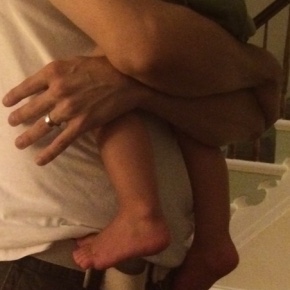
 This week has been a particularly tough one for our twins, Charlie and Amelia. At thirteen and a half months, we think they are cutting their molars, so their extreme fussiness is understandable. On Tuesday, I walked in the door of the kitchen, and before I had taken three steps, Charlie was toddling up to me as fast as his little legs and precarious balance would allow. He ran into me and buried his head between my knees, which is his way of saying, “Pick me up, Daddy.” I hefted him into my arms. He put his arms around my neck and his head on my shoulder. And for the next twenty minutes, I just walked around, holding him and speaking softly into his ear. It was a special moment, a physical heart to heart.
 You might be wondering if I accidentally read two weeks worth of Gospel lessons just now. The story of Jesus and the Syrophoenician woman ended satisfactorily, and at that point I could have said, “The Gospel of the Lord.” But the appointed lesson for today barrels forward into the next story, as well, and we read about Jesus healing a man who cannot hear and can hardly speak. We could focus on either half of this Gospel reading: there surely is enough in each to fill out a sermon. But today, I’m going to break a rule of preaching and bite off more verses than I normally do because I think the Gospel writer Mark places these two stories side-by-side for a reason. And this reason centers on the strangest word in the passage, a word that itself needs to be translated because Mark chose to preserve Jesus’ original language when he wrote it down. That word is “Ephphatha”: Be opened. Openness is the key to these two encounters. And openness is one of the keys to our lives as followers of Jesus Christ.
