God’s Glass

Sermon for Sunday, February 9, 2014 || Epiphany 5A || Isaiah 58:1-9a

Before I became a rector, I rarely had the opportunity to preach two sermons in a row. At my last church, my rector and I alternated, and we only got two in a row if the other was on vacation. So I’ve never really had much of a chance to preach a sequel to a sermon. But today, that’s exactly what I plan to do. So, just in case you weren’t here last week, let’s recap.

Previously on The Sermon at St. Mark’s, we listened in to Simeon’s lullaby as he held the infant Christ and named him the “light to enlighten the nations.” I invited you to join me in a mission: to bear witness to the light of Christ and to be vessels of that same light. To see the light and to be the light. We finished the sermon with three words to help us remember this mission: Christof’s command to “cue the sun” from the film The Truman Show.

We also went through a few small examples of what being the light might look like: being friendly in the grocery line, standing up for a victim of bullying, welcoming someone to church. Of course, I didn’t mean to diminish what it means to be the light of Christ by offering such small examples; rather, by the accumulation of small actions, we discover the light shining brighter around us and forth from us.

And here’s where, if this sermon were a television show, the screen would go black for a moment and we’d be in new territory. Is everyone with me? Great.

We’ll get back to those three small examples from last week in a bit, but first here’s the opening action sequence of the new episode to get everyone hooked.

GlassSo – did you know you are made of glass? It’s true! Now, of course, I don’t mean that you’re made of glass in the idiomatic way; it’s not that you’re easily offended or that your baseball career was cut short because you have a “glass arm.” Nor do I mean made from actual glass that once was sand.

Those caveats aside, you and I are made of glass. God spun the molten glass onto that hollow rod and blew, shaped, and molded each us into being. If somehow you were to scour clean all the layers of accumulated grime – all our misplaced priorities, all our missed chances, all our grubbing and selfishness – then you would uncover God’s glass. Indeed, each of us is transparent beneath the grime of everything that separates us from God (which, by the way, is another way to say “sin”).

With God’s help, we can scour clean some of that grime to come closer to being the transparent people God always envisioned, people who are windows through which the light of God shines. First, we need to celebrate the beautiful truth that we are, in fact, God’s glass; that we are, in fact, the vessels of God’s light we mentioned last week; that we are, in fact, the light of the world, as Jesus claims in today’s Gospel reading.

Second, we acknowledge that our glass is covered in grime. It has lost much of its transparency. The light is shining, but the window is obstructed. We cause some of this grime through our actions and inactions. Some of the grime accumulates simply because we are mindlessly complicit in the big and little sins of the world. The rest happens due to apathy, lethargy, and complacency; we haven’t cleaned in a while, so the window gets dirty.

So first we celebrate that we are God’s glass and then we confess that we do not emit nearly as much light as we are designed to do. Third, we participate with God in the act of scouring. This calls for attention, dedication, and practice – not to mention elbow grease. But I assure you there is no greater goal in this life than to be a window through which God’s glory shines. Truth, reconciliation, love, blessing – all the good things in this life and the next spring from this goal.

The prophet Isaiah knew this. He saw in today’s first reading an accumulation of grime due to a willful misinterpretation of the meaning of fasting. First he accuses his generation of going through the motions of fasting – the outward appearance that seems all well and good but is really covering up the light. His accusation comes in the form of several rhetorical questions, for which the silent answer is a resounding “NO!”

“Is such the fast that I choose,
a day to humble oneself?
Is it to bow down the head like a bulrush,
and to lie in sackcloth and ashes?
Will you call this a fast,
a day acceptable to the LORD?”

Notice that this certainly sounds like a textbook fast. I’m sure people in Isaiah’s day felt like they were on the right track with such outward signs. But Isaiah sees this as more grime accumulating, rather than more light shining. A fast, he says, should be a way to uncover the window beneath the grime. A fast, he says should look like this:

Is not this the fast that I choose:
to loose the bonds of injustice,
to undo the thongs of the yoke,
to let the oppressed go free…
Is it not to share your bread with the hungry,
and bring the homeless poor into your house;
when you see the naked, to cover them…

When we participate with God in this kind of life-affirming service, the grime wipes away and the window is revealed again. And, as Isaiah’s next words say:
“Then your light shall break forth like the dawn.”

We are God’s glass. We are covered with grime. But we have every opportunity to partner with God to scour away the grime and shine as God always intended us to do. Recall those three small examples we talked about last week: the grocery line, gym class, and church. Three small examples of partnering with God to shine as light in this dark world.

Let’s look at them again and give them a little more weight. The first was: “In the line at the grocery store when you choose not to be annoyed that the person ahead of you is taking too long.” It’s really just a minor inconvenience after all. Most of the things that send us towards negativity and broken relationships start as minor inconveniences. But by choosing not to be annoyed, by choosing instead to shine with God’s light and let the oh-so-tempting anger pass, we can allow God to turn inconvenience into blessing.

The second has happened every year since the invention of P.E.: “In gym class when you stand up for the kid who’s being laughed at because he can’t climb the rope.” Is this not a child’s first attempt at standing against oppression and injustice? Is this not an elementary school version of Isaiah’s true fast?

And the third, appropriate for this morning: “At church when you see a new face in your pew and you exchange a kind word of welcome.” I can’t think of a better way to be a window of God’s light than to cultivate a welcoming spirit, both here in the safety of our church home and out in the wilds of the world.

Turning inconvenience into blessing. Standing against oppression and injustice. Cultivating a welcoming spirit. These are merely three ways that we partner with God in scouring away the accumulated grime that keeps us from shining. And in so doing we help God’s kingdom shine even brighter here on earth. We can accomplish each of these ways and so many, many more in the small actions of the day and in the big events of our lives if we apply our attention, dedication, and elbow grease to the practice of being God’s glass.

So celebrate that we are, each of us, windows that God has designed to shine God’s light through. Confess that we do not emit nearly as much light as we are designed to do. And participate with God in the act of scouring, in the daily call to return to transparency. “Then,” as the prophet Isaiah says, “your light shall break forth like the dawn.”

*Art Credit: Kelly Cookson, commons.wikimedia.org

God’s Point of View

(Sermon for Sunday, November 10, 2013 || Proper 27C || Luke 20:27-38)

Today, I’d like to speak with you on a topic I’m entirely unqualified to talk about. No, it’s neither mortgage-backed securities nor the sport of cricket, though I’m definitely unqualified to talk about each. Nor is the topic the mysterious reasons for why my wife’s apple pie is so much more delicious than the ones I used to make. I know that one has something to do with butter, but that’s as far my understanding takes me. No, today I’d like to speak with you on a topic that no one besides Jesus has ever been qualified to talk about. I’d like to speak with you today about God’s point of view.

Because I’m unqualified to talk about this topic, you’ll have to take everything I say with a grain of salt. In the next few minutes I might say something that is true, but if I do, it will have been by accident because what I’m really going to do is talk about Adam’s point of view about God’s point of view. But maybe, just maybe, the Holy Spirit will help us glimpse the corner of the edge of the majesty of how God sees things.

So with those caveats aside, let’s listen in to the end of Jesus’ conversation with those wily Sadducees in today’s Gospel reading. They thought they could embarrass Jesus with a trick question, but in characteristic fashion, Jesus answers the question he wishes they had asked, not the one they’d actually asked. He finishes with these words: “The fact that the dead are raised Moses himself showed, in the story about the bush, where he speaks of the Lord as the God of Abraham, the God of Isaac, and the God of Jacob. Now he is God not of the dead, but of the living; for to him all of them are alive.”

Here Jesus references the third chapter of the book of Exodus, in which God says, “I am the God of your father, the God of Abraham…Isaac, and…Jacob.” Jesus notices that God doesn’t say, “I was the God of your father…” From our limited point of view, Abraham, Isaac, and Jacob are long dead – somewhere in the neighborhood of three thousand years ago, or about a thousand years in Jesus’ day. But God, says Jesus, sees things differently, as his emphatic end to the conversation demonstrates: “Now he is God not of the dead, but of the living; for to him all of them are alive.”

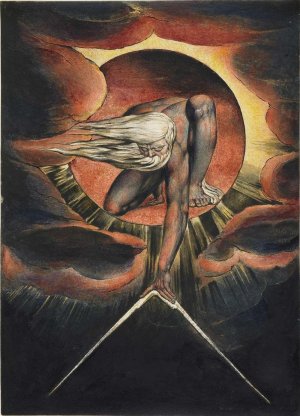
blakesGod
William Blake, Ancient of Days

This is our first glimpse into God’s point of view: “to God all of them are alive.” Can you imagine what that must be like for God? All of creation from the moment that moments began alive all at once. Every star that died billions of years ago, but whose light is just reaching us now; every single-celled organism gliding through the primordial ooze; every person we have ever loved and every person we have never known; all of them alive to God, all of it happening now for God.

I don’t know about you, but I get a little dizzy just trying to comprehend this thought – the riot of color and sound, the collision of what we see as the past and future, the unmeasured light years of space and uncounted eons of time all seen now by God, all spoken into being now by God, all loved and cherished now by God.

We can’t ever hope to comprehend this thought because we live our lives in linear fashion, moving moment to moment. We have memories of the past, and we have hopes for the future. Yesterday happened yesterday. It’s not still happening today. This linear model is like flipping through the pages of a magazine. Once I’ve flipped from page 35 to 36, I’m no longer looking at page 35. But from God’s point of view, the magazine is a collage of all the pages, with each picture cut out and arranged just so, like an elementary school art project.

This thought comforts me. From God’s point of view, I’m not simply Adam as I stand here before you: two months until his 31st birthday, his mother visiting from North Carolina, his sermon moving along apace. No. From God’s point of view, I am the totality of myself: everything that has ever happened, everything that will ever happen, every joy, every regret, every skinned knee, every embrace, every relationship, every failure, every triumph – everything that makes me the person I am, God sees and God speaks into being. This totality of myself includes my death and whatever there is in what we would call “After,” but what God still sees as “Now.”

The apostle Paul understands the difficulty of speaking about God’s point of view, and he says what I’m trying to say much better than I ever could. He says these words to the church in Corinth: “For now we see in a mirror, dimly, but then we will see face to face. Now I know only in part; then I will know fully, even as I have been fully known” (1 Cor. 13:12).

To be fully known. This is how God’s point of view works. God knows us fully. God knows the totality of each of us, just like God sees the entirety of creation happening now.

Speaking about God’s point of view has the unfortunate byproduct of making us feel so small, even insignificant. It’s only natural in the face of the idea that all of creation is always present to God to think that we don’t matter, that in the grand cosmic scale our lives are worthless.

But from God’s point of view, nothing could be farther from the truth. God couldn’t care less about the “grand cosmic scale” because the notion of a “scale” of any kind is meaningless to our eternal and infinite God. God speaks every subatomic particle into being and celebrates it as if it were the only speck in existence. Each speck has God’s full attention; if it didn’t, it would cease to be.

We may look up at the night sky and see ourselves as small, insignificant specks on a small, insignificant planet orbiting a small, insignificant star. But to do so is to deny the truth not just about ourselves, but about all of creation. All of creation is present to all of God. This includes you and me. If God weren’t constantly and continuously speaking each of us into existence, we would cease to be.

So if we are anywhere in the ballpark of the truth of God’s point of view, what does this all mean for us? Too many things, of course, to close this sermon with, so we’ll look at three – what we call past, present, and future, but each of which is always now to God.

First, the past and our grief over people dying: From our perspective, the sun sets below the horizon. But in reality, we are spinning away from the sun. Likewise, we grieve when someone dies because, from our perspective, that loved one is gone. But we know in a place deeper than normal knowing that, in reality, our loved one is still alive to God. Ultimately, grief is a way to express our frustration that we have a severely limited ability to perceive reality. But for anyone who has ever had a loved one die, you know that every now and again, you catch glimpses of true reality when you feel the presence of that loved one alive in a different way.

Second, the present: Since God is fully present to every particle of creation, which includes each of us, we have no business thinking of ourselves or anybody else as insignificant. Everyone matters, so we must affirm this in our actions.

Third, the future: Those we perceive as future generations are as alive to God as we are. Therefore, it is our duty to honor their significance in the same way we are called to honor those we meet today. This means making choices in our personal and communal lives that sustain our world, which, in the end, is another piece of creation fully present to God and therefore worthy of our honor.

So there you have it. I have now talked for more than ten minutes on a topic I’m entirely unqualified to speak about. However, being unqualified does not mean that we shouldn’t strive to see creation through the eyes of God. When we do this, we become better stewards, better servants, better followers. And we see deeper into the heart of what it means to be a child of God.

Epic Quest

(Sermon for Sunday, July 7, 2013 || Proper 9C || 2 Kings 5:1-14)

kingfisherNaaman, the central figure of today’s story from the Hebrew Scriptures, has superiority issues. And for good reason. He is, after all, the commander of the army of the King of Aram. He has the resources to travel with an entourage, not to mention bags and bags of precious gold and silver. He has the political clout to rate an audience with Israel’s king. And to top it off, Naaman has chariots! (No, seriously. The mention of chariots is a big deal. My Old Testament professor in seminary used to joke that Israel had “chariot-envy,” because it didn’t have any. So to mention this guy has chariots – watch out, he’s the real deal.)

So this Naaman is a big wig, the alpha dog; he’s large and in charge. And he knows he’s on top. We shouldn’t expect anything less, then, when Naaman explodes in a rage at the way Elisha the prophet treats him. He just saw the king, and now this lowly prophet won’t even come outside, but instead sends a messenger? To add insult to insult, the task Elisha gives him in order to clear up his skin condition is laughably small and easy – too small and easy, of course, for someone of Naaman’s stature.

Where’s the epic quest to pick the first bud of the first flower to bloom on the treacherous mountain peak a year’s journey to the west and then make a tea of its petals and drink and be cleansed? Where’s the command to chase after the last shooting star of the meteor shower and find its resting place far across the sea and melt down the metal to make a set of armor which, when worn, will rid the wearer’s skin of leprosy?

I’m sure Naaman expected this type of challenge when he went to see Elisha the prophet. Naaman’s superiority complex told him he was suited only for the most difficult and heroic of circumstances. His mission would, of course, match his own grandeur.

But he receives something wholly different than he expected. Elisha’s instructions invade the bubble of Naaman’s superiority and remind him he’s not quite as special as he thinks he is. Or perhaps, better yet, he’s not special for the reasons he thinks he is. Elisha gives Naaman quite an ordinary task to do. A small, easy task. Leave the mountaineering and meteor-seeking alone. Just go and wash in the closest river.

Thank God for Naaman’s servants. They have the measure of the situation and enough guts to set their commander straight. In the end, Naaman accomplishes the greatest task of all – he tames his own ego – and then he goes and washes in the Jordan. And he is made clean.

Naaman’s mistake is one of the most common mistakes we can make in our life of faith. It’s so common, in fact, that most of us probably don’t even recognize it as a mistake. Here’s what I mean. Naaman’s delusions of grandeur prompt him to expect an epic quest in order to be healed. Therefore, he is unprepared for the simple steps that will lead to his cleansing.

While Naaman might have been up for whatever challenge Elisha threw at him, when faced with the same prospect, I’d hazard most of us would rather just slink away. Indeed, many of us balk at connecting deeply with our own spiritual journeys because we see them as too difficult or arduous even to begin. We look out at the vast expanses of our lives, and we see the epic quest to follow God from now until eternity. The goal is so lofty, the mission so grand that instead we decide we haven’t faith or stamina enough to see it through. And so we never even try. We just roll over and hit snooze on our relationships with God.

But again, our mistake is the same as Naaman’s. We expect the grand and lofty lifelong challenge of following God, and so that’s what we see. What we miss is our version of Elisha’s instructions. Just go and wash in the river, he tells Naaman. Just take a deep breath and greet me in silent prayer, God whispers to us.

You see, we our mistaken when we look at our spiritual lives and see the whole long, arduous journey at once. Yes, the journey will be long. Yes, the journey will be arduous. Not to mention full of joy. But whatever the case, we don’t experience the journey as a whole. We live the epic quests of our lives with God one moment at a time, one step at a time, one prayer at a time, and that’s what we should concentrate on – the simple things we can commit to today and then commit to again tomorrow and the tomorrow after that. And so our epic quests to follow God grow slowly, imperceptibly, as we, moment by moment, choose our own versions of Elisha’s instructions to Naaman.

The brilliant writer Anne Lamott explains it all this way. (She’s talking about writing, but the point is the same.)

Thirty years ago my older brother, who was ten years old at the time, was trying to get a report on birds written that he’d had three months to write, which was due the next day. We were out at our family cabin in Bolinas, and he was at the kitchen table close to tears, surrounded by binder paper and pencils and unopened books on birds, immobilized by the hugeness of the task ahead. Then my father sat down beside him, put his arm around my brother’s shoulder, and said, “Bird by bird, buddy. Just take it bird by bird.” (Bird by Bird, p. 19)

The spiritual life is hard. But God doesn’t call us to live the spiritual life. God calls us to live the spiritual moment. Bird by bird, God whispers to us. Just take it bird by bird.

The True Self

(Sermon for Sunday, June 23, 2013 || Proper 7C || Luke 8:26-39)

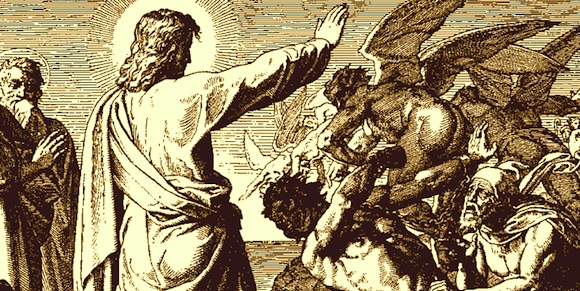
This sermon is about demons. I want you to know that before I get going because for a while it might not seem like I’m talking about demons at all. But I will be. If our real demons looked like the caricatured little red devils with horns, they’d be really easy to avoid. But real demons are much more subtle. So remember: this sermon is about demons.

GeraseneAround this time three years ago, I was sitting at Panera Bread working on some project or other. It was the most ordinary day imaginable – a little bit of rain pattering on the bushes outside, the normal bustle of Panera happening in the periphery of my headphoned consciousness. You’d think what happened next would have long since vanished from my memory because of its seeming insignificance. But as I was contemplating this sermon, the memory of that day at Panera started playing like a film in my head.

I was just sitting there drinking green tea, working on my computer, and listening to Beethoven’s piano sonatas. Then something pulled my attention. A young woman, whom I had idly noticed when I sat down and then promptly forgotten, was talking on her cell phone. Out of the corner of my eye, I watched the young woman’s brow crease. Her free hand went to her mouth. My internal pastoral alarm bells started blaring. The woman began to collapse inward. Here it comes, I thought.

“How long will it take me to get to the hospital from the airport?” Her voiced trembled as she asked the question, panic mixing with at least a veneer of bravery. She clung to her cell phone as if it were a flotation device.

I closed my eyes and tried to ignore the woman. She’s not one of mine, I thought. I’m not on duty right now. I’m not wearing the uniform today.

But even as these thoughts entered my mind, I felt the muscles in my arms and legs tense. My chest constricted. For a horrible moment, I felt myself unraveling. I was unmade. I was a traitor in my own body.

I know this seems like an overreaction or hyperbole employed for dramatic effect. But it is entirely accurate. So why would such a small event as me overhearing an anonymous woman in distress cause me to plummet into a moment of existential crisis?

Because I had a choice. I could ignore the woman in need or I could do something – anything – to help her. One of those choices would affirm the true self, the authentic person who God created me to be. And one wouldn’t. I chose the latter. When I chose to embrace the false self, the inauthentic person, I felt myself start to fray around the edges.

Have you ever felt like that? Have you ever felt yourself start to unravel, so to speak, because of a decision you made that runs counter to the person you know you are?

Perhaps you were in the cafeteria at school. You weren’t the bully or the bully’s target, but in the moment of decision you chose to laugh along with the rest of the onlookers as the victim was teased. And as you chuckled along, you noticed there was a hollowness in each of your laughs. But the hollowness wasn’t just in your laughs. You looked within and noticed a void, an emptiness, a lack of the self you knew to be true.

Perhaps you and your spouse got into an argument. It started over a perceived disparity in the household workload but pretty soon you were fighting just to fight. Then you chose to punch below the belt. A word escaped your lips – an expletive, a derogatory name that took all the light out of your spouse’s eyes. You grinned for a moment in triumph, but then as your spouse backed away and fled the room, you felt the light going out in your own eyes. You looked within and everything was darkness.

This is what it means to unravel, to fray at the edges, to be unmade, to be a traitor in your own body. When you make a decision that embraces the false self, the inauthentic person, you might be able to recognize your body in the mirror, but it won’t be you staring back.

Remember, I warned you this sermon is about demons. Have you seen them yet? No, probably not. You haven’t seen them because there’s nothing to see. But that’s precisely the point. The hollowness, the darkness – these tell us that demons have been by. We only ever notice them because of the absence they leave. We can choose the fullness of our true selves and the light of our authentic persons, but when we don’t, we unravel just a little bit more because that demonic absence is eating away at us and pulling us away from God.

The good news is that God doesn’t just sit idly by while we unravel. God is in the business of helping each and every one of us discover the true people God created us to be. When we live as our true selves, we are honoring the image and likeness of God within us. Just think how wonderful you feel when you make choices that affirm your authentic self. So full of light. So full of joy. You are at home in your body. You look in the mirror and see yourself smiling back. Far from an imposter, you are exactly the person you are supposed to be. You aren’t unraveling. You are whole.

In today’s Gospel lesson, Jesus engages in the ministry of helping us embrace our true and authentic selves. The Gerasene man hasn’t been himself in a long time. The demons have hollowed him out, and they fill this hollowness with their presence – or should I say, they fill it, paradoxically, with their absence. But Jesus yearns for the man – and for each of us – to live as our true selves. So Jesus heals the man. Jesus fills the hollowness with his own presence. And when he does so, the demons have nowhere to go.

This healing of the demonic within is a piece of each of our stories, too. With each of our choices, we embrace either our false selves or our true ones, we embrace either absence or presence, hollowness or fullness. When I chose to ignore the woman at Panera, I felt unmade. But God gave me a second chance. Rather than ignore her, I prayed for her from across the room. I asked God to connect my soul to hers for those few moments when our proximity made us kin and to make me a beacon emanating God’s peace. I don’t know if that prayer had an effect on her, but it did on me. The second chance gave me the opportunity to embrace the authentic person God created me to be.

I invite you this week to take stock of the choices you make. How do those choices make you feel? Which lead to wholeness and which to unraveling? When you are faced with a choice, pray to God to help you choose the decision that promotes your true self, the authentic person God created you to be.

I said this sermon was about demons. But it’s really about God’s triumph over the forces that seek to unravel us. While we may succumb to demons from time to time, God will never stop speaking healing and wholeness into our souls. And that means the demons will never win.

5 Years: Snapping Turtles

This June is the 5th anniversary of Wherethewind.com, and we are celebrating by looking back at some of the best of the last five years of this website. Today we have the first article in my two year relationship with EpiscopalCafe. Thanks to Jim and everyone else at the Cafe for giving me the chance to be part of the team. (Originally posted August 1, 2009)

Snapping turtles live in the muddy water underneath a dock that extends into Lake Kanuga. I know this because I have been slowly fattening them up with Wonderbread since I was eleven. I’m 26 now, and (while I’ve doubled my body mass in the intervening years) the turtles remain – stubbornly – about the size of my hand. All but one. There is the “Big One” that rises Kraken-like from the depths and that you only ever see out of the corner of your eye.

Misty crossFor years during the last glorious week of July, my friends and I have gone down to the water’s edge to feed the turtles. We used to sprint to the dock. Now we amble. Once there, we untwist our ordnance and pass out the sliced, carbohydrate projectiles. Some employ the patented tear-and-toss approach, which maximizes the number of pieces for the turtles to eat. Others drop whole slices of bread into the water and count the number of bites necessary to consume each piece.


Within seconds of the bread hitting the water, the turtles surface. Plop. Snap. The first breadcrumb disappears, and ripples are the only evidence the turtle was ever there. Plop. Snap. The second piece vanishes. Plop. Snap. We keep a weather eye out for the Kraken. Plop. Snap. There he is, the Big One, the Leviathan that God has made for the sport of it. Plop. Snap. No, it was just the way the light hit the water. Plop. Whoosh. Snap. Missed him again. Maybe next year. Plop. Snap. Plop. Snap. Plop. Snap.

The turtles propel themselves out of the depths, eyes on the dark spots on the surface. They trap the bread in their little, beaky mouths, and they dive again. They stay on the surface just long enough to snap up their sustenance before retreating to the darkness of the brackish shallows underneath the dock. After years of dropping bread to the turtles, I’ve realized that we do the same. We never stay topside in the sun for too long. We prefer the anonymity of the murk. We prefer to focus only on that bit of bread, a floating shadow above us. We prefer to surface only at feeding time, lest the daylight expose us to all the pesky problems of the world.

Now, I’m pretty sure that the above metaphor is thinly veiled enough that my impending addition of the Holy Eucharist to this discussion will seem both appropriate and timely. Here goes. All too often, we approach our worship with a Plop. Snap. mentality. For an hour and fifteen minutes on Sunday morning, we notice the Wonderbread falling from the sky, and we surface to snap up our fill. Then we dive until next week. Same time. Same place.

The trouble is twofold. First, the Wonderbread, heavenly manna, God’s grace – call it what you will – does not descend on us at predetermined times once a week. However, we condition ourselves to notice it only during those times we’ve set aside for God. We kneel at the altar rail. Plop. We lick the bread off our palms. Snap. In seven days time, we’ll commune again. In the six days in between, we are more than a little oblivious to the fact that God wants to commune with us every day. Indeed, we may say “daily,” but too often we mean, “Give us this day our weekly bread.”

Second, the surface is where the action is. The psalmist prays, “Out of the depths have I called to you, O Lord; Lord, hear my voice.” God’s grace pulls us out of these depths, out of the brackish water underneath the dock. We surface in the brightness of day. As our eyes adjust, we notice all the injustice and desperation and fear that the murk makes easy to ignore. And as we share the bread and cup, we remember that the Body we ingest connects us to the greater body of Christ in the world. Jesus says to his disciples, “ If you walk in the darkness, you do not know where you are going. While you have the light, believe in the light, so that you may become children of light.” Being children of light means remaining on the surface, knowing we share our lives in a larger community, and addressing those inequities that the light throws into sharp relief. We can accomplish none of these if we dive back to the depths – back to anonymity and ignorance – immediately after receiving our nourishment.

When we begin to notice the abundance of God’s grace around us, which pulls us to the light of the surface, we can break out of the cycle of the Plop. Snap. mentality. Silent ripples should not be the only signs that mark our ascent to the surface. Just as God blesses Abraham, God blesses us so we can be blessings in the world. God nourishes us with the bread of heaven so we can nourish others.

At the end of July this year, I will once again amble to the dock to feed the turtles. I will toss the bread into the water. Plop. Ever vigilant for signs of the Big One, I will watch the little, beaky mouths spear the soggy pieces. Snap. And I will pray to God that we can all remain on the surface, paddle there in the light of the sun, and serve our Lord.

They Call it Heartbreak Hill

I first published this reflection on the website Day1.org. You can see it here.

fenceThey call it Heartbreak Hill. It rises between the twentieth and twenty-first miles of the route of the Boston Marathon. It’s not much of a hill, unless you’ve been running for twenty miles and have no more glycogen left to power your leg muscles. You see this gradual rise and you know you only have six miles left, but then you hit the wall and your will to keep running vanishes. That’s why they call it Heartbreak Hill.

But at yesterday’s marathon, the heartbreak was elsewhere. It was at the finish line, where the bombs detonated. It was on Boston Common, where the final waves of runners were rerouted and then left to seek out frantic family members. It was at local hospitals, where trauma teams worked round the clock with valiant and tireless conviction. It was in the heart of each of us watching the confused, yet ardent news coverage.

And it was in the heart of God.

The heart of God broke yesterday along with ours. The heart of God broke for those who died in such senseless savagery, for those who were maimed, and for those who love them. The heart of God broke because those of God’s children who perpetrated this act of terror have severed themselves from the image of God within them.

So what are we to do with a God who has a broken heart? The answer might surprise you. What are we to do? Rejoice. Why? Because our God is a God of compassion, a God who suffers with us, a God who was there yesterday when the plumes of smoke began to rise and the tears began to fall.

To rejoice, we do not have to stop feeling sad or angry or lost or afraid. As a matter of fact, the most sincere rejoicing happens when we feel such feelings. To rejoice is to take joy, and joy is the abiding sense of God’s connectedness with God’s creation. Today, we need to feel that connection, we need to feel God suffering with us, and we need to feel God’s heart breaking. We need to feel these things because when God’s heart breaks, our own broken hearts are drawn to it – mystically and magnetically.

I live a short bus ride, a red line train ride, and a green line train ride from Copley Square. I have walked past Marathon Sports many times in the last few years, usually on the way to a restaurant or Trinity Church. But every time I walk by it now, I will remember God’s heart breaking yesterday and swallowing all of our collective brokenness into its depths of love.

Speaking of love, there’s an image from yesterday’s shaky video footage that I can’t get out of my mind. Within thirty seconds of the first bomb’s detonation, emergency responders were running to the sight of the blast. But they couldn’t get there because a barrier had been erected to separate the spectators from the runners. So the emergency personnel started tearing at it, stomping on it, and pulling it with all their might. It took a dozen of so of them to move it, but once they exerted their frenzied energy, the barrier didn’t stand a chance. They dragged the multiple layers of the wall into the street and rushed to help the victims.

I can’t think of a better image for what God accomplished in the resurrection of Jesus Christ, which we continue to celebrate during this season of Easter. Once for all, God tore down the barrier between life, death, and new life. God proclaimed God’s willingness to stay connected to God’s creation, come what may. God finished the race, won the victory, and left death behind, struggling up Heartbreak Hill. In the power of the resurrection, the heart of God, which broke when Jesus hung broken on the cross, was healed. And in the power of the resurrection, all of our broken hearts will find wholeness again.

Racing to Meet Us

(Sermon for Sunday, March 10, 2013 || Lent 4C || Luke 15:1-3, 11b-32)

"Return of the Prodigal Son," Rembrandt
“Return of the Prodigal Son,” Rembrandt

After I finish this opening bit of the sermon, I’m going to ask for a show of hands, so please listen to see if you remember this illustration from your youth. You arrive at school one day – perhaps you are a month or two into, let’s say, the seventh grade. That morning before school, you looked in the mirror and grimaced at the half dozen new pimples, which had colonized your forehead during the night. You tried to comb your bangs over the spots, but your hair just wouldn’t stay, so you resigned yourself to the fate of being called “pizza-face” all day. So you walk into the school wishing your forehead were in a less conspicuous area of your body, but you know it’s not, so instead you concentrate on making your entire self less conspicuous.

Halfway through the day, everything is going fine – better than expected even. No one has mentioned your acne; you really haven’t talked to anyone all day, except your best friend at lunch. But then on the way back to class, the day takes a turn. You and your classmates are waiting outside your fourth period room when someone brings up the hot TV show that everyone’s watching. (In my day, it was Dawson’s Creek, but I’m sure you can come up with one.) The show was on last night and something terribly important and life altering happened to the main character. Everyone’s discussing the episode and you just smile and nod, hoping against hope that no one asks your opinion because your mom doesn’t let you watch that show, but your classmates don’t know that and if they did, they’d have another reason to make fun of you.

But, of course, someone does ask, and you stammer out something generic about the show, but it’s obvious you don’t watch. Your classmates start laughing, and you can feel your face getting flushed, which only makes the pimples redder. You will the teacher to open the classroom door, but she doesn’t, so you race off to the bathroom to be alone with your shame.

So don’t be ashamed to admit it – show of hands, how many of you remember a day similar to this one back when you were in that Lord of the Flies–esque jungle known as middle school? …Yeah, that’s what I thought.

You want to know the worst thing about that feeling of shame from long ago? The feeling of shame is still there; hidden perhaps, but there. The context may be different. The constellation of catalysts may be more grown-up. But the disease of shame has – from a tender age – infected each and every one of us.

You can blame Adam and Eve if you like. They are the “Patient Zero” of this disease. After they eat the fruit of the tree, they notice their nakedness, so they cover themselves up with primitive garments. When God comes to them in the cool of the evening, Adam says, “I heard the sound of you in the garden, and I was afraid, because I was naked; and I hid myself.” Here we have the first documented case of the disease of shame. Adam and Eve hide from God because they are ashamed of their nakedness.

Shame, then, is the feeling that prompts us to want to hide – from God, from the world, and especially from ourselves. The disease of shame invades the secret places within us and then starts whispering incessantly: you aren’t good enough. You aren’t worthy. You are defective. How could you possibly think you measure up? And the worst of all:  You are a mess and a failure. How could you possibly think God or anyone else could ever love someone as shameful as you?

I’m sure these debilitating thoughts were running through the mind of the younger son as he fed the pigs. In today’s Gospel lesson, Jesus tells the famous and beloved story of the young man who squanders his inheritance in a far off land. He is destitute when a famine hits, so he hires himself to a pig farmer. On those days when the hollowness of hunger is worst, he longs to eat the pigs’ slop. Jesus chose his details well, for there isn’t a much more shameful position than for a good Jewish boy to be anywhere near such unclean animals. Jews were never to eat pork, let alone touch the pig. And here is the younger son, cut off from his family, wallowing in the mud, hungry, unclean, and ashamed.

You can hear his shame whispering to him, can’t you? How could you possibly think your father will take you back as his son, you worthless swine? His shame convinces him that all of his mistakes, all of his bad choices, all of his ruinous living amount to too much for his father to forgive. Another whisper: How could you possibly be reconciled with all this disastrous baggage?

The younger son agrees with his shame and decides that his father would never bring him back into the family, but that maybe his father’s generosity would extend to hiring him on as a laborer. So he sets off for home. And then something happens that the younger son doesn’t expect, something that his shame had convinced him was impossible. When he is still a speck on the horizon, his father sees him coming and races to meet him. His father runs flat out, as if he can’t bear one more minute estranged from his son. When they meet, the son begins his prepared speech, but his father isn’t listening. He’s already preparing a welcome feast because his son was lost and is now found.

How many of us have let the voice of shame drive us into hiding? How many of us still have the disease of shame eating away at our capacity to give and to receive love? How many of us have let our shame convince us that we are unworthy of God’s attention? I’d hazard to guess that we’ve all been there, feeling like the pimply kid in seventh grade or like the younger son among the pigs.

Perhaps your shame starts whispering when you look at all your bills and realize your salary will barely cover them. Or when you can’t bring yourself to acknowledge the presence of the homeless man on the street in Boston. Or when you say something hurtful to your spouse during an argument. Or when your colleagues don’t think to invite you to lunch. Or when your date stands you up. Or when you look in the mirror.

Whatever the source of your shame, please believe that God our Father is running flat out to meet you in the midst of it. Your shame might tell you to hide. Your shame might tell you that you aren’t worthy of God’s effort. But your shame is lying to you. There is no shame big enough to scare God away. You will never be so defective that God stops desiring to repair you. You will never be so lost that God can’t find you. And when God finds you, you can participate with God in beating your shame into submission. With your shame healed, you might find you are willing to ask for help when trying to make ends meet. Or you might find yourself serving the homeless man at the Long Island Shelter. Or you might look in the mirror and see beauty rather than shame looking back at you.

So the next time your shame threatens to engulf you with its incessant negative whispering, look to the horizon. See the dawn break. See the sunlight racing toward you. And know that God has already run out to meet you in the midst of your shame. God has already enfolded you in a compassionate embrace. And God has already welcomed you back into God’s family, as a beloved child who was lost and has been found.

Trouble in River City

(Sermon for Sunday, January 27, 2013 || Epiphany 3C || 1 Corinthians 12:12-31a)

rivercityWe got trouble. Right here in Corinth. With a capital “T” and that rhymes with “P” and that stands for “pool.” Wait a sec. That’s the trouble in River City in The Music Man. Let me try again. We got trouble. Right here in Corinth. With a capital “T” and that rhymes with “G” and that stands for “gifts.” Spiritual gifts, that is. And while the con artist Harold Hill makes up the trouble in River City in order to sell marching band instruments, the Apostle Paul is intensely earnest in his diagnosis of the trouble in Corinth. The trouble in Corinth was certainly Trouble with a capital “T.”

Last week, Margot hinted at this trouble when she mentioned the Corinthians bickering over the dramatic spiritual gifts God had showered on the community. Our second lesson today picks up right where last week’s left off, and now we see Paul lay out the trouble plainly. The new church in Corinth has many problems – rival groups trying to assert dominance, questions about marital relationships, even issues concerning what to wear and what to eat. But none seems as contentious as the trouble Paul addresses in today’s reading.

When you boil Paul’s words down, you find that the trouble he sees is, in the end, the most common trouble of all – people not valuing one another. The very commonness of this trouble wrenches it from the dusty pages of scripture and puts it front and center in our lives. The capital “T” Trouble of people not valuing one another happened back then in Corinth. But just look around this world today – in our society’s discourse, in our communities, even within our own families – and you’ll see the effects of people not valuing one another.

But let’s start with the trouble in Corinth, the trouble that began over their spiritual gifts. Paul goes to great metaphorical lengths to teach the Corinthians that they are all part of the same body. Each part of the body has value, no matter if your part is the hand or the foot, the eye or the ear. Apparently in Corinth, certain people had been made to feel that their contributions to the body just didn’t matter, that because they were “feet” and not “hands” they had nothing to offer. I can only imagine how angry Paul got when he heard about such hurtful nonsense.

Paul first addresses these people who were being denigrated. Don’t believe what they tell you, he says. Just because you don’t fit their exact specifications for membership in the body doesn’t make you any less of a member.

Then Paul addresses the other side. (In certain other letters he doesn’t seek to cover up his anger, but here he manages to keep his indignation just below the surface.) To the ones engaging in the denigration, Paul says: “The eye cannot say to the hand, ‘I have no need of you.’ nor again the head to the feet, ‘I have no need of you.’ On the contrary, the members of the body that seem to be weaker are indispensable, and those members of the body that we think less honorable we clothe with greater honor.”

This has always been the way of God, hasn’t it? To lift up the lowly, to shield the easy targets of denigration and devaluation, to bring people together as one body. But even in those early years of the church, when everything was fresh and new and exciting, even then the brokenness of human nature reared its ugly head. Even then, the forces of division (you might say the forces of evil, of Satan) tried to halt the spread of God’s good news. In today’s lesson, the good news is that all people have value. All people belong to the body. I can think of nothing that the powers of darkness and division would abhor more than this simple truth, which Paul reminds the Corinthians and us.

After Paul speaks to these two sides of the trouble, he circles back to the issue, which sparked the trouble in the first place – the gifts God had showered on the people of Corinth. How utterly broken their community must have been if the forces of division had been able so easily to turn God’s gifts into sources of strife. But that is what they became. So Paul lists a sample of the gifts again and notes that no one has all of the gifts. That’s not how this whole “body” thing works. Each member has a gift to share, he says to the Corinthians, so you will not tell people they have no value just because they don’t display the gifts you think they should.

(Next Paul tells them and us about the greatest gift of all, which is an antidote for the trouble in Corinth, but we won’t read that part until next week. I’ll give you a hint, though. The gift is love, and the passage is one you’ll be familiar with if you’ve ever been to a wedding. But I’ll let Margot tackle that next week.)

For now, let’s stick with the capital “T” Trouble because we haven’t yet seen how this trouble exists now in our society, in our community, and in our homes. Remember, the root of the trouble is the utterly broken human tendency not to value one another. We witness this brokenness in our political discourse when partisan differences degenerate into personal attacks. We witness this brokenness in our community when our children can’t go online without fear that a cyberbully is waiting to tear them down – anonymously. We witness this brokenness in our homes when relationships of trust and respect erode into ones of suspicion and convenience. In each of these instances, the other is not valued for one reason or another and the body is broken.

Let’s dwell for a moment on the example of marriage. With our second anniversary approaching in a few weeks, I’ve had extra cause to thank God for the gift of my wife Leah. But along with this wonderful gift I am also aware of the scary capacity, inherent in my own brokenness, of failing to put in the effort to make sure she knows that she is valued. So many marriages fail because of this kind of inattention, and with God’s help, I am determined never to give her cause to question her value.

Remember, the good news is that all people have value. All people belong to the body. Each of our relationships is a microcosm of this great reality. Our relationships are opportunities to show one another how much we value each other, and by extension, how much God loves us. Being active members of Christ’s body means participating with God in healing the brokenness that keeps us from valuing the other.

So this week, I challenge each of you, and I challenge myself, to act on the reality that we are members of Christ’s body, each with our own inherent value. Seek out your partner – your spouse if you are married; a friend, sibling, or relative if you are not. Sit down with that person. Look her right in the eye. Hold his hand. Dwell in a moment together where nothing at all matters except your connection to one another and your joint connection to God. Say a simple pray of thanks for that person’s presence in your life. And then let her know how much you value her. Tell him how valuable he is – not because of what he has done or not done – but simply because of who he is.

If you are having trouble in this relationship, perhaps this will be the chance for a new start, with God inviting you once again into the reality that each of you has inherent value as a person. If you are not having trouble in this relationship, perhaps this will be the chance to add a recurring practice to your interactions that will confirm your value to each other. Either way, I offer this challenge to you as a way to participate more deeply in your own relationship with God.

As we notice and celebrate the inherent value we see in each other, we will be working with God to heal the brokenness of this world. And we will be helping to fulfill the prayer we prayer every week: “Thy kingdom come, thy will be done on earth as it is in heaven.” Because, is heaven not the place where each of us will finally and forever know in the deepest recesses of our souls that we are truly valued, that we are truly loved.

You are my Child

I wrote this song for part of the sermon last Sunday, January 13, 2013. I based it on the line in the Gospel: “You are my Son, the Beloved, with you I am well pleased.” I believe that because we are God’s children by adoption through the Spirit, God says this to us as much as to Jesus. This song is written from God’s perspective, speaking the truth to us that God delights in us always. (See below for the lyrics.)

“You are my Child” Lyrics

You turned away so they could not see you cry;
Maybe tomorrow you’ll stand up to those guys
`Cause they picked you last for the football team
And made so much fun of your lifelong dream
To become a famous scientist some day.
You want to crawl home and go straight to bed
Because of all the hurtful things the bullies said,
And this is when I hope you hear me say:

Chorus:
You are my child, and I love you (yes, I do).
You might not believe me, but still it’s true,
I will never stop delighting in you
`Cause you are my child.

You slip your dress on and then you turn around;
Reflected back, your smile fades to frown.
You look at the models in the magazine,
And you realize you’ll never be a beauty queen
If you have to make your body look that way.
You stare into the mirror for a day or two,
And you can’t see the beauty staring back at you;
This is when I hope you hear me say: (Chorus)

You’ve gone to church on and off for several years,
But you have never quite shaken all your fears.
You’ve always been afraid you’re not good enough;
That’s why you put your faith in so much other stuff,
And feel a hole inside that grows each day.
But look inside and see me filling up that space
And know I long for you to look and see my face,
So raise your eyes, behold me as I say: (Chorus)

You cannot earn my love, nor can you lose it
I give it freely, all you need do is choose it. (Chorus)

You are my Beloved

 (Sermon for Sunday, January 13, 2013 || Epiphany 1C || Luke 3:15-17, 21-22)

tide2013Last Monday evening, I sat down to watch a very entertaining football game. Now, I know up here is Pats’ country, so many of you probably didn’t even realize the college football championship game was going on. But I grew up in Tuscaloosa, Alabama, so I was ready for my Crimson Tide to take it to the Notre Dame Fighting Irish. (Which they did, by the way.) Because I was watching a live sporting event, I didn’t have the opportunity to fast forward through the commercials. One commercial aired several times, and I became more and more uncomfortable every time I watched it.

The commercial is for a new smartphone, the “Droid DNA.” The thirty-second spot begins with a man being strapped to a chair. A lab-coated technician secures the phone to the man’s chest, and over the thirty seconds of the commercial, the phone “rewrites” the man’s DNA. A mechanical voice announces that the man’s “neural speeds” are increasing and his brain is upgrading to a “quad-core processor.” At the end of the commercial, a voiceover says, “Introducing Droid DNA by HTC. It’s not an upgrade to your phone, it’s an upgrade to yourself.”

Now, perhaps I was uncomfortable with the idea of a phone taking the place of my brain because ever since I wrote Digital Disciple I have been fighting this tendency tooth-and-nail. Or perhaps I was uncomfortable because by the end of the commercial, the man looked like one of the Borg on Star Trek. These two surely played a part. But I think I was uncomfortable mostly because the commercial let me know something about myself that I didn’t know before. According to the commercial, I am due for an upgrade. I am deficient in some way, and only the Droid DNA smartphone will make up for that deficiency.

This is how marketing campaigns work. They tell us ways we are defective, and then they try to sell us products designed to improve those defects. Truck commercials tell men they aren’t manly unless their vehicles can haul a couple tons of dirt. Toy commercials tell kids they won’t be happy unless they receive the hot new toy for Christmas. And don’t get me started on commercials aimed at women. Judging by the ads, women in this country have hair that isn’t shiny enough; bodies that aren’t the right shape; the wrong handbags, clothes, shoes, and earrings; too many wrinkles; and not enough diamonds.

All this must be true, right? I mean, we are bombarded with our supposed deficiencies everywhere we turn: the TV, magazines, Internet ads, the sides of buses. Then we repeat them over and over again until they seem like truth. And pretty soon, it’s not just the marketers, but everyone getting in on the fun. And that’s when the boy feels deficient because he hasn’t played the video game all his friends are talking about. That’s when the girl feels defective because she doesn’t quite fit the clothes her friends have started to buy. That’s when the parents feel substandard because they can’t afford the tuition at the “best” college. At one point or another, our society as a whole started believing in our supposed deficiencies, hence why Americans aren’t very happy people.

But we have been deceived.

Today’s Gospel reading uncovers the deception and offers the supreme truth that has the potential to scrub away all the battering our self-esteem has taken over our supposed deficiencies.

At the beginning of his ministry, Jesus is baptized. After he rises from the water, he prays, Luke tells us, and the heavens open. And the “Holy Spirit descends” on Jesus in “bodily form like a dove.” The voice of God speaks from heaven: “You are my Son, the Beloved; with you I am well pleased.”

Now, you might be wondering what these words have to do with counteracting our supposed deficiencies. After all, God is talking to Jesus, not to us, right? Of course, God would be well pleased in Jesus, who has no deficiencies.

Ah, yes, we who have been programmed to think of ourselves as hopelessly deficient beings wouldn’t possibly presume to think that God might be talking to us as much as God is talking to Jesus. But we would be wrong.

Remember that the Holy Spirit descends on Jesus like a dove. This same Spirit dwells within each one of us, animating us and speaking life into our souls. Thus, we are connected to the God who spoke those words to Jesus. But we are not just connected to God. Hear what Paul says to the church on Rome: “For all who are led by the Spirit of God are children of God. For you did not receive a spirit of slavery to fall back into fear, but you have received a spirit of adoption. When we cry, ‘Abba! Father!’ it is that very Spirit bearing witness with our spirit that we are children of God, and if children, then heirs, heirs of God and joint heirs with Christ” (8:14-17).

Not only are we connected to God, we are God’s children, and not only God’s children, but heirs right alongside Jesus. So God’s words at Jesus’ baptism are not just for Jesus. They are for us, as well. You are my son. You are my daughter. You are my beloved. With you I am well pleased.

With you I am well pleased. Notice that God loves Jesus, God is pleased with Jesus, even though Jesus has done nothing yet to earn God’s love and pleasure. At this point in Luke’s Gospel, we are at the very beginning of Jesus’ ministry. All of his miracles, his sermons, his death and resurrection – they are all ahead of him. Before any of that happens, God showers upon him God’s love and pleasure.

Likewise, you and I who are joint-heirs with Christ have never done anything in our lives, nor will we do anything in our lives, to earn God’s love and pleasure. They are ours intrinsically. They are ours because we are God’s. And because we cannot earn God’s love and pleasure, we cannot do anything to lose them either. They are part of what makes us who we are – the best part of what makes us who we are.

At Jesus’ baptism, God took the opportunity once for all time to tell all of God’s children that we are loved and that we are a delight to God. We can ignore these fundamental truths. We can choose to think they don’t apply to us. But we cannot undo them, no matter what.

That God chose Jesus’ baptism in the River Jordan as the opportunity to reveal these truths to us is simply wonderful. What is the one thing in this world that is more prevalent than advertising targeted at our supposed deficiencies? That’s right. Water.

So the next time you take a shower, the next time you wash your hands, the next time you take a drink or get stuck in the rain, I invite you to feel the water touch your skin. Remember your own baptism. Remember that all of our supposed deficiencies, which teach us to think we are defective or substandard, are no match for the fundamental truth that God has built into the fabric of life. You are God’s children. You are God’s beloved. And with you, God is well pleased.