

Sermon for Sunday, May 31, 2015 || Trinity Sunday B
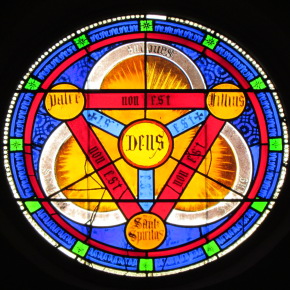 Have you ever looked closely at the round window high up the wall in the back of the church? Go ahead – turn around and give it a good look. I love this window. I love the vibrant colors. I love that when the sun is shining through it, an afterimage gets imprinted on my eyes, so I see it when I close them. If you’ve never given the window much thought, I don’t blame you. The words on it are in Latin, after all. But let’s keep looking. The window presents a diagram of the Holy Trinity. “Deus” – God – is encircled in the center. Three smaller circles float around it: Patri, Filius, Spiritus Sancti – Father, Son, and Holy Spirit. Each of the smaller circles is connected to the others with the words “non est” (is not), and each smaller circle is connected to the large central one with the word “est” (is). The diagram is telling us that the Father, Son, and Holy Spirit are not each other but they are all One God. How does this work? Wisely, the window doesn’t tell us. The window just illustrates the reality, a theological blueprint in stained glass.
Likewise, I’m going to take my cue from the window and stay silent on the “How does this work?” question. Too many sermons over the years have tried to explain the mystery of the Trinity by talking about apples or flames. What those sermons didn’t understand is that you can’t explain a mystery without destroying the very quality that makes it mysterious. When Sherlock Holmes figures out that the bell rope used to call for the maid was replaced with a poisonous snake, which somehow slithered unnoticed out of the room in the ensuing hubbub over discovering the body, the mystery is solved. No more mystery. This Whodunnit? type mystery is the kind we’re used to: Gibbs and the NCIS team solve their mysteries within the length of the 45-minute episode. The light-hearted mystery novels my mother loves to read always wrap up the intrigue by the end of the story.
But here’s the difference between these small, ordinary mysteries we watch or read and the great mystery of the Holy Trinity. The small mysteries have answers to them, like the poisonous snake. But the mystery of the Holy Trinity is the answer – the fundamental answer that rests at the very core of existence. Here’s what I mean.
Before creation came into being, there was God. There was only God. Then God spoke, “Let there be light,” and creation erupted in a rush of dust and energy and far flung fire. And suddenly, there was something known as “not God.” Suddenly, there was an “other” for God to love. And yet, we believe that God’s essence is love, which means that God must have loved before there was a creation to love. Confusing, right? It is confusing until we realize there’s only one possible answer for whom God loved before there was anything else. God loved God. This may sound narcissistic or vain, but it’s not. Narcissism and vanity are distortions of love, but God’s love is perfect and unsullied. God loves God with such perfection that there is still only One God, even though a loving relationship exists.
That’s the keyword: relationship. To try to come close to the mystery of the Holy Trinity, we employ relational words: Father and Son, Parent and Child. We speak of the Holy Spirit as being the love that flows between them. This perfect relationship existed before creation, and thus serves as God’s blueprint for creation. Have you ever noticed that if you drill right down to the core of any subject whatsoever, you end up at relationship? At the most fundamental level, life, the universe, and everything are based on the relationships between things. Elemental particles vibrate next to other elemental particles, weaving the fabric of creation. Atoms repel and attract each other. Ecosystems thrive as complex series of relationships. Celestial bodies dance the precarious waltz of gravitational balance. Not to mention, the most important things in the lives of us humans on this fragile earth is our relationships with one another.
All of this grows from that blueprint God used from God’s own self – the perfect relationship of the Holy Trinity. In the act of creating something that was not God, God knew creation wouldn’t be perfect. And yet, God made it anyway. The reason the Holy Trinity remains a mystery is that our relationships – indeed, all relationships in creation – are not perfect, and thus we cannot fathom perfection.
But while we aren’t perfect, the idea of perfection lingers within us, an echo of our Creator’s own perfect love. We feel this echo as a longing for connection, for relationship with God and with each other. God loves us perfectly, even though we have the capacity to return a mere sliver of that love. But that sliver is more than enough to activate our ability to engage in loving relationships here and now. When we nurture such loving relationships in our lives, we come as close as our imperfection allows to the perfect relationship of the Holy Trinity.
Indeed, the Holy Trinity transcends our imperfection, draws us in, and strengthens our earthly relationships. The echo of God’s perfect love grows louder, more insistent, as we give ourselves over to be born again from above, to be remade closer to the blueprint than we were before. The blueprint calls for less domination and more mutuality, less prejudice and more generosity, less pride and more humility. The blueprint calls for less defending and more welcoming, less grasping and more embracing, less tearing down and more lifting up. And above all, the blueprint calls for love to spill forth in the forms of justice-seeking, mercy-granting, grace-sharing, hope-planting, and joy-singing.
And so you go home and do the dishes even though it was your brother’s turn. Or you tell your wife “thank you” for her poise in the middle of chaos and for putting up with you all these years. Or you introduce yourself to that bedraggled person you always seem to run into on your morning jog and ask if he needs assistance. Or you look those who are oppressed in the eye and say, “I’m sorry for not showing up sooner,” and then turn to stand with them.
Each of these is an expression of the blueprint of the perfect relationship of the Holy Trinity. And each of these will be done imperfectly. And yet, the mystery of the Holy Trinity rests at the core of all existence, of all we do and all we are. And so our imperfection is even now being redeemed by the perfect love of God, which somehow manages to fit all of itself into our mere slivers of love.
If in your life, the Holy Trinity has seemed no more than an abstraction, as clear as the Latin writing on the window back there, then I invite you to take a step back and look again. Reassign every single urge you have ever had to seek justice, to grant mercy, to share grace, to plant hope, to sing joy, and to love. Reassign all of them to the perfect love of the Trinity flowing, however imperfectly, through you. Notice now the Father, Son, and Holy Spirit catching you up in the ever-spinning dance of perfect love, and be thankful.
—

 Today, on this day of Pentecost, I’d like to tell you a story about the Holy Spirit. It’s going to sound like a story about me, but if I tell it right, you’ll see that the Holy Spirit is the main protagonist of this little tale. The story takes place a stretch down River Road about three miles from the Middle of Nowhere, West Virginia.
 Last week, we talked about trying to discern how and when to lean into the newness shimmering on the horizon of your life. I invited you to stop and pray the next time you are at the precipice of a decision; to take a deep breath and feel which way the wind of the Holy Spirit is pushing you; to ask God what new thing God is trying to birth through you with the decision. I know many of us, myself included, often have a hard time finding words to put to these prayers for guidance. Silent prayer – with lots of listening – is a beautiful alternative when there are no words, but if you have the urge to speak, then I have the first five words of the prayer, just to get you started. They come from this morning’s first reading. The eleven apostles want to round out their number, so they select two candidates and then pray about which one will take Judas’s spot. And they begin their prayer for guidance with these five words: “Lord, you know everyone’s heart.”
 “Sing to the Lord a new song, for he has done marvelous things.” Today’s psalm begins with these glorious words, and for me it begins with a question. Why does the song we sing have to be a new one? Why can’t the song be an old song, one that has stood the test of time? “Amazing Grace,” perhaps? Or how about “In the Garden?” While these songs are beautiful and wonderful and should never, ever be lost to the ages, I think the psalmist feels the urge to sing a new song because he or she has discovered a fundamental truth about God’s movement in God’s universe. God is always doing something new.
 Twice last week, I got to wear a tie. I went to the MASH gala fundraiser and to the Eastern Connecticut Symphony concert, at which several of our parishioners sang their hearts out performing Carl Orff’s Carmina Burana. The benefit was fabulous, the concert was wonderful. And I went to both wearing a tie. This may sound like a strange thing for me to report to you, but I assure you, I am going somewhere with this. Whenever I’m getting dressed, I’m faced with a wardrobe decision. Do I wear my black shirt and collar or not? If I decide not to, then I leave the house incognito. I’m still a priest, of course, when wearing a coat and tie or jeans and flip flops, but people at the concert hall or grocery store won’t be able to spot that about me on first glance. (They probably think I’m a college sophomore home on break.)


 Stigma is not a happy word. If you use it in a sentence, more than likely the word “stigma” will be linked to something that people view as disgraceful or humiliating, whether that view is warranted or not. A couple of us recently read a book called The Rich and the Rest of Us by Tavis Smiley and Cornel West, who spoke of the need to lift the stigma associated with the word “poverty” if we are ever going to muster the societal will to lift those on the margins. In years past, society has stigmatized attributes of people who exhibit less capacity than most, using words like “retarded” and “crippled” to describe those with mental and physical challenges. Suffice to say that members of every minority group – no matter the difference used to justify labeling them as “those people” – have been stigmatized in one way or another. Stigmas lead to segregation and prejudicial behavior and animosity. “Stigma” is not a happy word.
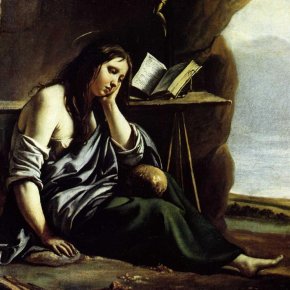
 Good morning, and welcome to St. Mark’s on this glorious Easter Sunday. This morning we walk with Mary Magdalene to the tomb and find it empty. And yet our emptiness doesn’t last for long because Jesus, the Risen Christ, stands there, shining before us, as the dew glistens on the early spring flowers blossoming in the garden.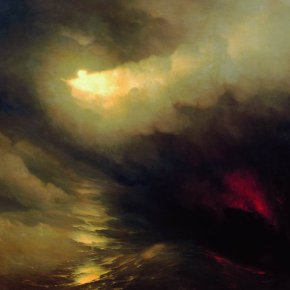
 It’s great to have a baptism scheduled for the Easter Vigil, but we didn’t this year at St. Mark’s. I still wanted to bless the water of baptism before we renewed our baptismal covenant, so my father suggested I build the blessing into my sermon. At the vigil, you can preach before or after the transition from darkness to light, and this year I chose before.
 Where the Wind...