It’s Love, in Point of Fact

(Sermon for Sunday, May 30, 2010 || Trinity Sunday, Year C, RCL || Proverbs 8:1-4, 22-31; Romans 5:1-5; John 16:12-15)
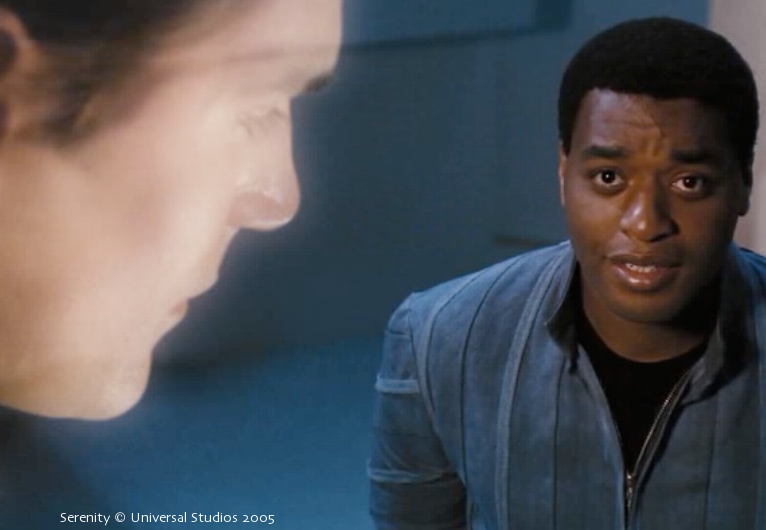
At the beginning of the science-fiction film Serenity, the Operative scans through security footage of Simon Tam breaking his sister, River, out of a government-run facility that has been conducting torturous experiments on River’s brain. The doctor who runs the facility tells the Operative that it was “madness” for Simon Tam to give up his own brilliant future in medicine in order to save his sister. “Madness?” the Operative replies. “Have you looked at this scan carefully, Doctor? At [Simon Tam’s] face? It’s love, in point of fact. Something a good deal more dangerous.” It’s love, in point of fact.

It’s love, in point of fact, that forms this wonderful community, which cares for those both within and without our little band of pilgrims. Some would say this is madness rather than love, asserting that maintaining a purely self-interested motivation for action is the only safe and sane way to live.

It’s love, in point of fact, that brings this wonderful community here today to worship a God we’ve never seen with our eyes nor heard with our ears nor touched with our fingers. Some would say this is madness rather than love, asserting that only what we can prove and quantify and predict are real.

And it’s love, in point of fact, that forms this wonderful community to worship an unseen God who reveals God’s personhood as threefold, as Father, Son, and Holy Spirit. Some would say this is madness rather than love, asserting that the Trinity is a needless complication of the already tenuous and rather dodgy business about God.

Some would say all this is madness, but it’s love, in point of fact. Let’s take a look at each of these three – community, belief in God, and belief in God as a Trinity of persons. We’ll look at them in the opposite order, so we’ll start before the beginning.

You see, if we start at the beginning, we’ve already arrived on the scene too late, as our lesson from Proverbs does today. Proverbs’ personification of Wisdom tells us, “The Lord created me at the beginning of his work, the first of his acts of long ago. Ages ago I was set up, at the first, before the beginning of the earth.” Wisdom may have been created before the earth, but Wisdom tells us that the Lord still created her. This is far too late to begin our discussion of the Trinity. Too even grasp the edge of the expanse of the majesty of the Trinity, we must cast our imaginations back to before there was even a concept known as “before.” You with me so far? Good.

In the First Letter of John, the writer makes the sweeping statement: “God is love.” If nothing besides God existed before the beginning, how did this love manifest? If there was no Creation to fill the role of the Beloved, then how could God be “love?” At first the answer seems rather narcissistic: if there was nothing else to love, then God loved God. But we can’t stop there because true love always manifests as a relationship. In our futile attempt to find the right word to name God, we latch on to relational language and call God “Father.” This sets up one side of a loving relationship, that of parent to child.

But the relationship is incomplete without that second person. And so we also call God “Son” to acknowledge the complete relationship between loving parent and beloved child. In the Gospel according to John, Jesus says that God “loved me before the foundation of the world.” This love between parent and child is so palpable that the love itself is the third member of the Trinity, which we experience as the Holy Spirit. Indeed, Paul tells the church in Rome that “God’s love has been poured into our hearts through the Holy Spirit that has been given to us.”

So this loving relationship between parent and child existed before anything else, including the concept of “before.” Nothing existed that could substitute for or diminish the relationship. The love was pure, perfect, unsullied by deficiencies such as lust or anger or apathy or dominance. In fact, the perfection of the relationship meant that, while there was a Trinity of persons, a Unity of being was the ultimate reality. This Unity of being was the home in which the three persons dwelt: the Parent, the Child, and the Love between them.

Now, I’ve been speaking in the past tense for the last few minutes. Of course, because all this happened before there was a “before,” there was no such thing as the “past” or the “future.” There was only the eternal present in which the perfect Love between Parent and Child manifested in the perfect Unity of being. Before the beginning was this ultimate reality of God, of love, of home.

Then came “In the beginning,” and suddenly there was a time known as “before.” God breathed the wind of God’s Holy Spirit over the face of the deep. God spoke the Word of God, through which all creation came into being. The Trinity, still loving itself into eternally perfect relationship, created the heavens and the earth, thus generating an “other” to bring into that loving relationship, that home that is God. This Creation is not God because God made it, just as God made Wisdom in today’s reading from Proverbs.

Everything that God creates exists in Space and Time, which are simply two more things that God created. Right now, we exist in the space that is this beautiful sanctuary. We don’t exist on your sailboats or sitting in the bleachers at this afternoon’s Red Sox game. And for the last seven minutes, we’ve existed in the time in which I’ve been speaking. Sad to say, we can’t move backward in time and choose not to come to church since the sermon will be really confusing. But because God created Space and Time, God exists outside of these constraints. However, since God loves this little universe of God’s making, God continues to move around and throughout and within it. Truly, God loved this little universe so much, that God the loving parent gave to Creation God’s beloved child.

This beloved child, this Word made flesh came to our little planet as a baby who grew up to be a man who said and did such wonderful things and who taught us about God’s love for all Creation and who expanded our hearts and minds so they could contain such wonderful thoughts and who was killed because of his vision of acceptance and love and who rose miraculously from the dead and who ascended once again to exist in the eternally perfect relationship with God and who showed us the way home to this relationship.

After Jesus Christ ascended, he sent the Holy Spirit to us, the same wind of God that swept across the face of the deep at the moment of Creation. Through the Holy Spirit, God continues to pour God’s love into our hearts so that they can expand to hold the Truth of Jesus’ message of hospitality, generosity, and service. Each member of the Trinity moves in our lives, a family perfectly unified as One, as One who yearns to bring us back home.

Far from being some obscure, antiquated doctrine, the Trinity permeates existence today as it always has even before anything else existed. The Trinity loves itself into eternally perfect relationship, which makes forming loving relationships in our own lives the best way to glorify God. When we come together in this wonderful, loving community to worship God, we participate in the life of the Trinity. When we share the body and blood of Christ, we participate in the life of the Trinity. When we go out into the world in the power of the Holy Spirit to love and serve and find God in those we meet, we participate in the life of the Trinity. This community is home – not a perfect home like the Trinity is unto itself – but a good home made by fallible humans doing our best to love one another.

At the end of the film Serenity, the captain of the small spacecraft finds River sitting in the copilot’s chair, while rain lashes the cockpit’s windows. “But [flyin’] ain’t all buttons and charts,” Malcom Reynolds tells River. “You know what the first rule of flyin’ is? …Love. You can learn all the math in the ‘Verse, but you take a boat in the air that you don’t love, she’ll shake you off just as sure as a turn in the worlds. Love keeps her in the air when she oughta fall down, tells ya she’s hurtin’ ‘fore she keens. Makes her a home.”

The majesty of the Trinity is that God is a perfect home unto God. And God invites us and everyone and all Creation into that home. What makes God a home for us? It’s love, in point of fact.
It’s not easy being green

The following post appeared Monday, May 3rd on Episcopalcafe.com, a website to which I am a monthly contributor. Check it out here or read it below.

* * *

Every February of my college years, the entire student body suffered from a mass case of seasonal affective disorder. The campus of Sewanee is one of the top five most beautiful spots on the planet, but the beauty of the Domain was difficult to appreciate during that dreadful month. What neophytes mistook for simple fog, veterans of Sewanee winters knew was in reality a low-hanging raincloud that hovered over the campus, sapping students of the will to do anything besides curl up under a blanket and nap. The weather lasted for weeks, and when the sun finally broke through the clinging barrier, we students discovered our vigor once again, as if by some sudden leap in evolution, we had developed the ability to photosynthesize.

A version of this same seasonal affective disorder hits Episcopalians every year within a few weeks of Pentecost. We look out over the vast expanse of the upcoming liturgical calendar, and we see nearly a month of Sundays with seemingly no variation, with nothing peculiar to distinguish one day from the next. It’s a sea of green, and without the concurrence of wedding season, the Altar Guild would forget where the paraments are stored.

We call it the season after Pentecost – even the designation gives it the sound of an afterthought. At first glance, those legendary church year framers seem to have measured the year wrong. They only programmed six months! What’s there to do with the rest, those twenty-odd Sundays after Pentecost that stretch on interminably during the dog days of summer and into the heart of autumn? Truly, we blanche at the long months and wonder if the Holy Spirit has enough juice in those Pentecost batteries to get us to the first Sunday of Advent.

The other liturgical seasons are nice and short; indeed, no other season creeps into double digits. Epiphany gets the closest, sometimes reaching as high as nine (watch out 2011!), but it can’t quite get there. And the short seasons always (and satisfyingly) lead somewhere: Advent moves to Christmas Day; Christmas season to the Epiphany; Epiphany season to Ash Wednesday; Lent to Easter Day; Easter season to Pentecost. Each season is like crossing a river or lake to the next feast or fast on the other side. But the season after Pentecost is an ocean, and Christ the King Sunday is in the next hemisphere.

So what do we do to combat the spiritual lethargy that can result from so many Sundays of unvarying green vestments? Well, we could try to split it into more liturgical seasons. So, starting with the Sunday after Pentecost, we’d have the season of the Trinity until mid-August. Then, beginning on August 15th, we’d have the season of the Blessed Virgin Mary until the end of September. Then, we’d have Michaelmas until Advent. There: three more manageable seasons for us modern people with our tweet-sized attention spans.

While this divvying up of the calendar has a certain appeal (especially to all the Anglo-Catholics reading this), I doubt the Church would go for it. So, where does that leave us? Our churches are still stuck in six months of monotonous green! The seasonal affective disorder will attack. Parishioners will fall away! (I know, I know – mostly because of summer holidays, but just go with me on this whole long liturgical season thing.)

Instead of lamenting the six months of green, let’s use the green season to our advantage. Don’t completely shut down program for the summer. Rather, take your cue from the liturgical color. Spend time each week or each month discussing how both the church and the individual can become more environmentally friendly. Devote education time to the intersection between theology and environmental sustainability. Set goals for the parish to meet by the end of the season after Pentecost to reduce consumption. Go paperless for the entire season to cut down on waste. Move service times to earlier in the day and turn off the A/C. Encourage people to bike to church or carpool. Have a light bulb changing party and replace all the lights with CFLs (the curlicue ones). Check out websites like nccecojustice.org for more ideas.

By taking positive steps to live into God’s pronouncement that we are stewards of creation and by staying active through the long days of the season after Pentecost, we can stave off that seasonal affective disorder. Even when the liturgical color hasn’t changed in four months, each Sunday is still a celebration of our Lord’s resurrection. Every Sunday we worship God, who through the Word brought all creation into being. The best way to praise God for that mighty creative act is by preserving it so countless generations to come can also praise God for God’s creation.

It’s a good thing the Green Season is so long. There sure is a lot to do.

Green Tea (Davies Tales #7)

Aidan Davies slipped out of his daydream and refocused his eyes on the bright screen of the computer warming his legs. The purple walls of the coffee shop, so captivatingly gaudy when he first arrived, melted into the background outside Davies’s headphoned and laptopped bubble. Customers claimed tables, ate, drank, bussed, and left. Employees emptied the trash and called out orders. The traffic rushed silently by on the wet street outside. All Davies saw was the screen and various vague shapes in his peripheral vision. All Davies heard was the lush sonorities of Beethoven sonatas through his headphones. The mug holding the dregs of his green tea was long forgotten.

The sermon writing that was supposed to be occupying Davies’s attention kept losing the battle to tangential diversions dedicated to researching unimportant details on the Internet. I should probably shut off my wireless, thought Davies when he was halfway through reading an article on the etymology of the word “tangent.” I’m having tangents about my tangents. Bad sign. Davies closed first the web browser and then his eyes. Focus, he told his tired mind. Just then, Beethoven’s “Pathétique” sonata invaded his consciousness, and he listened for the move from Grave to Allegro molto e con brio. “There it is,” he sighed under his breath.

But as the Allegro ran its course and the slow section of the piece reasserted itself, another sound began to pick and to nag for Davies’s attention. He opened his eyes and flicked them to the right. A young woman, whom Davies had idly noticed when he sat down and then promptly forgotten, was talking on her cell phone. Out of the corner of his eye, he watched the young woman’s brow crease. Her free hand went to her mouth. Oh no, thought Davies, as his internal pastoral alarm (what he called his spidey sense) whirred up from his gut. The woman began to collapse inward. Here it comes, thought Davies.

“How long will it take me to get to the hospital from the airport?” Her voiced trembled as she asked the question, fear mixing with at least a veneer of bravery. Davies closed his eyes again. For half a second, he tried to ignore the woman. She’s not one of mine. I’m not wearing the uniform today. I’m just here to drink green tea. But when the half-second ended, the muscles in Davies’s arms and legs tensed. His chest constricted. For a horrible moment, he was unmade, a traitor in his own body.

Davies glanced up at the ceiling. Even though he often preached that God’s presence was everywhere, he had never quite shaken the notion that God was located in the general direction of “up.” I know, he said to himself, they are all mine because they are all yours. But what can I do? Again Davies flicked his eyes toward the young woman, who was stabbing her cell phone with a shaking thumb.

He played through one scenario in his mind: Hi. My name is Aidan. I’ve been eavesdropping on what I’m sure is a very distressing set of conversations for you, but it’s okay because I’m a priest. Davies shifted uncomfortably in his seat and mentally crossed out that option. I’m not a superhero. I can’t run to the phone booth and do a quick change into my collar and black shirt. I can’t save her with the platitudinous ramblings of a stranger.

With the hero plan discarded, the resolve to do nothing crept back into his consciousness and this time it brought reinforcements. You don’t know her, so why should you care, asked Apathy. You’ve got enough on your own plate to worry about, reasoned Vanity. Go get another cup of tea. Maybe she’ll be gone when you get back, coaxed Craving.

They were convincing. The traitorous feeling, which Davies knew upon his first thought to feign ignorance of the young woman’s plight, did not resurface. No chest constriction. No tension in his extremities. Rather, Davies felt pleasantly sleepy, like a soldier who wore eighty pounds of gear all day but never saw combat. I resisted the urge to feed my own messiah-complex. I’m doing quite well. “Self-Differentiated.” He said the last word in his mind as if he were at a podium lecturing. The word echoed through his conscience. He smiled. Someone watching Davies could have seen a mite of smugness skitter across his grin.

Aren’t you forgetting something, whispered another voice. Davies looked across the battlefield from where he crouched with Apathy, Vanity, and Craving. It’s nothing, they said, Keep your head down. Get more tea. Davies looked at the soggy teabag in the mug and the sticky rings staining the table. You idiot, whispered the voice again, this time closer, from the adjacent foxhole. Davies climbed out of the trench and crawled to the mouth of hole from where the voice had come. The Reinforcements clamored and caterwauled for him to come back, to return to the safety of self-satisfied ignorance.

I can’t approach the distressed woman and I can’t do nothing. So what can I do? If the whispering voice could have taken corporeal form, Davies felt sure it would have slapped the back of his head. Pray for her, it said.

Davies glanced back at the woman. She continued to hold her cell phone to her ear, an electronic flotation device keeping her from drowning in the choppy waters of the unknown emergency. I lift her up to you, Lord, who already knows the distress in her heart. Use me as a beacon emanating your peace. Connect my soul to hers for these few moments when our proximity makes us kin. Grant her the strength to bear the pain that is ahead of her.

Davies exhaled. He turned his attention back to his computer screen, though his thoughts were all eight feet away at the woman’s table. A few minutes later, she shut her cell phone, put her computer in her bag, and walked out of the coffee shop. The Lord be with you, prayed Davies. Then he glanced at his watch and realized it was time for him to depart, as well. Davies gathered his things, placed his mug in the plastic dish tub near the door, and walked out into the rain.

The Last Prayer in the Bible

(Sermon for Sunday, May 16, 2010 || Easter 7, Year C, RCL || Revelation 22:20)

Words can help and words can harm. Words can enlighten and words can confuse. Words can dull the mind and words can infuse the soul with joy. Recently, I spoke some words to someone that wounded that person, and I continue to work to repair that relationship. Recently, I also spoke words to someone else that brought her a bit of peace, a quarter cup of hope for the recipe of her daily walk with Christ.

Words by themselves are innocuous little things, like bullets rattling around safely in the box. Then we employ these innocuous little words to order our thoughts. We combine them into phrases, sentences, speeches, lullabies, poems, diatribes. We use them to teach and to welcome and to express deep emotions that rarely fit neatly into our vocabulary. We also use them to manipulate and to control and to stoke our own fragile egos. Knowing that words surround and define us, the fact that we spend so little time choosing our words is startling. The fact that we spend so little time examining the repercussions of what we say is quite disturbing.

This is true at home, where a conversation can end in a tearful embrace or a slammed door. This is true at school, where teachers use words to encourage, and bullies use words to demean. And this is especially true at church, where we say collections of words used nowhere else in our lives. These words inspire humility and invite transformation, and yet we rarely take the time to notice the power of the words we speak here in this building.

This morning, we heard the final prayer in the Bible, the literal last words in the last book of the library that chronicles God’s interactions with all those grimy, messed up, beautiful people. “Come, Lord Jesus,” prays John of Patmos at the end of the Book of Revelation. Come, Lord Jesus. No prayer in the Bible is more fervent or more concise or more powerful. These three little words pass us by in the midst of another reading on another Sunday morning. But these three little words illustrate the fact that we rarely notice the power of the words we speak in church. We’ll get back to this final prayer in a few minutes. First, let’s explore this power that we tend to overlook.

In her book Teaching a Stone to Talk, Annie Dillard diagnoses this blissful ignorance that affects lay people and clergy alike. She asks, “Does anyone have the foggiest idea what sort of power we so blithely invoke? Or, as I suspect, does not one believe a word of it? The churches are children playing on the floor with their chemistry sets, mixing up a batch of TNT to kill a Sunday morning. It is madness to wear ladies’ straw hats and velvet hats to church; we should be wearing crash helmets.”

In her colorful prose, Dillard reminds us all that worshiping the Creator-Of-All-That-Is has never been an altogether safe or predictable proposition.  In our worship, we consciously commune with the foundation of our very existence, the God who transcends all thought and who, at the same time, moves within and around each of us, breathing life into our bodies and purpose into our souls. The church is not a museum for us to tour with amused and sleepy detachment; there is no frozen exhibit of doves in midair, no taxidermied Holy Spirit. Our God is no divine watchmaker who wound the universe and then left well enough alone. We worship the God who was and who is and who will be. God continues to speak creation into existence every moment of every day. But one of the things God never created is the box in which we often try to stick God, so that we can go about our daily lives secure in the knowledge that God is collecting dust on a shelf in the cupboard.

This box doesn’t exist. Any attempt to domesticate God is a severe delusion of grandeur, one that I know I’m guilty of. We worship a God who moves through our lives like the wind, uncontrollable and yet ever visible in the dancing of leaves and the billow of sails. This is the God whose name we toss about in frustrated oaths when we’re stuck in traffic. This is the God we rail at when the pain of loss wallops us in the gut. And this is the God to whom we address our praise and our prayers.

We ask God for forgiveness in the words of the confession. We invoke God’s name when we offer each other Peace. We recite the poetry of God’s grace in the words of the Eucharistic prayer. We pray for the coming of God’s kingdom in the words that Jesus taught us. After communion, we tell God of our plans to go out and serve God in the world, and we ask for strength and courage.

But how often do we stop and realize that God actually hears these words of ours. How often do we take stock of our conviction that God listens to our pitiful, halting, inadequate, wonderful prayers. Our words are powerful and transformative because we speak them to the God who empowers and transforms us. When we speak words like “Come, Lord Jesus,” are we really prepared for the transformation into which these words draw us?

This is why we need those crash helmets, of which Annie Dillard spoke. God calls us to participate in our own transformation. When we pray, “Come, Lord Jesus,” we signal our readiness to become a part of our own remaking. We discover the arduous path of discipleship, a path which Jesus never promised would be safe or easy. Rather, he promised that he would always be with us on the path, no matter the danger or difficulty. When we pray, “Come, Lord Jesus,” we notice that Christ is already here with us.

This is a comforting and a disturbing thought. Christ is already here with us guiding us and holding us up. But Christ is also here pushing us to step into new encounters that will transform us and, at the same time, transform the world. I know I can’t speak for all of us so I’ll speak for myself. Sometimes, I’m afraid to say, “Come, Lord Jesus,” because I know I might hear Jesus echo my prayer and send me where I don’t want to go. “Come, Lord Jesus,” I’ll say, and then Jesus will say: Come, Adam. Come to me here. Come to me at the prison, at the slum. Come to me when I rattle a Dunkin Donuts cup at you on Tremont Street. Come to me when I hold up a cardboard sign at the intersection. Come to me when I’m alone at the table in the soup kitchen.

Our transformations take place in those moments when we cry out “Come, Lord Jesus,” and Jesus hears us and echoes our cry with one of his own. The more conviction we have in saying those three little words, the easier will be our reception of Jesus’ call in our lives. The more often we pray, “Come Lord, Jesus,” the less often will we be tempted to sequester Jesus in the upper room or to stash him in the manger where he can’t do too much to stir our lives. In The Lord of the Rings, old Bilbo Baggins used to say to his nephew: “ ‘It’s a dangerous business, Frodo, going out of your door. You step into the Road, and if you don’t keep your feet, there is no knowing where you might be swept off to.’ ” Likewise, when we pray, “Come, Lord Jesus,” we step into the Road of our own discipleship, and Jesus sweeps us off to those places where our own transformation intersects God’s transforming of the world.

Words by themselves are innocuous little things until you combine them into phrases and invest those phrases with meaning and conviction. The last prayer in the Bible is just three little words: “Come, Lord Jesus.” With these words, we accept Christ’s invitation to participate in our own remaking. We open ourselves up to hearing Christ’s call to go to those places and to those people who are in need of change themselves. And when we arrive, we’ll find that the Lord Jesus has come there first, and that he will continue to strengthen us in our ministry with his grace.

Revelation (The Good Parts Version)

(Sermon for Sunday, May 9, 2010 || Easter 6, Year C, RCL || Revelation 21:10, 22—22:5)

These are my original sermon notes. I accidentally washed them in the laundry.

Have you noticed that we’ve been reading the Book of Revelation ever since Easter? Every Sunday since Easter, the New Testament lessons have come from the Book of Revelation. You probably haven’t noticed this for at least two reasons. One: Besides a quick quotation in last week’s sermon, no preacher at this church has come within spitting distance of the texts from Revelation. Two: We’ve only read from the few chapters that don’t sound like a cross between an acid trip and Dante’s Inferno.

Our lectionary trims down the Book of Revelation to “The Good Parts Version,” the parts that don’t make us bewildered and squeamish. In all six lectionary lessons, not once do we hear about wars or plagues. Not once do we hear about dragons with seven heads and ten horns and seven diadems on their heads or beasts with ten horns and seven heads and ten diadems on their horns. Not once do we hear about the seven bowls of wrath or the six-six-six number of the beast or the five months of torture or the four horsemen or the three foul spirits or the two hundred miles of blood or the one whore of Babylon. Not once.

And we like it that way, thank you very much. We like the “Good Parts Version” of Revelation because we don’t want to dwell on how the world’s going to end in wrath and blood and fire. We don’t want to read the perplexing script that narrates the world’s annihilation. We don’t want to hear prophetic predictions of horrible apocalypse.

But, you know what? We don’t have to. While Revelation is full of disturbing imagery, several popular misconceptions about the text have led to some strange and erroneous readings.

Before we move on to this morning’s lesson, we need to get a few things straight. For starters, the popular understanding that Revelation is a script that narrates the end of the world is utter nonsense. Doctrines espousing the “Rapture” and the seven-year “Tribulation” only work by pasting together a few disparate pieces of scripture into a collage of truly baffling interpretation.

Next, to move any further into Revelation we need to rescue the words “prophecy” and “apocalypse” from their popular connotations. Prophets are not fortune-tellers or predictors or spiritual meteorologists. Prophecy is not about predicting the future. Prophecy is about telling the truth of the present in order that the future may change. Prophets call people back to God and hope that those people will listen and change their lives.

The story of Jonah illustrates the true nature of biblical prophecy. People usually remember the bit about the fish, but there is more. Jonah goes to the city of Ninevah and says, “Forty days more, and Nineveh shall be overthrown!” He says this to shake them out of complacency, to get them to turn back to God. And they do: the city isn’t destroyed! Does this make Jonah a false prophet because his words didn’t come true? No. Quite the contrary: Jonah succeeds as a prophet because the people listened and changed.

“Prophecy” is about telling present truth, not about predicting the future. To redefine another popular word, “apocalypse” is not necessarily about the “end of the world.” Rather, “apocalypse” means “an unveiling” or “revealing.” We’re used to hearing the word paired with trailers for disaster movies like 2012, but the term is really about pulling back the curtain of reality to see the deeper reality at work underneath. The message of Revelation is urgent not because the book is specifically about the world’s end, but because much early Christian thought grew out of the notion that Christ would return very soon. In that context, John of Patmos, the writer of Revelation, prayerfully looks behind the veil of the world’s reality and tells the truth about the present. John’s vision convinces him that true reality is a very different place than the one, which the Roman propaganda machine describes. The Empire had declared peace – the Pax Romana – but John sees this peace for what it really is, a violent, suppressive regime that rules by intimidation, occupation, fear, and capital punishment.

John had also noticed that the seven churches of Asia Minor had begun to buy into the Roman system of social domination. They were getting comfortable, complacent. They were adapting to the false reality of the Empire rather than living the countercultural lifestyle of the people of the Way, the followers of Jesus Christ. So John proclaims his vision to these churches.

To compose his vision into written form, John employs disturbing imagery, much of which our imaginations can barely fathom. Through a series of repetitive spirals, John tells the vision multiple times with increasingly unsettling images. Prose could never capture the vision, so John writes a long, sometimes nauseatingly graphic poem. Pastor and scholar Eugene Peterson comments, “If St. John’s Revelation is not read as a poem, it is virtually incomprehensible, which, in fact, is why it is so often uncomprehended.”

This prophetic poem is epic and cohesive. We do the Book of Revelation a disservice by reading only the “Good Parts Version” in church. Far from being a script narrating the cataclysmic end of the world, John’s apocalypse tells the truth about how God’s kingdom exists with far grander and vaster scope than the scary, but ultimately doomed, imperial dominion of Rome. While John was writing to people in his own time, Revelation continues to be remarkably relevant today. The parts we read in church are all about God’s kingdom. But we need the rest of Revelation, as well, to prepare us to hear the good news of these “Good Parts.”

You see, Revelation is shocking the same way a car accident is shocking. We can’t drive by without looking at the tangled mess of fenders and engine parts. Once we’re passed, the collision reminds us of our responsibility to be safe drivers. Likewise, the itchy, disturbing parts of Revelation narrate the mess we get ourselves into when we buy into the domination systems that the world has been promulgating throughout history. Then the “Good Parts” tell us about God’s true reality underneath, which pushes and prods us to relinquish our grip on the world’s false reality.

In this morning’s reading, John reaches the climax of his vision in the description of God’s holy city. His poetry tries as hard as language can to describe the glory he beholds. If we’ve read the disturbing parts of Revelation, we are now struck with the utter reversal from darkness to light, from death to life, from war to creation. But the vision of the city doesn’t simply encompass what we can expect when we pass from life through death to new life. Every single Sunday, we pray (in words that Jesus taught us) for God’s kingdom to come while we still live on earth. When we pray, “Thy kingdom come, thy will be done, on earth as it is in heaven,” we offer ourselves to God to use in the growth of the kingdom here.

So what does John’s vision have to tell us about this kingdom, which we are participating in growing on earth? Three things stand out, and all three work to counteract the domination systems, which John’s Revelation exposes. First, members of God’s kingdom practice radical hospitality. John says, “[The city’s] gates will never be shut by day – and there will be no night there.” Back in John’s time, city gates were usually open during the day to facilitate trade unless the city was under siege. But all threats have been removed from the heavenly city. And what’s more, since there is no night, the city gates are always open. As members of God’s kingdom, we strive to model this hospitality in our churches and in our lives. All are welcome, and woe to us if we attempt to close the gates which God has thrown open wide.

Second, members of God’s kingdom share the extravagant blessings of God with everyone they meet. In the heavenly city, the river of the water of life flows right through the middle of the main street. On either side of the river grows the “tree of life with its twelve kinds of fruit.” Unlike earthly trees, which bloom once a year, the tree of life produces a different fruit each month. The tree of life blooms constantly with all the extravagant blessing of God. As members of God’s kingdom, we strive to model this blessing by working for the just distribution of the world’s resources, by managing them wisely and sustainably, and by demonstrating that these resources can nourish the entire human family.

Third, members of God’s kingdom work for healing, wholeness, and closer communion with God for all of God’s people. “Nothing unclean will enter [the city],” says John, but not because unclean things will be barred. Rather, as scholar Brian Peterson says, “The promise that nothing unclean will enter, in the end, is the promise that God will remove all uncleanness from us all.” John shows this with these words: “The leaves of the tree are for the healing of the nations.” These are the “nations” that we thought destroyed by the battles earlier in John’s vision. Now they “walk by [the city’s] light.” Likewise, the kings who had earlier allied themselves with Babylon against the Lord now “bring their glory into the city.” As members of God’s kingdom, our duty has never been to say who can and who cannot come into closer contact with God. Rather, the city is full of the glory, light, and “unmediated presence” of God. When we release the illusion that we somehow control this presence, we can work to bring God’s wholeness to a world broken by systems of domination.

Hospitality, blessing, communion – John’s Revelation shows these things to be pieces of God’s true reality. Assimilation by the world’s domination system blinds us to this reality. I invite you to read the rest of Revelation to see the new eyes, which John gives to the churches in Asia Minor. The disturbing, transient imagery of war and pestilence gives way to the glorious, eternal reality of God’s grace and presence. Simply reading the “Good Parts Version” of Revelation ignores all the baggage with which the world saddles us when we buy into the system. But God constantly breathes into us the strength and perseverance to labor with God to grow God’s kingdom here on earth so that only the “Good Parts Version” remains.

Notes

* Thanks to Craig Koester Revelation and the End of All Things for the background exegesis for this sermon.

Mountaintop removal

The following post appeared Monday, May 3rd on Episcopalcafe.com, a website to which I am a monthly contributor. Check it out here or read it below.

* * *

I recently moved to one of the top ten most beautiful spots in the world. I live a three-minute walk from the Atlantic Ocean. I can see a lighthouse from my living room window. I bought a new car. I started working at a new church, which is as beautiful as the town surrounding it. The people at church are wonderful. The trees and flowers are exploding with spring colors. And to top it all off: it’s Easter, the happiest and most celebratory season in the church year. I know I am blessed, radically blessed.

So, why am I having trouble finding something to write about? Why am I having difficulty elucidating God’s presence in my life, at this, one of my life’s most idyllic moments? You’re probably thinking: “Adam, go back and read your first paragraph and quit complaining.” Fair point. But my difficulty is symptomatic of a deeper spiritual malady, which (strangely enough) a simple recitation of my blessings actually exacerbates. I’m sure this malady affects more Christians than just me, so let’s do a little diagnosing.

Our walks with God are topographically interesting. For the most part, we walk the straight path, which Isaiah and John the Baptizer proclaim is the way of the Lord. But sometimes, we meander through desolate valleys, in which simply finding the tiniest token of God’s presence is drink for our arid souls. Other times, we climb mountains, atop which we touch the very face of God and can never imagine a time when our spiritual energy will need recharging. The valleys and peaks, the lows and highs, are the times we remember.

We remember the smile the stranger gave us in the frozen food aisle when we’d forgotten that God was still around. We remember hearing the choir singing choral evensong and how our hearts soared into the very heart of God during the first chords of the Magnificat. We remember the smell of disinfected despair when we sat overnight in the hospital room. We remember standing on a literal mountaintop and breathing in the wind of the Spirit and seeing the patchwork creation spread out below us.

These valleys and mountains shape our lives as Christians. Some folks have Grand Canyons and Himalayas. Others have dry streambeds and foothills. But the slope of our lows and highs matters little. For this discussion, let’s agree that our walks with God have valleys and peaks. The spiritual malady I mentioned a moment ago severely limits our ability to process the peak category.

By removing the mountaintop receptors, the malady keeps our souls from gathering spiritual nourishment from the peak times in our lives. Our minds know that God must be moving in our lives for life to be so full of blessing. But our souls have trouble metabolizing that blessing into the nutrients that sustain us while we search for God’s presence. Without that sustenance, we cease our active awareness of God until there is a noticeable change from “good” to “bad” times. When the paradigm shifts from “good” to “bad” – that is, from mountain to valley – we enter spiritual survival mode and begin frantically looking for God, only to have the walls of the depression limit our sight.

The disciple Peter is patient zero for this spiritual malady. When Jesus calls him out of the boat, Peter walks on the water as if he’s ambling down a garden path. Walking on the water is a spiritual mountaintop, but the paradigm shifts quickly. Peter notices the waves around him, and he starts to sink. Only when he is floundering in the surf does Peter reach up his hand for Jesus to rescue him. Peter could have taken Jesus’ hand while walking atop the water, but he waits until his valley moment.

Like Peter, I forget to seek God when things are going well. When I’m on a mountaintop, I rarely open my eyes to take in the glorious view. Through an intellectual exercise, I know that I am blessed, but this blessing fails to filter into my soul. Only when the jaggedness of grief or deprivation assaults me do I begin my tardy search for God anew.

I know I’m not alone in dealing with the spiritual malady of mountaintop removal. If you suffer from it, then know that there are steps to address it. Take a few moments to look at your life. Orient yourself on the topographical map of your walk with God. Where are you in relation to your most recent valley? If you know that you are no longer in the valley, force yourself to do more than think about your blessings. Rather than an amorphous abstraction you call “blessing,” separate each small blessing into individual shimmering lights of grace. Write each one down. Then thank God for the blessings individually, and be creative. Thank God with action, not thought. If your blessing is having enough food, go feed someone who is starving. If your blessing is living near the ocean, go stomp around in the shallows. If your blessing is being a member of a loving family, go tell them how much they mean to you. If your blessing is the song in your heart, go sing.

Once you’ve acted out your thanks to God, don’t stop. Actively seek out ways to thank God for God’s blessing in your life. Every morning when you draw your first breath, decide to look for God’s presence that day. Then over time, you may see the ground beneath your feet rise into a mountain. And you will notice just how close is the face of God.

Hear my voice

(Sermon for April 25, 2010 || Easter 4, Year C, RCL || John 10:22-30)

I’m sure we can all agree that making a real audible connection with Jesus is difficult. After all, our Lord ascended into heaven one thousand nine hundred and seventy-seven years ago, give or take. You can’t download his parables off of iTunes. You can’t watch the Sermon on the Mount on Youtube. You can’t get a podcast of the Last Supper. As Judas sings at the end of Jesus Christ Superstar: “If you’d come today you could have reached the whole nation. Israel in 4 BC had no mass communication.”

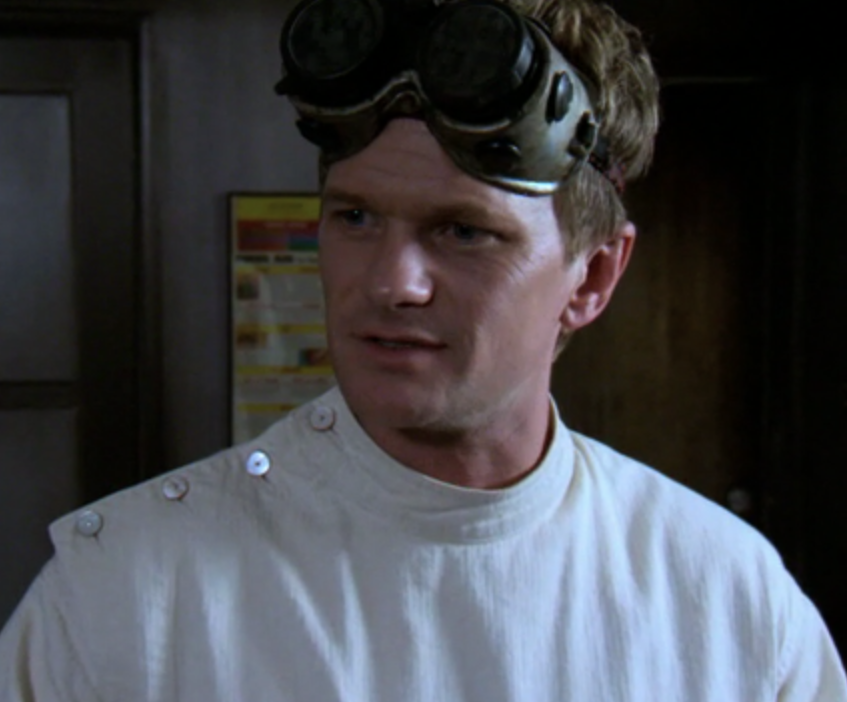
Dr. Horrible is only a few weeks away from a "real audible connection" with his crush, Penny.

With no way to make that real audible connection with Jesus, we might be tempted to disregard this morning’s Gospel as an antiquated relic of Jesus’ own time. In the verses preceding our lesson, John records Jesus discussing his identity as the good shepherd who takes care of the sheep. Then, in today’s reading, Jesus returns to that image when he tells his opponents, “My sheep hear my voice.” The fact that you got out of bed this morning and decided to come to church tells me that on some level you identify as a member of Jesus’ flock. So, with no person to speak or recording to play, how do we, his sheep, hear Jesus’ voice? How do we listen to someone who lived nineteen centuries ago and who inhabited the other side of the world and who spoke a language that no longer exists?

All those barriers notwithstanding, we sheep still hear Jesus’ voice. We hear his voice in myriad ways, too many to list exhaustively during this sermon. We especially hear Jesus speak to us from within ourselves, from the collective voice of the community, and from the prayerful reading of his words in the Gospel.

Let’s begin with the reading of scripture. Did you know that in the ancient world in which the Bible was written, there was no such thing as silent reading? People read aloud even when they were alone. The Book of Acts presents a clear example of this. Philip is walking along the road from Jerusalem to Gaza when he happens upon an Ethiopian eunuch reading the prophet Isaiah. How does Philip know he’s reading Isaiah? Right – because the eunuch is reading out loud to himself. Now, we all grew up with elementary school teachers giving us cross looks if we accidentally began reading aloud when we were supposed to be reading silently. I also imagine that if I began reading my novel out loud on the T, I might engender some strong negative reactions.

Obviously, our culture no longer subscribes to the ancient practice of reading everything out loud. But in our efforts to be the sheep who hear Jesus’ voice, I invite you to attempt this practice. Read the Gospel slowly, prayerfully, carefully, and audibly. Listen to the sound of your own voice speaking the words of Jesus:

“Come to me, all you that are weary and are carrying heavy burdens, and I will give you rest.”

“Truly I tell you, just as you did it to one of the least of these who are members of my family, you did it to me.”

“And remember, I am with you always, to the end of the age.”

Hear the voice of Jesus welling up from within you. Feel your mouth and tongue and breath work in concert to form those life-giving words. When you encounter a particular verse or passage that strikes you, don’t rush through the words. Sit with them. Say them aloud and hear Jesus speaking through you to you. Make those words your breath prayer. Practice making the voice of Christ the first thing that comes to your own lips in idle moments and joyful moments and fearful moments. As Paul says to the church in Colossae, “Let the word of Christ dwell in you richly.” We sheep hear Jesus’ voice in the words of scripture when we attend to them and attune to them and orient our lives around them.

This orientation continues in our own interior lives, which is the next setting for hearing the voice of Christ. At the outset of his own trek through the inward life, St. Augustine says, “My God, I would have no being, I would not have any existence, unless you were in me. Or rather, I would have no being if I were not in you.” Because we are in God and God somehow dwells within us, we can access the voice of Jesus within ourselves.

Most often, we are too distracted by external stimuli to attend to this voice. And when we manage to find grace enough to silence the outward bombardment, we still must contend with the chattering voice of our own selfish desire. This seductive voice constantly eats away at us, eroding us with whatever idols happen to be fashionable this season. But underneath the artillery and the idolatry, another voice speaks. This is the voice of Jesus speaking softly enough that we have to strain to hear. And everyone knows that when you have to strain to hear, you must be listening.

This internal voice of Jesus is the same “still, small voice” that Elijah hears on the mountain after the wind and the earthquake and the fire pass by. This is the same voice that the psalmist hears when God says, “Be still, and know that I am God.” The voice of Jesus speaks truth into our souls every moment of every day, and every once in a great while, we might happen to stop and hear that truth.

I remember a time in my life in which each day, I asked God if I was in the right relationship. And each day, I felt the resonance in my chest of a deep and abiding, “Yes.” Then, on a day of no particular consequence, the resonance disappeared. But rather than paying attention to the change, I forced myself to remember what the voice sounded like. And for months, I lied to myself rather than making the effort to listen to Christ’s voice within me. When the relationship ended, I was shocked, although I had no right to be. The voice of Jesus had been preparing me for that outcome. The still, small voice speaks to us continually. All we need do is listen.

We sheep hear Jesus’ voice in our inner selves, but without that voice also speaking to us from a loving community, the dialogue is incomplete. “Let the word of Christ dwell in you richly,” says Paul, and he continues, “Teach and admonish one another with all wisdom; and with gratitude in your hearts sing…songs to God.” Without this conversation, this communion, with one another, we struggle to discern the voice of Jesus in our lives. God calls each one of us to ministry both within the church and in our lives outside these walls. The voice of the community and the internal voice within each of us coalesce to form our calls to serve God.

We will reaffirm our baptismal promises in a few minutes. One promise asks, “Will you seek and serve Christ in all persons, loving your neighbor as yourself?” When we answer, “I will, with God’s help,” we signal our willingness to listen to the voice of Jesus speaking through one another. If we are able to sublimate the chattering voices of our own selfish desire, then each still, small voice within us can join with the next, creating the voice of Jesus in the community. When we share in one another’s lives, when we take the time to know one another on deep, personal levels, we more readily serve as vessels for the voice of Christ to each other.

Christ’s voice in the Gospel forms and guides the other two voices – the interior voice and the voice of the community. Working together, this threefold voice of Jesus speaks to us across the barriers of time and distance and language. Jesus proclaims, “My sheep hear my voice.” This statement is both a declaration and a hope. As we struggle with our flurries of distractions and entanglements both externally and internally, I pray that we each find the grace to take seriously these words of Jesus: “My sheep hear my voice.” We are his sheep. I hear Jesus’ voice calling each of us to serve one another in love and reach out with healing arms to a broken world. What do you hear?

Faithful Thomas

(Sermon for April 11, 2010 || Easter 2, Year C, RCL || John 20:19-31)

I’ve always had a special affinity for Thomas. Perhaps, because we share a name, I feel fraternally responsible for defending him against those who label him with one of the most enduring epithets of all time: Doubting Thomas. (Curiously enough, I’ve never felt much like defending Adam for his stupidity in the garden, but that’s another tale.) So, we have this fellow uncharitably nicknamed Doubting Thomas. We remember him for exactly one reason: he doesn’t trust the words of his fellow disciples when they tell him that they have seen the Risen Lord. Their witness is not enough for Thomas. He needs to see and touch Jesus, just as the other disciples had done when Jesus came to them the first time in that fearful room behind a locked door. Thomas needs the visual and tactile proof of the resurrection for himself. And for this one, simple reason, Thomas has been stricken with his unfortunate nickname, much maligned for his obstinacy, and readily dismissed for his doubt.

But this caricature misses the subtle interplay between doubt and faith that we are going to explore the next few minutes. Notice that Thomas never actually follows through with his stubborn ultimatum. He tells the other disciples, “Unless…I put my finger in the mark of the nails and my hand in his side, I will not believe.” The next weekend, Thomas is with the other disciples when Jesus comes to them again. And when Jesus invites Thomas to fulfill his requirement for belief, Thomas no longer needs to. Rather than reaching out his hand to touch Jesus’ side, Thomas lets loose from his lips the highest affirmation of Jesus’ divinity in the entire Gospel: “My Lord and my God!” Thomas is a man of deep faith.

This is the same Thomas who, when Jesus decides to travel near Jerusalem to raise Lazarus, says to the other disciples, “Let us go with him, that we might die with him.” Thomas is a man of deep conviction. This is the same Thomas who, when Jesus tells the disciples he goes to prepare a place for them, asks of his Lord, “How will we know the way?” Thomas is a man of deep questions.

When you add faith, conviction, and questions together, oftentimes doubt results, at least for a time. Faith gives you the reason to ask questions, and conviction gives you the perseverance to allow doubt to temper faith into a stronger whole. Too frequently, trouble happens when we mistake doubt for the opposite of faith, and therefore as something to be avoided at all costs.

One of the reasons for the persistent mistake of thinking that doubt is the opposite of faith comes from this very Gospel text (and indeed, this particular English translation of the Gospel text). When Jesus invites Thomas to touch his wounds, Jesus says, “Do not doubt but believe.” This sets up a dichotomy between doubt and belief and puts the two in opposition to one another. You can either doubt or believe, but you can’t do both. However, “Do not doubt but believe” is not actually what Jesus says. I don’t say this very often, but the English translation we read in church gets this sentence horribly wrong.

Because the New Revised Standard Version messes this verse up so badly, we need to have a short lesson in ancient Greek, the language in which the Gospel was written. I promise that I won’t make a habit of giving these lessons from the pulpit. But I also promise that you already know more Greek than you realize.

You're probably wondering why this picture makes sense in this context. I promise it does. Go watch the recently cancelled Dollhouse to find out why.

In Greek, to turn a word into its opposite, you add an alpha, which is really just an  “a,” to the front of the word. We do the same thing for English words that come from Greek. Try this one: Bios is a Greek word that means “life.” We get the English words “biology” and “biotic” from it. “Biotic” means “relating to living things.” If we add an “a” to the front, we get “abiotic,” which mean “relating to non-living things.” Or how about this one: Theos is the Greek word for “God.” In English, “theism” is the generic word for belief in God. So, add the “a” prefix and we get “atheism,” which is the belief that there is no God. We could come up with a dozen more examples, but I think you get the point.

Now let’s go back to our verse, which, if you recall, this morning’s reading translates as “Do not doubt but believe.” The Greek word translated “believe” comes from the word pistis, which means “faith.” The word that is translated as “doubt” is simply the word pistis with the “a” prefix – apistis. Therefore, the word should really just mean “unfaith” or “unbelief,” rather than “doubt.” With this new translation, the verse becomes, “Do not be unbelieving but believing.”

“Do not be unbelieving but believing.” This is a far cry from “Do not doubt but believe.” Jesus never tells Thomas not to doubt. Rather, Jesus tells Thomas not to jettison his belief all in one go. There is a huge difference between the two. This supposed “Doubting Thomas” is still incredibly faithful, even in the midst of his doubts. Remember, Thomas is a man of deep faith and conviction, who has the nerve to ask tough questions. Doubt arises in such a chemical makeup. But having doubts does not signal the loss of belief. Having doubts does not signal the abandonment of faith.

Doubt happens when you have enough conviction about your faith to question it. Thus, doubt gives you a reason to reexamine your faith and to sign up with Jesus Christ over and over again. Of course, too much doubt can lead to unbelief, just as, conversely, too much certainty can lead to stagnant faith.

Okay, now that we’ve established that doubt is not something to be avoided at all costs, let’s use our Easter celebration to bring the power of the resurrection into this discussion. Our faith finds its home in Jesus’ resurrection. Jesus triumphed over death in order to keep his promise that he would be with us always, despite the end of our physical existence. Resurrection happens with eternally vaster scope than death ever could. Because of this, death exists within the power of the resurrection. The resurrection subsumes death into itself, making death a piece of the reality of eternal life. In the same way, belief is so much more expansive than doubt; belief subsumes doubt into itself, making doubt a part of the pathway of faith.

Jesus tells Thomas, “Do not be unbelieving but believing.” And Thomas responds with such grand words to express his belief: “My Lord and my God!” Rather than dismissing Thomas as that good-for-nothing doubter, embrace Thomas as a faithful, thoughtful, courageous follower of Christ whose doubts ultimately lead him to a wondrous confession of faith.

God knows that we, too, have our doubts. We wouldn’t be human without them. But belief in God gives our doubts purpose, shape, and context. Do not be ashamed of your doubts. Shame only works to erode faith. Rather, see doubt as a sign of your conviction, as a sign of the fact that you care enough to ask tough questions. Then use that conviction, that perseverance to push through the doubt to the deeper faith beyond. And with those five glorious words of Faithful Thomas, praise the Risen One who is the beginning and end of our belief: “My Lord and My God.”

Clean feet becoming dirtier

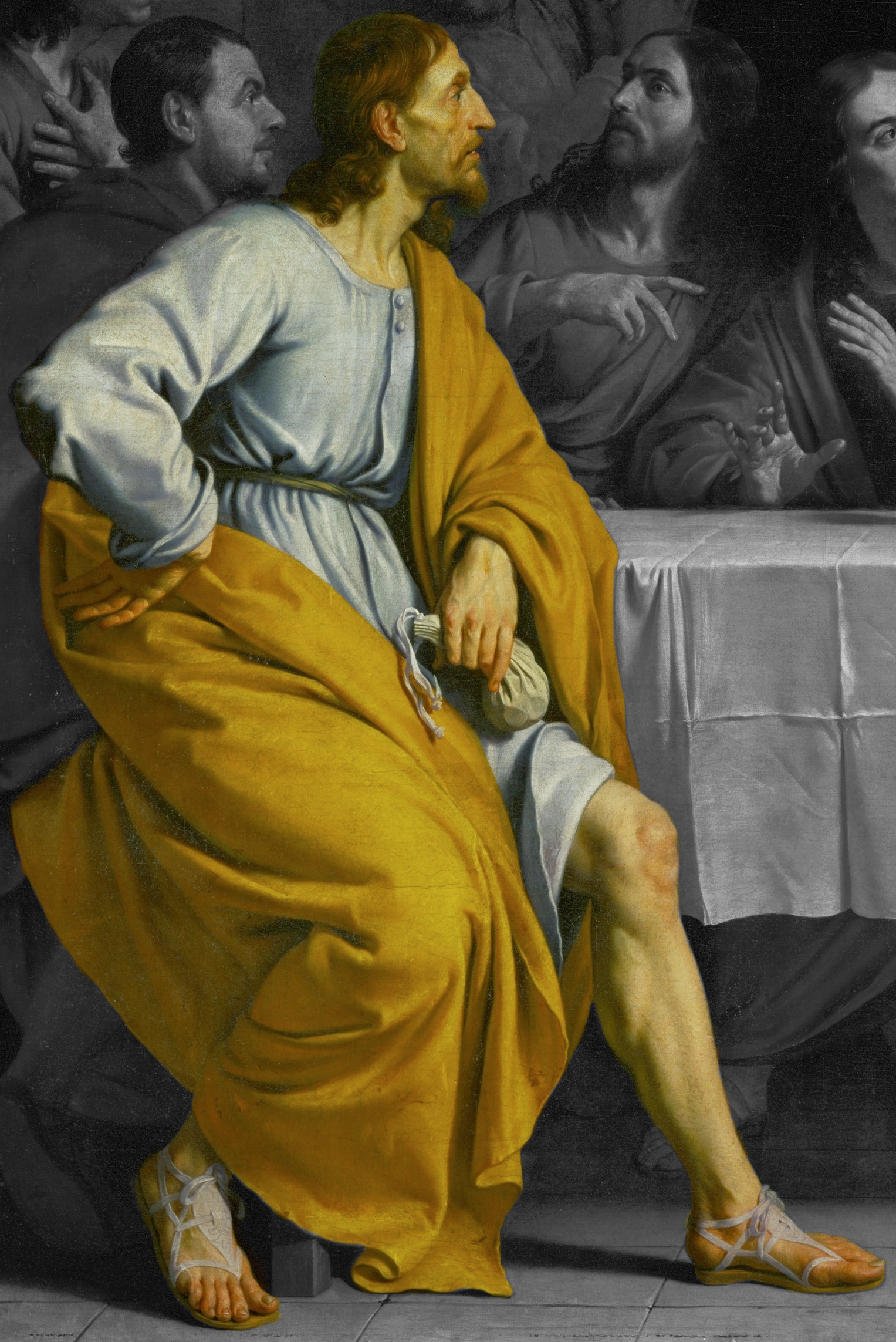
Imagine with me the thoughts of the disciple Judas Iscariot, after he has left the Last Supper while he is on the way to the police. You may wish to click here and read John 13:1-30 before reading the following.

Detail from "The Last Supper" by Philippe de Champaigne, 1648

I let him wash my feet. I knew what I was going to do, and I still let him wash my feet. I could feel the gentle pressure of his hands through the coarse towel as he dried them. God. Gentle pressure: it’s always gentle pressure with him. He touched the dirtiest part of me, and there was no recoil, no disgust. And all the while, I had this strange sense in my gut that he knew what I was getting ready to do. Even though I had decided to go to the police and let them know where they could find him, I still let him wash my feet. I let him serve me, but there was no earthly reason why he should, for I am on my way to betray him.

Betray him. It sounds so ugly when I say it like that. I’m not betraying him: I’m saving myself, saving all of those lazy hangers-on who don’t realize how much trouble he’s getting us into. Peter, who can’t keep his big mouth shut. Thomas, who says he’s ready to die with him, which I doubt. Andrew, Philip, Nathanael, the rest. They have no idea what’s really going on. I’m the only one that sees clearly. I’m giving them the opportunity to escape with their lives. Once he’s out of the picture, the police and authorities will forget all about the rest of us. I’ll be off the government’s most wanted list. I’ll be able to slip back into obscurity. No one will remember my name, and that’s just fine with me.

Will people remember his name after all this is through? He’s just another in a long line of disposable saviors. God. How did I let myself get caught up in all of this? I’m the smart one. I’m the planner. I see into the way of things. And still, he called my name and I followed. I feel so foolish. Foolish and angry. I’ve been angry for so long that I can hardly remember the last time I was at peace. Last week in Bethany, I yelled at Mary for being wasteful with her money, but I would’ve yelled at anyone who gave me an excuse. Why do I feel like this?

I’ve always sensed that I’m different somehow from the rest of them, that I’m on the outside of the group. Last year, he said one of us was a devil, and I’m sure he was talking about me. He didn’t say it outright, but I remember him looking at everyone but me. He always seems to hold me at arms length. I never feel close to him. Until tonight. Until he washed my feet tonight. Until he handed me that piece of bread tonight.

I had to get out of there. I felt this sudden surge of anger in my chest, a feeling of such malevolence, stronger and more foreign than I had ever felt before. He handed me that piece of bread. He handed me himself. God. At that moment, we had our closest connection ever and I understood most perfectly my place in all of this.

I’ve been so angry for so long because his words mean something different for me than for everyone else. I’m the exception. I’m the one who doesn’t count in the total. And he chose me! He chose me for this assignment. He knew all along. I’m not betraying him, no matter what people will say. I’m doing exactly what he wants me to do. I’m his most faithful follower. So why am I shut out? Why am I alone in the darkness?

He chose well. He knew I have the foresight and the stomach to see this through. I could go back. I could forsake the path I’m on. But that – that would be a betrayal. He handed me himself. He is in my hands. And I have to make those hands bloody. Now my anger is my ally. It steels me for the task ahead. As long as I keep seething with this foreign hatred I’ll be able to accomplish what he sent me to do. He told me to do it quickly. Perhaps he thought that I would change my mind if I dwelt on this task too long. But I will not. I will not. I will not. I will keep walking away from him, walking toward his end, walking with clean feet becoming dirtier with each step.

Stone Symphonies

(Sermon for March 28, 2010 || Palm Sunday, Year C, RCL || Luke 19:28-40)

“I tell you, if these were silent, the stones themselves would cry out.” So says Jesus to some Pharisees, who want him to corral his exuberant disciples. If we lived anywhere else, I would be tempted to take these words of Jesus merely as metaphor, as a turn of phrase intended to illustrate the remarkable nature of the event taking place. But in the month that I’ve been in Cohasset, I’ve walked on the beach several times, and I’ve heard a certain, special noise that has made these words come alive.

As you know, small stones populate the beaches here, stones that were once boulders and are not yet sand, stones made round and smooth by the ebb and flow of the tide, stones good for skipping on the ocean. Waves break over these stones and cover them with foamy surf. As the tidal forces suck the waves back out to sea, the water runs through air pockets between the round edges of the stones. And as the water vibrates the stones, they cry out. The stones sing with a quavering voice, a thousand violins playing the same note but each with unique rhythm and tempo. As the waves flow out, the stone symphony plays the chords of creation, joining the great company of all the myriad instruments in God’s terrestrial orchestra.

If we attune our ears and eyes and hearts, we can hear these chords and we can witness all of Creation praising God. This praise happens when God’s creatures fulfill the purposes for which God made them. The sun praises God by shining, the moon by reflecting the sun’s light. The thunder praises God by crashing, the rain by watering the earth. The gazelle praises God by running, the wolf by hunting, the rose by blooming, the bee by pollinating. Each member of the great symphony of Creation praises God in an unique way, and all work in concert to glorify the Creator.

Well, all except for one glaring exception. We humans are a thick lot. On our best days, we ignore the symphony, and on our worst days, we spend our time devising ways to silence Creation’s praise. Down through history, we have slowly but surely forgotten how to read Creation’s score, forgotten that we too have parts to fulfill in God’s orchestra.

We are able to join in praise to God when we remember that God created us to display one fundamental attribute: goodness. God created everything that is, Genesis tells us, and at the end of each creative session, God pronounced the new creation Good (and on the last day, not just Good, but Very Good). So, at the fundamental level of our human nature is goodness, which is a reflection of God’s delight in Creation. The manifestation of that goodness is our praise to God. We embody this praise when we sing and dance, when we laugh and pray, when we love, and most importantly, when we serve.

The trouble appears when we forget that goodness remains at the core of our human nature. Instead, we see all the malignant attributes that attack our goodness and mistake this tumorous growth for what defines us as humans. How often have you heard the following statements explained away by attributing the behavior to human nature:

“He’s just jealous because I won the office pool.” “Well, jealousy is just a part of human nature.”

“She’s so petty: who cares if we wore the same dress today.” “Well, pettiness is just a part of human nature.”

“I can’t believe he lied about where he was last night.” “Well, dishonesty is just a part of human nature.”

We make the worst mistake of our lives when we attribute these negative actions to human nature. Our fundamental nature is Good, and anything else is a perversion of the goodness by which God brought us into being. These perversions of our goodness (also known as “sin”) distort our relationship with God. We start playing our instruments out of tune, thus ruining the symphony of Creation.

But when Jesus rides that donkey’s colt down the Mount of Olives, he takes a step in the process of subverting all our tumorous perversions of human nature. On his way to the cross, which is the epicenter of the perversion the Good, he begins showing that goodness (and all of goodness’s positive emanations) still exist, despite the malignancy eroding the nature of humanity.

First, he tackles the perversion of power. Notice that his parade is rather incongruous. Anyone would expect a king to enter the city on an armored warhorse with weapons-laden legions flanking him. But Jesus rides in humility, on the back of a lowly farm animal. He displays that humility (which is one manifestation of goodness) has more majesty than any imperial power could ever muster.

While Jesus subverts the perversion of power, his disciples tackle the perversion of terror. While fear is sometimes a helpful emotion, terror is not simply “really big fear.” Terror is an extension of power meant to control. But at this moment in the Gospel, the disciples walk directly into the most dangerous situation in their lives unabashedly praising God with joyful voices. “Blessed is the king who comes in the name of the Lord!” They display courage, another manifestation of goodness, and their courage subverts any attempt by the perversion of terror to control.

The rest of the Gospel plays out in much the same way. Jesus subverts the perversion of greed when he overturns the tables of the moneylenders in the temple. He subverts the perversion of fame when he tells his disciples that he is among them as one who serves. He subverts the perversion of revenge when he stops the retaliation during his arrest and heals the slave’s ear. And in his greatest display of goodness, Jesus defeats the perversion of domination by willingly giving up his life. Jesus brought all our perversions of human nature to the cross and died with them. And in his resurrection, he shows us that these perversions of our good nature have no ultimate power over us.

Because of Jesus’ life, death, and resurrection, we have the ability to access the goodness at the core of our human nature. We have the humility and courage necessary to let God excise all the malignancy that perverts our relationships with one another and with the rest of Creation. We have ears to hear the symphony of praise playing all around us, and we have the music within us to add our own harmonies to the orchestra of Creation.

And when we fail, when we once again forget our goodness, we can be silent, we can be still, and we can listen. And then we will hear the stones themselves crying out on our behalf, crying out their praise to God.

Notes

For the Internet versions of my sermons, I usually remove the specifics of place, but for this sermon, I really needed to preserve them for the imagery. If you ever make it up to the Massachusetts coast, listen for the sound I’m talking about.