Happy Dancing Ewoks

(Sermon for September 5, 2010 || Proper 18, Year C, RCL || Luke 14:25-33)

The rain is so heavy that I feel like I’m driving through a carwash. I can barely see out the windshield, and I keep thinking that I’ve missed Furnace Brook Parkway. But just when I decide I need to turn around, I spot the sign reflecting green in the dim glow of my headlights. I turn left and five minutes later I park across the street from the Coffee Break Café. I make a mad dash for the dryness and warmth of the shop, but the rain still manages to soak my jeans during the ten seconds I’m out in the elements.

The moment I step into the café, however, I forget the dangerous drive. I forget the torrential downpour. I forget the soaked jeans and the English language and my name and how to walk correctly. The woman, whom I planned to meet at the café, stands before me wearing patterned rain boots, holding a steaming cup of tea, and smiling. And I forget everything about myself except for the fact that she is there to meet me – me of all people.

That was a little over five months ago. A little over five months from now, she and I will be married about ten feet over and four feet down from where I’m standing right now – right over there. Leah and I will hold hands, and Margot will direct us to look at one another and speak our vows. I will say, “In the name of God, I, Adam, take you, Leah, to be my wife, to have and to hold from this day forward, for better for worse, for richer for poorer, in sickness and in health, to love and to cherish, until we are parted by death. This is my solemn vow.”

In February, I will promise to love and to cherish Leah for the rest of my life. You might have guessed that I’m pretty excited by that prospect. And so, when I listen to this morning’s Gospel reading and hear Jesus say that to be his disciple I have to hate my wife, I’m just downright confused.

Return of the Jedi (1983) 20th Century Fox

Ever since I was a little kid, I’ve known that hate is a bad thing. In fact, I learned this lesson during my daily viewing of Return of the Jedi. Near the end of the film, Luke Skywalker finds himself standing before the twisted and evil Emperor Palpatine. The Emperor doesn’t want to kill the Jedi; he desires Luke to fall under the seductive power of the dark side of the Force. Palpatine has Luke’s lightsaber, and he tempts the young Jedi saying: “I am defenseless. Take your weapon. Strike me down with all of your hatred, and your journey towards the dark side will be complete.”

Even as a young child, I knew that Luke could not give in to his hate because then he would have been corrupted. He would have joined the dark side, and the film would not have ended with smiles and embraces and happy dancing Ewoks. I learned the lesson well. Hate is a bad thing. If you are anything like me, you were brought up learning the same lesson. So how do we encounter these words of Jesus? He says, “Whoever comes to me and does not hate father and mother, wife and children, brothers and sisters, yes, and even life itself, cannot be my disciple.” How do we obey a command that just seems so wrong?

The first thing we need to do is to make sure that we don’t ignore Jesus when his words sound wrong to our ears. When he says something that makes us uncomfortable, there is a tendency to skip over the offending words. The trouble is, skipping those bits is exactly the opposite reaction than Jesus is going for. When Jesus turns to the crowds and says these words, he employs shocking rhetoric in an attempt to make the crowd understand just what life following him looks like. In Jesus’ day, following spiritual gurus around was something of a pastime, akin today to following the Grateful Dead on tour. Most of the people making up the large crowds were following him because he was a local celebrity. When Jesus tells them that they can’t be his disciples unless they hate life itself, I imagine many of them left to find a less demanding guru.

So we shouldn’t ignore Jesus’ words when they sound wrong. But this still leaves the fact that they sound wrong. Now, please don’t interpret the rest of this sermon as an attempt to explain away Jesus’ tough words. Rather, permit me to reinterpret the word “hate,” and hopefully, when I’m done, the toughness of Jesus’ words will have remained intact.

In between last week’s passage from Luke 14 and this week’s, several verses fell through the cracks. Just before Jesus turns to the crowds and speaks today’s Gospel, Luke narrates Jesus telling a parable. In the story, all the people invited to a great dinner make excuses and fail to attend: “I have bought a piece of land, and I must go out and see it”; “I have bought five yoke of oxen, and I am going to try them out”; “I have just been married, and therefore I cannot come.” The host of the dinner becomes angry with these no-shows and sends his servants out into the streets to fill his house with all the people who wouldn’t normally be invited to a party.

Right after this parable, Jesus tells the crowds that to be his disciple they must hate father and mother and wife and children and life itself. The three people in the parable who made excuses were obviously not following this difficult command. Instead, they decided that land and livestock and spouse were more important than the great dinner. The word “hate” jolts us with its emotional connotation; but, based on the parable, I’m far from convinced that Jesus desires us to indulge in the emotion of hate. Rather, he uses the word “hate” to show that every person who isn’t Jesus is never meant to take the place of Jesus. Unlike the three people in the parable, those who come to Jesus cannot be his disciples unless they make him more important than everything else. Therefore, becoming Jesus’ disciples means putting Jesus ahead of all the other people in our lives.

Of course, this is incredibly difficult. But the incredibly difficult things that Jesus asks of us also turn out to be incredibly important. With his tough words about hating life itself, Jesus offers us protection from the most common sin in the book: idolatry. In the parable, the would-be guests make excuses to avoid the great dinner. The land, livestock, and spouse are their idols. In our lives, idols are those things that we turn to when we should turn to God. We let our parents, spouses, children, jobs, cars, computers, smartphones, and addictions invade the territory that should be God’s alone. We begin to look to something other than God for salvation. We mistake the creation for the Creator.

This is not bad just because our idolatry breaks one of the Ten Commandments. This is bad because when I set up another person as my god, my idolatry will eventually destroy both the other person and myself. If I made Leah into an idol, I would rely on her for everything. I would run her ragged trying to see to my needs. I would suck the life and the love out of her. And when there is nothing left, I would starve. Sooner or later, every idol ceases to be enough, and it’s usually not until this time that we realize our idolatry.

So let’s go back to those words that Leah and I will say to each other at our wedding in February. In all the good and bad times, I will promise to love and to cherish her. There is absolutely no way to fulfil this promise without the very first phrase I will say during my vows: “In the name of God.” God is the foundation of every healthy relationship. Loving God first is the only way to be able to love another. Cherishing God first is the only way to cherish another. We can only be Jesus’ disciples when we finally rid ourselves of any idea or notion that our ability not only to love, but to exist, comes from nowhere but God alone.

When I wed Leah, I will strive to remember that God formed us in our mothers’ wombs and God brought us into each other’s lives and God knit us together and God will continue to sustain us. God is the beginning, the middle, and the end. Cutting God out of our relationship – indeed, out of any relationship – simply ignores the reality that God is the foundation of all relationships. Cutting God out allows the sin of idolatry to creep in.

Jesus tells us that we must hate life to become his disciples. With this, he sets us the difficult task of putting him before all else. Accomplishing this difficult task means that when we cherish our loved ones, we remember that we are capable of that action because God cherishes us. When we love them, we draw upon the unrelenting outpouring of God’s love. And if we forget everything else – the English language and our names and how to walk correctly – we still remember that God somehow puts each one of us first. And so we thank God and ask for the grace to put God first. Everything else will find its proper place atop God’s sure and steady foundation.


Centerfield

The following post appeared Sunday, August 29th on Episcopalcafe.com, a website to which I am a monthly contributor. Check it out here or read it below.

* * *

The Sandlot (1993, 20th Century Fox), a.k.a. one of the best baseball movies of all time.

Long before I realized the sacredness of the altar or the font or the Gospel book with its gilded edges, my contact with the holy happened twenty yards due north of second base. The play-by-play guys and color commentators speak of the “baseball gods,” but I can forgive their polytheism, for they must not have heard the good news that the Almighty God of heaven and earth became the God of baseball around 1912. Of course, half a lifetime ago, I didn’t realize that. All I knew was that centerfield was, somehow, holy.

I lived to play defense—my hitting and striking out and stealing bases and popping out to the first baseman and scoring from second were dry toast. Catching fly balls and cutting off balls hit in the gap were pizza and hamburgers. I relished being a member of the home team because it meant wallowing in the purgatorial dugout was delayed half an inning. I sprinted out to centerfield, my cleats enduring a few mouthfuls of dusty clay before clamping their teeth into the damp, tussock-strewn earth of the outfield.

It had rained that morning—not hard, but the ground had drank in the drizzle for the same several hours that I sat around my house hoping the coach wouldn’t call with bad news. Any ball that bounced would be wet, making it harder to throw accurately. I would be slower by the third inning, after my cleats and socks each added a pound or two of mud and water. The rain had stopped, but the clouds still muffled the late-spring twilight. The sky was the color of a scuffed baseball, which, of course, made the actual scuffed baseballs that would soon be arcing toward me quite difficult to see.

I sprinted all the way to the chain-link fence that bounded the field. Faded, plywood advertisements for local car dealers and Baptist churches adorned the fence, which was polka-dotted with pockets of rust. The top of the fence was just out of my leaping reach, since I hadn’t hit my growth spurt yet. With my gloved right hand, I tapped the chain-links with all the reverence of crossing myself with holy water. Then I squelched back to continue my ritual north-northwest of the pitcher’s mound.

As a centerfielder, I never stood perfectly in the center of the field, else the pitcher would obscure my view of the batter. Instead, I let my internal dowsing rod lead me to the patch of ground four or five steps to the shortstop side of second base, the better to get the jump on balls batted by right-handed hitters. This spot was the spring at the center of my fiefdom, a territory it was my duty to protect from incoming mortar fire. I dug my cleats into the spot, creating a shallow foxhole. This was my land, and it was holy, and I soaked up its sacredness through my cleated feet.

As the leadoff batter walked toward home plate, the field’s lights hiccupped and hummed to life. But there was already electricity in the air, and the aftertaste of bubble gum mixed with the mint chocolate flavor of exhilaration in my mouth. The banks of lights cast four shadows, and they swirled around me like Busby Berkeley’s dancers. The familiar, but always surprising, feeling of anticipation hiccupped and hummed to life in my bowels.

The batter kicked his heals into the clay. The pitcher gripped the ball in his glove. I punched my glove and paced my foxhole. As the pitcher went into his windup, the organs south of my lungs declared war and started marching north. Strike One. My stomach occupied the region around my larynx. Ball One. My heart beat a double time cadence. Crack. I took a step back and moved to my right. The ball hurtled into the air, past the artificial horizon where the sloping roof of the concession stand met the sky. I took four more steps to my right and waited, while in my mind the thousands of ways I could fail tried to smother the single way I could succeed. For half a second, I wondered if Ashlee were in the bleachers. I waited as the ball reached its peak and fell back to earth, towards my land. Finally, after three and a half seconds of forever, the ball sailed into my glove and made the satisfying SWAPTH sound that I lived for. My sacred ground remained undefiled, and I could breathe again.

I tossed the ball to the shortstop, marched back to my foxhole, and the warring organs broke their ceasefires. Would that be my only catch of game? Or would I have a busy night patrolling my fiefdom? There was no way to know. So I stared down the batter on each pitch, flinched reflexively on each swing, and waited in anticipation, my feet poised on holy ground, connected to something that brought out the best in me and that called to me from the scuffed baseball sky and the fence and my foxhole. That something – I wouldn’t have known to call it God then – that something called to me, speaking the grace needed to taste the mint chocolate flavor of exhilaration, speaking the devotion that enabled me to move with purpose each time ball and bat connected, speaking the love that kept me returning again and again to the ballpark in rain or shine, speaking my very life into being.

Inadequacy

(Sermon for Sunday, August 22, 2010 || Proper 16, Year C, RCL || Jeremiah 1:4-10)

These geeks feel inadequate most of the time (NBC's shortlived, but brilliant "Freaks and Geeks")

Human nature urges us to shy away from thing we aren’t too good at. Boys at the middle-school dance tend to add their support to the structural integrity of the gymnasium rather than venturing out onto the dance floor. Folks who don’t have the best singing voices often lament the fact that they are “tone-deaf,” which, statistically speaking, is unlikely. I’ve never been a strong swimmer, so I keep to the shallows, or more often, the shore. We all nurse feelings of inadequacy – whether in dancing, singing, swimming, or whatever might be your particular constellation of shortcomings.

These inadequacies define as just as much as our strengths do. But while strengths define us positively, like an artist drawing shapes on a canvas, inadequacies fill up the negative space around those shapes. Our discomforts, our shortcomings, our inadequacies press in from outside of us, telling us that, no matter our strengths, we are failures. We are failures before we even try because we know we’ll never be any good, and therefore, we never try new things, we never step out of comfort zones. And when we never step out of comfort zones, they never have the chance to expand. As such, the feeling of inadequacy greatly impedes growth of all sorts: physical, emotional, spiritual.

But God, I think, sees our inadequacies from a different perspective than we do. To us, our inadequacy is an impediment. To God, our inadequacy is an opportunity for God to display God’s glory. This morning’s lesson from Hebrew Scripture demonstrates this perspective.

Jeremiah’s feelings of inadequacy prompt him to attempt to dissuade God from calling him to be a prophet. But God has no inclination to heed Jeremiah’s argument. Rather, God seems to call Jeremiah specifically because of the boy’s feelings of inadequacy, not in spite of them. Notice how God answers Jeremiah’s single piece of dialogue in the passage. After God informs Jeremiah that God has appointed him to be a prophet to the nations, Jeremiah says, “Ah, Lord GOD! Truly I do not know how to speak, for I am only a boy.”

God hears these words and keys in on the second half. “Do no say, “I am only a boy,” God says. Your youth doesn’t matter because I am with you to deliver you. You can’t help being your age. If I wanted someone older I’d call someone else. But no similar assurance addresses Jeremiah’s inadequacy in speaking. God never tries to assure Jeremiah by saying, “Do not say, ‘I do not know how to speak.’” Rather, God uses Jeremiah’s inadequacy in speaking as an opportunity to put God’s own words in Jeremiah’s mouth. God sees room for growth in Jeremiah, and God fills that room with God’s own words.

For his part, Jeremiah knows he is an inadequate speaker. But when he points this out to God, his argument backfires. What Jeremiah doesn’t realize is that God picks him precisely because of his inadequacy. This is a pattern throughout the Hebrew Scripture. Moses has a speech impediment, but God still calls him to stand up before Pharaoh. David wears no armor and carries only a sling and stones when he challenges Goliath, the Philistine champion. Gideon drastically reduces the numbers of his army – from 22,000 to three hundred – when he contends with the Midianites. In each of these cases, the human vessel called to work God’s purpose is laughably inadequate to the task at hand. And every time, God’s purpose succeeds.

God works through human inadequacy to display God’s own glory. In a sense, God is showing off. But this is not vanity, because God shows off for our sakes. I’ve mentioned before in sermons that we humans are a pretty thick lot. We often have trouble attributing our giftedness to God, which allows the sin of pride to creep in at ground level and start rotting out our appreciation for God’s blessing. This trouble magnifies greatly for gifts that we perceive we’ve always had. The constancy of our strengths makes us less apt to remember to thank God for them.

But we have a much easier time thanking God for abilities we’ve had to work hard to obtain. God cultivates growth in us by targeting our inadequacies. We remember what the inadequacy felt like when we didn’t have certain abilities, and so we thank God for helping us to step outside of our comfort zones and try new things. This is my experience with learning how to sing, and I’m willing to bet each of you can think of a similar example in your own lives.

God knows our trouble at offering thanks for our strengths, and so God insists on working through our inadequacies to remind us that God is the giver of all gifts. Rather than viewing inadequacy as an impediment, we can see it as God sees it. Our inadequacies are opportunities for us to invite God to work through us in new ways.

Think about your own most recent shortcoming. How can you invite God to work through this inadequacy? Perhaps God might say something like this:

“Do not worry that you don’t know how to speak. I do. I’ve been speaking creation into existence since time began. Borrow my speech and soon it will become yours.”

“Do not worry that you can’t turn down a fight. I did. My son went to the cross in order to show that violence does not have to beget violence. Borrow my courage and soon it will become yours.”

“Do not worry that you can’t sustain a relationship. I can. I have been the husband and the parent of my people for as long as anyone can remember, and I have never broken my promise to them. Borrow my love and soon it will become yours.”

Whatever our shortcomings, whatever our inadequacies, God can work through them to display God’s glory. God uses the inadequacy of Jeremiah to put God’s words in his mouth. God uses the inadequacies of Moses, David, and Gideon. And not just them: Jacob was a cheat. Joseph was a prima donna. Jonah hightailed it in the opposite direction. Rahab was a prostitute. Ruth was a stranger in a strange land. Rachel had trouble conceiving a child. Paul was a persecutor. Ehud was left-handed. Aaron built an idol five minutes after he heard the commandment not to. And not to mention, the disciples fled.

So why not us? Thousands of years may have passed, but our shortcomings, our inadequacies are the same. (Well, being left-handed isn’t so bad anymore.) Our strengths are opportunities for us to thank God for how God has always worked through us. But we thick humans have never been so great at that. And so God works through our inadequacies, granting us the ability to grow in God’s grace and praise God for all of God’s good gifts.

This week, I invite you to ask God to work in you, to work through your deficiencies. Pray to God for the courage to take a step outside of your comfort zone. Pray for the hospitality to welcome a stranger into your midst. Pray for the trust to give up some of your resources toward the work of God in the world. Pray for the peace necessary to stop in the midst of this swirling world and find God in the middle of your day. Pray to God to work through your inadequacy, and soon you will discover new strengths, which you can use to serve God in your lives.

Sermon Reconstruction: Luke’s Lord’s Prayer

A few weeks ago, I preached* a sermon on Luke’s version of the Lord’s Prayer, but I never wrote it down. The sermon existed in my mind as a skeletal structure of six or seven keywords, but with no meat or movement. So during the preaching moment, I wove in the muscles and tendons, and (as she so often does) the Holy Spirit animated the whole thing with breath. All that to say, my fingers never hit the keys on this particular sermon, so when a dear, dear lady at my church asked for a copy, I had none to give her. So what follows is not exactly what I preached, but a rough approximation of the sermon based on a reconstruction of my initial skeletal thought processes.

Jesus is praying in a certain place when his disciples approach him and say to him, “Lord, teach us to pray.” I imagine Jesus looking at them with bemused surprise and thinking: “Took you guys long enough. I called you six chapters ago!” Then he teaches them his own prayer:

Father, hallowed be your name.
Your kingdom come.
Give us each day our daily bread.
And forgive us our sins,
for we ourselves forgive everyone indebted to us.
And do not bring us to the time of trial.

You might look at these words and say, “Hey, wait a second. Where’s the rest of it? Is this the Cliff’s Notes version or something?” True, the version of the Lord’s Prayer in Luke’s account of the Gospel is not quite as long as the one found in Matthew and there are also a few differences in word choice (“sin” instead of “debt/trespass,” for example). Most scholars agree that Luke’s version is the older one, citing the fact that shorter versions of similar passages tend to be older because phrases tend to get added over time rather than subtracted. For our purposes, just remember that we’ll be talking about Luke’s version during this sermon and not the one we’ll pray later on in the service.

Jesus begins his prayer with the expectation of close relationship with God. Rather than saying something like “Almighty God, Lord of the Universe,” Jesus starts with a familial word. By addressing God as “Father,” Jesus tacitly shows himself to be in the role of child. And because he is teaching his prayer to his friends, he lets them and us know that we, too, are God’s children. With one word, Jesus sets up the relationship between God and us. We are both closely connected to the Father, and we occupy the position of dependent in the relationship.

With the words “Your kingdom come,” Jesus introduces hope into the prayer. Hope is about the future. When we hope, we begin to expect that the boundaries of possibility are far wider than we once supposed. When we pray for the coming of the kingdom, we show our willingness to participate in the advent of that kingdom here on earth, both in its current, unfinished manifestation and in its future culmination. The mere act of hoping for a better future can begin to change the present, which is the subject of the next phrase.

While scholars aren’t quite sure of the meaning of the word translated into English as “daily,” the fact that two words in this next sentence have to do with “today” stands out. Jesus teaches us to pray for the nourishment that sustains us just for this day – not yesterday, which is past, nor tomorrow, which is yet to come, but right now. When we pray for sustenance today, we remain grounded in the present moment, the moment in which we can encounter God moving in our lives. Nourishment today helps us hope for tomorrow, and sustains us to continue walking the path with Christ.

More than anything else, this path is about reconciliation, which is the subject of the next sentence. We ask for forgiveness, and at the same time we make a commitment to forgive others. I’m reminded of that great Anne Lamott line, in which she says that not forgiving is like drinking rat poison and then waiting for the rat to die. A quick recap: forgiveness is the action we take in the present to participate in the coming of the kingdom. Nourishment sustains us in the present. Hope drives us to the future. And a close relationship with God allows us to pray. One more sentence to go.

With the final phrase, Jesus gives voice to the fear that crops up in each of us. We do not like to think about coming into a time of trial. But by saying the words aloud, we permit ourselves to give that fear up to God. And the thing that occupies the space left by that fear is peace. This peace frees us from the worry that might keep us from praying in the first place.

And Jesus says that we must never stop praying. The disciples asked him to teach them to pray, but he’s interested in more than just the words they use. Like the person who keeps knocking and knocking to get his friend to come to the door, Jesus tells us that persistence is the key to prayer. Just like improvement in sport comes through constant training, practicing prayer makes the act of praying second nature (or perhaps, even first nature).

This persistence in defining a close relationship with God, hoping for the future, finding nourishment for the present, reconciling and asking for forgiveness, and discovering peace leads us into deeper faith in God. Through prayer, we participate in God’s movement in our lives, and our persistence helps us notice God’s blessing in our lives.

Relationship, hope, nourishment, reconciliation, peace, persistence, blessing. Jesus teaches us to pray these things. I pray that God may grant us these so that we can continue to be blessings in this world.

The sermon went something like this, though I know there was a line from The Shawshank Redemption in there somewhere. Mrs. E, I hope this is what you were looking for!

Footnotes

* Perhaps you’ve never given this much thought, but I’ve always wanted the past tense of “preach” to be “praught.”

Jesus throws me out

The following post appeared Friday, August 13th on Episcopalcafe.com, a website to which I am a monthly contributor. Check it out here or read it below.

* * *

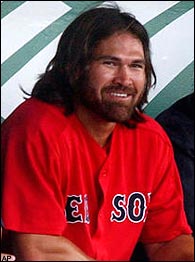
When he played for the Sox, Johnny Damon had the Jesus thing going, though he wasn't terribly effective at throwing people out.

On a certain Saturday in late July of 2006, I found myself sitting in the pastoral care office of Children’s Medical Center in Dallas, Texas, waiting for a ten-year-old boy to die. I had sat with his mother by his bedside earlier in the day. We had cried the Rosary together. We had held hands and gazed upon the face of the little boy. When his mother asked for some private time with her son, I returned to the office and waited for the pager to ring. And as I waited, I jotted down the first verse of a song that took me the next three years to write. The words of John 10 echoed in my mind as I wrote the lyrics because for weeks I had been telling the Godly Play story of the Good Shepherd with children on my floor of the hospital.

Almost four years to the day, I sit at my computer. None of the urgency or the heartbreak of that day remains, and I am aware of the complacency that has crept in over the years. And once again, the words of John 10 return to my mind: Jesus is the good shepherd who calls his sheep by voice. They hear their names and he leads them out of the sheepfold. But a closer look shows that Jesus doesn’t necessarily lead them out (as many English translations say). Rather, he throws them out of the sheepfold. Here’s what I mean.

Jesus begins his discussion with something as close to a parable as the Gospel according to John gets. In the other accounts of the Gospel, Jesus often speaks in parables, but not in John. Instead, Jesus himself is the parable of God — the way God is made known in the world (John 1:18). Here in chapter 10, Jesus speaks in a “figure of speech” about shepherding and sheep and wolves and bandits. Jesus identifies himself as the good shepherd who calls his sheep by name and “leads them out” (NRSV). The word for “lead out” is one of my favorite Greek words: ekballo. This is a fairly prevalent verb in the Gospel according to John and in the other accounts, as well. In the Synoptics (Matthew, Mark, and Luke), when Jesus casts out demons, he ekballo-s them. In John 2, when Jesus drives out the moneychangers and animal sellers from the temple, he ekballo-s them. The man born blind is ekballo-ed from the synagogue at the end of chapter 9. And finally, in chapter 12, Jesus mentions that the “ruler of this world” will be ekballo-ed from it.

In each of these cases, the connotation of ekballo is to drive out or cast out or throw out. But in John 10, according to, say, the NRSV, the shepherd calls his sheep by name and “leads them out.” While Greek words definitely have ranges of meaning, I suggest that we should translate the instance of the word ekballo in chapter 10 not as “lead out,” but as “throw out.” Here’s why.

The first character Jesus introduces in chapter 10 is a thief and a bandit. This person climbs into the sheepfold rather than entering through the gate. The thief comes only to “steal and kill and destroy.” Furthermore, outside the sheepfold there are wolves waiting to snatch up the sheep and scatter them. Hired hands are no help because they run away when they see the wolves coming. With thieves, bandits, and wolves roaming outside the sheepfold, leaving the fold can be frightening and dangerous.

In contrast, the sheepfold is safe and secure — shepherds bring their flocks to these enclosures at night for safety. But the sheep can’t live their whole lives in the sheepfold, no matter how safe and secure they may feel. They must go out into the world beyond the gate to graze for food (which, as far as I can tell, is all sheep do). So the shepherd ekballo-s them. The shepherd throws the sheep out of the fold so they can eat and drink and run.

The sheepfold is a safe place, but everything outside the sheepfold is dangerous. Who would not want to stay in the fold? Being led out into the world can feel like being thrown out. What is my fold? What do I use to shelter myself from the world? Where do I feel comfortable to the point of intransigence? The answer to these questions is the thing from which Jesus throws me out.

Contemporary sheepfolds come in all shapes, sizes, and disguises. Perhaps my family is my sheepfold, or my work, or, yes, even my church. For me, my complacency is the fold from which Jesus constantly throws me. The fold of complacency is slippery and amorphous because it has no walls, no group of people with whom to identify, no action of its own. And complacency leads to complicity with all the bad things in the world. I am so entrenched in my complacency that Jesus has to throw me out of it. It is the demon in me that Jesus casts out, the ruler of my world that Jesus drives out.

And he throws me out of this fold with one simple word: my name. Jesus calls me by name and I hear his voice and I know that I have been in the fold too long. By calling my name, Jesus brings me into an intimate relationship with him. (Remember in middle school when you found out your crush actually knew your name? It’s a good feeling, isn’t it?) By calling my name, Jesus tells me he knows me, knows that I struggle with complacency, knows that I need a swift kick in the trousers (a new translation of ekballo, perhaps?) to prompt me to act in the world on his behalf.

When I listen for Jesus calling my name, I feel his hands continually throwing me out of the fold of complacency. When I hear Jesus calling my name, I know that he has given me life and given it abundantly. This abundance of life is made possible by the intimate relationship Jesus has founded with me by knowing my name. When I venture out of my sheepfold into the frightening, dangerous world, I know that Jesus, my shepherd, is guiding me with his voice. And I know that he will continue to throw me out of the comfortable folds I find myself in so I can, with his help, continue to do God’s work in the world.

Facing Fear

(Sermon for August 8, 2010 || Proper 14, Year C, RCL || Luke 12:32-40)

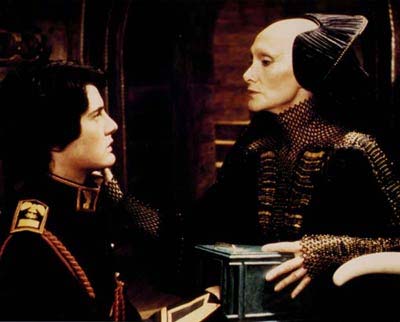
The Bene Gesserit test Paul Atreides at the beginning of Dune. (1984)

Many years ago in a dusty volume, I read an old Bene Gesserit litany against fear, and this prayer has stuck with me every since. “I must not fear,” says the litany. “Fear is the mind-killer. Fear is the little-death that brings total obliteration. I will face my fear. I will permit it to pass over me and through me. And when it has gone past I will turn the inner eye to see its path. Where the fear has gone there will be nothing. Only I will remain.”

Now that dusty volume was Frank Herbert’s Dune, the best selling science-fiction novel of all time, but the words of the litany ring true nonetheless. “I must not fear… Fear is the little-death… I will face my fear.”

From the time we are young children, our parents echo these words and tell us to face our fears. Perhaps you were afraid of the dark. So you mother let you sleep with the lights on for a while. Then she turned the lights off and left the bedside lamp on. A few days later, she turned off the bedside lamp and plugged a nightlight into the wall near the door. Pretty soon, you didn’t even need the nightlight. Your mother helped you face your fear of the dark, and you overcame it.

Or perhaps you were afraid of the monsters under your bed. There they were: always lurking, rumbling, slurping, ready to pounce – until you summoned up enough courage to dangle your head over the side of the bed and chase the monsters away. You faced your fear, and you overcame it.

We look back on these childhood fears and chuckle at how intangible worries grew into monstrous fears. The shadow of your own feet under the covers cast a winged creature on the wall, and the creature moved the more you shook. Under your bed, a pair of shoes and a couple of tennis balls made the ears and eyes of a monster peering up through the floorboards. The fears were nothing really. Our imaginations ran away with us, that’s all.

At least, this is how we adults dismiss those childhood fears. We dismiss them as fanciful or as attention-seeking or as the fruits of overactive imaginations. But hidden within this easy dismissal is also a tacit dismissal of our parents’ advice. “Face your fear,” they said, and we did, and everything got better.

But those were our intangible, childhood fears. That advice couldn’t possibly work on our concrete, grown-up fears. Our fears are too immediate, too relentless, too real. Of course, we forget that this is exactly how our childhood fears felt, as well. Perhaps our parents’ advice, the same advice that I learned reading science fiction, really might work in our lives today. In this morning’s Gospel, Jesus asks his disciples to take our parents’ advice. He asks them to face their fears.

But before we get to that, we first need to address where fear comes from. The root of fear is deprivation. We fear when something has the potential to become scarce. We fear when we perceive that there is not enough of a certain something. Supply and demand economic theory is based squarely on this reality. The root of fear is deprivation. You can trace all fears to this specific cause, even though specific fears may appear quite differently. Fears manifest themselves one way or another depending on the nature of the deprivation. If you are afraid of the dark, you fear a scarcity of light. If you are afraid of contracting a terminal illness, you fear being deprived of a long, healthy life. If you are afraid of how you will live when you retire, you fear that you will not have enough income to sustain your manner of living.

You can trace all fears to specific deprivations, and by confronting the sources of scarcity, you can face your fears. Jesus identifies the disciples’ source of fear when he says to them, “Do not be afraid, little flock, for it is your Father’s good pleasure to give you the kingdom. Sell your possessions, and give alms.” Jesus assures them that their fears are baseless because their accumulation of stuff will not help them enter the kingdom of God. This assurance runs counter to the fashionable reasoning of the day, which stated that the more stuff you owned, the more blessed you were. “God obviously favors that person,” ran this line of thinking. “Just look at all the stuff he has.” Not too much different from today, I’m sad to say.

But Jesus changed the rules. Remember last week’s Gospel? Jesus told us the parable of the rich fool. His land produced more than his barns could hold, so he decided to tear down those barns and build larger ones. The more stuff the rich man had, the more secure and comfortable he would feel, he told himself. Surely, this man would have been considered blessed in his society. But he died the very night he planned to erect larger storehouses, and he surely couldn’t take his barn-loads of stuff with him. The rich man’s folly shows the misguided lengths to which people will go to ward off deprivation, the root cause of fear.

But Jesus shows his disciples another way to face their fear. Rather than accumulating stuff, give it away, he says. Face deprivation by depriving yourself of the things you think you can’t live without. And you’ll discover pretty quickly that you can, in fact, live without those things.

I’m sure that you’ve heard this interpretation before, perhaps so many times that you tune it out now. And if you’re like me, you really aren’t any closer to facing the root of fear than you were the last time you heard someone talk about this. I know for myself that I used to be able to fit all my possessions in a 1992 Mazda Protégé. When I moved to Massachusetts, I needed every square inch of a 14-foot U-Haul. With more stuff comes more fear of loss, more fear of that stuff not being enough.

And the more fear that we have, the more we deprive ourselves of fear’s antidote. That antidote is trust. When we were children, we faced our fears because we trusted our parents’ advice. We believed that they would not lead us astray, and they didn’t. The darkness did not frighten us to death. The monsters did not pounce.

So how come we have so much trouble trusting in God? How come fear tends to trump trust more often than not? I think the answer is this. Trust takes energy. While fear creeps along, keeping us from action, trust derives from the kind of sustained relationship, which establishes and nourishes fidelity. God always keeps God’s promises. God is always trustworthy. The trouble is we have to trust that God is trustworthy. We have to practice the faith that God has given us in order to maintain our ability to trust in God.

And fear constantly diverts this ability. But when we practice trust, when we believe that God’s keeps God’s promises, we can face our fears, we can keep at bay the gnawing dread of deprivation. Our grown-up fears may be concrete and relentless. But I am convinced that they are no match for the power of trusting in God.

This week, I ask you to take some time to be silent and to turn your thoughts inward. What do you fear? What kind of deprivation is at the root of that fear? And how will practicing trusting God help you face that fear? In your reflection, remember this good news. When Jesus says, “Do not be afraid,” he is not just giving a command. He is giving a promise that when we face our fears, we will not be alone. When we face our fears, they will pass through us, and when they are gone, only God, holding us in the palm of God’s hand, will remain.

Pocketing the Sunglasses

During the summer, I am preaching without notes or a text; as such, what follows is the unraveling of my thought processes for a sermon, not the actual words I spoke.

I was riding the T on my way to Mass General when I noticed a young fellow across from me pick up a pair of sunglasses that had fallen out of the pocket of the man sitting next to him. The man was reading a crumpled edition of the free newspaper that seems to germinate in subway stations and hadn’t noticed his glasses fall. The fellow looked at the sunglasses for half a minute and then spent the rest of the minute attempting to get the attention of the man with the free paper. Finally, he poked the man in the knee with the glasses, and the man pocketed them with a grateful smile to the young fellow.

The fellow could have easily put the sunglasses into his own pocket, the complimentary bounty of the inattentive man. Rather, he confirmed my sometimes flagging faith in the human race and handed the glasses back. Of course, there is a clear right and clear wrong in this situation, and to his credit, the fellow chose the right.

Now (and this is for posterity, so be honest) how many of you would have taken the glasses for yourself? How many of you would have seen the (perhaps expensive) shades and decided that the man with the paper didn’t really need them anymore? Finders Keepers, right?

Owing to what were (I am sure) fine upbringings, I hope none of you raised your hands. We spend a goodly amount of time teaching our children the difference between right and wrong. “Emily, I’m glad you’re sharing your jelly beans with your brother. That’s the right thing to do.” “Jimmy, stop hitting your sister. That’s wrong!” Distinguishing between right and wrong is easy. If you have to keep your action a secret – say, for example, you cut the hair off all of your sister’s Barbie dolls – then you’ve probably chosen the wrong thing to do. From an early age, we learn right from wrong, and we hopefully also learn to choose the right, although the actions of recent Wall Street executives disprove the unanimity of this childhood lesson.

While we spend a good deal of time on this lesson, we spend much less time teaching our children the much trickier ability of choosing between right and right. How do we decide when the choice is not between a good and a bad, but between a good and another good?

Let’s look at an example. At 1:30 in the morning, you are driving down the street and you see the light ahead turn red. You roll to a stop and look both ways. No one is coming. Do you wait for green or do you run the light? Convenience may tell you to put the car in gear and keep on going. But, respect for the law keeps you waiting for the light to change. It’s only 35 seconds after all. So, what do you do? In this case, the good of respecting the law should override the good of you arriving at your destination a few seconds sooner.

Now let’s add a few more variables. At 1:30 in the morning, you are driving down the street and you see the light ahead turn red. Your wife is in the backseat; her contractions are only a few minutes apart. The baby is coming any minute now! You roll to a stop and look both ways. No one is coming. Do you wait for green or do you run the light? Respect for the law tells you to wait, but the biological instinct to protect your wife and unborn child by getting to the hospital as soon as humanly possible tells you to go Go GO. So, what do you do? In this case, the good of respecting the law falls short of the good of getting your wife to a medical professional.

Choosing between right and right is a tricky business because both choices are good. So, how do we followers of Jesus make these choices? This past Sunday’s Gospel lesson provides some clarity. Martha welcomes Jesus into her home and then goes about her tasks. Her sister Mary sits at Jesus’ feet and listens to him speak. When Martha asks Jesus to tell her sister to help her, Jesus says that Mary has chosen the better part.

Does this mean that Martha has chosen the wrong thing? Has she done something bad? Of course she hasn’t. This isn’t a zero-sum game with a winner and a loser. Martha has done the same thing that Abraham does in the accompanying reading from Genesis. Abraham bustled around preparing a meal for the three men, who tell him that he and Sarah are finally going to have a child of their own. This bustling isn’t right in the Hebrew scripture and wrong in the Gospel. Martha does the right thing: she provides hospitality for the gathering, which is arguably the highest good in the Hebrew law.

But Jesus says that Mary does a better right thing. She listens to Jesus when she is in his presence. She is not distracted or worried, but attentive to his words. This is the better good, which does not erase Martha’s attempt to do the right thing. Rather, Mary displays the fundamental action, of which Martha’s welcome and hospitality are secondary outcomes.

When I am worried and distracted by many things, how often do I actually stop, take a deep breath, and listen? Not often enough, I’ll tell you. Even when I am engaged in good things, my busyness often drowns out that voice, for which I should be listening. Choosing between right and wrong is easy, but choosing between right and right is difficult. When I have so many good things clamoring for my attention, I first must sit down at the feet of Jesus Christ and listen.

Why I Love Camp

The following post appeared Friday, July 16th on Episcopalcafe.com, a website to which I am a monthly contributor. Check it out here or read it below.

* * *

I love camp. I love being surrounded by more trees than buildings. I love singing Grace to John Williams’ theme from Superman. I love seeing the half-exhausted, half-excited faces of the campers at breakfast. And I love conversing with children and teenagers because every once in a while they will say something unexpected and profound amidst all the buzzwords and canned phrases that they know will be considered “correct” answers during afternoon Bible studies. Invariably, the profundity of their unexpected contributions comes in the form of the simplest, most direct response to a question.

Here’s why this practice is so profound. Over the years, we adults learn to hedge, to inject some wiggle room into everything we say in order to maintain some deniability later on. We prevaricate, deflect, and obfuscate because we’ve learned from the incessant 24-hour news cycle that a juicy sound byte can tank a career. We’ve learned that a verbal defense mechanism is a necessity for survival.

And with our deniability glands working at full capacity, we say, “Well, that’s not exactly what I meant,” or “I’m not sure you heard me correctly” (when, of course, I purposefully didn’t say exactly what I mean). But the problem with speaking equivocally creeps in over time: prevarication erodes the truth that has been in each of us since God knew us in our mothers’ wombs. When we hedge, we atrophy the muscles that store the truth, and we cut ourselves off from bits of the truth that is within us.

Now I’m not saying that we shouldn’t monitor our words to make sure we always speak hospitably and graciously. Hedging is simply a cheap and ultimately ineffective way to achieve what hospitality and grace achieve naturally – namely, speaking in a way that keeps conversation open and kind. Hedging achieves this end by leading us to speak obscurely so that no meaning can quite be pinned down. Hospitality achieves the same end by leading us to speak truth uncoupled from judgment. One of the epic failures of our time is the withering of this graceful truth when we bury it under our own insecurity and our need to conform to society’s agreed upon level of appropriate vagueness.

Okay, let me get back to why I love camp. I love camp because for a week I get to ascend into the clean and invigorating air of youthful wisdom. The young people just haven’t lived long enough to acquire toxic levels of prevarication. They say all the things that were the first to erode in us adults. God will always be with me. You are my friend. Jesus is awesome. And after a few days of rubbing elbows with the young people, I remember the need to nourish the root system within myself that keeps the truth from eroding.

Thankfully, I didn’t have to preach until Tuesday. I had enough time to drink in the campers’ wisdom, so that when it came time for me to speak I was in less danger of hedging and wiggling. (This was a good thing, too, because children can spot phony commitment a mile away.) I had five minutes to talk about Moses and Aaron, and I had played with several ways to approach the story as I thought about speaking to the campers. When I stood up to speak, I knew my direction of travel, but I was unsure where I would end up.

I began to talk about how Moses was making excuses to God, about how he’s no good at public speaking, about how God might as well get someone else. I looked out at the campers, and then I told them to look at each other. Just then, I realized where the direction of travel was taking me. “God gave everyone special gifts,” I said. “A few of those gifts are within us, but most gifts come wrapped in the people around us. Just because we aren’t good at something doesn’t mean we’re off the hook. It just means we have an opportunity to invite a friend to help us.” These words rang true as I said them, but I didn’t feel them within myself before speaking them. I felt like I was absorbing these words from the young people staring up at me. What a gift.

Of course, as usually happens, I spoke the words aloud, but I’m probably the one who benefited from them more than anyone else. I needed the injection of youthful wisdom to find that truth again, the fundamental truth that I forget more than any other. I am not alone. I am with God. And I am with other people. We are God’s gifts to each other. This is the truth, and it leads to another true statement.

I love camp.

Do You See this Woman?

(Sermon for Sunday, June 13, 2010 || Proper 6, Year C, RCL || Luke 7:36—8:3)

Every once in a while in my preaching, I’m going to ask you to imagine that I am a character in the story we’ve just heard. I will speak in the voice of that character and invite you to bring your own imagination to the story. This is an old technique for exploring the scripture going back to the sixteenth century’s St. Ignatius of Loyola and before him to the ancient Jewish Rabbis. So, imagine with me a letter written by Simon the Pharisee the day after his dinner party.

Simon, a servant of the Lord God and Pharisee faithful under the law, to Judith, my dearest sister and confidant: Peace to you and to your house.

I thank God for you every time I write to you since you are one of those rare people whom I know I can trust with my most private affairs. I smile as I write this because you yourself pointed out in your last letter that I only seem to write when I am vexed. And yes, this observation holds true today. I am vexed. I have so many questions, which I’m sure have answers, but I don’t know if I want to hear those answers.

By this point, I’m sure you’ve heard of the teacher from Nazareth who has been making the circuit throughout the region. I invited this Jesus to my house for the evening meal, as is my custom with all the rabbis visiting town. You know I have a soft spot for these provincial teachers who venture out of their backwater villages into the wider world. I enjoy their dusty, local wisdom, and their eyes always grow wide when they see the spread of my table. Never has one spoken words I could not predict. Never has one challenged me. Never has one planted festering questions in my heart.

Until he spoke up last night. I had heard stories about Jesus, but they were the same ludicrously incredible stories I always hear when the gullible discover hope. He forecast a huge catch of fish. He made a leper’s skin clean. He raised a widow’s son from the dead. I tell you, sister, the masses are never satisfied unless they have something sensational to chatter about. You know that I’ve always been good at reading people – but I confess, I misread Jesus from the very beginning. He may be from a provincial backwater, but he spoke with an authority I’ve never heard before. And he said such unnerving things. His voice continues to echo in my mind. But I get ahead of myself.

Here’s what happened. Dinner was progressing nicely. My guests were appropriately appreciative, and I was appropriately modest. But as the steward came around to refill our cups, he very nearly tripped over the prone body of a woman. She lay at Jesus’ feet, a quivering heap of streaming tears and unbound hair. A full minute passed before my shock subsided, and I realized that this trespasser, disguised by her reddened face and tangled curls, was in fact someone I had met several times. She is notorious in the district. Independently wealthy after a string of ancient husbands, she adds to her fortune by lending money at exorbitant rates of interest. Desperate people will take any avenue open to them, God knows – even the road to a predatory usurer.

Such was the kind of woman who walked uninvited into my home, disrupted my gathering, and disgraced everyone in the room with her outrageous display. Everyone that is, except Jesus. He allowed the behavior to continue. He even allowed the usurer to pour expensive ointment on his feet (bought no doubt by means of her immoral practices). “Some prophet,” I said to myself. “If he were who people claim he is, he’d know that the woman touching him is a sinner.”

Just then, as if he had heard my thoughts, Jesus confronted me. “A creditor had two debtors,” he said. Maybe he does know this woman’s sin after all, I thought. “One owed a lot of money and one owed a little,” he continued. “When neither could pay, the creditor canceled both debts. Which do you think will love him more?” The answer was obvious – the one who owed more money. But I couldn’t comprehend why he told the story. Then Jesus gestured to the sinner at his feet. “Do you see this woman?” he asked me.

Did I see her? Of course, I saw her. She was ruining my dinner. She was staining my house with her very presence. But sister, oh, his question does continue to fester. “Do you see this woman?” No. I did not see her. I saw “it.” I saw the spectacle: the weeping, the kissing, the impropriety of it all. I did not see her. I saw her sin – her usury, her taking advantage of the poor and desperate. I saw only her sin wrapped up around her like a costume.

But that is not how Jesus saw this notorious woman. He knew she had many sins, and he forgave them. He touched her face with his hand, looked her right in the eye, and said, “Your sins are forgiven.” An uproar went up around the table at these words, but I had no stomach to generate the appropriate outrage. Jesus’ words continued to echo in my mind, disarming me. And today, as I write you this letter, I find that those words have begun to sink down into my heart and into my gut.

Rather than seeing the woman, I saw only her sin wrapped around her. But Jesus saw her. He saw the person underneath the heavy layers of transgression and immorality. He saw the good creature that God created – before her sin distorted her. And in that act of forgiveness, I think Jesus removed those burdensome layers. Don’t ask me how, but he untwisted the distortion, and the costume fell away. Is it possible that Jesus never even saw the costume? Is it possible that he immediately saw the woman as she was going to be once he forgave her? And in his seeing beyond the distortion, did the costume simply disappear?

Oh sister, these thoughts are too much for my mind to comprehend. This provincial teacher understands forgiveness much better than I. Perhaps…perhaps Jesus has shown me a glimpse of how God sees us. Could it be that God sees beyond our sin from a place of total forgiveness? And because God sees from this place of total forgiveness, does not God grant us this same gift of vision? Could forgiveness allow us to see beyond the masquerade of sin that distorts our reality? If so, then forgiveness allows us to see others as they truly are, not as accumulations of sin, but as broken people in need of love.

Dearest sister, that is my sin: I see the transgression so I don’t have to see the person. I see the costume because I want an excuse to keep the person underneath at a distance. Jesus saw that in me right away. He called me out for my inhospitality. I didn’t wash his feet or welcome him with a kiss or anoint his head with oil. I brought him into my own home simply to stoke my own ego, not to form any kind of relationship.

But do you think he could forgive me like he forgave the woman? Or has he already done so? Yes, I think he has: in his act of forgiveness, I am able to see my own costume now. I see my sin. He must have forgiven me so that I might find the eyes to see myself as God sees me – without the distortion, without the costume. If I can see myself with these eyes, how could I ever again look at those around me and see only their sin?

Dearest sister, I pray for these new eyes. I pray for the capacity to see beyond the costume. I pray that, if Jesus ever again asks me, “Do you see this woman,” I can say without hesitation or equivocation: “Yes, I see her.”

Whatever Passes Along the Paths of the Sea: The Oil Spill and Psalm 8

I first posted this reflection on Psalm 8 (the Psalm from Trinity Sunday) on the website Day1.org, a site on which I am a “key voices” blogger. If it sounds more academic than my normal writing, it is because this piece began it’s life as a seminary paper. I promise it sounds way more academic in it’s original version.

* * *

source: huffingtonpost.com

Seen from aerial photographs, the oil spill looks like any old gasoline rainbow you might see on the pavement outside a gas station after a drizzle. Then you realize the picture is taken from a few thousand feet and the patch of oil is hundreds of square miles in area and the spill is growing because it’s not a leak, it’s a geyser. Such thoughts send the mind reeling. How could we be so bold, so cocky, so derelict in our duty to God to be stewards of this creation that we pump toxic liquids out of the ground without so much as even a sketch of a plan to deal with the consequences of our own fallibility?

With these thoughts on my mind (and, I must confess, I am safely ensconced on a different coast far from the poisonous ooze), I glance at the readings for Trinity Sunday and the words of Psalm 8 hit me hard upside the head.

1. O LORD, our Sovereign,
how majestic is your name in all the earth!
You have set your glory above the heavens.
2.  Out of the mouths of babes and infants
you have founded a bulwark because of your foes,
to silence the enemy and the avenger.
3.  When I look at your heavens, the work of your fingers,
the moon and the stars that you have established;
4.  what are human beings that you are mindful of them,
mortals that you care for them?
5.  Yet you have made them a little lower than God,
and crowned them with glory and honor.
6.  You have given them dominion over the works of your hands;
you have put all things under their feet,
7.  all sheep and oxen, and also the beasts of the field,
8.  the birds of the air, and the fish of the sea,
whatever passes along the paths of the seas.
9.  O LORD, our Sovereign,
how majestic is your name in all the earth!

With uncanny prescience, the psalmist speaks to our modern world about humanity’s role in creation, one based on the proper comprehension of humanity’s status as God’s subjects and therefore as servants of God’s creation. The second verse, which introduces the theme of dependence, seems out of place in the overarching language praising God for creation and humankind’s place in it. Of course, it’s always the verses that seem out of place that hold the most interpretive weight. By introducing the idea of dependence, the psalmist directs the audience to reflect on the necessity of human humility in regards to humanity’s relationship with God, especially concerning the dominion over creation.

At first glance verse 2 stands in contrast to the rest of the psalm since it concerns itself with enemies that are not mentioned again; further, verses 1 and 3 flow together nicely, with the thought of heaven connecting the two verses. But instead of mentally removing verse 2 so that the psalm flows smoothly, the reader must dwell on the second to come to the subtler and deeper orientation that the psalmist attempts to reach. The psalmist praises God for founding a “bulwark” (or strength, stronghold) against enemies “out of the mouths of babes and infants.” For those reading the psalms in order, this is the first time infants are mentioned in the entire Book of Psalms; indeed, the image of the babe is a fresh idea. A prevalent mental association made with infants is their dependency on their parents. The psalmist makes this association explicit by using not only the word for child, but also the word for “nursing infant,” The nursing infant truly is dependent on his or her mother in a way to which no other relationship quite compares. And it is out of the mouths of the utterly dependent that God achieves God’s plan — in this case beating back the foes, which scholar J. Clinton McCann deems “the chaotic forces that God conquered and ordered in the sovereign act of creation.”

With the interpretive key of dependence planted firmly in our minds, we can turn to the rest of the psalm. Verse 1 names God with the divine name and then follows with a title for God. The divine name automatically engenders feelings of obedience, but the addition of a title of “sovereign” serves as a further reminder that God is in charge. Because God exercises complete sovereignty, humans are as completely dependent on God as nursing infants are on their mothers.

Moving to verses 3-5, the psalmist looks up to the night sky and is walloped with a feeling of insignificance. And why not? In The Hitchhiker’s Guide to the Galaxy, Douglas Adams unwittingly offers an explanation of verse 3: “Space…is big. Really big. You just won’t believe how vastly hugely mindbogglingly big it is. I mean you may think it’s a long way down the road to the chemist, but that’s just peanuts to space.”

Scholar Peter Craigie points out that the psalmist drives home the point of humankind’s insignificance by saying that God establishes this mindbogglingly big thing with God’s fingers. This awareness of humanity’s smallness in the grand scheme could reduce us to apathetic movement through life because nothing we do would seem to matter. The psalmist nearly slips into this dangerous mode of thinking in v. 4; indeed, the hymn of praise could become a psalm lament at this point. But in the words “mortals that you care for them,” the reader recalls verse 2 and remembers that we are in a dependent relationship with God, who is our sovereign. Verse 5 continues this recollection by adding “yet you have made them (a little lower than God).” By reading verses 3-5 in light of verse 2, the faith that God made us and cares for us outweighs any feelings of insignificance that the night sky may provoke.

Verses 6-8 shift the focus from humankind’s dependence on God and humanity’s misplaced feelings of insignificance to the role God has ordained for humankind on earth. These verses recall the vocation God gives humanity on the sixth day of creation. While the word “dominion” in verse 6 is different than “dominion” in Genesis 1:26, the parallels with Genesis 1 are unmistakable. The language of largeness and smallness remains in these verses, which continues the theme of significance/insignificance seen in the previous three verses. God gives humankind dominion over small sheep, birds, and fish, and also large oxen, beasts, and “whatever passes along the paths of the seas” (the Leviathan which God “has made for the sport of it,” perhaps? (Psalm 104)). Humankind is given charge over great and small creatures; as the psalmist says, “you have put all things under their feet.” However, the psalm does not end with humanity’s dominion. In an inclusive bookend with verse 1, the psalmist reiterates the sovereignty of God over all things. This reprise recalls once again the dependence that humanity has on the LORD, who is their Lord.

What does this discussion offer the modern audience? We live in a global society hell-bent on destroying itself. We clear-cut forests, remove mountaintops, and pump toxic levels of Carbon Dioxide into the air. We do not share the bounty of the land, thus pushing others to burn rainforests and oases for farmland. We live under the delusion that we can develop “safe” oil rigs. We refuse to believe that our actions are slowly turning our world, a piece of God’s creation, into a planetary rubbish bin, fit only for storing the waste we accumulate.

Psalm 8 is a wakeup call, the An Inconvenient Truth of the Bible. To put it simply, the world today has forgotten the truth, which Psalm 8 espouses — that we are dependent on God even though (or more appropriately, especially because) we exercise dominion over the earth. We miss the all-important message that God has given us dominion: we do not intrinsically have it. We properly receive this gift only when we recognize our relationship with God is one of total dependence. Scholar James Mays puts it this way: Psalm 8’s “vision of the royal office of the human race is completely theocentric, but humanity in its career has performed the office in an anthropocentric mode. Dominion has become domination; rule has become ruin; subordination in the divine purpose has become subjection to human sinfulness.”

In the end, the problem is the oldest problem in the book — human self-aggrandizement destroys the purpose that God originally conceived for humanity. Misplaced delusions of grandeur unravel humanity’s proper relationship with God. Scholar Walter Brueggemann says, “Human persons are to rule, but they are not to receive the ultimate loyalty of creation. Such loyalty must be directed only to God.” Psalm 8 calls us back to the correct relationship with God concerning creation. We are utterly dependent on God, we are significant in the realm of creation, but we are not the source or the beginning (though we may very well be the end). In Psalm 8, the psalmist reclaims our primal orientation as dependent subjects on God who has been given us the gift of caring for creation. When we recover this proper relationship, we can take steps to retrieve creation from its slow decline, so that we can once again see the “majesty of God’s name in all the earth.”