Transfigured Eyes

Sermon for Sunday, February 7, 2016 || Last Epiphany C || Luke 9:28-36
transfiguredeyesEvery year on the Sunday before Lent begins, we read this Gospel lesson. We call it the story of the Transfiguration, which is a fancy way of saying “something turning into something else, usually a more beautiful something else.” And if we stopped there with the label we apply to the story, we would get something out of it to strengthen our faith. We would see some evidence that Jesus was really whom he said he was, since his face changed and his clothes dazzled and two famous dead prophets came round for a chat. But I don’t think this evidence is really what Luke means for us to get out of this story. I don’t even think the term “Transfiguration” applies to Jesus. Rather, since the whole story is told from the disciples’ perspective, I think they are the ones who are “transfigured.” I’ll explain what I mean by that in a minute, but first I’d like to tell you about my fifth grade science fare project.

While many of my friends were slapping papier-mâché over chicken wire frames to make baking soda and vinegar volcanoes, I was enamored by the properties of light. So for my project, I procured a small triangular prism, glued it inside a shoebox, and positioned a penlight to shine at the prism. Then I cut a slit in the box so the judges could see the subtle rainbow made when the white light broke apart into every child’s mnemonic friend, ROY G. BIV. (That’s Red, Orange, Yellow, Green, Blue, Indigo, Violet for those of you who never met Roy in school.) I remember feeling so proud of that science project, like I had done magic by shining light through a prism. My mother hung prisms in the most sun-drenched windows of our house, so we always had rainbows dancing on the walls, and now I had captured one in a shoebox!

In the end, however, the explosive grandeur of the baking soda and vinegar volcanoes ruled the day, and I did not take home a blue ribbon. But because of my research I did find a way to rationalize my loss. “That blue ribbon is no better than my yellow ‘honorable mention’ ribbon,” I told myself. “It only appears blue because it reflects a certain wavelength of the visible spectrum.” See, I learned something!

I also learned that we humans see because light breaks open in predictable ways. Objects absorb, reflect, and refract light in particular patterns, which allow our brains to catalog them. The first Genesis creation story begins with God saying, “Fiat Lux!” (God speaks in Latin, didn’t you know?) “Let there be light!” Why? Well, because from the human perspective, we need light to give everything else definition and vibrancy. And yet, the light we see is a teeny, tiny part of the spectrum – just a 300 nanometer band, in fact.

Of course, we often labor under the presumptuous notion that only what we see exists, despite all evidence to the contrary. We listen to the radio. We microwave leftovers. We sunburn. All these things happen due to parts of the (electromagnetic) spectrum that we can’t see. But they are just as real as our friend, ROY G. BIV.

Now, the jump from science to theology is a short one here. When he takes the three disciples up the mountain, Jesus also negates the presumptuous notion that only what we see exists. “And while he was praying,” Luke tells us, “the appearance of his face changed, and his clothes became dazzling white.” The appearance of his face changed. Peter, James, and John see Jesus in a different and more glorious way than they had seen him before. In this moment on the mountaintop, Jesus gives his friends the gift of seeing him with transfigured eyes. They are used to seeing a dusty traveler with ruddy skin weathered by so many nights out of doors. But now they see him as God sees him: a luminous being shimmering in the light of God’s glory and favor. Their transfigured eyes see him for once unfettered by any notion of the usual expectation of humanity. Their transfigured eyes see into their collective memory, see connection to the prophets of old. And their transfigured senses continue to expand when their ears hear a voice that commands them to listen to Jesus.

I’m sure the experience overwhelmed Peter, James, and John. It certainly left them speechless. Just imagine if suddenly you could see the rest of the spectrum: the gamma and x-rays speeding by, the ultraviolet and infrared light expanding your vision, all the other waves crowding your visual cortex. I think I might last about half a second before my brain just stopped working, overloaded by the torrent of stimulation. If the disciples felt anything like that when they saw the true and radiant reality of Jesus on the mountaintop, then it’s no wonder Peter just started rambling incoherently.

The point of this whole thought exercise is to focus us on the following questions. As we approach Lent, a season of rededication to spiritual practice and realignment of skewed priorities, what encompasses the limited spectrum through which each of us views our possibilities? What blinders have we affixed to our eyes that keep us from seeing all the possibilities that God’s grace illuminates around us? And how can we receive the same gift Jesus gave his friends, the gift of transfigured eyes?

Too often we shackle ourselves to the tyranny of the currently possible. The spectrum we see is the one we were taught or the one we are used to or the one we are comfortable with. But there is so much more than the currently possible. Who could have predicted a hundred years ago the technology we have today? And who can predict where your faith might lead you tomorrow if you decide to take a risk today, to trust God today, to say “yes” to something today?

Too often we affix blinders to our eyes so that we see only one path. It’s just so much easier to keep our heads down and trudge along. But the truth of the matter is that our path is not a single road, but a person. When Jesus said, “I am the way, the truth, and the life,” he never meant for us to separate the three. Our path is a dynamic one, full of choices and consequences, and it takes a lifetime, but we never walk the path alone.

Too often we see only what we expect to see. And so we pray for transfigured eyes so we might catch glimpses of how God sees. This Lent, I invite you to join me in praying for such eyes. Each day for practice, make a point to notice something you’ve never, ever seen before. Today’s something might be bird in flight at sunset. Tomorrow’s might be the shape of your child’s face, so different now than it was a year ago. The next day’s might be the lettering on the cardboard sign of a silent and bundled figure at the traffic light. Whatever you see, engage it with appreciation or concern or thanksgiving. Practice noticing. Train your eyes to see past the surface to God’s dazzling reality underneath. That’s what transfigured eyes are for: to discover God’s glorious presence at the heart of all things, and to be thankful.

The Rock and the River

Sermon for Sunday, August 23, 2015 || Proper 16B || John 6:56-69; Joshua 24:1-2a, 14-18

rockandtheriverToday we complete our long, five-week march through the sixth chapter of the Gospel according to John. We read every last word, some of them multiple times. Jesus fed the crowds – five thousand strong – with one person’s groceries. He walked on water to meet his companions across the sea. He spoke to the crowds at length, hoping to move them past their rumbling tummies to the deeper craving for the “bread of life”; that is, the sustenance of abiding relationship with him. But the people don’t get it. They aren’t ready to hear what he has to say. And yet, Jesus keeps pushing. He keeps extending the metaphor, making it more explicit, until he’s talking about eating and drinking his own flesh and blood.
To this many of his disciples respond, “This teaching is difficult; who can accept it?” And they stopped following Jesus that day. They “turned back and no longer went about with him,” John narrates. I bet – in that moment as they were wandering away back to their old lives – Jesus could feel the power to compel them to stay surge up within him. I bet he knew that if only he willed it, they would turn around and come back, like dogs on leashes. But Jesus knew better. He knew that every person had to be free to choose to leave, or else it wouldn’t ever be worth staying.

After they leave, he turns to his twelve most faithful companions, his inner circle, and asks them a question. I always hear a thick sadness in his voice when I read these words: “Do you also wish to go away?” In that moment teetering on despair, Peter gives Jesus a gift: “Lord, to whom can we go? You have the words of eternal life. We have come to believe and know that you are the Holy One of God.”

In John’s Gospel, belief is synonymous with relationship. So when Peter says these words, he affirms his relationship with Jesus, despite any perplexity Jesus’ words about flesh and blood might have caused him. This is the same Peter who later denies knowing Jesus three times on the terrifying night of Jesus’ arrest and trial. And this is the same Peter who even later has this denial healed when Jesus asks three times if Peter loves him. Peter’s real name is Simon. Jesus nicknames him Peter, which means “Rock.” You may recall in another account of the Gospel Jesus making a pun: I call you Peter/Rock, and on this Rock I will build my church.

When you call someone a rock, you mean she is steadfast to the end. “Patty was a rock the whole time her daughter was in the hospital.” That may seem true from the outsider’s perspective, but the real story probably looks more variable – like Peter’s. Maybe Patty held it together whenever she and her daughter had visitors. After all, in an odd but predictable reversal of roles, it often falls on the people involved in a tragedy to comfort those coming to visit. Of course, she was a rock when visitors came around. But how many times did Patty break down sobbing in the middle of the night by her daughter’s bedside, alone but for the steady beeping of the machines? How many times did despair creep in? How many times did she rage at God (a totally appropriate reaction to her situation, mind you)?

I seriously doubt that anyone who’s ever been called a “rock” ever felt like one themselves. In our example, Patty might even feel some misplaced shame for her lack of stability if people label her “rock,” no matter how well meaning they are. Throughout the Gospel and the book of Acts, we can see Peter trying to live up to his nickname, only to fail on multiple occasions. One of these failures actually leads to a huge expansion of the early church, when the Rock realizes he is wrong and changes his mind.

All this to say that the life of faith is much more variable than many of us desire or are comfortable with. None of us is on a perfectly straight road like the Interstates out in the mid-West. Rather our lives of faith run more like rivers or streams – twisting around boulders, bubbling through rapids, tumbling down waterfalls, flowing swiftly, flowing lazily, sometimes stagnating, sometimes surging.

And it has always been this way. In the reading from the Hebrew Scriptures this morning, Joshua puts a choice before the Israelites: “Choose this day whom you will serve.” Will it be the lifeless and false gods of the peoples of the land or will it be the Lord. Joshua answers for himself first: “As for me and my household, we will serve the Lord.” All the people answer the same way: “We also will serve the Lord, for he is our God.” But it doesn’t take long for this promise to fade into obscurity. In fact, the rest of the Hebrew Scriptures narrate the story of the people of Israel oscillating between following God and throwing their lot in with some other convenient deity of the month.

So why is the life of faith so much more variable than many of desire or are comfortable with? Well, because we don’t have two lives – a normal life and a life of faith. We just have life. And life is all about change. If we labored under the delusion that our faith could not and should not have some variability, then that faith would never line up authentically with the rest of our lives. It would be as disconnected from us as a Midwestern Interstate is from a stream meandering down a mountain.

I urge you, therefore, not to beat yourself up when you don’t feel as faithful as you did last week or last year. There are periods of time when each of us – including me – are lost in the desert. But the good news is this: in the end, our faith or lack thereof is only a part of the story, and a small part of the story at that. God’s steadfastness matters much more than ours. The story of the Hebrew Scriptures is not just the one about people turning away from God; it’s also the one about God continually calling them back. Remember, God was there in the desert, too.

This interplay between God and God’s people finds expression in a curious grammatical ambiguity that crops up in many of St. Paul’s letters. In several places Paul is either talking about “faith in Jesus Christ” (that is, our faith) or “faith of Jesus Christ” (that is, Jesus’ own faith). It could mean either, and Paul probably wants it to mean both. The steadfast faith of Jesus Christ, who is the true Rock (no matter Simon Peter’s nickname), holds our faith for us when we are too angry or too sad or too distracted or too apathetic to access it ourselves. In this, the faith of Jesus Christ is like our regent, ruling in the place of us, the infant kings and queens, until we are ready to take up the mantle.

I like to think that some of those folks who walked away from Jesus came back another day because they realized they were still hungry and only his words of truth could fill them. I like to think they once again took up the mantle of faith. The same goes for us. The invitations that Jesus Christ offers to us to join him in his work of healing and reconciliation will never stop arriving at our doorsteps. His faith in us activates our faith in him. Our meandering streams can each day meet his surging river. Why not today?

Four Faiths

Sermon for Sunday, June 21, 2015 || Proper 7B || Mark 4:35-41

fourfaithsTwelve years ago today, I preached my very first sermon. Delivering a sermon was a requirement of my internship at St. Michael and All Angels Church in Dallas, Texas. So when the other four interns and I received the readings we’d all be preaching on, we dove right in, determined to preach the best sermons the great state of Texas had ever heard. That didn’t happen. But we each managed to say something coherent about Jesus calming the storm, and none of us fainted in the pulpit, so I call that a win. I have a muffled recording of the sermon I preached. I made the mistake of listening to it earlier this week. Wow, it’s really bad. There was something about complacency and faith and God shaking us up and Isaac Newton’s first law of motion, but I didn’t real say anything to take home with you.
The thing is, at the time, I thought it was a pretty good attempt at preaching. I felt pretty good when I sat down. So why do I shake my head when I listen to it now? Well, my understanding of faith has changed quite a lot in the last twelve years, so what I hear in the sermon rings a bit hollow. But I expect my understanding of faith to change quite a lot in the next twelve years, too.

The question is this: if I’m no longer where I was faith-wise twelve years ago, does that make my earlier faith false? The answer to this question must be a resounding, “No!” Surely God is able to work through the most tentative faith or the most hardened faith or even the most erroneous faith. God makes use of any raw materials we bring to the table, however clumsy they happen to be.

I’d hazard to guess that your understanding of faith has changed quite a lot over the course of your lifetimes, as well. This isn’t a bad thing. Rather, if your faith has changed over time, you’ve probably been wrestling with it, questioning it, wondering how it impacts your life. A faith that does not undergo some kind of change over time is more than likely an unexamined faith or just a cosmetic one.

I’d like to share with you four understandings of faith that I have gone through since I preached that sermon twelve years ago. I don’t claim that any of these are wrong; rather, where I am now in faith happens to be the most helpful understanding for the current stage of my following Jesus. As you listen to these four descriptions, see if you can locate how you experience faith. Is another description beckoning you? Or is there a completely different understanding of faith that I know nothing about? This exercise is important because an unexamined faith often becomes a stagnant one.

First up: my understanding of faith during that sermon in Dallas. At that time, faith was a quantity. It was something I could measure. This makes sense: after all, in today’s Gospel reading, after Jesus calms the storm, he says to his disciples, “Why are you afraid? Have you still no faith?” If they have zero faith, then presumably they could also have a little faith or some faith or much faith.

The challenge to this understanding comes when something happens to tip the scales: a tragedy that takes a loved one’s life, an unexpected diagnosis, a relationship in tatters. You might beat yourself up, saying, “If only I had a little more faith, I could get through this.” When tragedy strikes, we forget the blessing that comes with this understanding of faith as a quantity. Jesus says that faith the size of a mustard seed (that is, the smallest amount possible) is enough to weather the storm.*

When I was in seminary, my understanding of “faith as a quantity” morphed into something else. For a long time, I swapped “faith” with a word that’s almost a synonym. That word was “trust.” For some reason, I couldn’t find the active component of faith that seemed to be missing from the “quantity” definition, so I replaced it with something I felt I could do. I could trust God. When Jesus calms the storm, he might as well have said, “Why are you afraid? Don’t you trust me?”

The most common expression of this understanding is the proverbial “leap of faith.” The shadowy unknown spreads out in front of you, and yet you walk on, trusting that God will guide you. Your faith is like the headlights on your car, which only illuminate the patch of road in front of you but still somehow manage to get you home.**

Over the first few years of ordained ministry, this view of “faith as trust” broadened. The act of trusting was not big enough to contain all that faith was. This is when “faith” became a verb for me. Faith was the active component of my relationship with God, the thing that spurred me to love God and serve God’s people. While Jesus might say the disciples have no faith, they still woke him up, thinking he could do something about the storm. As I said in a sermon for you all last year, this understanding of faith “borrows the best parts of trust, confidence, humility, and zeal and molds them into our response to God’s presence in our lives.”

The word “presence” carries over from this understanding of faith to the one that is alive for me today. And that is faith as direction or orientation. Faith is the mysterious something inside us that always and forever points to God’s presence, like a compass needle pointing due north. But we are not always facing the right way, and so the compass of faith prompts us to turn around. The technical word for this turning is “repenting,” which can lead to a renewal of our relationships with God.

Sometimes we have blinders on our eyes that make us look straight ahead through a narrow field of vision.*** God might be calling us to unimagined possibilities dancing just out of sight. Our faith invites us to widen those blinders until we can once again see what’s pointing to God. When we are overwhelmed by tragedy or grief or doubt, the blinders can snap tight again. But faith beckons us to open wide so we can find our true orientation towards God’s presence. Do you think Jesus halting the storm with a word was even close to a possibility on the disciples’ minds when they woke him? No. And yet what little faith they had still pointed to him as their refuge.

This is where my understanding of faith currently stands. I learned it from my father and from talking with many of you as you’ve sat on the couch in my office and spoken of your secret hopes and deepest fears and gnawing doubts and strangling griefs. I don’t know what my understanding of faith will be twelve years from now, but for today, this is it. Faith is the internal compass needle pointing to God’s presence. And since God’s presence happens to be everywhere, the blinders on my eyes serve no purpose at all.

I hope you will take some time this week to take stock of how your faith expresses itself. If faith is a quantity, how much do you need for it to guide your life? If faith is trust, into what unknown is God calling you to leap? If faith is a verb, the active component of your relationship with God, what are you and God doing together this afternoon, this week, this year? And if faith is your orientation towards to God’s presence, where and to whom is it pointing? What possibilities are dancing just out of sight?

*Actually, it’s enough to uproot the mulberry tree and have it throw itself in the sea, but I’m working with the storm metaphor here.
 **I first heard this metaphor during a seminary class, but I have no idea where it originated.
***Thanks to my father, the Rev. Dr. William Carl Thomas, for this image.

Psalm 23, Expanded

(Sermon for Sunday, May 11, 2014 || Easter 4A || Psalm 23)

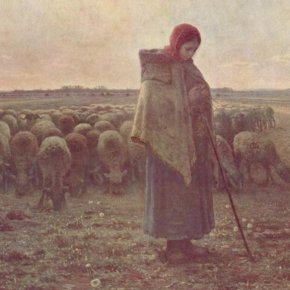
shepherdessIn six years of priesthood, I’ve preached on the psalm exactly twice. Today, I’m going to make it three times. Psalm 23 is among the most well-loved and oft-quoted passages of scriptures. We read it at funerals or by the bedsides of those who are sick. When you listen to these words, you might hear an echo of your grandmother reciting it to you when you were a child. The words of Psalm 23 are powerful and gentle at the same time. But, as with anything you hear over and over again, the words can grow stale and distant. So I’d like to try something. I’d like to offer a meditation on Psalm 23 by expanding the thoughts contained in each of the six verses. Saint Francis of Assisi did something similar with the Lord’s Prayer, and I’m going to follow his example. As you listen, see how the venerable words of the twenty-third Psalm strike you anew.


The LORD is my shepherd.
For most, our agrarian days are long past and we see pastureland only from the car window as we drive by on the highway. We see the animals in the field, and we think, “How quaint and how beautiful.” But something tugs inside, and we notice a secret longing for a simpler time. We desire to tramp through the long grass, the only sounds the swish of our clothes rubbing together and our voices calling the flock. Each sheep has a name, and as we call, they come. We have a shepherd, too, who calls us each by name. We have a guide. A protector. A provider. The Lord is my shepherd;

I shall not be in want.
It’s a statement of faith that hangs on the promise of provision, the expectation that the Lord will provide. But this English rendition of the Hebrew words gives them more than one meaning. We will not be in want; that is, we will lack for nothing we need to sustain us. But we will also be free from the concept of “wanting”; that is, when we believe the Lord will provide, we will resist the siren song of consumer culture that seduces us, that tries to tell us security only comes with more stuff. “I shall not be in want,” means that we understand proportion, that we have a realistic notion of the word “enough,” and that we find contentment in living simply.

He makes me lie down in green pastures and leads me beside still waters.
These are the good days – the days of plenty, the days of refreshment. The still waters reflect God’s peace. The green pastures announce God’s abundance. Peace and abundance feed our awareness of the One who leads us. We notice that, in the words of Gerard Manley Hopkins, “The world is charged with the grandeur of God.”* Noticing this grandeur re-“charges” us. Or in the words of the psalmist:

He revives my soul
My essence. My life-force. The gift God gave each of us in the sparkling moment of creation that connects our fleetingness to God’s eternity. God’s grandeur is present, and yet we might still miss it. We tire. We burn out. We feel more fleeting than eternal. Thus our Lord revives our souls time and time again…

And guides me along right pathways for his Name’s sake.
Oftentimes in the psalms the poet reiterates a thought with a parallel one, which is why many psalms have a repetitive nature to them. Here we have a hidden parallel: reviving our souls and guiding us along right pathways are two sides of the same coin. The pathways along which our shepherd guides us lead to revival, to green grass and refreshing water. And all for God’s name’s sake; in other words, all to make God’s grandeur apparent. And yet…

Though I walk through the valley of the shadow of death, I shall fear no evil.
If the shepherd is leading us, why do we walk through this particular valley? Why is it on the route at all? Do we stumble into the valley of the shadow of death because we have strayed from right pathways, or do the right pathways include a road through this valley? We all know life isn’t just green pastures and still waters. We are a people formed by the reality of the cross. But the cross – the shadow of death – is not the end of the story. The joy of the resurrection proclaims that we are not abandoned in the valley of the shadow of death. No. We walk through the valley and out the other side. Perhaps we make this journey because there are people stuck in the valley. It is our duty and our joy to help them find their way out.

In the valley we fear no evil; not because evil doesn’t exist, but because fearing evil gives it power. Fear keeps us from trusting that we will make it out the other side of the valley. Evil seeks to separate us from the One in whom we put our trust. But evil will not succeed…

For you are with me; your rod and your staff, they comfort me.
This is our mantra while in the valley: “You are with me. You are with me.” Just because we have trouble noticing God’s presence doesn’t mean God is absent. And so we breathe these words, “You are with me,” until they become, “I am with you.” And dwelling in that truth, we find comfort. Comfort and sustenance, for…

You spread a table before me in the presence of those who trouble me.
On the bad days, we might not be able to find the green pastures or the still waters. We might stop believing we have enough and start listening to the seductive voices of those who trouble us, those who chant: “More. More. More. Then you’ll find comfort.” And so, on those bad days, instead of leading us to the pasture to forage for ourselves, the Lord sets a banquet before us. The Lord places what we need right in front of us so we can’t miss it. And we discover once again the abundance inherent in trusting in the Lord to provide.

You have anointed my head with oil, and my cup is running over.
When the Lord provides, the Lord provides. What we are fearful won’t be enough overwhelms us instead. Our cups overflow with blessing, both because there is so much blessing, and also because we have made ourselves too small to contain it. The extravagance of God’s blessing fills us in a way that the “More” of the seductive voices could never achieve. When our cups run over, we have the opportunity to spill God’s blessing on all those we meet. As the Lord guides us along right pathways, overflowing blessing marks the way for us and for those who will come after. And as we walk those ways…

Surely your goodness and mercy shall follow me all the days of my life.
The Lord, our shepherd, guides us, leads us by the hand through the valley of the shadow of death to the green pastures and still waters. The Lord takes the lead. We follow. And notice what follows us: God’s goodness and mercy trails us like the churning wake of a ship at sea. Thus, we are surrounded: God’s blessing and abundance before us, God’s goodness and mercy behind us. And above, below, and within us is the truth of God’s promise that…

I will dwell in the house of the LORD for ever.
For ever includes right now. To dwell means not just to live, but to abide. To unpack all our boxes. To put our clothes in the drawers and fill the refrigerator. To make a home for ourselves in the palm of God’s hand. This is the witness of this beautiful poem, Psalm 23. Wherever we go, whatever we do, we have a home in our Lord’s house. We have a provider in the Good Shepherd. And we have eyes to witness, here and in the life to come, a world “charged with the grandeur of God.”


Art: Detail from “Shepherdess,” by Jean-Franc Millet (1864).
* Gerard Manley Hopkins, “God’s Grandeur

Vessels of God’s Revelation

A reflection for the Feast of the Epiphany

starsAt the end of the season of the church year that we begin today, we find ourselves standing on the mountain with Peter, James, and John. Countless stars shine in the deep blue sky above, and we find ourselves staring up at those stars in wonder and awe. But then a new light – one that outshines the stars themselves – grows in front of us. It’s so bright that we can barely look at it, yet it commands our vision. Jesus is at the center of the light. It’s not shining on him, but forth from him. He is the light. As we gaze at him, a thought stirs in our guts: this is what Jesus looks like all the time. But in this moment, we are given the gift of seeing him as God sees him: as a luminous being that outshines the sun. We are given the gift of revelation, a sudden and surprising knowledge that we can attribute only to God. We are given the gift of epiphany.
Working backward from this event known as the Transfiguration, we read in the Gospel the Sermon on the Mount, in which Jesus teaches any who would listen how to be his follower. We meet the disciples as they leave their boats and follow Jesus, as he invites them to “Come and see” where he abides. We stand on the shores of the river Jordan as Jesus comes up from the baptismal waters, and we hear the thunder call of God, within which is hidden special words for God’s beloved Son alone. And thus we backtrack to this evening, in which we hear the official story of the magi’s journey to Bethlehem.

Most often we conflate this story in the Christmas pageant, of course, but it should and does stand on its own. This is a story very much like the Transfiguration, a story of people seeing in a way that doesn’t seem normal. This group of wise people from a distant land is in tune with God’s movement throughout creation. They take upon themselves an arduous trek through the desert to Jerusalem and then to nearby Bethlehem. They find the Christ-child: so humble, so vulnerable. He’s not adorned as a king. He lives in a house, not a palace. His parents are poor. And yet, these wise people see beyond such mundane details.

They look into the heart of this situation, and they see the holy in their midst. Like Peter, James, and John witnessing their illuminated Lord on the mountain, so the magi see and celebrate the sovereignty before them. They look at the child Jesus and see the king he is.

The gift of the magi is not in their gold, frankincense, and myrrh. Those are mere tokens. Their gift is the ability to see beyond, to perceive the deeper, holier level of existence that most of us are blind to most of the time. They practice the ability to have epiphanies, to resonate with revelation.

You don’t have to be a wise person, a magi, to develop this spiritual resonance. Who knows how often the disciples would have seen Jesus as the luminous being he obviously was if they but trained themselves to see with the eyes of the heart? Who knows exactly what the magi saw when they looked at the young messiah?

There is so much more to see than the merely visible. There is so much that God is revealing to us each day of our lives that we miss because we are looking in the wrong direction or because we are wearing the wrong set of lenses. This is what the Feast of the Epiphany is all about – following the Magi’s example, training ourselves to see into the heart of things, to see what God is always revealing.

This is hard work, I know. God knows we often miss what’s right in front of us, let alone what’s deep within. And so God has given us the light of the world to help us see. The disciples notice the glory of this light on the mountain. The magi adore this light in the humble abode in Bethlehem. And each of us has this light shining both on us and forth from us. This is important, so I will say it again: Each of us has this light shining on us and forth from us. You and I are luminous beings in the eyes of God, like Jesus created to be bearers of God’s light to every place we go and everyone we meet. We ourselves are epiphanies. We ourselves are surprising vessels of God’s revelation.

When we take up this mantle – to be vessels of God’s revelation – we carry with us the joy of the magi as they adore the young messiah. We carry with us the wonder of the disciples as they witnessed the transfigured Jesus. And we carry with us the light of the world, which shines forth from the divine spark that God planted within each of us.

Isaiah knows this. Notice how he begins today’s reading: “Arise, shine; for your light has come, and the glory of the Lord has risen upon you.” Isaiah invites us both to bask in the radiance of the Lord, but also to shine ourselves. In this we are like the moon, which shines by reflecting the light of the sun.

The best way to keep your eyes open for God’s movement in this world is to shine out as a light of that same movement. The more you shine, the more your light will illuminate those things that God yearns for you to see.

As we enter the season after this Feast of the Epiphany, the light will continue to grow. This is a blessing of living in the northern hemisphere. Let the lengthening of days serve as a reminder that the light of the world is growing within you, as well. This world of ours has a way of diminishing us, and the truth we bear can fade away. But the good news is this: even just the hint of flame can keep the darkness at bay. So glow. Let your light shine through. Show the way that God sees you, as a luminous being whose light is a revelation, an epiphany, to others.

5 Years: The County Fair

This June is the 5th anniversary of Wherethewind.com, and we are celebrating by looking back at some of the best of the last five years of this website. Today we have a post from the first couple months of the blog. I was at a county fair in West Virginia with a couple of friends and the following encounter happened. (Originally posted August 12, 2008)

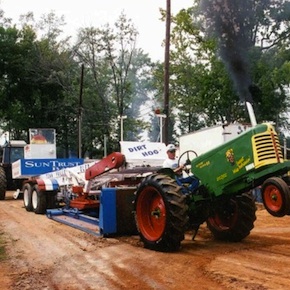
tractorpull2The smells of sweat and fried dough hung in the air, mixing with the burned oil of the tractor pull. He was sitting with hands clasped, wearing a plaid shirt with the sleeves rolled up and a challenge on his deeply lined, leathery face. She was standing, looking all the world like a Grant Wood painting, and thrusting matchbook-sized pamphlets into the hands of passersby. I walked by out of reach, but I couldn’t help looking at the booth, one of many at the county fair. “How sure are you of going to heaven? Are you 50% 75% 100% sure?” read the banner. My friend wondered aloud about how one arrives at a 75% surety of heaven. I chuckled, but I was unable to keep walking by the booth. On the table, a wooden contraption with three small doors read: “Do you know the three things God CANNOT do?”

I stopped. The Grant Wood painting saw my furrowed brow and handed me a pamphlet. It looked like a doll’s magazine. A smiley face decorated the cover along with the words: “Have you accepted Jesus Christ as your personal Lord and Savior?” I closed my hand around the pamphlet and pointed to the three doors. I tried to keep the incredulity out of my voice, but I failed miserably: “So, what are the three things God can’t do?” I said.

She opened the first door: “God CANNOT lie.” She opened the second door: “God CANNOT change.” She opened the third door: “God CANNOT let people into heaven who have not been born again.”

We talked for fifteen minutes. I told them I did not disagree with the first door, but that I preferred to state the sentiment in positive terms: “God always tell the truth” or “God is trustworthy and faithful.” I said that a “lie” is the absence of the “truth,” and that I’d rather talk about God’s goodness shown in God’s truthfulness than to try to hook people with the trappings of sensationalism. After five minutes, the man commented that I was very intelligent. I took that as a compliment, but I have a sneaking suspicion it was not meant as such.

As our conversation continued, I realized we weren’t conversing. We were sparring. I’ve never had a taste for theological pugilism, but I was already three rounds deep, so I kept jabbing and blocking. I’ve had this same conversation with county fair proselytizers, but never as an ordained person. After the man commented on my intelligence, he asked me what I did. I said, “I’m a priest.” Without another word, he thrust another pamphlet in my hand. It was about how Roman Catholics aren’t real Christians and are going to hell.The same thought kept jumping to the front of my mind: “People like these, no matter how pure and ardent their intentions, make my job harder.”

It didn’t matter that I wasn’t a Roman Catholic. It didn’t matter that I agreed with the man and woman several times during our bout. The only thing that mattered was that I didn’t buy into the way they framed the Christian faith–as a bottom-line venture whose only goal is to “save souls” by following the instructions in the smiley-face doll-sized magazine. Surely, there’s more than that. Surely, the abundance of what God has done and is doing is more important than a “what’s behind door number 3″ marketing scheme concerned with what God CANNOT do.

As I walked away, I wondered what had been accomplished during our boxing match. In the Gospel according to Matthew, Jesus says that when two or three are gathered in his name, he will be in the midst of them. Were we gathered “in his name” or in our own names, intent on KOing the other’s theological stance? Was Jesus there? Was I 50% 75% 100% sure of his presence? Looking back, Jesus was there, but he was not in my corner and he was not in their corner. He was there trying to get us to leave the ring.

Five Years Ago

Five years ago today, I navigated to WordPress.com and sat for an hour just staring at the computer screen. I had recently received some advice from an editor at a publishing company that I might consider starting a “weblog,” whatever that was. My seminary thesis  reader, Brian McLaren, had put me in touch with this editor (for the life of me, I can’t remember his name), and I’m so glad he did. The editor gave me the best practical advice imaginable for a young writer.

“You need to write,” he said. Sounds obvious, doesn’t it?

kite.png

“You need to write every day,” he continued. “And that means you need someone or something to be accountable to.” Then he turned me on to the idea of blogging, which was still not quite mainstream in 2008. Thank you, Mr. Editor! (Was it Kevin? Ah well. I really can’t remember.)

So there I was, five years ago today, staring at my computer screen. I was stuck trying to make a decision– namely, what to call my blog. I tried many names, also things I can’t remember now. I was listening to music, and in the moment of greatest despair that I would never come up with a name I was satisfied with, U2’s song “Kite” came on.

“Who’s to say where the wind will take you?
Who’s to say what it is will break you?
I don’t know which way the wind will blow.”

blogheaderaug09d.png

The words Bono was singing bore into me. It was like I was hearing them for the first time ever. The chorus hung in the air. I could have grabbed the word “wind” and held it in my hand. As I looked at the words in my mind’s eye, they reformed into a verse from the Gospel According to John: “The wind blows where it chooses, and you hear the sound of it, but you do not know where it comes from or where it goes.” So says Jesus to the Pharisee Nicodemus. This encounter is one of my favorite in the Gospel. In it, Jesus shatters Nicodemus’s preconceptions — his entire worldview, in fact — and rebuilds it with himself (Jesus) at the center. Over the course of the Gospel, we see Nicodemus first tentatively and then boldly step into his own re-creation.

blogbannerbricks.png

For Nicodemus, and for me, it starts with the wind of the Spirit (which, handily, is the same word in ancient Greek). The words from U2’s song shimmered with meaning from the Gospel, and I knew I had found the name of my blog.

Ever since, these words have guided me. I do not know where the wind will take me. But I believe that wherever it is, God will be waiting when I get there. The last five years have confirmed this belief over and over again. Through the blog, I made connections with The Christian Century and EpiscopalCafe. Then, about a year and half in, I came to the attention of the United Methodist Publishing House, and my second book with them comes out this summer! The blog is also partially responsible for the way I met my wife (as well as giving her mother something to find when she googled me). Above all, this website has kept me writing and reflecting on how God is moving in my life and how I am moving in God’s.

blogbannerdd5.png

Over the month of June, I plan to have a five year anniversary celebration for wherethewind.com. I will re-post some of my favorite entries, along with ones that marked significant moments and connections. (If you have a favorite post you’d like me to re-issue this month, let me know!) I look forward to the next five years of wherethewind.com, and I’m so profoundly grateful to all of my readers for taking this journey with me.

I leave you today with some of the first ever words I posted on this website, five years ago today.

Adam, a follower of Christ,

to all those who find this blog through the Series of Tubes.

Grace to you from God our Father and the Lord Jesus Christ!

The Apostle Paul really nailed the beginnings of his letters, so I thought I’d borrow his intro formula to begin my blog. Paul journeyed all over the Mediterranean following the little dotted purple and blue and red lines you see on the maps in the back of your study Bible. I’m afraid I can’t afford the airfares to Thessalonica or Ephesus, so I will have to rely on the Interwebs to make a new set of dotted lines from my MacBook to your computer. Since you’re probably in modern day Scranton or Lubbock rather than ancient Greece, I think the Internet is the way to go.

[…] Who’s to say where the wind will take me? Who’s to say where the Spirit is leading me? In this blog, I will reflect on the movement of God in my life, the movement that dances on the wind of the Spirit. I invite you to follow my reflections and discern how God is moving in your own life.

blogbannermay2011c.jpg

Faith-ing

Sermon for Sunday, June 2, 2013 || Proper 4C || Luke 7:1-10

Here’s a common situation in this day and age. For one reason or another – say, you’ve got to figure out how many packages of plastic cups to get for a party – you find yourself needing to do long division. Your phone’s battery is dead, so the calculator app is gone too. You flip over your shopping list and put pen to paper, and then you stop and realize that you have no idea how to do long division. You learned in fourth grade, but (wow) was that a long time ago. Has anyone else had that experience?

So, if basic math escapes us sometimes because we haven’t thought about it in a long time, I’d hazard a guess that we sometimes also lose sight of the basics of being followers of Jesus Christ.

Today, I’d like to get back to the basics. I’m going to talk about faith – specifically about how faith works in our lives. Hopefully, at the end of this sermon we will all rejoice that, while faith seems like an abstract, ephemeral concept, faith is in truth the fuel that fires our lives.

To start this little discussion about faith, we need to clear up one minor issue. In the English language the word “faith” is a noun. This grammatical construction makes it normal for us to ask a question like “Do you have faith?” Faith here is the object of your possession: “Yes, I have faith.” This sounds like completely correct and acceptable English, right? The trouble is, while faith is a noun, it should be a verb. I should be able to say “I’m going faith-ing today” or “We faith-ed yesterday and we’re going to faith again tomorrow.” But those sentences sound really strange, don’t they? I wish they didn’t. The word “faith” is a noun but whenever you use it, I hope you will remember it should be a verb.

Here’s why. We can possess things like concert tickets and hiking boots, but such possessions just sit on the counter or in the closet until we need to use them. If we have faith in the same way we have concert tickets, then we run the risk of storing our faith in the kitchen cupboard until we think we need it. But faith doesn’t work like that. Faith cannot be stored up or hoarded. We might get into situations where we say, “If I just had a little more faith…” But this turns faith into a commodity, something we can trade for something else. That’s not how faith works.

Thinking of faith as a verb removes it from the kitchen cupboard and puts it in our actions. We cannot store up or hoard our actions like we can our possessions. Rather, each action tumbles into the next in a never-ending stream. The problem we run into here is that, since the word faith isn’t actually a verb, we have trouble imagining what faith as action looks like. You know exactly what I mean when I say, “I saw someone running on my way to church this morning.” But you’d have difficulty conjuring up the image if I said, “I saw someone faith-ing on my way to church this morning.”

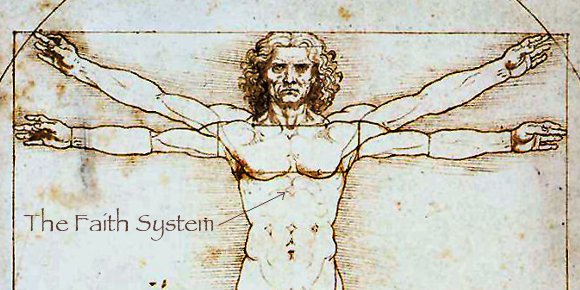
VitruvianMan(featured)Because of this difficulty, I’d like to invite you to imagine with me a reality that we don’t often think about. When God created animals, God gave us all sorts of biological systems that allow us to live. The respiratory system lets us breath, the circulatory system cycles our blood through our bodies, the digestive system turns food into nutrients. There’s the nervous system, the endocrine system, the lymphatic system and so on. But we were made in God’s image and likeness, which means we have one more system that other animals don’t have. We have a spiritual one to go along with all our biological ones. We have a faith system.
The faith system works a lot like our muscular system. We all have muscles (yes, even scrawny guys like me). We need our muscles to do simple tasks like getting out of bed, standing up, even smiling. We also need our muscles to do more difficult tasks like running a marathon or lugging a couch to a third floor walkup. Exercising hones and strengthens our muscles, making them more durable and less likely to fatigue. But whether we exercise or not, our muscles still put in work day in and day out.

So, too, with our faith system. The faith system spurs us to seek out life-affirming relationships, to support one another in our daily walks with God, to reach out to those in need, to welcome anyone into our midst, and to share with them the good news of God’s love. The faith system also sustains us through dry, desolate periods, giving us enough endurance not to give up quite yet. Like our muscles, our faith can get weary and fatigued. But also like our muscles, we can exercise our faith to hone and strengthen it, to make it more a part of our actions and less a thing sitting on the shelf in the kitchen cupboard.

If we’re going to exercise our faith, then we should figure out exactly what we mean when we say the word. We’ve already said how faith is a noun that should be a verb. Faith then is the action that happens when we participate in our relationships with God. Faith borrows the best parts of trust, confidence, and humility and molds them into our response to God’s presence in our lives. From trust, our faith borrows the willingness to give ourselves over to the power of another. From confidence, our faith borrows the courage to take the leap into God’s waiting arms. And from humility, our faith borrows the recognition that God (and not we ourselves) initiates the action that results in the giving ourselves up to God.

In today’s Gospel lesson, the Roman centurion actively engages his faith system. He trusts that Jesus can help him. He has courage actually to do something about that trust. And he shows his humility when he sends friends to Jesus to tell him he need not come all the way to the house to heal the slave. The centurion displays such strong faith that even Jesus is amazed. But no matter how strong or how weak our faith is, we each have a faith system that God gave us so we would be able to join God in relationship. The more we exercise our faith system – the more we act out our faith – the deeper can we go in our relationships with God.

Imagine if we exercised our faith in the same way we exercise our muscles. Going to the gym once doesn’t do much, but going every other day can work wonders on our bodies. God yearns for us to have this kind of dedication to our lives of faith. When we are serious about exercising our faith systems, we build time into every day to be in prayer with God. We start with faith and allow it to motivate all our other actions. We take part in the act of worship, both on Sunday mornings and in the moments of our days when our faith shows us special signs of God’s presence that our eyes alone might not see.

I invite you today to remember that faith is a noun but should be a verb. Faith is not a commodity or a possession. Faith is the active component of our relationships with God. God loves us and we love God. What could be better than cultivating that love everyday? What could be better than exercising our faith system so that we resonate deeper and deeper with God’s movement in our lives?

They Call it Heartbreak Hill

I first published this reflection on the website Day1.org. You can see it here.

fenceThey call it Heartbreak Hill. It rises between the twentieth and twenty-first miles of the route of the Boston Marathon. It’s not much of a hill, unless you’ve been running for twenty miles and have no more glycogen left to power your leg muscles. You see this gradual rise and you know you only have six miles left, but then you hit the wall and your will to keep running vanishes. That’s why they call it Heartbreak Hill.

But at yesterday’s marathon, the heartbreak was elsewhere. It was at the finish line, where the bombs detonated. It was on Boston Common, where the final waves of runners were rerouted and then left to seek out frantic family members. It was at local hospitals, where trauma teams worked round the clock with valiant and tireless conviction. It was in the heart of each of us watching the confused, yet ardent news coverage.

And it was in the heart of God.

The heart of God broke yesterday along with ours. The heart of God broke for those who died in such senseless savagery, for those who were maimed, and for those who love them. The heart of God broke because those of God’s children who perpetrated this act of terror have severed themselves from the image of God within them.

So what are we to do with a God who has a broken heart? The answer might surprise you. What are we to do? Rejoice. Why? Because our God is a God of compassion, a God who suffers with us, a God who was there yesterday when the plumes of smoke began to rise and the tears began to fall.

To rejoice, we do not have to stop feeling sad or angry or lost or afraid. As a matter of fact, the most sincere rejoicing happens when we feel such feelings. To rejoice is to take joy, and joy is the abiding sense of God’s connectedness with God’s creation. Today, we need to feel that connection, we need to feel God suffering with us, and we need to feel God’s heart breaking. We need to feel these things because when God’s heart breaks, our own broken hearts are drawn to it – mystically and magnetically.

I live a short bus ride, a red line train ride, and a green line train ride from Copley Square. I have walked past Marathon Sports many times in the last few years, usually on the way to a restaurant or Trinity Church. But every time I walk by it now, I will remember God’s heart breaking yesterday and swallowing all of our collective brokenness into its depths of love.

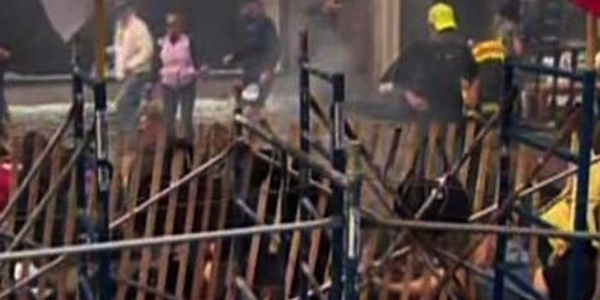
Speaking of love, there’s an image from yesterday’s shaky video footage that I can’t get out of my mind. Within thirty seconds of the first bomb’s detonation, emergency responders were running to the sight of the blast. But they couldn’t get there because a barrier had been erected to separate the spectators from the runners. So the emergency personnel started tearing at it, stomping on it, and pulling it with all their might. It took a dozen of so of them to move it, but once they exerted their frenzied energy, the barrier didn’t stand a chance. They dragged the multiple layers of the wall into the street and rushed to help the victims.

I can’t think of a better image for what God accomplished in the resurrection of Jesus Christ, which we continue to celebrate during this season of Easter. Once for all, God tore down the barrier between life, death, and new life. God proclaimed God’s willingness to stay connected to God’s creation, come what may. God finished the race, won the victory, and left death behind, struggling up Heartbreak Hill. In the power of the resurrection, the heart of God, which broke when Jesus hung broken on the cross, was healed. And in the power of the resurrection, all of our broken hearts will find wholeness again.

The Sermon Embedded in “Brave”

If any animated studio besides Pixar had made Brave, then the stitched up tapestry would have been enough. I don’t think I’m giving anything away with that sentence, but perhaps I will with this next one. Brave is a film about reconciliation. Check that. Brave is a wonderful film about reconciliation.

So many of the films that arrive at our movie theaters these days aren’t really about anything at all. They deliver pulse-pounding action or knee-slapping laughs, sure, but they are the cinematic equivalent of what MacBeth thinks of Life near the end of his Shakespearean tragedy. They are “tales told by…idiot[s], full of sound and fury, signifying nothing.”

Perhaps we want our films to signify nothing because we don’t want to be forced to think about them when we leave. Give us enough explosions or bare flesh or bathroom jokes and we’ll be happy. But wallop us with thematic content that encourages us to reflect on our own lives? That’s the property of indie films or documentaries or — gasp — sermons.

Of course, over the last 17 years, we have come to expect more from Pixar. And the amazing thing is that the company delivers again and again. While I’ll admit that Pixar has fallen prey to some of the sequelitis that has reached epidemic proportions in Hollywood, every one of their original properties is about something more than generating revenue for Disney.

The one that started it all, Toy Story, is about unselfishness and making friends. Finding Nemo shows the values of perseverance and never giving up. The Incredibles touts the importance of family. Wall-E is a scathing indictment of the negative trends of modern society. UP teaches that letting go of grief does not mean you let go of the love that activated the grief in the first place.

I know I skipped a bunch, but I’m writing this off the top of my head and it’s been a while since I’ve seen some of the others. I will say that every Pixar movie I’ve ever seen (and I think I’ve seen them all except for Cars 2) made me reflect on some aspect of my life in a way that a good sermon does.

And that brings us back to Brave. First, the film is gorgeous. Digital animation has reached such heights that I could have sworn that Pixar just flew a helicopter around the Scottish highlands to generate their backgrounds. Wow. Second, the story is at the same time fresh and original while being one of the oldest tales in the book. It starts as a straight up story about a princess who doesn’t want to get married to one of the icky suitors. But that’s just the jumping off point. Pretty soon into the movie, the story pivots into a tale of reconciliation between an estranged mother and daughter.

In a brilliant scene near the beginning of the film, the wizards at Pixar highlight the disconnect between the mother, Elinor, and daughter, Merida. Each has one side of the same conversation, but each is speaking their dialogue to someone else. After the inevitable big blowup between the two of them, Merida turns her mother into a bear using an ambiguous spell that a less-than-evil witch/entrepreneur concocts to change the mother’s fate. Over the course of the rest of the film, Elinor can’t speak because she’s a bear (a prim, proper bear, but a bear nonetheless). This allows her to listen and learn from the daughter she is always trying to teach. And Merida realizes that all of things that Elinor has taught her, which she has rebelled against, are truly for her (Merida’s) benefit.

And still Merida hangs all her hopes on stitching up the family tapestry. She thinks that simple gesture will break the spell. But as is the case with reconciliation, the gesture is less important than the exchange of confession and forgiveness. I don’t want to spoil the end of the film, but I left the theater reveling in the awesome power of reconciliation.

Thank you Pixar for another stellar film about something, and about something important. I hope everyone finds the hour and forty minutes it will take to sit through this one because it is worth it. Perhaps at the end of the film you will reflect on a relationship in your life that has become estranged. And you’ll find that the film has bucked the Hollywood trend and helped you take a first step in healing a rift in your own life.