Jesus throws me out

The following post appeared Friday, August 13th on Episcopalcafe.com, a website to which I am a monthly contributor. Check it out here or read it below.

* * *
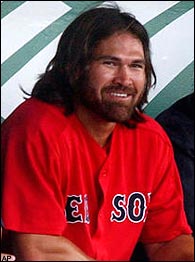
When he played for the Sox, Johnny Damon had the Jesus thing going, though he wasn't terribly effective at throwing people out.

On a certain Saturday in late July of 2006, I found myself sitting in the pastoral care office of Children’s Medical Center in Dallas, Texas, waiting for a ten-year-old boy to die. I had sat with his mother by his bedside earlier in the day. We had cried the Rosary together. We had held hands and gazed upon the face of the little boy. When his mother asked for some private time with her son, I returned to the office and waited for the pager to ring. And as I waited, I jotted down the first verse of a song that took me the next three years to write. The words of John 10 echoed in my mind as I wrote the lyrics because for weeks I had been telling the Godly Play story of the Good Shepherd with children on my floor of the hospital.

Almost four years to the day, I sit at my computer. None of the urgency or the heartbreak of that day remains, and I am aware of the complacency that has crept in over the years. And once again, the words of John 10 return to my mind: Jesus is the good shepherd who calls his sheep by voice. They hear their names and he leads them out of the sheepfold. But a closer look shows that Jesus doesn’t necessarily lead them out (as many English translations say). Rather, he throws them out of the sheepfold. Here’s what I mean.

Jesus begins his discussion with something as close to a parable as the Gospel according to John gets. In the other accounts of the Gospel, Jesus often speaks in parables, but not in John. Instead, Jesus himself is the parable of God — the way God is made known in the world (John 1:18). Here in chapter 10, Jesus speaks in a “figure of speech” about shepherding and sheep and wolves and bandits. Jesus identifies himself as the good shepherd who calls his sheep by name and “leads them out” (NRSV). The word for “lead out” is one of my favorite Greek words: ekballo. This is a fairly prevalent verb in the Gospel according to John and in the other accounts, as well. In the Synoptics (Matthew, Mark, and Luke), when Jesus casts out demons, he ekballo-s them. In John 2, when Jesus drives out the moneychangers and animal sellers from the temple, he ekballo-s them. The man born blind is ekballo-ed from the synagogue at the end of chapter 9. And finally, in chapter 12, Jesus mentions that the “ruler of this world” will be ekballo-ed from it.

In each of these cases, the connotation of ekballo is to drive out or cast out or throw out. But in John 10, according to, say, the NRSV, the shepherd calls his sheep by name and “leads them out.” While Greek words definitely have ranges of meaning, I suggest that we should translate the instance of the word ekballo in chapter 10 not as “lead out,” but as “throw out.” Here’s why.

The first character Jesus introduces in chapter 10 is a thief and a bandit. This person climbs into the sheepfold rather than entering through the gate. The thief comes only to “steal and kill and destroy.” Furthermore, outside the sheepfold there are wolves waiting to snatch up the sheep and scatter them. Hired hands are no help because they run away when they see the wolves coming. With thieves, bandits, and wolves roaming outside the sheepfold, leaving the fold can be frightening and dangerous.

In contrast, the sheepfold is safe and secure — shepherds bring their flocks to these enclosures at night for safety. But the sheep can’t live their whole lives in the sheepfold, no matter how safe and secure they may feel. They must go out into the world beyond the gate to graze for food (which, as far as I can tell, is all sheep do). So the shepherd ekballo-s them. The shepherd throws the sheep out of the fold so they can eat and drink and run.

The sheepfold is a safe place, but everything outside the sheepfold is dangerous. Who would not want to stay in the fold? Being led out into the world can feel like being thrown out. What is my fold? What do I use to shelter myself from the world? Where do I feel comfortable to the point of intransigence? The answer to these questions is the thing from which Jesus throws me out.

Contemporary sheepfolds come in all shapes, sizes, and disguises. Perhaps my family is my sheepfold, or my work, or, yes, even my church. For me, my complacency is the fold from which Jesus constantly throws me. The fold of complacency is slippery and amorphous because it has no walls, no group of people with whom to identify, no action of its own. And complacency leads to complicity with all the bad things in the world. I am so entrenched in my complacency that Jesus has to throw me out of it. It is the demon in me that Jesus casts out, the ruler of my world that Jesus drives out.

And he throws me out of this fold with one simple word: my name. Jesus calls me by name and I hear his voice and I know that I have been in the fold too long. By calling my name, Jesus brings me into an intimate relationship with him. (Remember in middle school when you found out your crush actually knew your name? It’s a good feeling, isn’t it?) By calling my name, Jesus tells me he knows me, knows that I struggle with complacency, knows that I need a swift kick in the trousers (a new translation of ekballo, perhaps?) to prompt me to act in the world on his behalf.

When I listen for Jesus calling my name, I feel his hands continually throwing me out of the fold of complacency. When I hear Jesus calling my name, I know that he has given me life and given it abundantly. This abundance of life is made possible by the intimate relationship Jesus has founded with me by knowing my name. When I venture out of my sheepfold into the frightening, dangerous world, I know that Jesus, my shepherd, is guiding me with his voice. And I know that he will continue to throw me out of the comfortable folds I find myself in so I can, with his help, continue to do God’s work in the world.

Why I Love Camp

The following post appeared Friday, July 16th on Episcopalcafe.com, a website to which I am a monthly contributor. Check it out here or read it below.

* * *

I love camp. I love being surrounded by more trees than buildings. I love singing Grace to John Williams’ theme from Superman. I love seeing the half-exhausted, half-excited faces of the campers at breakfast. And I love conversing with children and teenagers because every once in a while they will say something unexpected and profound amidst all the buzzwords and canned phrases that they know will be considered “correct” answers during afternoon Bible studies. Invariably, the profundity of their unexpected contributions comes in the form of the simplest, most direct response to a question.

Here’s why this practice is so profound. Over the years, we adults learn to hedge, to inject some wiggle room into everything we say in order to maintain some deniability later on. We prevaricate, deflect, and obfuscate because we’ve learned from the incessant 24-hour news cycle that a juicy sound byte can tank a career. We’ve learned that a verbal defense mechanism is a necessity for survival.

And with our deniability glands working at full capacity, we say, “Well, that’s not exactly what I meant,” or “I’m not sure you heard me correctly” (when, of course, I purposefully didn’t say exactly what I mean). But the problem with speaking equivocally creeps in over time: prevarication erodes the truth that has been in each of us since God knew us in our mothers’ wombs. When we hedge, we atrophy the muscles that store the truth, and we cut ourselves off from bits of the truth that is within us.

Now I’m not saying that we shouldn’t monitor our words to make sure we always speak hospitably and graciously. Hedging is simply a cheap and ultimately ineffective way to achieve what hospitality and grace achieve naturally – namely, speaking in a way that keeps conversation open and kind. Hedging achieves this end by leading us to speak obscurely so that no meaning can quite be pinned down. Hospitality achieves the same end by leading us to speak truth uncoupled from judgment. One of the epic failures of our time is the withering of this graceful truth when we bury it under our own insecurity and our need to conform to society’s agreed upon level of appropriate vagueness.

Okay, let me get back to why I love camp. I love camp because for a week I get to ascend into the clean and invigorating air of youthful wisdom. The young people just haven’t lived long enough to acquire toxic levels of prevarication. They say all the things that were the first to erode in us adults. God will always be with me. You are my friend. Jesus is awesome. And after a few days of rubbing elbows with the young people, I remember the need to nourish the root system within myself that keeps the truth from eroding.

Thankfully, I didn’t have to preach until Tuesday. I had enough time to drink in the campers’ wisdom, so that when it came time for me to speak I was in less danger of hedging and wiggling. (This was a good thing, too, because children can spot phony commitment a mile away.) I had five minutes to talk about Moses and Aaron, and I had played with several ways to approach the story as I thought about speaking to the campers. When I stood up to speak, I knew my direction of travel, but I was unsure where I would end up.

I began to talk about how Moses was making excuses to God, about how he’s no good at public speaking, about how God might as well get someone else. I looked out at the campers, and then I told them to look at each other. Just then, I realized where the direction of travel was taking me. “God gave everyone special gifts,” I said. “A few of those gifts are within us, but most gifts come wrapped in the people around us. Just because we aren’t good at something doesn’t mean we’re off the hook. It just means we have an opportunity to invite a friend to help us.” These words rang true as I said them, but I didn’t feel them within myself before speaking them. I felt like I was absorbing these words from the young people staring up at me. What a gift.

Of course, as usually happens, I spoke the words aloud, but I’m probably the one who benefited from them more than anyone else. I needed the injection of youthful wisdom to find that truth again, the fundamental truth that I forget more than any other. I am not alone. I am with God. And I am with other people. We are God’s gifts to each other. This is the truth, and it leads to another true statement.

I love camp.

It’s not easy being green

The following post appeared Monday, May 3rd on Episcopalcafe.com, a website to which I am a monthly contributor. Check it out here or read it below.

* * *

Every February of my college years, the entire student body suffered from a mass case of seasonal affective disorder. The campus of Sewanee is one of the top five most beautiful spots on the planet, but the beauty of the Domain was difficult to appreciate during that dreadful month. What neophytes mistook for simple fog, veterans of Sewanee winters knew was in reality a low-hanging raincloud that hovered over the campus, sapping students of the will to do anything besides curl up under a blanket and nap. The weather lasted for weeks, and when the sun finally broke through the clinging barrier, we students discovered our vigor once again, as if by some sudden leap in evolution, we had developed the ability to photosynthesize.

A version of this same seasonal affective disorder hits Episcopalians every year within a few weeks of Pentecost. We look out over the vast expanse of the upcoming liturgical calendar, and we see nearly a month of Sundays with seemingly no variation, with nothing peculiar to distinguish one day from the next. It’s a sea of green, and without the concurrence of wedding season, the Altar Guild would forget where the paraments are stored.

We call it the season after Pentecost – even the designation gives it the sound of an afterthought. At first glance, those legendary church year framers seem to have measured the year wrong. They only programmed six months! What’s there to do with the rest, those twenty-odd Sundays after Pentecost that stretch on interminably during the dog days of summer and into the heart of autumn? Truly, we blanche at the long months and wonder if the Holy Spirit has enough juice in those Pentecost batteries to get us to the first Sunday of Advent.

The other liturgical seasons are nice and short; indeed, no other season creeps into double digits. Epiphany gets the closest, sometimes reaching as high as nine (watch out 2011!), but it can’t quite get there. And the short seasons always (and satisfyingly) lead somewhere: Advent moves to Christmas Day; Christmas season to the Epiphany; Epiphany season to Ash Wednesday; Lent to Easter Day; Easter season to Pentecost. Each season is like crossing a river or lake to the next feast or fast on the other side. But the season after Pentecost is an ocean, and Christ the King Sunday is in the next hemisphere.

So what do we do to combat the spiritual lethargy that can result from so many Sundays of unvarying green vestments? Well, we could try to split it into more liturgical seasons. So, starting with the Sunday after Pentecost, we’d have the season of the Trinity until mid-August. Then, beginning on August 15th, we’d have the season of the Blessed Virgin Mary until the end of September. Then, we’d have Michaelmas until Advent. There: three more manageable seasons for us modern people with our tweet-sized attention spans.

While this divvying up of the calendar has a certain appeal (especially to all the Anglo-Catholics reading this), I doubt the Church would go for it. So, where does that leave us? Our churches are still stuck in six months of monotonous green! The seasonal affective disorder will attack. Parishioners will fall away! (I know, I know – mostly because of summer holidays, but just go with me on this whole long liturgical season thing.)

Instead of lamenting the six months of green, let’s use the green season to our advantage. Don’t completely shut down program for the summer. Rather, take your cue from the liturgical color. Spend time each week or each month discussing how both the church and the individual can become more environmentally friendly. Devote education time to the intersection between theology and environmental sustainability. Set goals for the parish to meet by the end of the season after Pentecost to reduce consumption. Go paperless for the entire season to cut down on waste. Move service times to earlier in the day and turn off the A/C. Encourage people to bike to church or carpool. Have a light bulb changing party and replace all the lights with CFLs (the curlicue ones). Check out websites like nccecojustice.org for more ideas.

By taking positive steps to live into God’s pronouncement that we are stewards of creation and by staying active through the long days of the season after Pentecost, we can stave off that seasonal affective disorder. Even when the liturgical color hasn’t changed in four months, each Sunday is still a celebration of our Lord’s resurrection. Every Sunday we worship God, who through the Word brought all creation into being. The best way to praise God for that mighty creative act is by preserving it so countless generations to come can also praise God for God’s creation.

It’s a good thing the Green Season is so long. There sure is a lot to do.

Mountaintop removal

The following post appeared Monday, May 3rd on Episcopalcafe.com, a website to which I am a monthly contributor. Check it out here or read it below.

* * *

I recently moved to one of the top ten most beautiful spots in the world. I live a three-minute walk from the Atlantic Ocean. I can see a lighthouse from my living room window. I bought a new car. I started working at a new church, which is as beautiful as the town surrounding it. The people at church are wonderful. The trees and flowers are exploding with spring colors. And to top it all off: it’s Easter, the happiest and most celebratory season in the church year. I know I am blessed, radically blessed.

So, why am I having trouble finding something to write about? Why am I having difficulty elucidating God’s presence in my life, at this, one of my life’s most idyllic moments? You’re probably thinking: “Adam, go back and read your first paragraph and quit complaining.” Fair point. But my difficulty is symptomatic of a deeper spiritual malady, which (strangely enough) a simple recitation of my blessings actually exacerbates. I’m sure this malady affects more Christians than just me, so let’s do a little diagnosing.

Our walks with God are topographically interesting. For the most part, we walk the straight path, which Isaiah and John the Baptizer proclaim is the way of the Lord. But sometimes, we meander through desolate valleys, in which simply finding the tiniest token of God’s presence is drink for our arid souls. Other times, we climb mountains, atop which we touch the very face of God and can never imagine a time when our spiritual energy will need recharging. The valleys and peaks, the lows and highs, are the times we remember.

We remember the smile the stranger gave us in the frozen food aisle when we’d forgotten that God was still around. We remember hearing the choir singing choral evensong and how our hearts soared into the very heart of God during the first chords of the Magnificat. We remember the smell of disinfected despair when we sat overnight in the hospital room. We remember standing on a literal mountaintop and breathing in the wind of the Spirit and seeing the patchwork creation spread out below us.

These valleys and mountains shape our lives as Christians. Some folks have Grand Canyons and Himalayas. Others have dry streambeds and foothills. But the slope of our lows and highs matters little. For this discussion, let’s agree that our walks with God have valleys and peaks. The spiritual malady I mentioned a moment ago severely limits our ability to process the peak category.

By removing the mountaintop receptors, the malady keeps our souls from gathering spiritual nourishment from the peak times in our lives. Our minds know that God must be moving in our lives for life to be so full of blessing. But our souls have trouble metabolizing that blessing into the nutrients that sustain us while we search for God’s presence. Without that sustenance, we cease our active awareness of God until there is a noticeable change from “good” to “bad” times. When the paradigm shifts from “good” to “bad” – that is, from mountain to valley – we enter spiritual survival mode and begin frantically looking for God, only to have the walls of the depression limit our sight.

The disciple Peter is patient zero for this spiritual malady. When Jesus calls him out of the boat, Peter walks on the water as if he’s ambling down a garden path. Walking on the water is a spiritual mountaintop, but the paradigm shifts quickly. Peter notices the waves around him, and he starts to sink. Only when he is floundering in the surf does Peter reach up his hand for Jesus to rescue him. Peter could have taken Jesus’ hand while walking atop the water, but he waits until his valley moment.

Like Peter, I forget to seek God when things are going well. When I’m on a mountaintop, I rarely open my eyes to take in the glorious view. Through an intellectual exercise, I know that I am blessed, but this blessing fails to filter into my soul. Only when the jaggedness of grief or deprivation assaults me do I begin my tardy search for God anew.

I know I’m not alone in dealing with the spiritual malady of mountaintop removal. If you suffer from it, then know that there are steps to address it. Take a few moments to look at your life. Orient yourself on the topographical map of your walk with God. Where are you in relation to your most recent valley? If you know that you are no longer in the valley, force yourself to do more than think about your blessings. Rather than an amorphous abstraction you call “blessing,” separate each small blessing into individual shimmering lights of grace. Write each one down. Then thank God for the blessings individually, and be creative. Thank God with action, not thought. If your blessing is having enough food, go feed someone who is starving. If your blessing is living near the ocean, go stomp around in the shallows. If your blessing is being a member of a loving family, go tell them how much they mean to you. If your blessing is the song in your heart, go sing.

Once you’ve acted out your thanks to God, don’t stop. Actively seek out ways to thank God for God’s blessing in your life. Every morning when you draw your first breath, decide to look for God’s presence that day. Then over time, you may see the ground beneath your feet rise into a mountain. And you will notice just how close is the face of God.

Schooling Nicodemus (or) “Imagine what you’ll know tomorrow”

The following post appeared Sunday, March 14th on Episcopalcafe.com, a website to which I am a monthly contributor. Check it out here or read it below.

* * *

In the film Men in Black, Jay discovers that aliens exist and many of them live on Manhattan Island. When he confronts Kay about this unnerving new detail, of which he (Jay) was previously unaware, Kay deadpans: “A thousand years ago everybody knew, as a fact, that the earth was the center of the universe. Five hundred years ago, everybody knew that the Earth was flat, and fifteen minutes ago, you knew that humans were alone on it. Imagine what you’ll know tomorrow.”

The season of Lent invites us to examine what we know, or, put more precisely, what we think we know. When we tackle this examination, we open ourselves up to encounters with Christ, which tend to augment, rearrange, and expand our knowledge with the addition of deeper faith. The Gospel contains myriad stories of Jesus blasting people with new knowledge,  so we should expect nothing different in our own lives. One such story co-stars the Pharisee Nicodemus (read up on John 3 before you continue).

As a general rule, if someone in the Gospel besides Jesus says “I know” or “we know,” then that person either knows a small fraction of the whole or, more commonly, nothing at all. Strangely enough, knowing nothing at all can even manifest itself when the statement made is quite true and correct. Such is the case with this leader of the Jews, who comes to see Jesus one night.

Nicodemus uses his “knowledge” displayed at the beginning of the conversation as a weapon to corner Jesus into a particular set of expectations. The Pharisee says, “Rabbi, we know that you are a teacher who has come from God, for no one could do these signs that you do apart from the presence of God.” Apparently, so far so good. This statement is true: Jesus has come from God and most definitely stands forever in the presence of God. But there’s irony in the statement, also. Nicodemus calls Jesus “teacher” twice — once in Hebrew (Rabbi) and once in Greek (didaskalos, from which comes the word “didactic”). But at the same time, Nicodemus’s conversational opener allows no room for Jesus to teach. Instead, Nicodemus is the one attempting to teach Jesus, to pigeonhole him into what Nicodemus and his colleagues have labeled him.

But Jesus refuses to be put on the defensive. In usual fashion, he completely ignores Nicodemus’s opening salvo and immediately expands the conversation to a depth and height that Nicodemus is not expecting. Jesus says, “No one can see the kingdom of God without being born from above/again.” There’s a delightful ambiguity here: in Greek, “from above” and “again” are the same word (anothen). They both work in the context, and Jesus probably means both when he says the word. How better to jostle someone loose from his rigidity than with a small helping of ambiguity?

But Nicodemus grasps at the more mundane of the two meanings and responds: “How can anyone be born after having grown old? Can one enter a second time into the mother’s womb and be born?” This may seem like a sarcastic response, but at least this Pharisee, who has always been the one answering questions, is now (albeit haltingly) beginning to ask some of his own. But Jesus doesn’t seem interested in staying on the terrestrial plane, so he ignores Nicodemus questions and pushes him to a new level of understanding. “No one can enter the kingdom of God without being born of water and spirit. What is born of the flesh is flesh and what is born of the Spirit is spirit.” At this point, I imagine Nicodemus’s brain starts hurting.

But Jesus keeps pushing him. Nicodemus’s opening “we know” now sounds empty in comparison to the mysteries Jesus is revealing to him. To begin to absorb these mysteries, Nicodemus must turn this empty “we know” into an “I don’t know” full of desire and curiosity. With his next words, Jesus gives Nicodemus license to let go of what he thinks he knows: “The wind/Spirit blows where it chooses and you hear the sound of it, but you do not know where it comes from or where it goes.” (Here’s another delightful ambiguity—in Greek, “wind” and “spirit” are the same word, pneuma.) Nicodemus must now consent to trusting in things he can never quite figure out. Indeed, he must realize that the truest things that have ever been or ever will be can be believed without being adequately explained. In a word, Jesus asks Nicodemus to have faith that the words he speaks are true, no matter how difficult, preposterous, or confusing they may sound.

And Nicodemus takes a tentative step into the shallows of faith in Jesus. He asks one of the sincerest questions in the Gospel: “How can these things be?” With this question, Nicodemus allows the cognitive dissonance that has been cresting to break on him like a wave. This dissonance is the necessary distress that happens when he realizes he doesn’t know something he thought he knew. But dissonance isn’t a bad thing. In music, dissonance is the interesting part, the part that pushes the piece onward. A pleasing harmony (called “consonance”) can hang in the air indefinitely, but a dissonance begs to move forward to the next consonant chord.

So it is with Nicodemus and anyone who opens up himself or herself to the possibility of the unknown. Allowing the cognitive dissonance to enter our comfortable worldviews pushes us to grow into the next consonant chords in our lives. When Jesus confronts us, like Nicodemus, with the mysteries of the faith, we can either step backward into the comfort of what we think we know or step forward, fully expecting the boundaries of possibility to be far wider than we can perceive. This confrontation goes by another name: revelation.

Every encounter with Jesus, whether in the text or in life, promises an opportunity for revelation, which obeys no boundaries of possibility. Revelation is that thing you know, but don’t know how you know it. Revelation is visceral as well as mental because the brain alone is ill-equipped to handle it. Revelation infuses us with an odd mixture of peace and exhilaration—peace because we know God is there, exhilaration because we know God is calling us to serve. Cognitive dissonance is the birthplace of such revelation. The dissonance reminds us that what we know is far less than the whole. When we can acknowledge that we don’t, in fact, know where the wind comes from or where it goes, we are primed for receiving the revelation of God’s love that Jesus is forever revealing to the world. This is a scary proposition, for if we do, indeed, remain attentive we might actually hear God calling us to serve in a way that doesn’t fit our plans.

But revelation bursts our ability and our desire to control because it blows where it chooses on the wind of the Spirit. When Nicodemus says to Jesus, “We know,” he is seeking to control the conversation that will follow. But he immediately discovers he’s in over his head. When we acknowledge that Jesus has things to reveal to us that we couldn’t possibly imagine, we discover we’re also in over our heads. The trick is to learn to breathe in the wind of the Spirit while underwater (to grow gills and fins) and to find a new natural state submerged in the revelatory love of Christ.

When Nicodemus says to Jesus, “How can these things be,” he allows the possibility for revelation to strike him in his head and in his gut. His cognitive dissonance jettisons his need to control. He is open for Jesus to reveal new and wonderful things to him. And Jesus does — things about the Son of Man ascending to and descending from heaven, things about the Son of Man being lifted up as Moses lifted up the serpent in the wilderness, things about eternal life and self-giving love and believing and salvation.

I imagine Nicodemus left his encounter with Jesus in a daze, his heart and mind on overload attempting to process all he had seen and heard. Is he able fully to put his trust in Jesus, to allow the dissonance to resolve into a new and deeper consonance? Not quite yet. But we are lucky enough to meet Nicodemus twice more in the Gospel (check them out! John 7 & John 19). His journey towards the consonance of a life of faith following Jesus models for us our Lenten journeys of self-examination. If we open ourselves up to encounters with Christ during this season of Lent, then (as Kay says), “Imagine what you’ll know tomorrow.”

Seeing gasoline rainbows

The following post appeared Tuesday, February 2nd on Episcopalcafe.com, a website to which I am a monthly contributor. Check it out here or read it below.

* * *

Sometimes, I am too young to hear Jesus’ words in the Gospel. Or too old. Or too naïve. Or too refined. Often I wonder if God is holding a particular set of words in reserve for a particular time in my life — when I need those words I will finally hear them. Or perhaps I already have, and they have settled into the bedrock of my faith.

The words of Jesus are beautiful and dynamic. They grow in depth of meaning as I grow in depth of experience, emotion, and faith. Many of Jesus’ words mean something new to the disciples after the resurrection because the disciples are different after the resurrection. Likewise, the words of Jesus are the same, the chapters and verses are the same, but I am different every time I read them. In the novel, The Catcher in the Rye, Holden Caulfield says a similar thing about the natural history museum:

The best thing, though, in that museum was that everything always stayed right where it was. Nobody’d move. You could go there a hundred thousand times, and that Eskimo would still be just finishing catching those two fish, the birds would still be on their way south, the deers would still be drinking out of that water hole…Nobody’d be different. The only thing that would be different would be you. Not that you’d be so much older or anything. It wouldn’t be that, exactly. You’d just be different, that’s all. You’d have an overcoat on this time…Or you’d heard your mother and father having a terrific fight in the bathroom. Or you’d just passed by one of those puddles in the street with gasoline rainbows in them. I mean you’d be different in some way – I can’t explain what I mean.

Both small differences in me from day to day and large changes in me from year to year can affect my reading of scripture and my encountering the words of Jesus. The climactic change in the lives of the disciples was the resurrection; for me, the changes tend to be small, the differences subtle. But a new encounter with Christ can erupt from even the smallest change, the subtlest difference. When I open myself up to seeing gasoline rainbows, when I realize I am different than I was before, I discover the power of the words of Christ working within me.

In a recent bout of nostalgia, I read some of my old writings and found that I had discussed the same verses on three occasions. After he washes the disciples’ feet, Jesus says, “I give you a new commandment, that you love one another. Just as I have loved you, you also should love one another. By this everyone will know that you are my disciples, if you have love for one another” (John 13:34-35). The words were the same each time, but I was different. Here’s what I mean.

It’s May 9, 2004, and Easter season blooms on the domain of Sewanee. I’m a junior in college. I’m two or three steps into the exhaustive process towards ordination. Classes are drawing to an end; exams are approaching. With flagging energy, I am writing lectionary-based reflections on xanga.com (before people ever used the word “blog”). And Jesus’ words encounter me:

“Wow. [Jesus] could not have put it more succinctly, or more beautifully. It does not take mighty acts or wondrous miracles to show people that we are followers of Christ. Just love. But I would argue that love is a mighty act, it is a miracle. Loving with the love Christ taught us – the only true love – is more powerful than anything. […] When we love with the love Christ taught us, we bring Christ to others. This love is powerful, transformative, life-changing, irresistible. Paul tells in his letter to the Romans that nothing can separate us from it. And it is our duty, and it should be our joy, to spread this love to others.”

It’s March 7, 2005, and fog rolls into the domain along with Lent. I’m a senior in college. I’m a postulant for Holy Orders, and I’m waiting for my bishop’s decision about sending me to seminary next school year. I’ve broken John’s Gospel into forty passages, one reflection per day for my Lenten discipline. And Jesus’ same words encounter me again:

“This is at the heart of what it means to be a Christian – to love one another as Christ loves us. We are capable of love because God loves us. Indeed, Paul tells us, ‘God is love.’ So how do we love? I think that is an impossible question to answer succinctly. In a past reflection, I called love the ‘conscious or unconscious search for God in other creatures.’ Searching for God means searching for all that is good, right, true, and graceful about another. However, this does not mean looking past all the other stuff. When we love truly, we see the good and the bad and continue to be in relationship. Contact (spiritual, emotional, &c.) is essential for love – only by staying in contact with God and others can we feel the love that purges our iniquities from us.”

It’s March 20, 2008, and Maundy Thursday comes impossibly early this year. I’m a senior in seminary. I’m a new deacon in the church, and I’m preaching at my field education parish. But the flu keelhauls me for five days, the middle of which is Palm Sunday. Being ill is all I can think about, and Jesus’ words encounter me a third time through that illness.

“Life is only worth living when it can be shared with others. This sharing is another word for love. And love shatters the illusion of self-sufficiency. When the flu knocked me out, my friends served me. I had no choice but to let them serve me because I could not serve myself. And I am better for it. They showed their love for me by bringing me medicine and food. In their act of loving service, they washed my feet. I have a share with them, and we all have a share with Jesus Christ. We are his disciples because we have love for one another. There is no such thing as self-sufficiency. An inability to accept the service of others masquerades as self-sufficiency. But this masquerade is a dismal half-life. Christ came that we may have life, and have it in abundance. Washing each other’s feet, serving one another, and loving each other with the love of God brings this full, abundant life in Christ.”

It’s January 26, 2010, and I’m seeing through the eyes of my old selves. On each day when I read those verses from the Gospel according to John, Jesus encountered me with the same words. And each time, Jesus used my gasoline rainbows to transform me into a new vessel for those words. Over the years, the same words have helped me change into the new person I am continually becoming.

I invite you to look for the gasoline rainbows in your life. You are a new person since you last picked up the Bible. How are you different from the last time you read a particular passage of scripture? What is new about you? How have Jesus’ words made you new? What are your gasoline rainbows?

The snow shovel (or an illustration of God’s providence)

The following post appeared Wednesday, January 6th on Episcopalcafe.com, a website to which I am a monthly contributor. Check it out here or read it below.

* * *

Here’s something you don’t know about me: I don’t own a snow shovel. This fact was unimportant until a few weeks ago when a record December snowfall dropped two feet of powder on Berkeley County, West Virginia. I woke up to a foot of snow outside, and the sky was dumping an inch an hour. I opened my front door, and the snow made an encroaching barrier to my front stoop. I went to the cupboard and pulled out my house broom. Sweeping the snow from the steps, I felt like Gandalf staring down the Balrog: “You shall not pass!”

But a broom is a poor substitute for a proper shovel, especially with the quantity of snow making islands of every vehicle on the street. And this is where the providence of God comes in. Providence is a tricky thing because one can easily over-define it to a point where we are simply chess pieces for God to move around the terrestrial board. To make matters trickier, one can also under-define Providence to a deistic level: God is merely an observer, having set events in motion with the winding of creation’s clock long ago. Neither of these definitions is satisfactory. Theologian Paul Tillich strikes a balance when he says, “Providence is a permanent activity of God. He is never a spectator; he always directs everything toward fulfilment. Yet God’s directing creativity always creates through the freedom of man and through the spontaneity and structural wholeness of all creatures.” *

So what’s all this have to do with my lack of a snow shovel? I’m glad you asked. Sometimes, encountering the Providence of God takes something quite small. We shall enter this small story during the early months of 2009, when a dear man from my congregation purchased a new car. He had been getting tired of his old Buick, and so he went for a shiny, silver Japanese sedan. But within a month of driving the car off the lot, he fell ill.

The cancer had been growing slowly, and for a time, the doctors held it at bay. The man spent several weeks in the hospital, until the medical staff, his family, and he decided that being comfortable in his own bed at home was as good for his condition as any drug. For several more weeks, he held on, making his wife laugh and cry, joking with the hospice nurses, slowly disintegrating from the inside. Not until his final day did the awareness, the flash in his eye, fade. He passed on in July, leaving his loving wife, a daughter, grandchildren, a cluttered house full of memories, and a brand new, silver, Japanese sedan.

Fast forward from midsummer to mid-autumn. A deer ran into my little Korean car, and the insurance company whisked it away to the total loss center to be evaluated. For some foolish reason, I didn’t have rental coverage as part of my plan. But I did have something even better: the man’s wife, who is the dear heart I’ve mentioned many times in blog entries over the last year. She found out that I was without a car, and asked (in her sweet, typical fashion) if I would help her out: “You see, his car’s been sitting in the garage since summer and if it doesn’t get driven, it will start to fall apart. I would be very pleased if you would drive it for me.”

I readily agreed to the arrangement, all the while smiling to myself because she made it sound like I was the one doing her a favor. After two weeks, my damaged car finally made it to the auto shop, the insurance company having decided it was worth repairing. I hoped to have it back by Thanksgiving, but the mechanic found more damage than the original estimate covered, which necessitated another visit from the adjuster. So when will it be done, I asked; by mid-December, the mechanic promised.

“Keep the car as long as you need to,” the dear heart said, when I told her the repairs were delayed. I suspect that if my car had been a total loss, she would have simply given me the shiny sedan because she’s just that generous a person. But I really like my car, so I was willing to wait out the repairs. I called the auto shop on December 17th hoping to hear that I could pick up the car that day. The collision was five weeks before, surely enough time to repair some front-end damage.

“Well, we took the car for a spin,” said the mechanic, “but it needs realigning so we put it on the lift and noticed something. Did you say your insurance company took the car to a total loss center first?” Yes, I said, not liking where this conversation was going. “Well,” the mechanic continued, “at those places, they use this kind of crane to lift the cars… We’d’ve never noticed it if we hadn’t put the car on the lift, but it looks like the crane cracked the fuel tank. So I need to get your adjuster out one more time to look at it.” Great, I thought. How long, I said. Another couple of weeks, what with the holiday and all, came the answer.

Two days later, the snow hit. With broom in hand, I stood on the front stoop and looked at the snow-covered Japanese sedan. The car had been driven a total of 317 miles before I took the wheel. I had put nearly two thousand miles on it during the last month. I thought about the dear man, a practical fellow, who bought the car last winter. I trudged out to the car, swept the snow from the trunk, and opened it. Inside was a shovel.

Now that’s Providence.

Footnotes

* Tillich, Paul. Systematic Theology. Vol 1. Chicago: University of Chicago Press, 1951 (p. 266)

Food (namely herbs and stewed rabbit) for the journey

The following post appeared Wednesday, December 9th on Episcopalcafe.com, a website to which I am a monthly contributor. Check it out here or read it below.

* * *

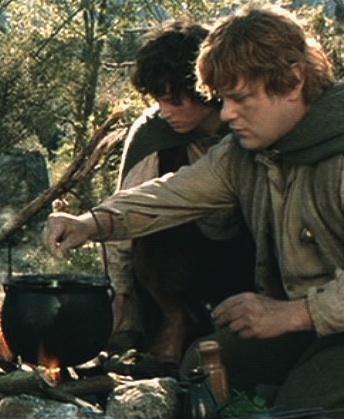
The hobbits Frodo Baggins and Samwise Gamgee arrive in a heather-strewn woodland between the River Anduin and the mountains that border the dreaded land of Mordor. After some walking around and griping about the knavish Gollum, who is their deranged hostage and guide, they sit down for a meal, as hobbits often do. They eat herbs and stewed rabbit and then…

Frodo (Elijah Wood) and Sam (Sean Astin) make stewed rabbit in The Two Towers (2002)

…I have no idea what happens next.

I’m twelve years old, and I have made it nearly two-thirds of the way through The Lord of the Rings. But I can no longer bear it, and I shelve the book. It’s just so boring. All they do is walk! They start in one place, walk for a bit, meet someone and chat, and then walk some more! I just want them to get somewhere! I want to yell, “Get to your destination, Frodo – don’t stop to eat herbs and stewed rabbit, which the author has described in painstaking detail! Just get to the mountain and be done with the ring! Enough of this walking…”

A year later, I’m thirteen (a much wiser and more mature age), and once again I pick up The Lord of the Rings. Maybe this year, I’ll finish it. I begin at the beginning, and they walk and meet folks and chat and run away from enemies and Frodo and Samwise reach the heather-strewn woodland and eat herbs and stewed rabbit and then…

…I have no idea what happens next.

My wisdom and maturity are no match for the walking. Again, I stop reading. The quest is just too long and arduous and their destination is still on the other side of the mountains and several hundred pages away.

A year later, I’m fourteen, and I pick up The Lord of the Rings again. On page 641, Frodo and Samwise sit down for a dinner of herbs and stewed rabbit and then…

…I keep reading. They find themselves in the middle of an ambush, Sam sees an oliphaunt, the hobbits are captured by people who are supposed to be on their side, and the story goes on and on. A few days later, I finish it. And I’ve read it at least eight more times since.

Finally, at fourteen, I could appreciate the journey, and let the destination take care of itself. Tolkien understood that a destination is more than a physical place. A destination is the culmination of all the shaping events of the journey that brings you to that ultimate location.

Every year, after the tryptophan has worn off, we begin just such a journey in our walks with God. While secular Christmas disgorges itself out of shipping containers every year the day after Thanksgiving, we have the opportunity to let Christmas happen only after the four weeks of Advent have run their course. Christmas is the destination. And Advent is about not arriving at your destination before you are shaped by the journey.

Have you ever had the soup du jour at a restaurant? It’s not some fancy French dish. It’s just the soup made for that particular day. Likewise, my journey happens every day. Every encounter, every decision, every road taken or not shapes me. The season of Advent gives me a dedicated four weeks to notice the shaping influence each day has on my journey with God.

On the first Sunday of Advent, we heard the psalmist pray, “ Show me your ways, O Lord, and teach me your paths…All the paths of the Lord are love and faithfulness” (25:3, 9). This Advent, I’m adopting this prayer because I’ve always had trouble not skipping to the end of the story. Every year of my childhood, I wanted to open the windows of my Advent calendar all at once. I just couldn’t wait to open tomorrow’s window tomorrow. Now, at twenty-six (a much wiser and more mature age) I pray for God to give me the patience to notice each day’s impact on my life. When I ask God to “teach me your paths,” I’m not hoping for some inside knowledge about the destination. I’m simply asking for guidance along the road.

Some time ago, I heard this illustration (the origin of which no longer resides in my brain). Have you ever noticed that headlights only show you thirty or forty yards ahead of your car on a dark night? But they still get you to your destination. Likewise, God teaches me God’s path even as I am struggling to stay on it. As I walk towards Christmas on this particular Advent journey, Christ walks a few steps ahead of me, illumining the road to his own nativity, to his own unique and wonderful expression of love and faithfulness.

Despite my opening description, my love for Tolkien’s works of fiction is deep and abiding. They taught me the lesson of Advent: don’t arrive at your destination before being shaped by the journey. I pray that, during this season of Advent, God teaches us God’s paths, which are love and faithfulness. And I pray that we may meet someday on the road, about which Tolkien’s Bilbo Baggins rhymes:

The Road goes ever on and on
Down from the door where it began.
Now far ahead the Road has gone,
And I must follow, if I can,
Pursuing it with weary feet,
Until it joins some larger way,
Where many paths and errands meet.
And whither then? I cannot say.

Encountering the Examen

The following post appeared Wednesday, November 18th on Episcopalcafe.com, a website to which I am a monthly contributor. Check it out here or read it below.

* * *

Three Novembers ago, I was a recluse in my seminary dormitory, I ate meals alone at tables with seven other people, and the light had gone out in my eyes. Heartbreak six months old continued to ferment within me. I had no way to deal so I drank deep of my own depression. I was a wretched creature, cast from the pages of Dickens or Dostoyevsky. To borrow from the psalmist, the water had risen up to my neck: I was sinking in deep mire and there was no firm ground for my feet.

In this state, I drove to St. Alban’s in Northwest DC to meet with my spiritual director. The month before, in our first meeting of the new school year, she could tell right away that something was different about me. I was waiting to be buzzed into the office, and she saw me through the little window in the locked door. The door opened, and without a word, she took my arm and pulled me into an embrace. The tears would have come if I had had any left.

A month after that first meeting, I had slipped even lower in the mire. The only thing that could have made the situation worse had happened, and I was struggling to go an hour without wallowing in the future that would have been. I sat down in the rocking chair in my spiritual director’s office. She lit the candle, and we sat in the relative silence of the intersection of Wisconsin and Mass Ave.

Over the next hour, I talked about how difficult it was not to dwell on the woman who left me. In that special way spiritual directors have of eliciting responses by being quiet at the right times, my director helped me discover something. During the nearly two years that we were together, I prayed for this woman every day. I lifted her up to God, and thanked God for her presence in my life. But the prayer dissolved with the relationship, which, of course, was the exact wrong time to stop praying. “When your mind starts to spiral to thoughts of her,” my spiritual director said, “pray for her instead. You are still connected through the love of God, even if you are no longer together.”

The guidance helped, but I don’t think I would have ever recovered if a new spiritual practice hadn’t accompanied the counsel. That same session, my director handed me a sheet of paper entitled “Ignatius’ 5 Step Daily Consciousness or ‘Awareness’ Examen.” “Pray these steps every night for the next month,” she said, “and write them down if writing makes you focus better.” This was a prescription for soul medicine, and, in my desperation, I saw it as a cure. She might have said, “Take two Examens and call me in the morning.” Of course, that’s not how spiritual practices work.

On the first night, I placed a red, five-subject notebook on my pillow so I wouldn’t forget. In the top right corner of the first page, I wrote “1,” and on the first line, “November 6, 2006.” Feeling a bit silly and wondering if I should get a little lock for my new diary, I took out the Examen.

“Step One,” I read: “Be Mindful.” I scratched the words, “Yes, Lord, you are here” under the date and took a deep breath. Something detached from my consciousness with that breath and I wrote it down. Yes, Lord, you are here in the presence of my friends. (My friends whom I have abandoned because I’m sure that none of them has ever felt the way I feel right now. How presumptuous.)

“Step Two. Be Thankful.” A roast beef sandwich, spiritual direction, sweater weather. When I thought about it, I found that I was thankful about some things. How wonderful.

“Step Three. Be Humble.” Ah, here’s the tough one, I thought. Humility and I have never been close; cards at Christmas – that’s about it. What is God teaching me through the lesson of today? How has God illumined me today without me realizing it? How uncomfortable.

“Step Four. Be Reflective.” What’s that one encounter from today that has stuck with me? Did the encounter bring me closer or push me away from God? Can’t think of one? How distracted.

“Step Five. Be Responsive.” I read over what I had written, and breathed deeply again. And again, something detached and I wrote it down. So this is where God is leading me. How revealing.

Three years later, the Examen has become a part of my life. I make mental notes during the day about what I want to write. I’m on my sixth notebook, and I switch between blue and black pens, so I can tell when they have run out of ink. The woman, who initially appeared in every entry, no longer stars in its pages. New thanksgivings and desolations and encounters and hopes abound. They are all parts of my story, which God already knows, but which I am discovering every day. I pray to be mindful, thankful, humble, reflective, responsive. I pray for the courage to live a life that can fill dozens of more notebooks. And I pray that God continues to guide my hand as I spill my soul onto those college-ruled pages.

Life, in some superlative form

The following post appeared Tuesday, October 13th on Episcopalcafe.com, a website to which I am a monthly contributor. Check it out here or read it below.

* * *

Over the last few months, I have had the opportunity to serve several people who were grieving over the deaths of loved ones. I’ve been a priest for nearly a year and a half, but it was not until this summer that I officiated at a burial office or spent hours with families, stumbling together through the wilderness of loss. These recent months have again and again brought me to the eleventh chapter of the Gospel according to John (which appears more than once in the burial service) and to my own first remembrance of the loss of a love one.

rockport
My grandmother died a few miles inland from this stunningly beautiful seascape.

In the months before she passed on, she began having difficulty remembering which of the people in the room were related to her. One time, she thought my father was her biological son, though he had married one of her four daughters thirty years before. The last time I saw my grandmother, she was confined to her bed in the nursing home, a sterile facility a few miles inland from the rock beaches of the northern Massachusetts coastline. In my memory, she was always a small woman, shrunken by age. But during that final visit, I was shocked by her deterioration: the sheets and blankets seemed to double her body mass. Her white hair, once so carefully curled, hung limply from her head. She spoke in a choked whisper, as if her words were too special to share with the rest of the world. And, in a way, they were.

We got the call one summer evening and immediately made plans to fly to New England. When we arrived, we joined the rest of the extended family and pooled our grief with theirs. Cousins and aunts and sisters shared long embraces and reassuring shoulder squeezes and tears. We conversed in muted tones, offering our favorite memories of Esther: the swing set adjacent to her apartment complex; her inability to cook pot roast; her glowing love for her grandchildren and great grandchildren. As we remembered my grandmother, we started repeating certain phrases. “She lived a long life.” “She’s no longer in pain.” “She was ready to go.” “A part of her died twenty years ago with Jack; I’m so glad they are together again.” These sentiments comforted us as we shared them with each other. An outsider listening in on our conversations might have scoffed at such clichéd remarks, but for our family such well-worn comments gave us words to assuage our grief.

When Jesus arrives in Bethany, Martha leaves her home and goes out to meet him. Their conversation begins with similar phrases that emerge out of grief. I imagine that Martha and Mary had often said, “If Jesus had been here, Lazarus wouldn’t have died,” in the four days since they had buried their brother. And now Martha addresses Jesus with these words: “Lord, if you had been here, my brother would not have died.” Perhaps, this is an accusation; perhaps, it is a statement of faith. More likely (as is so often the case), it is a combination of the two. She continues, “But even now I know that God will give you whatever you ask of him.”

At first, Jesus responds with what sounds like an empty, stock answer to a grieving person: “Your brother will rise again.” Indeed, such a statement had probably reached cliché status at that time, considering a large portion of Jewish society believed in a final resurrection. Judging by her next words, Martha certainly takes Jesus’ words in this clichéd manner. I imagine her hanging her head when she says, “I know that he will rise again in the resurrection on the last day.”

But Martha has not grasped Jesus’ full meaning. Far from offering the usual comforting words to a person in grief, Jesus eliminates the cliché by completely retooling the rules for resurrection. “I am the resurrection and the life,” he says, “Those who believe in me, even though they die, will live, and everyone who lives and believes in me will never die.”

The writer of the Gospel throws the full weight of Jesus’ “I am” statements behind these words. By taking resurrection into his very identity, Jesus proclaims to Martha and to us that his business is always remaining in life-giving relationships. Yes, death will occur, he says; after all, resurrection cannot take place without death. But life, in some superlative form, emerges when resurrection denies the finality of death. The first verses of the Gospel link life and light: “What has come into being in him was life, and the life was the light of all people.” Just as darkness did not overcome light, death fails to conquer life because of the power of the resurrection.

Jesus’ words to Martha appear in our burial services to remind us of that power. But these words carry the weight of Jesus’ divine identity, and thus serve as so much more than a simple reminder. Resurrection is not some impersonal thing that may or may not impact our lives and deaths. Resurrection is not something to bring up just to make a grieving person feel better. Jesus is resurrection. Jesus is life. By revealing resurrection as part of his identity, Jesus further divulges the lengths to which he goes to be in relationship with us. Death cannot stop this relationship, because Jesus is resurrection and life.

Martha understands that resurrection assures this continued relationship with Jesus. When he asks her if she believes his words, she replies in the affirmative, but she answers a different question than the one Jesus asked. “Yes, Lord,” she says, “I believe that you are the Messiah, the Son of God, the one coming into the world.” She answers that she believes in him. Rather than her belief fulfilling a requirement for resurrection, her belief simply affirms her relationship with Jesus. She desires a relationship with him, and Jesus, in his unwillingness to end such a relationship, offers the gift of resurrection. Our belief in Jesus affirms our desire to remain in relationship with him. His gift of resurrection affirms his desire to remain in relationship with us.

When my grandmother died, my family came together to celebrate her life in the midst of our grief. We spoke comforting words to each other, words that had the power of love behind them. And at the service where we laid Esther’s body to rest next to her beloved Jack, we heard Jesus’ words of life proclaiming Jesus’ desire to continue his relationship with us beyond death in the power of the resurrection.

Footnote

* The names of my maternal grandparents have been changed (in order that you’ll have a harder pretending to be me while filling out bank forms).