After a midsummer hiatus, here’s the fifth in a six part video series produced to accompany the book Digital Disciple. This video series is designed to be used in a class setting to introduce the material and spur discussion. Of course, watching it by yourself is fine too!
Don’t forget to head over to the Facebook page and participate in a little quiz about this video. We’ll pick a random winner from those who participate and he or she will receive an autographed copy of the book, the DVD, and one of the t-shirts that Adam wore in the video (again, not the actual shirt but one just like it). Check it out!
My lovely wife surreptitiously recorded the song from my sermon yesterday. I wrote it last Thursday and played it a lot on Friday and Saturday to prepare for singing it during church. This is only my second sung sermon in the five-ish years I’ve been preaching, so I probably won’t do one again for quite a while, but every so often you’ve just got to pull out the ol’ guitar. (Check out the previous blog post for the lyrics.)
(Sermon for Sunday, August 7, 2011 || Proper 14 Year A || Romans 10:5-15)
This Sunday, the phrase, “the word is near you,” which Paul quotes from Deuteronomy in his letter to the Romans, really struck me. As I sat down to write a sermon about how and when the word is near us, I kept having this feeling that this sermon needed to be a song instead of a more traditional offering. So I decided to pull out my guitar and write a sung sermon. Here it is. You can hear a rough live version of the song by clicking play on the audio file below.
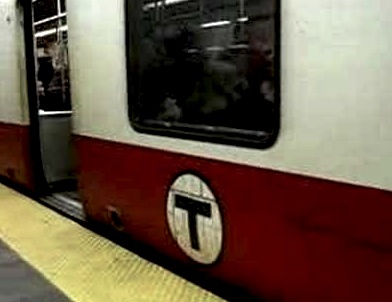
The T in Boston might run on a time table, but no one knows what it is.
When you’re standing on the subway platform,
And the Red Line is running late
When you’re landing on a rainy runway,
And the storm turns the sky to slate
When you’re handing out bread,
When you go where you’re led,
When you face what you dread…
the word is near you.
When you’re flipping through a family album
With your grandmother who you love
When you’re slipping down an icy sidewalk
With the cold seeping through your gloves
When you’re clipping your nails,
When you’re telling tall tales,
When the life support fails…
the word is near you.
The word is near you, the word is near you
It’s in the sun-setting sky,
And every answer to “why?”
Hear the still, small voice cry…
The word is near you.
When you’re clasping on your favorite bracelet,
The one made by your niece at camp
When you’re gasping on the field at halftime
And you fight through a wave of cramps
When you’re grasping at straws,
When you notice your flaws,
When your hardened heart thaws…
The word is near you.
When you’re looking for a baby present
For your friend who is almost due
When you’re booking travel for the funeral,
And your grief knocks the air from you.
When you’re cooking up eggs,
When the man near you begs,
When there’s nothing but dregs…
The word is near you.
It’s on your lips
And in your heart
Speaking life to your soul
And making you whole
Aidan Davies and his father walked out of the sacristy. “Wait a moment,” said Alastor. “Let me look at you.”
Aidan stopped and turned in a circle. He had on more layers of clothing than any sane person would wear in the month of June. But he always joked that the psychological testing that candidates went through before becoming priests was done to make sure you were crazy. On top of his suit trousers and black shirt, Aidan wore a white alb, a garment which he used to pretend was a toga when his childhood fantasies built ancient Rome in the churchyard. On top of the alb, he wore a green stole, which more than a handful of people had called a “scarf” when they paid him compliments for its subtle patchwork design. And on top of the stole, he wore a green and gold chasuble, which weighed on his shoulders like a down comforter. Aidan flapped his arms to move the chasuble off of his hands. Of course I’m going to spill wine on it today, he thought. It’s a good thing, then, that it cost more than my first car. Aidan smiled ruefully and gave the chasuble a quick once over, looking for previous stains. There weren’t any.
Alastor stepped to his son and straightened the neckline of the ornate garment. Then his hands suddenly went to Aidan’s shoulders and his father gathered him into a strong embrace. “I remember when you wore a chasuble on Halloween. Your mother had to pin it to keep it from dragging.” He pushed Aidan back to arms length. “Now look at you.”
Alastor choked off the last words, seemingly as surprised as Aidan at his sudden show of emotion. Alastor kept his hand on Aidan’s shoulder as they walked to the back of the church where the early service crowd was trickling in. Churches fill up like movie theaters, Aidan thought.
His father stuck his head outside and clucked good-naturedly at a few stragglers. As they settled in to their pew, Aidan made a quick head count. Two dozen or so. Pretty standard for an early service in the summer. Well, if I do trip and hit my head on the altar only a few people will see it. He glanced at his watch and gave a thumbs up to his father. Alastor led the way as they entered the nave and processed down the center aisle. Aidan had never walked behind his father in procession. This is something new, indeed.
The first half of the service came and went. Aidan kept stealing glances at the altar, wondering how something he used to play under could seem so imposing now. At the Peace, he shook hands with the two-dozen parishioners and embraced his father once again. Then he turned to face the altar and his parents’ advice from earlier that morning came to him. Go to the bathroom before you put your chasuble on. Check. Remember that God’s there too. Aidan looked at the cross and out the window to the misty morning sky. He looked back at the altar and at the people assembled. His mother’s advice had seemed so obvious when he sat perched on the edge of her bed. She might have said, “Remember that gravity will keep you from floating away.” But here in the church, with that special table in front of him, Aidan could not remember, could not see how he could go and stand behind that table and invoke God’s presence.
Aidan pulled his father to one side. “I don’t think I can do this,” he said. He tugged at the collar of his alb. “I don’t think I can consecrate communion.”
Alastor steadied his son with a look. It was the look the veteran paratrooper might give the new recruit before pushing him bodily from the plane. “And what makes you think that you’re the one doing anything,” he said simply.
Aidan stared blankly at his father. “You’re just the hands and the mouth,” said Alastor. “No delusions of grandeur. God’s doing the heavy lifting.” Aidan nodded and turned back to the altar. Alastor stepped up behind him and whispered, “And God does the heavy lifting whether or not you realize God is here.”
Once again Aidan let out a breath he didn’t know he was holding. God is here. God is here and that truth has nothing to do with me. No delusions of grandeur. “Okay. I’m really ready this time,” he said.
He mounted the steps to the altar and unwrapped the chalice. He folded the veil and laid it aside. He put the burse on top of the veil. He dumped a few dozen wafers onto the paten. He took the two silver cruets from the credence table and set them next to the chalice. Then he froze and his eyes went wide. He looked at the two containers: they were identical and they were solid metal. One held wine and one held water, but there was no earthly way to tell them apart. He pulled the stopper from one and glanced inside. Too dark. The liquid could have been either. He checked the other. Looks the same. He picked them up to feel the weight, hoping the cruet containing the wine would be fuller. No such luck. He put them down and gave his father a sidelong glance, along with a half grimace that he hoped communicated, “Help me!”
Perhaps, his father didn’t understand his attempt at telepathy. Perhaps, his father was trying to loosen him up some more before the Eucharistic prayer began. Perhaps, his father was getting him back for all those times that Aidan held up his watch to signal that a sermon had gone on too long. Whatever the reason, Alastor Davies gave his son a shrug, and not just any shrug, a comically expansive shrug, like one you might use while playing charades.
Aidan did his best to hide a scowl. Then he did the last thing he could think of. He tipped just a bit out of one cruet. Water. Of course. He switched cruets and poured. A more experienced priest wouldn’t have panicked. A more experienced priest would have known that less than ten percent of the congregation would have any clue that something was amiss at the altar. But Aidan had been a priest for less than twenty-four hours.
And yet, as his panic subsided, Aidan noticed something else filling its place. What is it? Aidan searched within himself before beginning the prayer. Ah, there it is. Peace. And what’s that next to it? Yes. Joy. Aidan lifted his head and smiled at the two-dozen people scattered around the church. “The Lord be with you,” he said.
In the end, he didn’t spill wine on the chasuble. He didn’t trip and bang his head on the altar. He didn’t have a panic attack. All he had to do was jump and pull the ripcord. And the wind caught his chute and brought him safely to ground.
Back at the kitchen table later that day, Aidan paused in the middle of eating his grilled cheese sandwich. Aquinas was curled up on his lap, sleeping soundly. Lucy and Alastor sat across from their son. They hadn’t stopped beaming at him since they arrived home. “So, Dad, I have a question,” he said.
“The Sox have a day game. Starts in about half an hour,” Alastor said.
“No, that’s not it.” He took a bite. The cheese stretched as he pulled the sandwich from his mouth. “How do you tell which cruet holds wine and which holds water?”
Alastor smiled at his wife, who reflected it back at him. He put on his best professorial tone and said to his valedictorian, Bachelor of Arts summa cum laude, Master of Divinity, seminary-trained new priest of a son, “You smell them, of course.”
On the third Sunday in June, Aidan Davies woke up in the bed in the guest room of his parents’ house. This was not his room, though it featured several artifacts from his childhood like a haphazardly designed display at the natural history museum. This is where young Aidan struggled to open the broken drawer of his bureau for his entire childhood, he mused, looking at the dingy piece of furniture. If you’ll direct your eyes above the dresser, this is where he simply had to own a poster from each Star Wars film, even The Phantom Menace. And now, if you’ll look to your right…
Davies’s thought trailed off as he examined another cheap piece of furniture that had been in his room for as long as he could remember. Since his contact lenses were bathing in solution in the bathroom, he couldn’t really see the squat shelving unit. But he could tell you exactly how much the middle shelf bowed under the weight of old books and how many CD cases would fit up top. However familiar the furniture was to him, though, the room itself was not his. His parents had moved when he was a junior in college, and he had needed directions to find his own house when he came home for Christmas that year. The move had happened five summers ago, and during that interval, most of Aidan had stopped grieving the loss of his bedroom. But the part of him, the part that would rather root around in the closet under the stairs for his old LEGO sets rather than go through with the events today held in store for him, still cherished the memory of the sky blue walls and beanbag chair reading nook of his old house.
Today. Sunday. He glanced at the clock on the bedside table. He didn’t have to get up for another hour, but he was restless. Today was an important day. He rose, brushed his teeth, and showered. He pulled the dark suit off the hanging bag and laid it on the bed. He donned his black shirt and snapped the white collar in place around his neck. He looked in the mirror. Yesterday morning, he was a deacon; today, he was a priest. A dozen other priests and Davies’s bishop had laid hands on him and prayed to God to make Aidan a priest, too. I suppose it took, he thought as he reached around and touched his left shoulder blade. His father had laid a firm, yet trembling, hand there yesterday, and Aidan could still feel a faint echo of the blessing held in Alastor Davies’s touch. He traced the lines of a cross, imagining he could feel the relief carving of his tattoo through his clothing. Then, picking up his jacket, he padded out of the room.
“Aidan?” The door to his parents’ room was cracked to let the cats in and out and his mother had spotted him.
“Morning,” he said as he poked his head around the doorframe. Lucy Davies was up to her chin in sheets and blankets, despite the early summer warmth rising with the sun. Anselm had annexed most of Lucy’s pillow, while Aquinas staked his claim to the foot of the bed.
Aidan’s father began the tradition of naming the family’s cats after medieval theologians during his time in seminary. Lucy took Aidan and his older sister Brigid to the animal shelter, and they argued all the way home over what to call their new pet. The argument continued inside the house, making Alastor look up from his reading. He tapped the cover of the book: “How about Bernard?” he suggested.
“But it’s a girl kitty, daddy,” Brigid said.
“No problem, dear. Bernard was from Clairvaux, so we can call her “Clair.”
Brigid beamed at him. Aidan, at age three and a half, hadn’t followed the conversation very well, and he thought his father had said “éclair,” which Aidan had recently discovered to his delight, so he beamed too. Clair was with the Davies family until the summer before Davies himself began seminary, but she had succumbed to a combination of old age and fear of the vet’s office. Six months later, Lucy and Alastor brought home two new cats. “Who are you studying in systematic theology right now?” Alastor asked Aidan over the phone.
“Anselm. Aquinas is next,” came his son’s reply. Luckily, the cats were both boys.
Aidan sat on the corner of the bed and scratched Aquinas behind the ears. “Nervous?” his mother asked.
He looked at her. When his mother asked him about his emotional state, she was usually reflecting her own feelings. What does she think is going to happen? Maybe that I’ll trip on my vestments and bang my head on the altar, he thought. Lucy had always had a fairly vivid imagination about how his various sporting engagements could end in brain damage or missing fingers. Perhaps, she’s confusing church with soccer. “Mom, the words are printed, I took a class in this, and I’ve been watching Dad do it my whole life,” he said. “I’ll be fine.”
The last three words sounded hollow, even to him. Lucy eyed him appraisingly. “If you say so, dear. Just don’t forget that God is there, too. That’s the whole point.”
She spoke the last words in the middle of a yawn, rolled over, and began rhythmically breathing a little too convincingly to be properly asleep. Aidan took that as his cue and left the room while Anselm resettled himself on Lucy’s pillow. As Aidan shut the door, Lucy’s breathing slowed, and Aidan wondered if anyone in the history of the world had ever feigned realistic sleep. It’s like wondering if the refrigerator light stays on when you close the door, he thought.
He moved down the hallway, passing the collages of his and Brigid’s infancy, of his childhood athletics and Brigid’s recitals, of their prom pictures and graduations. He arrived in the kitchen to find his father sitting down to his ritual bowl of oatmeal. You could set your watch to his Sunday morning routine. Aidan sliced off two thick pieces of the banana bread Lucy had made yesterday and sat down opposite his father. Always the sports section first. “Did the Sox win?” Aidan asked.
“Walk off double in the tenth. Hit the top of the scoreboard just out of reach of the left fielder’s glove,” said Alastor without looking up from the paper. “But they blew the save in the ninth so the extra inning heroics shouldn’t have been needed.”
“So the musical chairs at closer continues,” Aidan said. During the spring and summer (and into autumn if the Red Sox made the playoffs), baseball accounted for about eighty percent of the conversations between Aidan and his father. Even on a day like today we’re talking baseball. Aidan picked up the discarded sports section as Alastor moved on to the comics. I find that oddly comforting. Aidan’s hand strayed once again to his left shoulder blade. Alastor looked up. “Nervous.”
The word wasn’t a question as it had been when Lucy had asked. It was a statement, one that a veteran paratrooper might say to a new recruit before his first jump. It was the kind of statement that gives permission to feel the emotion but withholds permission to remain safely in the aircraft. “A little, I guess.”
“Just remember,” Alastor began.
“I know, I know,” Adain cut him off. “Mom already reminded me. God is there, too.”
“That’s true.” Alastor suppressed a smile, the crinkles around his eyes growing heavy. “But that’s not what I was going to say.” Aidan put down the sports section. “What I was going to say was: don’t forget to go to the bathroom before you put on the chasuble.”
Aidan let out a breath he didn’t realize he had been holding and started laughing, first quietly to himself and then louder and louder. Alastor joined in, and soon they were laughing just for laughter’s own sake.
An hour later, Aidan left the restroom at the church. He thought he might vomit like he had before many a high school soccer game. But he didn’t. His father was waiting for him, an ornate poncho draped over one arm. Aidan took the chasuble, put his head through its hole, and smoothed out the sleeves over his alb. He turned to the mirror in the sacristy. Well, you look like a priest, he told himself. You’re first celebration of Holy Communion. Are you ready?
Aidan put a hand on his father’s shoulder and pushed him toward the doorway. “I’m ready,” he said.
(Sermon for Sunday, July 17, 2011 || Proper 11 Year A || Genesis 28:10-19a; Psalm 139:1-11, 22-23)
What would your life be like if you had to think consciously about every breath you take? What would your life be like if your brain had to work your lungs like your hands might work a bicycle pump? What would your life be like if you needed to be aware of each of those millions of oxygen atoms that squeeze their way into your red blood cells for their continual circuit around your body? Well, for starters, you would never be able to sleep. You might be able to get a little work done by holding your breath for thirty seconds at a time and then concentrating furiously at the task at hand. You certainly wouldn’t be able to pay attention to this sermon. But that’s okay because I wouldn’t be able to preach in any coherent fashion either.
We are blessed, therefore, that God created us with “an autonomic nervous system,” which removes breathing from the list of bodily functions that require conscious thought. Of course, you might notice your breathing after walking up a particularly long flight of stairs or during a brisk run or when you are in labor. But for the vast majority of our lives, we simply breathe and never give the miracle of respiration a second thought.
I bet your high school anatomy class covered the wonder of the autonomic nervous system. Our bodies do so many things involuntarily, and the autonomic nervous system takes care of each one of them. What I’m sure the anatomy class didn’t cover, however, is the fact that, in addition to our bodily ones, every person here also has an autonomic spiritual system. God’s presence is even more constant than breathing, and so each of us has developed an autonomic spiritual system in order to handle our relationship with God during the vast majority of our lives when we are not consciously responding to that relationship.
Unlike the autonomic nervous system, which controls breathing and other things, none of us is born with an autonomic spiritual system. When you see a child’s eyes go wide at the splash of a stone in a pond or at the scurry of a squirrel on a branch, the child is experiencing God’s presence unfiltered by the involuntary sifting of the autonomic spiritual system. As we grow up, we develop this involuntary filtration, preferring the concrete stuff of the world over the spiritual substance of God’s presence. This is why the children in C.S. Lewis’s Chronicles of Narnia cannot return to Aslan’s domain once they’ve reached a certain age. The cares of the world keep them from wishing to go back to Narnia, and so they never find another gateway.
In today’s reading from the Hebrew Scriptures, Jacob demonstrates that even someone a mere two generations removed from Abraham has developed the problem of the autonomic spiritual system, this involuntary sifting of God’s presence from our daily experience. Jacob is on the run from his brother Esau, whose birthright and blessing Jacob has stolen. On his way to Haran, Jacob beds down in a certain place, which must have been quite rustic considering he uses a rock for a pillow. During the night, Jacob dreams of a ladder filled with angels going back and forth between earth and heaven. The Lord stands next to Jacob in this dream and says to him, “Know that I am with you and will keep you wherever you go.”
Jacob wakes up and proclaims to the sky and to the rocks: “Surely the Lord is in this place – and I did not know it!” Jacob’s involuntary filtration had prevented him from noticing that presence when he went to sleep, but his dream alerts him to override his autonomic spiritual system. Just like during the brisk run when you notice your breathing, Jacob wakes up dazzled by God’s presence.
And then, as so often happens, Jacob makes a common mistake that turns the autonomic spiritual system back on. He says, “How awesome is this place! This is none other than the house of God, and this is the gate of heaven.” Jacob’s mistakes his physical location as the catalyst for his spiritual awakening. By assigning spiritual meaning to that particular rock-strewn piece of ground, Jacob fails to remember the words that God spoke to him in his dream: “Know that I am with you and will keep you wherever you go.” God doesn’t say: “Know that I am here.”God will bring Jacob back to that land, but in the meantime, Jacob will be in God’s presence wherever he goes.
The psalmist may have had Jacob’s mistake in mind while writing Psalm 139:
Where can I go then from [God’s] Spirit?
where can I flee from your presence?
If I climb up to heaven, you are there;
if I make the grave my bed, you are there also.
If I take the wings of the morning
and dwell in the uttermost parts of the sea,
Even there your hand will lead me
and your right hand hold me fast.
The psalmist understands that God’s presence is everywhere we might go because God’s presence is everywhere. These verses, then, are the psalmist’s way of remembering that God’s hand leads us, that God’s right hand holds us fast, no matter how often we might forget to search for God. The good news is that our autonomic spiritual systems do not define our spiritual existence. We can override them by accepting the ever-present help of God. There have been people throughout time who never developed the involuntary filtration: the Church calls them saints. I’m sure you know someone the church hasn’t canonized who lives a life fully present to God, a life without an autonomic spiritual system.
But for those of us who have difficulty overriding the system, we can take solace and strength in holding fast to an essential truth: God’s presence is not dependent on our awareness of God’s presence. Our awareness only matters insofar as we are present to God. We practice this awareness by taking on disciplines that slowly wean us from our reliance on the autonomic spiritual system: counting blessings, praying at times we might otherwise not pray, appreciating the majesty of the simplest created things, loving each other without thought of reciprocation, serving those in need.
Think about the last time you were stressed out – I mean really stressed out – I mean “I have four papers due on Monday and I washed a red shirt with the whites and I’ve been stuck on the tarmac at Logan for two hours for no discernible reason” stressed out. What did your friends do? They took you for coffee or for ice cream or, perhaps, for coffee ice cream. They told you to take a couple deep breaths. They told you to focus on breathing. Everything will be alright, they said. They knew that breathing, like God’s presence, is a constant in our lives. They knew that we don’t have to focus on constant things in order for those constant things to continue happening. But they also knew that when we do focus on those constant things, we often find peace – peace and new beginnings.
On June 2, 2011, I gave this speech to a ballroom full of bookstore owners, managers, and reps from Christian publishers. They asked me to make it available, so here it is.
Ladies and Gentlemen, my sisters and brothers in Christ, thank you for welcoming me to the Religious Booksellers Trade Exhibit. If you looked this morning at your conference schedule and said to your companions, “who the heck is this kid speaking at lunch today,” then I can’t blame you. If I weren’t Adam Thomas, I doubt I would have ever heard of me either. But many thanks to the wonderful people at Abingdon Press and the United Methodist Publishing House for their courageous efforts to make me seem much more important than I actually am. In truth, I’m just a young Episcopal priest from outside of Boston who writes a blog that, through the mysterious machinations of the Internet and the Holy Spirit, came to the attention of the right people at the right building in Nashville, Tennessee. I thank God everyday for the opportunity to engage with other thoughtful people through my writing, and today I thank God for all of you.
(As an aside, I realized after writing that introduction, that what I just said very nearly follows the format of the opening of a Pauline epistle. I guess you can take the boy out of seminary, but you can’t take seminary out of the boy.)
Anyway, what follows would be the body of the epistle, so let’s get going. I hope that now that I’ve established my relative obscurity and complete lack of fame, you will indulge me in listening to me talk about my wonderful mother for a few minutes.
In the spring of 1995, my mother began managing a brand new independent bookstore in Tuscaloosa, Alabama. My family had moved to the Deep South from New England about six months before, and we were struggling to acclimatize to a place where a quarter inch of snow was a blizzard, “y’all” was the most prevalent word, and college football ruled even during the eight months of the year between seasons. We moved during the middle of my sixth-grade year (yes, I turned twelve in 1995 – you can do the math). On my first day of school, my lack of training as a cultural anthropologist was fully evident. The bell had barely stopped ringing when Mrs. Green, the social studies teacher, called on me. I answered, “yeah,” as any kid from Rhode Island would. Mrs. Green stared daggers at me. And I had no idea what I had done. Of course, I found out later that I had committed the South’s cardinal sin. My answer should have been, “yes ma’am.”
But since my adolescent brain was still soaking up everything around me and since I was surrounded by southerners all day everyday, I adapted to life in Alabama pretty quickly. Little League baseball had the same rules after all, and during the spring of 1995, that’s really all I cared about. My Boston-born mother, however, had lived in New England her entire life. She wasn’t surrounded by southerners all day and her brain had long since developed past the stage of easy adaptation. So those first few months in exile in a land where grits are plural and every soda is called “coke” were particularly difficult for her.
Then came a blessing from God. The owners of a new bookstore hired her to manage The Book Cellar (that’s cellar C-E-L-L-A-R). The store was across town in a row of shops dominated by a Winn-Dixie grocery store and a Sonic fast food restaurant. When she was hired, The Book Cellar was still a shell with empty bookcases just waiting to be filled. And the day the first boxes of books arrived from Ingram, my mother was at home at last. She was at home no matter the fact that Boston was 1,233 miles away. She was at home no matter the fact that she could practically breaststroke through the humid air outside. She was at home no matter the fact that some of her customers might as well have been speaking ancient Ugaritic for all she could understand them. My mother was at home with the books.
The old and, in my opinion, vastly better order.
She had always been a voracious reader, but when the bookstore job came along, her reading habit skyrocketed. She read several books a week, she kept (and still keeps) a journal of every book she finished, and she spent her entire Christmas bonus on books to fill again the already full shelves at our house. She instilled in my sister and me a love of reading and an appreciation for books. Indeed, because of my mother’s influence, I have never been able to break the spine of a paperback or dog-ear a page. She hired me to wrap presents at the bookstore during the December of my first two years of high school. Then she put me on the floor after that, and I spent my afternoons dusting shelves, fetching bestsellers, and correcting the order of The Chronicles of Narnia for folks who bought the boxed set after the publisher reordered them and put The Magician’s Nephew first. (Even ten years later, this is a topic that really heats me up. Find me after lunch if you want to know why.)
For a family of displaced New Englanders, The Book Cellar became one of the two gravitational centers around which our lives revolved, the other being St. Matthias Episcopal Church, which called my father as rector in late 1994, thus necessitating the culturally shocking move to Alabama in the first place. Over the years, the bookstore developed a small, but fervent, following. The only other game in town was a big box retailer which boasted of having a million books, but good luck ever finding the one you were looking for. My mother and her staff had read most of the books in their store and could tell a customer where on the shelf the new Tom Clancy was without leaving the front desk. The Book Cellar attracted every teacher in Tuscaloosa County, and they all ordered their summer reading selections from us. The store had dozens of ardently faithful customers, who came in just to chat with the staff and invariably went home with an armful of books. We had midnight Harry Potter release parties, and whimsical window displays, and a mystery section (handpicked by my mother) that would have satisfied the desires of Agatha Christie for life.
Then, in February of 2002, the inevitable happened. The burgeoning online retail market was selling books for ridiculous discounts. The big box’s inept service didn’t detract enough customers from shopping there. The returns on the owners’ investment were not high enough to justify staying in business. And The Book Cellar closed.
The years when my mother was managing the store were some of the happiest in her life, despite the dislocation in a place far from the one she had always known as home. The same years saw me grow a foot, learn to drive, share my first kiss, and go to college. And those years from 1995 to 2002 also marked the first huge growth of the Internet: America Online became a household name; cell phone use started filtering down into the hands of ordinary consumers; and the dot.com bubble ballooned and burst. In the years since, the Internet has undergone a second astronomical rise with the advent of ubiquitous broadband, social networking, and smartphone technology.
Looking back from the vantage point of mid-2011, I wonder how my family’s move to Alabama in late 1994 would have been different if we had been moving today. Would we have felt the extreme sense of displacement if we had been able simply to log on to Facebook and stay connected to friends in New England? Would we have felt the same level of culture shock if we could have researched the idiosyncrasies of Southerners using YouTube or brushed up on Southernisms through Urban Dictionary? Would we have felt so disconnected to everything we knew if everything we knew were just a click away?
I can’t imagine that we would have. We would have used the Internet as a life raft to stay afloat in a sea with no recognizable landmark. We would have ridden the raft of technology to the shore of our new home. Yet, even as I imagine how the Internet could have benefited us greatly in our transition from one pole of the country to the other, I can also envision how the Internet could have also deterred us from ever matriculating into our new culture. With New England friends readily reachable via Facebook, why would I have had to make new friends in my new home? With distractions like YouTube and Urban Dictionary at the ready, why would I have had to experience any of my new culture? With everything I ever knew available at the click of a button, why would I have had to learn anything new?
This is the intersection that those of us who are both steeped in Tech culture and also attempting to analyze the effects of that culture keep arriving at: the Internet offers wonderful opportunities for connection, but each of those opportunities comes attached to the ever-present danger of isolation. Every connection made via the Internet happens in an isolated manner. I may be connected to you via the web, but we are both isolated behind computer screens. I may use the GPS to find your house, but every time I visit after that, I will need to use those turn-by-turn instructions. I may read a funny text message from you, but the words don’t reach me through the welcome timbre of your unique voice.
When we use the Internet and other Tech, we cannot separate the opportunity of connection from the danger of isolation. We can only hope to trend toward the opportunity and away from the danger. This trending involves raising our awareness of how we are evolving to adapt to the omnipresence of the Internet in our lives. For followers of Jesus Christ like you and me, this awareness begins with taking stock of our expectations concerning God’s presence within the technology that has reshaped the world over the last twenty years.
Now, I don’t want to spoil my book Digital Disciple for you, considering you are all going to rush over to the Abingdon table after lunch and order it (right?), but here’s a little hint. For several years, I failed to look for God online because, when I logged on, I unconsciously shut off the part of me that seeks God’s presence. I didn’t give God a second thought when I was playing the game World of Warcraft for hours on end, so I kept myself from seeing that the Internet is suffused with potential for contact with the Divine.
Training ourselves to be open to God’s presence in the virtual world entails many of the same challenges as openness in the real world, but the disembodied, remote nature of virtual space adds a new dimension to those challenges. I hope you will dedicate some thought and prayer to your expectations of running into God online. Think about how you connect via the Tech and reflect on how those connections include some form of isolation. How will you trend away from the danger and toward the abundance of opportunities?
Before I finish, I want to get back to my mother’s bookstore and your bookstores for just a few moments. When The Book Cellar closed in 2002, a small community of booklovers became homeless. They would only begrudgingly darken the door of the big box, and the idea of buying online was still too experimental to be considered safe. With no physical location at which to congregate, the community evaporated.
As our Tech-driven society pushes more and more of our dealings with one another online and away from face-to-face interaction, I promise you that your beautiful, little, book-filled corners of the world are becoming more and more vital. Like the churches, in which many of your shops are located, bookstores are one of the vanishing places where we can rehabilitate the senses that we ignore online. While we see and hear via the Internet, the Tech gives the other three senses no purchase. But the books in your stores smell – some fresh, like crisp, new paper; others musty, like the bottom of the chest, in which you store your winter clothes. Books are tangible – whoever got a paper cut using a Kindle? And books are tasty – just ask Ezekiel or John of Patmos. And finally, books bring people together.
On behalf of my mother, the former bookstore manager, I thank you for all you do to deliver books into the hands of people who love them. I pray that your stores remain open, so that they can become little oases, at which citizens of the virtual world can remember their Incarnational selves.
Thank you. And may God bless you in your ministries and bring you the abundance of lives lived fully in God.
Here’s the fourth in a six part video series produced to accompany the book Digital Disciple. This video series is designed to be used in a class setting to introduce the material and spur discussion. Of course, watching it by yourself is fine too!
Don’t forget to head over to the Facebook page and participate in a little quiz about this video. In a few days, we’ll pick a random winner from those who participate. The winner will receive an autographed copy of the book, the DVD, and a mystery T-shirt, since the one Adam wore in the video is a one of a kind that his then fiancee made him for Christmas because she is awesome.
(Sermon for Sunday, May 29, 2011 || Easter 6A || Acts 17:22-31)
I wonder what Paul was thinking as he walked the streets of Athens. I’m sure that the many-columned Parthenon was looking down on him from atop the Acropolis, as this temple of Athena had for nearly five hundred years. But no matter the goddess Athena’s appeal, down every street, Paul sees another crumbling monument to one deity or another. He studies them carefully. I imagine he finds statues of all the Greek gods and perhaps other ones from far off places, considering Athens’ booming tourism trade.
At one point on his walk, however, Paul comes across something he doesn’t expect. He stumbles upon an altar with an odd inscription: “To an unknown god.” Now, Paul is no stranger to being run out of town, but he is also never one to sit quietly in a corner and listen. So, after seeing the inscription, Paul stands up at a gathering of the local scholarly elite and proclaims to them just who this unknown God is.
God, he says, is not like the gods of these gold, silver, and stone monuments. God is Lord of heaven and earth. God isn’t bound to set roles like your local gods. God breathes life into all things. God doesn’t live in a special house somewhere. God is not far from each one of us everywhere. And yet, while Paul’s sermon is full of stirring and magnificent images of God, I can’t help but wonder if the phrase “unknown God” still applies more than any other.
Now, I’m going to warn you that we are about to wade into particularly deep and boggy theological waters. I confused myself thoroughly trying to write all of this down, so if your brain starts to hurt, you’re not alone. However, I have confidence that with some help from our friend C.S. Lewis and a stiff breeze from the Holy Spirit, whom Jesus talked about in today’s Gospel, we will all come out on the other side of the bog with our minds intact. Are you with me? Good.
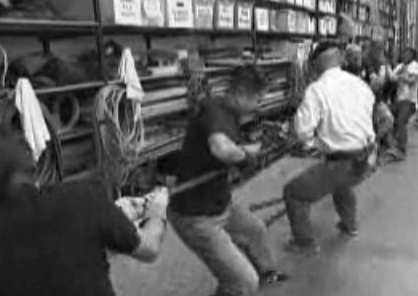
The Mythbusters try to pull apart two interlocked phonebooks
So two extremes play tug-of-war with this concept of our “knowledge of God.” In the case of the first extreme, I claim to have captured God, strapped the Divine to the operating table, and figured out what makes God tick. When I’m done with the exploratory surgery, I stuff and mount God on the wall just like a prize twelve-point buck. With my experimentation complete, I know just what button to push to make God act in my favor, and oddly enough, God disagrees with all the same people I do. This is the extreme where I have God pegged. Now, you might have spotted the flaw in this point of view. (Remember – we’re talking about extremes, so flaws are more common out here.) The flaw here is, of course, the delusion that God is small or mundane enough for me to figure out what makes God tick.
The other extreme is, naturally, the complete opposite of the first. In the case of the second extreme, I claim to have absolutely no ability to comprehend a God who exists for eternity in infinity. When I try to get a handle on God, I am at a complete loss for words and I must conclude that God is so unsearchably unknowable that I might as well give up. I’m an amoeba trying to read Shakespeare. But I make peace with my teeny-tinyness, and I go about my day trying not to have delusions of grandeur, in which I might rise to a level of intelligence that allows me to comprehend even a shred of what God is about. Of course, there’s a flaw here, too. The flaw in this extreme is the faulty thinking that God is too big and majestic to bother with an amoeba like me, no matter the evidence that God has been surprising humanity for millennia by encounters with the Divine, including one in which God sent his only Son to be an amoeba like me.
Now, each of us exists somewhere along the spectrum between these two extremes. When I really need something to happen – to get a job or pass a test or receive successful treatment – I might trend toward the first extreme, in which God comes at my beck and call. When something really terrible happens in the world – a huge earthquake or massive flooding or a category five tornado – I might trend toward the second extreme, in which God may exist in the ether of eternity but surely can’t be bothered with things here on lil’ ol’ Earth.
Do you see what’s happening here? My experience of God changes depending on my needs in the moment. I slide along the spectrum between the two extremes. The unique mixture of my appetites, yearnings, successes, failures, doubt, and faith paints a picture of the God to whom I address my prayers. And whatever else that painting may be, there is one thing that the picture surely is not. And that is an accurate portrait of God. This is why I wonder if the phrase “unknown God” still applies more than any other.
Now, as I tried to wade out of my confusion while writing this sermon, two questions struck me after that whole bit about the extremes. They might be on your mind right now, as well. First, if the God I’m worshiping isn’t really God, but rather my conception of God, then what’s the good of praying? And second, if I’m not really worshiping God, doesn’t that make me an idolater? This is when we need to call in one of the heavyweights.
C.S. Lewis wrote an incredible poem called “A footnote to all prayers.” He begins:
He whom I bow to only knows to whom I bow
When I attempt the ineffable name, murmuring thou,
And dream of Pheidian fancies and embrace in heart
Symbols (I know) which cannot be the thing thou art.
These Pheidian fancies are works of the Greek sculptor Phidas, the very statues of gods and goddesses that Paul saw in Athens. Lewis knows that, even when he tries to call upon God, the best he can do is some symbol that could never do God justice. He continues:
Thus always, taken at their word, all prayers blaspheme
Worshipping with frail images a folk-lore dream,
And all men in their praying, self-deceived, address
The coinage of their own unquiet thoughts…
Lewis poetically describes the same predicament we were in a minute ago: in prayer, we address the gods of our own “unquiet” thoughts and thus we blaspheme. But the poem is only half over, for Lewis continues: [we blaspheme]
…unless
Thou in magnetic mercy to thyself divert
Our arrows, aimed unskillfully…
Even someone of C.S. Lewis’ verbal skill aims his prayer-arrows unskillfully, always at some conception of an “unknown” god than at the one, true God. But, in the end, our story isn’t really about you and me. Our story is always and forever about God working in, around, and through us, no matter how unknown God may be to us. And God’s story is all about God’s “magnetic mercy,” by which God pulls our prayers to God, even though we shoot them far wide of the target. Lewis concludes:
Take not, oh Lord, our literal sense. Lord, in thy great,
Unbroken speech our limping metaphor translate.
As we slide along the spectrum between the two faulty extremes of our conception of God, we can only speak in “limping metaphor.” But the true God, according to Lewis, speaks in “great, unbroken speech.” This is the speech that voiced light in the beginning and continues to sustain creation. This is the speech that speaks each one of us into being everyday, no matter the degree to which the speaker is unknown to us.
To tell you the truth, this unknown quality of God will be with us until God takes us fully into God’s glorious presence. Indeed, the unknown quality will keep us searching and reaching out and finding God in even the unlikeliest of places. And I believe that God redeems our lack of knowledge through God’s magnetic mercy. God translates our limping metaphor into the leaping speech of abundant life (even the words I’m speaking right now). Here’s the good news. In the end, our knowledge of God places a far distant second to God’s knowledge of us. As Paul says to the church in Corinth: someday “I will know fully, even as I have been fully known.”
(Sermon for Sunday, May 15, 2011 || Easter 4A || John 10:1-10; find it also on Day1.org as part of the series “Young Leaders of the Church” series.)
Having the flu changed my life. The day was Thursday, March 13th, 2008, and I was sitting on my futon with my computer on my lap. Quite suddenly, I realized how clammy and hot I felt. Half an hour before, I had felt just fine, but in just thirty minutes my insides decided that they needed desperately to become my outsides. I put my computer on the floor, leapt up, and staggered into the bathroom. I was ill for five days, and during that time all I did was sleep and watch my recently acquired complete series of Star Trek: The Next Generation on DVD. For those five days, I did not open the lid of my laptop. I did not press the power button. And I did not log in to the computer game that had dominated my life for nearly two years.
The following Tuesday, when I felt that I could walk around without gripping the furniture for support, I stumbled over to the computer and deleted World of Warcraft from the hard drive. I tossed the game discs in the trash. And in the three years, two months, and two days since contracting the flu bug, I have never logged back into the game. The flu acted as the catalyst for the breaking of my addiction to the computer game. The illness put me on the disabled list for a week right before Easter, but no matter how awful the flu made me feel, I thank God every day for the not-so-gentle push away from the stagnant life I was living. I thank God every day for yanking me out of the comfortable sheepfold that I had built up around me. I thank God every day for pulling me kicking and screaming through the gate, away from my dormant life and toward a life full of God.
This not-so-gentle shove out of the sheepfold happens in today’s Gospel reading, although I doubt you noticed any mention of being kicked through the gate in Jesus’ words. We’ll get back to this shove in a moment. First, notice that in John chapter 10, Jesus employs the imagery of first century shepherding practice in an attempt to reveal his own identity and his relationship to us. Now, the most experience I’ve ever had with sheep was in southern England, where I spent one windy afternoon dodging the sheep’s ubiquitous droppings while trying to appreciate the mystery of Avebury’s standing stones. If you’re anything like me, you have no clue about shepherding practice of any sort, ancient or modern. Therefore, in order to access what John calls a “figure of speech,” we first acknowledge our lack of personal contact with Jesus’ choice of image, and second we embrace the opportunity to use our imaginations.
So imagine with me a rolling plain, dotted with humps and hillocks. Dusk descends, and the shepherd leads his flock into the sheepfold. One of the hillocks has been hollowed out, and the sheep huddle inside next to the sheep of several other shepherds who share this particular fold. A pair of piled rock walls extends out a few feet from the sides of the hill. The shepherd lies down in the space between the low walls, effectively sealing the enclosure. Thieves and bandits and wolves will have a difficult time getting in with the shepherds on guard. The sheep are safe in the sheepfold.
When the shepherd arises the next morning, Jesus explains, “He calls his own sheep by name and leads them out. When he has brought out all his own, he goes ahead of them, and the sheep follow him because they know his voice.” The sheep can’t spend their whole lives in the sheepfold, no matter how safe the enclosure may be. There’s no food in the fold, after all. The sheepfold may be comfortable and safe, but the sheep must follow the shepherd out of the fold in order to find sustenance, in order to live.
Jesus’ choice of words here is telling, but our translation into English hides the special word that Jesus uses. “When he has brought out all his own, he goes ahead of them,” says Jesus in the version we use in church. In this verse, there’s a fairly weak rendering of a Greek word that appears over and over again in the Gospel. We hear this word every time Jesus casts out a demon. We hear this word when Jesus makes a whip and throws the moneychangers out of the temple. We hear this word when Jesus speaks of driving out the “ruler of this world.” In every instance of this word in the Gospel, Jesus is doing some sort of battle: he is pushing, pulling, throwing, yanking, driving, exorcising, casting out. But in this instance about the shepherd and the sheep, the translators decided a nice, safe, neutral translation was better. The shepherd simply “brings” his sheep out of the fold.
Now, perhaps those dimwitted, wooly animals trod placidly from the fold every morning at the beckoning of the shepherd. But Jesus is, of course, not talking about real sheep. He’s talking about us, about you and me. He’s talking about calling out to us, about speaking the word that will bring us forth from our own sheepfolds, from those places of comfort and safety that we have built up around us. The seductive force that pulls us into these personal sheepfolds tells us that everything will be okay as long as we keep quiet and stay put. Play another hour. Have another drink. Watch another show. I don’t know about you, but I need to be pushed, pulled, thrown, yanked, and driven out of that place of stagnation and dormancy every time I start settling into my comfortable enclosure.
For two years, my sheepfold was the virtual world created in the computer game World of Warcraft. I lived there more than I did in the real world. I played every day. Often I ate all three meals in front of my computer. But during those stagnant months that stretched into years, I didn’t live. I existed. I simply settled myself in my sheepfold. My mind numbed. My heart hibernated. My spirit deflated. But I didn’t notice because I was safe and I was comfortable. Then the flu hit, and I was too weak to resist the pulling and yanking that God had been doing for who knows how long. God drove me out of my sheepfold. And my life began anew.
This is the message of the Resurrection: life cannot be conquered – not by death, not by sin, not by the powers of darkness. Life happens – fully, intensely, eternally. Indeed, Jesus tells us this morning: “I came that they may have life, and have it abundantly.” The Resurrection of Jesus Christ ripples out to touch every life, everywhere, for all time. The wonder of Easter morning shows us the utter lengths that God goes to offer us abundant life.
And yet, while life cannot be conquered, life can be delayed, put on hold, made dormant. When we retreat to the safety and comfort of our own personal sheepfolds – whatever they may be – we refuse to participate in the fullness of a life lived in God. Of course, existing in the sheepfold is easier, less demanding. But existence is not life. Ease does not bring joy. And less demanding often means less fulfilling.
We cannot import into our sheepfolds the abundant life that Christ offers us because the very fullness of that life cannot fit inside a safe, comfortable enclosure. Christ drives us out of the sheepfold so that our lives have the opportunity to expand, that we may embrace God’s unrestrained abundance. During this season of Easter, join God in the expansive life found in the Resurrection. Listen for the voice of the shepherd calling you by name, calling you out of complacency. And give Christ the chance to cast you out of your sheepfold so that you may find the fullness of a life lived in the abundance of God.




 Where the Wind...