
Sermon for Sunday, June 21, 2015 || Proper 7B || Mark 4:35-41
 Twelve years ago today, I preached my very first sermon. Delivering a sermon was a requirement of my internship at St. Michael and All Angels Church in Dallas, Texas. So when the other four interns and I received the readings we’d all be preaching on, we dove right in, determined to preach the best sermons the great state of Texas had ever heard. That didn’t happen. But we each managed to say something coherent about Jesus calming the storm, and none of us fainted in the pulpit, so I call that a win. I have a muffled recording of the sermon I preached. I made the mistake of listening to it earlier this week. Wow, it’s really bad. There was something about complacency and faith and God shaking us up and Isaac Newton’s first law of motion, but I didn’t real say anything to take home with you.
The thing is, at the time, I thought it was a pretty good attempt at preaching. I felt pretty good when I sat down. So why do I shake my head when I listen to it now? Well, my understanding of faith has changed quite a lot in the last twelve years, so what I hear in the sermon rings a bit hollow. But I expect my understanding of faith to change quite a lot in the next twelve years, too.
The question is this: if I’m no longer where I was faith-wise twelve years ago, does that make my earlier faith false? The answer to this question must be a resounding, “No!” Surely God is able to work through the most tentative faith or the most hardened faith or even the most erroneous faith. God makes use of any raw materials we bring to the table, however clumsy they happen to be.
I’d hazard to guess that your understanding of faith has changed quite a lot over the course of your lifetimes, as well. This isn’t a bad thing. Rather, if your faith has changed over time, you’ve probably been wrestling with it, questioning it, wondering how it impacts your life. A faith that does not undergo some kind of change over time is more than likely an unexamined faith or just a cosmetic one.
I’d like to share with you four understandings of faith that I have gone through since I preached that sermon twelve years ago. I don’t claim that any of these are wrong; rather, where I am now in faith happens to be the most helpful understanding for the current stage of my following Jesus. As you listen to these four descriptions, see if you can locate how you experience faith. Is another description beckoning you? Or is there a completely different understanding of faith that I know nothing about? This exercise is important because an unexamined faith often becomes a stagnant one.
First up: my understanding of faith during that sermon in Dallas. At that time, faith was a quantity. It was something I could measure. This makes sense: after all, in today’s Gospel reading, after Jesus calms the storm, he says to his disciples, “Why are you afraid? Have you still no faith?” If they have zero faith, then presumably they could also have a little faith or some faith or much faith.
The challenge to this understanding comes when something happens to tip the scales: a tragedy that takes a loved one’s life, an unexpected diagnosis, a relationship in tatters. You might beat yourself up, saying, “If only I had a little more faith, I could get through this.” When tragedy strikes, we forget the blessing that comes with this understanding of faith as a quantity. Jesus says that faith the size of a mustard seed (that is, the smallest amount possible) is enough to weather the storm.*
When I was in seminary, my understanding of “faith as a quantity” morphed into something else. For a long time, I swapped “faith” with a word that’s almost a synonym. That word was “trust.” For some reason, I couldn’t find the active component of faith that seemed to be missing from the “quantity” definition, so I replaced it with something I felt I could do. I could trust God. When Jesus calms the storm, he might as well have said, “Why are you afraid? Don’t you trust me?”
The most common expression of this understanding is the proverbial “leap of faith.” The shadowy unknown spreads out in front of you, and yet you walk on, trusting that God will guide you. Your faith is like the headlights on your car, which only illuminate the patch of road in front of you but still somehow manage to get you home.**
Over the first few years of ordained ministry, this view of “faith as trust” broadened. The act of trusting was not big enough to contain all that faith was. This is when “faith” became a verb for me. Faith was the active component of my relationship with God, the thing that spurred me to love God and serve God’s people. While Jesus might say the disciples have no faith, they still woke him up, thinking he could do something about the storm. As I said in a sermon for you all last year, this understanding of faith “borrows the best parts of trust, confidence, humility, and zeal and molds them into our response to God’s presence in our lives.”
The word “presence” carries over from this understanding of faith to the one that is alive for me today. And that is faith as direction or orientation. Faith is the mysterious something inside us that always and forever points to God’s presence, like a compass needle pointing due north. But we are not always facing the right way, and so the compass of faith prompts us to turn around. The technical word for this turning is “repenting,” which can lead to a renewal of our relationships with God.
Sometimes we have blinders on our eyes that make us look straight ahead through a narrow field of vision.*** God might be calling us to unimagined possibilities dancing just out of sight. Our faith invites us to widen those blinders until we can once again see what’s pointing to God. When we are overwhelmed by tragedy or grief or doubt, the blinders can snap tight again. But faith beckons us to open wide so we can find our true orientation towards God’s presence. Do you think Jesus halting the storm with a word was even close to a possibility on the disciples’ minds when they woke him? No. And yet what little faith they had still pointed to him as their refuge.
This is where my understanding of faith currently stands. I learned it from my father and from talking with many of you as you’ve sat on the couch in my office and spoken of your secret hopes and deepest fears and gnawing doubts and strangling griefs. I don’t know what my understanding of faith will be twelve years from now, but for today, this is it. Faith is the internal compass needle pointing to God’s presence. And since God’s presence happens to be everywhere, the blinders on my eyes serve no purpose at all.
I hope you will take some time this week to take stock of how your faith expresses itself. If faith is a quantity, how much do you need for it to guide your life? If faith is trust, into what unknown is God calling you to leap? If faith is a verb, the active component of your relationship with God, what are you and God doing together this afternoon, this week, this year? And if faith is your orientation towards to God’s presence, where and to whom is it pointing? What possibilities are dancing just out of sight?
—
 I first learned how to tell Godly Play stories back in 2006 when I was interning as a hospital chaplain at Children’s Medical Center in Dallas, Texas. We chaplains had these miniature golden parable boxes, which we would bring to the patients’ rooms and lay out the stories on their beds. The first one I got my hands on comes from today’s Gospel lesson. The kingdom of God is “like a mustard seed, which, when sown upon the ground, is the smallest of all the seeds on earth; yet when it is sown it grows up and becomes the greatest of all shrubs, and puts forth large branches, so that the birds of the air can make nests in its shade.”

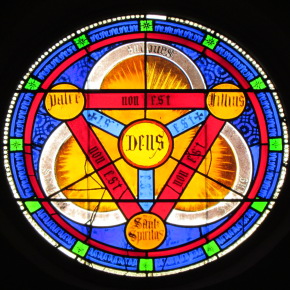 Have you ever looked closely at the round window high up the wall in the back of the church? Go ahead – turn around and give it a good look. I love this window. I love the vibrant colors. I love that when the sun is shining through it, an afterimage gets imprinted on my eyes, so I see it when I close them. If you’ve never given the window much thought, I don’t blame you. The words on it are in Latin, after all. But let’s keep looking. The window presents a diagram of the Holy Trinity. “Deus” – God – is encircled in the center. Three smaller circles float around it: Patri, Filius, Spiritus Sancti – Father, Son, and Holy Spirit. Each of the smaller circles is connected to the others with the words “non est” (is not), and each smaller circle is connected to the large central one with the word “est” (is). The diagram is telling us that the Father, Son, and Holy Spirit are not each other but they are all One God. How does this work? Wisely, the window doesn’t tell us. The window just illustrates the reality, a theological blueprint in stained glass.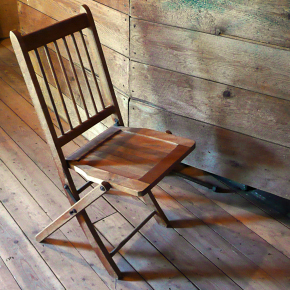
 Today, on this day of Pentecost, I’d like to tell you a story about the Holy Spirit. It’s going to sound like a story about me, but if I tell it right, you’ll see that the Holy Spirit is the main protagonist of this little tale. The story takes place a stretch down River Road about three miles from the Middle of Nowhere, West Virginia.
 Last week, we talked about trying to discern how and when to lean into the newness shimmering on the horizon of your life. I invited you to stop and pray the next time you are at the precipice of a decision; to take a deep breath and feel which way the wind of the Holy Spirit is pushing you; to ask God what new thing God is trying to birth through you with the decision. I know many of us, myself included, often have a hard time finding words to put to these prayers for guidance. Silent prayer – with lots of listening – is a beautiful alternative when there are no words, but if you have the urge to speak, then I have the first five words of the prayer, just to get you started. They come from this morning’s first reading. The eleven apostles want to round out their number, so they select two candidates and then pray about which one will take Judas’s spot. And they begin their prayer for guidance with these five words: “Lord, you know everyone’s heart.”
 “Sing to the Lord a new song, for he has done marvelous things.” Today’s psalm begins with these glorious words, and for me it begins with a question. Why does the song we sing have to be a new one? Why can’t the song be an old song, one that has stood the test of time? “Amazing Grace,” perhaps? Or how about “In the Garden?” While these songs are beautiful and wonderful and should never, ever be lost to the ages, I think the psalmist feels the urge to sing a new song because he or she has discovered a fundamental truth about God’s movement in God’s universe. God is always doing something new.
 Twice last week, I got to wear a tie. I went to the MASH gala fundraiser and to the Eastern Connecticut Symphony concert, at which several of our parishioners sang their hearts out performing Carl Orff’s Carmina Burana. The benefit was fabulous, the concert was wonderful. And I went to both wearing a tie. This may sound like a strange thing for me to report to you, but I assure you, I am going somewhere with this. Whenever I’m getting dressed, I’m faced with a wardrobe decision. Do I wear my black shirt and collar or not? If I decide not to, then I leave the house incognito. I’m still a priest, of course, when wearing a coat and tie or jeans and flip flops, but people at the concert hall or grocery store won’t be able to spot that about me on first glance. (They probably think I’m a college sophomore home on break.)


 Stigma is not a happy word. If you use it in a sentence, more than likely the word “stigma” will be linked to something that people view as disgraceful or humiliating, whether that view is warranted or not. A couple of us recently read a book called The Rich and the Rest of Us by Tavis Smiley and Cornel West, who spoke of the need to lift the stigma associated with the word “poverty” if we are ever going to muster the societal will to lift those on the margins. In years past, society has stigmatized attributes of people who exhibit less capacity than most, using words like “retarded” and “crippled” to describe those with mental and physical challenges. Suffice to say that members of every minority group – no matter the difference used to justify labeling them as “those people” – have been stigmatized in one way or another. Stigmas lead to segregation and prejudicial behavior and animosity. “Stigma” is not a happy word.
 Where the Wind...