
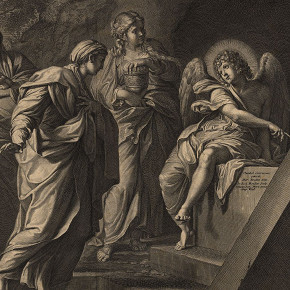
Sermon for Easter Sunday, March 27, 2016 || Easter C || Luke 24:1-12
 Good morning, and welcome to St. Mark’s Church on this Feast of the Resurrection. You know, every Sunday is a Feast of the Resurrection, but today is special. Do you know why? Because today is the first Sunday after the first full moon after the vernal equinox – and that makes today Easter. So if a late night talk show host ever jumps out of a cab and asks you how to calculate the date of Easter, now you know.
Today is also special because of the week we’ve just had here at St. Mark’s. We’ve walked with Jesus from his triumphant entry into Jerusalem, to the last supper with his friends to his agony in the garden, to his betrayal and arrest and trial, to his crucifixion, to his burial in the tomb. We’ve been through the darkness of Good Friday; we’ve been to the foot of the cross. Now the dawn breaks on Sunday morning, and once again we set off, walking this time with the women and their spiced ointments.
I doubt they slept much the last two nights, Mary Magdalene and the other women who rose early on the first day of the week to minister to their dead Lord. Every time they shut their eyes, I’m sure they saw the silhouette of Jesus’ cross in the distance, his limp body barely recognizable because of his torturous hours hanging there. No, I doubt these women slept much, though if they did finally fall into fitful slumber, it was because they cried themselves to sleep. When all you have left is your tears, you’d want to hoard them; but that’s when they flow all the more freely.
I’m sure the tears began again when they awoke early Sunday morning. New grief is like that. Each morning you wake and remember again that your loved one is gone, and again the pain stabs you anew, just as fresh as the first time. They bear the rawness of their grief by taking on a mission; after all, staying busy is one way to soften the blow. And so the women take up their burden of fragrant spices and trudge out into the darkness in order to arrive at the tomb at first light.
Out of deep troves of love and compassion, these brave women are ready to care for the body of their Lord and to prepare it for proper burial. It turns out Mary and her friends are making the happiest mistake in the history of mistakes. They are ready to wash and anoint a lifeless body, but what they find is no body at all. They find an empty tomb. For a horrible moment, their grief threatens to overwhelm them because the mission they were planning to perform – the one they had been clinging to since his death – is gone now, too. They didn’t think they could be more desolate, but they are wrong. For this horrible moment, the empty tomb magnifies their desolation.
But into this scene of despair and grief comes the sudden presence of two gleaming messengers. They enlighten the woman as to their happy mistake: “Why do you look for the living among the dead? He is not here, but has arisen.”
The messengers continue talking, but the women have ears only for that last word: “Arisen!” For the first time since Friday, they remember Jesus’ words, and first one, then another, then another breaks out into a tentative smile. “Could it be true?” they ask each other.
“Yes, yes, yes it could.”
“Jesus never lied to us.”
“How could we forget his words?”
Then one repeats the messengers’ question: “Why are we looking for the living among the dead?”
This question echoes down through the centuries, and we find ourselves asking it when we read the beginning of the final chapter of Luke’s account of the Gospel. Why do you look for the living among the dead? How often in our day-to-day lives could we hear the gleaming messengers ask us this question? How often do we trudge down our own well-worn paths to life-defeating things hoping this time – maybe this time – something life-affirming will happen?
Perhaps you’ve had a string of boyfriends who were real losers. Your friends tell you so at every opportunity, but you’ve got a blind spot for the proverbial bad boy. They treat you with no respect. From time to time they’ve even called you a name that I can’t say during this sermon. And yet you meet another one and all the signs are there, but you dive in headfirst anyway. To you the gleaming messengers say, “Why do you look for the living among the dead?”
Perhaps you’ve been sober for three months. Your sponsor hands you your chip and slaps you on the back. You’ve got a couple of other three-month chips in a drawer somewhere, but that’s not on your mind right now. On your way home from the meeting, you run into an old buddy from back in the day. The next morning, you stagger to the drawer and toss the newest chip in. Maybe you’ll get another one in a few months time, but for today your salvation is at the bottom of a bottle. To you, the messengers say, “Why do you look for living among the dead?”
Perhaps you work through your family vacation because you’ve got too many projects on your plate. Or you’ve given into the tiny fearful voice that says you’re too old or too sick or too broken to make a difference in someone else’s life. Or you spend every waking hour mindlessly surfing YouTube and Facebook and Instagram. Or…or…or… Every one of us has a few life-defeating paths that we have no trouble finding. To each of us, the messengers say, “Why do you look for the living among the dead?”The Resurrection of Jesus Christ spurred this question all those centuries ago. The women made the happy mistake of looking for a dead messiah, when the Risen One was alive again. Our life-defeating paths lead to tombs, as well, but they are not empty, for our dead messiahs are there waiting to suck the life from us. But the tomb of the Risen Lord is empty, and a new, life-affirming path stretches from that tomb and reaches into eternity.
Today, on this first Sunday after the first full moon after the vernal equinox, on this special Feast of the Resurrection, we see most clearly this new, life-affirming path stretching from our feet off to the sun-drenched horizon. As we walk it together and with our Risen Lord, we will pass by so many people going the opposite way down the life-defeating paths. This may be due to their own choices or because they are caught up in systems that will never produce anything but defeat; systems of poverty, injustice, racism, apathy.
But as we walk this life-affirming path, we have the opportunity to be apostles like those brave women, to show people the power of the Risen Christ in our lives, to hook arms with folks going the other way and help turn them around. We have the opportunity to be the gleaming messengers who ask one simple question. “Why do you look for the living among the dead?”
And then we have the glorious opportunity to share the heart of the Good News. “He is not here, but has arisen.”
—

 The Passion narrative Stacey just read can be quite overwhelming. It is by far and away the longest reading we listen to all year, and there’s a lot going on. There’s Judas’s betrayal, Jesus’ arrest, Peter’s denial, the trial with the high priest, the interview with Pilate, the frenzy of the crowd, the crucifixion, and the last words from the cross. There’s so much going on, in fact, that we can easily lose sight of the overarching story of the Gospel when we find ourselves overloaded by this painful and heart-breaking narrative. So instead of talking about the entire Passion narrative, each year I like to focus on one little moment of it that speaks to the whole story. On this Good Friday, that moment happens between the soldiers gambling for Jesus’ clothes and Jesus drinking the sour wine.
 In our lovely, little town of Mystic, today is a day of parades. There’s one this afternoon that will get all the press – the St. Patrick’s Day parade will attract throngs of green-clad people to Main Street to watch and revel at a charming small town spectacle. The Highland Pipe Band will set the tone as they march off from Mystic Seaport towards downtown. Hundreds of people on floats, in cars, and on foot will follow, not to mention the real reason to go to parades, which is the fire engines. They say everyone is Irish on St. Patrick’s Day, and the same extends to Mystic’s parade four days later.

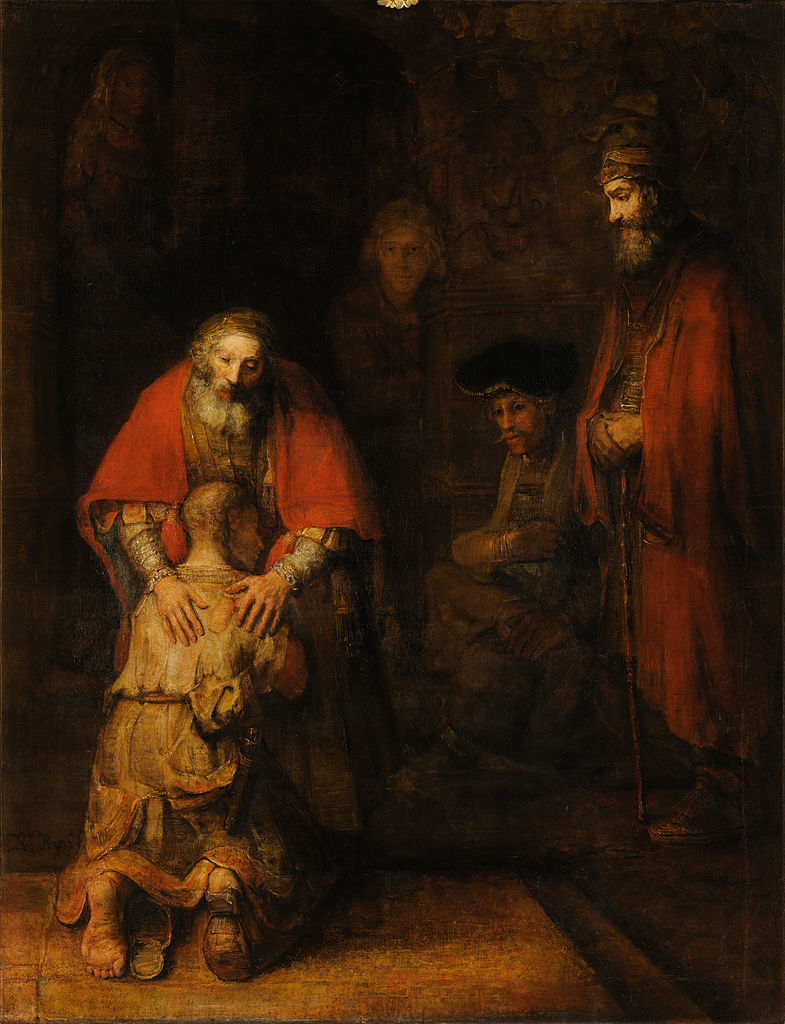

 This is a sermon about grace. I’ve been wanting to share with you my definition of grace for a while now, but the time didn’t seem right. Then after spending time with Megan Palmer’s family two weeks ago, preparing for and leading Megan’s service last weekend, and having the stomach flu most of this past week, the time to talk about grace has finally come. Maybe I was waiting for a moment when I was sure I had recently experienced it. But before we talk about grace, I need to tell you about my dad’s sense of humor.
 Last fall, I had to renew my passport before my trip to Haiti with Tim Evers. I had originally gotten my passport in advance of a choir trip to England back in college in 2003, and that first document was still valid when Leah and I went to South Africa for our honeymoon in 2011. But they’re only good ten years, so in the fall of 2015, I found myself stapling an unsmiling picture to an application I picked up at the post office. I filled in all the information – name, address, social security number. I checked the box marked “U.S. Citizen,” dropped the package in the mail with the processing fee, and a few weeks later, received my new passport.
 Right now, the bedtime ritual at home goes something like this: bath time around 6:15; diapers and pajamas at 6:30; stories, snuggles, and songs until 6:45; and then, blessedly, sleep. We rotate through many beloved and well-worn bedtime books: Goodnight, Moon; Time for Bed; Guess How Much I Love You; The Going to Bed Book. Leah and I can recite every one of these and more. But I tell you, I can’t wait until Charlie and Amelia are old enough to ask us to make up bedtime stories.
 Every year on the Sunday before Lent begins, we read this Gospel lesson. We call it the story of the Transfiguration, which is a fancy way of saying “something turning into something else, usually a more beautiful something else.” And if we stopped there with the label we apply to the story, we would get something out of it to strengthen our faith. We would see some evidence that Jesus was really whom he said he was, since his face changed and his clothes dazzled and two famous dead prophets came round for a chat. But I don’t think this evidence is really what Luke means for us to get out of this story. I don’t even think the term “Transfiguration” applies to Jesus. Rather, since the whole story is told from the disciples’ perspective, I think they are the ones who are “transfigured.” I’ll explain what I mean by that in a minute, but first I’d like to tell you about my fifth grade science fare project.
 We’ve all heard those words from the Apostle Paul a hundred times. “Love is patient. Love is kind.” I read them at my sister’s wedding. Perhaps you had them read at your own. Statistically speaking, if you go to a wedding there’s a better than average chance you’ll hear First Corinthians 13. Now, it is true beautiful chapter can stand apart as an ancient ode to love. But when we sequester these verses to the marital service alone, we miss how Paul uses them in the greater context of his letter. We miss how love is the corrective for the issues facing the church in Corinth. We miss what love is for. So let’s put these famous words back in context, and with a little help from Harry Potter, we’ll remember a thing or two about love.
