
Sermon for Sunday, December 6, 2015 || Advent 2C
 As many of you know, Tim Evers and I spent much of last week in Haiti visiting our mission partner, St. Luc School. As you will see later in this sermon, I’m so thankful that a coincidence of calendar had us travel there during Advent. My first glimpse of the country came from 10,000 feet in the air. The Haitian landscape rises rugged and mountainous to the east where it abuts the Dominican Republic and flattens to the west where a peninsula bathes in the Caribbean Sea. Our destination was in the countryside west of the capital.
We arrived at the hospital of St. Croix in Leogane after the wildest vehicular ride of my life. Negotiating intersections paired survival of the fittest with a massive game of chicken. There were next to no traffic lights, and the painted traffic lanes seemed merely suggestive. Even which side of the road to drive on was in doubt. But we made it, thanks to our driver’s aggressive skill and liberal use of the horn.
As we drove, both from the airport and on the way to St. Luc, I tried to take in as much of my surroundings as possible. Here are a few impressions in no particular order:
Wherever there is an open patch of ground, there are kids playing soccer on it. Grass is optional. And having a ball is optional.
Most people are dressed the way you or I might when we’re doing yard work. The big exception are kids – particularly girls – wearing immaculate school uniforms. And I mean immaculate. Their blouses are the only thing I saw that I would classify as the color white. Everything else that could be white was painted tan by all the dust.
There are stray dogs all over the place, many with mammary glands obviously swollen with milk. I realized how odd this sight was to me because nearly every dog in the U.S. is spayed or neutered.
The two main forms of transportation are walking and riding small motorcycles — dirt bikes, really. I didn’t know you could fit five people on a dirt bike, but you can.
There are lots of scrawny little goats milling around.
Many of the ramshackle dwellings are fenced in with tarps emblazoned with “USAID” – the United States Agency for International Development. The tarps say, “From the American People” on them. It’s a sad commentary that the emergency tarps provided five years ago after the earthquake have become a permanent fixture in people’s dwellings.
In the distance, the landscape is truly stunning, but focusing on the landscape close by tells what happens when there is no functioning sanitation department. Discarded bottles and Styrofoam food containers collect in piles like raked leaves, along with other unidentified refuse.
All this I saw from the seat of a dented Mazda dualcab truck. All this I saw without actually interacting with anyone. Thankfully, we did interact with people, and so my appreciation for both the blessings and challenges of life in Mercery, Haiti deepened. Our main contact was Fr. Sonley Joseph, the priest in charge of St. Croix and its eight — eight! — satellite parishes, including St. Luc. Sonley and I have a lot in common: we’re both writers and we both lived in the same dormitory at Virginia Theological Seminary (he a couple years after I). I liked him immediately, and not just because of our kinship, but because of his soft-spoken, yet ardent and inviting vision of the mission of God. In Haiti, the Church’s participation in God’s mission has always been linked with education, and most churches have schools attached. Sounds like St. Mark’s, if you ask me.
Fr. Sonley was our guide and interpreter when we went to St. Luc on Wednesday morning to say hello to the students and teachers. We received 270 bon jours in return across the eight classrooms, from 6th grade on down to pre-K. The school has no electricity, but there is enough tropical sunlight to illuminate all the rooms, save one whose windows are shaded by plants. The classrooms are quite noisy because there’s nothing but cinderblocks to keep sounds from one room invading another. And most teaching is done using the blackboard, as there aren’t enough books to go around.
But even with these challenges, the teachers’ love for their profession and their students is evident from the moment you step into the room. Tim and I met with the teachers later in the day, and they all agreed that St. Luc is the best school in Mercery. Their pride for and dedication to their school was wonderful to feel. Access to education is a fundamental human right. And these teachers are realizing this fundamental human right for those 270 beautiful children, in a country were such access is far from assured.
To be involved in the process of educating these children, even in the small way we at St. Mark’s are, is a gift. Our partnership with St. Luc School is a gift from God, a participation in God’s mission as Fr. Sonley described it. Of course, there is so much more we could do. We have a list, prioritized from simple to incredibly ambitious. But that’s only for these 270 kids. What about the other children of Haiti or in other poverty-stricken places (even here in the States) or the other needs and disparities that need to be addressed or the issues of injustice that keep people from having access to fundamental human rights? There is so much more that we could do! There is always so much more we can do — So, so, so, so, so much more that we can easily be overwhelmed; the need can steal our breath, then our balance, then our will to persevere.
And this is where the season of Advent infiltrates our hearts and minds and gives us a little breathing room to stand back and take it all in. Yes, the needs of this world are great. Yes, the harvest is plentiful and the laborers are few. But Advent teaches us two things that will sharpen our focus and our will.
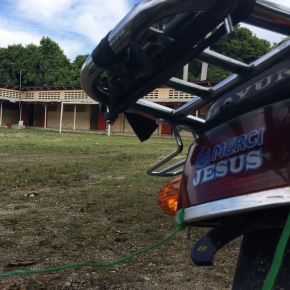
First, as Stacey so aptly put it last week, Advent reminds that the One we long for is already here. There is a tension at play between God’s kingdom already here and God’s kingdom still to come. God’s kingdom is alive and well in Haiti. Indeed, despite the general poverty of resources and circumstances, the faith of the people of Haiti is deep and abiding. I saw dozens of signs that said “Merci Jesus” on them. Thank you, Jesus! For what, you might ask? For life. For love. For family. For the same things you and I thank Jesus for. That’s the “already” of the kingdom. The “not yet” is still breaking in: it’s in the teachers sweltering at blackboards with 50 students clamoring for attention; it’s in the mother painstakingly washing the uniform each night so it is immaculate again in the morning; it’s in the hungry yet smiling faces of those children who are Haiti’s future, whom we are helping to educate.
Second, Advent teaches us to focus on a particular spot at a particular time on a particular person. The particularity of Jesus’ Incarnation is what we are getting ready for. God came to us in all the particularity of a precious human life, born in a place that could easily have been fenced with a tarp from USAID. Because of this Incarnation, Jesus had a chance to meet people in a way God couldn’t — eye to eye, touching, embracing, walking with, eating with…dying for. When you start to get overwhelmed by the needs of the world, return to Advent. Walk with Mary and Joseph to that starlit stable in Bethlehem and witness the birth of grace and love. See Christ embodied in his own peculiar humanness. Then go back to the needs of this world. Don’t be overwhelmed by the sheer quantity. Instead, do what God did in the Incarnation: pick a place; pick a person. Be present there. Form a partnership there. Form relationships there in that singular place. Find Christ in that person. And be an incarnation of Christ to that person.
That’s what we’re doing in the partnership between St. Mark’s Church and St. Luc School. It’s an Advent partnership: already begun but never quite finished. It’s also a Christmas partnership, because in that little school off a dirt road in the boondocks of the poorest country in the western hemisphere, we incarnate Christ for each other. Thanks be to God.

 I find it ironic that the framers of our lectionary chose the Gospel lesson I just read as the one for today. Today is the feast we call “Christ the King” or “Reign of Christ.” And yet, for the entire length of his conversation with Pontius Pilate, Jesus specifically dodges Pilate’s questions about his kingship. “Are you the king of the Jews?” Do you ask this on your own, or did others tell you about me? “So you are a king?” You say I am a king. But if Jesus is king of anything, if Jesus claims to reign over anything in this passage, his kingdom would not include land or crops or livestock or resources. His reign would be over “the truth.” For this I was born, and for this I came into the world, to testify to the truth.
 Note: For the sermon at St. Mark’s on 11/15, I was planning to read the Bishop’s address to the Diocesan Annual Convention, which took place the same weekend. Then when the terrorist attack in Parish happened, I knew I needed to say something different. Arriving home from convention in the evening of Saturday, I had little time to put a sermon together, so I went back in my vault to see if I had anything appropriate. I found a sermon from six years ago and started with that as my base. But with the Paris attacks on my mind, the old sermon morphed into something completely different, with nearly two-thirds of the words being new.
 I’ve been preparing recently for Confirmation class, which begins later today. We have four tenth and eleventh graders and their sponsors ready to begin a five-month journey through their faith: learning, discussing, sharing stories. The next time the bishop visits, these four will have the opportunity to make a mature profession of faith if they so desire, and I am really excited to get to walk with them these next several months. Because I’ve had Confirmation on my mind, I’ve been thinking and rethinking some of the “nuts and bolts” of the way we express our faith as Episcopalians. Every once in a while, I like to preach on these “nuts and bolts” because in my job I get asked the same dozen or so questions about our practice all the time, and exploring such questions can help us all deepen our engagement in worship and in mission.
 Today’s sermon is about practicality and belief. I don’t have time for a fancy intro about when I was in fourth grade or about how something my children did reminded me of the Gospel. We’ve got too much to do in this All Saints’ Day service for that – most importantly, getting to the baptism, which is up next. Since today’s sermon is in part about practicality, I thought I’d be practical in my time-management and just skip the intro. So to reiterate, today’s sermon is about practicality and belief.
 Imagine with me the beggar Bartimaeus. He is remembering the fateful day when a large crowd passed his perch beside the road from Jericho. It started like every other day, with a certain memory dancing before his sightless eyes.

 Jesus feels drawn to the man kneeling in front of him. His heart is warmed, and he feels the stirrings of love and compassion for this frightened soul in the midst of an existential crisis. Perhaps the man recently had a parent or friend die, or perhaps he himself had experienced an accident or illness that brought death near. Whatever the trigger, the man comes to Jesus with a serious question that has obviously been plaguing him because of some unspoken dread roiling within him.
 “Those whom God has joined together let no one put asunder.” By the end of this year, I will have said these words eleven times after hearing the marriage vows of eleven couples. Jesus says these words in today’s Gospel lesson. And he says many other words about marriage and divorce, about fidelity and desire, and about relationships with the most vulnerable. Beneath these words, no matter how hard they are to hear or to speak, beneath these words shimmers Jesus’ surpassing dream for all creation – that none of us and no part of that creation will ever truly be alone.
 The ministry intern at St. Mark’s preached yesterday, so I have no sermon to offer to the Internet this morning. Instead, I held on to the following for just such an occasion, and I am glad to share it today. In August, I attended a training event called
  Where the Wind...