Revelation (The Good Parts Version)

(Sermon for Sunday, May 9, 2010 || Easter 6, Year C, RCL || Revelation 21:10, 22—22:5)

These are my original sermon notes. I accidentally washed them in the laundry.

Have you noticed that we’ve been reading the Book of Revelation ever since Easter? Every Sunday since Easter, the New Testament lessons have come from the Book of Revelation. You probably haven’t noticed this for at least two reasons. One: Besides a quick quotation in last week’s sermon, no preacher at this church has come within spitting distance of the texts from Revelation. Two: We’ve only read from the few chapters that don’t sound like a cross between an acid trip and Dante’s Inferno.

Our lectionary trims down the Book of Revelation to “The Good Parts Version,” the parts that don’t make us bewildered and squeamish. In all six lectionary lessons, not once do we hear about wars or plagues. Not once do we hear about dragons with seven heads and ten horns and seven diadems on their heads or beasts with ten horns and seven heads and ten diadems on their horns. Not once do we hear about the seven bowls of wrath or the six-six-six number of the beast or the five months of torture or the four horsemen or the three foul spirits or the two hundred miles of blood or the one whore of Babylon. Not once.

And we like it that way, thank you very much. We like the “Good Parts Version” of Revelation because we don’t want to dwell on how the world’s going to end in wrath and blood and fire. We don’t want to read the perplexing script that narrates the world’s annihilation. We don’t want to hear prophetic predictions of horrible apocalypse.

But, you know what? We don’t have to. While Revelation is full of disturbing imagery, several popular misconceptions about the text have led to some strange and erroneous readings.

Before we move on to this morning’s lesson, we need to get a few things straight. For starters, the popular understanding that Revelation is a script that narrates the end of the world is utter nonsense. Doctrines espousing the “Rapture” and the seven-year “Tribulation” only work by pasting together a few disparate pieces of scripture into a collage of truly baffling interpretation.

Next, to move any further into Revelation we need to rescue the words “prophecy” and “apocalypse” from their popular connotations. Prophets are not fortune-tellers or predictors or spiritual meteorologists. Prophecy is not about predicting the future. Prophecy is about telling the truth of the present in order that the future may change. Prophets call people back to God and hope that those people will listen and change their lives.

The story of Jonah illustrates the true nature of biblical prophecy. People usually remember the bit about the fish, but there is more. Jonah goes to the city of Ninevah and says, “Forty days more, and Nineveh shall be overthrown!” He says this to shake them out of complacency, to get them to turn back to God. And they do: the city isn’t destroyed! Does this make Jonah a false prophet because his words didn’t come true? No. Quite the contrary: Jonah succeeds as a prophet because the people listened and changed.

“Prophecy” is about telling present truth, not about predicting the future. To redefine another popular word, “apocalypse” is not necessarily about the “end of the world.” Rather, “apocalypse” means “an unveiling” or “revealing.” We’re used to hearing the word paired with trailers for disaster movies like 2012, but the term is really about pulling back the curtain of reality to see the deeper reality at work underneath. The message of Revelation is urgent not because the book is specifically about the world’s end, but because much early Christian thought grew out of the notion that Christ would return very soon. In that context, John of Patmos, the writer of Revelation, prayerfully looks behind the veil of the world’s reality and tells the truth about the present. John’s vision convinces him that true reality is a very different place than the one, which the Roman propaganda machine describes. The Empire had declared peace – the Pax Romana – but John sees this peace for what it really is, a violent, suppressive regime that rules by intimidation, occupation, fear, and capital punishment.

John had also noticed that the seven churches of Asia Minor had begun to buy into the Roman system of social domination. They were getting comfortable, complacent. They were adapting to the false reality of the Empire rather than living the countercultural lifestyle of the people of the Way, the followers of Jesus Christ. So John proclaims his vision to these churches.

To compose his vision into written form, John employs disturbing imagery, much of which our imaginations can barely fathom. Through a series of repetitive spirals, John tells the vision multiple times with increasingly unsettling images. Prose could never capture the vision, so John writes a long, sometimes nauseatingly graphic poem. Pastor and scholar Eugene Peterson comments, “If St. John’s Revelation is not read as a poem, it is virtually incomprehensible, which, in fact, is why it is so often uncomprehended.”

This prophetic poem is epic and cohesive. We do the Book of Revelation a disservice by reading only the “Good Parts Version” in church. Far from being a script narrating the cataclysmic end of the world, John’s apocalypse tells the truth about how God’s kingdom exists with far grander and vaster scope than the scary, but ultimately doomed, imperial dominion of Rome. While John was writing to people in his own time, Revelation continues to be remarkably relevant today. The parts we read in church are all about God’s kingdom. But we need the rest of Revelation, as well, to prepare us to hear the good news of these “Good Parts.”

You see, Revelation is shocking the same way a car accident is shocking. We can’t drive by without looking at the tangled mess of fenders and engine parts. Once we’re passed, the collision reminds us of our responsibility to be safe drivers. Likewise, the itchy, disturbing parts of Revelation narrate the mess we get ourselves into when we buy into the domination systems that the world has been promulgating throughout history. Then the “Good Parts” tell us about God’s true reality underneath, which pushes and prods us to relinquish our grip on the world’s false reality.

In this morning’s reading, John reaches the climax of his vision in the description of God’s holy city. His poetry tries as hard as language can to describe the glory he beholds. If we’ve read the disturbing parts of Revelation, we are now struck with the utter reversal from darkness to light, from death to life, from war to creation. But the vision of the city doesn’t simply encompass what we can expect when we pass from life through death to new life. Every single Sunday, we pray (in words that Jesus taught us) for God’s kingdom to come while we still live on earth. When we pray, “Thy kingdom come, thy will be done, on earth as it is in heaven,” we offer ourselves to God to use in the growth of the kingdom here.

So what does John’s vision have to tell us about this kingdom, which we are participating in growing on earth? Three things stand out, and all three work to counteract the domination systems, which John’s Revelation exposes. First, members of God’s kingdom practice radical hospitality. John says, “[The city’s] gates will never be shut by day – and there will be no night there.” Back in John’s time, city gates were usually open during the day to facilitate trade unless the city was under siege. But all threats have been removed from the heavenly city. And what’s more, since there is no night, the city gates are always open. As members of God’s kingdom, we strive to model this hospitality in our churches and in our lives. All are welcome, and woe to us if we attempt to close the gates which God has thrown open wide.

Second, members of God’s kingdom share the extravagant blessings of God with everyone they meet. In the heavenly city, the river of the water of life flows right through the middle of the main street. On either side of the river grows the “tree of life with its twelve kinds of fruit.” Unlike earthly trees, which bloom once a year, the tree of life produces a different fruit each month. The tree of life blooms constantly with all the extravagant blessing of God. As members of God’s kingdom, we strive to model this blessing by working for the just distribution of the world’s resources, by managing them wisely and sustainably, and by demonstrating that these resources can nourish the entire human family.

Third, members of God’s kingdom work for healing, wholeness, and closer communion with God for all of God’s people. “Nothing unclean will enter [the city],” says John, but not because unclean things will be barred. Rather, as scholar Brian Peterson says, “The promise that nothing unclean will enter, in the end, is the promise that God will remove all uncleanness from us all.” John shows this with these words: “The leaves of the tree are for the healing of the nations.” These are the “nations” that we thought destroyed by the battles earlier in John’s vision. Now they “walk by [the city’s] light.” Likewise, the kings who had earlier allied themselves with Babylon against the Lord now “bring their glory into the city.” As members of God’s kingdom, our duty has never been to say who can and who cannot come into closer contact with God. Rather, the city is full of the glory, light, and “unmediated presence” of God. When we release the illusion that we somehow control this presence, we can work to bring God’s wholeness to a world broken by systems of domination.

Hospitality, blessing, communion – John’s Revelation shows these things to be pieces of God’s true reality. Assimilation by the world’s domination system blinds us to this reality. I invite you to read the rest of Revelation to see the new eyes, which John gives to the churches in Asia Minor. The disturbing, transient imagery of war and pestilence gives way to the glorious, eternal reality of God’s grace and presence. Simply reading the “Good Parts Version” of Revelation ignores all the baggage with which the world saddles us when we buy into the system. But God constantly breathes into us the strength and perseverance to labor with God to grow God’s kingdom here on earth so that only the “Good Parts Version” remains.

Notes

* Thanks to Craig Koester Revelation and the End of All Things for the background exegesis for this sermon.

Mountaintop removal

The following post appeared Monday, May 3rd on Episcopalcafe.com, a website to which I am a monthly contributor. Check it out here or read it below.

* * *

I recently moved to one of the top ten most beautiful spots in the world. I live a three-minute walk from the Atlantic Ocean. I can see a lighthouse from my living room window. I bought a new car. I started working at a new church, which is as beautiful as the town surrounding it. The people at church are wonderful. The trees and flowers are exploding with spring colors. And to top it all off: it’s Easter, the happiest and most celebratory season in the church year. I know I am blessed, radically blessed.

So, why am I having trouble finding something to write about? Why am I having difficulty elucidating God’s presence in my life, at this, one of my life’s most idyllic moments? You’re probably thinking: “Adam, go back and read your first paragraph and quit complaining.” Fair point. But my difficulty is symptomatic of a deeper spiritual malady, which (strangely enough) a simple recitation of my blessings actually exacerbates. I’m sure this malady affects more Christians than just me, so let’s do a little diagnosing.

Our walks with God are topographically interesting. For the most part, we walk the straight path, which Isaiah and John the Baptizer proclaim is the way of the Lord. But sometimes, we meander through desolate valleys, in which simply finding the tiniest token of God’s presence is drink for our arid souls. Other times, we climb mountains, atop which we touch the very face of God and can never imagine a time when our spiritual energy will need recharging. The valleys and peaks, the lows and highs, are the times we remember.

We remember the smile the stranger gave us in the frozen food aisle when we’d forgotten that God was still around. We remember hearing the choir singing choral evensong and how our hearts soared into the very heart of God during the first chords of the Magnificat. We remember the smell of disinfected despair when we sat overnight in the hospital room. We remember standing on a literal mountaintop and breathing in the wind of the Spirit and seeing the patchwork creation spread out below us.

These valleys and mountains shape our lives as Christians. Some folks have Grand Canyons and Himalayas. Others have dry streambeds and foothills. But the slope of our lows and highs matters little. For this discussion, let’s agree that our walks with God have valleys and peaks. The spiritual malady I mentioned a moment ago severely limits our ability to process the peak category.

By removing the mountaintop receptors, the malady keeps our souls from gathering spiritual nourishment from the peak times in our lives. Our minds know that God must be moving in our lives for life to be so full of blessing. But our souls have trouble metabolizing that blessing into the nutrients that sustain us while we search for God’s presence. Without that sustenance, we cease our active awareness of God until there is a noticeable change from “good” to “bad” times. When the paradigm shifts from “good” to “bad” – that is, from mountain to valley – we enter spiritual survival mode and begin frantically looking for God, only to have the walls of the depression limit our sight.

The disciple Peter is patient zero for this spiritual malady. When Jesus calls him out of the boat, Peter walks on the water as if he’s ambling down a garden path. Walking on the water is a spiritual mountaintop, but the paradigm shifts quickly. Peter notices the waves around him, and he starts to sink. Only when he is floundering in the surf does Peter reach up his hand for Jesus to rescue him. Peter could have taken Jesus’ hand while walking atop the water, but he waits until his valley moment.

Like Peter, I forget to seek God when things are going well. When I’m on a mountaintop, I rarely open my eyes to take in the glorious view. Through an intellectual exercise, I know that I am blessed, but this blessing fails to filter into my soul. Only when the jaggedness of grief or deprivation assaults me do I begin my tardy search for God anew.

I know I’m not alone in dealing with the spiritual malady of mountaintop removal. If you suffer from it, then know that there are steps to address it. Take a few moments to look at your life. Orient yourself on the topographical map of your walk with God. Where are you in relation to your most recent valley? If you know that you are no longer in the valley, force yourself to do more than think about your blessings. Rather than an amorphous abstraction you call “blessing,” separate each small blessing into individual shimmering lights of grace. Write each one down. Then thank God for the blessings individually, and be creative. Thank God with action, not thought. If your blessing is having enough food, go feed someone who is starving. If your blessing is living near the ocean, go stomp around in the shallows. If your blessing is being a member of a loving family, go tell them how much they mean to you. If your blessing is the song in your heart, go sing.

Once you’ve acted out your thanks to God, don’t stop. Actively seek out ways to thank God for God’s blessing in your life. Every morning when you draw your first breath, decide to look for God’s presence that day. Then over time, you may see the ground beneath your feet rise into a mountain. And you will notice just how close is the face of God.

Hear my voice

(Sermon for April 25, 2010 || Easter 4, Year C, RCL || John 10:22-30)

I’m sure we can all agree that making a real audible connection with Jesus is difficult. After all, our Lord ascended into heaven one thousand nine hundred and seventy-seven years ago, give or take. You can’t download his parables off of iTunes. You can’t watch the Sermon on the Mount on Youtube. You can’t get a podcast of the Last Supper. As Judas sings at the end of Jesus Christ Superstar: “If you’d come today you could have reached the whole nation. Israel in 4 BC had no mass communication.”

Dr. Horrible is only a few weeks away from a "real audible connection" with his crush, Penny.

With no way to make that real audible connection with Jesus, we might be tempted to disregard this morning’s Gospel as an antiquated relic of Jesus’ own time. In the verses preceding our lesson, John records Jesus discussing his identity as the good shepherd who takes care of the sheep. Then, in today’s reading, Jesus returns to that image when he tells his opponents, “My sheep hear my voice.” The fact that you got out of bed this morning and decided to come to church tells me that on some level you identify as a member of Jesus’ flock. So, with no person to speak or recording to play, how do we, his sheep, hear Jesus’ voice? How do we listen to someone who lived nineteen centuries ago and who inhabited the other side of the world and who spoke a language that no longer exists?

All those barriers notwithstanding, we sheep still hear Jesus’ voice. We hear his voice in myriad ways, too many to list exhaustively during this sermon. We especially hear Jesus speak to us from within ourselves, from the collective voice of the community, and from the prayerful reading of his words in the Gospel.

Let’s begin with the reading of scripture. Did you know that in the ancient world in which the Bible was written, there was no such thing as silent reading? People read aloud even when they were alone. The Book of Acts presents a clear example of this. Philip is walking along the road from Jerusalem to Gaza when he happens upon an Ethiopian eunuch reading the prophet Isaiah. How does Philip know he’s reading Isaiah? Right – because the eunuch is reading out loud to himself. Now, we all grew up with elementary school teachers giving us cross looks if we accidentally began reading aloud when we were supposed to be reading silently. I also imagine that if I began reading my novel out loud on the T, I might engender some strong negative reactions.

Obviously, our culture no longer subscribes to the ancient practice of reading everything out loud. But in our efforts to be the sheep who hear Jesus’ voice, I invite you to attempt this practice. Read the Gospel slowly, prayerfully, carefully, and audibly. Listen to the sound of your own voice speaking the words of Jesus:

“Come to me, all you that are weary and are carrying heavy burdens, and I will give you rest.”

“Truly I tell you, just as you did it to one of the least of these who are members of my family, you did it to me.”

“And remember, I am with you always, to the end of the age.”

Hear the voice of Jesus welling up from within you. Feel your mouth and tongue and breath work in concert to form those life-giving words. When you encounter a particular verse or passage that strikes you, don’t rush through the words. Sit with them. Say them aloud and hear Jesus speaking through you to you. Make those words your breath prayer. Practice making the voice of Christ the first thing that comes to your own lips in idle moments and joyful moments and fearful moments. As Paul says to the church in Colossae, “Let the word of Christ dwell in you richly.” We sheep hear Jesus’ voice in the words of scripture when we attend to them and attune to them and orient our lives around them.

This orientation continues in our own interior lives, which is the next setting for hearing the voice of Christ. At the outset of his own trek through the inward life, St. Augustine says, “My God, I would have no being, I would not have any existence, unless you were in me. Or rather, I would have no being if I were not in you.” Because we are in God and God somehow dwells within us, we can access the voice of Jesus within ourselves.

Most often, we are too distracted by external stimuli to attend to this voice. And when we manage to find grace enough to silence the outward bombardment, we still must contend with the chattering voice of our own selfish desire. This seductive voice constantly eats away at us, eroding us with whatever idols happen to be fashionable this season. But underneath the artillery and the idolatry, another voice speaks. This is the voice of Jesus speaking softly enough that we have to strain to hear. And everyone knows that when you have to strain to hear, you must be listening.

This internal voice of Jesus is the same “still, small voice” that Elijah hears on the mountain after the wind and the earthquake and the fire pass by. This is the same voice that the psalmist hears when God says, “Be still, and know that I am God.” The voice of Jesus speaks truth into our souls every moment of every day, and every once in a great while, we might happen to stop and hear that truth.

I remember a time in my life in which each day, I asked God if I was in the right relationship. And each day, I felt the resonance in my chest of a deep and abiding, “Yes.” Then, on a day of no particular consequence, the resonance disappeared. But rather than paying attention to the change, I forced myself to remember what the voice sounded like. And for months, I lied to myself rather than making the effort to listen to Christ’s voice within me. When the relationship ended, I was shocked, although I had no right to be. The voice of Jesus had been preparing me for that outcome. The still, small voice speaks to us continually. All we need do is listen.

We sheep hear Jesus’ voice in our inner selves, but without that voice also speaking to us from a loving community, the dialogue is incomplete. “Let the word of Christ dwell in you richly,” says Paul, and he continues, “Teach and admonish one another with all wisdom; and with gratitude in your hearts sing…songs to God.” Without this conversation, this communion, with one another, we struggle to discern the voice of Jesus in our lives. God calls each one of us to ministry both within the church and in our lives outside these walls. The voice of the community and the internal voice within each of us coalesce to form our calls to serve God.

We will reaffirm our baptismal promises in a few minutes. One promise asks, “Will you seek and serve Christ in all persons, loving your neighbor as yourself?” When we answer, “I will, with God’s help,” we signal our willingness to listen to the voice of Jesus speaking through one another. If we are able to sublimate the chattering voices of our own selfish desire, then each still, small voice within us can join with the next, creating the voice of Jesus in the community. When we share in one another’s lives, when we take the time to know one another on deep, personal levels, we more readily serve as vessels for the voice of Christ to each other.

Christ’s voice in the Gospel forms and guides the other two voices – the interior voice and the voice of the community. Working together, this threefold voice of Jesus speaks to us across the barriers of time and distance and language. Jesus proclaims, “My sheep hear my voice.” This statement is both a declaration and a hope. As we struggle with our flurries of distractions and entanglements both externally and internally, I pray that we each find the grace to take seriously these words of Jesus: “My sheep hear my voice.” We are his sheep. I hear Jesus’ voice calling each of us to serve one another in love and reach out with healing arms to a broken world. What do you hear?

Faithful Thomas

(Sermon for April 11, 2010 || Easter 2, Year C, RCL || John 20:19-31)

I’ve always had a special affinity for Thomas. Perhaps, because we share a name, I feel fraternally responsible for defending him against those who label him with one of the most enduring epithets of all time: Doubting Thomas. (Curiously enough, I’ve never felt much like defending Adam for his stupidity in the garden, but that’s another tale.) So, we have this fellow uncharitably nicknamed Doubting Thomas. We remember him for exactly one reason: he doesn’t trust the words of his fellow disciples when they tell him that they have seen the Risen Lord. Their witness is not enough for Thomas. He needs to see and touch Jesus, just as the other disciples had done when Jesus came to them the first time in that fearful room behind a locked door. Thomas needs the visual and tactile proof of the resurrection for himself. And for this one, simple reason, Thomas has been stricken with his unfortunate nickname, much maligned for his obstinacy, and readily dismissed for his doubt.

But this caricature misses the subtle interplay between doubt and faith that we are going to explore the next few minutes. Notice that Thomas never actually follows through with his stubborn ultimatum. He tells the other disciples, “Unless…I put my finger in the mark of the nails and my hand in his side, I will not believe.” The next weekend, Thomas is with the other disciples when Jesus comes to them again. And when Jesus invites Thomas to fulfill his requirement for belief, Thomas no longer needs to. Rather than reaching out his hand to touch Jesus’ side, Thomas lets loose from his lips the highest affirmation of Jesus’ divinity in the entire Gospel: “My Lord and my God!” Thomas is a man of deep faith.

This is the same Thomas who, when Jesus decides to travel near Jerusalem to raise Lazarus, says to the other disciples, “Let us go with him, that we might die with him.” Thomas is a man of deep conviction. This is the same Thomas who, when Jesus tells the disciples he goes to prepare a place for them, asks of his Lord, “How will we know the way?” Thomas is a man of deep questions.

When you add faith, conviction, and questions together, oftentimes doubt results, at least for a time. Faith gives you the reason to ask questions, and conviction gives you the perseverance to allow doubt to temper faith into a stronger whole. Too frequently, trouble happens when we mistake doubt for the opposite of faith, and therefore as something to be avoided at all costs.

One of the reasons for the persistent mistake of thinking that doubt is the opposite of faith comes from this very Gospel text (and indeed, this particular English translation of the Gospel text). When Jesus invites Thomas to touch his wounds, Jesus says, “Do not doubt but believe.” This sets up a dichotomy between doubt and belief and puts the two in opposition to one another. You can either doubt or believe, but you can’t do both. However, “Do not doubt but believe” is not actually what Jesus says. I don’t say this very often, but the English translation we read in church gets this sentence horribly wrong.

Because the New Revised Standard Version messes this verse up so badly, we need to have a short lesson in ancient Greek, the language in which the Gospel was written. I promise that I won’t make a habit of giving these lessons from the pulpit. But I also promise that you already know more Greek than you realize.

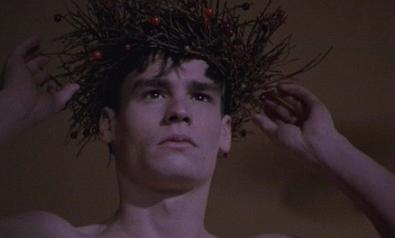
You're probably wondering why this picture makes sense in this context. I promise it does. Go watch the recently cancelled Dollhouse to find out why.

In Greek, to turn a word into its opposite, you add an alpha, which is really just an  “a,” to the front of the word. We do the same thing for English words that come from Greek. Try this one: Bios is a Greek word that means “life.” We get the English words “biology” and “biotic” from it. “Biotic” means “relating to living things.” If we add an “a” to the front, we get “abiotic,” which mean “relating to non-living things.” Or how about this one: Theos is the Greek word for “God.” In English, “theism” is the generic word for belief in God. So, add the “a” prefix and we get “atheism,” which is the belief that there is no God. We could come up with a dozen more examples, but I think you get the point.

Now let’s go back to our verse, which, if you recall, this morning’s reading translates as “Do not doubt but believe.” The Greek word translated “believe” comes from the word pistis, which means “faith.” The word that is translated as “doubt” is simply the word pistis with the “a” prefix – apistis. Therefore, the word should really just mean “unfaith” or “unbelief,” rather than “doubt.” With this new translation, the verse becomes, “Do not be unbelieving but believing.”

“Do not be unbelieving but believing.” This is a far cry from “Do not doubt but believe.” Jesus never tells Thomas not to doubt. Rather, Jesus tells Thomas not to jettison his belief all in one go. There is a huge difference between the two. This supposed “Doubting Thomas” is still incredibly faithful, even in the midst of his doubts. Remember, Thomas is a man of deep faith and conviction, who has the nerve to ask tough questions. Doubt arises in such a chemical makeup. But having doubts does not signal the loss of belief. Having doubts does not signal the abandonment of faith.

Doubt happens when you have enough conviction about your faith to question it. Thus, doubt gives you a reason to reexamine your faith and to sign up with Jesus Christ over and over again. Of course, too much doubt can lead to unbelief, just as, conversely, too much certainty can lead to stagnant faith.

Okay, now that we’ve established that doubt is not something to be avoided at all costs, let’s use our Easter celebration to bring the power of the resurrection into this discussion. Our faith finds its home in Jesus’ resurrection. Jesus triumphed over death in order to keep his promise that he would be with us always, despite the end of our physical existence. Resurrection happens with eternally vaster scope than death ever could. Because of this, death exists within the power of the resurrection. The resurrection subsumes death into itself, making death a piece of the reality of eternal life. In the same way, belief is so much more expansive than doubt; belief subsumes doubt into itself, making doubt a part of the pathway of faith.

Jesus tells Thomas, “Do not be unbelieving but believing.” And Thomas responds with such grand words to express his belief: “My Lord and my God!” Rather than dismissing Thomas as that good-for-nothing doubter, embrace Thomas as a faithful, thoughtful, courageous follower of Christ whose doubts ultimately lead him to a wondrous confession of faith.

God knows that we, too, have our doubts. We wouldn’t be human without them. But belief in God gives our doubts purpose, shape, and context. Do not be ashamed of your doubts. Shame only works to erode faith. Rather, see doubt as a sign of your conviction, as a sign of the fact that you care enough to ask tough questions. Then use that conviction, that perseverance to push through the doubt to the deeper faith beyond. And with those five glorious words of Faithful Thomas, praise the Risen One who is the beginning and end of our belief: “My Lord and My God.”

Clean feet becoming dirtier

Imagine with me the thoughts of the disciple Judas Iscariot, after he has left the Last Supper while he is on the way to the police. You may wish to click here and read John 13:1-30 before reading the following.

Detail from "The Last Supper" by Philippe de Champaigne, 1648

I let him wash my feet. I knew what I was going to do, and I still let him wash my feet. I could feel the gentle pressure of his hands through the coarse towel as he dried them. God. Gentle pressure: it’s always gentle pressure with him. He touched the dirtiest part of me, and there was no recoil, no disgust. And all the while, I had this strange sense in my gut that he knew what I was getting ready to do. Even though I had decided to go to the police and let them know where they could find him, I still let him wash my feet. I let him serve me, but there was no earthly reason why he should, for I am on my way to betray him.

Betray him. It sounds so ugly when I say it like that. I’m not betraying him: I’m saving myself, saving all of those lazy hangers-on who don’t realize how much trouble he’s getting us into. Peter, who can’t keep his big mouth shut. Thomas, who says he’s ready to die with him, which I doubt. Andrew, Philip, Nathanael, the rest. They have no idea what’s really going on. I’m the only one that sees clearly. I’m giving them the opportunity to escape with their lives. Once he’s out of the picture, the police and authorities will forget all about the rest of us. I’ll be off the government’s most wanted list. I’ll be able to slip back into obscurity. No one will remember my name, and that’s just fine with me.

Will people remember his name after all this is through? He’s just another in a long line of disposable saviors. God. How did I let myself get caught up in all of this? I’m the smart one. I’m the planner. I see into the way of things. And still, he called my name and I followed. I feel so foolish. Foolish and angry. I’ve been angry for so long that I can hardly remember the last time I was at peace. Last week in Bethany, I yelled at Mary for being wasteful with her money, but I would’ve yelled at anyone who gave me an excuse. Why do I feel like this?

I’ve always sensed that I’m different somehow from the rest of them, that I’m on the outside of the group. Last year, he said one of us was a devil, and I’m sure he was talking about me. He didn’t say it outright, but I remember him looking at everyone but me. He always seems to hold me at arms length. I never feel close to him. Until tonight. Until he washed my feet tonight. Until he handed me that piece of bread tonight.

I had to get out of there. I felt this sudden surge of anger in my chest, a feeling of such malevolence, stronger and more foreign than I had ever felt before. He handed me that piece of bread. He handed me himself. God. At that moment, we had our closest connection ever and I understood most perfectly my place in all of this.

I’ve been so angry for so long because his words mean something different for me than for everyone else. I’m the exception. I’m the one who doesn’t count in the total. And he chose me! He chose me for this assignment. He knew all along. I’m not betraying him, no matter what people will say. I’m doing exactly what he wants me to do. I’m his most faithful follower. So why am I shut out? Why am I alone in the darkness?

He chose well. He knew I have the foresight and the stomach to see this through. I could go back. I could forsake the path I’m on. But that – that would be a betrayal. He handed me himself. He is in my hands. And I have to make those hands bloody. Now my anger is my ally. It steels me for the task ahead. As long as I keep seething with this foreign hatred I’ll be able to accomplish what he sent me to do. He told me to do it quickly. Perhaps he thought that I would change my mind if I dwelt on this task too long. But I will not. I will not. I will not. I will keep walking away from him, walking toward his end, walking with clean feet becoming dirtier with each step.

Stone Symphonies

(Sermon for March 28, 2010 || Palm Sunday, Year C, RCL || Luke 19:28-40)

“I tell you, if these were silent, the stones themselves would cry out.” So says Jesus to some Pharisees, who want him to corral his exuberant disciples. If we lived anywhere else, I would be tempted to take these words of Jesus merely as metaphor, as a turn of phrase intended to illustrate the remarkable nature of the event taking place. But in the month that I’ve been in Cohasset, I’ve walked on the beach several times, and I’ve heard a certain, special noise that has made these words come alive.

As you know, small stones populate the beaches here, stones that were once boulders and are not yet sand, stones made round and smooth by the ebb and flow of the tide, stones good for skipping on the ocean. Waves break over these stones and cover them with foamy surf. As the tidal forces suck the waves back out to sea, the water runs through air pockets between the round edges of the stones. And as the water vibrates the stones, they cry out. The stones sing with a quavering voice, a thousand violins playing the same note but each with unique rhythm and tempo. As the waves flow out, the stone symphony plays the chords of creation, joining the great company of all the myriad instruments in God’s terrestrial orchestra.

If we attune our ears and eyes and hearts, we can hear these chords and we can witness all of Creation praising God. This praise happens when God’s creatures fulfill the purposes for which God made them. The sun praises God by shining, the moon by reflecting the sun’s light. The thunder praises God by crashing, the rain by watering the earth. The gazelle praises God by running, the wolf by hunting, the rose by blooming, the bee by pollinating. Each member of the great symphony of Creation praises God in an unique way, and all work in concert to glorify the Creator.

Well, all except for one glaring exception. We humans are a thick lot. On our best days, we ignore the symphony, and on our worst days, we spend our time devising ways to silence Creation’s praise. Down through history, we have slowly but surely forgotten how to read Creation’s score, forgotten that we too have parts to fulfill in God’s orchestra.

We are able to join in praise to God when we remember that God created us to display one fundamental attribute: goodness. God created everything that is, Genesis tells us, and at the end of each creative session, God pronounced the new creation Good (and on the last day, not just Good, but Very Good). So, at the fundamental level of our human nature is goodness, which is a reflection of God’s delight in Creation. The manifestation of that goodness is our praise to God. We embody this praise when we sing and dance, when we laugh and pray, when we love, and most importantly, when we serve.

The trouble appears when we forget that goodness remains at the core of our human nature. Instead, we see all the malignant attributes that attack our goodness and mistake this tumorous growth for what defines us as humans. How often have you heard the following statements explained away by attributing the behavior to human nature:

“He’s just jealous because I won the office pool.” “Well, jealousy is just a part of human nature.”

“She’s so petty: who cares if we wore the same dress today.” “Well, pettiness is just a part of human nature.”

“I can’t believe he lied about where he was last night.” “Well, dishonesty is just a part of human nature.”

We make the worst mistake of our lives when we attribute these negative actions to human nature. Our fundamental nature is Good, and anything else is a perversion of the goodness by which God brought us into being. These perversions of our goodness (also known as “sin”) distort our relationship with God. We start playing our instruments out of tune, thus ruining the symphony of Creation.

But when Jesus rides that donkey’s colt down the Mount of Olives, he takes a step in the process of subverting all our tumorous perversions of human nature. On his way to the cross, which is the epicenter of the perversion the Good, he begins showing that goodness (and all of goodness’s positive emanations) still exist, despite the malignancy eroding the nature of humanity.

First, he tackles the perversion of power. Notice that his parade is rather incongruous. Anyone would expect a king to enter the city on an armored warhorse with weapons-laden legions flanking him. But Jesus rides in humility, on the back of a lowly farm animal. He displays that humility (which is one manifestation of goodness) has more majesty than any imperial power could ever muster.

While Jesus subverts the perversion of power, his disciples tackle the perversion of terror. While fear is sometimes a helpful emotion, terror is not simply “really big fear.” Terror is an extension of power meant to control. But at this moment in the Gospel, the disciples walk directly into the most dangerous situation in their lives unabashedly praising God with joyful voices. “Blessed is the king who comes in the name of the Lord!” They display courage, another manifestation of goodness, and their courage subverts any attempt by the perversion of terror to control.

The rest of the Gospel plays out in much the same way. Jesus subverts the perversion of greed when he overturns the tables of the moneylenders in the temple. He subverts the perversion of fame when he tells his disciples that he is among them as one who serves. He subverts the perversion of revenge when he stops the retaliation during his arrest and heals the slave’s ear. And in his greatest display of goodness, Jesus defeats the perversion of domination by willingly giving up his life. Jesus brought all our perversions of human nature to the cross and died with them. And in his resurrection, he shows us that these perversions of our good nature have no ultimate power over us.

Because of Jesus’ life, death, and resurrection, we have the ability to access the goodness at the core of our human nature. We have the humility and courage necessary to let God excise all the malignancy that perverts our relationships with one another and with the rest of Creation. We have ears to hear the symphony of praise playing all around us, and we have the music within us to add our own harmonies to the orchestra of Creation.

And when we fail, when we once again forget our goodness, we can be silent, we can be still, and we can listen. And then we will hear the stones themselves crying out on our behalf, crying out their praise to God.

Notes

For the Internet versions of my sermons, I usually remove the specifics of place, but for this sermon, I really needed to preserve them for the imagery. If you ever make it up to the Massachusetts coast, listen for the sound I’m talking about.

Schooling Nicodemus (or) “Imagine what you’ll know tomorrow”

The following post appeared Sunday, March 14th on Episcopalcafe.com, a website to which I am a monthly contributor. Check it out here or read it below.

* * *

In the film Men in Black, Jay discovers that aliens exist and many of them live on Manhattan Island. When he confronts Kay about this unnerving new detail, of which he (Jay) was previously unaware, Kay deadpans: “A thousand years ago everybody knew, as a fact, that the earth was the center of the universe. Five hundred years ago, everybody knew that the Earth was flat, and fifteen minutes ago, you knew that humans were alone on it. Imagine what you’ll know tomorrow.”

The season of Lent invites us to examine what we know, or, put more precisely, what we think we know. When we tackle this examination, we open ourselves up to encounters with Christ, which tend to augment, rearrange, and expand our knowledge with the addition of deeper faith. The Gospel contains myriad stories of Jesus blasting people with new knowledge,  so we should expect nothing different in our own lives. One such story co-stars the Pharisee Nicodemus (read up on John 3 before you continue).

As a general rule, if someone in the Gospel besides Jesus says “I know” or “we know,” then that person either knows a small fraction of the whole or, more commonly, nothing at all. Strangely enough, knowing nothing at all can even manifest itself when the statement made is quite true and correct. Such is the case with this leader of the Jews, who comes to see Jesus one night.

Nicodemus uses his “knowledge” displayed at the beginning of the conversation as a weapon to corner Jesus into a particular set of expectations. The Pharisee says, “Rabbi, we know that you are a teacher who has come from God, for no one could do these signs that you do apart from the presence of God.” Apparently, so far so good. This statement is true: Jesus has come from God and most definitely stands forever in the presence of God. But there’s irony in the statement, also. Nicodemus calls Jesus “teacher” twice — once in Hebrew (Rabbi) and once in Greek (didaskalos, from which comes the word “didactic”). But at the same time, Nicodemus’s conversational opener allows no room for Jesus to teach. Instead, Nicodemus is the one attempting to teach Jesus, to pigeonhole him into what Nicodemus and his colleagues have labeled him.

But Jesus refuses to be put on the defensive. In usual fashion, he completely ignores Nicodemus’s opening salvo and immediately expands the conversation to a depth and height that Nicodemus is not expecting. Jesus says, “No one can see the kingdom of God without being born from above/again.” There’s a delightful ambiguity here: in Greek, “from above” and “again” are the same word (anothen). They both work in the context, and Jesus probably means both when he says the word. How better to jostle someone loose from his rigidity than with a small helping of ambiguity?

But Nicodemus grasps at the more mundane of the two meanings and responds: “How can anyone be born after having grown old? Can one enter a second time into the mother’s womb and be born?” This may seem like a sarcastic response, but at least this Pharisee, who has always been the one answering questions, is now (albeit haltingly) beginning to ask some of his own. But Jesus doesn’t seem interested in staying on the terrestrial plane, so he ignores Nicodemus questions and pushes him to a new level of understanding. “No one can enter the kingdom of God without being born of water and spirit. What is born of the flesh is flesh and what is born of the Spirit is spirit.” At this point, I imagine Nicodemus’s brain starts hurting.

But Jesus keeps pushing him. Nicodemus’s opening “we know” now sounds empty in comparison to the mysteries Jesus is revealing to him. To begin to absorb these mysteries, Nicodemus must turn this empty “we know” into an “I don’t know” full of desire and curiosity. With his next words, Jesus gives Nicodemus license to let go of what he thinks he knows: “The wind/Spirit blows where it chooses and you hear the sound of it, but you do not know where it comes from or where it goes.” (Here’s another delightful ambiguity—in Greek, “wind” and “spirit” are the same word, pneuma.) Nicodemus must now consent to trusting in things he can never quite figure out. Indeed, he must realize that the truest things that have ever been or ever will be can be believed without being adequately explained. In a word, Jesus asks Nicodemus to have faith that the words he speaks are true, no matter how difficult, preposterous, or confusing they may sound.

And Nicodemus takes a tentative step into the shallows of faith in Jesus. He asks one of the sincerest questions in the Gospel: “How can these things be?” With this question, Nicodemus allows the cognitive dissonance that has been cresting to break on him like a wave. This dissonance is the necessary distress that happens when he realizes he doesn’t know something he thought he knew. But dissonance isn’t a bad thing. In music, dissonance is the interesting part, the part that pushes the piece onward. A pleasing harmony (called “consonance”) can hang in the air indefinitely, but a dissonance begs to move forward to the next consonant chord.

So it is with Nicodemus and anyone who opens up himself or herself to the possibility of the unknown. Allowing the cognitive dissonance to enter our comfortable worldviews pushes us to grow into the next consonant chords in our lives. When Jesus confronts us, like Nicodemus, with the mysteries of the faith, we can either step backward into the comfort of what we think we know or step forward, fully expecting the boundaries of possibility to be far wider than we can perceive. This confrontation goes by another name: revelation.

Every encounter with Jesus, whether in the text or in life, promises an opportunity for revelation, which obeys no boundaries of possibility. Revelation is that thing you know, but don’t know how you know it. Revelation is visceral as well as mental because the brain alone is ill-equipped to handle it. Revelation infuses us with an odd mixture of peace and exhilaration—peace because we know God is there, exhilaration because we know God is calling us to serve. Cognitive dissonance is the birthplace of such revelation. The dissonance reminds us that what we know is far less than the whole. When we can acknowledge that we don’t, in fact, know where the wind comes from or where it goes, we are primed for receiving the revelation of God’s love that Jesus is forever revealing to the world. This is a scary proposition, for if we do, indeed, remain attentive we might actually hear God calling us to serve in a way that doesn’t fit our plans.

But revelation bursts our ability and our desire to control because it blows where it chooses on the wind of the Spirit. When Nicodemus says to Jesus, “We know,” he is seeking to control the conversation that will follow. But he immediately discovers he’s in over his head. When we acknowledge that Jesus has things to reveal to us that we couldn’t possibly imagine, we discover we’re also in over our heads. The trick is to learn to breathe in the wind of the Spirit while underwater (to grow gills and fins) and to find a new natural state submerged in the revelatory love of Christ.

When Nicodemus says to Jesus, “How can these things be,” he allows the possibility for revelation to strike him in his head and in his gut. His cognitive dissonance jettisons his need to control. He is open for Jesus to reveal new and wonderful things to him. And Jesus does — things about the Son of Man ascending to and descending from heaven, things about the Son of Man being lifted up as Moses lifted up the serpent in the wilderness, things about eternal life and self-giving love and believing and salvation.

I imagine Nicodemus left his encounter with Jesus in a daze, his heart and mind on overload attempting to process all he had seen and heard. Is he able fully to put his trust in Jesus, to allow the dissonance to resolve into a new and deeper consonance? Not quite yet. But we are lucky enough to meet Nicodemus twice more in the Gospel (check them out! John 7 & John 19). His journey towards the consonance of a life of faith following Jesus models for us our Lenten journeys of self-examination. If we open ourselves up to encounters with Christ during this season of Lent, then (as Kay says), “Imagine what you’ll know tomorrow.”

Broken

(Sermon for Sunday, March 14, 2010 || Lent 4, Year C, RCL || 2 Corinthians 5:16-21; Luke 15:-13, 11b-32)

Connie looked especially haggard. For the better part of two hours, I watched her hold a phone to each ear, tap-tap-tap on the keyboard, and patiently plead with belligerent passengers all at the same time. As I inched closer to the desk to change my flight information, I caught snippets of the abuse hurled in Connie’s direction and prayed for forgiveness for the entire irate human race. The reason for the belligerence was simple: the airplane was broken. Some gizmo that keeps the flaps from freezing fell off during the plane’s trip to Nashville. One piece in a hundred thousand broke, and the plane was grounded. One piece – a nothing part, really, until you don’t got one. Then it appears to be everything.

Ironically, Delta had to fly this nothing part, this anti-flap-freezing gizmo, in from elsewhere. The departure time leapt forward, finally settling on 8:00am yesterday morning, a full twenty hours and ten minutes late. With the airplane broken, the system broke down, as well. All the other flights out of Nashville were booked solid. Passengers missed connections. People were stranded and growing more bellicose with every update of the plane’s ramshackle status. And in the middle of it all stood Connie, a wisp of a woman on the verge of tears. She clung to the desk, and she clung to her manners. She was the unlucky target of vented frustration, of heaps of bile, of caustic protestations. And all because the plane was broken.

You’d think that people would be used to brokenness by now. You’d think that people would take the brokenness in stride because brokenness marks our lives everyday: broken homes, broken bones, broken pavement, broken promises, broken ecosystems. You’d think that this brokenness would come as no surprise. But every time we encounter brokenness, we seem to react with astonishment and incredulity. How could your best friend betray your trust? How could the kid break his wrist right before the big game? How could the airplane be grounded?

While brokenness does seem to mark our existence, I think we react with astonishment because in some deep place within, we know that “broken” is not the way things are supposed to be. We believe that God created everything and called Creation “good” and never made a thing called “brokenness.” And yet, brokenness crept into Creation. Separation and division soon followed. Today, we see a broken world, and we know that it could be, that it should be – better.

And in that seeing, in that knowing, we hear God calling to us, inviting us to work with God’s help to repair this brokenness. In today’s lesson from his Second Letter to the Corinthians, Paul tells us that God “has given us the ministry of reconciliation.” He continues, “In Christ, God was reconciling the world to himself, not counting their trespasses against them, and entrusting the message of reconciliation to us.”

The world needs this message of reconciliation because the world is marred by broken relationships that need repairing, separations that need healing, divisions that need stitching up. When Jesus welcomes and eats with “tax collectors and sinners” in this morning’s Gospel, he models the ministry of reconciliation. The scribes and Pharisees like their society just fine the way it is, and they grumble when Jesus upsets the brokenness with which they have learned to live. So Jesus tells them a story about a family, a family marred by brokenness, a family in need of reconciliation.

The younger of two sons presses his father to give him his share of the inheritance. The father acquiesces and divides his property. The younger son takes his portion and travels to a distant country where he squanders his fortune in what the King James Version calls “riotous living.” So I’m wondering: what’s the younger son’s sin? At first glance, his sin sure seems to be his debauchery, given his status as a decadent wastrel. And while this qualifies as sin, I don’t think his prodigality takes the top seed.

Instead, his major sin is the division caused by his separation from his family. Jesus makes a point to say that the father divides his household to fulfill his son’s wish. And then the son doesn’t settle nearby, but in a “distant” country. With the division and separation complete, all that’s needed is a famine for the younger son to notice his folly. When he comes to himself sitting in the filth among the pigs, he realizes the brokenness his departure caused. He no longer feels worthy to be called a son, so he prepares himself to live with the brokenness and to be considered a hired hand rather than a member of the family.

At this point in the parable, I imagine the scribes and Pharisees nodding their heads in approval. The younger son defiled himself. He is unclean after touching all those pigs. Of course, he mustn’t be welcomed home. But Jesus isn’t finished telling the story yet.

The younger son travels back to his father’s house, and yet he’s aware that it will never be home again. His decision to separate himself from his family saw to that. But when he is still a vaguely human shape on the twilit horizon, his father sees him and runs out to meet him and embraces him and kisses him. “I am no longer worthy to be called your son,” he says. But his father will not tolerate the separation, the brokenness any longer. “This son of mine,” he says, “was dead and is alive again; he was lost and is found.” This son of mine. With these words, the father repairs the broken relationship, and the two are reconciled.

At this point in the parable, I imagine the scribes and Pharisees raising incredulous eyebrows. Now the father is unclean, as well, because he touched the younger son before he purified himself with the appropriate rituals. What kind of family is this? But Jesus still isn’t finished telling the story.

A celebration for the younger son’s return begins. His elder brother hears the revelry coming from the house and asks a slave what’s going on. When he finds out about his brother’s return, he will not enter the house or join the party. The elder son echoes his brother’s sin by separating himself from the celebration. When the father comes out to plead with him, the elder son shows his own division from the family. He calls his brother “this son of yours,” thus ignoring the fraternal relationship. And rather than working like a son, he says, “For all these years I have been working like a slave for you.” Like a slave. Like the hired hand the younger son was prepared to be.

But the father continues to repair the brokenness in his family. “Son,” he calls his eldest. There is no division between us because “you are always with me, and all that is mine is yours.” Then the father attempts to heal the fraternal separation by emphasizing the sons’ relationship to one another: “This brother of yours was…lost and has been found.”

As the parable ends, I imagine the scribes and Pharisees noticing that they themselves look an awful lot like the elder brother. I wonder if their own irritation with Jesus deafens them to the reconciling nature of the father in the parable.

Both sons separate themselves from the family, the younger through taking his inheritance to a distant country and the elder through refusing to join the celebration. But their father goes out and meets both sons in their brokenness. He runs up to the younger when his son is still far off. He leaves the party to be with the elder. When neither brother feels much like a son, the father practices reconciliation and repairs his broken family.

The father refuses to separate himself from his sons. Likewise, God refuses to be separated from us. Our sin may separate us from God, but God never separates from us. As Paul says, God “reconciled us to himself through Christ.” God never gives up on relationships with us. Instead, God continually brings us back into relationship with God. We may be broken, but God is whole, and so we can find wholeness. We may be separated, but God is welcoming, and so we can bring welcome. We may be divided, but God is One, and so we can come together.

Today, we see a broken world, and we know that it could be, that it should be – better. We know in that deep place within that the world is not supposed to be broken. And we also know that God has reconciled us to himself in order that we might engage in a ministry of reconciliation to this broken world. The question is: will we?

And the answer is this: we will, with God’s help.

Notes

* The first person to notice and correctly identify the reference to Joss Whedon’s Firefly in this sermon wins five points. (These points aren’t really redeemable for anything, but hey, you should try to get them anyway.)

* If you are as big a fan of Firefly and Serenity as I am, you may also notice that the overarching theme of this sermon is pretty similar to that of the film Serenity. And no, that’s not the reference. The reference is incredibly specific.

A Gospel Medley

Several people who’ve heard me sing this live have asked for a recording, so here it is. And I’m including the lyrics because parts of it (especially the Peter Gabriel section) are a bit difficult to follow. If you want to play it yourself, let me know, and I’ll send you the lead sheet. I hope you enjoy it!

(Oh, btw, I’m working on a second Gospel Medley. If you think of a song I could use for a piece of the Gospel, let me know. Right now, I just have Bryan Adams for the call of the disciples.)

(To download, right-click picture and choose “Save Link As…”)

The Nativity (Journey, “Don’t Stop Believin'”)
Just a virgin girl when the angel said to her,
“You will bear the Son of God.” She said, “Here am I.”
Just a carpenter of David’s line from Bethlehem;
He took her for his wife (the angel told him to).
So Caesar made the census rule
Telling all to go back home
In a stable Mary bears her babe
He’s the Son, the Son, the Son, the Son.

Shepherds grazing up and down the countryside
The wise men searching in the night
Starlight, angels singing ‘bout the Incarnation
Shining on this holy night

Don’t stop believing
Remember it’s with God you’re dealing
Peace to people

– – –

John the Baptizer (John Mellencamp, “Jack and Diane”)
A little ditty about John the Baptist
Whose favorite dinner was honeyed locusts
John, he’s saying, “I’m just the voice crying out:
Prepare the way of the Lord, that’s what I’m talking ‘bout.” (Sayin’)
Oh yeah, it won’t be long:
the kingdom has come near, repent your wrongs
Oh yeah, it won’t be long:
He is coming soon, I can’t tie his sandals’ thong (now walk on)

– – –

The Feeding of the 5000 (The Proclaimers, “I’m Gonna Be (500 Miles)”)
Jesus looks up, and he knows he’s gonna feed,
He’s gonna feed the people coming to see him.
The disciples, they all say they’re gonna need
They’re gonna need denarii to feed them all.

But I see there five loaves of bread
And I see there two tiny fish
I will bless this food to feed five thousand people
So sit down in the grass
Gotta lot now! Gotta lot now!
Gotta lot of scraps of bread leftover now!

– – –

Peter’s Confession and the Transfiguration (John Parr, “Man in Motion (St. Elmo’s Fire)”)
Jesus asks, “Who do you disciples say has come?”
Peter says, “You’re the Son of God, the Chosen One.”
God revealed this to you, not some fleshly search
So I name you Rock, now go build my church.

Then they climb the highest mountain, underneath the starry sky
And they witness Jesus’ changing, whiter and whiter
Gonna build some tabernacles, but then a cloud descends:
“This is my beloved Son, listen to him”

– – –

The Last Supper (John Denver, “Leaving on a Jet Plane”)
All my friends are here in this upper room.
Their feet are clean, now my Passion looms:
Here’s a four long chapter speech to say goodbye.
See this bread I’m breakin’, it’s a special loaf,
The wine you’re drinkin’ is my blood’s merlot.
Let’s share this meal before I’m brought to die.

So take, eat: you’re sharing me.
Drink this to remember me.
Hear my words ‘cause soon I’ll have to go.
I’ll be dying on the cross soon,
But know that I’ll be back again
Oh, friends, I hate to go…

– – –

The Crucifixion (Peter Gabriel, “In Your Eyes”)
On his head’s placed a crown of thorns;
The temple veil will soon be torn.
Without a noise, without his pride, he reaches out to his bride.

They crucify: the blood, the sweat
His mouth is dry from thirstiness.
Eli, Eli, Have you forsaken
Me to die? You’ll be with me in
Paradise. Oh God forgive them.
Then he cries: I commend my Spirit.
I see the blood and the sweat, oh, but it’s not over quite yet.
Just come on down this Sunday, meet you there at sunrise.

– – –

The Resurrection (U2, “Beautiful Day”)
They go to the tomb, on the first day of the week
But there’s no stone, so Mary takes a peak
She’s out of luck, and the reason that she had to care
Was apparently snuck away when they were unawares
But she knows she’s found a friend when the gardener says her name.
And then Jesus sends her saying, “My return proclaim.”

On this Easter Sunday, the grave falls and you know
On this Easter Sunday, death’s sting is wiped away
On this Easter Sunday…

Touch me, put your finger in my side
When I leave, my Holy Spirit will abide

It’ll be Pentecost Day, tongues of fire, you know
On that Pentecost Day, the Church is here to stay
On that Pentecost Day…

The Word Happens

(Sermon for February 28, 2010 || Lent 2, Year C, RCL || Genesis 15:1-12, 17-18)

Something happens during our worship service that I would bet you’ve never really noticed before. Actually, this something happens twice during our worship. In fact, this something has already happened twice during this very service. The readers finished both the story about Abram and the piece of Paul’s Letter to the Philippians, and then they said, “The Word of the Lord.” And you responded, “Thanks be to God.”

Have you ever wondered why we say, “Thanks be to God” at that particular moment at the conclusion of a scriptural reading? If you haven’t, don’t worry: I didn’t wonder why until I started writing this sermon. Saying “Thanks be to God” seems rather strange at first. For what are we really thanking God? Honestly, this thanksgiving would make much more sense if the reader herself were the one offering it. I can imagine the reader thanking God for the lack of unpronounceable names in the lesson; or for the ability to pronounce Melchizedek and Nebuchadnezzar on the first try; or for the opportunity to serve God in the capacity of reading the Bible aloud. But the question remains: why do we respond with thanks to God when the reader says, “The Word of the Lord”?

This morning’s lesson from Genesis provides an answer. But first, here’s a quick recap of the first few episodes of Abram’s story. God tells Abram to leave his country and set out for a new place, which only God knows about. So Abram, his wife Sarai, his nephew Lot, and their household set out on a journey. They wander through Canaan and down into Egypt, where Abram gives his wife to Pharaoh to save his own skin. But when a great plague hits Egypt, Pharaoh realizes Sarai’s already married, and he sends her back to her husband. Abram and Lot part ways because their herds have grown too great to share the same land. Finally, Abram settles by the oaks of Mamre. Soon after, he takes part in a battle among the local kingdoms. And on three separate occasions during these adventures, God tells Abram that God will give him offspring and make of him a great nation.

But Abram worries because he remains childless. He’s getting on in years. Sarai is barren. He’s rich and powerful and secure, but the one blessing he desires above all else has eluded him. He has no descendants to inherit his land. A slave born in his house will have to be his heir. Eliezer of Damascus is going to get everything. How does this fulfill your promise, God?

In this way, Abram questions God when the word of the Lord comes to him in a vision. Half in accusation, half in resignation, Abram states the situation bluntly: “You have given me no offspring.” And during this moment – during Abram’s most anxious, most doubtful, most defeated moment – the “word of the Lord” comes to him. The Word of the Lord comes to him and says, “No one but your very own issue will be your heir. Look toward heaven and count the stars, if you are able to count them. So shall your descendants be.” The Word of the Lord comes to him and gives Abram the strength to believe that God will fulfill God’s promise. This is the same “Word of the Lord” for which we twice give thanks on Sunday morning.

You may ask: “How can mere words give Abram such strength? What if the promises are empty? Where’s the action to back up the talk?” Okay, I’m about to say the “H”-word and I need you to stay with me for just a minute here. Genesis was originally written in Hebrew. Translators do the best they can to render the original language into English, but sometimes a Hebrew word is just too deep and complex for a single English word to suffice. In these cases, the English is like looking at a picture of a cake. The Hebrew is like taking a big bite of the cake itself.

Such is the case with the word “Word.” In Hebrew, the “Word” is not simply speech or writing on a page. The “Word” happens to people. The “Word” is an event, an encounter, an action that calls for further action. In the beginning when God created the heavens and the earth, God spoke creation into being: “God said, ‘Let there be light’ and there was light.” The Word of the Lord happened, and, as a result, creation came into existence. When the Word of the Lord happens to Abram, he finds the strength to go on trusting God in spite of all the reasons why God’s promise seems preposterous.

And when we hear a reading from Holy Scripture on Sunday morning, we respond “Thanks be to God” because the Word of the Lord has just happened to us. In that encounter with the Word, we are aware that God continues to speak us into existence. And from existence into service. And from service into love. And from love into the transformation that happens when we follow Jesus Christ our Lord.

You see, when the Word happens to us, we are changed. We may be changed minutely or momentously, but we are changed. We may be changed slowly or suddenly, but we are changed. We are changed into better lovers of God, better servants of other human beings, and better human beings ourselves.

In the film Life as a House, George talks about change, a subject about which he knows a great deal. George has been diagnosed with cancer, and he is using his final months to repair his relationship with his estranged son. By tearing down his house and rebuilding the home he always wanted, he and his son work through the messy process of reconnecting. At one point, George says: “You know the great thing, though, is that change can be so constant you don’t even feel the difference until there is one. It can be so slow that you don’t even notice that your life is better or worse, until it is. Or it can just blow you away, make you something different in an instant. It happened to me.”

In Abram’s case, the Word happens to him, and the change comes slowly. The Word gives him trust in God’s faithfulness, but at first Abram fails to understand the expanse of God’s miraculous promise. Abram doesn’t realize that God desires not just Abram’s own offspring, but Sarai’s, as well. So Abram bears a son with Hagar, his wife’s slave-girl. But the Word isn’t finished happening to Abram yet. Years later, Abram stumbles into God’s presence again, and God renews his promise a final time. In the pivotal sign of the change, which the Word has on Abram’s life, God changes his name to Abraham and Sarai’s to Sarah. Soon after, Sarah bears Abraham a son named Isaac, and the countless generations that follow rival the number of stars in the heavens.

I invite you to reflect on how the Word is even now happening to you. Is the change, which the Word is causing in your life, so constant that you don’t feel the difference until there is one? Or is the Word blowing you away and making you into something different, something new, in an instant? Either way, know that our Creator continues to speak creation into existence. Our Creator writes the Word on our hearts. Our Creator puts the Word on our lips so we may speak love and welcome to all we encounter.

The reader says “The Word of the Lord” to make us aware that the Word is happening to us even now this morning while we sit in our pews. We respond “Thanks be to God” to show our gratitude for God’s movement in our lives. But the Word isn’t through happening to us yet either. The Word happens to us to enable us to serve and to love. The Word impels us to go out into the world and invite others to notice the Word happening to them. As followers of Christ, we live with the joyful expectation that the Word will happen to anyone, anywhere, at any time.

And when the Word happens to us, we will be changed.

Speaking of cake, the day I preached this sermon was my first at the church to which I was recently called to be the Assistant Rector (Assistant to the Rector, Dwight!). They got me this cake, which is awesome.

Then, the kids ate it.