(Sermon for February 28, 2010 || Lent 2, Year C, RCL || Genesis 15:1-12, 17-18)
Something happens during our worship service that I would bet you’ve never really noticed before. Actually, this something happens twice during our worship. In fact, this something has already happened twice during this very service. The readers finished both the story about Abram and the piece of Paul’s Letter to the Philippians, and then they said, “The Word of the Lord.” And you responded, “Thanks be to God.”
Have you ever wondered why we say, “Thanks be to God” at that particular moment at the conclusion of a scriptural reading? If you haven’t, don’t worry: I didn’t wonder why until I started writing this sermon. Saying “Thanks be to God” seems rather strange at first. For what are we really thanking God? Honestly, this thanksgiving would make much more sense if the reader herself were the one offering it. I can imagine the reader thanking God for the lack of unpronounceable names in the lesson; or for the ability to pronounce Melchizedek and Nebuchadnezzar on the first try; or for the opportunity to serve God in the capacity of reading the Bible aloud. But the question remains: why do we respond with thanks to God when the reader says, “The Word of the Lord”?
This morning’s lesson from Genesis provides an answer. But first, here’s a quick recap of the first few episodes of Abram’s story. God tells Abram to leave his country and set out for a new place, which only God knows about. So Abram, his wife Sarai, his nephew Lot, and their household set out on a journey. They wander through Canaan and down into Egypt, where Abram gives his wife to Pharaoh to save his own skin. But when a great plague hits Egypt, Pharaoh realizes Sarai’s already married, and he sends her back to her husband. Abram and Lot part ways because their herds have grown too great to share the same land. Finally, Abram settles by the oaks of Mamre. Soon after, he takes part in a battle among the local kingdoms. And on three separate occasions during these adventures, God tells Abram that God will give him offspring and make of him a great nation.
But Abram worries because he remains childless. He’s getting on in years. Sarai is barren. He’s rich and powerful and secure, but the one blessing he desires above all else has eluded him. He has no descendants to inherit his land. A slave born in his house will have to be his heir. Eliezer of Damascus is going to get everything. How does this fulfill your promise, God?
In this way, Abram questions God when the word of the Lord comes to him in a vision. Half in accusation, half in resignation, Abram states the situation bluntly: “You have given me no offspring.” And during this moment – during Abram’s most anxious, most doubtful, most defeated moment – the “word of the Lord” comes to him. The Word of the Lord comes to him and says, “No one but your very own issue will be your heir. Look toward heaven and count the stars, if you are able to count them. So shall your descendants be.” The Word of the Lord comes to him and gives Abram the strength to believe that God will fulfill God’s promise. This is the same “Word of the Lord” for which we twice give thanks on Sunday morning.
You may ask: “How can mere words give Abram such strength? What if the promises are empty? Where’s the action to back up the talk?” Okay, I’m about to say the “H”-word and I need you to stay with me for just a minute here. Genesis was originally written in Hebrew. Translators do the best they can to render the original language into English, but sometimes a Hebrew word is just too deep and complex for a single English word to suffice. In these cases, the English is like looking at a picture of a cake. The Hebrew is like taking a big bite of the cake itself.
Such is the case with the word “Word.” In Hebrew, the “Word” is not simply speech or writing on a page. The “Word” happens to people. The “Word” is an event, an encounter, an action that calls for further action. In the beginning when God created the heavens and the earth, God spoke creation into being: “God said, ‘Let there be light’ and there was light.” The Word of the Lord happened, and, as a result, creation came into existence. When the Word of the Lord happens to Abram, he finds the strength to go on trusting God in spite of all the reasons why God’s promise seems preposterous.
And when we hear a reading from Holy Scripture on Sunday morning, we respond “Thanks be to God” because the Word of the Lord has just happened to us. In that encounter with the Word, we are aware that God continues to speak us into existence. And from existence into service. And from service into love. And from love into the transformation that happens when we follow Jesus Christ our Lord.
You see, when the Word happens to us, we are changed. We may be changed minutely or momentously, but we are changed. We may be changed slowly or suddenly, but we are changed. We are changed into better lovers of God, better servants of other human beings, and better human beings ourselves.
In the film Life as a House, George talks about change, a subject about which he knows a great deal. George has been diagnosed with cancer, and he is using his final months to repair his relationship with his estranged son. By tearing down his house and rebuilding the home he always wanted, he and his son work through the messy process of reconnecting. At one point, George says: “You know the great thing, though, is that change can be so constant you don’t even feel the difference until there is one. It can be so slow that you don’t even notice that your life is better or worse, until it is. Or it can just blow you away, make you something different in an instant. It happened to me.”
In Abram’s case, the Word happens to him, and the change comes slowly. The Word gives him trust in God’s faithfulness, but at first Abram fails to understand the expanse of God’s miraculous promise. Abram doesn’t realize that God desires not just Abram’s own offspring, but Sarai’s, as well. So Abram bears a son with Hagar, his wife’s slave-girl. But the Word isn’t finished happening to Abram yet. Years later, Abram stumbles into God’s presence again, and God renews his promise a final time. In the pivotal sign of the change, which the Word has on Abram’s life, God changes his name to Abraham and Sarai’s to Sarah. Soon after, Sarah bears Abraham a son named Isaac, and the countless generations that follow rival the number of stars in the heavens.
I invite you to reflect on how the Word is even now happening to you. Is the change, which the Word is causing in your life, so constant that you don’t feel the difference until there is one? Or is the Word blowing you away and making you into something different, something new, in an instant? Either way, know that our Creator continues to speak creation into existence. Our Creator writes the Word on our hearts. Our Creator puts the Word on our lips so we may speak love and welcome to all we encounter.
The reader says “The Word of the Lord” to make us aware that the Word is happening to us even now this morning while we sit in our pews. We respond “Thanks be to God” to show our gratitude for God’s movement in our lives. But the Word isn’t through happening to us yet either. The Word happens to us to enable us to serve and to love. The Word impels us to go out into the world and invite others to notice the Word happening to them. As followers of Christ, we live with the joyful expectation that the Word will happen to anyone, anywhere, at any time.
And when the Word happens to us, we will be changed.

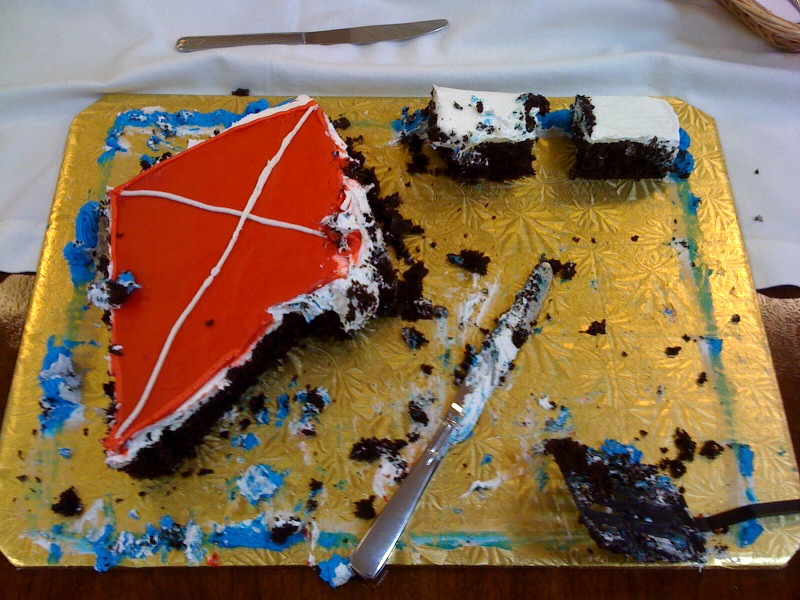
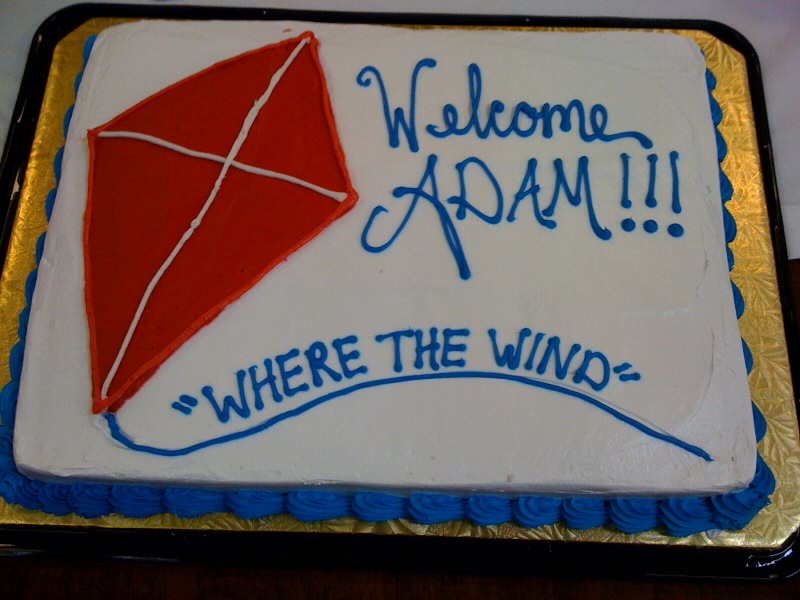
Speaking of cake, the day I preached this sermon was my first at the church to which I was recently called to be the Assistant Rector (Assistant to the Rector, Dwight!). They got me this cake, which is awesome.
Then, the kids ate it.