At War Within (April 8, 2013)

…Opening To…

For a second after Aslan breathed upon him the stone lion looked just the same. Then a tiny streak of gold began to run along his white marble back — then it spread — then the colour seemed to lick all over him as the flame licked all over a bit of paper — then, while his hind-quarters were still obviously stone the lion shook his mane and all the heavy, stony folds rippled into living hair. (C.S. Lewis, The Lion, the Witch and the Wardrobe)

…Listening In…

Peter and the other disciple left to go to the tomb. They were running together, but the other disciple ran faster than Peter and was the first to arrive at the tomb. Bending down to take a look, he saw the linen cloths lying there, but he didn’t go in. (John 20:3-5; context)

…Filling Up…

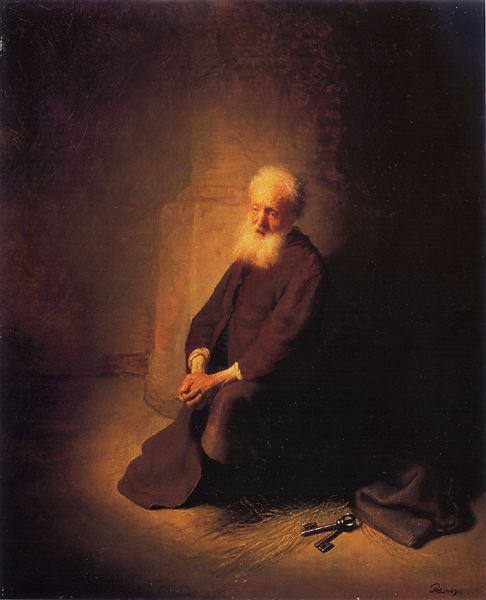
We’re going to change it up a little bit on devotiONEighty this week with five days of narrative. Every once in a while at my church, I preach sermons as a character from the text of the Bible. Likewise, this week on devo180, imagine with me the Apostle Peter, who is in Rome near the end of his life, talking to a friend about the day when Jesus rose from the dead and appeared to the disciples in the locked house (John 20).

I wish I could tell you that seeing the empty tomb was enough. I went inside the tomb and saw the linen cloths lying there and the cloth that had covered Jesus’ face folded up in a corner. Thinking back now, surely grave robbers would not have folded his ceremonial burial garments while stealing his body! But in the semi-darkness of that early morning, I wasn’t thinking rationally. I wasn’t thinking at all. I was numb on the outside, immune to the sliver of hope that the empty tomb brought.

I was numb on the outside, but on the inside, I was at war. I always thought of myself as his most faithful disciple, but at the time of his greatest need, I abandoned him, I lied about knowing him to save my own skin. In the garden, I had been ready to fight to the death for Jesus. But the moment he took away my sword, I crumbled. I wasn’t strong enough to remain by his side without a weapon in my hand. I wasn’t strong enough to trust him, to trust that his plan included death without fighting. I was at war within myself, and I could not access a single crumb of the peace that Jesus had always radiated.

…to be continued tomorrow.

…Praying For…

Dear God, you are the life-breath of all things. Help me to believe even when I can’t see and help me to proclaim your love even when I am afraid. In Jesus Christ’s name I pray. Amen.

…Sending Out…

I leave this moment with you, God, feeling you breathe the peace that passes all understanding into my heart and soul.

Four Names

DevotiONEighty will be taking a break during the week following Easter. It will return next Monday, April 16th. In the meantime, here is my sermon for the Easter Vigil from Saturday evening. –Adam

(Sermon for Saturday, April 7, 2012 || The Easter Vigil || John 20:1-18 )

If you’ve ever been to a Bible study that I’ve led, then you know that I have a lot of favorite scenes in the Gospel according to John. But the one we just read is easily in the top three. What always strikes me about the scene is the movement from Mary’s desolation when she weeps at the empty tomb to her utter elation when she recognizes the resurrected Christ. John paints the scene with a special tenderness he reserves for only the most intimate of moments between Jesus and his followers. John focuses our attention on this intimate moment, the first reaction to Jesus’ resurrection, because the moment of the resurrection itself is far too mysterious and far too momentous for John to attempt to narrate. That moment belongs to God alone. And so John gives us a sliver of Mary Magdalene’s story – her move from desolation to elation when she realizes that Jesus is still with her as he promised he always would be. And the pivotal moment of this story is Jesus calling her by name.

Names are rare in the Gospel according to John. I went back and counted, and in the entire 21 chapters of the Gospel, Jesus calls exactly four people by name. There’s Simon Peter, first among the disciples. There’s Lazarus, whom Jesus brought back to life. There’s Philip, who had been with Jesus from the beginning. And then there’s Mary, who heads to the tomb before dawn on the first day of the week. In each of the special moments when Jesus calls these four people by name, he is somehow affirming or strengthening his relationships with them.

The first thing Jesus does when he meets Simon is give him the nickname “Peter,” which means “Rock,” which is a pretty cool nickname. We invest all kinds of theological motivation to this name because of Peter being the “rock” on which the church is built. But if they were any two people besides Jesus and Peter, we would see the nicknaming as a sign that their relationship is moving into the territory of good friendship. At the end of the Gospel, Jesus says Peter’s name three times, and this naming reasserts the relationship that Peter had denied three times during Jesus’ trial. In the end, their relationship is repaired because Jesus calls Peter by name.

The Gospel describes Lazarus as “one whom Jesus loves.” When Lazarus dies, Jesus is days away, and Lazarus’s sisters make the faithful accusation that if Jesus had been there, Lazarus wouldn’t have died at all. So Jesus goes to the tomb and shouts out, “Lazarus, come out.” Notice that Jesus doesn’t say, “Lazarus, I raise you from the dead.” Rather, he says, “Come out.” Jesus calls Lazarus by name, but does not give Lazarus the option of remaining in the tomb. The naming is joined to Jesus’ command to return to his family and his friendship with Jesus.

Jesus calls Philip by name after Philip says to him, “Lord, show us the Father; that will be enough for us.” Jesus replies, “Don’t you know me, Philip, even after I have been with you all this time? Whoever has seen me has seen the Father.” Jesus calls Philip by name in the midst of wondering how Philip could possibly not know him yet after being with him from the beginning. With this, Jesus calls Philip into deeper, more committed relationship with him.

And then there’s Mary Magdalene, who is weeping at the empty tomb. She is desolate, thinking that her Lord’s body had been stolen and possibly desecrated by the people who put him to death. With tears and the fog of despair clouding her vision, she sees the gardener, who asks her, “Woman, why are you weeping? Whom are you looking for?” Could this gardener be in collusion with the body-snatchers, she wonders? And she accuses him of being in on the plot. But then he says the all-important word: “Mary.” And she turns and the desolation vanishes in an instant of delight. And new elation, new hope, new life surges in to fill the void. “Teacher!” she shouts, and I imagine her jumping into his arms. Then Jesus gives her a task – to be the first to proclaim his resurrection.

So why does Jesus saying her name change the story? Why is this the pivotal word? As with Peter, Lazarus, and Philip, saying Mary’s name proves Jesus’ relationship with Mary. Her name is the outward sign of her inward identity. In this way, names are quite sacramental. Know a name and you know something of the person. Who among us didn’t feel elation when we found out our high school crush did, in fact, know our names? On the flip side, take away a name and you begin to take away the humanity of the person. How many Jews had their names erased and exchanged for numbers in the concentration camps?

Saying Mary’s name is Jesus’ shorthand for saying that he has returned just as he promised and that life would never be the same again because their relationship would never end. Earlier in the Gospel, Jesus foreshadowed this when he said, “[The shepherd] calls his own sheep by name and leads them out. Whenever he has gathered all of his sheep, he goes before them and they follow him, because they know his voice.” Later in the same passage, Jesus talks about the command from his Father that he “give up” his life in order to “take it up again.” Thus, Jesus links the power of the resurrection with the power of naming, which is really shorthand for the power of relationship.

This is the good news of the resurrection: Christ rose from the dead to show us that nothing, not even death, has the power to keep him from remaining in relationship with us. Christ knows each of our names. They are written in the book of life. They are written on his heart, just as his name is written on ours. As Jesus called Peter, Lazarus, Philip, and Mary to deeper relationship by saying their names, he calls to each of us. He calls to each of us, speaking our names, and thus ourselves, into being.

These names of ours are special things – they carry within them the promise of eternal relationship with God in Christ through the power of the resurrection. So the next time you find yourself in a moment of silence, a moment of peace at the center of the maelstrom of busyness that marks our lives today, just be still. Be still and listen. Be still and listen for the resurrected Christ calling you by name.

Make Your Face Shine

(Sermon for Sunday, November 27, 2011 || Advent 1B || Mark 13:24-37; Psalm 80 )

Imagine with me the Apostle Peter, who is imprisoned in Rome near the end of his life, talking to his cellmate about the day when Jesus spoke about his coming again.

We were used to hearing Jesus say strange things. He would get this faraway look in his eyes, like he was seeing another place and time, or perhaps every other place and time. When we noticed him go distant like that, the twelve of us would gather around close because we knew he would have something to say when he came back to us a moment later. More often than not, the faraway look meant something strange and sometimes unsettling was about to come from his lips. But, as I said, we were used to Jesus saying strange things, having traveled with him for months or years. In fact, I suspect that a few of us – Bartholomew especially – followed Jesus precisely because of those strange things he said.

But this one time was different. I think Bartholomew was just trying to bait Jesus into saying something memorable when he pointed out the architecture around us and said: “Teacher, look! What awesome stones and buildings!”

I don’t think Jesus was in a mood to banter with Bartholomew because his response was short and clipped: “Do you see these enormous buildings? Not even one stone will be left upon another. All will be demolished.”

I remember seeing the smile drain off of Bartholomew’s face. The conversation ended as quickly as it had begun. But Jesus’ words had unsettled me. I knew that the temple had been demolished in the past by invaders, but if the Romans had wanted to destroy such a grand building, wouldn’t they have done so already?

Later that day, we were sitting on the Mount of Olives, and James, John, Andrew, and I went to Jesus privately to ask about what he had said. The temple rose out of the city across from us, and Jesus gazed at those old stones for several minutes. But he had that faraway look in his eyes, so we knew he was seeing something other than Jerusalem’s skyline.

We waited patiently, and finally he came back to us. He spoke in low tones for a time, as if the sky and the trees around us weren’t prepared for what he had to say. He spoke of wars and earthquakes and famines. He spoke of deceivers and false prophets. He spoke of stars falling from the sky and the sun going dark. I had hoped for something comforting after his clipped response to Bartholomew, but what Jesus had to say troubled me even more.

Seeing the distressed look on my face, Jesus squeezed my shoulder and said, “But after this they will see the Son of Man coming in clouds with great power and glory.”

He meant the words to be reassuring, but my mind was still filled with images of famine and falling stars. All I could think to say was, “When will this happen, Lord?”

Jesus shook his head and shrugged. “I don’t know,” he said. “No one does but the Father. That’s why you need to keep alert. Think what happens at a house when the master goes off leaving the slaves in charge. They don’t know when the master will return – in the evening or at midnight or when the rooster crows or at dawn – so they stay awake.” Jesus fixed his eyes on each of us in turn and said: “The same goes for you: keep awake.”

A week later I failed to do what he said. It was the most important week of Jesus’ life, of my life, and I failed to keep awake to the great power and glory of God being revealed in the world. Even during his trial and crucifixion, even during that pivotal moment, I could not keep awake and alert. Did Jesus know? When his eyes went faraway on the Mount of Olives, did he see me falling asleep in the garden at midnight? Did he hear the rooster crow when I abandoned him? Did he see me sobbing when I realized my betrayal?

After such total failure, I vowed from then on always to keep alert for the Lord’s coming. And over the years, I discovered three things. Very quickly, I discovered just how easily the distractions of this world can lull me to sleep. There is always something other than God clamoring for my attention, something immediate and important. And yet this something doesn’t necessarily lead me astray from following God. Rather, the things that clamor for my attention simply make me walk with my head down so I don’t see God’s glory all around me. The distractions win out much of the time because God doesn’t clamor. God whispers. God nudges. God invites. I don’t know about you, but keeping awake and alert is the only way I ever notice God’s subtle movement.

I also discovered that Christ still comes to me even now – again and again – but like God’s movement, subtly. Now, I know what you’re going to ask. Before you do, the answer is yes. I do believe Jesus when he said the Son of Man will come again in great power and glory. But I also know that I saw him in the face of the woman who brought us fresh clothes, and I see him in you. I know this sounds like a paradox – how can Jesus be present with us here in this rotten prison and still be coming again? I wish I could explain, but I’m no theologian. But Jesus taught me how the truth tastes, and this seeming contradiction tastes true.

Thirdly, I discovered that the best way to keep awake was to keep a light burning. Yes, I know they don’t allow us candles in this stinking cell, but that’s not what I mean. Many years ago, I wandered into a synagogue somewhere in Galilee and found the scroll of the book of psalms open on a table. I glanced down and read the first few lines of the eightieth psalm. And one of them has been with me ever since, rising unbidden from my consciousness whenever I begin to fall asleep. The verse reads: “Restore us, God! Make your face shine so that we can be saved!”

“Make your face shine!” God is the light that shines to keep me awake. Now, my friend, I don’t think you know the history of my people. Well, the psalm was written when Israel was in exile. That’s why they prayed, “Restore us, God!” But what they discovered in exile was that God was there with them even though they assumed God had stayed in Jerusalem. So they prayed: “Make your face shine” so they could see God more clearly when they were far from home. And I have taken up their prayer.

I am far from home. I have been distracted by many things clamoring for my attention. I don’t always notice Christ’s subtle presence in the people I meet. But when this prayer to God springs to my lips – “Make your face shine” – I become more alert. I notice Christ’s face shining in the faces of those I meet. I look up from all the immediate and important things and notice God’s glory shining all around me. I may be far from home. And the Son of Man may not come in great power in glory for years, even centuries. But I have tasted the truth that Christ’s face shines in the darkness of my life. I failed to keep awake during Jesus’ own dark days. But because his face is shining light on my path, I will not fall asleep again.

Breathing on Statues

(Sermon for Sunday, May 1, 2011 || Easter 2A || John 20:19-31)

Imagine with me the Apostle Peter, who is in Rome near the end of his life, talking to a friend about the day when Jesus rose from the dead and appeared to the disciples in the locked house.

"Aslan Breathes" by Melissa Carter. Click the picture to see more of her paintings.

I wish I could tell you that seeing the empty tomb was enough. I went inside the tomb and saw the linen cloths lying there and the cloth that had covered Jesus’ face folded up in a corner. Thinking back now, surely grave robbers would not have folded his ceremonial burial garments while stealing his body! But in the semi-darkness of that early morning, I wasn’t thinking rationally. I wasn’t thinking at all. I was numb on the outside, immune to the sliver of hope that the empty tomb brought.

I was numb on the outside, but on the inside, I was at war. I always thought of myself as his most faithful disciple, but at the time of his greatest need, I abandoned him, I lied about knowing him to save my own skin. In the garden, I had been ready to fight to the death for Jesus. But the moment he took away my sword, I crumbled. I wasn’t strong enough to remain by his side without a weapon in my hand. I wasn’t strong enough to trust him, to trust that his plan included death without fighting. I was at war within myself, and I could not access a single crumb of the peace that Jesus had always radiated.

I saw the empty tomb, but the conflict within kept me blind to what the emptiness might mean. The war inside of me – with fresh reinforcements of guilt – was still raging when I returned to the house we had used a few nights before, on the night when I didn’t want Jesus to wash me feet. Nine of the others were there; they had been locked in the room since the mob had formed three days before. As I was shutting the door, Mary Magdalene rushed up and squeezed her way into the room. “I have seen the Lord,” she shouted.

She was breathing hard. I had left her standing outside the tomb, so she must have raced all the way to the house to catch up with me. I looked at Mary: her face glistened with sweat, her eyes were bright. If the conflict within had not been blinding me, I might have identified the brightness in her eyes as “joy,” but how could there ever be joy again after what had happened? The other disciples barely looked up when she burst in shouting. She looked around the room, then back at me. “He has risen from the dead,” she said, defiantly.

I took a step toward her. “Just because the tomb was empty,” I began, but my voice trailed off. She backed away, and now her voice was very small, small and wounded. “But I did see him,” she said. And I shut the door with Mary on the other side.

Sliding the bolt home, I slumped against the door and slid to the ground. Oblivious to Mary’s pounding on the door, I looked around the room. Judas was gone, of course, but everyone else was there, I was sure. We had escaped the mob and the authorities. Would they be content with the death of our leader or would they be coming after us, too? I counted the others. Nine, and I made ten. Someone else was missing. “Where’s Thomas,” I called out.

Philip looked up for a moment and managed a one-word response. “Gone,” he said, and he put his head back into his hands. I sat with my back to the locked door. Eventually Mary gave up her pounding. I could hear her sobbing, her breath coming in great heaves. She was, no doubt, sitting against the other side of the door. Three inches of wood separated us: three inches of wood and my disbelief and the war raging within me.

Inside the room, we might have been statues. I couldn’t even hear the others breathing. Hours passed and no one noticed. No one spoke. No one ate or drank. We were entombed in the locked house, alive but acting like dead men. And all the while the war raged on while numbness froze my body against the bolted door.

The ten of us were still frozen in place when evening fell. I had been staring at nothing in particular when I began unconsciously counting the others again. “Eight. Nine. Ten.” I counted aloud, and then I put my finger to my own chest. “Eleven.” I counted again. Eleven again. I leapt up and stared at the man in the center of the room. He was slowly spinning in a circle, studying each statue in turn. I looked where he was looking: at the hollow eyes, at the sunken cheeks, at the dried up streams of tears that had washed clean lines on dirty faces.

As far as I could tell, I was the only one who had noticed his presence. Since my rational mind was still turned off, I didn’t even wonder how someone else had entered the room while I was sitting against the locked door. I just stared at him, uncomprehending, but the sliver of hope that lay dormant in me since the tomb was beginning to glow. Then he said, “Peace be with you.”

They were the first words spoken since Philip’s one-word response to my question hours earlier. The words rang out, and the others began to stir. They raised their heads. Some stood up. The man walked over to me, gripped my arm in a firm grasp, and I noticed fresh wounds that cut through both of his wrists. He went around the room clasping the others’ shoulders and lifting their chins with his fingers. “He can’t be,” I said, as the war of guilt and pain and loss continued to rage within me, stronger now that the faint glow of hope was illuminating the battlefield.

The man heard me and turned to face my direction. “Peace be with you,” he said again. We were all standing now. The room, so empty a moment before, seemed full now, but not full enough for him. He gestured to me. I turned, unbolted the lock, and opened the door. Mary, still slumped against the other side, fell into the room. I helped her to her feet. “Is he?” I whispered to her. She looked from the man to me, and she beamed at me through brimming eyes.

“As the Father sent me, so I am sending you,” he continued. With these words, we, who had been as still as statues mere minutes before, all leaned in, like trees bending toward the sunlight. And he exhaled a deep, cleansing breath, then another and another. As he breathed out, I breathed in. I breathed in his breath, the wind of his life. I breathed in the words he had spoken twice since his arrival, the very peace that he proclaimed, that he radiated. This was Jesus, and he was alive, and he was breathing life back into us, into the ones who had entombed ourselves in that locked house.

As we leaned closer, Jesus said, “Receive the Holy Spirit.” And his breath washed over me, into me, through me. His Spirit brought peace to the war raging within. His breath blew across the faint glow of hope, turning the glow into a spark, and the spark into a flame, and the flame into a fire. And the fire set my heart alight with all the fervor of rekindled belief in this Jesus, this risen Lord, this one who would not abandon me to the grave even after I had abandoned him to die.

I tell you, friend, that in the years since that day, my daydreams have often brought me back to that moment when Jesus breathed his Spirit into me. When I am in distress, when I am in grief, when I forget that I believe that I am with God, I can take a breath. And I will remember that I am breathing in the peace that our Lord has given to each of us, the peace that passes all my ability to understand and lodges where I need that peace the most – in the secret places within where the war still rages from time to time. You see, every time I take a breath, and, for that matter, every time you take a breath, we are not only filling up our lungs with air. We are filling up our souls with the Holy Spirit of God, who continues to breathe into us the new life of the Risen Christ.

Wake Up, Jerusalem

An interview with Peter, James, and John about the Transfiguration, performed March 6, 2011 as the homily.

The morning news show in Jerusalem is interviewing the disciples Peter, James, and John about Jesus’ Transfiguration. Since the news show didn’t pay much attention to Jesus until his trial and death (they never reported his Resurrection, considering it hearsay from biased sources), this interview is happening after Jesus rose from the dead. The disciples could not have talked about it beforehand without breaking Jesus’ command, after all. The interviewer is Benjamin Bar-Reuben of Bethlehem.

Benjamin: (talking to the camera) Welcome back to Wake Up, Jerusalem. I’m your host Benjamin Bar-Reuben of Bethlehem. It’s three weeks after a very eventful Passover here in Jerusalem, and today I’m joined by three special guests who you’ve met before on the show, (gestures to the others) Simon Peter and James and John, the sons of Zebedee. These three fishermen from Galilee were all followers of the late Jesus of Nazareth. (turning to the trio, and voice full of concern) Before I go any further, let me express my condolences for the loss of your teacher. He was by all accounts a great man.

James: Thank you for your kind words, Benjamin. But while we grieved his loss for a few days, something miraculous happened…(Benjamin cuts in)

Benjamin: Now, now…let’s not get into that again. The last time you were on the show, we had to cut the interview short because you three started talking about impossible things. People can’t come back from the dead. Everyone knows that.

James: Don’t be so sure.

Benjamin: I want to talk about something else today. I’ve brought you back on the show to clear up some confusing reports of something that happened several weeks ago before the story got buried by the events of Passover. There were some strange localized weather distortions on the top of the mountain – thunder and strange lights, like lightning – but there was no storm that night. Our viewers want to know what happened on that mountain, and you three seem to be the only ones alive that know the real story.

Peter: If we tell you the real story, you’re likely to cut this interview short as well, Benjamin.

John: That’s true.

Benjamin: Just stick with the facts and we should be all right. (grimaces towards the camera) Okay, so why were you on the mountain in the first place?

James: Jesus asked us to accompany him when he went off to pray. He often did that, but usually he would go off a little ways by himself and we would wait for him.

John: But not on that mountaintop!

Peter: It all happened less than a week from the time I told him that I thought he was the Messiah, the Son of the Living God.

Benjamin: But surely that can’t be true now. The Messiah doesn’t die on a cross. He drives out the Romans with great armies at his back.

Peter: That’s what I thought, too, when Jesus told us he was going to die. I know better now.

John: We all know better now.

Benjamin: Leaving that for the time being, tell me what made the mountaintop different. Why the changes in weather? Our viewers want to know!

James: It may have seemed like strange weather from below. But I assure you, what we saw was stranger still. When I close my eyes, I still see the brightness of the light that your viewers thought was lightning.

Benjamin: What was it then?

Peter: It was Jesus. (Benjamin tries to cut in, but Peter continues) You wanted to know and we’re telling you. This is the truth, no matter how strange it sounds. Jesus looked like I had never seen him before. He was dazzling. He was as bright as a signal fire used to keep ships from running aground.

John: It was like the sun had fallen out of the sky and lodged inside him.

Benjamin: Wait a minute. How can that be? How can a man be filled with light?

James: If Jesus taught me one thing, Benjamin, it’s that we’re all filled with light. We just hide it most of the time.

John: That night, we saw Jesus shining with all the light that God blesses each of us with. He didn’t hide any of it. Never has anyone been able to shine like that. But Jesus did!

Peter: That’s why he’s the Messiah, the Son of God, because he shines with God’s light – unbounded, undiminished, like the lights of a city on a hill. He has no thought to cover up the light.

John: And for years, he’s been teaching us to uncover ours.

Benjamin: You mean, I might have this light inside of me, too?

John: Of course you do. Everyone does. From the smallest child in the street to the Emperor of Rome!

Peter: People have always had God’s light in. Some have let it shine brighter than others. We saw two of them with Jesus when his light was shining!

James: Moses and Elijah were there, standing with him.

Benjamin: You could see Moses and Elijah?

Peter: I know it sounds out of this world, but they were there. You know what? I think they have always been there, near us, surrounding us…

John: …But it has always been too dark to see them…

James: …Until Jesus was shining on the mountain.

Peter: Moses and Elijah – and everyone who God loves – their lights never went out. The light just changed. It spread out, filling the space between things, filling the world!

Benjamin: Fascinating! But tell me, what about the thunder!?

John: That wasn’t thunder. We heard – well, it was so loud that we didn’t really hear it – we felt it in our bones. It was the voice of God.

James: God confirmed that Jesus is God’s son.

Peter: And God told us to listen to Jesus.

Benjamin: This all sounds so strange…strange and amazing…amazing and true…I don’t know why, but I believe you.

John: Maybe you are seeing us shine with some of Jesus’ light.

James: When we listen to what Jesus teaches us, we can begin to uncover the light that we spent so much time hiding.

Peter: And we can shine it all over the world.

Benjamin: How can I find the light in me?

Peter: Start be being quiet…

James: …being still…

John: …and listening.

Letting down the nets

(Sermon for February 7, 2010 || Epiphany 5, Year C, RCL || Luke 5:1-11)

I wrote this sermon before a blizzard dumped three feet of snow of my town, so I never got to preach it. Accordingly, here’s a recording of the sermon as it would have sounded. Use the audio player below or download it here.

Imagine with me the Apostle Peter, who is in Rome near the end of his life, thinking back on that day when he met Jesus by the lake of Gennesaret.

“He sounds like my kind of fellow,” I remember saying to the traveler at my stall, just days before I met Jesus in the flesh. The traveler was gossiping with the rest of my customers about the goings-on in his hometown of Nazareth. According to him, an angry mob nearly threw Jesus off a cliff for something he said in the synagogue. That was the first thing I heard about him. Like I said, my kind of fellow.

At the end of the next Sabbath day, I was getting my gear ready to go out on the water, when my brother Andrew burst through the door. He stumbled into the room and panted, “He’s coming here.”

I stared at him, both eyebrows arched. He kept talking: “Jesus of Nazareth. Jesus is coming here.” Then he grabbed me by both shoulders. “I need to tell you, I just saw the most incredible thing: there was a man in the synagogue with a demon that was screaming at Jesus, but he told it to be silent and go, and it did, and the man’s not even hurt.”

He said it all in one breath. I don’t think I’d ever seen Andrew so excited. “He’s coming here?” I said it as a question, and then realization dawned. “He’s coming here.” I looked around the house. I hadn’t realized how dirty my home had become since my wife started taking care of her mother. “Why?” I asked.

His reply came all in one breath again: “Your mother-in-law: I told him about her fever, and how she was getting sicker and sicker, and he wants to help, and I ran ahead, so he should be here any time now.” Right on cue, I heard a knock on the door. I barely remember what happened next. Jesus shook my hand, and ten minutes later, my wife’s mother was cooking dinner like she had never even been sick.

A month later, I met Jesus again, and I remember that second meeting like it were yesterday. We’d just finished arguably our worst night ever. Not a single fish. And we weren’t out there with bait and tackle. We were using trawling nets, and we still didn’t catch anything. To make matters worse, a crowd of people was surging onto the docks, which creaked and groaned under the weight. I looked up from my net and saw Jesus at the front of the crowd, backing slowly toward the end of the dock. I thought about the cliff in Nazareth. Was this crowd trying to drown him? I couldn’t reach him from where I was, so I dived into the water and swam a diagonal to the other side of the pier. He and I reached the end of the dock at the same time. “Simon,” he called, and laughing, he hoisted me from the water.

I could tell by the way he said my name that he wasn’t in immediate danger of being tossed from the pier. “You remember me?” I said.

“Yes, and I also remember you have a boat. It doesn’t happen to be one of these, does it? My friends want to hear me speak, but I’m afraid they might knock me into the water by accident.” He gestured to a pair of boats moored to either side of the jetty and then out to the crowd still pressing onto the docks. “Here,” I said, untying the lines to my boat. We embarked, and I pushed a few yards into the bay.

Then Jesus sat on the gunwale, his legs dangling over the side of the boat, and he began to speak. His tone was casual, like he was speaking just to me, though I expect everyone thought the same thing. I can’t quite remember what he said that morning, but I can remember the feeling. His words got inside me somehow. They got inside me and found a hole that I didn’t even know was there. And they filled the hole. I wish I could explain it better than that, but I’m not an educated man. I just know that those little gnawing fears and disappointments that I always have and my frustration with the night’s fishing mattered less while he was speaking.

When he was finished, he swung his legs back into the boat. “Put out in the deep water and let down your nets for a catch,” he said.

I stared at him. I’m sure my mouth hung open. I was tired and sore and hungry and I just wanted to go home and flop onto my bed and sleep. Or at least I should have been tired and sore and hungry. I was always tired and sore and hungry after a night’s fishing. But that morning, I wasn’t. His words had invigorated me and soothed me and fed me. Of course, nothing Jesus ever said purged me of my natural cynicism, so my response came out with a hint of sarcasm: “We’ve worked all night long but haven’t caught anything. Yet if you say so, I’ll let down the nets.”

I steered the boat to where Andrew sat scrubbing the nets, and he dragged them aboard. We tacked for the middle of the lake and let down the nets. Within minutes, the boat began to list to starboard, groaning under the weight of so many fish. Through my bare feet on the deck, I could feel the small tremors of lines breaking underwater. Frantically, I signaled to James and John in the other boat. Andrew and I began hauling in the nets, and Jesus lent a hand, all the while shaking with unrestrained glee.

My boat started taking on water because of the added weight of so great a catch. I splashed to my knees in front of Jesus. “Go away from me, Lord, for I am a sinful man,” I said. Again, Jesus hoisted me up, saying, “That’s precisely why I’m staying with you.” Then he looked at all of us. We stood there, on sinking boats with torn nets in our hands, looking back at him. “Do not be afraid,” he said, “From now on you will be catching people.”

That day was longer ago than I care to remember, and still I feel ashamed for not understanding those final words until years later: “From now on you will be catching people.” Jesus had cast out the demon from the man in the synagogue and healed my mother-in-law. He had spoken to everyone while making me feel like he was talking to me alone. He was so personal. He healed and loved and encouraged and admonished each individual person he encountered. For years, I thought his personal approach meant he was being selective, like an angler casting for one kind of fish. But I was mistaken.

He told us to catch people – not to fish for them. No selectivity. No specificity. No discrimination. He told us to catch people like we caught fish: throw the nets in the water and trawl for everyone.

Years later, I finally understood this call. I was living at Joppa when I had a vision: I saw a sheet descending from heaven loaded with all kinds of food that I’d never eaten before. The food was unclean according to the law, but a voice called to me: “What God has made clean, you must not call profane.” That same day, a group came and took me to Ceasarea to meet Cornelius the centurion. Cornelius told me about his own vision of a man in dazzling clothes who told him he was remembered before God. At that moment, I remembered Jesus’ words: “From now on you will be catching people.” I looked at Cornelius and all his friends, and I said, “I truly understand that God shows no partiality.”

That day on the lake of Gennesaret, I met Jesus for the second time. He taught a crowd with his legs dangling over the side of my boat. I heard his words, and he filled a hole I didn’t even knew I had. All those years later, his words continued to teach me. God shows no partiality. Jesus told us to throw our nets into the deep water and catch everyone: not just a select few, but everyone.

Like I said, my kind of fellow.

Notes

Special thanks to my friend Steve for unlocking the ideas in this sermon. He writes the blog draughting theology.

Horizons

(Sermon for February 22, 2009 || Last Epiphany, Year B, RCL || Mark 9:2-9)

Imagine you are strolling down a pier on the cold, rocky coast of Massachusetts. You stop, lean your elbows on a metal railing, and look out at the vastness of the ocean before you. You can feel the impatient energy of morning and smell the sun about to rise. First, the door of the sky opens just a crack and lets a sliver of light ripple across the face of the water. Then, all in one breath of reckless animation, the sun spills out of the distant horizon, red and completecoast

Then something strange and altogether unexpected happens. As the sun continues to rise, you notice the line of the horizon crumbling into the ocean. With the horizon gone, the thousands of miles of brooding Atlantic open before you. You see the waves crashing into the northwest coast of Spain. You see skiers flying down the slopes of the Alps. You see oil derricks pounding the banks of the Caspian Sea. Abandoned missile silos in Kazakhstan. Mongolian shepherds driving their flocks. The Great Wall of China. The DMZ. Tokyo skyscrapers. The Pacific Ocean. California a distant speck but growing…

You snap your eyes shut and grip the metal railing. You’re overwhelmed, unsteady on your feet, nauseous. Your brain attempts to catalogue all the far-flung images you just saw. But it shuts down, unable to process this excess of information. After several weak-kneed minutes, your heart rate begins to slow, and you hesitantly reopen your eyes. The horizon has returned to its accepted place at the end of the reach of your vision.

Near as I can tell, this is how Peter, James, and John must feel during the event described in this morning’s Gospel reading. With Jesus leading, they hike up a high mountain, a pastime not unknown to Jesus’ friends, who are always chasing him up hills and through deserts. But this time, at the top, something new happens. These three disciples look at Jesus and, with neither warning nor preparation, they see far past all reasonable limits of normal human vision.

Peter, James, and John look at Jesus with new eyes. And the biological horizon limiting their perception crumbles. Until now, they have been used to seeing only what they expect to see. Until now, they have been lulled to sleep by the monotony of the mundane. Until now, they have looked at Jesus, but have never seen him. Until now.

The horizon of Jesus’ body cannot contain his dazzling glory, and the disciples see him as he really is. The horizon between this life and the next cannot veil their eyes, and they see Jesus talking with Moses and Elijah, two of the great prophets they had heard stories about their whole lives.

Peter, it seems, cannot handle this raw data, this overabundance of visual stimulation. He’s terrified, and understandably so. Horizons seem to exist to limit our sight, and limits are comforting. When the horizons crumble, Peter doesn’t know what to say. But, being Peter, he says something anyway: “Rabbi, it is good for us to be here; let us make three dwellings, one for you, one for Moses, and one for Elijah.” Now, from all those stories Peter had heard, he knew that back when the people of Israel were wandering around the desert for forty years, they lugged about a special portable dwelling, a tent really. Inside this tent, they arranged all their sacred luggage. The people thought the tent holy because they believed God, while eternal, omnipotent and ever-present, also dwelled in the tent.

So, when Peter suggests constructing a trio of tents, he is attempting to circumscribe the event unfolding in dazzling brightness before him. He is trying to erect temporary horizons, trying to control the situation, trying to jam the impossible back into a box consisting of normal, everyday things.

On the other hand, he may just be so dumbfounded that he blurts out the first thing that comes to his mind. Again, knowing Peter, this is a distinct possibility. But, it’s a bit harder to preach about, so let’s stick with the horizons.

When Peter sees Jesus’ biological horizon crumble, revealing the dazzling brightness of Jesus’ connection to God, Peter’s first response is to put Jesus in a holy box in order to contain him. Peter had seen Jesus do some impossible things – feed five thousand with one person’s lunch, calm a storm, heal Peter’s own mother-in-law – but this, this transfiguration is something else entirely. You could explain away those other things if you wanted to: persuasion, charisma, being in the right time at the right place. You could store those other things in a box and refuse to believe the horizon between God and humanity is more permeable than was originally thought.

But this, this transfiguration, this holy event Peter witnesses with his own eyes would never fit in the box, no matter how precisely he might have constructed those three tents. And why not? In this event, Jesus doesn’t change. He is neither better nor more holy than he was before. But Peter, James, and John are granted the gift of seeing Jesus as God sees him – dazzlingly bright and beloved. The Greek word we translate as “Transfiguration” has been transmitted directly into our own language. The English equivalent is metamorphosis, a complete change in form or shape. So, in this transfiguration, what changes, if not Jesus?

Until the mountaintop, the disciples had seen some things, some miracles, and they thought they understood them. But their small understanding was dangerous because it amounted to just enough to create an unwarranted category labeled “impossible.” In this category, in this box, they stored everything that ran counter to what they thought they knew about the world. They were terrified of the walking on water. Their hearts were hardened about the multiplied loaves. “Who then is this, that even the winds and the sea obey him?” And yet, Jesus did all these things, and he couldn’t care less what they labeled “impossible.”

The change, the metamorphosis, that occurs on the mountaintop happens when Peter fails to begin his construction of the three tents. A cloud overshadows the disciples, and they hear a voice: “This is my Son, the Beloved, listen to him.” Then, all of sudden, they look around and the horizon is back to normal. But nothing would ever be “normal” again.

When God tells the disciples to listen to Jesus, God implicitly commands them and us to rid ourselves of the box labeled “impossible.” If we listen to Jesus and obey him, then we trust that everything he does is the “real” thing – not a parlor trick or smoke and mirrors, not mere charisma or happenstance. He doesn’t bend the rules of a set universe, but he does bend the ones that our dangerously limited understanding has contrived. Miracles aren’t glitches in the natural order. They are the natural order, the natural order that we dumped into the box long ago. The change, the metamorphosis, that occurs on the mountaintop prepares us for the even greater change that happens when Jesus rises from the dead, when Jesus tips the box over and removes the first two letters from the word “impossible.”

You see, the horizon exists not to limit our senses, but to give us something beyond which our dreams can thrive. The transfiguration we celebrate this morning shines in our lives with dazzling brightness, reminding us of two things. First, there is something wonderful and glorious beyond the horizon. And second, that wonderful and glorious something couldn’t care less about horizons. The dazzling brightness of this morning foreshadows the even greater brightness of the resurrection, the brightness that rises in one breath of reckless animation. We will celebrate this triumph seven weeks from today.

During that time, I invite you to look at the horizon. What do you see beyond it? What sliver of light ripples across the water? I also invite you to look inside yourselves. What have you restored to the box that Jesus once overturned? What change in your life are you resisting? Reflect on these questions. And, at the same time, know that Jesus stands forever before you, beckoning you to see him in all his dazzling brightness, beckoning you to see him with transfigured eyes, with eyes that see beyond the horizon.


To be that follower

(Sermon for August 31, 2008 || Proper 17, Year A RCL || Matthew 16:21-28)

Imagine with me the Apostle Peter, who is in Rome near the end of his life, thinking back on that day spoken of in this morning’s Gospel. *

The coals in the cooking fire still smoldered hours after the last log was cast on them. I awoke in the pre-dawn chill and warmed my fingers over the scant heat. Mine was the night’s last watch, and I muttered to myself about the senselessness of posting a sentry. But our resident Zealot,** the other Simon, had spoken persuasively about the need for vigilance, especially as Jesus’ words reached more important and more vindictive ears. As the foggy, half-light of dawn crept through our camp, I saw movement coming through the scrub from the foothills. I was about to wake the Zealot when I heard the tune of a psalm carried on the breeze, and then Jesus himself stepped out of the mist. Under one arm, he had a load of sticks and twigs, which he deposited on the coals. Blowing gently on the embers, he rekindled the fire and sat down next to me.

“Lord, you shouldn’t go off alone like that. It isn’t safe.” Apparently, I said this louder than I had meant to because our companions began to stir.

“You’re right,” he said, “It probably isn’t safe.” He turned to look at me and smiled. “But I wasn’t alone, Peter. No. None of us is ever alone.” He paused, held his breath. Then he exhaled slowly, and his cold breath mingled with the smoke from the damp twigs on the fire. He called out to those still sleeping. “Gather around, everyone. I have something to tell you.”

Once the rest of our group was seated at the fire, Jesus lifted his head and greeted us each by name. “My friends,” he said, “Yesterday, I asked you to keep my identity a secret. I asked you not to tell anyone that I am the Messiah. I know I can trust all of you, and this morning I have more to entrust to your confidence. Peter has just cautioned me about the danger of going off alone. Simon has you all standing guard through the night. I thank them both for their devotion to our safety. However, my friends, this morning I must tell you where our story is going, where my path is leading. Soon, I will abandon the safety of these hills and go to Jerusalem. Once there, I will ask you not to protect me. Men from the elders and the chief priests and the scribes will come, and they will arrest me, and they will beat me, and they will kill me. And three days later I will be raised from the dead.”

I stood up and looked down at Jesus. I didn’t know what to say. Twenty minutes ago he was rekindling the fire, and now he was talking about his own fire being snuffed out. I looked around at my companions—stunned into silence every one, even Bartholomew who always had some joke or jest on his lips. I started walking away. I needed to get away.

I thought I had everything figured out. I thought I knew what was to come. I saw him do amazing things: I saw him make the blind see and the lame walk. I saw him cleanse the leper’s skin. I saw him feed five thousand with enough to feed five. I saw him cry out in the storm and calm the waves. The words of the prophet were coming to life before my very eyes. The day before, Jesus had asked us who we thought he was. “You’re the Messiah,” I had said, and something inside me that was not myself told me I had spoken the truth.

But what kind of Messiah lets himself be led like some silent sheep to the slaughter? What kind of Messiah allows himself to be killed? The Messiah is the heir to David’s throne, the king who brings victory over our oppressors, the warrior who will sweep our enemies from our land and make us free once again. Not one who surrenders. Not a victim. Not a dead man.

These maddening thoughts crashed into me, and I dropped to one knee, my chest heaving, my cheeks moist with tears. I felt a hand on my shoulder and looked up. Jesus was there, looking down at me. “Why, Lord?” I snarled from my kneeling position. Then I stood up and shouted in his face: “Why? I trusted you. I called you Messiah and you did not deny it. I gave you my life, and for what? So that I might dig your grave?” I turned around and put my hands on my head, squeezing as if the pressure would keep my mind from flying apart. “Heavens preserve you, Lord. This must never happen to you.”

Jesus turned and looked at me or into me. When he spoke, his voice was calm, but commanding. “Get behind me, Satan! You are a stumbling block to me; for you are setting your mind not on godly things, but on human things.”

Then he walked back to camp, leaving me alone in the morning fog. “None of us is ever alone,” I heard him say, as in a distant memory. I followed him back to the fire, my thoughts as thick as the fog. Yesterday, I was Rock. Today, I am stumbling block? Yesterday, the father in heaven was revealing things to me. Today, my mind is set on human things. What happened? What changed?

I had been clinging so tightly to my own image of the Messiah that I failed to see this new, brilliant vision of the Christ in my midst. Where was his army marshalling to cast out the Romans? Where were his generals and siege towers and chariots? Of course, there were none. Instead of soldiers there were blind men with new eyes. Instead of swords and shields there were loaves and fishes. Instead of slaughter and death there was healing and life for all. I realized in that moment that I was the blind one: I missed what was there because I was looking for what was not. I was the deaf one: I had never heard Jesus properly because I was always filtering him through my own preconceptions. I vowed then and there to listen with new ears and see with new eyes.

As I reached the camp, I heard him say to our companions, “If any want to become my followers, let them deny themselves and take up their cross and follow me. For those who want to save their life will lose it, and those who lose their life for my sake will find it.”

I wanted to be that follower. But I couldn’t make it happen that cold morning. There were too many changes happening and just too much new information to process. And I couldn’t make it happen later that year. Instead of denying myself, I denied Jesus. Three times in one night. He took up his cross and I fled to save my life. But three days later, he rose from the dead, and I saw him, and that voice inside me remembered that he said he would do this. But was I his follower yet, even then?

The years bring clarity, and now I know that I was his follower even on that cold morning and on that terrifying night before his death. You see, being his follower had very little to do with how much I understood. I didn’t understand the kind of Messiah he was and yet he still welcomed me back, still loved me, no matter how much I shouted at him. Being his follower also had very little to do with how good I was at it. I denied him and yet he still welcomed me back, still loved me.

Yes, the years do bring clarity, and many things are clear to me now. Jesus never said that those who lose their life for his sake will save their life. The saving is Jesus’ job and his alone. No. He said that those who lose their life for his sake will find their life. You don’t find something without searching for it. The search gave me the space to let go of my preconceptions, to lose all those things I was holding onto so tightly—my own vision of the Messiah, my own need for Jesus to be exactly who I needed him to be. As I let go of those things, the search offered me the license to believe in Jesus without understanding everything he said or did. As my own death approaches, I see that the losing, the searching, and the finding are all somehow wrapped into one. The One I seek has already found me. The One I seek is bearing his cross with me. The One I seek is walking before me as I try to follow him.

None of us is ever alone. No matter how much or how little I think I understand, I hear Jesus’ voice inside of me saying, “Understanding will come…in time. For now, lift up that cross and follow me.”

Footnotes

* This narrative type of sermon has its roots in the ancient Jewish practice of Midrash, in which scholars took the stories of scripture and expanded them to reach new insight and new interpretive depth.

** The Zealots were a sect that favored violent encounter to achieve political ends. If they were around today, they’d be one man’s freedom fighters and another man’s terrorists. I try not to mix the accounts of the Gospel, but in this case, I borrow a bit from Luke, who assigns the category of Zealot to the other Simon. Matthew does not.