Homily for Maundy Thursday || April 17, 2014 || John 13
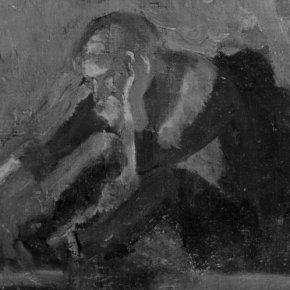 Imagine with me the Apostle Peter at night in his prison cell in Rome near the end of his life.
It all happened so long ago. Thirty years or more now. And yet sometimes – like tonight – I wake up in the cold wee hours of the morning gasping for air because my dreams drag me back to that week. One moment, I’m being suffocated by the crowds pressing in on me, buffeting me, shouting for blood. The next I awake in my prison cell, take in great swallows of stale air.
My cellmate – another follower rounded up here in Rome like I was – he says, “You were shouting in your sleep again.”
“What was I shouting?” I ask, though I already know the answer.
“Something like, ‘I don’t know who you’re talking about,’ ” he says.
Yes, of course. The same old dream. I always wake up when the rooster crows.
Why can’t I dream of the happier times? Lugging the huge catch of fish onto the beach. Talking with Jesus around the campfire. Sharing a meal with him in our hideout in Jerusalem.
“Perhaps you still feel guilty,” my cellmate says. “We’ve all heard the story: how you denied you knew Jesus when he needed you most.”
“But Jesus forgave me,” I say. “I told him I loved him. He gave me a mission to feed his sheep. He knew I couldn’t live with myself, so he told me to live for him instead…And I have…”
My voice trails off. I used to give this defense with more fire.
“He might have forgiven you.” My cellmate again. “But have you truly accepted his forgiveness? Have you ever forgiven yourself?”
I want to say, “yes.” I want this fellow in my cell to know that I am one of Jesus’ most fervent followers, that I remember everything he ever taught, that I apply it constantly to my life. But it’s all a lie. A front I put on so others will be encouraged. If they knew the doubts that assail my hearts, they’d be less eager to follow, I tell myself. I do follow, but…fervently?
His question lingers in the stale air: “Have you ever forgiven yourself?” I want to say, “yes,” but something about the dank prison cell drags the truth out of me instead. Must be the hardness of the floor, the right angles of the walls, the smoothness of the stones. In Rome, even the prison cells are plumb. “No,” I say. The word rebounds off the wall. The echo indicts me.
Silence replaces the echo, and we listen to each other breathing in the dark. “I’d always heard you were stubborn, Peter,” says my cellmate. “But that forgiveness. That love of his. It was a free gift. You didn’t need to earn it. Your denial didn’t make you unworthy of it. Do you not see that?”
A recent convert, this one. I can always tell by their zeal. This one is mouthier than most.
He presses on. “It’s the footwashing all over again.”
“The what?”
“The night before Jesus went to his death on the cross. We’ve all heard that story, too. Jesus knew he was going to God and so he wanted to show you all the importance of service. Of love. The fact that service and love are really the same thing. So he took off his robe, got down on his knees, and washed the feet of his friends.”
“I remember. I was there.”
“But…but when he got to your feet, you didn’t want them washed. You didn’t feel worthy of that either.”
This I have to answer. “He just looked so small,” I say. “Crawling on his knees, pushing the wash basin before him. It felt so wrong for him to humble himself like that for my sake. His humility made me feel even more unworthy.”
More silence. Again, the truth tumbles out.
“It still does.”
And what does my cellmate do? He starts to sing:
“Being found in human form,
he humbled himself
and became obedient to the point of death–
even death on a cross.
“I heard that the day I was arrested,” he says. “We sang it at a gathering.”
“So?”
“It says Jesus humbled himself and became obedient. Don’t you see, Peter? How can I, who is so new to the Way, be the one to teach you this, you who have the keys to the kingdom? Humility and obedience go together.”
I shift on my cot. I don’t want to hear this, but his voice has taken on a new tone, one I remember Jesus using: excitement and insight mixing together to form revelation. I sit up and feel the hairs raise on the back of my neck.
“When he washed your feet he demonstrated humble service. And what did he do next?”
“He told us to love each other.”
“No. He commanded you to love each other. It wasn’t a request. Jesus gave you a direct order, a new commandment. To obey you had to love. To show love you had to serve humbly. To serve humbly you had to obey – to listen deeply for his call and act on it. I found my church – my new family – because I watched them loving each other, serving each other, and I knew I wanted to be part of that. I wanted to follow Jesus’ commandment.”
“And yet here you are, in prison with me.”
“I believe I’m exactly where I’m supposed to be, doing exactly what I’m supposed to do.”
“And what exactly is that?”
He takes a deep breath. “Helping Peter find a new dream.”
I grunt my derision, but the memory of the rooster crowing still hovers behind my eyes. I’m listening, in spite of myself.
“Look,” he presses. “You can dismiss everything I say as the ravings of convert’s zeal. But just because I’m new doesn’t mean I’m wrong. Those words you said in fear that night still haunt you. Let them go. Tell me now. Say it aloud. Say you know him.”
His words awaken the same ones in me. I open my mouth. My voice catches in my throat. But I force them out. “I do know the man.”
“Say it again.”
“I do know him.”
“Where is he?”
“He’s here in this cell. I hear him speaking through you.”
“What is he commanding?”
“He wants me to let go, to let his forgiveness wash me clean, to release my stubbornness and pride, to hear and obey.”
“ To hear and obey. To love and serve in humility?”
“That is his command. Loving and serving. The command and the gift, both at the same time.”
He reaches across the divide between our cots and grasps my hand. I can feel his blood pulsing. And for the first time in God knows how long, I feel the fire blaze in me again. He squeezes my hand and holds it fast. “Peter, my friend, there’s your new dream.”
*Art: detail from “Columbus in Prison” by Thomas Eakins (1844-1916)




 We’ve all heard those words from the Apostle Paul a hundred times. “Love is patient. Love is kind.” I read them at my sister’s wedding. Perhaps you had them read at your own. Statistically speaking, if you go to a wedding there’s a better than average chance you’ll hear First Corinthians 13. Now, it is true beautiful chapter can stand apart as an ancient ode to love. But when we sequester these verses to the marital service alone, we miss how Paul uses them in the greater context of his letter. We miss how love is the corrective for the issues facing the church in Corinth. We miss what love is for. So let’s put these famous words back in context, and with a little help from Harry Potter, we’ll remember a thing or two about love.
 “You are my Son, the Beloved; with you I am well pleased.” Whenever I read this beautiful verse of Scripture, my lungs expand with more air than normal. I take a deep, cleansing breath, and I remember the truth of these words, and I lament how easy it is to forget them.
 Have you ever looked closely at the round window high up the wall in the back of the church? Go ahead – turn around and give it a good look. I love this window. I love the vibrant colors. I love that when the sun is shining through it, an afterimage gets imprinted on my eyes, so I see it when I close them. If you’ve never given the window much thought, I don’t blame you. The words on it are in Latin, after all. But let’s keep looking. The window presents a diagram of the Holy Trinity. “Deus” – God – is encircled in the center. Three smaller circles float around it: Patri, Filius, Spiritus Sancti – Father, Son, and Holy Spirit. Each of the smaller circles is connected to the others with the words “non est” (is not), and each smaller circle is connected to the large central one with the word “est” (is). The diagram is telling us that the Father, Son, and Holy Spirit are not each other but they are all One God. How does this work? Wisely, the window doesn’t tell us. The window just illustrates the reality, a theological blueprint in stained glass.

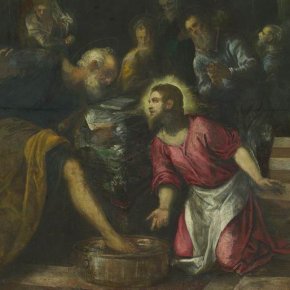
 “Before the festival of the Passover, Jesus knew that his hour had come to depart from this world and go to the Father. Having loved his own who were in the world, he loved them to the end.” Thus begins the second half of the Gospel according to John. We’ve walked with Jesus for three years since he called his first disciples, since he miraculously turned water into wine, since he drove the businesspeople out of the temple. We’ve overheard his conversations with the Pharisee Nicodemus and the Samaritan woman at the well. We’ve seen him heal a man suffering from paralysis and a man born blind. We’ve eaten the bread broken to feed 5,000 people. We’ve listened to Jesus call himself all sorts of names: the bread of life, the light of the world, the good shepherd. Recently, in an act that probably sealed his fate with his enemies, he raised his friend Lazarus from the dead.


 English is a strange language. We have thousands upon thousands of words – more than most languages – and more get added every year. And still there are plenty of instances in the English language where we employ the same word to speak about multiple concepts. I can’t bear to be in the same room as him. The apple trees are about to bear fruit. Yikes, there’s a bear in our campsite! Now bear with me. This idiosyncrasy of English often leads to confusion, especially among non-native speakers. What’s worse is that it can also lead to a concept being watered down, diluted when the various understandings of the word start to merge.

