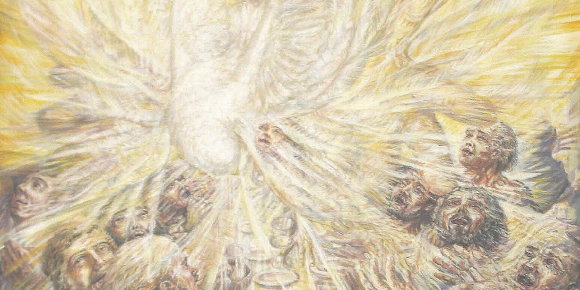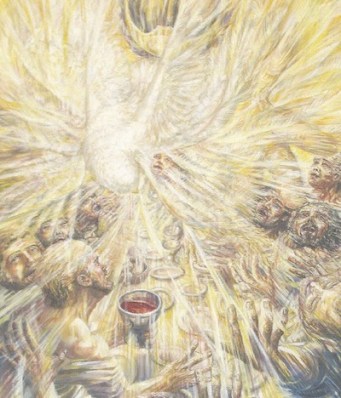
Spark. Fuel. Fire.

Sermon for Sunday, June 8, 2014 || Pentecost, Year A || Acts 2:1-21
sparkfuelfireBeing a creative type, I have found myself relating to the Holy Spirit more readily than most people do. Whenever I sit down to write or play my guitar, I try to acknowledge the Holy Spirit’s presence in that creative activity. I’ve always thought of the Holy Spirit as God’s creativity in the act of making and molding and speaking existence into being. And I’ve always thought of my own creativity as my response to the Holy Spirit moving in my life. The Holy Spirit, then, is the in-spir-ation for my creativity. The Spirit inspires. The two words even come from the same Latin root!

But after many, many conversations with parishioners across several churches, anecdotal evidence suggests that most people gravitate to God the Father or God the Son, rather than to God the Holy Spirit. For a long time, I’ve honestly felt a bit strange due to my affinity for the Holy Spirit. After all, so many people have told me they have real difficulty relating in any meaningful way to this creative force, this inspirer, the Holy Spirit.

But here I must confess something. I’ve come to realize that my process of anecdotal evidence gathering has been totally flawed. For years, I’ve been shortchanging the Holy Spirit when conversing with people about their relationships with God. I’ve been shortchanging the Holy Spirit because in those conversations, I’ve described how I relate to the Holy Spirit as if it’s the only viable option. If the other people didn’t relate to the Holy Spirit in the way I do – in the creative, inspirational way – then I failed to help them name the way the Holy Spirit was, in fact, relating to them. And they assumed they just had no share in the Holy Spirit.

So the rest of this sermon is the beginning of my own remedial training in how the Holy Spirit moves, apart from the raw creativity I’m used to. When I was in college, I often studied by recounting aloud to other people what I had learned, so consider the next several minutes a study session on the Holy Spirit’s movement. As this is a remedial course, I’m going to stick close to our textbook and even to the word “Spirit” itself.

Here goes. We’ve already talked about in-spir-ation, the creative spark that I mistakenly reduced the Holy Spirit to. But what about a-spir­-ation. Each and every one of us experiences the Holy Spirit because each and every one of us has aspirations – goals, dreams, hopes for the future. The Holy Spirit fires these aspirations within us, and gives us strength and support to realize our own potential.

The Holy Spirit was present at creation as the wind that swept over the face of the waters. In the tremulous moment before God said, “Let there be light,” there was nothing. But there was aspiration. There was God’s dream for creation. In that tremulous moment, the Holy Spirit gathered the potential energy of all that would be.

We are each of us small pieces of that potential energy. We are each of us small pieces of God’s aspirations. When we set goals, when we dream, when we aspire to accomplish all that God invites us to do, then we are resonating with the Holy Spirit’s movement. It’s no wonder then, that after the Spirit descends in the rushing wind and tongues of fire, the apostle Peter quotes from the prophet Joel: “I will pour out my Spirit upon all flesh, and your sons and your daughters shall prophesy, and your young men shall see visions, and your old men shall dream dreams.”

Are you beginning to see how much bigger the Spirit’s movement is than my pigeonholing it to simple creativity? We have inspiration. And we have aspiration. How about per-spir-ation? Each and every one of us experiences the Holy Spirit because each and every one us has worked hard to achieve something worthwhile. We’ve put our backs into it. We’ve used our elbow grease. We’ve sweated, perspired.

The Holy Spirit, as our constant companion, gives us the perseverance and endurance to see things through. Those tongues of fire that descended on the heads of the apostles didn’t vanish. No, they kept descending and lodged in their guts. Have you ever heard the expression “a fire in your belly?” The fire of the Holy Spirit catalyzed the apostles to spread the good news of Jesus Christ far and wide, and to be witnesses for the love and grace of God, come what may. It’s no secret that most of Jesus’ original followers came to untimely and grisly ends, but they did so with the fire un-extinguished. They kept perspiring for the sake of the Gospel because the Holy Spirit kept fueling their fire.

When we sweat for things, when we put our hearts and souls into a worthwhile project, then we are ever so much more invested in the outcome. Habitat for Humanity calls the work their homeowners put into their own homes “sweat equity.” Their perspiration gives them a deeper sense of ownership when the work is done. And so does ours when we partner with the Holy Spirit and perspire for the coming of God’s kingdom on earth as it is in heaven.

We have inspiration. We have aspiration. We have perspiration. Finally, in our remedial course on the Holy Spirit’s movement, we have re-spir-ation. Each and every one of us experiences the Holy Spirit because each and every one of us breathes. It’s that simple. Each breath we take is a gift from God. We inhale this gift. The breath of the Holy Spirit infuses us; keeps our bodies, souls, and spirits intact and integrated; and animates us with the desire to serve God in our day-to-day lives. Then we exhale the gift of the Holy Spirit in our actions, in our service, in our love.

The Church calls the Holy Spirit the “sustainer” and the “comforter.” The “sustainer” evokes the constancy of the Spirit’s presence; the “comforter” evokes the peace that comes from breathing deeply. During the last supper, Jesus told his friends he would not leave them orphaned, but would provide them the Spirit to abide with them. After the resurrection, Jesus met them again in the upper room and breathed on them, saying, “Receive the Holy Spirit.” Our constant respiration – whether we are conscious of our breath or not – links us to the Holy Spirit.

Inspiration. Aspiration. Perspiration. Respiration. We participate in the Holy Spirit’s movement in each of these ways. The Spirit sparks our creativity. The Spirit fuels our dreams. The Spirit fires our determination. And the Spirit breathes on our embers, rekindling us again and again. If you have never given your relationship with the Holy Spirit much thought, I invite you, I urge you, to pray about these things. Do not ask if the Spirit is moving in your life. Ask how.

5 Years: These Inadequate Hands

This June is the 5th anniversary of Wherethewind.com, and we are celebrating by looking back at some of the best of the last five years of this website. Today we have the original “Davies Tale,” the first in a series of autobiographical fiction that I’ve written off and on over the years. I’ve always loved this story. While some of the details were changed, the gist of this story is entirely true. (Originally posted February 4, 2009)

The summer before Davies’s senior year of college, his bishop told him that he was going to work at summer camp. Davies raised a hand to his forehead in salute and said “yessir” without hesitation because he was several steps into The Process to become an Episcopal Priest. The amount of deference he was compelled to show the purple shirt equaled that of what he would show if he had a favor to ask of Don Corleone. This was the summer before the Red Sox won their first world series since 1918; the summer before he started looking over the stacks of polisci books to what his future held; the summer before he got himself into a two-year relationship, which eventually fizzled a few weeks before he planned to ask for her hand in marriage. It was the summer before all the real life stuff that college is so good at ignoring.

A skit at Peterin, the real camp behind Camp Madison. (We fake bishops had corporate sponsorships for our miters.) With the Rev. Siobhan Patterson and the late Rev. Keith Butler.

Davies had never been to summer camp as a child, so he didn’t know what to expect as a counselor. Until he googled “James Madison Conference Center,” he also didn’t know the camp was named after a bishop rather than a president. Nor did he know where it was located. As it happens, Madison is three miles down River Road from the no Starbucks town of Lucado, West Virginia. Lucado (pronounced LUCK-a-do) is in the Eastern panhandle of the state. Unless you are already in the Eastern panhandle, a geographical idiosyncrasy of West Virginia (called the Appalachian Mountains) means you pretty much have to leave the state to get to Lucado. A piece of the Potomac, in which Davies once learned to fly fish, gives River Road its name. If you are looking for nowhere on the map, three miles down River Road from Lucado, West Virginia is pretty close by.

Despite Madison’s lack of a cell tower within fifty miles, kids came to the camp. Davies could see their love for the place in their wide, expectant eyes as they queued up to turn in meds and decorate nametags. They loved the camp because it was out-of-doors; they loved it because it broke the monotony of what-do-you-want-to-do-I-don’t-know-what-do-you-want-to-do summer vacations; they loved it because they got to be themselves around other kids who also got to be themselves. In his own teenage years, Davies learned that places where teenagers are unafraid of coming out of their shells are few and sacred. Madison is one of them.

Senior high camp was the biggest week of the summer, with over five score hormone bombs flipping off the diving board, sneaking into the woods, crushing on each other, and complaining every day at breakfast because every day unfairly started in the morning. By midweek, Davies was one among many counselors with nerves fraying, ready to throw up his hands. The counselors used a code word to notify each other if they needed to be extracted from the clutches of a clingy/adoring/needy/smelly/nettlesome camper. As the days wore on, alert campers began wondering what “rich brownie candy bars” had to do with a pet rabbit or the athletic physique of that dreamy counselor.

On Friday morning, Davies thought his body was going to go on strike: he had never been so exhausted. But there was just one more day and night and then he could rest, mercifully. The camp shared Eucharist every day, and Friday’s included a special healing service. When the priests asked for counselors to assist with the laying on of hands, Davies volunteered because he had never done it before.

During the opening song, Davies noticed the new campers who were reticent at the beginning of the week singing with everyone else: You are my Prince of Peace and I will live my life for you! With the addition of those new voices, the camp’s volume went from ten to eleven. The peace took just as long as it usually did because, as usual, everyone tried to hug everyone else. They shared Communion, and then the campers settled into their seats for the laying on of hands. The usually boisterous crowd was quiet all of a sudden as if the mystery of God hit them all at once with the least awkward silence imaginable.

Davies walked to the back of the chapel with his priest friend Rick and a pair of sisters, Jennifer and Elise. The first camper stood up and turned towards them. Davies looked at his hands. He turned them over, saw the lines and the fingerprints and the dirt under his nails. What are these supposed to do?

The camper sat in a metal folding chair, and Rick leaned close. The boy had a pimple on his lip, which quivered as he spoke in a stage whisper: “My parents are divorced and I keep thinking it’s all my fault and I feel sad all the time.” Davies kept looking at his hands, his inadequate hands. Rick motioned for Davies and the sisters to touch the camper’s shoulders. Davies reached out one hand tentatively, lightly, like he was testing a bruise on the boy’s arm. Rick touched oil to the camper’s forehead and prayed. Davies found himself mouthing words that sprang unbidden to his lips.

Lord, make him whole, make him holy, make him wholly new.

This became his breath prayer. Over and over again, he breathed these words in and out. God, use my inadequate hands for healing, use my inadequate heart for loving, he prayed. Without thinking of the consequences, he prayed with fervor he didn’t know he possessed: Holy Spirit, fill me and flow out of me, down my arms, into my hands, and into these broken campers who keep coming and coming.

Their need for healing was so great. Who knew such young people could feel such pain: depression, suicidal thoughts, drug addiction, alcohol addiction, eating disorders, feeling the urge to cut themselves, feelings of abandonment, grief, loss.

Lord, make her whole, make her holy, make her wholly new.

Davies kept whispering this prayer with his fingertips and his breath. He kept asking the Holy Spirit to fill him so the campers could know the healing presence of God. The last camper stood up from the metal folding chair. Davies had forgotten his own exhaustion in the half hour of laying his hands on the campers. They trickled out of the chapel on the way to the dining hall. The counselors and priests who had participated in the healing gathered around the altar for a final prayer. They held hands and prayed. As they let go of each other, Davies felt that little squeeze of his hands from friends on either side.

He backed away from the altar. A tear rolled down his cheek, then another and another. Suddenly, Davies was crying. He sat down in the second pew. Just as suddenly, he was no longer crying—he was bawling, blubbering, sniffling, choking. He had no restraint. His chest heaved, his cheeks reddened. For twenty minutes, he sat with his head in his hands, weeping. As he wept, he felt in his gut and in the soles of his feet the truth: God, you granted me exactly what I asked for—an excess of Spirit, an overflowing of your healing power. The fat tears forming a puddle at his feet were the Holy Spirit spilling out of him. His ragged breath was the Holy Spirit releasing from his body, bringing him back to a level of Spirit that is safe for one human being.

As Davies began to calm, he noticed a hand on his back. Elise had stayed behind and sat silently with him. She had said nothing. She had not tried to hand him a tissue. She had let Davies weep, alone and yet not alone.

He rose to his feet, shakily, drained and full at the same time. They walked across the field to the dining hall. The campers had gone back to their lodges for rest time, and all the grilled cheese was gone. But one of the ladies at the dining hall saw them, fired the griddle back up, and cooked them a pair of sandwiches each. Elise thanked her for this small act of kindness and slid a plate across the table to Davies.

He munched on his grilled cheese for a few minutes. His head pounded with the exertion from crying, but a new feeling a peace was emerging between the throbs. He looked down at his hands again, sticky now with molten cheese. These hands, God? These inadequate hands?

Five Years Ago

Five years ago today, I navigated to WordPress.com and sat for an hour just staring at the computer screen. I had recently received some advice from an editor at a publishing company that I might consider starting a “weblog,” whatever that was. My seminary thesis  reader, Brian McLaren, had put me in touch with this editor (for the life of me, I can’t remember his name), and I’m so glad he did. The editor gave me the best practical advice imaginable for a young writer.

“You need to write,” he said. Sounds obvious, doesn’t it?

kite.png

“You need to write every day,” he continued. “And that means you need someone or something to be accountable to.” Then he turned me on to the idea of blogging, which was still not quite mainstream in 2008. Thank you, Mr. Editor! (Was it Kevin? Ah well. I really can’t remember.)

So there I was, five years ago today, staring at my computer screen. I was stuck trying to make a decision– namely, what to call my blog. I tried many names, also things I can’t remember now. I was listening to music, and in the moment of greatest despair that I would never come up with a name I was satisfied with, U2’s song “Kite” came on.

“Who’s to say where the wind will take you?
Who’s to say what it is will break you?
I don’t know which way the wind will blow.”

blogheaderaug09d.png

The words Bono was singing bore into me. It was like I was hearing them for the first time ever. The chorus hung in the air. I could have grabbed the word “wind” and held it in my hand. As I looked at the words in my mind’s eye, they reformed into a verse from the Gospel According to John: “The wind blows where it chooses, and you hear the sound of it, but you do not know where it comes from or where it goes.” So says Jesus to the Pharisee Nicodemus. This encounter is one of my favorite in the Gospel. In it, Jesus shatters Nicodemus’s preconceptions — his entire worldview, in fact — and rebuilds it with himself (Jesus) at the center. Over the course of the Gospel, we see Nicodemus first tentatively and then boldly step into his own re-creation.

blogbannerbricks.png

For Nicodemus, and for me, it starts with the wind of the Spirit (which, handily, is the same word in ancient Greek). The words from U2’s song shimmered with meaning from the Gospel, and I knew I had found the name of my blog.

Ever since, these words have guided me. I do not know where the wind will take me. But I believe that wherever it is, God will be waiting when I get there. The last five years have confirmed this belief over and over again. Through the blog, I made connections with The Christian Century and EpiscopalCafe. Then, about a year and half in, I came to the attention of the United Methodist Publishing House, and my second book with them comes out this summer! The blog is also partially responsible for the way I met my wife (as well as giving her mother something to find when she googled me). Above all, this website has kept me writing and reflecting on how God is moving in my life and how I am moving in God’s.

blogbannerdd5.png

Over the month of June, I plan to have a five year anniversary celebration for wherethewind.com. I will re-post some of my favorite entries, along with ones that marked significant moments and connections. (If you have a favorite post you’d like me to re-issue this month, let me know!) I look forward to the next five years of wherethewind.com, and I’m so profoundly grateful to all of my readers for taking this journey with me.

I leave you today with some of the first ever words I posted on this website, five years ago today.

Adam, a follower of Christ,

to all those who find this blog through the Series of Tubes.

Grace to you from God our Father and the Lord Jesus Christ!

The Apostle Paul really nailed the beginnings of his letters, so I thought I’d borrow his intro formula to begin my blog. Paul journeyed all over the Mediterranean following the little dotted purple and blue and red lines you see on the maps in the back of your study Bible. I’m afraid I can’t afford the airfares to Thessalonica or Ephesus, so I will have to rely on the Interwebs to make a new set of dotted lines from my MacBook to your computer. Since you’re probably in modern day Scranton or Lubbock rather than ancient Greece, I think the Internet is the way to go.

[…] Who’s to say where the wind will take me? Who’s to say where the Spirit is leading me? In this blog, I will reflect on the movement of God in my life, the movement that dances on the wind of the Spirit. I invite you to follow my reflections and discern how God is moving in your own life.

blogbannermay2011c.jpg

The Spirit Moves

Sermon for Sunday, May 19, 2013 || Pentecost, Year C || John 14:8-17, 25-27

In today’s Gospel reading, Jesus makes one of his biggest promises ever. He is in the middle of his discussion with the disciples, which takes place on the night of his arrest. You can tell from their questions that they are worried, anxious, and fearful. So Jesus promises them this: “I will ask the Father, and he will give you another Advocate, to be with you for ever. This is the Spirit of truth…[the Spirit] abides with you, and…will be with you.”

holyspiritJesus made this promise, and if there’s one thing I can believe in, one thing I can rest my weight on, it’s that Jesus never breaks a promise. The Spirit of truth, the Holy Spirit, has been and will be active in the lives of God’s people forever. But the trouble for us followers of Jesus comes, rather paradoxically, in the very constancy of the Holy Spirit’s presence. We humans are so much better at noticing the things that change. The constant things tend to fade into the background of our lives.

Take breathing, for example. Breathing just happens. I’m breathing right now, and I’m not giving my breath a second thought. I can be unconscious all night, and yet my breath keeps going, independent of my control. For the better part of each day, I am completely unaware of my breathing, and yet my respiratory system continues to function with constant efficiency.

But in one of God’s marvels of human engineering, if I decide to, I can focus on my breath. I can choose to take in a deep lungful of air, or I can choose to hold my breath underwater, or I can choose to let my breath out slowly to calm myself down. Breathing is an unnoticed constant in our lives until we decide to focus on the air entering and exiting our lungs. Then the act of breathing becomes something that we consciously participate in.

Do you know what is the same word as “breath” in the ancient biblical languages? You guessed it. Spirit. Just like our breath, the Holy Spirit is a constant presence in our lives, active within and around us. Because of this constancy, we have a tendency to overlook the Spirit’s presence and to allow the Spirit to fade into the background. But also just like our breath, we have the opportunity to focus on the Holy Spirit’s presence, to breath in a deep lungful of the Spirit, so to speak. When we do this, we actively participate in the transformation that the Spirit is subtly working in our lives.

I’d like to spend the rest of this sermon speaking about several ways the Spirit moves. This won’t be an exhaustive list by any means, but I encourage you to listen for a way in which the Spirit has moved in your life, or a way you pray the Spirit will move.

If you’ve ever had the impulse to create, then you’ve felt the Holy Spirit move in your life. If you’ve ever penned a poem or sang a song or played an instrument or stepped a dance or planted a garden or written a love letter or experimented with ingredients or built an imaginary world or raised a child or made a dream a reality, then you’ve participated in the Holy Spirit’s movement.

The Spirit connects with us via the creative spark, which God implanted in each of us. Being made in the image of God means that God gave us the gift of imagining. The Creator made us to be creative. And just as the Holy Spirit was with God, brooding over the depths at the moment when God spoke creation into being, the Holy Spirit is also with us when we access our own creativity. In fact, the Spirit catalyzes the creative process in us. God has never stopped creating; therefore, one of the ways the Spirit keeps us in relationship with God is keeping us creating too. In my own life, whenever I sit down to write a song, I know the Spirit has prompted me to do so and will guide me as I create new music. So that’s number one: the creative impulse.

If you’ve ever sensed which direction to go, then you’ve felt the Holy Spirit move in your life. If you’ve ever been lost – not on the map, but in your heart – and then felt a subtle beckoning down a new path, and at the moment you took the first step in that new direction you felt your heart shine with the rightness of it all, then you’ve participated in the Holy Spirit’s movement.

The ancient biblical languages use the same word for breath and spirit and for another word: wind. The Holy Spirit is the unseen wind, which subtly pushes us in one direction or another. The wind is both constant and unpredictable, always blowing, but perhaps blowing in a direction we might not expect. When we are lost, the Holy Spirit is present, and we have the opportunity to trim our sails and catch the wind. In my own life, I’ve experienced the Spirit’s presence in this way at the rare times when I have actually been able to give up control. That’s number two: sense of direction to go along with the creative impulse.

If you’ve ever had a sudden sense of peace wash over you, then you’ve felt the Holy Spirit move in your life. If you’ve ever been rushing around, moving to and fro, trying to keep up, trying just to keep your feet in a maelstrom of activity, but then something prompted you just to stop, take a deep breath, then you’ve participated in the Holy Spirit’s movement.

Each time Jesus gives his friends the gift of the Spirit, he also gives them his own peace. Peace is not just the absence of conflict; rather, peace is the soil in which new wholeness grows out of old fragmentation. The Holy Spirit nurtures this growth in us, always pushing us away from brokenness and towards wholeness, towards peace. In my own life, the Spirit has encountered me in this way when I have stopped doing, stopped acting, and have just existed for a spell, just abided in the Spirit’s constant presence. That’s three: sense of peace. Sense of direction. Creative impulse.

Finally, if you’ve ever felt deeply connected to another person, then you’ve felt the Holy Spirit move in your life. If you’ve ever held another’s hand or embraced or laughed together and known in a place deeper than normal knowing that your two souls are connected, woven together, then you’ve participated in the Holy Spirit’s movement.

The Holy Trinity is the perfect relationship of Father, Son, and Holy Spirit — so perfect, in fact, that there is only one God, though we name God as three persons. There cannot be a Father without a Son, nor a Son without a Father. Nor can there be the perfect relationship without love. This love connecting Father and Son in perfect relationship is the Holy Spirit. Whenever we feel a deep connection to another person, we are participating in our own small way in the divine relationship of the Trinity. The Holy Spirit makes our loving connections possible. In my own life, I’ve felt this deep connection since the day I met Leah, and I expect I’ll feel it again when we have our own children. That’s four: deep connection.

The creative impulse. Sense of direction. Sense of peace. Deep connection. These are only four of the vast expanse of ways the Holy Spirit is moving in our lives. Like breathing, the Spirit is active whether or not we recognize the Spirit’s movement. But God engineered us to be capable of focusing on our breath and on the Holy Spirit. So I invite you this week to celebrate the Spirit’s movement in your life. Engage in an act of creation. Catch the wind blowing you in a new direction. Stop for a moment and embrace a sense of peace. Rejoice in the deep connections in your life. And know in the place deeper than normal knowing that God the Holy Spirit will abide with you forever.

Breathing on Statues

(Sermon for Sunday, May 1, 2011 || Easter 2A || John 20:19-31)

Imagine with me the Apostle Peter, who is in Rome near the end of his life, talking to a friend about the day when Jesus rose from the dead and appeared to the disciples in the locked house.

"Aslan Breathes" by Melissa Carter. Click the picture to see more of her paintings.

I wish I could tell you that seeing the empty tomb was enough. I went inside the tomb and saw the linen cloths lying there and the cloth that had covered Jesus’ face folded up in a corner. Thinking back now, surely grave robbers would not have folded his ceremonial burial garments while stealing his body! But in the semi-darkness of that early morning, I wasn’t thinking rationally. I wasn’t thinking at all. I was numb on the outside, immune to the sliver of hope that the empty tomb brought.

I was numb on the outside, but on the inside, I was at war. I always thought of myself as his most faithful disciple, but at the time of his greatest need, I abandoned him, I lied about knowing him to save my own skin. In the garden, I had been ready to fight to the death for Jesus. But the moment he took away my sword, I crumbled. I wasn’t strong enough to remain by his side without a weapon in my hand. I wasn’t strong enough to trust him, to trust that his plan included death without fighting. I was at war within myself, and I could not access a single crumb of the peace that Jesus had always radiated.

I saw the empty tomb, but the conflict within kept me blind to what the emptiness might mean. The war inside of me – with fresh reinforcements of guilt – was still raging when I returned to the house we had used a few nights before, on the night when I didn’t want Jesus to wash me feet. Nine of the others were there; they had been locked in the room since the mob had formed three days before. As I was shutting the door, Mary Magdalene rushed up and squeezed her way into the room. “I have seen the Lord,” she shouted.

She was breathing hard. I had left her standing outside the tomb, so she must have raced all the way to the house to catch up with me. I looked at Mary: her face glistened with sweat, her eyes were bright. If the conflict within had not been blinding me, I might have identified the brightness in her eyes as “joy,” but how could there ever be joy again after what had happened? The other disciples barely looked up when she burst in shouting. She looked around the room, then back at me. “He has risen from the dead,” she said, defiantly.

I took a step toward her. “Just because the tomb was empty,” I began, but my voice trailed off. She backed away, and now her voice was very small, small and wounded. “But I did see him,” she said. And I shut the door with Mary on the other side.

Sliding the bolt home, I slumped against the door and slid to the ground. Oblivious to Mary’s pounding on the door, I looked around the room. Judas was gone, of course, but everyone else was there, I was sure. We had escaped the mob and the authorities. Would they be content with the death of our leader or would they be coming after us, too? I counted the others. Nine, and I made ten. Someone else was missing. “Where’s Thomas,” I called out.

Philip looked up for a moment and managed a one-word response. “Gone,” he said, and he put his head back into his hands. I sat with my back to the locked door. Eventually Mary gave up her pounding. I could hear her sobbing, her breath coming in great heaves. She was, no doubt, sitting against the other side of the door. Three inches of wood separated us: three inches of wood and my disbelief and the war raging within me.

Inside the room, we might have been statues. I couldn’t even hear the others breathing. Hours passed and no one noticed. No one spoke. No one ate or drank. We were entombed in the locked house, alive but acting like dead men. And all the while the war raged on while numbness froze my body against the bolted door.

The ten of us were still frozen in place when evening fell. I had been staring at nothing in particular when I began unconsciously counting the others again. “Eight. Nine. Ten.” I counted aloud, and then I put my finger to my own chest. “Eleven.” I counted again. Eleven again. I leapt up and stared at the man in the center of the room. He was slowly spinning in a circle, studying each statue in turn. I looked where he was looking: at the hollow eyes, at the sunken cheeks, at the dried up streams of tears that had washed clean lines on dirty faces.

As far as I could tell, I was the only one who had noticed his presence. Since my rational mind was still turned off, I didn’t even wonder how someone else had entered the room while I was sitting against the locked door. I just stared at him, uncomprehending, but the sliver of hope that lay dormant in me since the tomb was beginning to glow. Then he said, “Peace be with you.”

They were the first words spoken since Philip’s one-word response to my question hours earlier. The words rang out, and the others began to stir. They raised their heads. Some stood up. The man walked over to me, gripped my arm in a firm grasp, and I noticed fresh wounds that cut through both of his wrists. He went around the room clasping the others’ shoulders and lifting their chins with his fingers. “He can’t be,” I said, as the war of guilt and pain and loss continued to rage within me, stronger now that the faint glow of hope was illuminating the battlefield.

The man heard me and turned to face my direction. “Peace be with you,” he said again. We were all standing now. The room, so empty a moment before, seemed full now, but not full enough for him. He gestured to me. I turned, unbolted the lock, and opened the door. Mary, still slumped against the other side, fell into the room. I helped her to her feet. “Is he?” I whispered to her. She looked from the man to me, and she beamed at me through brimming eyes.

“As the Father sent me, so I am sending you,” he continued. With these words, we, who had been as still as statues mere minutes before, all leaned in, like trees bending toward the sunlight. And he exhaled a deep, cleansing breath, then another and another. As he breathed out, I breathed in. I breathed in his breath, the wind of his life. I breathed in the words he had spoken twice since his arrival, the very peace that he proclaimed, that he radiated. This was Jesus, and he was alive, and he was breathing life back into us, into the ones who had entombed ourselves in that locked house.

As we leaned closer, Jesus said, “Receive the Holy Spirit.” And his breath washed over me, into me, through me. His Spirit brought peace to the war raging within. His breath blew across the faint glow of hope, turning the glow into a spark, and the spark into a flame, and the flame into a fire. And the fire set my heart alight with all the fervor of rekindled belief in this Jesus, this risen Lord, this one who would not abandon me to the grave even after I had abandoned him to die.

I tell you, friend, that in the years since that day, my daydreams have often brought me back to that moment when Jesus breathed his Spirit into me. When I am in distress, when I am in grief, when I forget that I believe that I am with God, I can take a breath. And I will remember that I am breathing in the peace that our Lord has given to each of us, the peace that passes all my ability to understand and lodges where I need that peace the most – in the secret places within where the war still rages from time to time. You see, every time I take a breath, and, for that matter, every time you take a breath, we are not only filling up our lungs with air. We are filling up our souls with the Holy Spirit of God, who continues to breathe into us the new life of the Risen Christ.

It’s Love, in Point of Fact

(Sermon for Sunday, May 30, 2010 || Trinity Sunday, Year C, RCL || Proverbs 8:1-4, 22-31; Romans 5:1-5; John 16:12-15)

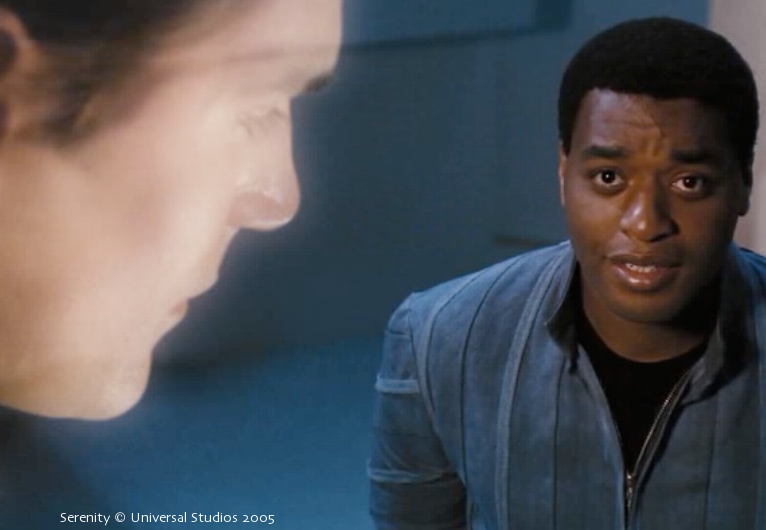
At the beginning of the science-fiction film Serenity, the Operative scans through security footage of Simon Tam breaking his sister, River, out of a government-run facility that has been conducting torturous experiments on River’s brain. The doctor who runs the facility tells the Operative that it was “madness” for Simon Tam to give up his own brilliant future in medicine in order to save his sister. “Madness?” the Operative replies. “Have you looked at this scan carefully, Doctor? At [Simon Tam’s] face? It’s love, in point of fact. Something a good deal more dangerous.” It’s love, in point of fact.

It’s love, in point of fact, that forms this wonderful community, which cares for those both within and without our little band of pilgrims. Some would say this is madness rather than love, asserting that maintaining a purely self-interested motivation for action is the only safe and sane way to live.

It’s love, in point of fact, that brings this wonderful community here today to worship a God we’ve never seen with our eyes nor heard with our ears nor touched with our fingers. Some would say this is madness rather than love, asserting that only what we can prove and quantify and predict are real.

And it’s love, in point of fact, that forms this wonderful community to worship an unseen God who reveals God’s personhood as threefold, as Father, Son, and Holy Spirit. Some would say this is madness rather than love, asserting that the Trinity is a needless complication of the already tenuous and rather dodgy business about God.

Some would say all this is madness, but it’s love, in point of fact. Let’s take a look at each of these three – community, belief in God, and belief in God as a Trinity of persons. We’ll look at them in the opposite order, so we’ll start before the beginning.

You see, if we start at the beginning, we’ve already arrived on the scene too late, as our lesson from Proverbs does today. Proverbs’ personification of Wisdom tells us, “The Lord created me at the beginning of his work, the first of his acts of long ago. Ages ago I was set up, at the first, before the beginning of the earth.” Wisdom may have been created before the earth, but Wisdom tells us that the Lord still created her. This is far too late to begin our discussion of the Trinity. Too even grasp the edge of the expanse of the majesty of the Trinity, we must cast our imaginations back to before there was even a concept known as “before.” You with me so far? Good.

In the First Letter of John, the writer makes the sweeping statement: “God is love.” If nothing besides God existed before the beginning, how did this love manifest? If there was no Creation to fill the role of the Beloved, then how could God be “love?” At first the answer seems rather narcissistic: if there was nothing else to love, then God loved God. But we can’t stop there because true love always manifests as a relationship. In our futile attempt to find the right word to name God, we latch on to relational language and call God “Father.” This sets up one side of a loving relationship, that of parent to child.

But the relationship is incomplete without that second person. And so we also call God “Son” to acknowledge the complete relationship between loving parent and beloved child. In the Gospel according to John, Jesus says that God “loved me before the foundation of the world.” This love between parent and child is so palpable that the love itself is the third member of the Trinity, which we experience as the Holy Spirit. Indeed, Paul tells the church in Rome that “God’s love has been poured into our hearts through the Holy Spirit that has been given to us.”

So this loving relationship between parent and child existed before anything else, including the concept of “before.” Nothing existed that could substitute for or diminish the relationship. The love was pure, perfect, unsullied by deficiencies such as lust or anger or apathy or dominance. In fact, the perfection of the relationship meant that, while there was a Trinity of persons, a Unity of being was the ultimate reality. This Unity of being was the home in which the three persons dwelt: the Parent, the Child, and the Love between them.

Now, I’ve been speaking in the past tense for the last few minutes. Of course, because all this happened before there was a “before,” there was no such thing as the “past” or the “future.” There was only the eternal present in which the perfect Love between Parent and Child manifested in the perfect Unity of being. Before the beginning was this ultimate reality of God, of love, of home.

Then came “In the beginning,” and suddenly there was a time known as “before.” God breathed the wind of God’s Holy Spirit over the face of the deep. God spoke the Word of God, through which all creation came into being. The Trinity, still loving itself into eternally perfect relationship, created the heavens and the earth, thus generating an “other” to bring into that loving relationship, that home that is God. This Creation is not God because God made it, just as God made Wisdom in today’s reading from Proverbs.

Everything that God creates exists in Space and Time, which are simply two more things that God created. Right now, we exist in the space that is this beautiful sanctuary. We don’t exist on your sailboats or sitting in the bleachers at this afternoon’s Red Sox game. And for the last seven minutes, we’ve existed in the time in which I’ve been speaking. Sad to say, we can’t move backward in time and choose not to come to church since the sermon will be really confusing. But because God created Space and Time, God exists outside of these constraints. However, since God loves this little universe of God’s making, God continues to move around and throughout and within it. Truly, God loved this little universe so much, that God the loving parent gave to Creation God’s beloved child.

This beloved child, this Word made flesh came to our little planet as a baby who grew up to be a man who said and did such wonderful things and who taught us about God’s love for all Creation and who expanded our hearts and minds so they could contain such wonderful thoughts and who was killed because of his vision of acceptance and love and who rose miraculously from the dead and who ascended once again to exist in the eternally perfect relationship with God and who showed us the way home to this relationship.

After Jesus Christ ascended, he sent the Holy Spirit to us, the same wind of God that swept across the face of the deep at the moment of Creation. Through the Holy Spirit, God continues to pour God’s love into our hearts so that they can expand to hold the Truth of Jesus’ message of hospitality, generosity, and service. Each member of the Trinity moves in our lives, a family perfectly unified as One, as One who yearns to bring us back home.

Far from being some obscure, antiquated doctrine, the Trinity permeates existence today as it always has even before anything else existed. The Trinity loves itself into eternally perfect relationship, which makes forming loving relationships in our own lives the best way to glorify God. When we come together in this wonderful, loving community to worship God, we participate in the life of the Trinity. When we share the body and blood of Christ, we participate in the life of the Trinity. When we go out into the world in the power of the Holy Spirit to love and serve and find God in those we meet, we participate in the life of the Trinity. This community is home – not a perfect home like the Trinity is unto itself – but a good home made by fallible humans doing our best to love one another.

At the end of the film Serenity, the captain of the small spacecraft finds River sitting in the copilot’s chair, while rain lashes the cockpit’s windows. “But [flyin’] ain’t all buttons and charts,” Malcom Reynolds tells River. “You know what the first rule of flyin’ is? …Love. You can learn all the math in the ‘Verse, but you take a boat in the air that you don’t love, she’ll shake you off just as sure as a turn in the worlds. Love keeps her in the air when she oughta fall down, tells ya she’s hurtin’ ‘fore she keens. Makes her a home.”

The majesty of the Trinity is that God is a perfect home unto God. And God invites us and everyone and all Creation into that home. What makes God a home for us? It’s love, in point of fact.

Inspiration (Davies Tales #3)

The irony was unbearable. A theology paper about the Holy Spirit due in less than twenty-four hours, and Aidan Davies had less than nothing. No topic. No thesis statement. No inspiration. No inspiration for an essay about the Spirit, the source of in-SPIR-ation. Davies snorted and shook his head. I hate irony. He focused again on the glow emanating from the screen in front of him. He and his laptop had been engaged in a staring contest for the better part of the morning, and the blank document on the screen was winning handily. He reached into the empty bag of pretzels, forgetting about the last half dozen failed attempts to discover untapped sources of pretzel crumbs from the bag’s darker recesses. No thesis statement. No inspiration. And now no pretzels either.

Davies stood up abruptly. Black spots appeared in the corners of his eyes. He swayed and grasped the back of the chair to steady himself. He shut his eyes, willing the oxygen to double time it to his brain. A deep yawn built in his chest, which he exhaled in a frustrated groan. Then he stretched, and his fingertips brushed the ceiling of his dorm room. He looked up and pushed the square tile with his middle finger. He knew that by evening he wouldn’t be tall enough to touch the paneling above him. No oxygen in my brain. No inspiration. And I’ll be getting shorter for the rest of the day.

Davies looked down at the screen. “You win,” he said aloud to the blank document before shutting the laptop with perhaps more force than normal. He stuffed the computer into his messenger bag and cast around for his trainers. He laced up his shoes, slung the bag over his shoulder, and stalked from the room. He didn’t know where he was going. He had only a vague notion that he might walk a bit before lunch. He passed Mark Riley’s room, whose door was ajar as usual. Mark looked up from a comic book (He calls them ‘graphic novels,’ Davies reminded himself) and said, “Where you off to, brother?”

Davies poked his head into the room, “I dunno. It’s just this Holy Spirit paper. I’ve got—” He cupped his hand into a zero. “Zilch.”

“Same here,” Mark said grinning. “That’s why I’m doing some background reading.” He held up the graphic novel and tapped the title: The Spirit. Davies grinned back, appreciating Mark’s ability to justify his procrastination.

Leaving the dormitory, Davies drifted up the twisting sidewalk. He inhaled the perfume of freshly-cut grass and felt the early spring sun warm his hair. He wandered past the library, down the stairs behind the academic building, and across the parking lot. He watched a pair of squirrels zig and zag up a tree trunk before losing them in the budding canopy. He followed his shadow to the sporting field, its rolling expanse dotted with the stragglers of the flocks of migrating geese.

The moment he stepped onto the field, the geese took flight. Davies watched them until he could no longer distinguish their honking from the ambient noise of lunch hour traffic. As his eyes lost the geese to the distant clouds, a sharp breeze reminded Davies that winter hadn’t quite given up yet. He watched the breeze spiral through the trees, the new leaves spinning and dipping with their unseen partner. Words echoed across Davies’s empty mind: “The wind blows where it chooses, and you hear the sound of it, but you do not know where it comes from or where it goes. So it is with everyone who is born of the Spirit.”*

Wind and Spirit, Davies thought, remembering his Greek class from the first semester of seminary. They’re the same word. When Jesus tells Nicodemus about the wind, he could be talking about wind or Spirit or both. Wind and Spirit act the same: you can’t see the wind until it moves the leaves. You can’t see the Spirit until it interacts with us. You notice the Spirit when you see the change, the movement in our lives.

Davies raced back up the hill, his messenger bag bumping his back with each stride. He reached the bench outside the administration building and put his hands on his head. His breath came in ragged gasps as his lungs and heart protested the sprint after a winter of idleness. Several minutes later, he was able to catch his breath. Catch your breath. What a strange phrase. It’s not like a baseball or anything. More words echoed in Davies’s mind: “Jesus breathed on them and said to them, ‘Receive the Holy Spirit.’ ”**

Breath and Spirit, Davies thought, reaching all the way back to high school Latin. Respiration comes from the same root as Spirit. When Jesus breathes on the disciples, they ‘catch’ the Holy Spirit. Every time I take a breath, the Spirit is breathing life into me. The Spirit is always with me, changing me, moving me, giving me life. ‘Giver of life’ – that’s what the Creed says.

Davies sat down on the bench and opened his laptop. No staring matches this time. He looked up at the leaves pirouetting in the wind. He took a deep breath. And he began to write.

Footnotes

* John 3:8

** John 20:22

These inadequate hands (Davies Tales #1*)

The summer before Davies’s senior year of college, his bishop told him that he was going to work at summer camp. Davies raised a hand to his forehead in salute and said “yessir” without hesitation because he was several steps into The Process to become an Episcopal Priest. The amount of deference he was compelled to show the purple shirt equaled that of what he would show if he had a favor to ask of Don Corleone. This was the summer before the Red Sox won their first world series since 1918; the summer before he started looking over the stacks of polisci books to what his future held; the summer before he got himself into a two-year relationship, which eventually fizzled a few weeks before he planned to ask for her hand in marriage. It was the summer before all the real life stuff that college is so good at ignoring.

Davies had never been to summer camp as a child, so he didn’t know what to expect as a counselor. Until he googled “James Madison Conference Center,” he also didn’t know the camp was named after a bishop rather than a president. Nor did he know where it was located. As it happens, Madison is three miles down River Road from the no Starbucks town of Lucado, West Virginia. Lucado (pronounced LUCK-a-do) is in the Eastern panhandle of the state. Unless you are already in the Eastern panhandle, a geographical idiosyncrasy of West Virginia (called the Appalachian Mountains) means you pretty much have to leave the state to get to Lucado. A piece of the Potomac, in which Davies once learned to fly fish, gives River Road its name. If you are looking for nowhere on the map, three miles down River Road from Lucado, West Virginia is pretty close by.

Despite Madison’s lack of a cell tower within fifty miles, kids came to the camp. Davies could see their love for the place in their wide, expectant eyes as they queued up to turn in meds and decorate nametags. They loved the camp because it was out-of-doors; they loved it because it broke the monotony of what-do-you-want-to-do-I-don’t-know-what-do-you-want-to-do summer vacations; they loved it because they got to be themselves around other kids who also got to be themselves. In his own teenage years, Davies learned that places where teenagers are unafraid of coming out of their shells are few and sacred. Madison is one of them.

Senior high camp was the biggest week of the summer, with over five score hormone bombs flipping off the diving board, sneaking into the woods, crushing on each other, and complaining every day at breakfast because every day unfairly started in the morning. By midweek, Davies was one among many counselors with nerves fraying, ready to throw up his hands. The counselors used a code word to notify each other if they needed to be extracted from the clutches of a clingy/adoring/needy/smelly/nettlesome camper. As the days wore on, alert campers began wondering what “rich brownie candy bars” had to do with a pet rabbit or the athletic physique of that dreamy counselor.

On Friday morning, Davies thought his body was going to go on strike: he had never been so exhausted. But there was just one more day and night and then he could rest, mercifully. The camp shared Eucharist every day, and Friday’s included a special healing service. When the priests asked for counselors to assist with the laying on of hands, Davies volunteered because he had never done it before.

During the opening song, Davies noticed the new campers who were reticent at the beginning of the week singing with everyone else: You are my Prince of Peace and I will live my life for you! With the addition of those new voices, the camp’s volume went from ten to eleven. The peace took just as long as it usually did because, as usual, everyone tried to hug everyone else. They shared Communion, and then the campers settled into their seats for the laying on of hands. The usually boisterous crowd was quiet all of a sudden as if the mystery of God hit them all at once with the least awkward silence imaginable.

Davies walked to the back of the chapel with his priest friend Rick and a pair of sisters, Jennifer and Elise. The first camper stood up and turned towards them. Davies looked at his hands. He turned them over, saw the lines and the fingerprints and the dirt under his nails. What are these supposed to do?

The camper sat in a metal folding chair, and Rick leaned close. The boy had a pimple on his lip, which quivered as he spoke in a stage whisper: “My parents are divorced and I keep thinking it’s all my fault and I feel sad all the time.” Davies kept looking at his hands, his inadequate hands. Rick motioned for Davies and the sisters to touch the camper’s shoulders. Davies reached out one hand tentatively, lightly, like he was testing a bruise on the boy’s arm. Rick touched oil to the camper’s forehead and prayed. Davies found himself mouthing words that sprang unbidden to his lips.

Lord, make him whole, make him holy, make him wholly new.

This became his breath prayer. Over and over again, he breathed these words in and out. God, use my inadequate hands for healing, use my inadequate heart for loving, he prayed. Without thinking of the consequences, he prayed with fervor he didn’t know he possessed: Holy Spirit, fill me and flow out of me, down my arms, into my hands, and into these broken campers who keep coming and coming.

Their need for healing was so great. Who knew such young people could feel such pain: depression, suicidal thoughts, drug addiction, alcohol addiction, eating disorders, feeling the urge to cut themselves, feelings of abandonment, grief, loss.

Lord, make her whole, make her holy, make her wholly new.

Davies kept whispering this prayer with his fingertips and his breath. He kept asking the Holy Spirit to fill him so the campers could know the healing presence of God. The last camper stood up from the metal folding chair. Davies had forgotten his own exhaustion in the half hour of laying his hands on the campers. They trickled out of the chapel on the way to the dining hall. The counselors and priests who had participated in the healing gathered around the altar for a final prayer. They held hands and prayed. As they let go of each other, Davies felt that little squeeze of his hands from friends on either side.

He backed away from the altar. A tear rolled down his cheek, then another and another. Suddenly, Davies was crying. He sat down in the second pew. Just as suddenly, he was no longer crying—he was bawling, blubbering, sniffling, choking. He had no restraint. His chest heaved, his cheeks reddened. For twenty minutes, he sat with his head in his hands, weeping. As he wept, he felt in his gut and in the soles of his feet the truth: God, you granted me exactly what I asked for—an excess of Spirit, an overflowing of your healing power. The fat tears forming a puddle at his feet were the Holy Spirit spilling out of him. His ragged breath was the Holy Spirit releasing from his body, bringing him back to a level of Spirit that is safe for one human being.

As Davies began to calm, he noticed a hand on his back. Elise had stayed behind and sat silently with him. She had said nothing. She had not tried to hand him a tissue. She had let Davies weep, alone and yet not alone.

He rose to his feet, shakily, drained and full at the same time. They walked across the field to the dining hall. The campers had gone back to their lodges for rest time, and all the grilled cheese was gone. But one of the ladies at the dining hall saw them, fired the griddle back up, and cooked them a pair of sandwiches each. Elise thanked her for this small act of kindness and slid a plate across the table to Davies.

He munched on his grilled cheese for a few minutes. His head pounded with the exertion from crying, but a new feeling a peace was emerging between the throbs. He looked down at his hands again, sticky now with molten cheese. These hands, God? These inadequate hands?

Footnotes

* This is the first story in a series I’ve been meaning to write for a while now. Gordon Atkinson’s character “Foy” gave me the inspiration to begin my own series of autobiographical fiction. If you haven’t read the “Foy Stories,” read them because they are incredible. Since Gordon Atkinson originally  referred to “Foy Davis” as simply “Foy,” I didn’t realize the similarity of names until I wrote this footnote! (I hope you don’t mind, Gordon!)

Expect to be surprised (Bible study #4)

I wasn’t planning to write about this particular aspect of Bible study for a while yet, but a few days ago I broke the very direction I’m about to relate to you. Before I tell you what this direction is, I must say that failing to observe my own guidelines is an odd and humbling experience. You might say, “Adam, you made them up; you can get rid of them just as easily.” Well, I’ve never liked when presidents dump their own executive orders when they get inconvenient. So I better stick to my guidelines and remember that God’s greatest gift to me is slapping me upside the head with humility.

Incidentally, I wonder if police officers experience any humility or remorse when they speed by with nary a siren or light turned on. I doubt it. Anyways, back to the Bible. So, I was beginning my sermon prep and reading through this Sunday’s lessons in a book that has all three of them conveniently grouped together. I finished the short passage from Paul’s Letter to the Romans, and my eyes wandered down to the Gospel reading. “Matthew 16:13-20” said the bold headline. Right, I thought, that’s Peter’s confession of Jesus being the Messiah, keys to the kingdom and all that. Then I closed the book.

Yep, I closed the book. I closed the book WITHOUT READING THE GOSPEL LESSON. Take 30 seconds to mull over all the ways that’s just stupid before continuing to read this post………..right, let’s press on.

The next morning in the shower (I do all my best thinking in the shower), I was thinking about my sermon and realized I couldn’t remember what the Gospel text was for Sunday. I could, however, remember shutting the book after reading Romans. I took 30 seconds to mull over all the ways that’s just stupid. When I got to church, I pulled out my Bible, opened up to Matthew 16, and read it. And read it again. And read it again.

And I surprised myself so much that I threw my head back and laughed a manly laugh of triumph. Actually, I had an uncontrollable fit of giggles, but if Cameron Crowe ever makes my biopic, I hope he inaccurately portrays me so I seem less like a 12-year-old girl.

I giggled because I noticed something in the text I’ve never noticed before. I’ve read Matthew 16 a few dozen times over the years, but until Tuesday morning, I never saw that Jesus asks his disciples two different questions: “Who do people say that the Son of Man is?” and “Who do you say that I am?” I always saw the “those people/you disciples” distinction, but never the “Son of Man is/I am” one. My sermon is still percolating somewhere in the region of my belly, so I don’t know if this distinction will influence what I say on Sunday. But, the important thing is this: the text surprised me–this text that I thought I knew so well that I didn’t even need to read it to write a sermon about it surprised me with something new and exciting.

The title of this post is a bit of an oxymoron. If you’re expecting to be surprised, then will there really be a surprise? With birthday parties, No. With reading the Bible and living your life in God’s grace, Yes. God can and surely does surprise us when we are least expecting it. But we can also foster the faithful expectation that God’s sleeves are full of never-ending pocket handkerchiefs and affixed to God’s lapel is one of those flowers that squirts water and in God’s loving embrace await ever deeper and more beautiful surprises.*

When you read the Bible, practice expecting to be surprised, especially when you are studying the most familiar passages. And I do mean practice. Every reading will not yield some surprising event, but every expectant reading will cultivate an openness to the Holy Spirit, whose whole game plan is about surprising us with God’s grace and joy.

Here’s one exercise I find helpful. Read the passage twice, with a few minutes of silence in between. The first time, read as critically as you can, with all your past experience and knowledge of the historical context and history of tradition and understanding of ancient biblical languages and your kitchen sink. The second time, let all the baggage recede into your mind’s Green Room and read with the lightness of a holy naivete. Finally, have a conversation with yourself about how your two readings compared. What was the same/different? What was confusing/clear? What sprung from the page? As your intellect, curiosity, and hunger mingle with the Holy Spirit’s guidance, you will find something new and exciting. And you might just giggle like a 12-year-old girl.

Footnotes

*After the first comment on this post, I think I’ll qualify my clown imagery. I was going for the surprising things clowns do. If you’ve ever met me, you know clowns really freak me out, but it’s the painted smiles, not the gags. The clown therapy people who frequented the hospital at which I worked one summer wore white lab coats like doctors. It was weird.