The True Self

(Sermon for Sunday, June 23, 2013 || Proper 7C || Luke 8:26-39)

This sermon is about demons. I want you to know that before I get going because for a while it might not seem like I’m talking about demons at all. But I will be. If our real demons looked like the caricatured little red devils with horns, they’d be really easy to avoid. But real demons are much more subtle. So remember: this sermon is about demons.
GeraseneAround this time three years ago, I was sitting at Panera Bread working on some project or other. It was the most ordinary day imaginable – a little bit of rain pattering on the bushes outside, the normal bustle of Panera happening in the periphery of my headphoned consciousness. You’d think what happened next would have long since vanished from my memory because of its seeming insignificance. But as I was contemplating this sermon, the memory of that day at Panera started playing like a film in my head.

I was just sitting there drinking green tea, working on my computer, and listening to Beethoven’s piano sonatas. Then something pulled my attention. A young woman, whom I had idly noticed when I sat down and then promptly forgotten, was talking on her cell phone. Out of the corner of my eye, I watched the young woman’s brow crease. Her free hand went to her mouth. My internal pastoral alarm bells started blaring. The woman began to collapse inward. Here it comes, I thought.

“How long will it take me to get to the hospital from the airport?” Her voiced trembled as she asked the question, panic mixing with at least a veneer of bravery. She clung to her cell phone as if it were a flotation device.

I closed my eyes and tried to ignore the woman. She’s not one of mine, I thought. I’m not on duty right now. I’m not wearing the uniform today.

But even as these thoughts entered my mind, I felt the muscles in my arms and legs tense. My chest constricted. For a horrible moment, I felt myself unraveling. I was unmade. I was a traitor in my own body.

I know this seems like an overreaction or hyperbole employed for dramatic effect. But it is entirely accurate. So why would such a small event as me overhearing an anonymous woman in distress cause me to plummet into a moment of existential crisis?

Because I had a choice. I could ignore the woman in need or I could do something – anything – to help her. One of those choices would affirm the true self, the authentic person who God created me to be. And one wouldn’t. I chose the latter. When I chose to embrace the false self, the inauthentic person, I felt myself start to fray around the edges.

Have you ever felt like that? Have you ever felt yourself start to unravel, so to speak, because of a decision you made that runs counter to the person you know you are?

Perhaps you were in the cafeteria at school. You weren’t the bully or the bully’s target, but in the moment of decision you chose to laugh along with the rest of the onlookers as the victim was teased. And as you chuckled along, you noticed there was a hollowness in each of your laughs. But the hollowness wasn’t just in your laughs. You looked within and noticed a void, an emptiness, a lack of the self you knew to be true.

Perhaps you and your spouse got into an argument. It started over a perceived disparity in the household workload but pretty soon you were fighting just to fight. Then you chose to punch below the belt. A word escaped your lips – an expletive, a derogatory name that took all the light out of your spouse’s eyes. You grinned for a moment in triumph, but then as your spouse backed away and fled the room, you felt the light going out in your own eyes. You looked within and everything was darkness.

This is what it means to unravel, to fray at the edges, to be unmade, to be a traitor in your own body. When you make a decision that embraces the false self, the inauthentic person, you might be able to recognize your body in the mirror, but it won’t be you staring back.

Remember, I warned you this sermon is about demons. Have you seen them yet? No, probably not. You haven’t seen them because there’s nothing to see. But that’s precisely the point. The hollowness, the darkness – these tell us that demons have been by. We only ever notice them because of the absence they leave. We can choose the fullness of our true selves and the light of our authentic persons, but when we don’t, we unravel just a little bit more because that demonic absence is eating away at us and pulling us away from God.

The good news is that God doesn’t just sit idly by while we unravel. God is in the business of helping each and every one of us discover the true people God created us to be. When we live as our true selves, we are honoring the image and likeness of God within us. Just think how wonderful you feel when you make choices that affirm your authentic self. So full of light. So full of joy. You are at home in your body. You look in the mirror and see yourself smiling back. Far from an imposter, you are exactly the person you are supposed to be. You aren’t unraveling. You are whole.

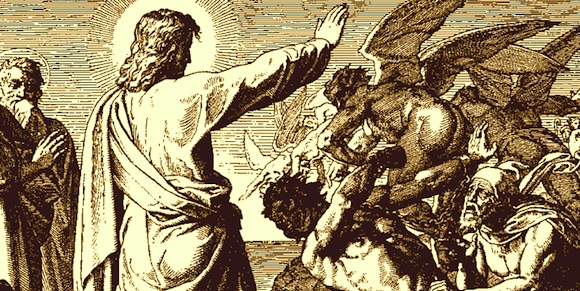
In today’s Gospel lesson, Jesus engages in the ministry of helping us embrace our true and authentic selves. The Gerasene man hasn’t been himself in a long time. The demons have hollowed him out, and they fill this hollowness with their presence – or should I say, they fill it, paradoxically, with their absence. But Jesus yearns for the man – and for each of us – to live as our true selves. So Jesus heals the man. Jesus fills the hollowness with his own presence. And when he does so, the demons have nowhere to go.

This healing of the demonic within is a piece of each of our stories, too. With each of our choices, we embrace either our false selves or our true ones, we embrace either absence or presence, hollowness or fullness. When I chose to ignore the woman at Panera, I felt unmade. But God gave me a second chance. Rather than ignore her, I prayed for her from across the room. I asked God to connect my soul to hers for those few moments when our proximity made us kin and to make me a beacon emanating God’s peace. I don’t know if that prayer had an effect on her, but it did on me. The second chance gave me the opportunity to embrace the authentic person God created me to be.

I invite you this week to take stock of the choices you make. How do those choices make you feel? Which lead to wholeness and which to unraveling? When you are faced with a choice, pray to God to help you choose the decision that promotes your true self, the authentic person God created you to be.

I said this sermon was about demons. But it’s really about God’s triumph over the forces that seek to unravel us. While we may succumb to demons from time to time, God will never stop speaking healing and wholeness into our souls. And that means the demons will never win.
Faith-ing

Sermon for Sunday, June 2, 2013 || Proper 4C || Luke 7:1-10

Here’s a common situation in this day and age. For one reason or another – say, you’ve got to figure out how many packages of plastic cups to get for a party – you find yourself needing to do long division. Your phone’s battery is dead, so the calculator app is gone too. You flip over your shopping list and put pen to paper, and then you stop and realize that you have no idea how to do long division. You learned in fourth grade, but (wow) was that a long time ago. Has anyone else had that experience?

So, if basic math escapes us sometimes because we haven’t thought about it in a long time, I’d hazard a guess that we sometimes also lose sight of the basics of being followers of Jesus Christ.

Today, I’d like to get back to the basics. I’m going to talk about faith – specifically about how faith works in our lives. Hopefully, at the end of this sermon we will all rejoice that, while faith seems like an abstract, ephemeral concept, faith is in truth the fuel that fires our lives.

To start this little discussion about faith, we need to clear up one minor issue. In the English language the word “faith” is a noun. This grammatical construction makes it normal for us to ask a question like “Do you have faith?” Faith here is the object of your possession: “Yes, I have faith.” This sounds like completely correct and acceptable English, right? The trouble is, while faith is a noun, it should be a verb. I should be able to say “I’m going faith-ing today” or “We faith-ed yesterday and we’re going to faith again tomorrow.” But those sentences sound really strange, don’t they? I wish they didn’t. The word “faith” is a noun but whenever you use it, I hope you will remember it should be a verb.

Here’s why. We can possess things like concert tickets and hiking boots, but such possessions just sit on the counter or in the closet until we need to use them. If we have faith in the same way we have concert tickets, then we run the risk of storing our faith in the kitchen cupboard until we think we need it. But faith doesn’t work like that. Faith cannot be stored up or hoarded. We might get into situations where we say, “If I just had a little more faith…” But this turns faith into a commodity, something we can trade for something else. That’s not how faith works.

Thinking of faith as a verb removes it from the kitchen cupboard and puts it in our actions. We cannot store up or hoard our actions like we can our possessions. Rather, each action tumbles into the next in a never-ending stream. The problem we run into here is that, since the word faith isn’t actually a verb, we have trouble imagining what faith as action looks like. You know exactly what I mean when I say, “I saw someone running on my way to church this morning.” But you’d have difficulty conjuring up the image if I said, “I saw someone faith-ing on my way to church this morning.”

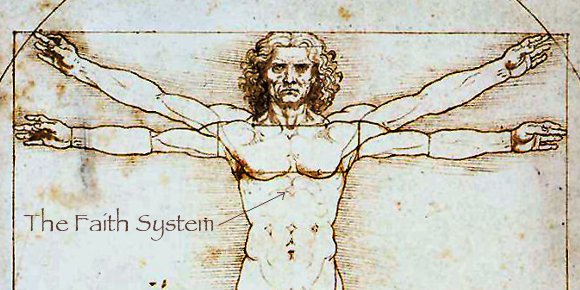
VitruvianMan(featured)Because of this difficulty, I’d like to invite you to imagine with me a reality that we don’t often think about. When God created animals, God gave us all sorts of biological systems that allow us to live. The respiratory system lets us breath, the circulatory system cycles our blood through our bodies, the digestive system turns food into nutrients. There’s the nervous system, the endocrine system, the lymphatic system and so on. But we were made in God’s image and likeness, which means we have one more system that other animals don’t have. We have a spiritual one to go along with all our biological ones. We have a faith system.


The faith system works a lot like our muscular system. We all have muscles (yes, even scrawny guys like me). We need our muscles to do simple tasks like getting out of bed, standing up, even smiling. We also need our muscles to do more difficult tasks like running a marathon or lugging a couch to a third floor walkup. Exercising hones and strengthens our muscles, making them more durable and less likely to fatigue. But whether we exercise or not, our muscles still put in work day in and day out.

So, too, with our faith system. The faith system spurs us to seek out life-affirming relationships, to support one another in our daily walks with God, to reach out to those in need, to welcome anyone into our midst, and to share with them the good news of God’s love. The faith system also sustains us through dry, desolate periods, giving us enough endurance not to give up quite yet. Like our muscles, our faith can get weary and fatigued. But also like our muscles, we can exercise our faith to hone and strengthen it, to make it more a part of our actions and less a thing sitting on the shelf in the kitchen cupboard.

If we’re going to exercise our faith, then we should figure out exactly what we mean when we say the word. We’ve already said how faith is a noun that should be a verb. Faith then is the action that happens when we participate in our relationships with God. Faith borrows the best parts of trust, confidence, and humility and molds them into our response to God’s presence in our lives. From trust, our faith borrows the willingness to give ourselves over to the power of another. From confidence, our faith borrows the courage to take the leap into God’s waiting arms. And from humility, our faith borrows the recognition that God (and not we ourselves) initiates the action that results in the giving ourselves up to God.

In today’s Gospel lesson, the Roman centurion actively engages his faith system. He trusts that Jesus can help him. He has courage actually to do something about that trust. And he shows his humility when he sends friends to Jesus to tell him he need not come all the way to the house to heal the slave. The centurion displays such strong faith that even Jesus is amazed. But no matter how strong or how weak our faith is, we each have a faith system that God gave us so we would be able to join God in relationship. The more we exercise our faith system – the more we act out our faith – the deeper can we go in our relationships with God.

Imagine if we exercised our faith in the same way we exercise our muscles. Going to the gym once doesn’t do much, but going every other day can work wonders on our bodies. God yearns for us to have this kind of dedication to our lives of faith. When we are serious about exercising our faith systems, we build time into every day to be in prayer with God. We start with faith and allow it to motivate all our other actions. We take part in the act of worship, both on Sunday mornings and in the moments of our days when our faith shows us special signs of God’s presence that our eyes alone might not see.

I invite you today to remember that faith is a noun but should be a verb. Faith is not a commodity or a possession. Faith is the active component of our relationships with God. God loves us and we love God. What could be better than cultivating that love everyday? What could be better than exercising our faith system so that we resonate deeper and deeper with God’s movement in our lives?

Do You Love Me?

(NOTE: I completely forgot to post my sermon on Sunday, so here it is, two days belated. Devo180 will be back tomorrow.)

(Sermon for Sunday, April 14, 2013 || Easter 3C || John 21:1-19)

I can only imagine the maelstrom of thoughts roiling in Simon Peter’s head in the weeks following Jesus’ resurrection. At the last supper, he promised Jesus: “I will lay down my life for you.” He was willing to draw blood when they came to arrest Jesus in the garden. He followed Jesus all the way to the gate of the high priest’s house. And then everything fell apart. People began recognizing him and he felt afraid and in his fear he did something he never dreamed he would do, not even in his worst nightmare.

But this was worse than his worst nightmare. “Aren’t you one of his disciples?” I am not. “Didn’t I see you in the garden with him?” No. “You are one of his disciples.” I am not. And at that moment the rooster crowed, signaling the dawn. But Simon Peter remained in the night with his denial – afraid, ashamed, broken. The nickname Simon received from Jesus when they first met – the nickname Peter, “Rock” – must have haunted him from that moment on. How could a rock be so inconstant? He was supposed to be steadfast, strong; but in the moment of decision, he crumbled. As I said, I can only imagine the maelstrom of thoughts roiling in Simon Peter’s head in the weeks following Jesus’ resurrection.

So to quiet the storm raging within, even for just a short time, it makes sense for Peter to suggest a fishing trip – something normal to take his mind off things. He and his friends fish all night but catch nothing. Even though Peter has met the Risen Christ, Peter himself is still shackled to the night, where his shame and fear have kept him since his denial. No wonder he didn’t catch any fish. But then day breaks, and Jesus calls to him from the beach. He and his friends let down the net one more time and catch more fish than they know what to do with.

They bring the catch ashore and have breakfast around a charcoal fire with Jesus. Peter gazes into the flames, and suddenly his maelstrom of thoughts transports him back to another charcoal fire, around which he warmed himself – and denied his Lord. He is still lost in the night of his regret, his fear, and his brokenness. Though a new dawn has come, Peter cannot bring himself to step into the light. He sits around the fire with Jesus and the rest, but he himself is far away, reliving the nightmare.

And so when Jesus says his name, Simon Peter flinches out of his daydream and returns to the present. “Do you love me?” Jesus asks him. Yes, Lord, you know that I love you. “Do you love me?” Yes, Lord, you know that I love you. “Do you love me?” And with the third question, a wave of sadness washes over Simon Peter because he realizes what Jesus is doing. The sadness is the echo of the nightmare, the last vestige of the darkness Peter has been mired in. Lord, you know everything (including my shame and my guilt and my brokenness); and you know that I love you.

Jesus gives Peter the opportunity to affirm their relationship three times, once for each denial; and with that, they are reconciled. Peter’s love for his Lord trumps his fear and his brokenness, and he finally steps from the night into the day. This reconciliation shines with the good news of the resurrection. The Risen Christ meets Peter in his brokenness and reaffirms their relationship. The Risen Christ meets us in the same place – in our fear and our brokenness – and affirms that nothing in all creation, not even death, can separate us from his love.

sheepBut Jesus is only half done with Peter and with us, because Jesus takes this reconciliation one step further. Jesus doesn’t just heal Peter’s brokenness and leave it at that. If he had, then Peter would have no direction to travel, nowhere to bring his healed heart. So Jesus renews their relationship and then gives Peter a mission. “Do you love me?” Yes, Lord, you know that I love you. “Feed my lambs… Tend my sheep… Feed my sheep.”

Jesus knows that Peter, despite his nickname, has shown inconstancy in the past. Jesus knows that Peter once crumbled because of fear. Jesus knows that Peter isn’t perfect. And still, Jesus affirms their relationship, binds himself to Peter in love, and gives him a mission. The Risen Christ gathers to himself all of Peter’s fear and brokenness and says, “This stuff will not hold you back from doing my work. This stuff may rear its head from time to time, but it will not win. This stuff is now mine, and in its place you can have my love and the promise of eternal relationship with me.”

Sounds like a pretty good deal. Imagine someone coming up to you and saying, “You give me all your junk, everything about yourself that you don’t like or you don’t want, and I’ll give you the most precious thing in the world.”

That’s what Jesus did on the beach with Peter after breakfast. And in the power of the resurrection, that’s what Jesus does with each of us. And after we make such an unbalanced trade, Jesus invites us to join him in a mission. Feed. Tend. Listen. Support. Help. Love. Serve.

If we listen for the Risen Christ’s call in our lives, we will each hear something a little different because Jesus knows what sets each of our hearts on fire. And Jesus knows where the world most needs us to serve. He combines the two and then sails these unique calls to us on the wind of the Holy Spirit. And if we listen for that wind whispering in our hearts, we will hear the call. Peter heard the call to feed God’s sheep. I hear the call to proclaim God’s presence in our lives. What do you hear? What is Jesus healing you to do?

In our story today, Jesus heals Peter with love. This love propels Peter into service. And this service brings healing to all of God’s people. And thus the cycle renews. On down through the ages, God has propelled this cycle of healing, loving, and serving. Now we are the inheritors of the legacy of this chat on the beach after breakfast. The Risen Christ sits with us across our kitchen counters after a bowl of oatmeal – the most ordinary of moments, mind you – and offers us his love, his healing, and his mission.

“Do you love me?” Yes, Lord, you know that I love you. Then notice me healing your brokenness.

“Do you love me?” Yes, Lord, you know that I love you. Then feel my love binding us together.

“Do you love me?” Yes, Lord, you know that I love you. Then go out and serve in my name.

With My Arms Spread Wide

(Sermon for Sunday, February 24, 2013 || Lent 2C || Luke 13:31-35)

(Most sermons are better if you listen to them rather than read them. This one is especially so.)

Imagine with me a letter written by Simon the Pharisee some years after the events described in this morning’s Gospel reading.

henSimon, a servant of the Lord God, to Judith, my dearest sister and confidant: Peace to you and your house.

I know it’s an inside joke between us that I only write to you when I am vexed or need to process something, but in this case, I write with a more urgent need. Yesterday in the marketplace something happened that has shaken me to my bones. Not only that, but after all these years, this event has caused me to let go of a secret I had been holding onto so very tightly. I need to tell you the truth about myself before you hear others slander me. I hope after you read these words you do not think less of me; rather, I hope you might consider joining me in my new-found freedom. But I get ahead of myself.

Here’s what happened. I was walking with my colleagues, Eli and Reuben, when we witnessed a strange scene. A small boy, no bigger than your grandson, snatched a loaf of bread off a baker’s cart. The boy must have been on his last legs because as soon he turned to run away, he dropped to his knees, nearly fainting. The baker had the boy by the arm when a woman picked up the loaf of bread and handed it back to the hungry child, saying, “Go and eat your fill, young one, and may the blessing of the Lord Jesus Christ be upon you.”

Then she reached into her purse to pay the baker for the bread. But before she could pull out a coin, Eli and Reuben rounded on her. I’ve never known them to be the most zealous persecutors of the followers of the Way, but something about this exchange riled them up. They dragged the woman to the ground, hollering the whole time about her blasphemy. Her trial, conviction, and sentence were the work of a moment, and before I knew what was happening, Eli had a chunk of rock in his hand ready to throw.

I didn’t plan to do it. I didn’t mean to do it. But in the instant after I realized what Eli was about to do, I found myself standing between him and the woman, arms wide, protecting her with my body. It was too late for Eli to stop, and I took the impact of the stone on my left shoulder. “If you’re going to stone her,” I yelled at them, “then you’ll have to stone me, too.”

What I’m trying to tell you, dear sister, is that, for these long years, I have been a follower of the Way of Jesus Christ. But until yesterday, my fear of being disowned by everyone I know convinced me to hold tightly to the secret. Now that my true devotion lies unmasked, I feel suddenly free to share my story with you – and not just free, but full of joy.

You see, you never know on what day your life will change. If you did, then you might be more prepared. You might wear a clean shirt or wash your face beforehand. The day my life started to change was a day similar to yesterday. I was out in the marketplace with a couple of colleagues. Jesus and his disciples were making a scene: throngs of people were clamoring for his attention, and talk of miraculous healing was in the air. You might recall I had met Jesus previously when he came to dinner at my house. That first meeting troubled me because he was so different than the country bumpkin I expected. This second meeting replaced my uneasiness with the seeds of new conviction.

At the time, we Pharisees were tired of Jesus upsetting the apple cart. He had been in our region quite long enough, and we wanted him gone. So we concocted a story about Herod wanting to kill him. The tale seemed plausible enough; after all, Herod had beheaded Jesus’ cousin John and then just continued on eating his dinner. Perhaps Herod did want Jesus dead. Either way, that’s what we told him. And I was completely unprepared for his response. Maybe he was calling our bluff. Or maybe he had no fear for his own life. He told us his plans – and they did not involve fleeing – and then told us to go tell Herod.

But his bravery wasn’t what enthralled me. It was what he said next. A haunted look played across his face as he lamented Jerusalem. I’ll never forget what he said: “How often have I desired to gather your children together as a hen gathers her brood under her wings, and you were not willing.”

Before I could arrange my face into the shocked expression appropriate for a Pharisee, my heart commandeered my body. It was the strangest sensation. Something deep inside me fluttered at his words, like one of the chicks in the hen’s brood. The fluttering stirred up three words that echoed in my depths. “I am willing.”

From that day on, I kept track of Jesus. My three words – “I am willing” – played over and over again in my mind. But I didn’t make the leap yet because I couldn’t chase his image of the hen and her brood out of my mind. What an odd animal to identify with. Why not something bigger? Something with teeth and claws. Something worthy of his fearlessness. Why a defenseless hen? A chicken, for God’s sake?

Later that year, I got my answer. I watched as he was crucified. I heard the dull thud of the hammer striking the nails. He was raised up on the cross, chest bared, arms wide. And as I watched and wept, all I could see was that mother hen, defenseless, spreading her wings wide to protect her brood, giving her life for theirs.

I was his from that moment on. I believe that he rose again and that his Spirit is with us to help us live a life full of God his Father. It feels good to write that down. Dear sister, it has taken me all these years to say it, but the words are there on the page now, never to be erased.

I might have said “I am willing” on that day of our second meeting, but as they say, the spirit is willing, but the flesh is weak. So what made me abandon my well-worn lie yesterday? I had gotten comfortable living as his secret follower, even though I knew that meant I was cutting myself off from so much of what being his follower means. Something about the events yesterday brought to my mind the image that so haunted me.

Eli raised the rock, ready to strike the woman who had helped the little boy, and I found myself getting in the way. If I had had time for rational thought, I doubt I would have done it. Perhaps my long years as Jesus’ secret follower finally spurred me to action. My brain didn’t have time to get in the way, so my heart interceded. And since my heart belongs to Jesus Christ, he propelled me to take a risk, to take a chance, secure in the knowledge that I am always and forever standing under the shadow of his wing. In that moment, I knew Christ was alive in me. He used me as the mother hen, defenseless, chest bared, arms wide, ready to absorb the blow. If I hadn’t known I was secure under his wing, I wouldn’t have had the strength to protect someone under mine.

And so this is my prayer for all my days hence: Lord Jesus Christ, sustain my faith so I can be vulnerable. Be my sheltering wing so I can take risks. Help me spread my arms wide as you did on the cross so I can fully and truly embrace others with your love.

My sister, I bare my heart to you in this letter not to convince you to become a follower of the Way like I am, nor to make you worry for my safety. I have written these words simply because I am not afraid anymore. Jesus Christ is alive in me. Therefore, I am resolved to live my life under the shadow of his wings, with my arms spread wide.

* Special thanks to Barbara Brown Taylor for her words about this passage found here. They unlocked this sermon for me.

The Overstuffed Life

(Sermon for Sunday, October 14, 2012 || Proper 23B || Mark 10:17-31)

During my time in college and seminary, I spent seven years living in dorms. Over that time, I lived in five different dorm rooms, and you know what? They all came with a bed and a dresser and an end table and a desk. The beds weren’t always long enough for my six-foot frame and one of the dressers had several sticky drawers, but those were minor complaints. For the most part, I loved living on campus. And the best part about living in a dorm was that I could fit everything I owned – everything – in my car. At the end of the school year, I could pile all of my stuff into my 1992 Mazda Protégé and just drive away.

Then, after seminary, I moved into a rented townhouse in West Virginia. There was no bed, no dresser, no end table, and no desk. So my dad and I drove a borrowed Chevy Suburban to an IKEA near Baltimore and came back with the SUV full of cheap furniture (some assembly required). Gone were the days when I could just throw all my stuff in the back of the car and drive away. I now owned enough stuff that when I moved here to Massachusetts, I had to rent a 14-foot U-Haul.


Then, Leah and I got married, and all of a sudden our apartment had my stuff and her stuff and our stuff. As I sat in the living room pondering this sermon, I looked around and made a mental note of what size U-Haul we would need the next time we move. Let’s just say it’s much bigger than 14 feet.

Reading this morning’s Gospel, I get a bit wistful for the time when I could pile all my stuff in a subcompact car. Now that I have a Subaru Forester, I bet I could fit all of my college-aged stuff and all of Leah’s college-aged stuff in the roomy SUV, though the cello might need to go on the roof rack. And then we could just drive away. We’d be unburdened by everything we have accumulated since: the piano, the couch, the TV, the dining room table, the chairs, the queen-sized bed, the full-sized bed, the bicycles, the bookcases, the books, the DVDs, the dishes…the Kitchen-Aid. (Well, maybe I could find a space in the Forester for the Kitchen-Aid, since Leah makes a mean apple pie.)

I read this morning’s Gospel, and thoughts of such a free lifestyle, unburdened by all that extraneous stuff sounds so appealing. But, of course, whenever I envision such a life, I’m romanticizing it. As I finish mentally storing the essentials in the back of the Forester, I remember that plenty of people live with just the essentials – or not even them – and they don’t have the option to live comfortably in a one-bedroom loft in an apartment community in Weymouth.

I’ve met many such folks at the Long Island Homeless Shelter. With many of you, I’ve served them chicken parmesan and ice cream. I’ve sat there listening for the handful of Spanish words I know while Deb Viscomi carries on with a group of laughing gentleman. I know a young couple – probably about mine and Leah’s age – who do live out of their car. Whenever I see them, their faces always show a potent mix of hope and desperation that breaks my heart. And confronted with their reality, I feel chastened that I could ever romanticize the notion of throwing all our stuff in the car and just driving away.

So you can see my confusion (a confusion that I’d be willing to bet you share) when we read Jesus’ words to the rich man in today’s lesson. The man wants to know how he can inherit eternal life. He says that he has kept all the commandments since his youth. Then Mark’s Gospel tells us: “Jesus, looking at him, loved him and said, ‘You lack one thing; go, sell what you own, and give the money to the poor, and you will have treasure in heaven; then come, follow me.’ When he heard this, he was shocked and went away grieving, for he had many possessions.”

The standard confusion with this story that trips many of us up is the logical progression that would lead this man to sell all of his possessions, give the money to the poor, and then end up being in poverty himself, thus adding to the overarching problem. That’s where I’ve been stuck for a long time, hence the first half of this sermon being about me wondering if I could every truly do this radical thing that Jesus proposes to this man. The trouble is I don’t want to water down Jesus’ words, and, at the same time, I don’t want to wind up down such a confusing logical progression.

So perhaps, I might ask for your charity to bend this story just a little bit, with the proviso that when I’m done I hopefully will have stayed true to an undiluted presentation of Jesus’ message.

The man’s ostensible reason for coming to Jesus is to learn what he must do to inherit eternal life. But Mark tells us that he kneels before Jesus, which is curious behavior. Throughout the rest of Mark’s Gospel, everyone who kneels before Jesus is seeking healing. So, could it be that this man, unbeknownst to himself, is looking to be healed of something?* Since he has kept all the commandments since his youth, his healing doesn’t have to do with obedience to the law. So Jesus gives him another diagnosis. “Your possessions are holding you back,” he seems to say. “You are up to your eyeballs in stuff; therefore, you cannot see the need surrounding you.” This man who kneels before Jesus, not seeking to be healed, but sure in need of healing, has the malady of an overstuffed life, a life cluttered to the extent that he cannot see what is truly important.

After getting rid of your possessions, Jesus continues to prescribe: give the money to the poor, then come and follow me. Here Jesus tells him and us the two things that the man isn’t doing because of his overstuffed life. He isn’t helping the poor (which was a cultural imperative in Israel from time immemorial) and he isn’t following Jesus.

When Jesus heals the blind men in passages before and after this one, he restores their sight with a touch and a word. But to heal an overstuffed life, Jesus can only give the man the prescription to let go of the things that distract him from what really matters. The man can respond positively or negatively. Jesus loves him either way, which is a point that Mark states quite clearly. The man in the story goes away, “shocked and grieving, for he had many possessions.” We can only hope that over time, Jesus’ prescription nestled into his soul and he found his way back to the one who loves him.

When I think of all the stuff cluttering up my life, all the stuff that has no hope of ever fitting in my car so I can just drive away, I wonder hard just what my material possessions are doing to my spiritual life. How often do I abandon Jesus, shocked and grieving, because I am too tethered to my stuff to remember why following him is the most important part of my life? How often do I need to kneel before Jesus to be healed of an overstuffed life?

As we approach the weeks in which our stewardship team asks us to pledge our time, talent, and treasure for the coming year, I invite you to sit in your living room and imagine just how big a U-Haul you would need to fit all of your stuff. Pray about the ways in which your material wealth serves as a barrier to your spiritual health. Kneel before Christ and asked to be healed if you feel your life is overstuffed. And take joyful notice that the abundance in your life has less to do with your material goods and ever so much more to do with the relationships you cherish, the service you render, and the God who loves you no matter what.

* Thanks to David Lose, whose discussion of this passage brought the healing nature of the story to my study.

Letting Go of the Grail

(Sermon for Sunday, September 30, 2012 || Proper 21B || Mark 9:38-50 )

Indiana Jones and the Last Crusade (Paramount, 1989)

The floor of the ancient structure splits open, revealing a gaping chasm. Nazi sympathizer Elsa, the treacherous blonde bombshell, who earlier in the film skewers the heart of our hero Indiana Jones, falls in, only to be caught at the last second by Indy. But he has a dubious grip on her gloved hand and, over the next tenuous seconds, his grip starts slipping. If only she would reach up with her other hand. But no. The Holy Grail has also fallen into the chasm and is even now perched on a ledge mere inches from Elsa’s reach. “I can’t hold you,” shouts Indy. “Give me your other hand!”

“I can reach it,” she screams back, all the while groping for the cup. “Give me your other hand,” Indy shouts again. Another pulse-pounding moment flies by, punctuated by the an eerie silence in the glorious John Williams score. Elsa reaches a final time for the Grail. And then she’s gone. She falls, screaming as she goes, and vanishes into the mist that obscures the endlessness of the chasm.

Indy stares after her, but he has only a moment to grieve because the floor buckles again, and Indy finds himself thrown into the chasm. His father, Henry, slides across the floor just in time to catch Indy’s hand, but his grip is just as dubious as Indy’s had been moments before. Of course, the Grail is still perched on the ledge. Indy has longer arms than Elsa. “I can get it. I can almost reach it,” says Indy.

Then Henry, who has spent his entire life chasing the legend of the Grail, calls his son’s name: “Indiana,” he says, and then again with more gravity, as only Sean Connery can. “Indiana.” Indy looks up and their eyes lock. “Let it go,” says Henry, “Let it go.” Indy doesn’t give the Grail another look, but instead flings his arm up. Henry grasps both of Indy’s hands in a tight grip, and a moment later they are running from the ancient structure, soon to ride off into the sunset.

This scene from Indiana Jones and the Last Crusade flawlessly illustrates what Jesus is trying to tell his disciples in today’s Gospel lesson. Now, every commentary I read about the passage made sure to note just how harsh Jesus sounds in all the talk about cutting off body parts and going to hell, so I’d bet that my reading of Jesus’ words a minute ago made us all a bit squeamish.

And for good reason. I think Jesus is going for far more than squeamish. His disciples have demonstrated time and again that they just can’t grasp the kind of life that Jesus is trying to teach them to live. As their utter thickness becomes more apparent, Jesus gropes for more and more outlandish imagery in an attempt to reach them.

Jesus has tried telling them point blank what’s going to happen. He has tried the object lesson of putting a child among them. He has even been transfigured into a dazzling being. And yet the disciples still try to dissuade Jesus from his chosen path, they try to figure out which of them is the best, and they try to stop someone not in their group from doing Jesus’ work. Finally, Jesus has had enough. “Listen up,” he says. “If your hand causes you to stumble, cut it off; it is better for you to enter life maimed than to have two hands and to go to hell, to the unquenchable fire.”

Here’s another way to read this same verse: “If your hand causes you to separate yourself from God, then separate yourself from your hand instead. If your goal is to live the kind of abundant life that God yearns for you to live, then you would be better off having only one hand than to have two and wind up in the refuse dump, where they burn trash all day long.”

Jesus reiterates the same point using feet and eyes, and I imagine the disciples stand there dumbfounded and maybe a little sick to their stomachs. But perhaps Jesus’ point has finally hit home. There are so many things in our lives that we cling to, which impede us from living the kind of abundant life that God yearns for us to live. Therefore, we have a choice. We can choose the impediment, as Elsa does in the movie when she reaches and reaches for the Grail, only to fall to her death. Or we can cut ourselves off from the impediment, as Indiana Jones does when he ignores the Grail in favor his father’s strong grasp.

Jesus makes his point in a visceral, ugly way, but that seems to be the only way his disciples will hear him. The severed hand and foot and the torn out eye are parts of ourselves that seem integral, but you know what? Life can go on without them. Of course, Jesus only uses these bodily features to make his point. Physical body parts are not what cause us to separate ourselves from God. So the question is: what does? What about our choices or our actions or our way of looking at the world does separate us from God? What part of ourselves do we continually and erroneously reach for, even when our grip on God is failing?

I can’t answer these questions for you. I can only answer them for myself. And there are so many things that I should amputate from my life in order to participate more fully in my relationship with God. My anxiety is one – I know I should trust God enough to let go of my fears for the future and my stress for today, but I’m so used to feeling anxious that I tell myself I don’t know what would happen if I asked God finally to sever anxiety from my life. To tell you the truth, I do know what would happen. I’d find a more abundant, more peaceful life. So why do I keep reaching for the Grail of anxiety? Because I always have, and the inertial force of complacency is a strong foe.

Anxiety is one. Pride is another old standby. Apathy. The craving for security, which leads to chances never being taken. Perhaps the thing that Jesus calls you to amputate is on my list, or perhaps your list is full of other cancerous impediments that would best be excised like tumors rather than clung to like pieces of wreckage in a storm-tossed sea.

Jesus’ strong, visceral language in today’s passage is a wake-up call to the disciples and to us that the barriers we erect between us and God do nothing but hurt us and keep us from living the kind of abundant life that God yearns for all people to live. The good news is this. As we continue to reach for our favorite impediment, for our Grail perching so tantalizingly on the ledge just out of reach, God is clinging to our other hand, clinging with a grasp that will never slip. And God is whispering, “Let it go. Let it go.”

Digital Disciple Chapter 3: Remote Intimacy

Here’s the third in a six part video series produced to accompany the book Digital Disciple. This video series is designed to be used in a class setting to introduce the material and spur discussion. Of course, watching it by yourself is fine too!

Don’t forget to head over to the Facebook page and participate in a little quiz about this video. In a few days, we’ll pick a random winner from those who participate. The winner will receive an autographed copy of the book, the DVD, and a Doctor Who t-shirt like the one Adam wore in the video! It could be you!

Digital Disciple Chapter 2: From Connection to Communion

Here’s the second in a six part video series produced to accompany the book Digital Disciple. This video series is designed to be used in a class setting to introduce the material and spur discussion. Of course, watching it by yourself is fine too!

Don’t forget to head over to the Facebook page and participate in a little game about this video. In a few days, we’ll pick a random winner from the first 23 players. The winner will receive an autographed copy of the book, the DVD, and a Battlestar Galactica t-shirt like the one Adam wore in the video! It could be you!

Digital Disciple Chapter 1: Virtual People

Here’s the first in a six part video series produced to accompany the book Digital Disciple. This video series is designed to be used in a class setting to introduce the material and spur discussion. Of course, watching it by yourself is fine too!

Don’t forget to head over to the Facebook page and participate in the quiz about the video. In a few days, we’ll draw from the correct answers a random winner. The winner will receive an autographed copy of the book, the DVD, and the Blue Sun T-shirt (from Joss Whedon’s Firefly) that Adam wore in the video (well, not that specific shirt, but a similar one that’s brand new!) It could be you!

Digital Disciple Preview: Virtual People (part 2 of 3)

Digital Disciple will be on the physical bookstore shelf and the virtual website shelf on May 1. You can pre-order it here. Here’s the second part of a three part preview that can also be found on my Facebook page and on Episcopal Cafe.com.

* * *

As I view the intersections between connection and isolation, Tech culture and following Jesus, you should know that I make my observations from the perspective of a member of the first generation that has never known a world without the Internet. I’m a Millennial, one of the vanguard of the generation whose first members were born in 1982. As one of the eldest of the Millennials, I remember artifacts such as Prodigy and CompuServe, which lost the evolutionary battle to AOL. I remember when Napster was new and innovative and not at all threatening to the music industry. I remember when e-mail caught the attention of spellcheck.

But I don’t remember a time before http and www were more than just letters. I don’t remember my father owning a computer without a port for a phone cord. Ask younger members of the generation, and they won’t even realize that computers came with phone ports rather than Ethernet ones. My first cell phone was for emergencies only because it had a paltry fifteen minutes a month. (Don’t tell my dad, but most of my emergencies were of the pizza-ordering variety.) Younger Millennials have had cell phones since they were in elementary school. But from the eldest of us who remember the cretaceous period of dial-up to the youngest who were born with Bluetooth implants, we Millennials are dependent on the Tech, on all the gadgets and machines and Series of Tubes that connect us one to another and each to the world.

It's only a short leap from walking around with your bluetooth in your ear all day to the Borg. But they're still in the Delta quadrant, so we're safe for a couple hundred more years, right?

Of course, Millennials aren’t the only ones affected by the rise of the Internet and associated Tech. GenXers, Boomers, and computer-savvy older people like my grandmother feel the strong current of the Internet pulling them online just as much. As a Millennial, I have felt this current pulling me since I could reach the keyboard. As a follower of Christ, I feel God moving in both my virtual and my real lives. Knowing that these dual influences are neither mutually exclusive nor entirely compatible gives rise to a series of questions.

How do the Tech’s simultaneous forces of connection and isolation affect our walks with Christ? How does living in a virtual world influence living in both the physical and the spiritual ones? How do we maintain the body of Christ when the physical bodies we see and touch in church expand to include the virtual bodies we inhabit online? What place does prayer have in our instantaneous, Tech-driven world? Where do we keep our knowledge of God when our preferred method of storing information has shifted to the external? How do we resist isolation while remaining plugged into the Series of Tubes?

Now, I can speak only from my own experience. But I know that we humans are ineffective at arriving at the truth on our own, so I hope and pray that you will interact with my experience to delve more deeply into the truth revealed in Jesus Christ. Each of us has a call from God, each a ministry. Within each of the questions above, we find this fundamental one: How do we continue in the tradition of the personal nature of the ministry of Jesus in lives that are increasingly siphoned off into remote, disembodied, virtual space? I invite you to explore this question with me.

But first, you might be wondering why you should take what I say seriously. Who am I to write this book? Well, I claim neither special revelation from the Almighty nor a mandate from my generation. I’m just another disciple of Jesus Christ who has a few words to share with you. I endeavor to follow Christ wherever he leads me, but increasingly I find myself walking along the data streams and fiber-optic paths of the virtual world. Is it possible that Jesus might find me and I might find him on those virtual paths? Is it possible that God can use the Tech to create better followers of Jesus Christ? I am convinced that the answer is a resounding yes, but a yes stamped with a necessary warning label. Our Tech-driven world is changing rapidly, and we are changing with it. Unlike the great cloud of Christian witnesses that has preceded us, we’re not simply earthbound, pavement-pounding disciples of Jesus Christ. The Tech has added a new dimension to our lives; we are physical, emotional, spiritual, and now virtual people. But I believe that God continues to move through every facet of our existence, and that makes us new kinds of followers. We are digital disciples.