Digital Disciple Preview: Virtual People (part 2 of 3)

Digital Disciple will be on the physical bookstore shelf and the virtual website shelf on May 1. You can pre-order it here. Here’s the second part of a three part preview that can also be found on my Facebook page and on Episcopal Cafe.com.

* * *

As I view the intersections between connection and isolation, Tech culture and following Jesus, you should know that I make my observations from the perspective of a member of the first generation that has never known a world without the Internet. I’m a Millennial, one of the vanguard of the generation whose first members were born in 1982. As one of the eldest of the Millennials, I remember artifacts such as Prodigy and CompuServe, which lost the evolutionary battle to AOL. I remember when Napster was new and innovative and not at all threatening to the music industry. I remember when e-mail caught the attention of spellcheck.

But I don’t remember a time before http and www were more than just letters. I don’t remember my father owning a computer without a port for a phone cord. Ask younger members of the generation, and they won’t even realize that computers came with phone ports rather than Ethernet ones. My first cell phone was for emergencies only because it had a paltry fifteen minutes a month. (Don’t tell my dad, but most of my emergencies were of the pizza-ordering variety.) Younger Millennials have had cell phones since they were in elementary school. But from the eldest of us who remember the cretaceous period of dial-up to the youngest who were born with Bluetooth implants, we Millennials are dependent on the Tech, on all the gadgets and machines and Series of Tubes that connect us one to another and each to the world.

It's only a short leap from walking around with your bluetooth in your ear all day to the Borg. But they're still in the Delta quadrant, so we're safe for a couple hundred more years, right?

Of course, Millennials aren’t the only ones affected by the rise of the Internet and associated Tech. GenXers, Boomers, and computer-savvy older people like my grandmother feel the strong current of the Internet pulling them online just as much. As a Millennial, I have felt this current pulling me since I could reach the keyboard. As a follower of Christ, I feel God moving in both my virtual and my real lives. Knowing that these dual influences are neither mutually exclusive nor entirely compatible gives rise to a series of questions.

How do the Tech’s simultaneous forces of connection and isolation affect our walks with Christ? How does living in a virtual world influence living in both the physical and the spiritual ones? How do we maintain the body of Christ when the physical bodies we see and touch in church expand to include the virtual bodies we inhabit online? What place does prayer have in our instantaneous, Tech-driven world? Where do we keep our knowledge of God when our preferred method of storing information has shifted to the external? How do we resist isolation while remaining plugged into the Series of Tubes?

Now, I can speak only from my own experience. But I know that we humans are ineffective at arriving at the truth on our own, so I hope and pray that you will interact with my experience to delve more deeply into the truth revealed in Jesus Christ. Each of us has a call from God, each a ministry. Within each of the questions above, we find this fundamental one: How do we continue in the tradition of the personal nature of the ministry of Jesus in lives that are increasingly siphoned off into remote, disembodied, virtual space? I invite you to explore this question with me.

But first, you might be wondering why you should take what I say seriously. Who am I to write this book? Well, I claim neither special revelation from the Almighty nor a mandate from my generation. I’m just another disciple of Jesus Christ who has a few words to share with you. I endeavor to follow Christ wherever he leads me, but increasingly I find myself walking along the data streams and fiber-optic paths of the virtual world. Is it possible that Jesus might find me and I might find him on those virtual paths? Is it possible that God can use the Tech to create better followers of Jesus Christ? I am convinced that the answer is a resounding yes, but a yes stamped with a necessary warning label. Our Tech-driven world is changing rapidly, and we are changing with it. Unlike the great cloud of Christian witnesses that has preceded us, we’re not simply earthbound, pavement-pounding disciples of Jesus Christ. The Tech has added a new dimension to our lives; we are physical, emotional, spiritual, and now virtual people. But I believe that God continues to move through every facet of our existence, and that makes us new kinds of followers. We are digital disciples.

Digital Disciple Preview: Virtual People (part 1 of 3)

Digital Disciple will be on the physical bookstore shelf and the virtual website shelf on May 1. You can pre-order it here. Here’s the first part of a three part preview that can also be found on my Facebook page and on Episcopal Cafe.com.

* * *

We call it an Internet “connection.” On any given day, I know that an acquaintance from high school just had a baby shower. I know that an old college friend chose the strappy sandals. I know who had one too many at a party last night. Through my keyboard, LED monitor, wireless router, and ISP, I’m connected to several layers of people—my close friends, my acquaintances, strangers with similar interests, and the hordes of people with spelling so dreadful it would make Noah Webster weep.

Doesn't Noah Webster look sad?

But we could just as easily call it an Internet “isolation.” While millions of little connections happen every day—from friends and relatives to subcultures and fan bases—these connections always happen remotely. I can see and hear people thousands of miles away using the warm box on my lap. But I can’t touch using Facebook. I can’t taste a friend’s tweets. And I sure can’t smell a Wikipedia entry. My senses are reduced by 60 percent. I have a contacts list on my Gmail account, but I rarely make contact. A wall of technology isolates me from you, and the more we use the Tech, the more comfortable we feel hiding behind it. We develop a dependence on what can only be described oxymoronically as remote intimacy.

Yes, we are connected, but more often than not we connect remotely. Yes, I may know your favorite bands and books, but I may never know the timbre of your voice or how heavy your footfalls are. Yes, community forms on the Internet, but how can you share a meal or look someone in the eye via an online forum?

I make the observations found in this book from a vantage point overlooking a pair of intersections. The first intersection occurs where the opposing forces of connection and isolation meet. These two forces have been around since the Garden of Eden, but never have they been as coupled as the Internet makes them. The second intersection occurs at the junction between Tech culture and the greater reality of following Jesus Christ our Lord.

Following Jesus Christ is first and foremost about connection, about the arms of love reaching from the cross to embrace everyone. The Word became flesh in Jesus Christ in order that we might see more clearly the connection that God yearns for us to have with one another and with God. The Internet offers wonderful opportunities for connection, but they always come attached with the danger of isolation. Like most things in this life, we can’t separate the danger from the opportunity; we can only hope to trend toward the opportunity while trying not to ignore the nature of the danger.

As the Internet continues to change the way we communicate and connect with one another, the opportunities and dangers grow increasingly intertwined. The trouble is that the speed of innovation has kept us from pausing, breathing deeply, and taking a hard look at technology’s effects on our lives. Consider that a hundred years ago, people dashed and dotted with the telegraph and wrote long correspondences in perfect cursive. Seventy-five years ago, they shared a phone line with half a dozen neighbors and sat in front of the radio in the evening. Fifty years ago, they had their own telephone numbers and televisions. Twenty-five years ago, mobile phones and personal computers had begun the big, boxy stage of their evolutions. Fifteen years ago, my computer spent an agonizing forty-five seconds doing a fuzzy R2-D2 impression while attempting to dial up a connection to the Internet. Ten years ago, my family got our hands on a shiny new piece of technology called a cable modem, and the connection tripled in speed. Today, broadband allows connections of ease and immediacy. The breadth and depth of content online have now matched the blazing download rate; indeed (and I’m saying this with only the slightest hyperbole), I could live my whole life virtually and never notice the lack of fresh air and exercise.

We communicate more quickly, more frequently, more globally (and often more anonymously) than ever before. The Internet, once a harebrained idea hatched in a military think tank, has pervaded our lives and our society. Removing it would be like amputating not an arm or a leg, but a central nervous system. I know I’m not alone when I confess that, while I don’t live my whole life virtually, I do almost everything online: shop, check baseball scores, read the news, watch TV, play games, chat with friends, research my sermons. I even met my wife through some combination of divine intervention and the Series of Tubes.

Cloudburst (Davies Tales #8)

Aidan Davies stepped onto the platform of South Station. He looked left, then right, then left again. The trickle of passengers disembarking the commuter rail train turned left, and Davies joined them. As he headed for the terminal, a drop of rain hit his nose. He quickened his pace, but the drop only brought along a few dozen companions. Davies looked up and frowned at the sky. The sun shone through the clouds’ ragged edges, gilding them with light but failing to penetrate the bulk of the cloud, which was becoming increasingly darker. It’s a good thing the subway stops at the hospital, Davies thought.

Today would be his third day in a row traveling into the city to Mass General. The accident had happened late Saturday evening, and he had arrived at the hospital bleary-eyed but alert early Sunday morning, wearing his clergy clothes and the “I’m supposed to be here” expression that he saved specifically for the ICU. The family had been on a nighttime sail when nine-year-old Janice stood up at the wrong time. The boom hit her full in the back of the head, knocking her simultaneously unconscious and overboard. The rescue chopper brought her straight to the hospital in Boston, leaving her stricken parents on Nantucket to await the ferry the next day. Janice was brought up to the ICU from the OR an hour before Davies arrived. A patch of her dark ringlets was cut away at the base of her skull, revealing a dozen hasty sutures. He held her hand gingerly so as not to disturb the IV until midmorning when her mother pelted into the room. Davies then melted into the background, feeling suddenly inadequate in the face of the mother’s frenzy.

Two days later, Janice was still unconscious in the ICU, and her mother had not left her bedside. The doctors had not used the word “coma” but Janice’s mother feared the worse. With her husband at the office for a few hours, that fear was her only companion until Davies arrived. Fat lot of good I’ve done the past two days, he chided himself. An unconscious girl is one thing. A desperate mother is something else. I wonder when she’ll figure out I have no idea what to do.

He checked his mobile phone. Plenty of time to get there, he thought. Just a few stops up the Red Line. He swiped his card, jogged down the stairs, and flung himself aboard an idling subway car. Perfect timing, he thought, beaming around at the passengers as if he had just landed the dismount. A few of his fellow travelers smirked at him, shook their heads, and looked away. Just then the PA system crackled to life, and the man next to him pointed in the general direction of the indistinct voice coming over the speaker: “Due to a fire at Charles/MGH station, the Red Line is delayed. We are sorry for the inconvenience.”

Chagrined by his train-catching heroics, Davies shared a shrug with the man, leaned nonchalantly against a pole, and called up a mental map of downtown Boston. MGH isn’t too far a walk from South Station, he told himself. Just through the Common and over Beacon Hill. He looked around at the waiting passengers and wondered how long the train had been stuck at South Station. Just then two young men, frat boys by the looks of their untidy hair and polo shirts half tucked in to display massive belt buckles, launched themselves into the car as Davies had done. He smirked at them, shook his head, and exited the car.

He walked back up the stairs into South Station. There’s a buck seventy I’ll never see again. He ordered a panini and ate it quickly as he walked out of the station onto Summer Street. Davies oriented himself toward the Common and trudged up the sidewalk, hands in his pockets and his laptop bag bouncing against his back. He looked up at the sky again and the amateur meteorologist in him told him he would have been better off with the train delay. The sky had darkened considerably while the Massachusetts Bay Transit Authority had been thwarting him below ground. Licking his fingers, he tossed the remains of his hurried lunch into a trashcan and strode toward a store a few blocks from the station.

Five minutes later Davies emerged with a new umbrella under one arm. It’ll never rain now, he thought triumphantly, assured that reverse psychology works quite well to influence colliding low-pressure systems. Davies licked his lips, suddenly thirsty from his sodium-laced sandwich. I wish I had bought a bottle of water at the store. “Too late now,” he said aloud to no one in particular. Just then, he walked past a van painted in violently neon shades of green and orange. Two college-aged women, wearing shorts and the kind of socks that basketball players wore in the 70s, stood at the rear of the van, each holding a case of violently neon sports drinks.

“Have you Thrust today?” one of them asked Davies as he walked by, and he could tell she enjoyed asking such a seemingly provocative question to a guy wearing a clerical collar.

“No, I can’t say I have,” Davies said.

“You should try it,” said the other, and she held out a bottle sporting the word Thrust in lightning bolt-shaped letters. The bottle was filled with a liquid that looked like it was distilled from traffic cones.

“Thanks.” Davies took the drink and continued up the street, trying to resist the urge to look over his shoulder at the nubile Thrust promoters. He chugged the neon fluid, hoping that it would quench his thirst before he noticed how awful it tasted. He crossed Tremont Street and entered Boston Common as he emptied the last drops of the traffic cone flavored beverage into his mouth. Then he heard the rain.

With the sound of a thousand car washes a solid sheet of water was approaching rapidly from across the Common. So much for tricking the weather, Davies thought. At least I have this handy thing. He opened the umbrella and hunched beneath it just as the deluge reached him. After a minute of slogging across the open green space, his trousers felt like they had just come out of the washing machine. Davies reached the far end of the Common and looked through the rain for the street his phone’s GPS had told him to take over Beacon Hill. He walked one block down the Hill hoping for a street sign. No such luck. This city, apparently attempting to stymie foreign military occupation, keeps signage to a minimum, he mused ruefully. Davies took the next right and walked fifty yards. This isn’t it, he thought, seeing the street terminate in a row of brownstones a couple blocks ahead. He turned to retrace his steps. Then the rain did the impossible and worsened.

With the same vigor he had used flinging himself into the subway car, Davies dove for the relative dryness of a sheltered doorway. He squeezed the excess water out of his pants, dried his glasses, and oriented himself. I am one street down too far. Davies waited out the worst of the rain hunkered down in the doorway. After ten torrential minutes, the sun blazed through the spent clouds, raising steam from the street. Davies left the shelter and continued his charge up Beacon Hill.

Taking a left on Cambridge Street, he walked the last few blocks to the hospital. The imposing complex of parking garages and mismatched hospital buildings rose up on his right. He stopped to cross the intersection at Cambridge and North Grove. The cars navigating Boston’s surface streets glistened after the downpour. There it is, he thought, storm clouds forming in his mind as they had done in the sky. Through the main doors, down the hall, up the elevator, around the ward, into the room. Davies shivered. I’m just cold from the rain, he told himself, though he knew it wasn’t true. What am I supposed to do? What am I supposed to say? I am so ill-equipped for this that it would be laughable if the situation weren’t so serious.

The traffic light changed and the walking person blinked across the road, telling him to cross. Davies stayed put. After half a minute, the light changed again, and a red hand replaced the person, warning pedestrians not to cross. Davies stared at the hand. He closed his eyes and the blurry afterimage of the warning signal danced across his eyelids. He took a deep breath and held it. The hand fixed itself in his mind, a symbol of something he told people everyday but often forgot to believe himself. The hand slowly dissolved into a voice in his head, his own voice but with deeper resonance and greater clarity. You were thirsty and I provided drink. You were drowning in the rain and I provided shelter. Do you honestly think that I will break this pattern when you enter that hospital room?

Davies exhaled slowly and opened his eyes. The red hand shone from the signal across the street. The voice echoed faintly in his mind. You are always in the palm of my hand. Yes, even you, Aidan. The hand changed back into the walking person, and Aidan Davies crossed the intersection. He pushed through the main doors of the hospital, strode down the hall, rode up the elevator, paced around the ward, and walked into the room.

Attempted Temptation

(Sermon for Sunday, March 13, 2011 || Lent 1, Year A  || Matthew 4:1-11)

At dinnertimes growing up, I was often accused of having “a hollow leg.” I kept piling mashed potatoes on my plate and polishing them off and by the time I was on my third helping, my grandmother would be commenting on the vacancy in my lower extremities. In eighth grade, I weighed all of 85 pounds soaking wet, and still, I could put away the food. It has to be going somewhere, my relations would say. “He must have a hollow leg.”

"Close Encounters of the Third Kind" (1977)

During my overly literal early years, this commentary on my anatomy confused me terribly. Both of my legs seemed full of bone, ligaments, and muscle tissue. How could I have a hollow leg? And even if I did, wouldn’t the appendage fill up with mashed potatoes over the course of a few meals? Over time, I learned about metaphor and imagery, so I stopped wondering about the mutant connection between my stomach and leg. Then sophomore year of high school and my growth spurt hit simultaneously. My already ravenous appetite doubled, and my mother began saying that I had not one, but two hollow legs.

Every day, I filled myself up with carbs and fruit and sweets and the odd vegetable. And the next day, I had to fill up again. My hollow legs got longer, which was a good thing, considering all the food I was packing into them. My metabolism was so high that I often found myself parked in front of the refrigerator half an hour after dinner looking for a post-prandial snack.

In our society, we consume as if we have not only hollow legs, but hollow arms and hollow torsos, not to mention, hollow heads. We fill ourselves up with fast food and fast cars, all the while buying stuff that we tell ourselves we need, but we really don’t. We fill ourselves up with anxiety over making sure our lives and livelihoods are secure, all the while ignoring the vast majority of people who will never have security. We fill ourselves up with the sensational, yet banal, details of the lives of the rich and famous, all the while daydreaming about what we would do if the paparazzi followed us into a restaurant.

We fill ourselves up by hoarding stuff, by worrying about our security, by coveting fame. We fill ourselves up until there’s no room left within us for anything that we ourselves didn’t squash in there, until there’s no room left within us for God.

In the Gospel reading this morning, the Holy Spirit leads Jesus into the wilderness immediately following his baptism. After more than a month in the wilderness, Jesus meets the devil. And the devil can’t pass up such a juicy opportunity for temptation.

“See that rock over there,” says the tempter. “I bet you could turn that rock into bread and fill yourself up.”

“See the ground way below,” says the tempter. “I bet you could jump and be secure in the arms of angels who would never let you hurt even your foot.”

“See the kingdoms spread all over the world,” says the tempter. “I bet you’d be the most famous ruler of those kingdoms who ever lived if you first swore fealty to me.”

These three attempts at temptation are the industry standard. Worrying about getting stuff, getting security, and getting fame – they’ve worked for centuries, thinks the devil. Surely, they will work on this Jesus fellow. Not to mention, Jesus has been out in this wilderness for forty days. I’ve got him right where I want him, thinks the devil. Surely, the industry standard temptations about stuff, security, and fame will work on a guy who has been living out in the elements alone with no food for forty days!

Of course, the industry standard temptations fail. Jesus isn’t worried about getting stuff or being secure or finding fame. Why not? Well, the easy answer is that Jesus is the Son of God and therefore more than a match for temptation. But that’s not much help to you and me, so try this on for size. Rather than being a benefit to the devil in the devil’s attempted temptation, Jesus’ forty days in the wilderness actually help not the tempter, but Jesus himself.

You see, Jesus wasn’t just killing time during those forty days. He wasn’t twiddling his thumbs waiting for the devil to turn up. Jesus was fasting.

A fast is a way to make a space, to open up a hole within ourselves. A fast is an active and difficult denial of something that has influence over us (traditionally food, though fasts certainly are not limited to that area). When we fast, we forego the things that we usually use to fill us up, the things that we depend on to keep us going. And when we cease to fill ourselves up with all the junk of the world or all the anxiety about our own security or all our envy of the famous – when we cease to fill ourselves up with these things, we make room within ourselves for God.

Fasting intentionally opens up a hole for God to fill. When Leah and I moved into our new place a few weeks ago, we had boxes piled up all over the living room and dining room floors. But each day, we unpacked a bit and tidied up a bit, and now, we can walk around the house unhindered by all our stuff. This is what fasting does for us. When we clear away the rubbish that has piled up in our interior selves, we make a space for God to come in and dwell. And the more interior square footage we devote to God, the better we will be able to listen and respond to God’s movement in our lives.

This is just how Jesus fends off the devil in the wilderness. After forty days of fasting, he’s not empty, but full – full of God. Notice that each time the devil attempts a temptation, Jesus dredges up from within himself words of scripture that speak to the believer’s relationship with God.

“Bread alone can’t sustain you,” Jesus says. “But every word that God speaks gives sustenance to creation.”

“I’m not going to jump off the temple,” Jesus says. “I don’t need to test God to trust God.”

“I’m not going to bow down to you,” Jesus says. “I serve God, and only God instills in me the desire to worship.”

Jesus combats the industry standard temptations of stuff, security, and fame. He beats off the tempter by filling himself up with God. And he fills himself up with God by emptying himself through fasting. During our own forty days this Lent, how will we make spaces within us for God? How can we clear away the rubbish so that God can move in and walk around? We can make a start by choosing to fast.

If you tend to fill yourself up with stuff you don’t really need, then don’t buy anything beyond basic necessity. If you tend to fill yourself up with worry about the security of your livelihood, then stop and pray when you find anxiety setting in. If you tend to fill yourself up with desire to live as the rich and famous do, then skip the grocery aisle magazine racks and E! Entertainment Television for the next six weeks.

As you deny yourself the things that normally fill you up, actively invite God to enter the newly cleared space. Choose to fast. Clear away the rubbish, hollow out your insides, and give God a place to fill.

The Vow

The following post appeared Saturday, March 5th on Episcopalcafe.com, a website to which I am a monthly contributor. Check it out here or read it below.

* * *

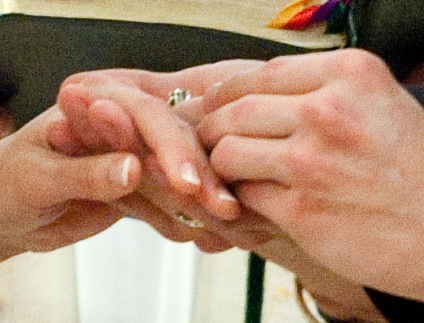
A couple of months before our recent wedding, my wife and I sat down with the Book of Common Prayer and turned to page 423. We read the header and the italicized rubrics, and then our eyes fell on those famous words: Dearly Beloved. “We’re really doing it?” she asked. “We’re really planning our wedding ceremony?”

“We really are,” I confirmed. We each held one side of the book as we leafed through the service, discussing music and readings and the people we might ask to participate. When we reached the end of the printed liturgy, she looked at me, confusion written on her face. “What’s wrong?” I asked.

“When do I get say ‘I do?’ ”

I stifled a chuckle, remembering that each of the brides I had counseled before their weddings had asked me the same question. From the days when brides, my wife included, draped white pillowcases from their hair and walked down imaginary aisles lined with dolls and stuffed animals, they had each dreamed of saying those two small words. When they discovered that “I do” doesn’t appear in the beautiful Episcopal liturgy, I had ten-minute mutinies on my hands. “What do you mean I don’t get to say ‘I do?’ I’m out of here. We’ll get married at the VFW hall and my cousin will get a temporary license to officiate and he’ll let me say, ‘I do.’ Come on, dear, we’re leaving.”

After of few minutes, though, they calmed down enough to listen to reason. Now, I don’t relish the thought of destroying the dreams of brides everywhere, so I try to be as sensitive as possible. But when my own bride-to-be wondered aloud about the lack of those two little words, I didn’t really know what to say. My standard pastoral line wouldn’t work on her because I’m not her priest. So instead, I patted her on the back and resisted the urge to say, “There, there.”

A few weeks later, we had our first premarital counseling session, and the priest suggested that we memorize our vows rather than have the officiant feed them to us line by line. We decided to take on the challenge. Each day from then on, we practiced the vows. We spoke them aloud, prompting each other when we hesitated and gently correcting each other when we mixed up the phrases. Over the course of a few weeks, we learned the words by heart.

In the name of God, I, Adam, take you, Leah, to be my wife, to have and to hold from this day forward, for better for worse, for richer for poorer, in sickness and in health, to love and to cherish, until we are parted by death. This is my solemn vow.

These deep, rich words sunk into us as we learned them. They are now the bedrock of our marriage, and (I hope my wife agrees with me!) they are so much better than “I do.” These words make me wonder: how often in our lives do we vow something? We might give assurances that we’ll get the paperwork done or promise to pick someone up after school, but we don’t “vow” to do these things.

Vows don’t happen too often. Witnesses swear to tell the whole truth in court; government officials, new citizens, and military folks pledge to uphold the Constitution or obey officers. These are as close to “vows” as people make outside of the covenant of marriage. But the “solemn vow” of marriage is unique in society, and that makes it all the more special.

A vow is neither time nor place specific. It covers more than the limited scenario during which one might make a promise. Indeed, a vow is not promise, but the framework on which promises are hung. This is made explicit by the pairs of opposites that the couple speaks during the vows – better and worse, richer and poorer, sickness and health. The vow is the acknowledgment that life will never quite be the same as it was before that moment, no matter how long a couple might have been living together before marriage. When I vowed to take Leah to be my wife, I entered into a new type of existence, one in which I now (at long last) own the fact that I am not the most important person in my own life. I vowed to cherish her and to love her – come what may. I can think of no greater duty and no greater joy than to explore with her this new existence that our vow has opened to us.

This new existence begins with the vow – not two measly words – but a few sentences that change lives. And the vow begins with a few more words that are more important the all the rest: “In the name of God…” The vow would mean nothing if God were not part of it. Just as the vow is the framework for all promises, God is the framework for the vow. The new existence into which we entered a few weeks ago at our wedding happens with God’s name at the top of the page. It couldn’t be otherwise.

I know that it has only been a few weeks, and we aren’t planning on having children for a while; but I wonder if our future daughter will put a pillowcase on her head and walk down an imaginary aisle? She probably will. But hopefully, we will teach her not to look forward to saying, “I do.” Rather, we will teach her to dream about the deep, rich words: “This is my solemn vow.”

Wake Up, Jerusalem

An interview with Peter, James, and John about the Transfiguration, performed March 6, 2011 as the homily.

The morning news show in Jerusalem is interviewing the disciples Peter, James, and John about Jesus’ Transfiguration. Since the news show didn’t pay much attention to Jesus until his trial and death (they never reported his Resurrection, considering it hearsay from biased sources), this interview is happening after Jesus rose from the dead. The disciples could not have talked about it beforehand without breaking Jesus’ command, after all. The interviewer is Benjamin Bar-Reuben of Bethlehem.

Benjamin: (talking to the camera) Welcome back to Wake Up, Jerusalem. I’m your host Benjamin Bar-Reuben of Bethlehem. It’s three weeks after a very eventful Passover here in Jerusalem, and today I’m joined by three special guests who you’ve met before on the show, (gestures to the others) Simon Peter and James and John, the sons of Zebedee. These three fishermen from Galilee were all followers of the late Jesus of Nazareth. (turning to the trio, and voice full of concern) Before I go any further, let me express my condolences for the loss of your teacher. He was by all accounts a great man.

James: Thank you for your kind words, Benjamin. But while we grieved his loss for a few days, something miraculous happened…(Benjamin cuts in)

Benjamin: Now, now…let’s not get into that again. The last time you were on the show, we had to cut the interview short because you three started talking about impossible things. People can’t come back from the dead. Everyone knows that.

James: Don’t be so sure.

Benjamin: I want to talk about something else today. I’ve brought you back on the show to clear up some confusing reports of something that happened several weeks ago before the story got buried by the events of Passover. There were some strange localized weather distortions on the top of the mountain – thunder and strange lights, like lightning – but there was no storm that night. Our viewers want to know what happened on that mountain, and you three seem to be the only ones alive that know the real story.

Peter: If we tell you the real story, you’re likely to cut this interview short as well, Benjamin.

John: That’s true.

Benjamin: Just stick with the facts and we should be all right. (grimaces towards the camera) Okay, so why were you on the mountain in the first place?

James: Jesus asked us to accompany him when he went off to pray. He often did that, but usually he would go off a little ways by himself and we would wait for him.

John: But not on that mountaintop!

Peter: It all happened less than a week from the time I told him that I thought he was the Messiah, the Son of the Living God.

Benjamin: But surely that can’t be true now. The Messiah doesn’t die on a cross. He drives out the Romans with great armies at his back.

Peter: That’s what I thought, too, when Jesus told us he was going to die. I know better now.

John: We all know better now.

Benjamin: Leaving that for the time being, tell me what made the mountaintop different. Why the changes in weather? Our viewers want to know!

James: It may have seemed like strange weather from below. But I assure you, what we saw was stranger still. When I close my eyes, I still see the brightness of the light that your viewers thought was lightning.

Benjamin: What was it then?

Peter: It was Jesus. (Benjamin tries to cut in, but Peter continues) You wanted to know and we’re telling you. This is the truth, no matter how strange it sounds. Jesus looked like I had never seen him before. He was dazzling. He was as bright as a signal fire used to keep ships from running aground.

John: It was like the sun had fallen out of the sky and lodged inside him.

Benjamin: Wait a minute. How can that be? How can a man be filled with light?

James: If Jesus taught me one thing, Benjamin, it’s that we’re all filled with light. We just hide it most of the time.

John: That night, we saw Jesus shining with all the light that God blesses each of us with. He didn’t hide any of it. Never has anyone been able to shine like that. But Jesus did!

Peter: That’s why he’s the Messiah, the Son of God, because he shines with God’s light – unbounded, undiminished, like the lights of a city on a hill. He has no thought to cover up the light.

John: And for years, he’s been teaching us to uncover ours.

Benjamin: You mean, I might have this light inside of me, too?

John: Of course you do. Everyone does. From the smallest child in the street to the Emperor of Rome!

Peter: People have always had God’s light in. Some have let it shine brighter than others. We saw two of them with Jesus when his light was shining!

James: Moses and Elijah were there, standing with him.

Benjamin: You could see Moses and Elijah?

Peter: I know it sounds out of this world, but they were there. You know what? I think they have always been there, near us, surrounding us…

John: …But it has always been too dark to see them…

James: …Until Jesus was shining on the mountain.

Peter: Moses and Elijah – and everyone who God loves – their lights never went out. The light just changed. It spread out, filling the space between things, filling the world!

Benjamin: Fascinating! But tell me, what about the thunder!?

John: That wasn’t thunder. We heard – well, it was so loud that we didn’t really hear it – we felt it in our bones. It was the voice of God.

James: God confirmed that Jesus is God’s son.

Peter: And God told us to listen to Jesus.

Benjamin: This all sounds so strange…strange and amazing…amazing and true…I don’t know why, but I believe you.

John: Maybe you are seeing us shine with some of Jesus’ light.

James: When we listen to what Jesus teaches us, we can begin to uncover the light that we spent so much time hiding.

Peter: And we can shine it all over the world.

Benjamin: How can I find the light in me?

Peter: Start be being quiet…

James: …being still…

John: …and listening.

Never Wear Your Collar on an Airplane

(Sermon for Sunday, February 27, 2011 || Epiphany 8, Year A || Matthew 6:24-34)

A few weeks before he ordained me to the priesthood, the Bishop of West Virginia gave me one truly inspired piece of advice. You might imagine that this piece of advice dealt with the delicacy of liturgy or the intricacy of theology or the intimacy of pastoral care. No. Rather, his advice was quite a bit more practical and worldly. He said to me: “Adam. Never ever ever – no matter what you do – never wear your collar on an airplane.”

In the three years that I have been snapping the collar on, I have discovered the unerring truth behind this advice. There are two reasons why a priest like me should not wear his collar and black clerical shirt on an airplane. First, I will undoubtedly attract the attention of the one person on board who will feel compelled to sit next to me and tell me his or her entire life story. While this isn’t necessarily awful, I’d much rather read Ken Follett’s new book while in the air. I admit that this reason is a bit self-serving, but the second reason is more convincing: I’m not really all that great a flyer.

Airplane! (1980)

There’s something about traveling at six hundred miles per hour, thirty thousand feet in the air in a glorified hollow, metal cylinder that tends to rattle me. And there are not many things worse for passengers’ morale than a priest in his clerical collar who is having a mild panic attack during takeoff.

Better to travel incognito: a guy in a t-shirt and jeans having a mild panic attack during takeoff is much easier to ignore. Now, I’ve heard all the statistics. You’re more likely to have a vending machine fall on you, more likely to be struck by lightning, more likely to die in a motor vehicle collision than you are to be involved in a plane crash. But the statistics have nothing to do with my dislike for flying. I don’t have anxiety over that fact that the plane might do something as unlikely as crash. I’m not anxious that a bird might get sucked into a turbine or that the landing gear won’t deploy.

My anxiety comes from the simple truth that there’s nothing I can do if one of these things happens. I’m anxious because I have no control. I’m anxious because, once the cabin doors are sealed and the tray tables and seats are in the upright and locked position, I have absolutely no ability to determine the direction of my fate.

And this is most unnerving. When I connect the two metal parts of the belt buckle and the plane starts taxiing to the runway, my anxiety takes over. I bow to the anxiety and all I have left to me is an expected bout of intestinal distress. But you know what? Anxiety, as a state of being, is (when you get right down to it) a sin, a distortion in our relationships with God.

Anxiety happens when we give in to the temptation not to trust. Trust is a fundamental building block of any good relationship. When (for any number of reasons) our trust for one another evaporates, we lose the foundation of the relationship. The same is true in our relationships with God. When we give into the temptation not to trust that God fulfills God’s promises, our relationship with God becomes distorted. And anxiety is one of the unpleasant byproducts.

In this morning’s Gospel reading, Jesus continues his Sermon on the Mount by looking up into the air and speaking about the birds and looking down the hill and seeing the wildflowers poking up through the grass. God, he says, gives to these birds and flowers what they need to flourish. The birds have enough food, even though they do not plant, grow, or store their sustenance. The flowers display great beauty, even though they are here today and gone tomorrow. If God sustains these small, passing things that have no worries at all, then why are you worrying, why are you anxious, Jesus wonders.

On our honeymoon last week, Leah and I saw dozens of examples of Jesus’ illustration. Bumping along in the open air Land Cruiser on our safari in South Africa, we took in the grandeur of God’s creation and witnessed hundreds upon hundreds of animals eating and sleeping and wallowing in the mud. The trip was truly spectacular. I found myself agreeing with Jesus all the more. Of course, God’s relationship with me allows me to flourish as the elephants and buffalo and giraffe and zebra do.

Then we got into the propeller driven plane back to Johannesburg, which kept threatening simply to fall out of the sky, and my trust abdicated once again, only to be replaced by anxiety. Notice the odd reality at work in this example: I am less anxious on the ground because I have some semblance of control over myself. In the air, anxiety reigns because that control is gone. Now, if anxiety is the temptation not to trust in God, why would flying trigger my anxiety while being on the ground does not? In neither situation am I relying particularly on God. On the ground, I rely on myself. In the air, I don’t have that option, so I quickly notice the absence of my self-reliance. Cue the mild panic attack.

The loss of control confronts us with the stark truth that our tendency to rely on ourselves overwhelmingly trumps our tendency to rely on God. When we are in control, we can ignore the fact that we aren’t carrying our weight in our relationships with God. We aren’t opening ourselves up to God’s movement. We aren’t filling the role of trusting children. But when we go up in the air, our self-reliance vanishes and we cannot ignore our failure to join God in right relationship. We cannot ignore the fact that anxiety, rather than trust, fills the hole, which is left when self-reliance is not an option.

So, how do we fill the hole with trust instead of anxiety? Well, the short answer is that we can’t. Whenever our self-control or self-reliance or self-determination is threatened, anxiety will be the byproduct. Therefore, removing things such as self-reliance from the equation is the only way to move toward trust and away from anxiety. After Jesus talks about God’s care for the birds and flowers, he tells his disciples not to be anxious. And then he gets to the punch line: “Strive first for the kingdom of God and God’s righteousness, and all these things will be given to you as well.”

Striving for God’s righteousness means devoting ourselves to living in right relationship with God. This relationship acknowledges that we are never really in control, whether we are on the ground or in the air. A right relationship with God is predicated on relying on God first, so that we can be open to God working through us. Holding up our part in this relationship means making an effort to take stock how much we rely on ourselves, how often we maintain lone wolf attitudes, how quickly we fail to trust when things get bumpy. Flourishing in this relationship with God happens when we notice ourselves falling into old patterns of anxiety, and, instead of giving in, we pray, we surrender our self-determination, and we trust God.

This is not easy. God knows my success rate is quite low. But over a lifetime of spiritual practice, of walking with God, of following Jesus’ path rather than our own, I believe that we can, with God’s help, overcome the temptation not to trust, the temptation that leads to anxiety. In today’s reading from the Prophet Isaiah, an anxiety-ridden Zion cries out: “The Lord has forsaken me, my Lord has forgotten me.”

But the Lord responds: “Can a woman forget her nursing child, or show no compassion for the child of her womb? Even these may forget, yet I will not forget you. See, I have inscribed you on the palms of my hands.”

God has each of us written on the palm of God’s hands. God will not forget us. God is here and always will be. When we begin to trust this fundamental, immutable basis of our existence, we will find our right relationship with God. We will move from the floundering of anxiety to the flourishing of trust. Who knows: when I find this trust, perhaps I’ll be able to wear my collar on an airplane.

462 Years

(Sermon for Sunday, January 30, 2011 || Epiphany 4, Year A || Matthew 5:1-12)

I preached this sermon on a Sunday in which the church had Morning Prayer for the first half of the service. We timed the service a little long, so my rector encouraged me to shorten the sermon, hence this 900 word piece rather than my normal 1200-1400 word ones.)

Four hundred and sixty-two years ago, the first edition of a certain book went to the printing press. The year was 1549, the author was Archbishop Thomas Cranmer, and the book was the Book of Common Prayer. In this original Book of Common Prayer (or BCP for short), Cranmer compiled, crafted, codified, and composed the prayers that became the central structure of a new expression of Christianity known as Anglicanism. A decade and a half before this publication, the King of England, Henry VIII, had officially broken away from the Roman Catholic Church. However, in the years immediately following the split, very little changed about the English church besides the pope no longer being the supreme earthly authority. Two years after Henry’s death, Archbishop Cranmer published the first BCP and ushered in the unique expression of Christianity that we at this church continue to practice today.

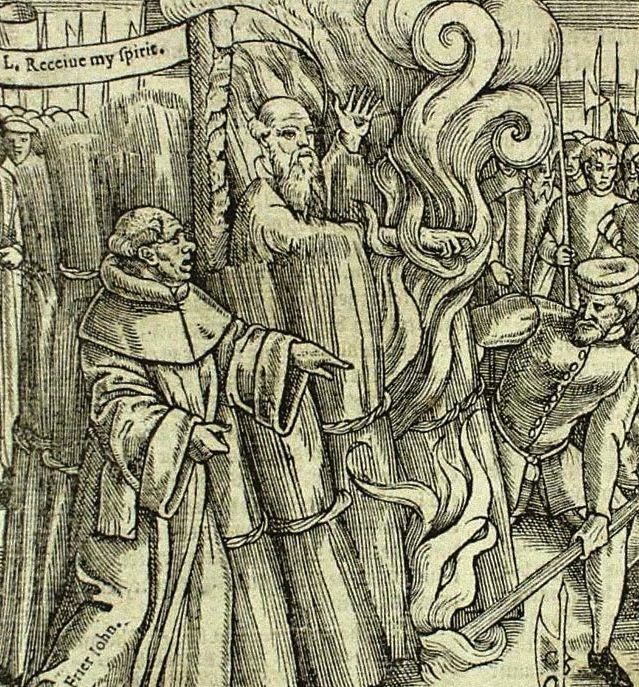
Queen Mary (Henry's daughter) didn't like Cranmer much. She had him burned at the stake.

This unique expression of following the way of Jesus Christ creates a structure, a framework of prayer, around which we organize our lives. Cranmer borrowed from the monastic example when he created this framework. Benedictine monks framed their days around an eightfold worship cycle; they prayed formally in church with one another about once every three hours. Cranmer wanted all people, not just monks, to frame their days with prayer, so he took the monastic practice and synthesized the eightfold structure into a twofold one. In his new structure, people prayed formally in the morning, then they went to work, and then they prayed formally again in the evening. Thus, the uniquely Anglican worship experience of Morning and Evening Prayer was born.

Every morning and every evening to this very day, Anglicans around the world have gathered to observe these two rituals. During them, we sing psalms and songs of praise to God. We read scripture. We pray and confess our sins. I would be willing to bet that, thanks to time zones, there is a service of Morning or Evening Prayer happening at every hour of every day all year long. When Cranmer developed this dual service, he did so in order to give his flock a method by which to order their lives around prayer and praise to God. This morning, we are participating in a cycle of worship that envelopes the whole world in constant prayer, a prayer that runs all the way back 462 years.

Whether or not we personally practice Morning and Evening prayer ourselves, the example, which Cranmer set, still guides us. Episcopalians prize the order behind our worship because the structure gives us a way to organize our lives around the things that are most important. The framework of prayer allows us to participate in God’s movement not just when we remember to or when we need to, but at all times.

When we adopt this structure and begin to practice our awareness of God’s presence, we can also begin to access another structure, a framework that lies beneath the one we normally witness with our eyes. This deeper structure is the one that Jesus speaks about to his disciples in this morning’s Gospel reading. The beatitudes, or statements of blessing, give us a glimpse of the deeper framework of reality that exists beneath the misplaced priorities and distorted vision of the world at large. This deeper reality is the one that God infused into creation from the beginning, a reality in which communion overrides isolation, peace quells domination, and love bests fear. Of course, humanity has ignored this deeper reality from the word go, preferring instead to set ourselves up as petty lords of our own destinies, oblivious to the fact that we have never really been in control of anything. Humanity’s greatest sin throughout history has always been setting up structures and systems that bury the deeper reality of God’s presence in all and through all. The ordered life of prayer gives us access to this reality.

Jesus’ beatitudes show us how the deeper structure of creation works. The poor in spirit, the grieving, and the persecuted are blessed. The meek, the merciful, the pure in heart, and those passionate about peace and righteousness are blessed. These are not mere moral platitudes spoken to console a downtrodden people. They are not future promises that will be fulfilled someday in heaven if you can just endure long enough to get there. They are not hopes for what could be coming down the road. These statements of blessing are ways in which the deeper reality of God’s presence breaks through the distortions of the world – then and there on the mountainside with Jesus and here and now in our midst.

When we participate in an ordered life of prayer like the one that Archbishop Cranmer developed, we practice the presence of God every day, not just when we remember to or need to, but every day. This practice is a spiritual workout, which strengthens not our muscles, but our vision and our ability to respond to God’s call to serve. When we take on the framework of daily prayer, we train ourselves to see the deeper reality of God’s movement, to which the beatitudes point us. And then we leave this room, our spiritual gym, and we go out into the world to begin uncovering that reality and showing that God’s presence is, indeed, here.

What are you looking for?

(Sermon for Sunday, January 16, 2011 || Epiphany 2, Year A || John 1:29-42)

The hospital was a maze. Children’s Medical Center had several buildings, and they were all connected somehow, but getting from one part of this building to another part of that building always involved multiple corridors and elevators. During the summer of 2006 between my first and second years of seminary, I was learning how to be a chaplain at this sprawling medical complex. One of the first things I learned was the hospital policy of refraining from giving directions to visitors. The hospital was just too confusing. Instead, if little Jimmy’s grandmother asked me how to get to the oncology unit, the hospital policy directed me to take her there myself and to make sure she knew her way back to the parking garage (which happened to be two elevators, three corridors, a skywalk, and two Starbucks away). In effect, hospital employees said, “Come and see” to their visitors and then accompanied them all the way to their destinations. These words – “Come and see” – make up Jesus’ second line of dialogue in the entire Gospel according to John. We’ll get to them in due time. But right now, let’s talk about Jesus’ first line of dialogue.

His first five words would not have been out of place in the labyrinthine hospital: “What are you looking for?” You might hear this question at any hospital elevator as any lost visitor stares helplessly at the building schematics printed on the wall. What are you looking for? Jesus speaks these words to two of John the Baptizer’s disciples after he notices them following him. At this point in the Gospel, Jesus has no followers of his own. He is the new guy in town. John the Baptizer owns the market on charismatic fellows who say compelling, challenging things. But John knows who Jesus is, so John encourages his disciples to begin following Jesus. Right away, Andrew and an unnamed person – quite literally – begin following Jesus.

When Jesus turns around and challenges them with his question –“What are you looking for?” – his words speak on two levels. This dual-layered dialogue is a common occurrence in the Gospel according to John. The first layer speaks to superficial, surface meaning. This layer is easy for Jesus’ listeners to access, and so they become drawn in. Then the second, deeper layer of meaning presents itself. Many of Jesus’ listeners resist this deeper level. But those who do dive deeply find rich, life-giving substance in his words.

With Jesus’ first words in the Gospel, he challenges Andrew, the unnamed disciple, and us to dive deeply to this second level of meaning. At the first level, John’s two disciples probably interpret Jesus’ question as a straightforward query into their present intentions. Do they happen to be going his way by chance or are they following him purposefully? But at the second level, Jesus’ five words penetrate to the deepest places of the human heart. What are you looking for? His question beckons an answer from those same deep places within us. The trouble is there are so many potential answers to this question that digging through them to find the ones that exist in those deep places can become problematic to say the least. Here’s what I mean.

What are you looking for?
A mid-sized sedan with good gas mileage and a high safety rating.
A doctor who understands my symptoms and actually seems to care for my wellbeing.
An assisted living facility for my parent whose mind is rapidly deteriorating.

What are you looking for?
The right greeting card to express my feelings.
A college that’s not too big but still has my major.
A quick hit to forget the day.

What are you looking for?
A boyfriend I can bring home to mom.
A scrap of meaning in a dead end job.
My car keys.

What are you looking for? John’s two disciples seem to understand that the “car key” type of answers will not suffice because Jesus’ words penetrate right into their hearts. So instead of answering his question, they ask one of their own: “Teacher, where are you staying?” Now, Jesus apparently does not hold a monopoly on dialogue with dual layers. At the first level, they want to know just what the question appears to ask: “In what house are you going to rest your head tonight?” But on that deeper second level, their question seeks a much more profound answer. Where are you staying? In Greek, the word that is translated as “staying” means quite a bit more than the English equivalent. Rather than the connotation of “staying at a hotel” or “staying on a friend’s futon,” the Greek word means to “abide” or to “continue to be present.” Thus, at the deeper level, the disciples ask Jesus where he dwells, where he abides, where he is present.

Their question, then, is the best response to Jesus’ own question. What are you looking for? Lord Jesus, I’m looking for where you abide. I’m looking for where you are present in my life. I’m looking for where you dwell in this particular situation I’ve gotten myself into.

When we receive Jesus’ question at the deeper second level, we can feel his words penetrating our hearts. We can hear his voice whispering up from the very depths of our beings: What are you looking for? Paying attention to his words rising from those depths helps us locate our own responses, the ones that originate in the same deep places of our beings. The transient, daily, car key type answers to the question fall away when we search deep within.

The best way to begin this search is with the disciples’ question: “Where are you staying?” When we ask this question, we open ourselves to finding Jesus dwelling somewhere in every facet of our lives. We open ourselves to hearing his voice whispering his presence into and out from our souls. We open ourselves, and in doing so, we turn the depths of our beings outward. The hidden deep places, where our responses to Jesus’ question lie dormant, become the pieces of ourselves that we display to the world. These pieces of ourselves are our callings from God. They are our personal, individual discoveries of Jesus beckoning us to find him in everything we do, in everything we say, and in everyone we meet.

And this brings us back to Jesus’ second line of dialogue in the Gospel according to John: “Come and see.” What are you looking for? Teacher, where are you staying? Come and see. Jesus invites us to see where he abides, where he is present in our lives. He invites us to dwell with him, no matter the situations we find ourselves in. Finding his presence means we have found those deep places within ourselves. Abiding in his presence gives us the grace to be vulnerable and to show the world the deepest yearnings that God has put in our hearts, the callings that God has blessed us to follow.

And the good news is this: “Come and see” means that Jesus will be with us, to take us where we need to go, to show us what we need to see. Just like the hospital employees accompanying a lost visitor to her destination, Jesus remains with us throughout our journeys. He dwells in our hearts whispering his question: “What are you looking for?” And when we ask him in return where he is staying, where he is abiding in our lives, he walks one step before us, saying, “Come and see.”

What Will I Become: A Decade with God’s Call

The following post appeared Saturday, January 8th on Episcopalcafe.com, a website to which I am a monthly contributor. Check it out here or read it below.

* * *

John Lennon popularized the saying that life is what happens to you when you’re busy making other plans. For followers of Jesus Christ, this isn’t entirely accurate. You see: God usually has plans for us that are fairly different from the ones that we have for ourselves. Our joy as followers of Christ happens when we listen for and then respond to God’s call in our lives. And so, to modify Lennon’s quotation: life is what happens to you when you’re busy allowing your plans to resonate with God’s.
Here’s a snapshot of three times over the last decade of my life that shows my movement from my plans to God’s, a movement that I assure you continues today. (And please, don’t misunderstand – just because God’s plan for me has so far been to become a priest, know that God’s call manifests in myriad other ways, as well.)

January 11, 2001

It is ten years ago, and I am really starting to think long and hard about what my life might look like as an adult. My senior year of high school is half over, and my college applications are finished. The days are approaching when I will hourly test the mailbox’s hinges hoping for a fat letter from Sewanee, my first choice college. The days are long gone when I dreamt of being a part-time firefighter and a part-time paleontologist. With my college letters soon to arrive at my house, it is high time to think about the future, the real future apart from the shiny red engines and dinosaurs’ fossils of childhood. And so, right before I turn eighteen, I type a few paragraphs entitled “What Will I Become?”

I believe that when a student enters his or her freshman year of college, he or she should be open to a vast array of new experiences. From my perspective, having my life planned the minute I graduate from high school is unhealthy. I am not saying that a student should not narrow his or her interests at all, but having a rigid path to walk can become detrimental.

As I prepare for my college education I have envisioned no less than four scenarios, one of which has only begun to fester in my brain. I know I would like to continue writing as I grow older, but I am practical and also know that very few writers succeed. Nevertheless, my first scenario is to major in English and hopefully have something published while I am still attending college. The second is to major in journalism and become a reporter; I would love to work for ESPN, but that is more of a dream than a reality. The third scenario is to go pre-law and attend law school. I have always been interested in the judicial process, but I am not sure I want to be a lawyer.

The fourth scenario, the one that is starting to fester in brain, is to double major in English and political science, and then perhaps still go to law school. I do not think I want to be a politician, but I would consider being someone linked to one. I am in the fledgling stages of an AP United States government class, and it absolutely fascinates me. This last scenario is beginning to excite me because it connects the other three. If I became a speechwriter or press secretary then I would have to use skills from all of my other loves. I would need the communication skills of a journalist, the writing skills of an English major, and the thought processes of a lawyer. […] I have narrowed my mindset some, but I will use the next few years to truly decide what I want to do with the rest of my life.

December 28, 2004

The acceptance letter comes and I pack up for Sewanee. Four years later, I am nearly done with the double major, though music composition has replaced English as one of the pair. Halfway through another senior year, I write again about what I will become, this time in response to an essay question on the application for Virginia Theological Seminary.

At the beginning of the second semester of my senior year of high school, I sat down at my computer and wrote out a list of possible career paths in an attempt to bring some focus to the new world that would soon open up to me. I called the list “What Will I Become?” and it included writer, journalist, lawyer, and speechwriter. With this exercise, I was trying to persuade myself that it was perfectly acceptable not to have my future planned out before I went to college. The piece concluded with this sentence, “I have narrowed my mindset some, but I will use the next few years to truly decide what I want to do with the rest of my life.” A year later, my entire perspective changed.

I was taking a humanities class the second semester of my freshman year at Sewanee, and we read the Confessions of Saint Augustine. I was truly struck by Augustine’s attempt to look back over his whole life and search for God’s movement in it; indeed, the text is one long introspective prayer. Heartened by Augustine’s example, I tentatively began to look inside myself. Over the course of the semester, “what do I want to do with the rest of my life” became “what does God want me to do with the rest of my life.” With this new paradigm, my heart and mind became open to new possibilities—or to what I thought were new possibilities. Upon further reflection, I have discovered that this new and exciting avenue, becoming a priest, is actually the earliest path open to me that I had ignored for years.

You see, my father graduated from seminary when I was six years old, and I grew up in the church. I was never the stereotypical rebellious priest’s kid; on the contrary, I always went to services, but for the first seventeen years of my life, the Word and the liturgy failed to move me. I went to church, I was baptized, I was confirmed. I believed in God through the borrowed faith of my parents. But my own faith was still nascent. The church has caused my family intense pain and overwhelming joy, and throughout my early teenage years I was always on guard in church because the painful times were ever so much more vivid in my mind. I would not allow myself to be hurt again, would not allow myself to become vulnerable; therefore, I would not allow myself to love. People would jokingly ask me if I was “going to follow in my father’s footsteps.” Heck no, I always thought, I know what he has to put up with. The pain that kept my faith locked away also kept me from seeing my true calling.

However, on a Sunday morning in October of 2000, something miraculous happened, something that I have been trying to put into words ever since. But mere words are inadequate when the power of the Living God becomes involved. To put it the best I can, I had a moment with God, in which I felt connected to both the enormity of God’s movement in the world and the intimacy of an intense feeling of personal love…. A little over a year later, with Saint Augustine’s example newly in my mind and this transforming experience of God’s love still reforming my heart, I discerned that I was called to the path that has always been only one step away.

December 3, 2007

Another acceptance letter comes, and I attend seminary. Three years later, during my final senior year, I write again about what I will become, this time within a fortnight of the event when “What will I be” will turn into the “What I am.”

A few weeks ago, I decided to try on the outfit I am planning to wear to my ordination. I unzipped the suit bag and laid out the trousers and jacket. I put on my brand new (quite stiff, still) clergy shirt and collar. Then I added the suit, shoes, and belt. As I approached the mirror, I hesitated. I wasn’t sure who I would see looking back at me. A hand, then an arm, then my body appeared in the reflection. I looked me up and down. I folded my hands. I tried to raise one eyebrow and failed. I unbuttoned the jacket and stuck my hands in my pockets. I smiled. There I am, I thought.

As I approached the mirror, I was afraid that I would not see the me I have always been because I was decked out in the attire of the me I am becoming. But as I assumed a stance, a gesture, a facial expression that are uniquely mine, I realized that the mere trappings of the calling to which I have responded will not override the me that continues to respond to the call. When God called me to the ordained life, God called me. God called a person with both gifts and limitations, both experience and baggage. As I looked at my reflection, I did not see a necessarily better me, but the me that shows outwardly my striving to accept God’s call.

As I thought that, I felt my gut twinge with the same feeling I used to have when a fly ball was hit to me in center field. Go and catch it, my gut used to say. Now it says, Look at the way God has moved in your life. Now what are you going to do about it? In many of the places in the bible where our new translations use the word “heart,” the text really says “gut.” In my gut, I know I am called to serve God because I get that same feeling when I contemplate my future. In my gut, I sense the utter enormity of the One I am called to serve. In that deep place, at the very core of my being, I know that the me I am and the me I am becoming are both the me that God has called. Indeed, God’s call created the me I am.

Today

Three more years, the first three of my ordained life come and go. I sit at my computer reading the words I wrote over the past ten years, and I hear echoes of the person I used to be, echoes that somehow became solid, sunk down into my soul, and now fortify the call that God continues to breathe into my life. Another decade spans out ahead of me: marriage in less than two months, a parish in which to serve God, a PhD, followed, perhaps, by a post helping students learn the art of preaching. Some of these surely are part of God’s plan for me, but, even so, I must not allow my plans to become idols that pull me away from God. I must continue to listen and strive to resonate with God’s call. And I must keep myself open to all of God’s glorious possibilities by wondering: what will I become tomorrow?