10,000 Talents

Sermon for Sunday, September 14, 2014 || Proper 19A || Matthew 18:21-35
10000talentsImagine with me the Apostle Peter in prison in Rome near the end of his life. He is talking to his cellmate, a new convert to the Way of Jesus Christ.

I’ve been thinking about what you said last night – about getting arrested at your first ever gathering of Jesus’ followers, about wishing you had had the chance to talk to your mother before being thrown in this cell with me, about feeling guilty for having lied to her as to where you were going. You seek forgiveness, and you’re not sure you’ll ever have the chance to ask for it. For both your sakes, I hope you do. Son, there’s nothing as precious as forgiveness for making a life worthwhile. I wish I had understood that when I was your age.

I understood so little back in the days when Jesus was with us. I was headstrong and curious, but I was curious about the wrong things. If I had known then what I know now, I would have asked different questions. Instead of asking Jesus about quantities and statistics, I would have asked about values and purpose. I remember this one time, I asked about forgiveness. Well, not about the practice of forgiveness, but about how often I was obligated to forgive my brother or sister. And knowing Jesus to be the generous sort, I shot high. Seven times seemed a bit excessive, but still reasonable. Seven is, after all, a number that, in my culture, evokes completion.

For once Jesus answered the question I asked rather than the one he wished I had asked. And yet, as he always did, he answered it in his own unique, unexpected, and unrelentingly gracious way. I remember him raising his eyebrows and tilting his head to one side. It was his, “Seriously, Peter?” look. Bartholomew used to do a spot on impression of it. “Not seven times,” Jesus said. “Try seventy-seven times.” Now, he could apparently see me doing math in my head, so before I finished my multiplication table, he made his outrageous hyperbole clear.

He told a story about a slave who didn’t understand forgiveness, and this slave owed his master 10,000 talents. You don’t use talents where you’re from? Let’s see: 10,000 talents is equal to…about 150,000 years worth of wages.* You see what I mean about Jesus’ hyperbole. This slave had a debt that neither he, nor the next hundred generations of his family could ever hope to pay off. You wonder how he ever accumulated that much debt, but Jesus never went into that part of the story.

But his master forgives it all. Just waves his hand, and the slave is forgiven. If it were me, I think I’d about float away with such a weight lifted off my chest. But this fellow doesn’t float. No, he sinks. He goes out and demands the 100 denarii another slave owes him. That’s only about three months wages – a laughably tiny amount compared to his own forgiven debt. Makes you wonder about the nerve of some people or their lack of compassion or just plain lack of decency. But don’t be too quick to count yourself out of such a group. I’m in it. We’re all in it some of the time.

This story has stuck with me all these years. It reminds me of the prayer Jesus taught us. You might have said it at the gathering before you were arrested. Do you know the line I’m thinking of? “Forgive us our trespasses as we forgive those who trespass against us.” Now what’s the line right before it? “Give us this day our daily bread.”

I prayed Jesus’ prayer for years before I ever saw a connection between these two phrases. I always said them in isolation. I prayed for my daily sustenance. Then I prayed for the capacity to offer and receive forgiveness. It must have been fifteen or more years after Jesus sent his Holy Spirit to guide us when the two lines finally joined for me. There was a big council of the various groups that had sprung up around Jesus. People came from all over. Paul was there – you may have heard of him. I don’t want to bore you with the issues we discussed, but suffice to say tempers got heated. There were arguments, rancor, vitriol spat back and forth. I gave as good as I got, I’m sorry to say. I left the council with the taste of bile in my mouth. And for days and days after, that’s all I could taste. Any food I tried to eat made me so nauseated. I didn’t eat for a long time. I started wasting away.

During those days of unintentional fasting, I continued praying Jesus’ prayer. I had my daily bread, but I couldn’t stomach it. I had been forgiven by our Father in heaven – to the tune of those 10,000 talents in the story. But I had not practiced forgiveness myself. I had not let it flow from my heart, as Jesus taught. Instead, I had relished the anger I had for my opponents at the council. For those first days, the bile I tasted was like a war wound proudly worn.

But as food continued to turn to ash in my mouth, I realized that my stubborn refusal to forgive was the cause. When the desire to forgive finally returned, so did my appetite. And the return of my daily bread gave me the strength to ask for forgiveness from my opponents and grant it, too. From then on, the two lines of Jesus’ prayer have gone together: “Give us this day our daily bread, and forgive us our trespasses as we forgive those you trespass against us.”

You see, my young friend, forgiveness is not just something we do occasionally. Like our daily bread sustaining us each and every day, forgiveness is a posture that we can employ all the time, an attitude that leads to open, trusting, caring, and fulfilling relationships. Forgiveness is an act of grace, a gift given or received whether or not it is deserved.

That’s why Jesus told me to forgive 77 times. He didn’t mean exactly 77. He didn’t mean for us to take out our accounting ledgers. No. Just look at the number. Two sevens. Two instances of completion. A beginning and an end. A life made complete by the grace-filled act of forgiveness.

So if you ever get out of this cell, my son, I hope you reunite with your mother in order to ask for her forgiveness. But don’t stop with just that one instance. Make your life one in which you never grow accustomed to the angry taste of bile in your mouth. As your daily bread sustains you, remember that offering and receiving forgiveness are parts of your sustenance, as well. And through them you partner with God in nourishing this hollow and starving world. We all have a tendency to sink in the mire, like the wicked slave in the story. But God has already forgiven our 10,000 talent debts. In response, make such outrageous and extravagant forgiveness one of purposes of your life. And instead of sinking, you will float on the wind of grace.

* The calculation about the 10,000 talents comes from this article by Karl Jacobson.

The Challenge of Christ’s Presence

Sermon for Sunday, September 7, 2014 || Proper 18A || Matthew 18:15-20

challengeofchristspresence“For when two or three are gathered together in my name, I am there among them.” I’ve always heard these famous words of Jesus as an astonishing promise, as a steadfast assurance that Christ is present in our midst no matter what. If you’ve ever been to a church gathering where only a few people showed up, I bet someone said, rather wistfully, “Well, when two or three are gathered…” I’ve said the same many times as a way to remind myself that what we’re doing when we gather as the church, as the body of those whose faith and action is motivated by the life, death, and resurrection of Jesus Christ, is important, no matter the size of the group.

This is all well and good, but I think our wonderful verse of scripture suffers from the same ailment as the most famous verse ever, John 3:16. I call it the “fun-sized candy bar” problem. Now bear with me: At Halloween, all the candy in the supermarket starts showing up in big bags filled with little individually wrapped units. They call them “fun-sized,” but I don’t understand what’s fun about getting a smaller candy bar than normal. In the same way, we wade into dangerous biblical territory when we individually wrap single verses of scripture, isolating them from their neighbors and from the larger interpretive ecosystem as a whole. It’s easy to get the Bible to say exactly what you want it to say when you pinch a verse from here and snipe a verse from there.

So this week, I went back and read the Gospel surrounding our famous, fun-sized verse: “For when two or three are gathered together in my name, I am there among them.” Right before these words, Jesus counsels his disciples in the proper way to deal with broken relationships amongst members of the church. Right after these words, Peter tries to nail down the number of times he’s obligated to forgive someone. He pegs the number at seven, but Jesus multiplies that by eleven, essentially saying, “Forgiveness should be limitless.” Thus the interpretive ecosystem, within which our fun-sized verse lives, seems to be about how difficult it can be to live together in community. Community can be messy, especially church, because church is for broken people. It would be for perfect people too, but there aren’t any of those.

So while I still see the beautiful promise embedded in Jesus’ words about being among us when we gather, I now also see something else. I see a challenge – a challenge to share the Spirit of Christ residing in us with others and to recognize and honor the Spirit of Christ residing in them. Jesus promises to be with us whenever we gather in his name. This is Gospel truth if I’ve ever heard any. Our challenge comes when we strive to make this truth evident in our lives.

I invite you, as we begin another program year here at St. Mark’s, to join me in this challenge. After being with you these past seven months, I’ve seen so much evidence of Christ’s presence in our midst, but from here on out I invite each and every one of you to name that presence when you see it flourishing in one another. Name it aloud. Celebrate it. Thank each other for making the Spirit of Christ more present in our midst. When visitors or guests pass through St. Mark’s, I want them to depart knowing Christ better than when they entered. I want them to meet Christ when they meet you. And I want you to meet Christ when you meet them.

I’m conscious of the fact that we enter rather ephemeral territory when we speak of being and seeing the Spirit of Christ. It can all be a bit theoretical or metaphorical. But we need something we can sink our teeth into, that we can really engage in. Therefore, in full awareness that what follows is only a tiny portion of the ways we can be and see the Spirit of Christ, I’d like to name three specific actions that each and every one of us can do – today, even – to live into the challenge of Jesus’ presence in our midst.

The first is inviting. One of my favorite stories of Jesus comes from the first chapter of the Gospel according to John. A pair of John the Baptist’s disciples hears their teacher call Jesus “the lamb of God,” and so they follow him. Jesus asks them what they’re looking for and they in turn ask where he is staying. “Come and see,” he replies. Come and see. He doesn’t tell them where he’s staying; instead, he invites them to join him. This is the first of many invitations Jesus offers throughout the Gospel. Each subsequent invitation involves Jesus expanding his followers’ comfort zones and moving them to embrace the abundant life he offers to all.

When we take seriously Christ’s presence in our midst, we embrace his attitude of invitation. We open ourselves up to the vulnerable nature of the new. We reach out our hands to those we don’t know, those whom we consider “other.” And in so doing, we discover one of the secrets of life: there’s no such thing as a stranger.

When we reflect Jesus’ priority of invitation, our group gathered in Christ’s name becomes permeable. We draw others towards us with the charisma of the Spirit of Christ: with our welcome, our hospitality, our utter delight in saying, “Come and see,” to those hungering for spiritual connection. Jesus drew people to him, and when we accept the challenge of living with him in our midst, we will draw people to us, as well.

Along with inviting, our next action is serving. One of the holy invitations Jesus offers to all is to serve in his name. His was a life of service to those who were poor and marginalized. He healed people not just by curing ailments, but by seeing a person standing before him when society saw only a problem or a disease or a demon.

When we take seriously Christ’s presence in our midst, we embrace his attitude of service. We actively seek out ways to step outside of our comfortable bubbles and rub shoulders with those on the margins. I spent an hour at the WARM shelter in Westerly last Wednesday, and the opportunities for us to serve their population are myriad. I can’t wait to imagine with you how to expand our work with them.

With inviting and serving, we come to our third action, which is sharing. On the night before he died, Jesus shared a meal with his friends. We participate in this same meal each week as we share his Body and Blood with each other. In this sharing, we become Christ’s Body, a group gathered in his name, strengthened and unified by his Spirit.

When we take seriously Christ’s presence in our midst, we embrace his attitude of sharing. We take an interest in each other’s lives. When we ask how you’re doing, we really want to know. When we embrace, we feel the kinship of Christ holding tight even after we let go. We share our talents and our resources with the group because we are stronger together.

Our sharing strengthens us for service. Our serving broadens our understanding of invitation. And our inviting expands our circle of sharing. Each of these actions responds to the challenge of Christ’s presence in our midst. When we gather together in Christ’s name, he is here among us. This is Gospel truth. This is the reality that makes our lives what they are. This is Jesus’ promise to us. Embedded in that promise is our challenge to make visible, to make tangible the gift of his presence. So this year at St. Mark’s, we will invite any and all to come and see what God is up to. We will serve those on the margins. We will share our lives with each other. We will gather in Christ’s name. And Christ will be among us.

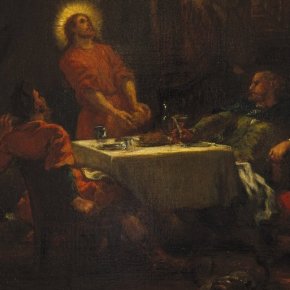
Art: Detail from “The Disciples at Emmaus” by Eugene Delacroix (1853)

A Resounding Yes

Sermon for Sunday, August 31, 2014 || Proper 17A || Exodus 3:1-15


aresoundingyesI’ll tell you all the truth: I’ve been struggling lately. The day the twins were born, about a month ago now, life took a dramatic turn. I knew this tectonic shift in life was going to happen, but I sure wasn’t prepared for it. At times over the past month, I have felt helpless. I have felt frantic. I have felt desperately inadequate. The learning curve for new parenthood is steep, and I’ve had to adjust my expectations about how fast I catch on. I’ve always been a quick study, but in this particular case, there’s no substitute for the exhausting daily grind of caring for the twins. I guess what I’m trying to say is that I knew it was going to be hard, but my definition of “hard” has never reached the superlative level of caring for multiple newborns.
Of course, there is joy, too. And love – so much love that it leaks from my tear ducts when I gaze upon their sleeping faces. But both joy and love often get buried under the weight of bone-wearying exhaustion, and at the end of the day or at the end of the night – and with newborns they are pretty much the same thing – all you can say is, “We survived.” And you’re too tired most of the time to appreciate that survival, in itself, is a pretty astounding gift.

In light of the last month, I read our passage from the Hebrew Scriptures this week with new eyes. I have read the story of Moses and the burning bush hundreds of times, but this time around new words shimmered for me. My feeling of desperate inadequacy led me to see the same feeling in Moses. Today’s story takes place on Mount Horeb, but let’s back up and see how Moses got there.

After growing up the adopted son of Pharaoh’s daughter, Moses was caught between two worlds, the life of privilege of the king’s house and the life of slavery of Moses’s family of origin. One day Moses visits the work camps and sees an Egyptian beating a Hebrew. While the book of Exodus skips Moses’s upbringing, we can easily conjure a scenario where he had no firsthand knowledge of the plight of his people before this. Sure he heard rumors, but they were easily dismissed by his Egyptian family. Then he sees for himself the rumors are true, and his sense of betrayal mingles with his sense of justice. Moses secretly kills the offending Egyptian. But such an act cannot stay secret for long, and when Pharaoh finds out, Moses flees.

Settling in the land of Midian, Moses meets his wife at a well (which is where everyone meets his spouse in the Hebrew Scriptures). Zipporah brings Moses home to her father, who takes him in and teaches him to be a shepherd. A long time passes, and Moses finds himself with the flock beyond the wilderness on the mountain. God calls to him from the burning bush and gives Moses the task of delivering God’s people from the hands of the Egyptians. And this is where Moses’s feeling of desperate inadequacy rises to the surface. He asks, “Who am I that I should go to Pharaoh, and bring the Israelites out of Egypt?”

You can see where Moses is coming from. He’s been gone so long. Who would remember him? He wasn’t even raised among his own people. Who would accept him? Later, he mentions he’s not a very persuasive talker. Who would listen to him? All of these worries and fears boil under the surface of Moses’s question. But God stops Moses in his tracks.

And here we must pause for a moment for an aside. Whenever you read the Bible, I want you to pay especially close attention to how questions are answered. More often than not questions are not answered directly in scripture. When God in the Hebrew Scriptures and Jesus in the Gospel answer questions, they often answer the one they wish they had been asked, rather than the one that was asked. So – Bible study tip – pay special attention to how questions are answered.

So let’s turn this special attention to Moses’s question. Moses asks, “Who am I that I should go to Pharaoh?” His feeling of deep inadequacy weighs the question down. But God lifts him back up with the answer. “I will be with you.”

This doesn’t answer the question Moses asked. “Who am I?” he pleads. And the response. “I will be with you.” The question God answered, the question God wished Moses had asked, was: “Will you be with me?” And the answer: a resounding “Yes.”

God’s answer to this question reverberates throughout the Bible. God shows Abraham the way through the desert to a new home. God comes to Elijah not in the storm but in the sound of sheer silence. God descends into the den of lions with Daniel. God gives Jesus a second name, Emmanuel, which means, “God with us.”

And so when I read the story of Moses and the burning bush in the light of my own desperate inadequacy this past month, I realize I have been asking the wrong question. Like Moses, I have been asking, “Who am I? Who am I that I should be able to accomplish the task of helping to care for these two precious lives?” But that’s not the question God is answering right now.

Instead, God has prompted me to ask the question God yearned for me to ask all along: not “Who am I” but “Will you be with me?” And God has answered that question with the same resounding “Yes” which God promised Moses. Yes, I am with you in the helping hands and loving hearts of the friends and family who have given countless hours of their time. Yes, I am with you when you breathe deeply in moments of serenity and when your patience stretches past the breaking point when the crying won’t stop. Yes, I am with you in the peace that comes from a few hours of treasured sleep. Yes, I am with…always.

The feeling of desperate inadequacy can paralyze us. Perhaps a challenge seems too big for us to even begin to grasp. Perhaps we’ve been down a certain road before and failed. Perhaps we’re facing something new and the fear of the unknown cripples us. Whatever the case, we can begin to move past our inadequacy or whatever else is holding us back by changing the question we ask of God. Rather than asking, “Who am I to take care of my aging parents”; or “Who am I to be able to find friends at my new school”; or “Who am I to make the slightest difference in a world full of pain”; rather than asking, “Who am I” ask the question God yearns for you to ask.

Ask, “Will you be with me?” And believe in the deepest core of your being that the answer to that question is always and will always be, “Yes.” When you hear that “Yes” resound in your core, you will begin to see with new eyes and reach out with less burdened arms and discover all the ways God is already using you to shine God’s light in this darkened world, no matter the inadequacy you feel.

I still feel inadequate when the twins start crying. I’m still exhausted most of the time. But we’re doing it. One day becomes the next, and that in itself is a gift, as is God prompting me to change the question I was asking, so that God could answer with a resounding “Yes.”

Trailblazer

Sermon for Sunday, August 24, 2014 || Proper 16A || Matthew 16:13-20

(A problem with our sound system rendered the audio for this sermon unusable.)

TrailblazerFor as long as I can remember, my father has worn a cross beneath his clothing, resting on his skin close to his heart. So when my parents gave me a cross of my own to wear when I was in my early teen years, I was thrilled. I was going to be just like Dad, wearing my cross all the time, even in the shower! The trouble was I kept losing it. I couldn’t wear the cross all the time because I played soccer, and there was a “no jewelry” rule. So it would get lost in the depths of my soccer bag (which was not a place for the faint of heart). The chain broke once, but I managed to find the cross beneath the seat of my car. Then during my freshman year of college the chain broke again, and I lost the cross for good.
At that time, I was just beginning to glimpse the edge of the expanse of the life God was calling me into, so I was quite upset at losing my cross. I’m not naturally a superstitious person, but I took it as a bad omen. So two weeks before I turned nineteen, I went to a local tattoo parlor and emerged a few hours later with a Celtic cross indelibly inked on my back. It was my way of telling myself that I was, indeed, a follower of Jesus, that if push came to shove there was no way to deny my identity. At baptism I was marked with oil as “Christ’s own forever,” but now I was visibly marked as Christ’s own.

And yet, walking out of the tattoo parlor on that fine January day, I don’t think I could have told you what it meant to me to be a follower of Jesus. I think I could do a bit better job today, but such meaning-making will take the rest of my lifetime to unfold, so check back with me again sometime. What’s telling is that – in my tattoo experience – I identified as “follower.” Since I put myself in the position of “follower,” for me Jesus took on the identity of “guide.”

As my guide, or better yet my “trailblazer,” I envisioned Jesus walking ahead of me, as if we were tramping through a marsh and he knew where it was safe to place one’s feet. Because he was my trailblazer and I his follower, I attempted to step where he stepped and to stay on the path he showed me. When people learned I was in the process to become an ordained minister, they asked if I was following in my father’s footsteps. I responded, “No,” because in my mind, we were both following in Jesus’ footsteps. Thus, in my language and in my imagination – two of the most potent vehicles for meaning-making – I identified as the follower of a trailblazer.

But the trailblazer-follower relationship is only one of myriad possibilities. And this is why today’s story from the Gospel according to Matthew is so important for us today. You see, when Jesus asks the disciples, “Who do you say that I am?” he’s really asking them, “What kind of relationship do you want to have with me?”

This powerful secondary question hovers just beneath the primary one because no matter what the disciples say, they set up the presumption of a relationship. Let’s take Simon Peter’s answer, for instance. I imagine his words rushing from Peter’s mouth all at once, as if an unseen force reached into his heart and yanked them out: “You are the Messiah, the Son of the Living God.”

So if Peter names Jesus “Messiah,” what title would Peter use for himself to relate to this identity? Would it surprise you if I said soldier? The title of “Messiah” was something of a political identity at this time in Israel. The Jewish Messiah was supposed to be a warrior like the great King David, who swept away the forces occupying Israel with his martial prowess. It’s not a coincidence at all that Matthew sets this exchange in the city of Ceasarea Phillipi, a city named for the Roman Emperor. Peter’s confession of Jesus as Messiah tacitly sets Jesus against the power of occupying Rome. That Peter identifies as a soldier in the Messiah’s army is made clear both in his use of a sword when Jesus is arrested and in the very next passage after ours today. We’ll read it next week, but here’s a spoiler. Jesus reveals to the disciples what is going to happen to him – namely something basically the opposite of kicking the Romans out of Israel – and Peter is stunned to hear the Messiah will die. Another set of words rips itself from Peter: “God forbid it, Lord! This must never happen to you.”

It takes the rest of the Gospel, and indeed the rest of Peter’s life, to fathom Jesus’ understanding of “Messiah.” Peter’s journey takes him from confession to denial to redemption to proclamation as he struggles with his relationship to Jesus in light of calling him Messiah. By the end of his time in the book of Acts, Peter has moved from soldier to something of a herald of Jesus’ understanding of Messiah-ship.

So Peter undergoes a long transformation of his identity in the light of calling Jesus Messiah. I still think of Jesus as my trailblazer, and I try to follow his steps. But what of you? When Jesus puts this question to you, who do you say that he is? And what does that say about the kind of relationship you want to have with him?

Perhaps you answer that Jesus is “Lord,” which makes you his “subject.” If so, this means you cede your sovereignty over to him. You surrender your will to his. You are a vassal and he is your liege. We might not want to give up our autonomy to a higher power, knowing as we do how badly that turns out most of the time here on earth. But Jesus is a Lord who is trustworthy and true, and giving up our wills for his leads not to enslavement but to freedom.

Perhaps you answer not Lord but “Teacher.” This makes you Jesus’ “student.” If so, you desire to learn all you can from him, both by searching the scriptures and listening for his instruction as you pray. We have so much to learn from Jesus our teacher, and we will never graduate from his class, not until we “know fully, even as we are fully known.”

Perhaps you answer not Lord or Teacher, but “Savior.” Thus, you relate to Jesus as someone who needs saving. He is the knight in shining armor and you are in distress in the dragon’s lair. As our savior, Jesus accomplished the great work set before him between the cross and the empty tomb. But if we let him, his presence in our lives continues to save us from all the small, yet debilitating, ways we drift towards annihilation.

And if not Lord or Teacher or Savior, how about “Friend?” If Jesus is your friend, then you are his. This is not blasphemy, for Jesus calls his disciples friends in the upper room on the night of his arrest. As a friend, a companion, Jesus is not walking ahead of us blazing the path. Rather, he is walking with us, hand in hand, as we discover the way together.

Of course, these ways of answering Jesus’ question are not mutually exclusive. Jesus is trailblazer and Messiah and Lord and teacher and savior and friend. And that is just a small sampling. Answering his question – “Who do you say that I am?” – does not limit our relationships with him, but it does define them. Discerning how we relate to Jesus at any given time or in any given situation will only serve to strengthen our relationships with him. And the more we follow our trailblazer and proclaim our Messiah and serve our Lord and learn from our teacher and reach out to our Savior and walk with our friend Jesus Christ, the better and fuller and deeper will we answer his call in our lives.

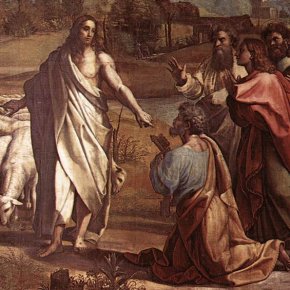
Art: Detail from “Handing Over the Keys” by Raphael (1515)

The Faith System

Sermon for Sunday, August 17, 2014 || Proper 15A || Matthew 10:21-28

thefaithsystemGood morning! It’s good to be back after three weeks away. I know I’ve only been next door, but it seems like another world when newborns are filling all your waking (and the few sleeping) moments. I seriously thought about skipping this sermon entirely and just showing you baby pictures for the next ten minutes, but then I realized lemonade on the lawn might be a better venue for that. So, let’s get down to the sermon.

Having newborns in the house has a way of making you get back to basics. It’s not easy to care for them, but it is simple. Feed. Change. Soothe. Try to catch a few zz’s. Repeat. Likewise, today I’d like to get back to one of the basics of following Jesus Christ. I’m going to talk about faith – specifically about how faith works in our lives. Hopefully, at the end of this sermon we will all rejoice that, while faith seems like an abstract, ephemeral concept, faith is in truth the fuel that fires our lives.

To start this little discussion about faith, we need to clear up one minor issue. In the English language the word “faith” is a noun. This grammatical construction makes it normal for us to ask a question like “Do you have faith?” Faith here is the object of your possession: “Yes, I have faith.” This sounds like completely correct and acceptable English, right? The trouble is, while faith is a noun, it should be a verb. I should be able to say “I’m going faith-ing today” or “We faith-ed yesterday and we’re going to faith again tomorrow.” But those sentences sound really strange, don’t they? I wish they didn’t. The word “faith” is a noun but whenever you use it, I hope you will remember it should be a verb.

Here’s why. We can possess things like concert tickets and hiking boots, but such possessions just sit on the counter or in the closet until we need to use them. If we have faith in the same way we have concert tickets, then we run the risk of storing our faith in the kitchen cupboard until we think we need it. But faith doesn’t work like that. Faith cannot be stored up or hoarded. We might get into situations where we say, “If I just had a little more faith…” But this turns faith into a commodity, something we can trade for something else. That’s not how faith works.

Thinking of faith as a verb removes it from the kitchen cupboard and puts it in our actions. We cannot store up or hoard our actions like we can our possessions. Rather, each action tumbles into the next in a never-ending stream. The problem we run into here is that, since the word faith isn’t actually a verb, we have trouble imagining what faith as action looks like. You know exactly what I mean when I say, “I saw someone running on my walk to church this morning.” But you’d have difficulty conjuring up the image if I said, “I saw someone faith-ing on my walk to church this morning.”

Because of this difficulty, I’d like to invite you to imagine with me a reality that we don’t often think about. When God created animals, God gave us all sorts of biological systems that allow us to live. The respiratory system lets us breath, the circulatory system cycles our blood through our bodies, the digestive system turns food into nutrients. There’s the nervous system, the endocrine system, the lymphatic system and so on. But we were made in God’s image and likeness, which means we have one more system that other animals don’t have. We have a spiritual one to go along with all our biological ones. We have a faith system.

The faith system works a lot like our muscular system. We all have muscles. We need our muscles to do simple tasks like getting out of bed, standing up, even smiling. We also need our muscles to do more difficult tasks like running a marathon or lugging a couch to a third floor walkup. Exercising hones and strengthens our muscles, making them more durable and less likely to fatigue. But whether we exercise or not, our muscles still put in work day in and day out.

So, too, with our faith system. The faith system spurs us to seek out life-affirming relationships, to support one another in our daily walks with God, to reach out to those in need, to welcome anyone into our midst, and to share with them the good news of God’s love. The faith system also sustains us through dry, desolate periods, giving us enough endurance not to give up quite yet. Like our muscles, our faith can get weary and fatigued. But also like our muscles, we can exercise our faith to hone and strengthen it, to make it more a part of our actions and less a thing sitting on the shelf in the kitchen cupboard.

If we’re going to exercise our faith, then we should figure out exactly what we mean when we say the word. We’ve already said how faith is a noun that should be a verb. Faith then is the action that happens when we participate in our relationships with God. Faith borrows the best parts of trust, confidence, humility, and zeal and molds them into our response to God’s presence in our lives. From trust, our faith borrows the willingness to give ourselves over to the power of another. From confidence, our faith borrows the courage to take the leap into God’s waiting arms. From humility, our faith borrows the recognition that God (and not we ourselves) initiates the action that results in the giving of ourselves up to God. And from zeal, our faith borrows the passion actually to get going and do something.

In today’s Gospel lesson, the Canaanite woman actively engages her faith system. She trusts that Jesus can help her. She has courage actually to do something about that trust, even in the midst of the disciples’ and Jesus’ own dismissal of her. She shows humility when she kneels before Jesus, calls him “Lord,” and asks for help. And her passion erupts when she counters Jesus’ statement about the children’s food. All she needs is a crumb, she says, a scrap discarded to the floor. Jesus calls her faith “great.” But no matter how great our faith is, we each have a faith system that God gave us so we would be able to join God in relationship. The more we exercise our faith system – the more we act out our faith – the deeper can we go in our relationships with God.

Imagine if we exercised our faith in the same way we exercise our muscles. Going to the gym once doesn’t do much, but going every other day can work wonders on our bodies. God yearns for us to have this kind of dedication to our lives of faith. When we are serious about exercising our faith systems, we build time into every day to be in prayer with God. We start with faith and allow it to motivate all our other actions. We take part in the act of worship, both on Sunday mornings and in the moments of our days when our faith shows us special signs of God’s presence that our eyes alone might not see.

I invite you today to remember that faith is not a commodity or a possession. Faith is the active component of our relationships with God. Faith is a noun but in our lives let’s make it a verb.

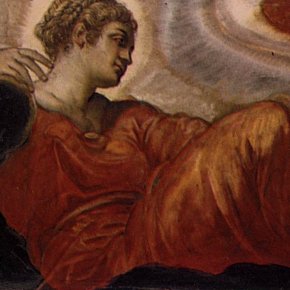
* Art: detail from “Allegory of Faith” by Tintoretto (c. 1564)

God’s Presence: A Letter to My Children

Sermon for Sunday, July 20, 2014 || Proper 11A || Genesis 28:10-19a

godspresenceDear Baby Boy and Baby Girl,

Right now you are still in Mommy’s tummy, but only for a few more days. The doctors tell us everything is going well, and they are really excited that you’ve managed to stay inside as long as you have. As for Mommy and me, we can’t wait to meet you, now that you’re big enough to live out here in this messy, yet beautiful world. But before you arrive, there are a few things I need to tell you. You probably already know everything I’m about to say (you being so close to God and all), but at times, like the rest of us, you will forget. That’s why I’m writing this letter to you. It’s not just for you, but for me, and for everyone who hears it, as well.

This morning at church we read the story of a fellow named Jacob who camps out one night under the stars. Maybe we’ll do this someday, too, but Daddy doesn’t really like camping so you’ll have to persuade me. Anyway, Jacob dreams that angels are connecting earth to heaven, and he hears God speak promises to him. “Know that I am with you and will keep you wherever you go,” says God. God had said something similar to Jacob’s grandfather Abraham, but before then people didn’t understand that “all of God was in every place.”* Instead, people thought there were all sorts of little gods who lived inside of things like rivers and mountains. They couldn’t take those little gods with them when they traveled. But Abraham left home and discovered that God was already present wherever Abraham went. It was a wonderful and staggering notion.

In fact, my children, even though thousands of years have passed since then, this notion is still so wonderful and staggering that even today we have to remember over and over again that all of God is present everywhere we go. When Jacob wakes up the next morning after his vision of God, he says, “Surely the LORD is in this place – and I did not know it!” I’ve said the same thing many times when I didn’t expect to find God only to be surprised when God showed up.

You two are smart, so you might be wondering why we have so much trouble noticing God’s presence even when that presence is everywhere all the time. Well, that’s the rub. The very constancy of God’s presence keeps us from noticing it. Let me tell you a quick story to illustrate this point. Mommy’s been having me read you guys a story every night recently, so I hope you like it when I tell you stories. Here goes: A long time ago our ancestors didn’t live in towns with grocery stores. They didn’t even have farms to grow vegetables and raise cows. (What sound does the cow make? Moo! You got it!) Instead, they had to go out into the dangerous wilderness to search for food. There were certain animals in the wilderness searching for food, too, and our ancestors were on their menus – animals like lions and tigers and…well, you get the idea. Our ancestors started noticing rustling in the underbrush and new odors coming to them on the wind. These changing signals warned them when they were in danger. The people who were best at noticing the changes in their environment flourished and passed their instincts on to their children.

We still have those instincts in us. Mommy and I passed them on to you. While we don’t usually have to worry about animals that have us on their menus, we do live in a world where things are changing all the time. Keeping up with everything that’s changing takes nearly all our attention. And so we forget to focus on the one thing that remains constant through it all, and that is the presence of God.

This is what I wanted to tell you in this letter, children: Sometimes you have to fight against your instincts. Sometimes you have to shut out all your distractions – all the change swirling around you – and just be. Just sit in a comfortable chair like your Daddy. Just lay on the ground at night under the stars like Jacob in the story. As you lay under the stars remind yourselves that you are in God’s presence. Acknowledge that it can be hard to notice because God’s presence is so constant, and we aren’t wired to notice constancy. But God knows this. God knows our instincts tell us to perceive change instead of constancy. That’s why God gave us the gift of memory.

As you lay under the stars reminding yourselves that you are in God’s presence, remember also that you were in God’s presence even when you didn’t notice it. Look back over your day or week or month or lifetime and start to uncover the footprints of God’s presence when you least expected to find it but needed it most.** You’ll be surprised to discover all the subtle and startling ways God was moving in your lives in the past. Doing this work of reflection will then help you see those same patterns of God’s movement in the future. And the more you do this work, the more readily you will notice God’s movement in the present.

I know it will be a long time before you, Baby Boy and Baby Girl, will have the ability or need to do this reflective work. But this is where the other facet of God’s presence arrives. Right now you two are reminders of God’s presence for your Mommy and me. As each day rolls into the next and your birth approaches, we know beyond a shadow of a doubt that God is present in our lives because God has given us the gift of the two of you. The fact that God has also given us a beautiful community in which to raise you makes God’s gift even more wonderful and staggering.

Being a reminder of God’s presence in the life of someone else will not only make that person’s life better, it will also help you discover God’s presence in your own. When you serve as such a reminder you trick your instincts into thinking God’s presence is one of the things that is changing, which helps you notice it. But what’s really changing is you. As you grow up, you will have the opportunity to be signs of God’s presence in so many ways. Grab hold of those opportunities with both hands and with your heart. Never let a chance to serve God by helping someone pass you by. Never assume you are too small to make a difference because assuming that makes you much smaller than you are. Know that you began your lives as reminders of God’s presence, and you will continue to be your whole lives long.

Your Mommy and I love you very much, and we can’t wait to meet you. In a few days, we’ll be in the hospital. We’ll be waiting for you. And then, suddenly, you’ll be there. And when I hold you and smell the tops of your heads and touch you to my skin, I will know that I am in the presence of God through God’s gift of you, Baby Boy and Baby Girl. We are in God’s presence all the time, yet we rarely notice it. But on that day, I will say, “Surely the LORD is in this place – and I do know it.” May you have many days when you can say the same thing.

With all the love in my heart,

Daddy

* Quoted from “The Great Family” Godly Play story by Jerome Berryman (my favorite story to tell)

** Borrowed from my father. It’s his favorite thing to say.

Inside the Golden Box

Sermon for Sunday, July 13, 2014 || Proper 10A || Matthew 13:1-9, 18-23


InsidetheGoldenBoxOkay, to start off: I’m not going to preach this morning about my rapidly approaching fatherhood. But I just want to point out God’s divine sense of humor in us reading in the Hebrew Scripture a story about the birth of twins. Rather, this morning, I’m going to preach about God’s persistence and God’s extravagance. To do this, I’d like to talk about the second of my three days of Godly Play training.
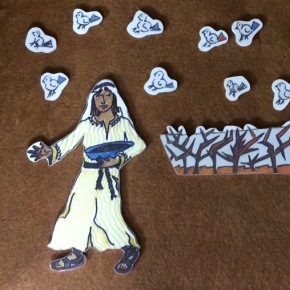
In Godly Play, Jesus’ parables reside in golden boxes, and on this second day of training, the leader invited the students to pair up and choose a box. Now, I don’t remember if I chose the parable of the sower or if the parable of the sower chose me, but either way, my partner and I opened our golden box to reveal a long piece of brown felt, three types of ground depicted on wooden cutouts, some tiny birds, and a sower with arm sweeping up from his satchel of grain.

We laid out the parable and started learning how to tell it in Godly Play style. We rolled out the long piece of felt underlay and slowly placed the types of ground on it. In Godly Play, everything happens slowly and deliberately. You take each piece out of the box, hold it, look at it, and draw the children into the story through your own focus and intentionality. Well, at that day of training, as I had just learned this theory, I was extra careful to move slowly, deliberately, and intentionally. I studied each piece as I removed it from the golden box. I held the sower. I held the birds. I held the rocky ground. I held the thorny soil. I held the good soil.

At the end of my first rehearsal of the story, all I could think was this: “Why waste so much seed?” Out of four types of ground, only one yielded grain. A mere 25 percent of the seed was successfully planted. The rest was stolen by birds or scorched in the sun or choked by thorns. What kind of sower would waste three-quarters of his seed?

Turns out, God is that kind of sower. Our God is a God of abundance, of surpassing love and extravagant grace. God scatters the seed of God’s word everywhere in creation and within the hearts of all people. What might seem like waste to us who are so often concerned with the scarcity of things, to God the scattering of seed among all things is simply standard operating procedure. The word of God is eternal. The word of God is never going to be exhausted. Thus, God can scatter as much of the seed of the word wherever God wants with no care given to it ever running out.

The prophet Isaiah proclaims such a reality when he speaks this word from God: “For as the rain and the snow come down from heaven, and do not return there until they have watered the earth, making it bring forth and sprout, giving seed to the sower and bread to the eater, so shall my word be that goes out from my mouth; it shall not return to me empty, but it shall accomplish that which I purpose, and succeed in the thing for which I sent it” (55:10-11).

So if God’s word accomplishes that for which God sent it, what of the seed that seems to be wasted? What of the seed that fell on the path, on the rocky ground, and among the thorns? These questions were on my mind as I continued preparing the parable of the sower for presentation at Godly Play training. But it wasn’t until I was putting away the parable for the final time that God gave me the gift of a small insight. I had already put the sower, the birds, and the types of ground back into the golden box. All that was left was the long strip of brown felt, the simple underlay for the other pieces. I sat there staring at it.

In a parable story, the felt underlay exists mostly to give shape to the other pieces. But as the first thing you pull from the golden box when you begin a story, the underlay can also serve as a warm-up activity to fire the imaginations of the children. “ ‘I wonder what this could be?’ you say,” as you turn the felt over in your hands, looking at both sides before smoothing it out on the floor. It’s a chocolate bar, a child might offer. It’s a brown snake. It’s a belt for a giant.

But as I sat there staring at the brown underlay all alone, I said, “I wonder what this could be?” and the answer came back, “It could be me.”

The brown felt upon which I placed the different kinds of ground could be any of – is each of us. Each of us, at various moments in our lives, has been the path upon which the birds came and ate. We have been the rocky ground. We have been the thorns. And hopefully, at some points, now or in the past or future, we have been the good soil. Thus, the kinds of ground upon which God’s seed falls are not different people, but different moments in the lives of each individual person.

Sometimes we receive the word with apathy and allow the birds to eat it up. Sometimes we dedicate ourselves with renewed fervor, only to have the fire burn hot and quick and die as soon as it started. Sometimes we allow the cares of the world to drown out the whispers of the abiding promises of God. And sometimes…sometimes we are receptive to God’s word, and the seed sprouts up abundantly.

I said at the beginning of this sermon that it would be about God’s persistence and God’s extravagance. Have you noticed them yet? The sower could plant the seed only in the good soil, but instead the sower flings it far and wide, trusting that even on challenging ground, the seed makes some impact. This is God’s extravagance – an expansive gesture of love and grace on the receptive and unreceptive alike.

And what of God’s persistence? Well, to extend the metaphor of the parable, the birds eat up the seed only to deposit it somewhere else. The seeds that die by scorching sun and choking thorn still sink into the loam to fertilize the ground. Thus, none of the seed is wasted; even the seed that falls outside the good soil can accomplish the purpose for which God cast it in the first place. Likewise, when you and I are at places in our lives when we are not exhibiting traits of good soil, God still casts seed upon us, knowing that even a hint of the word can make an impact, however small. Each seed cast upon us when we are unreceptive prepares us to become good soil at some future time. God yearns for us to be good soil, but God can wait because God is persistent.

As you take stock of your current relationship with God, ask God what kind of ground you are right now. What steps can you take to partner with God to till your soil into the kind receptive to God’s word? Trust that God continues to shower seed upon you because of God’s extravagant grace and persistent love no matter how many rocks or thorns stand in the way. The good news is this: sooner or later, in this life or the next, God’s word will take root in each of us because the sower will never run out of seed.

Art: The Parable of the Sower Godly Play story

Once Upon a Time

Sermon for Sunday, July 6, 2014 || Proper 9A || Matthew 11:16-19, 25-30

onceuponatime I confess: I have babies on the brain. I hope you’ll forgive me another sermon that springs from my impending fatherhood. I promise that in the years to come not all my sermons will generate from this experience. But it’s all I can think about right now, so naturally, in a Gospel lesson crammed with various fabulous sermonic content, I would gravitate to the verse about babies. Jesus says, “I thank you, Father, Lord of heaven and earth, because you have hidden these things from the wise and the intelligent and have revealed them to infants; yes, Father, for such was your gracious will.”
Jesus isn’t entirely clear as to the antecedent for “these things” his Father has hidden from the wise, but judging by the surrounding verses, Jesus seems to be talking about ways in which we notice and enter into God’s presence. Jesus says God has revealed these ways to babies, so today I’d like to explore four of these ways, in order that we might reclaim some of their power in our own lives. My goal in this is not to glorify childhood, but to uncover some of the delightful and important things we may have lost along the way to adulthood. The good news here is that it’s much easier to recover something lost than it is to invent something new.

For the first several months of a human existence, our species is woefully incapable of taking care of itself. We just lie there on our backs looking up at this new world that’s full of blurry shapes and is neither as warm nor as comfortable as the womb we so recently exited. We rely on our parents for everything. We can’t cook our own food. We can’t change our own diapers. And we can’t even come up with the manual dexterity to turn on the TV.

In the animal kingdom, buffet type animals – that is, animals that, sooner or later, become prey for carnivores – tend to be born ready to take on the world. They can stand after a few hours (minutes, in some cases) and can run soon after. If they were as helpless as we are, not a one would survive to adulthood.

But there’s something precious and special about our utter dependence as babies. We are born into this world in an extreme version of the state that each follower of Jesus is striving for – dependence on God. At some point in our early years, we actively (and appropriately) lose this utter dependence on our parents. After all, a small dose of rebellion is healthy in order to claim our individuality. But when this healthy rebellion sets in, it’s difficult to let ourselves be dependent again, on anyone, let alone God.

Once upon a time, we lived with the kind of dependence that a right relationship with God exhibits, the radical reliance on the Lord in all things. The memory of this reliance on a greater power exists within each of us, and we can access it again, with God’s help.

Along with our dependence, as we grow up we lose access to many other faculties we had in early childhood. One of these is imagination. Now, of course, we don’t lose this faculty fully; the ability to imagine can stick around for a lifetime. But the imagination of early childhood is special. There are neither boundaries nor inhibitions. Whereas an older child or an adult might feel foolish chatting to imaginary people, the small child sees it as the most natural thing in the world.

There need be no prompting or stimulus. The imagination carries the child into new worlds that seem just as real as the real world because the real world hasn’t been explored yet. Exploration of the real and imagined worlds happens simultaneously, much to the bewilderment of parents, who see their children fascinated by the most ordinary things. Of course, to the child, the feather duster isn’t a feather duster – it’s a rare bird migrating home to Antarctica.

Because the imagination of early childhood is so untamed, it’s much better at communing with the source of imagination. We are made in the image and likeness of God. Because we are made in God’s image, we have the ability to imagine. Just as God imagined and then spoke creation into being, our imaginations help us see and celebrate all the profound links between our world and our world’s Creator.

Once upon a time, each of us imagined with unfettered power and scope. But even now, we can imagine ourselves into God’s presence and discover that we’ve been there all the while.

So we have dependence and imagination as vehicles of God’s revelation. And closely linked to imagination we have the expansive concept of wonder. Wonder comes in two forms, and young children exhibit both. First, wonder happens when you are in awe of something, when you are engrossed in something bigger than yourself that you cannot explain, nor do you desire to explain. In small children, this kind of wonder happens for all sorts of things – things that grown-ups consider mundane. The rain pattering a window, the dog’s fur, and the fireplace’s crackle each have the capacity to instill wonder in the young child who has never experienced these things before.

Second, wonder happens when the desire to explain creeps in, but the ability to explain does not yet exist. Here curiosity meets inexperience, and an explosion of questions results. But have you ever noticed that young children hardly ever ask yes/no questions? Theirs are often much deeper than they realize, especially their favorite question: “Why?” We adults have trained ourselves to look for answers. But wonderers like young children are happy exploring without needing such a goal at the end.

Once upon a time, each of us had the ability to wonder. We can again. And when we do, our awe will prompt us to ask questions that do not have easy answers, but instead lead us deeper into the heart of God, who is the object of our wonder.

Dependence. Imagination. Wonder. Rediscovering these facets of ourselves helps us see God’s revelation in this world. And finally, we have the natural physical manifestation of imagination and wonder. This is called play. Play happens when we engage both our imaginations and our bodies. We dance to unheard music, we build castles with pillows and sheets, we sculpt mountain ranges with our mashed potatoes.

Play is the most common manner in which young children encounter and learn about the world. Play leads to better manual dexterity, better spatial relations, and more active imagination. There’s little separation between play and the rest of life. But at some point during childhood, play becomes segregated from the more serious side of life. And by the time we reach adulthood, many of us have simply lost the desire and ability to play at all.

As adults, our version of the play of small children is called recreation. It has other names as well: hobby time, dates with your spouse, relaxation, vacation, Sabbath. Just say the word “recreation” differently and see how our play reveals God’s work: re-creation.

Once upon a time, each of us played just for the sake of it. When we play now, God gives us the opportunity to rediscover the joy and delight we had as children. Such joy and delight connects us more deeply to the God who desires to make our joy complete.

In today’s Gospel lesson, Jesus thanks his Father for revealing to babies ways of seeing and entering into God’s presence. By granting this revelation to the youngest of children, which we all were once, God instilled in each of us certain knowledge and abilities that might atrophy from disuse but will never be lost completely. With God’s help, we can recapture our dependence. We can discover God’s image in our imagining. We can stumble into the sublime state of wonder. We can take joy in play. Once upon a time, these things came as naturally to us as breathing. And as we seek to grow deeper in our relationships with God, they can again.

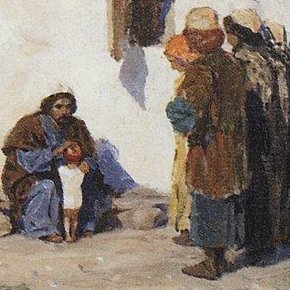
Art: Detail from  “They Brought the Children,” by Vasily Polenov (c. 1900)

Walk on Together

Sermon for Sunday, June 29, 2014 || Proper 8A || Genesis 22:1-14

(I forgot to hit the button on my recording device this week, so it’s just text this time around.)

walkontogetherAs I contemplate my impending fatherhood, the story of the binding of Isaac, which we read a few minutes ago, has taken on new meaning for me. I’ve always struggled with this story, and, if you’ve ever read or heard it, I’m sure you have, too. This reading from the Hebrew Scripture brings up so many questions: why would God ever test someone in such a barbaric way? How could God be so apparently abusive? How could Abraham even think about going through with it? If the angel hadn’t stopped him, would Abraham actually have killed his son? What would that prove?
We could spend this and many more sermons attempting to explain (and only succeeding in explaining away) such difficult questions. We could say that people experienced God differently back then, but that wouldn’t satisfy us. We could say that this story simply narrates the move from human to animal sacrifice, which, in future generations, distinguished the Israelites from many of their neighbors. This is a little better, but such academic aloofness doesn’t account for the tenderness of the relationship displayed between Abraham and Isaac. We could say so many things in order to feel okay about this story, but, despite the happy ending, something will still not sit right. Indeed, the Jewish rabbis have been struggling with the binding of Isaac for millennia; one sermon from me isn’t going to put a dent in that effort.

But I have to say something, so here goes. Often, when a story in the Bible makes us feel uncomfortable, we have a tendency to dismiss it: to flip the page, wipe the offending verses from our memory banks, and move on as if they never existed. However, if we take the time, like the Jewish rabbis, to struggle with the difficult passages instead of ignoring them, we can hear the Holy Spirit whispering good news to us, even in the midst of the struggle. I heard such a whisper of good news this week when I read the binding of Isaac over and over again in preparation for this sermon.

The whisper of good news started when, as I said, I began reading the story through the lens of my impending fatherhood. I expected to be horrified by Abraham’s action as I have been in the past; by the “I was only following orders” defense Abraham would have had to give Sarah when he got home, had he gone through with it. Strangely, this time around, the first time I’ve ever read this story after having spent hours staring at the ultrasound picture of my son’s face, I was not horrified.

I wasn’t. Instead of seeing the brutality of the test, I saw the tenderness of the relationship between father and son in a pair of verses that I’ve never noticed before. On the third day, Abraham and his son Isaac leave their servants and pack animals and continue on alone. Here the narrator tells us, “So the two of them walked on together.” As they make their way up the mountain, Isaac stops and questions his father. Abraham answers, and then again the narrator tells us, “So the two of the walked on together.” Father and son, together: Keeping each other from stumbling as they hike up the mountain; feeling each other’s warmth; walking hand in hand, perhaps.

Of course, the sad irony of this walking up the mountain together is that Abraham is preparing to walk down alone. Or is he? And this is where a new question arises, a question that links Abraham’s deep relationship with Isaac to Abraham’s deep relationship with God. The question is this: Is Abraham lying?

In between those two tender bits of narration (“So the two of them walked on together”) Isaac asks the whereabouts of the lamb for the burnt offering. And Abraham responds: “God himself will provide the lamb for a burnt offering, my son.”

So, is Abraham lying to Isaac here? Is Abraham just telling Isaac what the boy needs to hear to keep him going, to keep him pliant? Or does Abraham actually believe what he is saying to his son? Does Abraham believe that God will, indeed, provide a way out of this mess?

I think the answer falls somewhere in between. A cynical person would call his response a lie. But I think Abraham is speaking out of his hope, out of the deepest conviction of his heart that he will not need to go through with it, that the promise God made to him years earlier will continue to hold, the promise that countless generations will spring from his son Isaac. No, Abraham isn’t lying: he’s speaking the only truth he’s ever known. From the day Abraham stepped out into the desert all those years ago, God has provided, even when Abraham’s impatience or fear kept him from seeing God’s provision.

But for us the phrase, “God will provide,” has, sadly, reached sound byte status. We hear the words and say, “Yeah, sure,” and then go about our business. And we fail to attribute to God’s provision both the miniscule and the monumental blessings in our lives. For all the struggle our story today causes, the binding of Isaac also invites us to hear again the good news that God does, indeed, provide, and God gives us the eyes to notice God’s provision.

It all starts with the word “provide”: in Hebrew this is literally the word “see” or “perceive.” So when Abraham says to Isaac, “God will provide,” we can loosely translate it as, “We shall see what God is up to.” This understanding of God’s provision presupposes that God is already active wherever we are going, that God has already shown up when we arrive. We enter a story already in progress, so to speak.

Notice what Abraham says three times in our passage today: “Here I am.” With these words, Abraham makes himself available, opens himself up, orients himself towards the stimulus of his response. “Here I am,” is the verbal equivalent of a posture of openness and reception. By saying, “Here I am,” Abraham signals his desire to see what God is up to, to see how God is providing in the current situation.

We believe that a piece of God’s very nature is that of provider. And we have the opportunity to participate in God’s provision by training ourselves to see the many and varied ways God is moving in our lives. When Abraham tells Isaac that God will provide, Abraham is reminding himself what he believes, what he has relied on his whole life. God’s provision has not always fit Abraham’s timetable, and Abraham has not always done the best job trusting, but, one way or another, God has provided.

When we look back at the trajectories of our lives, we often see coincidences that cannot be explained; or relationships that have stood the test of time; or burdens we didn’t think we could bear, but did. This is evidence of God providing. But so are the deep, calming breath when the baby is screaming her head off; and your mother’s embrace after a hard day at school; and the desire to help someone in need; and all of the little things that never make headlines, that we won’t remember when we look back at the trajectories of our lives.

Since we won’t remember the small blessings once they’ve sunk down into the depths of memory, God invites us to appreciate today’s provision today. We pray, “Give us this day our daily bread,” for the same reason Abraham told Isaac that God will provide: so that our eyes will be open to the blessings of this life, so that a day never goes by when we don’t notice God’s presence in something, no matter how small.

I know the story of the binding of Isaac is hard to hear and uncomfortable to process. Even so, through it the Holy Spirit has good news to whisper into our hearts. Today, the good news is that God provides and we participate in that provision when we say, “Here I am.” As we move through our daily journeys, sustained by our daily bread, each of us has the opportunity to walk hand in hand with God, to go forth and see what God is up to. So take joy in trusting that when our stories are written in the book of life, the narrator will say, “So the two of them walked on together.”

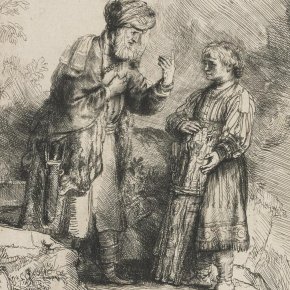
*Art: Detail from “Abraham and Isaac” by Rembrandt (1645)
*Thanks to Kathryn Schifferdecker’s article on Workingpreacher.org for the Hebrew relationship between seeing and providing.

The Comfort and the Challenge

Sermon for Sunday, June 22, 2014 || Proper 7A || Matthew 10:24-39


comfortandchallengeSometimes when we pull a piece of the Gospel out of its natural habitat and read it in our cozy New England church, the impact of the words changes. Take the lesson I just finished, for example. How surprised would you be to learn that Jesus is trying to comfort his disciples with these words? You just heard them. They don’t sound very comforting, do they?

Certain passages of the Gospel cut through the dusty weight of years and touch our hearts in the same way I’m sure they touched the hearts of Jesus’ original followers. Others, like today’s, meander towards the present time and get a bit lost along the way. So let’s see if we can follow the path back to Jesus’ lips and hear anew these difficult words. Then we can bring them back to the present and hear what they have to say to us now.

Today’s Gospel lesson comprises the end of a set of instructions, which Jesus gives to his inner circle before sending them out to do the work he has appointed them to do, namely to cast out unclean spirits and cure disease. If we had started the passage sooner, we would have heard Jesus instruct the twelve disciples not to take any extra clothes or food with them, but to rely on God’s provision in the form of hospitality. If we had started the passage sooner, we would have heard Jesus tell them not to worry about what they will say when brought before the authorities, but to rely on God’s Spirit to speak through them. If we had started the passage sooner, we would see what a challenge Jesus sets before his friends, a challenge to rely on God – for sustenance, shelter, endurance, eloquence, in all things really.

This show of reliance on God in the face of challenging circumstances might even be the reason Jesus sent his friends out in the first place. They were living billboards for the kind of life Jesus promoted: a life of trust in God, a life in which you put God first and everything else fell into place. Jesus’ disciples trudged from town to town with nothing but the clothes on their backs, good news on their lips, and the power to heal in their hands. Now some scholars tell us that they didn’t bring extra clothes or food so they wouldn’t be juicy targets for bandits out on the dangerous roads. And I’m sure that’s part of it. But the more compelling story is their acceptance of the challenge to rely on God for all things.

And I’m sure the story was compelling: compelling enough to make new disciples and new enemies. And this is where Jesus’ supposedly comforting words for today arrive on the scene. First he reminds his friends that his opponents have openly called him Beelzebul (that is, the father of demons). If they call me such a name, he says, then don’t expect kind treatment. But even if they treat you poorly, “Have no fear of them.” In fact, Jesus tells his friends not to be afraid three times in this passage, just to make sure the words sink in.

Don’t be afraid, he says, because, while they slander you now with false words, all will be revealed in time. Don’t be afraid because, while they can hurt your physically, they cannot touch the soul, which resides with God for safekeeping. And don’t be afraid because your Father in heaven knows you intimately, knows even how many hairs are on your head. If you do happen to fall to the ground, God will be there to pick you up again.

So far, Jesus’ words are speaking comfort to the challenge. Jesus trusts his disciples to rely on God, and this trust will help them overcome their fear. But now we move to the more difficult words, the ones which the long march of time has mangled. As we listen to them, we have to remember one immutable fact that separates our experience from that of Jesus’ original followers. We do not live in a part of the modern world that is charged with religious fervor. Indeed, in our part of the modern world, the religious fervor tank is approaching empty. I don’t know about you but when people discover I am a practicing Christian, their responses range from total indifference to mild surprise to pleasant curiosity. I can count on less than one hand the number of times my identity as a follower of Jesus has been met with unmitigated derision.

Not so for his original followers. Their world was charged with religious fervor. The very idea that someone like Jesus might be teaching something new would be downright offensive to many people. Jesus’ reinterpretation (and in some cases strengthening) of the Jewish law was a punishable act. The words Jesus speaks in the rest of today’s passage are not intended to strike fear into the hearts of his listeners (as they might do to us), but rather to lay out plainly the state of affairs if you were to take the leap and join Jesus’ team. Such a leap would cause division, as symbolized by the sword. Such a leap could separate families. Such a leap could lead to physical death.

The religiously charged atmosphere was hostile to change, and with his words here, Jesus shows that he knows exactly what he is asking his friends to do. But in the final verse of our passage, he also tells them that it’s worth it: “Those who lose their life for my sake will find it,” he says.

So, as we bring Jesus’ words with us back to our modern moment, what do they say to us? Well, the comfort remains. “Do not be afraid” always rings true and always will. But the things we might be afraid of have changed. In fact, our fear might ironically spring from Jesus’ own words: what he meant as comfort has become our challenge. He says, “What I say to you in the dark, tell in the light; and what you hear whispered, proclaim from the housetops.” As religious fervor leeches from our land, speaking about how we make choices because of God’s movement in our lives – indeed, being on fire for God’s service – has somehow become impolite, even taboo. But we have good news to share, and we have God’s work to do. And we can do so invitingly, unapologetically, and – yes – fervently. Our faith is nothing to be ashamed of. So be open, and rely on God to find the right words and actions to display your allegiance.

In Jesus’ day, he upset the status quo by deepening and expanding the meaning of what it meant to be a follower of God. He spoke comfort and challenge in equal measure to attract and galvanize people to join him in his mission to re-imagine what God was doing on earth – indeed, to make earth more like heaven. In our day, we follow Jesus’ lead when we continue upsetting the status quo. With God’s help, we offer hospitality to the stranger when society tells us to shut our door. We offer generosity to the needy when society tells us to hoard what’s ours. We offer friendship to the lonely, dignity to the outcast, love to the unlovable. This is our story, and it is a compelling one.

Just as Jesus sent his friends out to heal and serve, so he sends us out. He sends us out in trust and not in fear. He sends us out, knowing that our road will not always be an easy one. But he sends us out always walking a road he trod before us, a road that leads, yes, to the cross, but then past the cross to the empty tomb and the glorious new life God offers to all.

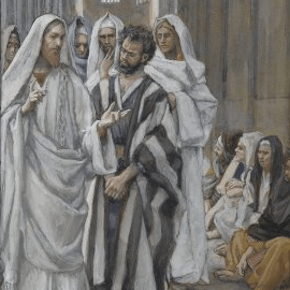
Art: Detail from “Jesus Walks in the Portico of Solomon” by James Tissot