
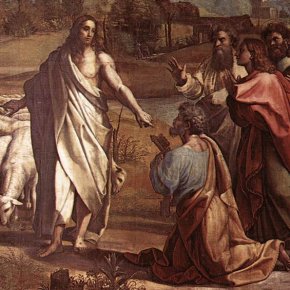
Sermon for Sunday, August 24, 2014 || Proper 16A || Matthew 16:13-20
(A problem with our sound system rendered the audio for this sermon unusable.)
 For as long as I can remember, my father has worn a cross beneath his clothing, resting on his skin close to his heart. So when my parents gave me a cross of my own to wear when I was in my early teen years, I was thrilled. I was going to be just like Dad, wearing my cross all the time, even in the shower! The trouble was I kept losing it. I couldn’t wear the cross all the time because I played soccer, and there was a “no jewelry” rule. So it would get lost in the depths of my soccer bag (which was not a place for the faint of heart). The chain broke once, but I managed to find the cross beneath the seat of my car. Then during my freshman year of college the chain broke again, and I lost the cross for good.
At that time, I was just beginning to glimpse the edge of the expanse of the life God was calling me into, so I was quite upset at losing my cross. I’m not naturally a superstitious person, but I took it as a bad omen. So two weeks before I turned nineteen, I went to a local tattoo parlor and emerged a few hours later with a Celtic cross indelibly inked on my back. It was my way of telling myself that I was, indeed, a follower of Jesus, that if push came to shove there was no way to deny my identity. At baptism I was marked with oil as “Christ’s own forever,” but now I was visibly marked as Christ’s own.
And yet, walking out of the tattoo parlor on that fine January day, I don’t think I could have told you what it meant to me to be a follower of Jesus. I think I could do a bit better job today, but such meaning-making will take the rest of my lifetime to unfold, so check back with me again sometime. What’s telling is that – in my tattoo experience – I identified as “follower.” Since I put myself in the position of “follower,” for me Jesus took on the identity of “guide.”
As my guide, or better yet my “trailblazer,” I envisioned Jesus walking ahead of me, as if we were tramping through a marsh and he knew where it was safe to place one’s feet. Because he was my trailblazer and I his follower, I attempted to step where he stepped and to stay on the path he showed me. When people learned I was in the process to become an ordained minister, they asked if I was following in my father’s footsteps. I responded, “No,” because in my mind, we were both following in Jesus’ footsteps. Thus, in my language and in my imagination – two of the most potent vehicles for meaning-making – I identified as the follower of a trailblazer.
But the trailblazer-follower relationship is only one of myriad possibilities. And this is why today’s story from the Gospel according to Matthew is so important for us today. You see, when Jesus asks the disciples, “Who do you say that I am?” he’s really asking them, “What kind of relationship do you want to have with me?”
This powerful secondary question hovers just beneath the primary one because no matter what the disciples say, they set up the presumption of a relationship. Let’s take Simon Peter’s answer, for instance. I imagine his words rushing from Peter’s mouth all at once, as if an unseen force reached into his heart and yanked them out: “You are the Messiah, the Son of the Living God.”
So if Peter names Jesus “Messiah,” what title would Peter use for himself to relate to this identity? Would it surprise you if I said soldier? The title of “Messiah” was something of a political identity at this time in Israel. The Jewish Messiah was supposed to be a warrior like the great King David, who swept away the forces occupying Israel with his martial prowess. It’s not a coincidence at all that Matthew sets this exchange in the city of Ceasarea Phillipi, a city named for the Roman Emperor. Peter’s confession of Jesus as Messiah tacitly sets Jesus against the power of occupying Rome. That Peter identifies as a soldier in the Messiah’s army is made clear both in his use of a sword when Jesus is arrested and in the very next passage after ours today. We’ll read it next week, but here’s a spoiler. Jesus reveals to the disciples what is going to happen to him – namely something basically the opposite of kicking the Romans out of Israel – and Peter is stunned to hear the Messiah will die. Another set of words rips itself from Peter: “God forbid it, Lord! This must never happen to you.”
It takes the rest of the Gospel, and indeed the rest of Peter’s life, to fathom Jesus’ understanding of “Messiah.” Peter’s journey takes him from confession to denial to redemption to proclamation as he struggles with his relationship to Jesus in light of calling him Messiah. By the end of his time in the book of Acts, Peter has moved from soldier to something of a herald of Jesus’ understanding of Messiah-ship.
So Peter undergoes a long transformation of his identity in the light of calling Jesus Messiah. I still think of Jesus as my trailblazer, and I try to follow his steps. But what of you? When Jesus puts this question to you, who do you say that he is? And what does that say about the kind of relationship you want to have with him?
Perhaps you answer that Jesus is “Lord,” which makes you his “subject.” If so, this means you cede your sovereignty over to him. You surrender your will to his. You are a vassal and he is your liege. We might not want to give up our autonomy to a higher power, knowing as we do how badly that turns out most of the time here on earth. But Jesus is a Lord who is trustworthy and true, and giving up our wills for his leads not to enslavement but to freedom.
Perhaps you answer not Lord but “Teacher.” This makes you Jesus’ “student.” If so, you desire to learn all you can from him, both by searching the scriptures and listening for his instruction as you pray. We have so much to learn from Jesus our teacher, and we will never graduate from his class, not until we “know fully, even as we are fully known.”
Perhaps you answer not Lord or Teacher, but “Savior.” Thus, you relate to Jesus as someone who needs saving. He is the knight in shining armor and you are in distress in the dragon’s lair. As our savior, Jesus accomplished the great work set before him between the cross and the empty tomb. But if we let him, his presence in our lives continues to save us from all the small, yet debilitating, ways we drift towards annihilation.
And if not Lord or Teacher or Savior, how about “Friend?” If Jesus is your friend, then you are his. This is not blasphemy, for Jesus calls his disciples friends in the upper room on the night of his arrest. As a friend, a companion, Jesus is not walking ahead of us blazing the path. Rather, he is walking with us, hand in hand, as we discover the way together.
Of course, these ways of answering Jesus’ question are not mutually exclusive. Jesus is trailblazer and Messiah and Lord and teacher and savior and friend. And that is just a small sampling. Answering his question – “Who do you say that I am?” – does not limit our relationships with him, but it does define them. Discerning how we relate to Jesus at any given time or in any given situation will only serve to strengthen our relationships with him. And the more we follow our trailblazer and proclaim our Messiah and serve our Lord and learn from our teacher and reach out to our Savior and walk with our friend Jesus Christ, the better and fuller and deeper will we answer his call in our lives.
—
 Good morning! It’s good to be back after three weeks away. I know I’ve only been next door, but it seems like another world when newborns are filling all your waking (and the few sleeping) moments. I seriously thought about skipping this sermon entirely and just showing you baby pictures for the next ten minutes, but then I realized lemonade on the lawn might be a better venue for that. So, let’s get down to the sermon.
 Dear Baby Boy and Baby Girl,
 Okay, to start off: I’m not going to preach this morning about my rapidly approaching fatherhood. But I just want to point out God’s divine sense of humor in us reading in the Hebrew Scripture a story about the birth of twins. Rather, this morning, I’m going to preach about God’s persistence and God’s extravagance. To do this, I’d like to talk about the second of my three days of Godly Play training.
 I confess: I have babies on the brain. I hope you’ll forgive me another sermon that springs from my impending fatherhood. I promise that in the years to come not all my sermons will generate from this experience. But it’s all I can think about right now, so naturally, in a Gospel lesson crammed with various fabulous sermonic content, I would gravitate to the verse about babies. Jesus says, “I thank you, Father, Lord of heaven and earth, because you have hidden these things from the wise and the intelligent and have revealed them to infants; yes, Father, for such was your gracious will.”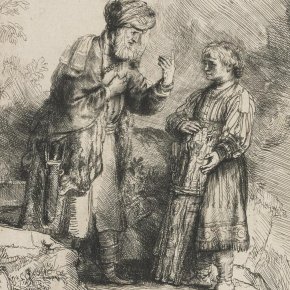
 As I contemplate my impending fatherhood, the story of the binding of Isaac, which we read a few minutes ago, has taken on new meaning for me. I’ve always struggled with this story, and, if you’ve ever read or heard it, I’m sure you have, too. This reading from the Hebrew Scripture brings up so many questions: why would God ever test someone in such a barbaric way? How could God be so apparently abusive? How could Abraham even think about going through with it? If the angel hadn’t stopped him, would Abraham actually have killed his son? What would that prove?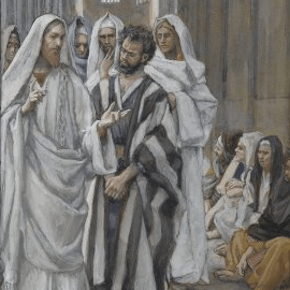
 Sometimes when we pull a piece of the Gospel out of its natural habitat and read it in our cozy New England church, the impact of the words changes. Take the lesson I just finished, for example. How surprised would you be to learn that Jesus is trying to comfort his disciples with these words? You just heard them. They don’t sound very comforting, do they?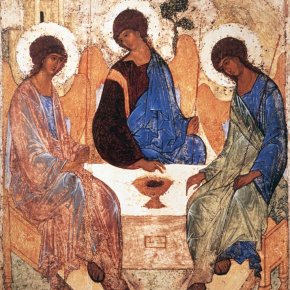
 As most of you know, Leah and I are expecting twins in just a couple of weeks. I’ll let you in on a little secret. I am so excited. And terrified. And excited. Whenever I think of the immensity of the change that is about to take place in our lives, I get this “deer in the headlights” look on my face for a minute. But then I remember to breath, and I remember that we’re going to have a lot of help and support, and I remember what Jesus says at the end of today’s Gospel reading: “I am with you always.” And all that helps.
 Being a creative type, I have found myself relating to the Holy Spirit more readily than most people do. Whenever I sit down to write or play my guitar, I try to acknowledge the Holy Spirit’s presence in that creative activity. I’ve always thought of the Holy Spirit as God’s creativity in the act of making and molding and speaking existence into being. And I’ve always thought of my own creativity as my response to the Holy Spirit moving in my life. The Holy Spirit, then, is the in-spir-ation for my creativity. The Spirit inspires. The two words even come from the same Latin root!
 I couldn’t help but notice the readings selected for today all have some flavor of courtroom drama. We have the Apostle Paul sightseeing around Athens and discovering an out of the way shrine dedicated “to an unknown god.” When he stands up to debate at the Areopagus (the Athenian equivalent of the Supreme Court), he proclaims to the Athenians that this unknown god is the God who created all that is, the God of Abraham and his descendants, the God and Father of our Lord Jesus Christ. At the end of his speech, some scoff at him and leave; others are intrigued and join Paul on his journey.
 Where the Wind...