

Sermon for Sunday, November 2, 2014 || All Saints Year A
 The feast of All Saints, which we celebrate today, is about family, namely the family of God. Each saint has a special day commemorating his or her life of devotion and service, but on this day we celebrate all of them. We celebrate them collectively: not as a group of individuals who walked the way of discipleship alone, but as the glistening threads of God’s tapestry woven together to tell the story of God’s presence in creation since the time of Jesus. However, this tapestry is vast, so much bigger than the threads of particular saints could fashion, and so God weaves other threads into the warp and weft in order to complete the story. I have a thread. You have a thread. And Reggie, the beautiful six-month old collection of smiles and joy we’ll be baptizing in a few minutes, has a thread. The tapestry God continues to weave is the story of God’s family from the dawn of time. It is the story of the people of Israel. It is the story of the Gospel. And it is our story because we are all members of God’s great family. Today, we celebrate God weaving us together with all the saints into the story of this great family. And today, we celebrate bringing another person into that story, into this great family, when we baptize Reggie.
So what’s really going on in baptism? The traditional understanding tells us that baptism serves as the initiatory rite of the church and marks the cleansing of our sins. Now neither of these definitions is wrong (let me be clear), but I think if we stop there we will be prone to misunderstanding. We need to dig a little deeper. Here’s one thing to remember about baptism, and this will be on the test (there’s no test): the sacrament of baptism affirms and celebrates a state of being that already exists. The action of baptizing doesn’t create anything new; rather, the sacrament marks our participation in something God is already doing.
Here’s what I mean. At the end of the baptism service, we will welcome Reggie saying: “We receive you into the household of God. Confess the faith of Christ crucified, proclaim his resurrection, and share with us in his eternal priesthood.” However, by virtue of Reggie being born in the image and likeness of God, he is already a member of God’s family. He is already part of God’s household. He already has a thread in God’s tapestry. Thus, his baptism is an affirmation and celebration of a state of being he already possesses. Today we will celebrate his membership in God’s family so that we can see the deep truth of God’s reality: that we are all members of that family.
Participating in this deep truth is what makes baptism one of the sacraments of the faith. If you’ve taken a confirmation class or CCD in the Roman Catholic Church, then you might remember the classic definition of a sacrament: An outward and visible sign of an inward and spiritual grace. Another way to put this is that sacraments are windows through which God gives us the gift of viewing the true and eternal reality of God’s movement in creation. Sacraments take ordinary, everyday things – water and bread, for example – and use them to reveal extraordinary holiness hidden in plain sight.
When we baptize Reggie, the hidden will be revealed for a moment, and we will see the unconditional love of God embracing a soul who has never done a thing to earn that love. And we will learn once again that we can do nothing to earn it either. We can only respond to God’s unconditional love in our lives.
If Reggie has done nothing to earn God’s love, then neither has he done anything to reject it, so you might be wondering why we baptize to cleanse sins, which you’ll recall was the second part of our traditional understanding of baptism. Once again, we are affirming and celebrating a state of being that already exists.
The word “baptism” sounds all fancy until you dig down to its roots. “Baptism” simply means “to wash.” When we bathe, we scrub away all the dirt and sweat and grime that accumulates during our day-to-day lives. We have to bathe regularly because we get dirty regularly. But we baptize only once because baptism is a celebration that our sins are forgiven – not just the ones we already committed but all of our sins past and future, everything that has, does, or will separate us from God. When we wash in the waters of baptism, we join God’s reality in progress, a reality in which nothing in all creation can separate us from God’s love. The sacrament of baptism allows us to mark the beginning of our participation in this reality.
So if baptism is an affirmation and celebration of a state of being that already exists, you might be wondering if it asks anything of us at all. If we’re just jumping into a river that’s already flowing, what is our responsibility in all of this?
Well, the action of baptism takes place in a few seconds at the font behind me. We’ll pour a few ounces of blessed water on Reggie’s forehead, say the words, and that will be that. But the baptismal life continues from that moment on. The baptismal life is a sacramental life, a life in which each baptized person becomes one of those windows into the true and eternal reality of God’s movement in creation. Thus baptism invites us into deeper commitment as followers of Jesus Christ, deeper relationship with God, and deeper resonance with the Holy Spirit’s presence.
When we reaffirm our Baptismal Covenant in a moment, we will promise with God’s help to commit ourselves once again to serve God in this world. We will remember that nothing separates us from God’s love, that we are all members of God’s great family, that we all have threads woven into God’s tapestry. And we will celebrate that God invites us to live baptismal lives, committed to bearing witness to the true and deep reality of God’s presence in creation.

 English is a strange language. We have thousands upon thousands of words – more than most languages – and more get added every year. And still there are plenty of instances in the English language where we employ the same word to speak about multiple concepts. I can’t bear to be in the same room as him. The apple trees are about to bear fruit. Yikes, there’s a bear in our campsite! Now bear with me. This idiosyncrasy of English often leads to confusion, especially among non-native speakers. What’s worse is that it can also lead to a concept being watered down, diluted when the various understandings of the word start to merge.
 “Give therefore to the emperor the things that are the emperor’s, and to God the things that are God’s.” Give to God the things that are God’s. Two weeks ago in the sermon and last week at the forum hour between services, we talked quite a bit about giving to God. We said that all giving to God is really and truly giving back to God. We said that good stewardship comprehends the intentional awareness that what we have isn’t really ours; therefore we cultivate an attitude in which all that we are and all that we have is a gift given back and forth between us and God.
 Today I’d like to do something a little different. Do you remember how, in math classes, your teacher told you to “show your work” in order to get full credit for answering a question? Well, this morning, I’m going to show my work as we go through this sermon together. Rather than just give you the end product of my Bible study, my struggles and false starts, and my attempts to listen to the Holy Spirit, I thought I’d pull back the curtain and show you some of the process.
 Because of my peculiar and very frustrating allergy, there’s one aisle of the grocery store I never travel down – the bread aisle. If you read the nutrition information on each and every plastic-wrapped and twist-tied loaf, you’ll find it contains soy flour, which means I can’t eat it. But there’s a happy byproduct of this limitation. Because I can’t eat the store bought loaves, Leah makes our bread from scratch. And, boy, is it good. I’ve watched her make it on several occasions. She starts by activating the yeast in warm water. She mixes the ingredients in the Kitchen Aid, counting the cups of flour aloud so she doesn’t put in too much. She let’s the dough hook work its kneading magic. She waits for the dough to rise, first in the mixer, and then, after forming the loaves, in the pans before putting them in the oven. The whole process takes the better part of a morning.
 I started writing this sermon at 5:30 in the morning last Wednesday. I was sitting on the floor in the living room with my eight-week old son sleeping fitfully on my lap. In the minutes preceding opening my laptop to write, I gave him a bottle in the stillness and darkness of the hour before dawn. Just enough light drifted in from the kitchen that I could see his face in the darkness. He was looking at me intently as he sucked down the bottle. I gazed back at him, and that’s when I felt it. I felt this impenetrable feeling of rightness, of completion. I felt “the glow.”
 My twins are not quite two months old, and yet I wonder when they will first look at the other and feel jealous. It might be my imagination, but I swear I’ve seen a barely perceptible glint in my daughter’s eye while she’s rocking away in the mechanical swing and I’m holding her brother – a barely perceptible glint of envy. Her eyes haven’t settled on a color yet, but I would swear in those few moments that they were green.
 Imagine with me the Apostle Peter in prison in Rome near the end of his life. He is talking to his cellmate, a new convert to the Way of Jesus Christ.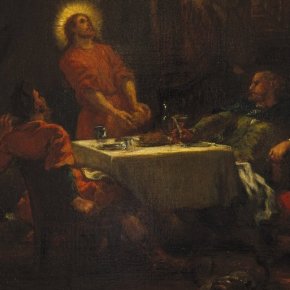
 “For when two or three are gathered together in my name, I am there among them.” I’ve always heard these famous words of Jesus as an astonishing promise, as a steadfast assurance that Christ is present in our midst no matter what. If you’ve ever been to a church gathering where only a few people showed up, I bet someone said, rather wistfully, “Well, when two or three are gathered…” I’ve said the same many times as a way to remind myself that what we’re doing when we gather as the church, as the body of those whose faith and action is motivated by the life, death, and resurrection of Jesus Christ, is important, no matter the size of the group.
 I’ll tell you all the truth: I’ve been struggling lately. The day the twins were born, about a month ago now, life took a dramatic turn. I knew this tectonic shift in life was going to happen, but I sure wasn’t prepared for it. At times over the past month, I have felt helpless. I have felt frantic. I have felt desperately inadequate. The learning curve for new parenthood is steep, and I’ve had to adjust my expectations about how fast I catch on. I’ve always been a quick study, but in this particular case, there’s no substitute for the exhausting daily grind of caring for the twins. I guess what I’m trying to say is that I knew it was going to be hard, but my definition of “hard” has never reached the superlative level of caring for multiple newborns.
 Where the Wind...