Christmas Pageant 2022
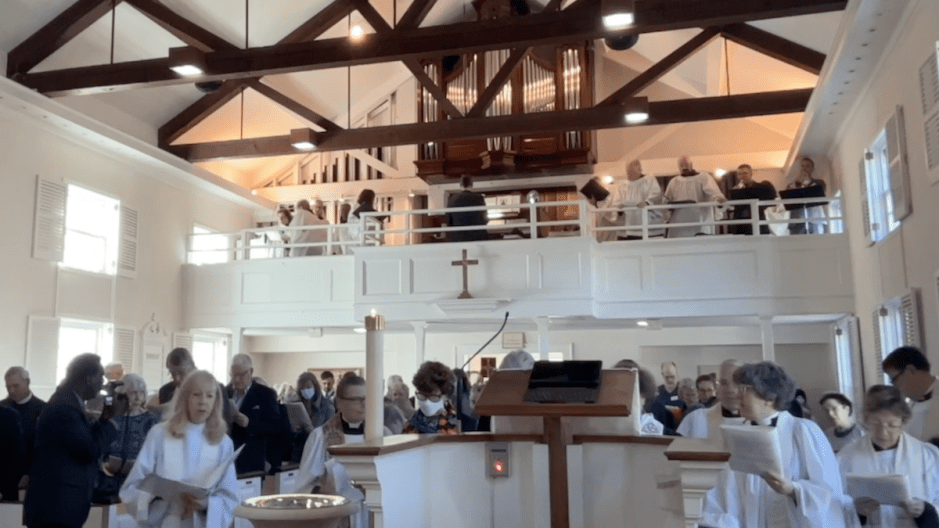
This is the text of the Christmas Pageant I wrote for this year, which was performed by the children at the 10am service at St. Mark’s on December 18th.
Continue reading “A New Song”This is the text of the Christmas Pageant I wrote for this year, which was performed by the children at the 10am service at St. Mark’s on December 18th.
Continue reading “A New Song”Imagine with me a letter written by Joseph to his father on the night Joseph had the dream of the angel that today’s Gospel reading narrated.
Joseph, eldest son and protégé, to Jacob, my father, mentor, and confidant: Blessings and peace to you, my mother, and my brothers and sisters.
By the time you read this letter, I will have left home. I awoke in the still hours of the night to write it, and I imagine that when I leave, the sun will be many hours from rising. I hope someday you will welcome me back into this house. I know it will not be tomorrow or the next day. But someday, I hope.
Continue reading “Joseph’s Letter”Today I’m going to talk about the concept of repentance. But to get there, I need to talk about my experience of the fire here in Mystic that destroyed Seaport Marine last Sunday night. On Sunday evenings, Leah and I play Dungeons and Dragons with some friends in our basement. We were wrapping up our game when we heard a thunk coming from upstairs. Leah went to investigate and found a book had fallen off of one of the kids’ beds. No big deal. But right when she got back downstairs, we heard another thunk, and then another. But they weren’t thunks. They were explosions.
We went outside into the parking lot and that’s when we saw the intense orange glow filling the sky over the buildings in downtown Mystic. Orange smoke poured northward, deepening to gray then black as it billowed forth. We could see flames above the buildings. Sirens rent the air, a near constant wail of fire trucks from all over the region screaming towards the blaze. The trouble for the six of us, however, was that, from our position, we couldn’t tell where the fire was. We couldn’t tell where the fire trucks were headed. I climbed out onto the roof of the education wing to try to get a better look, but I still couldn’t tell what was on fire.
Continue reading “The Fire”Sermon for Sunday, November 20, 2022 || Reign of Christ C || Jeremiah 23:1-6
Today is the final Sunday of the church year, the day on which we celebrate the Reign of Christ. Next week, we begin a new church year with the season of Advent. Both today’s event and the season of Advent share a similar theological lens. They both celebrate a present reality that is always happening AND a future reality that fulfills or completes the present one, a future reality that we long for and hope for, but has not yet come to pass.
We tend to shorten these two realities into two camps: the “already” and the “not yet.” The upcoming season of Advent is a time when we celebrate the constant presence of Christ (that’s the “already”) while we also wait in hope for the second coming of Christ (that’s the “not yet”). And today, on this day we celebrate the Reign of Christ, we recognize God’s kingdom as the ever-present reality undergirding all of Creation (that’s the “already”) while we also recognize the continual need to partner with God to make that reality even more present across our broken world (that’s the “not yet”).
Today is also the day where the Greater New London Clergy Association, a group of several dozen pastors, priests, and rabbis from the region, (we all) decided to preach on the same topic – the housing crisis in Southeastern Connecticut. So I thought to myself: how am I going to talk about the housing crisis and about the Reign of Christ in the same sermon? And the answer hit me very quickly. The biggest obstacle to solving the housing crisis is also something that runs absolutely counter to the Reign of Christ.
Continue reading “NIMBY and the Reign of Christ”You all know that one of my favorite Bible study exercises is reconstructing the questions Jesus wishes he would have been asked. So often in the Gospel, Jesus does not answer questions directly. People ask him questions, and frequently, his answers don’t line up with what they ask. This pattern happens often enough in the Gospel that I’d bet it was a hallmark of Jesus’ conversational style. And let me be clear, Jesus doesn’t dodge questions or spin them towards talking points like a politician. Rather, Jesus answers the deeper questions he hopes people would ask.
Continue reading “Pretenders”Today we celebrate the feast of All Saints. (The actual day was last Tuesday, November 1st, but we celebrate this holy day on the following Sunday.) I’d like to take this opportunity to talk with you about the saints, especially about how they can inspire us to follow Christ more closely.
Continue reading “The Uncommon Lives of Saints”The last three Sundays, I stumbled my way into a sermon series on prayer. Three weeks ago, we talked about prayers of thanksgiving shaping our lives. Two weeks ago, we talked about prayer as a response to God’s constant invitations. And last week, we talked about making sure God is the subject of our prayers and not our own egos. Which brings me to today. Today we’re going to talk about a specific type of prayer – intercessory prayer. So, with four Sundays in a row all on one topic, I’ve decided to call this month my “Accidental Sermon Series About Prayer.”
Continue reading “Intercession”Today’s sermon is a natural follow-up to last week’s, so here’s a quick recap. When we pray, we never initiate a prayer; we only ever respond to God’s invitation to pray. Everything we do in response to God’s movement in our lives is a form of prayer. Everything – literally everything – begins with God. And in our lives of faith, we can inhabit right relationships with God and one another when we humbly recognize our true place in the great web of relationships. Here’s a hint: it’s not in the middle.
But our egos try to convince us otherwise. Or maybe I shouldn’t pluralize that. Let me try again. MY ego tries to convince me otherwise. My ego tells me that of course I’m in the middle, that of course my identity should be centered above all others, that of course any experience that didn’t happen to me is not valid. There are centuries of unjust social structures that buttress these things my ego tells me. And so I have to practice reminding myself that my ego is lying to me, that I am not, in fact, the center of the universe.
And still, that sneaky sneaky ego keeps tricking me. Here’s a recent example.
Continue reading “Intentions, Revisited”“Jesus told his disciples a parable about their need to pray always and not to lose heart.” So Luke tells us before sharing the story of a woman whose primary attribute is her unflagging persistence. But I wonder how many of us might like to tiptoe past Jesus’ reason for telling the story in the first place – his desire for his followers (then and now) to pray with dogged persistence, to pray always.
We might like to tiptoe past this notion because it seems so unrealistic. How could we possibly pray all the time? Maybe Jesus is thinking that if he starts as high as “always,” then when we bargain him down, we’ll still be praying sometimes.
Or maybe not. Jesus doesn’t really seem to be one for haggling. Maybe he really does yearn for us to pray always, to pray with the same unflagging persistence as the widow demonstrates in her quest for justice. If that’s the case, then the popular understanding of prayer isn’t going to cut it; that is, an understanding of prayer as simple wish fulfillment. We need a bigger definition of prayer.
Continue reading “Calling to You”I’d like to talk today about the action of giving thanks. In today’s Gospel lesson, Jesus heals ten people of the skin conditions that have marginalized them from their society. One of them returns and thanks Jesus for healing him. And Jesus commends him for his faith. If you remember from last week, faith sharpens our vision and motivates our actions. This person, who is healed of his leprosy, acts on his faith in Jesus by giving thanks to him. We can learn from his example and find God’s abundance in so many surprising places in our lives when we intentionally practice thanksgiving. At the end of this sermon, we’re going to sing a song about thanksgiving that I guarantee is going to get stuck in your heads, so…fair warning.
But for the bulk of my time with you this morning, I’d like to take you through a framework for intentionally giving thanks that you can use every day. Your program has a bookmark of this framework stapled to it, which I invite you to take home with you today. This framework splits our thanksgivings into five categories: the Now, the Always, the Never, the Past, and the Future. I know that sounds vague and strange, but stick with me. We’ll give each one about a minute, starting with the Now.
Continue reading “See All the Gifts“