Three squares a day

My friend Paula, who writes the blog Welcoming Spirit, recently challenged her readers to take on a discipline for thirty days. I am a week into mine and I’ll tell you, it’s not going so well. You’d think a priest would be better at remembering to pray at meals. I mean, look at the Eucharistic meal — I pray for a solid five minutes before anyone gets to eat anything. But for some reason or other, I’m just not that disciplined at praying before my three squares a day.

Well, not “some reason or other.” Honestly, I know the reasons. When I lived at home with my parents, we had our dinnertime rites. We tried not to answer the phone, though the thirty second pause to listen for the machine made that rule laughably futile. We always put our napkins on our laps and kept our elbows off the table. And we always prayed. (My father usually tapped the person who unsuccessfully failed to make eye contact with him. If everyone succeeded, he led the prayer.)

Now that I live on my own and take most of my meals alone, I have yet to develop the discipline of thanking God for all of God’s blessings, of which the meal is a palpable reminder. I am one week into my intentional practice, and I am doing dreadfully. I’m two for two today, but over the course of the week, I can’t have remembered more than three out of ten. That average would be great if I were a baseball player, since no other job in the universe measures success at thirty percent.

But I’m not a baseball player. I’m a priest. I’m supposed to be the one who remembers to pray — 100% of the time. Prayers should be the first words that spring to my lips in the morning and the last ones to whisper out when I fall asleep. Prayer should be as natural as breathing, should happen with each of my breaths.

It doesn’t, God knows. Too often, I just forget to pray. Not the best example, I know. Neither were the disciples, and from them I take a measure of hope. They follow Jesus around, they hear his words, they cast out demons and heal the sick. But they only get it three out of ten times. They bicker about which is the greatest, they bar people’s access to Jesus, and they abandon him.

I’m not saying that the disciples’ example gives me a free pass. They mess up, they misunderstand, but Jesus stays in relationship with them. He even repairs his relationship with Simon Peter after this most adamant follower denies him three times. Peter, do you love me? You know I do, Lord. Then feed my sheep.*

Jesus has invested way too much time and energy in me to give up now. Indeed, his resurrection shows me that he’ll never give up on me, even after I die. Everyday, he invites me into a deeper relationship with him, and  I usually ignore the invitation. I prefer, instead, to wade in the shallow end, to make sure my feet can touch the bottom.

But there are those days — few and far between — that I acknowledge my apathy and ask God to help me float into the deeper waters. And I find the strength to accept the invitation.

As I write this, one of my favorite songs from my college years is playing on my Itunes. The chorus of Jennifer Knapp’s “Hold Me Now” goes like this: “I’m weak, I’m poor. I’m broken, Lord, but I’m yours. Hold me now.”

My apathy and forgetfulness about praying before meals (among other things) stem from my grasping, prideful illusion that I need not rely on God. Perhaps, deep down, I don’t really believe that God will claim me if I’m weak or poor or broken. But that’s not how God operates. Nothing I do will elevate me past weakness or paucity or brokenness. Only when I allow God to hold me in the palm of God’s hand can I find strength. Only when I take part in the relationship into which Jesus calls me can I find abundance. Only when I let go the illusion can I see the reality of God making me whole.

Praying before meals may seem like a small step, but it is an essential one. It creates a pattern, a practice, a discipline. If I remember to pause even three times a day to thank God for God’s presence in my life, then perhaps my illusory self-reliance will begin to fall away. Perhaps I’ll remember that God has blessed me to be a blessing to others. Perhaps I’ll hear Jesus ask, “Adam, do you love me?”

And I’ll be able to say, “You know I do, Lord.”

Then feed my sheep.

Footnotes
* John 21:15-17

Voices

Sometimes, when I’m praying with a small group — say, the ladies at Morning Prayer whom I have mentioned before — I stop speaking aloud and listen instead. Starting with the woman closest to me, I try to pick out each voice.

Our Father, who art in heaven, she begins. Her voice is measured, calm, the sound of warm milk being poured into a glass for a child who can’t fall asleep. Hallowed be thy name. I imagine her voice checking off ingredients as she pulls baking powder and brown sugar from her cupboard. Her apron has a floury hand print below the pocket, into which she replaces the battered heirloom of a recipe card. I can taste the flaky crust of her apple pie.

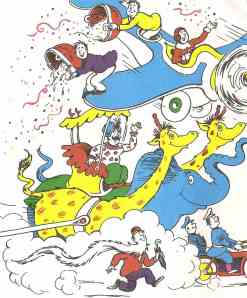
And to Think That I Saw It on Mulberry Street, by Dr. Seuss, 1937

Thy kingdom come, thy will be done. I shift my focus to the dear heart across the aisle. Her voice is honey and love, the sound of grass on a hillside when you’re having a picnic and have to weigh down the napkins with the salt and pepper shakers. On earth as it is in heaven. I imagine her voice reading Dr. Seuss and Shel Silverstein to laughing children who sit cross-legged on mats and never want naptime to come. At the end of each page, she makes sure all of the children have seen the pictures. I laugh, too, when the airplane drops confetti near the end of ” And to Think that I Saw It on Mulberry Street.”

Give us this day our daily bread. I strain to hear the woman next to her. Her voice is soft but durable, the sound of late afternoon rain watering patchwork fields and seeping into the clay. And forgive us our trespasses, as we forgive those who trespass against us. I imagine her speaking comfort in the ICU, her words keeping time with the pinging heart monitor. She holds a frail hand in both of hers, careful not to disturb the needle and tape and gauze and drip-drip of the IV bag. I stand in the doorway with my stomach in my throat and watch her care.

And lead us not into temptation. The last lady is easy to pick out because she is always a few words ahead of everyone else. Her voice is crystal, weightless, the sound of water splashing out of a bucket as it is rises haltingly from the depths of a stone-lined well. But deliver us from evil. I imagine her voice distributing presents on Christmas morning after all the adults have gotten coffee and hot-cross buns. She thanks her grandchildren for their gifts of pipe cleaner and popsicle stick ornaments. I wait for her to call my name and shake a present in my direction.

My focus dissipates, and I join the four woman for the conclusion. For thine is the kingdom, and the power, and the glory, forever and ever. Our voices mix into one voice — warm milk and rain, windswept grass and splashing water, and my voice, which always sounds strange to me when I hear it on a recording. We raise that voice as one to the One that gave us voice. And after our Amen we fall silent.

And we listen.

“If we only had a wheelbarrow…”

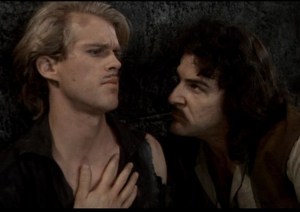
princessbrideThe situation looks hopeless. The odds are twenty to one against, and one-third of their party has just been revived after being mostly dead all day. Westley, Inigo, and Fezzek peer furtively at the newly improved defenses of the castle gate. They have only Westley’s brain, Inigo’s steel, and Fezzek’s strength against 60 men. “If I had a month to plan I might come up with something,” says Westley. Then, half to himself, “If  we only had a wheelbarrow, that would be something.” It turns out, upon second thought, they do have a wheelbarrow; and, upon third thought, a fire-resistant cloak. With this rather odd pairing of materials, they break into the castle, save the princess, steal the prince’s beautiful horses, and make a daring escape. On the walltop over looking the castle, the three heroes make their plan. Here’s the progression as I see it: they state the problem (breaking into a castle guarded by sixty men); they say what they do not have (a month to plan); they re-examine their assets (a cloak and a wheelbarrow); they overcome the problem even though their assets are meager.*

A similar progression, with an all-important extra step, happens when Jesus feeds the five thousand people (as told in Chapter 6 of the Gospel according to John). A large crowd is following Jesus because they like a good spectacle. Jesus has just healed the man at the pool of Bethzatha, so the crowd knows they won’t be disappointed. Jesus goes up the mountain with his disciples and looks down, surveying the vast multitude spread out below him. They could ignore the crowd, and, judging by Philip’s response to Jesus’ question the disciples probably wanted to. But Jesus does not give them that option. Instead, he states the problem: “Where are we to buy bread for these people to eat?” Philip (characteristically for this Gospel) answers a different question than the one Jesus asks. He says what they do not have: “Six months wages would not buy enough bread for each of them to get a little.” Then Andrew re-examines their assets: a little boy has five barley loaves and two fish. Notice how wildly inadequate this amount of food is for so many; I bet Andrew felt foolish even bringing it up.

But Jesus seems to think this very foolishness is just the sort of thing needed to solve such an intractable problem. So he takes the loaves and fish and then adds the all-important extra step in the progression. He gives thanks. He gives thanks even though he has a loaf per thousand people. He gives thanks even though the situation seems impossible. He does not let the apparent meagerness of his resources dictate whether or not he offers thanks to God. He gives thanks, and the crowd eats, and the disciples gather up twelve full baskets. The crowd is looking for a spectacle and they get such a grand one that they try to take Jesus and make him king.

Let’s take another look at the giving thanks. The special word for The Lord’s Supper or Holy Communion is “Eucharist.” (N.B. “Eucharist” comprehends the entire Sunday worship experience, but we are focusing here on the second half, the meal.) When we worship God by sharing this meal, we pray to Christ to somehow enter the bread and wine. Then we break the bread and share the cup, thus sharing Christ with each other. And our eyes are opened to the reality that the love of Christ is inside us and is made known in the sharing of community and love with each other.

The fancy word “Eucharist” is a much less fancy word if you happen to be both from Asia Minor and two thousand years old. This strange looking word simply means “to give thanks.” So, when we come together to share the meal, we are coming together to give thanks to God for all the blessings God has bestowed upon us. The fact that this intentional thanksgiving happens in a community reminds us that we must share our blessings just as we share the body and blood of Christ. And it is the very dwelling of Christ in us and we in him that sustains us as we share with others.

When I give thanks to God for the blessings and gifts God has given me, I must remember that thanksgiving is the catalyst for sharing. If I do not share my gifts with others, then I have not truly thanked God for them. Let me say that again, make it plural, and italicize it so you don’t miss it: If we do not share our gifts with others, then we have not truly thanked God for them

Sometimes, these gifts may seem meager or inadequate. But those are the times we must remember that Christ is there with us, giving thanks for us, and breaking us so he can share himself through us.

Footnotes

* The Princess Bride (1987); dir. Rob Reiner. Watch this film ASAP if you’ve never seen it. In fact, just go home right now and watch it. I’ll lend you my DVD.

Sensuous

Episcopalians are often accused of being too brainy, too intellectual. We think too much. We get caught up in the space between our ears and forget about that throbbing muscle in our chests. These accusers are correct up to a point: we do not check our brains at the door. Jesus asks us to love the Lord with all our mind, as well as our heart and strength. But our intellectual engagement with faith is only half the story.

You see, worship in the Episcopal Church is quite sensuous. Don’t get me wrong – I’m not talking about the Harlequin romance definition of the word. Our worship is sensuous in that we employ all our senses to encounter the presence of God. We hear the Word of God read and proclaimed. We see the stained glass and changing seasonal color palates. We smell the incense puffing from the thurible.* We taste the bread and wine. We touch one another in the handshake or embrace of the peace of the Lord.

To engage all of our senses, we use things in our worship. We use candles, books, and bowls. We use bread, wine, and water. These things are all incredibly – laughably – ordinary. Nothing about a loaf of bread is inherently special. Hand me a loaf of bread, and I might feed the birds or save it and make French toast tomorrow morning. (Actually, if you know me, the most likely scenario is that I’ll eat the loaf right then and there.)

breadaisleSo, how does the loaf of bread, which was one of a hundred bar coded loaves at the grocery store, transform from a laughably ordinary carbohydrate delivery system to a holy vessel of Christ’s presence? The bread moves from its ordinary location on the shelf in the store to its new, strange location on a linen-draped table in a church. The bread behaves quite normally, sitting there waiting to be eaten.

But the table and the action done to the bread and the people watching the action are not normal. The table is abnormal because it has several tablecloths covering it, some ornate, some plain. The action is abnormal – whoever talks about a loaf of bread before they start slicing it? And the watching is abnormal – unless you’re in the studio audience for Iron Chef, who joins dozens of others in watching someone prepare a meal?

So the bread is laughably ordinary. But the situation is not. The juxtaposition between the normal loaf of bread and the strange way it is being treated invest the ordinary with new meaning. This new meaning turns the bread into a symbol. Now, before we go any further, I want to dispel from your mind any notion of the phrases “it’s only a symbol” or  “it’s merely symbolic.” Symbols are woefully misunderstood things in American culture – like soccer and irony. A symbol is an object that points beyond itself to a deeper truth. Too often, “sign” and “symbol” are used interchangeably, but they are not synonymous. A stop sign lets you know you are supposed to brake at an intersection, but that’s all it tells you. The red octagon doesn’t compel you to ruminate on why you should stop. But a symbol – the cross, for instance – stirs within us all of the historical and theological and emotional resonances of the truth to which it points.

Okay, so the bread is a symbol. It connotes the bounty of harvest, the fruits of the earth, the goodness of creation, the nourishment of our bodies. And when we put it on that table, and a priest (in the presence of God’s people) asks God to indwell that bread with the Spirit of Christ, the bread becomes a special sort of symbol called sacrament.

God moves within us, spurring us to love, praise, act, pray, serve. Outward connections with our inward spiritual lives are called sacraments. These special symbols take the ordinary things we’ve been discussing – bread, water, even our own actions and personhoods – and set them ablaze with physical and emotive evidence of the presence of God.

When we participate in the sacraments, we ourselves become sacramental symbols of God’s movement. Our service to God points to the deeper truth of God’s creation of and love for the world. Worship nourishes us for our role as bearers of God’s image, as vessels of the light of Christ. We enter church as normal, ordinary people, like the loaves of bread on the grocery store shelves. We leave church transformed by our sharing in the presence of Christ with one another. Over time – months, years, lifetimes – the transformation helps us to realize that what we mistook as “normal” was really quite miraculous and extraordinary.

All of the normal, everyday things we use in church gather new meaning when we employ them to worship God. The candle becomes the light of Christ. The bowl becomes the vessel for the waters of baptism. The bread and wine become the Body and Blood. Likewise, we – as sacramental beings – discover new meaning for our lives when we come together to worship the Lord.

Footnotes

*The metal censer on the chain that you swing to disperse the perfumed smoke; sort of like a liturgical yo-yo.

Harmony

Ecce Quam Bonum! These three Latin words are carved in moss-covered stones and lintels of doorways across the campus of my alma mater, the University of the South in Sewanee, Tennessee. Ecce Quam Bonum! “Behold, how good!” These words begin Psalm 133, and they speak of the desire for joyful, harmonious fellowship with our brothers and sisters: “Behold, how good and pleasant it is, when brethren live together in unity!”

The lectionary for the Second Sunday of Easter joins this psalm with three readings, each of which speaks of community and fellowship. In the Acts of the Apostles, Luke paints a happily-ever-after picture of the apostles and their companions, in which the “whole group of those who believed were of one heart and soul” (4:32). In the First Letter of John, the writer says, “We declare to you what we have seen and heard so that you also may have fellowship with us; and truly our fellowship is with the Father and with his Son Jesus Christ” (1:3). In the Gospel, the risen Jesus appears to the disciples as a group, grants them peace, and breathes the Holy Spirit upon them. Thomas is not with the disciples at the time, so as a group they seek him out and tell him the good news. A week later, when Thomas has returned to the fellowship, Jesus once again appears, and Thomas believes.

At church this Sunday, we are baptizing a beautiful newborn, and I can’t think of better lessons to accompany the joyous occasion. The sacrament of Baptism celebrates the inward movement of God in a person’s life by outwardly welcoming that person into God’s family the Church. Hmm… I know that definition sounds incredibly boring and academic, so let me try again, this time with a musical metaphor.

The music of God plays in each one of our hearts. Sometimes the music is soft, a half-whispered lullaby, barely discernible over the din of the world. Sometimes the notes crescendo to a deafening fortissimo that knocks us, weeping, to our knees. Most often, the music sounds as the percussive TUB-thp of our hearts — a rhythm that, if you listen closely, beats in time with the rest of the performing forces of creation.

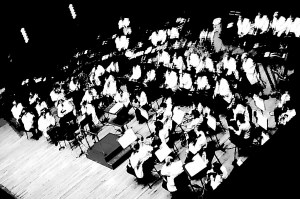
orchestraEach one of us has the music of God resounding within, but the symphony is incomplete until we have found each other, until we have joined together in fellowship as the orchestra of God. In Greek, this fellowship is called koinonia, but I’ve always thought that “fellowship” is a rather limp translation. For the sake of our metaphor, let’s translate koinonia as “harmony,” which lands much closer to the descriptive intent of the Greek word. Musical harmony is the collection of notes that adds structure, color, tone, depth, and meaning to the main tune. This tune, called the “melody” is the music of God within us. The combination of our own unique passions, trials, joys, griefs, and loves creates the harmony of the music of God.

In the sacrament of Holy Baptism, we welcome another violin or French horn or bassoon into the orchestra. We await eagerly the subtle changes in timbre that the new life will bring. Together, we play the koinonia, the harmony, of the music of God to a world so accustomed only to noise and clatter. The movements of our symphony resonate with the movement of God in this world. This is the sacrament of Holy Baptism: new sound, new harmony, new resonance in the symphony of the music of God.

Behold how good and pleasant it is when brethren live and sing and make music together in unity.

Forty days

Americans are rarely a self-reflective people. We have eyes only for result and effect, caring little for process and cause. We seek to assign blame, caring little for our own culpability. We repeat the mistakes of the past, caring little for the lessons those mistakes teach. Never look back. Never let ‘em see you bleed. Never stop to think or the world will pass you by.

Living in this results-driven world is, at the same time, both exceedingly difficult and quite easy. It’s difficult because true joy, the fuel for any fruitful life, is a scarce commodity. Joy happens during not after, and in a results-oriented society, the during is dismissed as superfluous. 50percentBut this dismissal is why the results-driven life is also quite easy. You crop half of life away. The journey becomes unimportant: only the destination matters. How easy would a test be if you only had to score a 50% to pass?
Self-reflection makes life hard, but it also allows us to recognize that joy abounds, poised to infuse our lives with meaning. Because we are such poor practitioners of self-reflection and because our culture tells us not to take time for such a revealingly honest enterprise, we need a swift kick in the trousers to boot us from the grasping current of the results-driven half-life.

In the Church, this swift-kick-in-the-trousers is called the season of Lent. “Lent” is an old translation of the Latin word quadragesima, which simply means “forty days.” Forty days is a significant period of time in the Bible: Noah, Moses, and Elijah all had forty days of something –flooding, fasting, sitting around with God on the mountaintop. Jesus spent forty days in the desert, during which Satan tempted him. Begun this year on February 25 (on the fast the church names “Ash Wednesday”) Lent continues until the day before Easter. Historically, the season of Lent was the period of time that people used to prepare for baptism, which took place at the Great Vigil of Easter on Easter Eve.

During these forty days that bring us to Easter, we examine our lives and discern how attuned to God’s movement we are. We pray for God to create in us clean hearts and renew right spirits within us, as Psalm 51 says. We rededicate ourselves to following Christ and wonder how last year’s dedication faded away. We slow down and turn our thoughts inward. How have my actions and inactions contributed to the brokenness in the world? To what have I enslaved myself? Where is my joy and freedom? Do I really want to follow Christ?

When we enter this period of self-reflection, when we honestly answer questions such as these, it often becomes apparent just how skin deep and results-oriented we’ve become. The season of Lent helps us see the error in statements such as “It’s only cheating if you get caught” and “The ends justify the means.” Living a full life – not a half-life of results only – means valuing the moral fortitude that counters wanton opportunism and caring about how things are accomplished, not just that they are. Observing Lent means taking a hard look at ourselves and borrowing enough strength from God to be capable of seeing those festering things that we usually ignore. Then we borrow enough faith from God to know that God will help us change and will reawaken within us those faculties of hope and love that have long lay dormant.

I invite you to turn your gaze inward during this season of Lent and discover the true joy that comes from a full life lived in the love of God.

* This post began its life as an article in my local newspaper.

The invisible cross

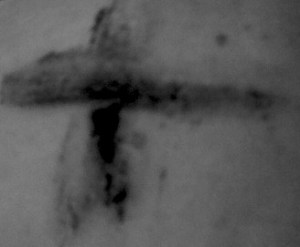
For many years, I became queasy at the thought of having ashes scraped across my forehead — not because they are a reminder of my own mortality, not because I dislike being called to repent, but because I couldn’t square the action with Jesus’ command in the Gospel for the day. In the middle of the Sermon on the Mount, Jesus takes to task those who do things merely for show rather than for dedicated spiritual discipline. “Beware of practicing your piety before others in order to be seen by them,” he says. Don’t sound a trumpet when you give alms. Don’t pray ostentatiously on street corners so others will see you. Don’t disfigure your face when you fast. Give alms, pray, and fast in secret, “and your father who sees in secret will reward you.”ashes

Don’t disfigure your face. These words stuck in my mind while walking to the altar rail, while watching the priest’s trembling thumb touch the powder, while feeling the gritty scrape first vertical then horizontal on my forehead, like sooty sandpaper. Why are we disfiguring our faces when Jesus just told us not to?!

I was preparing a children’s sermon when I realized I had it all wrong. As far back as I can remember, I had not seen the ashes as anything other than a disfigurement, a liturgically pretentious sign that I was a pious person. Everything changed when I tried to explain Lent to a group of five-year-olds.

“Did you know that you have a cross on your forehead,” I asked, arching my eyebrows as high as they could go. They all looked back at me with those funny, squinched up faces that kids make when they are quizzical. Several shook their heads emphatically. “It’s true,” I said, “but the cross on your forehead is invisible.”

That got their attention. They began looking at each other’s foreheads. I continued, “When you were baptized, a priest took some oil and made a cross right here” — I demonstrated on myself — “and said, ‘You are sealed by the Holy Spirit in Baptism and marked as Christ’s own forever.’

“That cross is still there, but you can’t really see it. It’s a reminder that you belong to God and that God loves you very much.” They nodded, open-mouthed. “Today is a special day because today we are going to use some special dust to make that cross appear on your foreheads again.”

On Ash Wednesday, we don’t disfigure our faces so others can see how pious we are. In fact, it’s just the opposite. By making visible again the cross that we received at Baptism, we acknowledge our impiety, our lack of repentance, our apathy to the suffering in the world. The renewed visiblity of our baptismal crosses indicts us for our indifference to our baptismal promises.

We look in the mirror and see a pair of lines, crude charcoal calligraphy. And we remember what it means to be a follower of Christ, to be sealed by the Holy Spirit and marked as Christ’s own forever. We remember that we have only a limited time on this earth to make a difference in the lives of those we meet, to show forth the love and light of God to a world too familiar with darkness. Disfigurement happens when we rub the ashes away and forget that there is still a cross written on our foreheads.

On Ash Wednesday we make that cross visible, if but for a brief time. This small, crudely drawn cross reminds us of another cross, the one that Jesus calls his followers to pick up when they decide to follow him. All too often, this cross also fades into invisibility, a wooden victim of our lethargy and misplaced priorities. During the season of Lent, we are given the opportunity to discern how to make that cross visible again.

Graceful

At today’s weekly healing service, I forgot something rather important. “Today, we are using Eucharist Prayer B found on page 367,” I said, and then a moment later, “The Lord be with you.”

“And also with you” came the reply from seven chilly parishioners (unlike the abiding presence of God, the heat in our building is both scarce and unreliable). We then exchanged the rest of the sursum corda* and I prayed the proper preface for Epiphany. Together, we said the Sanctus, after which I began the rest of the Eucharistic prayer.

“We give thanks to you, O God…” O God, I thought. I looked down. I looked up. O God. I looked down again. My distorted reflection peered up at me out of an empty chalice. I stopped speaking, pulled my hands out of the orans position, and turned around. “It seems that I forgot to put the wine in the chalice. Um…one moment please.”

I finished setting the table, smiling in a mortified kind of way. Then we continued the Eucharistic prayer, and the rest of the service went as expected. As I was walking back to my office, I thought to myself: I can’t believe I forgot to fill the chalice. That wasn’t very graceful of me.

Then I remembered some of the words I heard at my friend’s ordination, which I attended this weekend in Denver. The bishop looked at my friend standing before him and said, “In all that you do, you are to nourish Christ’s people from the riches of his grace…”

Nourish Christ’s people from the riches of his grace. What a phrase. At my own ordination, these words passed right through my sternum and took up residency in the neighborhood of my left ventricle. They set me on fire and I never thought I’d stop burning. But in the last seven months, I somehow forgot the message of these words. I don’t know — maybe their house in my heart went into foreclosure. Maybe I wasn’t inhaling enough Holy Spirit with each breath to keep the fire going. I never forgot that it was my job to nourish. But I did forget whose meal was providing that nourishment.

You see, as a priest (heck, as a person) it is my job to say, “I have nothing of my own to offer. I have only what you, Lord, have given me.” Too often, I get caught up in succeeding at things that I forget that my success is not really mine at all. Too often, I try to nourish Christ’s people from the paucity of my grace, rather than from the riches of Christ’s. But doing that is like trying to water your lawn with the hose turned off.

When I forgot to put wine in the chalice, I remembered just how graceless I am. There I was with hands outstretched and prayer on autopilot, about to ask God to bless an empty cup. After filling the chalice with wine and a few drops of water, I realized that it was not the only empty cup in the room. I needed to be filled, too. I needed the riches of Christ’s grace to nourish me again because I — through inattentiveness and pride — had let his sustenance leach from my body.

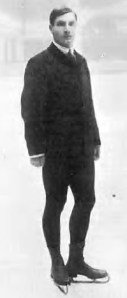
This guy invented the salchow. His name is Ulrich Salchow. What a coincidence!?!

We use the word “graceful” when we describe a dancer pirouetting or a figure skater performing a triple salchow. The word also applies to those people who suck every ounce of nutrition out of Christ’s nourishment and walk about with shimmering cascades of grace spilling over the tops of their heads. I know a few such people. You can tell them apart because they leave little puddles of grace behind them when they leave.

Lord, help me to remember that it is your grace with which you call me to nourish others. I can’t nourish them if I don’t allow you to nourish me. So please, fill this empty cup with the shimmering riches of Christ’s grace.

Footnotes

* Here’s a list of the technical words I used in this post:

Sursum corda: The three calls and responses at the beginning of the Eucharistic prayer, in which the congregation gives the priest the okay to go ahead and celebrate the Eucharist. The responsory nature of this prayer makes explicit that the Eucharist is a corporate event.

Epiphany: The twelfth day after Christmas, on which we celebrate the coming of the wise men to see Jesus. The coming of light into darkness and the call of the disciples are stressed during the season of Epiphany, which extends from January 6 to the day before Ash Wednesday.

Sanctus: “Sanctus” means holy and is the name for the prayer which begins “Holy, holy, holy Lord, God of power and might.” In Hebrew, there’s no way to make a word superlative (good, better, best); so, a three time repetition serves the same purpose.

Chalice: The cup we use at church. Remember that scene at the end of Indiana Jones and the Last Crusade? The room with the old knight is full of chalices. (“He chose…poorly”)

Orans position: “Orans” comes from the Latin word for “prayer” and is used when the priest is saying a prayer on behalf of the congregation. Think of a referee unethusiastically signaling touchdown and you’ve got it.

Ordination: The thing that happens to make someone who’s not a priest into a priest. The word comes from Latin and means something to the effect of “to put into order”; thus, ordination is when someone is set apart from others. There are four “orders” in the church: lay, deacon, priest, bishop — the latter three are “ordained” positions.

Red sky in the morning…

In the Gospel, Jesus mentions that we can tell when summer is coming by the budding of the fig tree. He recognizes that we’re pretty good at figuring out what’s ahead. Arthritic knees feel the storm before it strikes. “We’ve got to talk” means Friday’s dinner date is off. Red sky in the morning, sailor take warning. If we humans are paying attention (even just a little bit), not much can slip by us.

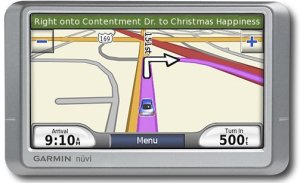
And so, I pay attention to the signs: every retail store is trying to sell you a Garmin GPS system, pop singers are taking it in turns to butcher “O Holy Night” on the radio, and astronauts aboard the International Space Station can see your neighbor’s decorations. So this is Christmas, I echo John Lennon’s hopeful lament.garmin

Now, I promise this article isn’t going to degenerate into the generic, tired outrage about consumerism during the holiday season, so stick with me for a few minutes. I’m paying attention to the signs, and all I see are discounted LCD flat screens and all I hear is another cover of “Frosty the Snowman.” Ever since the commercial sector replaced black and orange with red and green, we have been living in a winter wonderland of perpetual Christmas Eve. And I’m telling you, I could have weight-trained with the circular-laden Thanksgiving edition of the newspaper.

I’m paying attention, but the luster and volume of perpetual Christmas Eve flash brighter and shout louder than the subtle, increasingly subversive current that charges this holiday with meaning. This subtle event is, of course, the birth of an infant. Not so newsworthy, right? Indeed, the Bethlehem Gazette would have only covered the event because of the odd behavior of a bunch of shepherds.

You see, the people of Israel weren’t looking for an infant born out in the barn. They were looking for a triumphant, well-muscled, military superhero to be their messiah, to be their exterminator of all things Roman. And so they missed the signs because they were paying attention to the wrong thing. They were so busy yearning for pomp and swagger that they missed love and humility. While we don’t have to worry about the Roman Empire, we often fall in the same trap of misplaced attention. By observing some mutated version of Christmas for weeks ahead of time we fail to recognize a truly wonderful season of preparation for Christmas, which the Church has been celebrating for centuries.

Today marks the sixth day* of that season of Advent, the four weeks leading up to the celebration of the birth (or Incarnation, if you want to be technical) of Jesus Christ. During the season of Advent, we pause, we notice our ragged breath, and we take time to catch it. We prepare a place in our hearts to receive once again the love of God in the presence of Jesus Christ and wonder how we let that place get so cluttered since last year. And as we prepare to celebrate the Incarnation, we realize just how badly our society has missed the point.

This Advent, drag your eyes and ears away from all that clamors for your notice, all that sound and fury. Pay attention to the true signs of the subtle, subversive event of the presence of Christ in our midst. Your neighbor’s decorations may sparkle and glitter, but they do not shine like the light of the world. That pop singer’s quivering ornamentations might adorn “O Holy Night,” but they do nothing for a world that still lays long in sin and error pining. And that GPS system you bought on Black Friday for $89.95 might give good directions, but it won’t show you the way.

The way, the truth, the life comes. Pay attention and see the signs of Christ’s presence in our midst. And don’t just notice those signs. Be one.

Footnotes

* This post began its life as an article in my local newspaper. Today is actually the ninth day of Advent, and the article actually appeared on the seventh day — so I’m wrong across the board.

Finding your voice

You may not believe me, but there is a severe malady that targets clergy. To my knowledge, there are no support groups for those with chronic cases and no medical advances from the pharmaceutical companies. Indeed, doctors can do nothing to diagnose or treat this malady. Attacks happen almost exclusively during worship when the cleric is praying aloud and cease only when he or she has stopped speaking.

Liturgical professionals have made great strides in diagnosing this debilitating affliction; after much research, they have discovered that clergy with high self-importance blast counts most often contract it. Once, in the crypt of a great English cathedral, I came across an ancient description, but my memory is now woefully incomplete. My mind’s eye sees a crumbling illuminated page filled with cramped Latin writing. As near as I remember, the recorder named the malady something to the affect of inficere fenestrae voce — what is now commonly called “Stained Glass Voice.”

National Stained Glass Voice Awareness Week

If you have never heard of this affliction, please permit me to raise your awareness. “Stained Glass Voice” happens when the cleric prays aloud in a vastly different voice than he or she uses when saying anything else. Indicators of Stained Glass Voice include, but are not limited to, the dramatic pause (especially in the middle of a phrase); syllable elongation (especially “O” as in “O Lord”); pitch augmentation (especially an affected deep voice); and unnatural stressing (especially on words such as “who has”).

Most often, clergy contract Stained Glass Voice because they start acting instead of praying. Usually, they don’t even realize it because the affliction spreads gradually. They say the same prayers over and over again. In subconscious attempts to assuage the encroaching dullness of the repetitive action, they begin to say the words differently. Over time, the Stained Glass Voice replaces the original fervor of prayer, and clerics start competing for Best Supporting Actor in a Collect or Blessing.

Ever since I began leading worship, I have attempted to monitor my own vocal patterns when I pray aloud in church. At first, I suffered from Stained Glass Voice because I had trouble combining authenticity with volume. My natural praying voice is quite quiet, so my own voice felt foreign when I raised it to be heard by the congregation. Since my ordination to the priesthood, I have been praying aloud more often and for longer periods at a time. And I am coming to a point where volume does not inhibit authenticity. Attacks of Stained Glass Voice are less frequent (I hope), and I give credit for my remission to a mentor who probably has no idea how much she has taught me.

A few weeks ago, I wrote about a foursome of women who attend Morning Prayer every single day. One of these women, a beautiful lady whose advanced years have not robbed her of what they called in her day “moxie,” adds a set of prayers near the end of our daily worship. She says the prayers in her normal voice, with the same tone and character she uses after the service when she wishes me a good day. For many weeks, I reflected about how wonderful it was that she prays the same way she speaks. Then I realized why her prayers affect me so. It is not that she prays the same way she speaks. She just never stops praying. In every syllable she utters, I hear her prayer for her friends and her community, whether she is talking about God or about all the doughnuts I need to eat to fatten up a bit.

The Apostle Paul instructs the Thessalonians to “pray without ceasing.” I’ve known few people in my life who live up to such a lofty charge, but my friend at Morning Prayer does. As I listen to her speak and pray at the same time, I am learning how to make prayer an integral part of my life —  to make prayer the studs inside the wall rather than the pictures hung to adorn it. As I continue to grow as a person and as a priest, I hope that my true voice rises to my lips, and that the only stained glass in the building is the windowpanes.

Footnotes

I totally made up the story about the crypt at a great English Cathedral because I couldn’t figure out how to say “Stained Glass” in Latin.