Faithful Thomas

(Sermon for April 11, 2010 || Easter 2, Year C, RCL || John 20:19-31)

I’ve always had a special affinity for Thomas. Perhaps, because we share a name, I feel fraternally responsible for defending him against those who label him with one of the most enduring epithets of all time: Doubting Thomas. (Curiously enough, I’ve never felt much like defending Adam for his stupidity in the garden, but that’s another tale.) So, we have this fellow uncharitably nicknamed Doubting Thomas. We remember him for exactly one reason: he doesn’t trust the words of his fellow disciples when they tell him that they have seen the Risen Lord. Their witness is not enough for Thomas. He needs to see and touch Jesus, just as the other disciples had done when Jesus came to them the first time in that fearful room behind a locked door. Thomas needs the visual and tactile proof of the resurrection for himself. And for this one, simple reason, Thomas has been stricken with his unfortunate nickname, much maligned for his obstinacy, and readily dismissed for his doubt.

But this caricature misses the subtle interplay between doubt and faith that we are going to explore the next few minutes. Notice that Thomas never actually follows through with his stubborn ultimatum. He tells the other disciples, “Unless…I put my finger in the mark of the nails and my hand in his side, I will not believe.” The next weekend, Thomas is with the other disciples when Jesus comes to them again. And when Jesus invites Thomas to fulfill his requirement for belief, Thomas no longer needs to. Rather than reaching out his hand to touch Jesus’ side, Thomas lets loose from his lips the highest affirmation of Jesus’ divinity in the entire Gospel: “My Lord and my God!” Thomas is a man of deep faith.

This is the same Thomas who, when Jesus decides to travel near Jerusalem to raise Lazarus, says to the other disciples, “Let us go with him, that we might die with him.” Thomas is a man of deep conviction. This is the same Thomas who, when Jesus tells the disciples he goes to prepare a place for them, asks of his Lord, “How will we know the way?” Thomas is a man of deep questions.

When you add faith, conviction, and questions together, oftentimes doubt results, at least for a time. Faith gives you the reason to ask questions, and conviction gives you the perseverance to allow doubt to temper faith into a stronger whole. Too frequently, trouble happens when we mistake doubt for the opposite of faith, and therefore as something to be avoided at all costs.

One of the reasons for the persistent mistake of thinking that doubt is the opposite of faith comes from this very Gospel text (and indeed, this particular English translation of the Gospel text). When Jesus invites Thomas to touch his wounds, Jesus says, “Do not doubt but believe.” This sets up a dichotomy between doubt and belief and puts the two in opposition to one another. You can either doubt or believe, but you can’t do both. However, “Do not doubt but believe” is not actually what Jesus says. I don’t say this very often, but the English translation we read in church gets this sentence horribly wrong.

Because the New Revised Standard Version messes this verse up so badly, we need to have a short lesson in ancient Greek, the language in which the Gospel was written. I promise that I won’t make a habit of giving these lessons from the pulpit. But I also promise that you already know more Greek than you realize.

You're probably wondering why this picture makes sense in this context. I promise it does. Go watch the recently cancelled Dollhouse to find out why.

In Greek, to turn a word into its opposite, you add an alpha, which is really just an  “a,” to the front of the word. We do the same thing for English words that come from Greek. Try this one: Bios is a Greek word that means “life.” We get the English words “biology” and “biotic” from it. “Biotic” means “relating to living things.” If we add an “a” to the front, we get “abiotic,” which mean “relating to non-living things.” Or how about this one: Theos is the Greek word for “God.” In English, “theism” is the generic word for belief in God. So, add the “a” prefix and we get “atheism,” which is the belief that there is no God. We could come up with a dozen more examples, but I think you get the point.

Now let’s go back to our verse, which, if you recall, this morning’s reading translates as “Do not doubt but believe.” The Greek word translated “believe” comes from the word pistis, which means “faith.” The word that is translated as “doubt” is simply the word pistis with the “a” prefix – apistis. Therefore, the word should really just mean “unfaith” or “unbelief,” rather than “doubt.” With this new translation, the verse becomes, “Do not be unbelieving but believing.”

“Do not be unbelieving but believing.” This is a far cry from “Do not doubt but believe.” Jesus never tells Thomas not to doubt. Rather, Jesus tells Thomas not to jettison his belief all in one go. There is a huge difference between the two. This supposed “Doubting Thomas” is still incredibly faithful, even in the midst of his doubts. Remember, Thomas is a man of deep faith and conviction, who has the nerve to ask tough questions. Doubt arises in such a chemical makeup. But having doubts does not signal the loss of belief. Having doubts does not signal the abandonment of faith.

Doubt happens when you have enough conviction about your faith to question it. Thus, doubt gives you a reason to reexamine your faith and to sign up with Jesus Christ over and over again. Of course, too much doubt can lead to unbelief, just as, conversely, too much certainty can lead to stagnant faith.

Okay, now that we’ve established that doubt is not something to be avoided at all costs, let’s use our Easter celebration to bring the power of the resurrection into this discussion. Our faith finds its home in Jesus’ resurrection. Jesus triumphed over death in order to keep his promise that he would be with us always, despite the end of our physical existence. Resurrection happens with eternally vaster scope than death ever could. Because of this, death exists within the power of the resurrection. The resurrection subsumes death into itself, making death a piece of the reality of eternal life. In the same way, belief is so much more expansive than doubt; belief subsumes doubt into itself, making doubt a part of the pathway of faith.

Jesus tells Thomas, “Do not be unbelieving but believing.” And Thomas responds with such grand words to express his belief: “My Lord and my God!” Rather than dismissing Thomas as that good-for-nothing doubter, embrace Thomas as a faithful, thoughtful, courageous follower of Christ whose doubts ultimately lead him to a wondrous confession of faith.

God knows that we, too, have our doubts. We wouldn’t be human without them. But belief in God gives our doubts purpose, shape, and context. Do not be ashamed of your doubts. Shame only works to erode faith. Rather, see doubt as a sign of your conviction, as a sign of the fact that you care enough to ask tough questions. Then use that conviction, that perseverance to push through the doubt to the deeper faith beyond. And with those five glorious words of Faithful Thomas, praise the Risen One who is the beginning and end of our belief: “My Lord and My God.”


Stone Symphonies

(Sermon for March 28, 2010 || Palm Sunday, Year C, RCL || Luke 19:28-40)

“I tell you, if these were silent, the stones themselves would cry out.” So says Jesus to some Pharisees, who want him to corral his exuberant disciples. If we lived anywhere else, I would be tempted to take these words of Jesus merely as metaphor, as a turn of phrase intended to illustrate the remarkable nature of the event taking place. But in the month that I’ve been in Cohasset, I’ve walked on the beach several times, and I’ve heard a certain, special noise that has made these words come alive.

As you know, small stones populate the beaches here, stones that were once boulders and are not yet sand, stones made round and smooth by the ebb and flow of the tide, stones good for skipping on the ocean. Waves break over these stones and cover them with foamy surf. As the tidal forces suck the waves back out to sea, the water runs through air pockets between the round edges of the stones. And as the water vibrates the stones, they cry out. The stones sing with a quavering voice, a thousand violins playing the same note but each with unique rhythm and tempo. As the waves flow out, the stone symphony plays the chords of creation, joining the great company of all the myriad instruments in God’s terrestrial orchestra.

If we attune our ears and eyes and hearts, we can hear these chords and we can witness all of Creation praising God. This praise happens when God’s creatures fulfill the purposes for which God made them. The sun praises God by shining, the moon by reflecting the sun’s light. The thunder praises God by crashing, the rain by watering the earth. The gazelle praises God by running, the wolf by hunting, the rose by blooming, the bee by pollinating. Each member of the great symphony of Creation praises God in an unique way, and all work in concert to glorify the Creator.

Well, all except for one glaring exception. We humans are a thick lot. On our best days, we ignore the symphony, and on our worst days, we spend our time devising ways to silence Creation’s praise. Down through history, we have slowly but surely forgotten how to read Creation’s score, forgotten that we too have parts to fulfill in God’s orchestra.

We are able to join in praise to God when we remember that God created us to display one fundamental attribute: goodness. God created everything that is, Genesis tells us, and at the end of each creative session, God pronounced the new creation Good (and on the last day, not just Good, but Very Good). So, at the fundamental level of our human nature is goodness, which is a reflection of God’s delight in Creation. The manifestation of that goodness is our praise to God. We embody this praise when we sing and dance, when we laugh and pray, when we love, and most importantly, when we serve.

The trouble appears when we forget that goodness remains at the core of our human nature. Instead, we see all the malignant attributes that attack our goodness and mistake this tumorous growth for what defines us as humans. How often have you heard the following statements explained away by attributing the behavior to human nature:

“He’s just jealous because I won the office pool.” “Well, jealousy is just a part of human nature.”

“She’s so petty: who cares if we wore the same dress today.” “Well, pettiness is just a part of human nature.”

“I can’t believe he lied about where he was last night.” “Well, dishonesty is just a part of human nature.”

We make the worst mistake of our lives when we attribute these negative actions to human nature. Our fundamental nature is Good, and anything else is a perversion of the goodness by which God brought us into being. These perversions of our goodness (also known as “sin”) distort our relationship with God. We start playing our instruments out of tune, thus ruining the symphony of Creation.

But when Jesus rides that donkey’s colt down the Mount of Olives, he takes a step in the process of subverting all our tumorous perversions of human nature. On his way to the cross, which is the epicenter of the perversion the Good, he begins showing that goodness (and all of goodness’s positive emanations) still exist, despite the malignancy eroding the nature of humanity.

First, he tackles the perversion of power. Notice that his parade is rather incongruous. Anyone would expect a king to enter the city on an armored warhorse with weapons-laden legions flanking him. But Jesus rides in humility, on the back of a lowly farm animal. He displays that humility (which is one manifestation of goodness) has more majesty than any imperial power could ever muster.

While Jesus subverts the perversion of power, his disciples tackle the perversion of terror. While fear is sometimes a helpful emotion, terror is not simply “really big fear.” Terror is an extension of power meant to control. But at this moment in the Gospel, the disciples walk directly into the most dangerous situation in their lives unabashedly praising God with joyful voices. “Blessed is the king who comes in the name of the Lord!” They display courage, another manifestation of goodness, and their courage subverts any attempt by the perversion of terror to control.

The rest of the Gospel plays out in much the same way. Jesus subverts the perversion of greed when he overturns the tables of the moneylenders in the temple. He subverts the perversion of fame when he tells his disciples that he is among them as one who serves. He subverts the perversion of revenge when he stops the retaliation during his arrest and heals the slave’s ear. And in his greatest display of goodness, Jesus defeats the perversion of domination by willingly giving up his life. Jesus brought all our perversions of human nature to the cross and died with them. And in his resurrection, he shows us that these perversions of our good nature have no ultimate power over us.

Because of Jesus’ life, death, and resurrection, we have the ability to access the goodness at the core of our human nature. We have the humility and courage necessary to let God excise all the malignancy that perverts our relationships with one another and with the rest of Creation. We have ears to hear the symphony of praise playing all around us, and we have the music within us to add our own harmonies to the orchestra of Creation.

And when we fail, when we once again forget our goodness, we can be silent, we can be still, and we can listen. And then we will hear the stones themselves crying out on our behalf, crying out their praise to God.

Notes

For the Internet versions of my sermons, I usually remove the specifics of place, but for this sermon, I really needed to preserve them for the imagery. If you ever make it up to the Massachusetts coast, listen for the sound I’m talking about.

Broken

(Sermon for Sunday, March 14, 2010 || Lent 4, Year C, RCL || 2 Corinthians 5:16-21; Luke 15:-13, 11b-32)

Connie looked especially haggard. For the better part of two hours, I watched her hold a phone to each ear, tap-tap-tap on the keyboard, and patiently plead with belligerent passengers all at the same time. As I inched closer to the desk to change my flight information, I caught snippets of the abuse hurled in Connie’s direction and prayed for forgiveness for the entire irate human race. The reason for the belligerence was simple: the airplane was broken. Some gizmo that keeps the flaps from freezing fell off during the plane’s trip to Nashville. One piece in a hundred thousand broke, and the plane was grounded. One piece – a nothing part, really, until you don’t got one. Then it appears to be everything.

Ironically, Delta had to fly this nothing part, this anti-flap-freezing gizmo, in from elsewhere. The departure time leapt forward, finally settling on 8:00am yesterday morning, a full twenty hours and ten minutes late. With the airplane broken, the system broke down, as well. All the other flights out of Nashville were booked solid. Passengers missed connections. People were stranded and growing more bellicose with every update of the plane’s ramshackle status. And in the middle of it all stood Connie, a wisp of a woman on the verge of tears. She clung to the desk, and she clung to her manners. She was the unlucky target of vented frustration, of heaps of bile, of caustic protestations. And all because the plane was broken.

You’d think that people would be used to brokenness by now. You’d think that people would take the brokenness in stride because brokenness marks our lives everyday: broken homes, broken bones, broken pavement, broken promises, broken ecosystems. You’d think that this brokenness would come as no surprise. But every time we encounter brokenness, we seem to react with astonishment and incredulity. How could your best friend betray your trust? How could the kid break his wrist right before the big game? How could the airplane be grounded?

While brokenness does seem to mark our existence, I think we react with astonishment because in some deep place within, we know that “broken” is not the way things are supposed to be. We believe that God created everything and called Creation “good” and never made a thing called “brokenness.” And yet, brokenness crept into Creation. Separation and division soon followed. Today, we see a broken world, and we know that it could be, that it should be – better.

And in that seeing, in that knowing, we hear God calling to us, inviting us to work with God’s help to repair this brokenness. In today’s lesson from his Second Letter to the Corinthians, Paul tells us that God “has given us the ministry of reconciliation.” He continues, “In Christ, God was reconciling the world to himself, not counting their trespasses against them, and entrusting the message of reconciliation to us.”

The world needs this message of reconciliation because the world is marred by broken relationships that need repairing, separations that need healing, divisions that need stitching up. When Jesus welcomes and eats with “tax collectors and sinners” in this morning’s Gospel, he models the ministry of reconciliation. The scribes and Pharisees like their society just fine the way it is, and they grumble when Jesus upsets the brokenness with which they have learned to live. So Jesus tells them a story about a family, a family marred by brokenness, a family in need of reconciliation.

The younger of two sons presses his father to give him his share of the inheritance. The father acquiesces and divides his property. The younger son takes his portion and travels to a distant country where he squanders his fortune in what the King James Version calls “riotous living.” So I’m wondering: what’s the younger son’s sin? At first glance, his sin sure seems to be his debauchery, given his status as a decadent wastrel. And while this qualifies as sin, I don’t think his prodigality takes the top seed.

Instead, his major sin is the division caused by his separation from his family. Jesus makes a point to say that the father divides his household to fulfill his son’s wish. And then the son doesn’t settle nearby, but in a “distant” country. With the division and separation complete, all that’s needed is a famine for the younger son to notice his folly. When he comes to himself sitting in the filth among the pigs, he realizes the brokenness his departure caused. He no longer feels worthy to be called a son, so he prepares himself to live with the brokenness and to be considered a hired hand rather than a member of the family.

At this point in the parable, I imagine the scribes and Pharisees nodding their heads in approval. The younger son defiled himself. He is unclean after touching all those pigs. Of course, he mustn’t be welcomed home. But Jesus isn’t finished telling the story yet.

The younger son travels back to his father’s house, and yet he’s aware that it will never be home again. His decision to separate himself from his family saw to that. But when he is still a vaguely human shape on the twilit horizon, his father sees him and runs out to meet him and embraces him and kisses him. “I am no longer worthy to be called your son,” he says. But his father will not tolerate the separation, the brokenness any longer. “This son of mine,” he says, “was dead and is alive again; he was lost and is found.” This son of mine. With these words, the father repairs the broken relationship, and the two are reconciled.

At this point in the parable, I imagine the scribes and Pharisees raising incredulous eyebrows. Now the father is unclean, as well, because he touched the younger son before he purified himself with the appropriate rituals. What kind of family is this? But Jesus still isn’t finished telling the story.

A celebration for the younger son’s return begins. His elder brother hears the revelry coming from the house and asks a slave what’s going on. When he finds out about his brother’s return, he will not enter the house or join the party. The elder son echoes his brother’s sin by separating himself from the celebration. When the father comes out to plead with him, the elder son shows his own division from the family. He calls his brother “this son of yours,” thus ignoring the fraternal relationship. And rather than working like a son, he says, “For all these years I have been working like a slave for you.” Like a slave. Like the hired hand the younger son was prepared to be.

But the father continues to repair the brokenness in his family. “Son,” he calls his eldest. There is no division between us because “you are always with me, and all that is mine is yours.” Then the father attempts to heal the fraternal separation by emphasizing the sons’ relationship to one another: “This brother of yours was…lost and has been found.”

As the parable ends, I imagine the scribes and Pharisees noticing that they themselves look an awful lot like the elder brother. I wonder if their own irritation with Jesus deafens them to the reconciling nature of the father in the parable.

Both sons separate themselves from the family, the younger through taking his inheritance to a distant country and the elder through refusing to join the celebration. But their father goes out and meets both sons in their brokenness. He runs up to the younger when his son is still far off. He leaves the party to be with the elder. When neither brother feels much like a son, the father practices reconciliation and repairs his broken family.

The father refuses to separate himself from his sons. Likewise, God refuses to be separated from us. Our sin may separate us from God, but God never separates from us. As Paul says, God “reconciled us to himself through Christ.” God never gives up on relationships with us. Instead, God continually brings us back into relationship with God. We may be broken, but God is whole, and so we can find wholeness. We may be separated, but God is welcoming, and so we can bring welcome. We may be divided, but God is One, and so we can come together.

Today, we see a broken world, and we know that it could be, that it should be – better. We know in that deep place within that the world is not supposed to be broken. And we also know that God has reconciled us to himself in order that we might engage in a ministry of reconciliation to this broken world. The question is: will we?

And the answer is this: we will, with God’s help.

Notes

* The first person to notice and correctly identify the reference to Joss Whedon’s Firefly in this sermon wins five points. (These points aren’t really redeemable for anything, but hey, you should try to get them anyway.)

* If you are as big a fan of Firefly and Serenity as I am, you may also notice that the overarching theme of this sermon is pretty similar to that of the film Serenity. And no, that’s not the reference. The reference is incredibly specific.

The Word Happens

(Sermon for February 28, 2010 || Lent 2, Year C, RCL || Genesis 15:1-12, 17-18)

Something happens during our worship service that I would bet you’ve never really noticed before. Actually, this something happens twice during our worship. In fact, this something has already happened twice during this very service. The readers finished both the story about Abram and the piece of Paul’s Letter to the Philippians, and then they said, “The Word of the Lord.” And you responded, “Thanks be to God.”

Have you ever wondered why we say, “Thanks be to God” at that particular moment at the conclusion of a scriptural reading? If you haven’t, don’t worry: I didn’t wonder why until I started writing this sermon. Saying “Thanks be to God” seems rather strange at first. For what are we really thanking God? Honestly, this thanksgiving would make much more sense if the reader herself were the one offering it. I can imagine the reader thanking God for the lack of unpronounceable names in the lesson; or for the ability to pronounce Melchizedek and Nebuchadnezzar on the first try; or for the opportunity to serve God in the capacity of reading the Bible aloud. But the question remains: why do we respond with thanks to God when the reader says, “The Word of the Lord”?

This morning’s lesson from Genesis provides an answer. But first, here’s a quick recap of the first few episodes of Abram’s story. God tells Abram to leave his country and set out for a new place, which only God knows about. So Abram, his wife Sarai, his nephew Lot, and their household set out on a journey. They wander through Canaan and down into Egypt, where Abram gives his wife to Pharaoh to save his own skin. But when a great plague hits Egypt, Pharaoh realizes Sarai’s already married, and he sends her back to her husband. Abram and Lot part ways because their herds have grown too great to share the same land. Finally, Abram settles by the oaks of Mamre. Soon after, he takes part in a battle among the local kingdoms. And on three separate occasions during these adventures, God tells Abram that God will give him offspring and make of him a great nation.

But Abram worries because he remains childless. He’s getting on in years. Sarai is barren. He’s rich and powerful and secure, but the one blessing he desires above all else has eluded him. He has no descendants to inherit his land. A slave born in his house will have to be his heir. Eliezer of Damascus is going to get everything. How does this fulfill your promise, God?

In this way, Abram questions God when the word of the Lord comes to him in a vision. Half in accusation, half in resignation, Abram states the situation bluntly: “You have given me no offspring.” And during this moment – during Abram’s most anxious, most doubtful, most defeated moment – the “word of the Lord” comes to him. The Word of the Lord comes to him and says, “No one but your very own issue will be your heir. Look toward heaven and count the stars, if you are able to count them. So shall your descendants be.” The Word of the Lord comes to him and gives Abram the strength to believe that God will fulfill God’s promise. This is the same “Word of the Lord” for which we twice give thanks on Sunday morning.

You may ask: “How can mere words give Abram such strength? What if the promises are empty? Where’s the action to back up the talk?” Okay, I’m about to say the “H”-word and I need you to stay with me for just a minute here. Genesis was originally written in Hebrew. Translators do the best they can to render the original language into English, but sometimes a Hebrew word is just too deep and complex for a single English word to suffice. In these cases, the English is like looking at a picture of a cake. The Hebrew is like taking a big bite of the cake itself.

Such is the case with the word “Word.” In Hebrew, the “Word” is not simply speech or writing on a page. The “Word” happens to people. The “Word” is an event, an encounter, an action that calls for further action. In the beginning when God created the heavens and the earth, God spoke creation into being: “God said, ‘Let there be light’ and there was light.” The Word of the Lord happened, and, as a result, creation came into existence. When the Word of the Lord happens to Abram, he finds the strength to go on trusting God in spite of all the reasons why God’s promise seems preposterous.

And when we hear a reading from Holy Scripture on Sunday morning, we respond “Thanks be to God” because the Word of the Lord has just happened to us. In that encounter with the Word, we are aware that God continues to speak us into existence. And from existence into service. And from service into love. And from love into the transformation that happens when we follow Jesus Christ our Lord.

You see, when the Word happens to us, we are changed. We may be changed minutely or momentously, but we are changed. We may be changed slowly or suddenly, but we are changed. We are changed into better lovers of God, better servants of other human beings, and better human beings ourselves.

In the film Life as a House, George talks about change, a subject about which he knows a great deal. George has been diagnosed with cancer, and he is using his final months to repair his relationship with his estranged son. By tearing down his house and rebuilding the home he always wanted, he and his son work through the messy process of reconnecting. At one point, George says: “You know the great thing, though, is that change can be so constant you don’t even feel the difference until there is one. It can be so slow that you don’t even notice that your life is better or worse, until it is. Or it can just blow you away, make you something different in an instant. It happened to me.”

In Abram’s case, the Word happens to him, and the change comes slowly. The Word gives him trust in God’s faithfulness, but at first Abram fails to understand the expanse of God’s miraculous promise. Abram doesn’t realize that God desires not just Abram’s own offspring, but Sarai’s, as well. So Abram bears a son with Hagar, his wife’s slave-girl. But the Word isn’t finished happening to Abram yet. Years later, Abram stumbles into God’s presence again, and God renews his promise a final time. In the pivotal sign of the change, which the Word has on Abram’s life, God changes his name to Abraham and Sarai’s to Sarah. Soon after, Sarah bears Abraham a son named Isaac, and the countless generations that follow rival the number of stars in the heavens.

I invite you to reflect on how the Word is even now happening to you. Is the change, which the Word is causing in your life, so constant that you don’t feel the difference until there is one? Or is the Word blowing you away and making you into something different, something new, in an instant? Either way, know that our Creator continues to speak creation into existence. Our Creator writes the Word on our hearts. Our Creator puts the Word on our lips so we may speak love and welcome to all we encounter.

The reader says “The Word of the Lord” to make us aware that the Word is happening to us even now this morning while we sit in our pews. We respond “Thanks be to God” to show our gratitude for God’s movement in our lives. But the Word isn’t through happening to us yet either. The Word happens to us to enable us to serve and to love. The Word impels us to go out into the world and invite others to notice the Word happening to them. As followers of Christ, we live with the joyful expectation that the Word will happen to anyone, anywhere, at any time.

And when the Word happens to us, we will be changed.

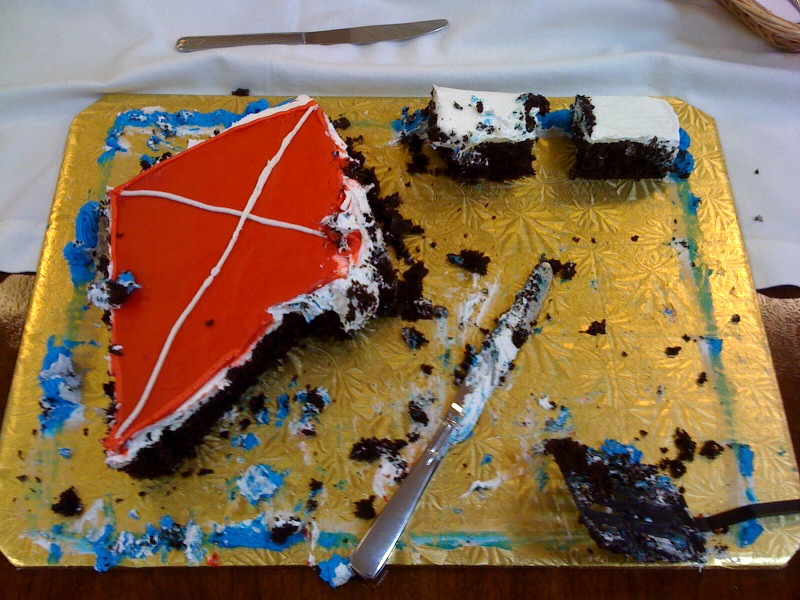
Speaking of cake, the day I preached this sermon was my first at the church to which I was recently called to be the Assistant Rector (Assistant to the Rector, Dwight!). They got me this cake, which is awesome.

Then, the kids ate it.

Letting down the nets

(Sermon for February 7, 2010 || Epiphany 5, Year C, RCL || Luke 5:1-11)

I wrote this sermon before a blizzard dumped three feet of snow of my town, so I never got to preach it. Accordingly, here’s a recording of the sermon as it would have sounded. Use the audio player below or download it here.

Imagine with me the Apostle Peter, who is in Rome near the end of his life, thinking back on that day when he met Jesus by the lake of Gennesaret.

“He sounds like my kind of fellow,” I remember saying to the traveler at my stall, just days before I met Jesus in the flesh. The traveler was gossiping with the rest of my customers about the goings-on in his hometown of Nazareth. According to him, an angry mob nearly threw Jesus off a cliff for something he said in the synagogue. That was the first thing I heard about him. Like I said, my kind of fellow.

At the end of the next Sabbath day, I was getting my gear ready to go out on the water, when my brother Andrew burst through the door. He stumbled into the room and panted, “He’s coming here.”

I stared at him, both eyebrows arched. He kept talking: “Jesus of Nazareth. Jesus is coming here.” Then he grabbed me by both shoulders. “I need to tell you, I just saw the most incredible thing: there was a man in the synagogue with a demon that was screaming at Jesus, but he told it to be silent and go, and it did, and the man’s not even hurt.”

He said it all in one breath. I don’t think I’d ever seen Andrew so excited. “He’s coming here?” I said it as a question, and then realization dawned. “He’s coming here.” I looked around the house. I hadn’t realized how dirty my home had become since my wife started taking care of her mother. “Why?” I asked.

His reply came all in one breath again: “Your mother-in-law: I told him about her fever, and how she was getting sicker and sicker, and he wants to help, and I ran ahead, so he should be here any time now.” Right on cue, I heard a knock on the door. I barely remember what happened next. Jesus shook my hand, and ten minutes later, my wife’s mother was cooking dinner like she had never even been sick.

A month later, I met Jesus again, and I remember that second meeting like it were yesterday. We’d just finished arguably our worst night ever. Not a single fish. And we weren’t out there with bait and tackle. We were using trawling nets, and we still didn’t catch anything. To make matters worse, a crowd of people was surging onto the docks, which creaked and groaned under the weight. I looked up from my net and saw Jesus at the front of the crowd, backing slowly toward the end of the dock. I thought about the cliff in Nazareth. Was this crowd trying to drown him? I couldn’t reach him from where I was, so I dived into the water and swam a diagonal to the other side of the pier. He and I reached the end of the dock at the same time. “Simon,” he called, and laughing, he hoisted me from the water.

I could tell by the way he said my name that he wasn’t in immediate danger of being tossed from the pier. “You remember me?” I said.

“Yes, and I also remember you have a boat. It doesn’t happen to be one of these, does it? My friends want to hear me speak, but I’m afraid they might knock me into the water by accident.” He gestured to a pair of boats moored to either side of the jetty and then out to the crowd still pressing onto the docks. “Here,” I said, untying the lines to my boat. We embarked, and I pushed a few yards into the bay.

Then Jesus sat on the gunwale, his legs dangling over the side of the boat, and he began to speak. His tone was casual, like he was speaking just to me, though I expect everyone thought the same thing. I can’t quite remember what he said that morning, but I can remember the feeling. His words got inside me somehow. They got inside me and found a hole that I didn’t even know was there. And they filled the hole. I wish I could explain it better than that, but I’m not an educated man. I just know that those little gnawing fears and disappointments that I always have and my frustration with the night’s fishing mattered less while he was speaking.

When he was finished, he swung his legs back into the boat. “Put out in the deep water and let down your nets for a catch,” he said.

I stared at him. I’m sure my mouth hung open. I was tired and sore and hungry and I just wanted to go home and flop onto my bed and sleep. Or at least I should have been tired and sore and hungry. I was always tired and sore and hungry after a night’s fishing. But that morning, I wasn’t. His words had invigorated me and soothed me and fed me. Of course, nothing Jesus ever said purged me of my natural cynicism, so my response came out with a hint of sarcasm: “We’ve worked all night long but haven’t caught anything. Yet if you say so, I’ll let down the nets.”

I steered the boat to where Andrew sat scrubbing the nets, and he dragged them aboard. We tacked for the middle of the lake and let down the nets. Within minutes, the boat began to list to starboard, groaning under the weight of so many fish. Through my bare feet on the deck, I could feel the small tremors of lines breaking underwater. Frantically, I signaled to James and John in the other boat. Andrew and I began hauling in the nets, and Jesus lent a hand, all the while shaking with unrestrained glee.

My boat started taking on water because of the added weight of so great a catch. I splashed to my knees in front of Jesus. “Go away from me, Lord, for I am a sinful man,” I said. Again, Jesus hoisted me up, saying, “That’s precisely why I’m staying with you.” Then he looked at all of us. We stood there, on sinking boats with torn nets in our hands, looking back at him. “Do not be afraid,” he said, “From now on you will be catching people.”

That day was longer ago than I care to remember, and still I feel ashamed for not understanding those final words until years later: “From now on you will be catching people.” Jesus had cast out the demon from the man in the synagogue and healed my mother-in-law. He had spoken to everyone while making me feel like he was talking to me alone. He was so personal. He healed and loved and encouraged and admonished each individual person he encountered. For years, I thought his personal approach meant he was being selective, like an angler casting for one kind of fish. But I was mistaken.

He told us to catch people – not to fish for them. No selectivity. No specificity. No discrimination. He told us to catch people like we caught fish: throw the nets in the water and trawl for everyone.

Years later, I finally understood this call. I was living at Joppa when I had a vision: I saw a sheet descending from heaven loaded with all kinds of food that I’d never eaten before. The food was unclean according to the law, but a voice called to me: “What God has made clean, you must not call profane.” That same day, a group came and took me to Ceasarea to meet Cornelius the centurion. Cornelius told me about his own vision of a man in dazzling clothes who told him he was remembered before God. At that moment, I remembered Jesus’ words: “From now on you will be catching people.” I looked at Cornelius and all his friends, and I said, “I truly understand that God shows no partiality.”

That day on the lake of Gennesaret, I met Jesus for the second time. He taught a crowd with his legs dangling over the side of my boat. I heard his words, and he filled a hole I didn’t even knew I had. All those years later, his words continued to teach me. God shows no partiality. Jesus told us to throw our nets into the deep water and catch everyone: not just a select few, but everyone.

Like I said, my kind of fellow.

Notes

Special thanks to my friend Steve for unlocking the ideas in this sermon. He writes the blog draughting theology.

The garden and the wasteland

(Sermon for January 3, 2010 || Christmas 2, RCL || Luke 2:41-52)

They say that every therapist should be in therapy. Likewise, every priest should participate in spiritual direction. Without trained professionals helping us priests notice God’s movement in our lives, one of two things happens. We either forget to rely on God, thus emptying ourselves of all nourishment even though a feast is perpetually spread before us. Or we decide we don’t need to rely on God, because we are doing just fine on our own (thank you very much!) and the same starvation results. We priests are a rather thick bunch, usually quite stubborn when faced with the Almighty, because the Creator-of-All-That-Is rarely seems to fit the predictions of our seminary studies.

When I was in seminary, my spiritual director diagnosed my particular case as a combination of failing to notice God’s presence and deciding I didn’t need God anyway. I’m glad I could offer her such a potent mixture of blindness and stupidity. Needless to say, our sessions were never boring. Over our two years together, she taught me many things, but one stands above the rest. You can basically separate the events of your life into two categories, she said. There are moments of consolation, and there are moments of desolation. Both will happen and ignoring one will make the other that much harder to define. In this morning’s Gospel, Mary runs the gamut from desolation when she loses Jesus to consolation when she finds him again. Then she treasures “all these things in her heart” because she knows that the emptiness of desolation and the joy of consolation combine to form the trajectory of her life.

(c) Wizards of the Coast

Usually, people want the bad news first, so we’ll begin with the emptiness of desolation. Desolation is the nuclear winter of the soul. Desolation makes the soul a wasteland – arid, parched, rendered uninhabitable by events in the life of the very person who must inhabit the internal desert.

Sometimes, we bring desolation on ourselves: a man cheats on his wife, and she doesn’t even catch him. He expects to feel the thrill of adventure, of subterfuge. Instead, he feels the pain of a broken promise. He doesn’t realize he is a moral person until he fails to live up to his own unexamined values. And his failure eats away at his soul. Sometimes, external events bring desolation upon us: the pregnancy has been difficult, but the doctors have managed to stay positive. If she can hold on just a few more weeks…but the contractions start, and she delivers a tiny life. The infant’s underdeveloped lungs struggle for breath. He lives for four days, and her soul dies with him. Sometimes, desolation happens not in these large events but in the accumulation of small frustrations and disappointments. They hired the other guy. The repair cost more than the estimate. Another D-minus. Chicken for dinner – again. Each frustration erodes the soil of the soul, nutrients leach out, and eventually only the wasteland remains.

In these times of desolation, we do not look for the presence of God because we think God can’t possibly be there. We abandon ourselves to despair, so we expect that God has abandoned us too. We may even stop believing in God, while paradoxically blaming God for our situations. When we are desolate, we don’t live: we merely subsist. And we fail to realize that our very ability to survive through the torment of despair is a manifestation of God’s awesome power and love.

While our desolation happens when we think God is gone, Mary’s desolate moment happens when she literally loses Jesus. The family has been attending the festival of the Passover in Jerusalem. They start their journey back to Nazareth, and Jesus is not with them. But they’re not worried because the caravan is peopled with family and friends; surely, he’s wandered off to chat with some favorite uncle. A day out, Mary and Joseph realize Jesus is missing. They rush back to Jerusalem, frightened, anxious. They search for three frantic days. As someone who has only experienced the combination of harsh words and fervent embraces that accompany a parent finding a lost child, I can only imagine the desolation that those three days brought to Mary’s soul.

On the third day, Mary’s search brings her to the temple. And there she finds Jesus, safe and sound and unaware of the years his absence has shaved off his mother’s life. Desolation gives way to the warmth, the electricity of consolation. What was lost, Mary now has found. They travel to Nazareth without incident, and Luke assures us that Jesus is obedient to his parents.

(c) Wizards of the Coast

Whereas desolation makes the soul a wasteland, consolation makes the soul a garden in full bloom. In consolation, the roots of our souls grow deep in the rich soil of God’s presence. We are aware of the persistent activity of creation, and we revel in the joys that life has to offer.

Sometimes, our determination brings consolation to us: a young girl is told she’ll never become a concert pianist. Her hands are too small, her technique mediocre, pedestrian. But she practices and practices and practices. Her joy is in the vibration of hammer on string buzzing up through her fingertips, in the notes transferred from black dots and squiggles to tones of weight and beauty. She may never play at Carnegie Hall, but the music is inside her soul. Sometimes, as with desolation, external events bring consolation to us: the city-dweller finds himself in rural woodland at night. The sky is clear, the moon a sliver. He lies on his back and gazes up at the stars. He didn’t know there were so many. The subtle band of the Milky Way brings shape to the clutter. The innumerable points of light in the darkness bring light to his soul. More often than not, consolation happens when we gather together all of the small blessings in our lives. A good night’s sleep leads to energy and cheerfulness. An unexpected phone call comes from an old friend. The house is warm. Chicken for dinner again! Each blessing enriches the soil, in which our souls thrive, and our gardens bloom with unrestrained life.

In these times of consolation, we notice God filling us to overflowing. We cannot possibly hold any more grace, so it spills from us, hopefully landing on those around us. Our joy prompts us to invite others to gather up their blessings and notice God’s presence in their lives. We form communities to share our joy, and these communities help sustain those who inevitably fall into periods of desolation.

You see, desolation and consolation are the extremes of life – the subsistence and the abundance. Most of the time, we exist somewhere along the spectrum between the two. Luke tells us that Mary treasures “all these things in her heart” – both the empty time of desolation when Jesus was lost and the joyful time of consolation when she found him again. Mary takes both categories into her heart and ponders them. Her life, like all our lives, brings together experiences both of desolation and consolation. As faithful people of God, we try with God’s help to lead lives that trend toward consolation on the spectrum.

As we begin a new year and a new decade, I invite you to take stock of where you fall on the spectrum between desolation and consolation. If your trajectory is moving toward consolation, rejoice, and continue to gather your small blessings and keep a weather eye out for God’s presence in your life. If your trajectory is moving toward desolation, I pray that God grants you the courage to turn around. You may still be stuck in the wasteland, but you will be facing the right direction – out of the desert and toward the garden.

Finally, may God grant you the grace to survive when you are desolate, to thrive when you are overflowing, and to treasure all these things in your hearts.

Make believe

(Sermon for November 15, 2009 ||Proper 28, Year B, RCL || 1 Samuel 1:4-20; Hebrews 10:11-25)

Inigo Montoya, the Spanish hired sword who helped kidnap Princess Buttercup, is losing his duel with the Man in Black. The fight has ranged all over the rocky terrain at the precipice of the Cliffs of Insanity. The two swordsmen had both begun left-handed, but have switched to their dominant hands when they recognized the masterful fencing of the other. Thrust. Parry. Riposte. The Man in Black acrobatically flips off the ruins. Inigo stares at him, clearly amazed: “Who are you?” he asks.

inigoandwestley“No one of consequence,” replies the Man in Black.

“I must know,” pleads the Spaniard.

“Get used to disappointment.”

The fight continues, only to end a minute later with an increasingly flustered Inigo receiving a knock to the back of the head. And the Man in Black sprints off to track down the title character of The Princess Bride.

Get used to disappointment. Sounds like quite sensible advice. Sounds like the Man in Black has been around the block a few times. Sounds like he knows something about the ways of the world. However, this worldly wisdom is often counterproductive to a life of faith. The Letter to the Hebrews urges us this morning to “hold fast to the confession of our hope without wavering, for he who has promised is faithful.” In a world that teaches us to “get used to disappointment,” holding fast to our hope can be so very difficult.

Our inoculation begins at an early age. Children enter life with bright, wide eyes and unbounded, unfettered imaginations. Every couch cushion is a stone in a castle under siege by the invading hordes who desire nothing more than to pillage your kingdom. Every bath is a deep-sea expedition to find the lost city of Atlantis. Every day is another chance to see a unicorn. But before long, we start getting used to disappointment. We are told that couch cushions are for sitting, baths are for bathing, and there’s no such thing as unicorns.

I remember my mother shouting: “Young man, there are no dinosaur bones in the backyard. Stop digging up my flowerbeds.” But what she didn’t know was that my imagination was equipped with ground-penetrating sonar and that there was an intact velociraptor skeleton just underneath the gardenias. It was the find of the century. Any moment, Richard Attenborough was going to land in a helicopter and whisk me off to Jurassic Park. (I don’t mean to rag on my mother – she always cultivated her children’s imaginations as long as we left her flowers alone.)

But in the grand scheme of things, from the moment we are born, our imaginations do nothing but shrink as our understanding of so-called reality grows. Only a few people make it to the major leagues or become astronauts or famous singers. But children always start out dreaming about these things. Do you know anyone at age six who wanted to be a CPA?

As we get used to disappointment, our ability to imagine new worlds wanes. The trouble is that hope exists in the imagination’s ability to frustrate the enclosing nature of the so-called “real” world. We are made in the image of God; therefore, our imagination connects us to the creative spark of our Creator within each of us. And hope resides in this spark. As mounting disappointment attempts to snuff out our imaginations, we encounter great difficulty in accessing the hope, which our Creator installed in us.

In this morning’s lesson from the Hebrew Scriptures, Hannah has gotten used to disappointment. She has no children, and her husband’s other, very fertile wife, provokes her on this account. Every year, when the family goes up to the house of the Lord to sacrifice, Hannah weeps and does not eat because of her situation, which is made all the more humiliating by Penninah’s taunting.

But Hannah does not let her disappointment snuff out the hope she has in the Lord. Hannah goes to the temple and asks God to remember her. She pours out her soul before the Lord. She prays so fervently that Eli, the priest, supposes she’s drunk. But no: Hannah is only anxious and vexed. She still believes that God continues to be present in her life, despite the worthlessness, which the world tells her she should be feeling. Hannah combats her own disappointment with the hope that she still has in God to act in her life. Soon God remembers Hannah. She bears a son named Samuel, and he grows up to be the prophet of the Lord.

Hannah’s devotion and perseverance serve as a model for the words of the Letter to the Hebrews. Hannah approaches God “with a true heart in full assurance of faith.” And she “hold[s] fast to the confession of our hope without wavering,” for she knows that “he who has promised is faithful.”

We, too, hold fast to the confession of our hope because he who has promised is faithful. Too often, we think that our faith in God needs to sustain us. We think that if we had been just a bit more faith, everything would turn out the way we want and there’d be no more disappointment. But our faith is a wavering, sporadic thing. If we had to feed on our faith alone, we would have starved long ago.

But Hebrews urges us to reorient our understanding of faith. Our wavering, sporadic faith in God pales in comparison with the ultimate reality that God is the faithful One. God keeps God’s promises. God is the rock upon which our disappointments shatter. We do not manufacture our faith. Faith is not self-centered. Faith is God-centered, and God invites us to step into the reality where our faith is as constant as God’s. The confession of our hope proclaims that this reality exists and that we will encounter its utter joy when we finally and fully enter God’s eternal presence.

We believe that this happens in the power of the resurrection when we pass from life through death to new life. But the confession of our hope does not merely cast our thoughts to the life beyond death. Remember, hope exists in the imagination’s ability to frustrate the enclosing nature of the so-called “real” world. This real world is full of disappointments, but it doesn’t have to be. While we may never find the lost city of Atlantis or see a unicorn, concrete disappointments, which may be better termed “crises,” abound in our world.

But God has blessed us with hope-fueled imaginations. God has blessed us with the mission, as Hebrews says, “to provoke one another to love and good deeds.” God has blessed us with the resources to feed and clothe everyone in this world. We must only provide the will. We must only get over our own disappointments and harness the hope that God’s own faith makes real in our lives.

When we were children, the magical words “Once upon a time” lost their luster when we heard their counterparts: “Sweetheart, it’s only make-believe.” But I say to you that we have the opportunity, we have the imagination, we have the will to change this world for the better. Because God keeps God’s promises, we are able to keep our promises. We are able to make a difference in people’s lives. We are able because God’s own faithfulness makes us believe.

From arrogance to obedience

(Sermon for Sunday, October 18, 2009 || Proper 24, Year B, RCL || Mark 10:35-45)

Here we go again. A month has passed since my last sermon delivered to you. A chapter has passed in the Gospel According to Mark. And Jesus has passed through Capernaum on his way to Jericho and then on to Jerusalem for his final days. In the Gospel lesson four weeks ago, the disciples argued about which one of them was the greatest. In response, Jesus placed a small child in their midst and said to them, “Whoever wants to be first must be last of all and servant of all.” In today’s Gospel lesson, two of Jesus’ disciples, James and John, get a little more specific in their quest for greatness: “Grant us to sit, one at your right hand and one at your left, in your glory.” In response, Jesus repeats himself (I imagine, with some exasperation), “Whoever wishes to become great among you must be your servant, and whoever wishes to be first among you must be servant of all.” And so I say, here we go again.

The disciples exhibit the eminently human habit of forgetting everything Jesus has been teaching them. And we love them for their poor memories because we can relate. But Jesus matches their eminently human forgetfulness with eminently divine patience. Jesus could say, “Didn’t you take notes last month? No?! Well, then get them from someone who was paying attention.” Instead, Jesus reiterates his message and offers us the opportunity to dive more deeply into his words.

Don’t worry: I’m not going to repeat my sermon about the linear model turning into the circular one, and I’m not going to use any examples from fourth grade. Rather, today’s Gospel lesson, in conjunction with the other lessons, helps us explore the roots of the two models. The linear model, in which hierarchical disparity perpetuates a “me first, you last” attitude, finds its roots in presumptive arrogance. The circular model, in which relational expectations lead to a “you before me makes us better” attitude, finds its roots in unassuming obedience. Thus, the giving up of the linear model for the circular necessitates a move from arrogance to obedience.

Let’s look at arrogance first. James and John, the sons of Zebedee, preface their request with these words: “Teacher, we want you to do for us whatever we ask of you.” Right away, we know something is out of joint. The brothers attempt to get Jesus’ consent before they make their appeal known. Every parent out there knows that a child only employs this tactic if the request is unlikely to garner agreement. Earlier in the Gospel According to Mark, Herod makes the rookie mistake of swearing to his daughter to give her whatever she asks, and John the Baptizer turns up minus one head.

But Jesus makes no such mistake. He’s on to James and John from the start. “What is it you want me to do for you,” he says. Foiled in their search for premature commitment, the brothers soldier on and ask to sit on either side of Jesus in his glory. And here, Jesus exposes their arrogance by saying, “You do not know what you are asking.” In other words: You have no clue what you are talking about. Haven’t you been listening to me? Are you read to drink my cup? I’m about to die a gruesome death. This isn’t a Sunday stroll. If you knew what you were getting yourselves into, you would never have asked.

In their arrogance, James and John expect their request will be fulfilled on their terms. Sitting on Jesus’ right and left hands is as easy as asking him. The brothers do not contemplate the consequences of their appeal because, in their arrogance, they see none. Arrogance is a delusion of grandeur, a state of mind borne out of misplaced, narcissistic superiority. Arrogance assumes that the world works according to the expectations of the arrogant. But Jesus attempts to puncture the brothers’ delusion by reminding them of the very real consequences of their request. “Are you able to drink the cup that I drink,” he asks. Their terse reply of “We are able” shows more deluded arrogance – they are able to say the words, but their comprehension of the weight of those words leaves much to doubt.

The arrogant worldview, which conforms to the reality of narcissistic desire, has contributed to most, if not all, of the world’s worst sins: the enslavement and degradation of other races; the destruction of the environment for purposes of insatiable consumption; the apathy for the plight of others masked as laudable self-interest; the horror of war. In all of these, arrogance leads to the objectifying of some nebulous other in order to maintain the narcissistic reality. Everything is fodder, every person a pawn.

In today’s reading from the Hebrew Scriptures, God reminds Job that this deluded, arrogant worldview is far from reality. The writer does this in a rather snarky way, by having God interrogate Job on subjects, about which Job can know nothing. God says, “Where were you when I laid the foundation of the earth? Tell me, if you have understanding. Who determined its measurements – surely you know!” This continues for a few pages, but you get the picture. God reminds Job that reality and Job’s delusion of reality are two different things. The implication is this: only the arrogant assume they know enough about creation to substitute for the Creator.

God’s interrogation of Job calls us out of our arrogance. Of course, we weren’t there when God laid the foundation of the earth. Much like James and John, who arrogantly assume their own primacy, we often forget that we aren’t the centers of our own universes. When we accept the grace from God to look past our delusions, we begin to grasp the other way to live. We begin to see that our own narcissistic realities pale in comparison to the harmony, radiance, and joy of God’s reality. And we begin to realize that obedience to God is our participation in this reality.

The word “obedience” is much maligned, so we must quickly reassemble its meaning. Banish from your minds the thought of canine “obedience” school or the memory of a ruler to the back of your hand to teach “obedience.” Obedience relies neither on the carrot nor the stick because obedience exists on a plane apart from reward and punishment. True obedience comprehends listening for God’s call and having the courage to act on that call. Obedience is shorthand for “resonance with God’s movement.” When we are tuned to God’s presence, we vibrate with all the vibrancy that God’s love could offer to us.

But obedience is difficult because arrogance beckons and pulls us back to our easy, little realities. According to the Letter to the Hebrews this morning, Jesus had to learn “obedience through what he suffered.” Because of his suffering, because of his obedience, “he became the source of eternal salvation for all who obey him,” for all who desire to resonate with him.

This obedience, this resonance, finds its deepest expression in Jesus’ words to his disciples following James and John’s request. First, he reminds them of the arrogance of the world: the rulers of the Gentiles “lord it over them, and their great ones are tyrants over them.” The tyrant is the prime example of the arrogant worldview. “But,” Jesus continues, “it is not so among you; but whoever wishes to become great among you must be your servant, and whoever wishes to be first among you must be servant of all.” Then, he uses himself as a paradigm: “For the Son of Man came not be served but to serve.”

We serve because Jesus served. We resonate with Christ most readily when we are serving others, when we are looking upon that nebulous other and seeing not a pawn, but a companion. We move from arrogance to obedience when we include in our realities the people who don’t fit and the consequences that we ignore. As the shells of our realities fade to reveal God’s greater reality, we realize how small were the lives we lived in our arrogance. We discover, somewhat paradoxically, how much more freedom exists in our obedience.

In that freedom, we will find joy and suffering, especially as we look with love upon the other. In that freedom, we will find grief and hope, because both are antidotes for narcissism. In that freedom, we will find the faith of the One who calls us to obedience. And we will walk in the confidence of that faith as God continues to peal away our arrogance to reveal beautiful, resonant, radiant children of God.

The circle and the line

(Sermon for September 20, 2009 || Proper 20, Year B, RCL || Mark 9:30-37)

Every day of my fourth grade year, my class lined up at the end of recess to go back inside. The bell rang, and we raced to our spots in the queue. But the race was in vain because no matter who arrived at the door first, we always lined up alphabetically by last name. By last name. What I wouldn’t have given to line up by first name. Then (Oh happy day!) I would have been at the very front of the line. No Aarons or Abigails in my class. No. Adam would have been the first name on the list. But those days were cruel. Every morning, I stood on tiptoes to see over the twenty-three heads in front of me, and only one boy – stricken with a name beginning with the letter “Y” – was worse off than I.

Then, on the day when all the mothers began insisting that their fourth graders wear winter coats to school, something happened. Mrs. Hughes, my math teacher, challenged us to line up in reverse alphabetical order. And for one cold, drizzly, glorious day, I stood at the front of the queue and only one head obstructed my view of the playground doors.

beefeatersStanding at the front of the line feels good and the benefits are numerous. Being in front means that the concert tickets aren’t sold out. The first baseman hasn’t tired of signing autographs. The stalls of the women’s bathroom remain unoccupied. The bucket of fried chicken at the church potluck retains its full complement of chicken legs. Certainly, perks abound for those in front. Go to any shopping center in the wee hours of the morning on the day after Thanksgiving and witness the millions of Americans attempting be first in line simply to purchase a GPS system for twenty percent off retail.

Of course, these benefits are all about me. I get the tickets and the autograph and the preferred piece of chicken. I get the deal on the GPS. I get all these things because I got in line before you. You are behind me and someone else is behind you and countless faceless others line up behind that someone else. So we stand in our line and stare at the backs of the heads in front of us. In this linear configuration, no one can converse. No one can relate. No one can do anything more than slowly shuffle forward, both surrounded and isolated at the same time.

This isolation is the danger Jesus envisions when he places a little child among his disciples. They’ve been arguing about which one of them is the greatest (in other words, which one of them should be first in line). The prevailing linear culture has thoroughly molded the disciples. They only understand relationships in terms of hierarchy based on class, gender, and age. But they’ve been hanging around Jesus long enough to know that Jesus is thoroughly countercultural. He talks with women. He eats with outcasts. He touches the unclean. And so the disciples lapse into embarrassed silence when Jesus asks them about the content of their argument. They know that they’ve provided Jesus with what would now be called a “teachable moment.”

Now, we know Jesus is about to [drop some knowledge] on the disciples because he sits down, which is the preferred position of any self-respecting Jewish teacher. The disciples expect something countercultural and that’s exactly what Jesus gives them: “Whoever wants to be first must be last of all and servant of all.” To illustrate the revolutionary nature of this statement, Jesus brings a small child and places the child among the disciples – not before them or after them, but among them. In Jesus’ day, this child was the last of the last. The hierarchy of the society placed children just below farm animals because you could get a lot more out of a goat than a toddler, and the goat would probably live longer. Children had no rights or protections. They weren’t even considered people until they were old enough to work.

But Jesus ignores this cruel stratification when he says: “Whoever welcomes one such child in my name welcomes me.” Jesus commands his disciples and us to welcome those whom society deems lowest of all. With this welcome comes the opportunity to see the faces and learn the stories of those who until now were at the end of the line, too far removed from us to register on our radar. As we hear the stories of the lowest, we seek ways to serve them.

One of the greatest mistakes of our time has been the Western presumption that we know what’s best for the people we serve. But this imperialistic attitude only perpetuates the linear model, which our service attempts to supplant. However, with his command to welcome, Jesus doesn’t allow us to develop a “Serve first and ask questions later” mentality. Welcoming provides the framework through which service leads to the building up of relationships.

With his emphasis on relationships, Jesus changes the existing linear model into a circular one. In the line, you can’t welcome anyone because all you see are the backs of heads. You can’t serve anyone because the implied hierarchy of the line makes isolation the norm. You can only count the number of people ahead of you and nurse your own indignation over your rotten place in line. But in the circle, there is no first and no last. We grasp hands in welcome because we are unable to quantify our position in the continuous round. And relationships have a chance to flourish because we look not at backs but at each other’s faces.

This circular model of welcome and service stands in laughable contrast to the current situation in this country. A declining economy makes people cling ever tighter to their presumed spot in line. Distrust and belligerence and hate disfigure our political discourse. The gap between the first and last grows ever wider. And in the middle of this maelstrom, here we sit on Sunday morning. Here we sit with our Lord challenging us to do something, which every screaming voice on the other side of those doors claims is utter nonsense. Here we sit and if Jesus’ words don’t make us squirm in our seats then we aren’t listening.

To be first you must be last of all and servant of all, he says. Let go of linear relationships based on power and ambition and embrace circular relationship based on welcome and service. If you are at the front of the line now, start walking to the back. Grab the hand of the last person in line and form the circle. Welcome the least among us. Listen to their needs. Serve them because we are only as strong as our weakest member. Jesus commands us to accomplish these things. And the good news is this: Jesus never issues a command without simultaneously offering the gifts needed to carry it out.

So to every fourth grader queuing up after recess and every suit lining up at Starbucks and to everyone, myself included, whose ambition blinds him or her to those standing on tiptoes in the back:

Give up your place in line.

Something stronger

(Sermon for June 28, 2009 || Proper 8, Year B, RCL || Mark 5:21-43)

Imagine with me the thoughts of Jairus, the leader of the synagogue, in the aftermath of his encounter with Jesus.

I have been afraid my whole life. When I was little, a scorpion stung my friend, and he died drooling and thrashing in his crib. And so I feared scorpions. When I was old enough to understand the meaning of the scowling soldiers wearing shiny, metal armor, I realized what happened to people who looked at them the wrong way. And so I feared that my father might one day fail to return home. When I met my wife, I feared I wouldn’t be able to provide for her. When I became leader of the synagogue, I feared that I would have no wisdom to share. And when my little girl was born, I feared for her safety every minute of every day. I have been afraid my whole life.

And so when my daughter showed me the tiny, insignificant puncture on her forearm, and she bit her bottom lip to keep from crying out in pain, my world ended. I found the assassin and stomped its hardened, scaly body into the dirt, and then I collapsed – shivering – to the ground. My wife came `round the corner and saw me weeping, the dead scorpion in pieces next to me. She dropped the washing, raced over, and began checking me for signs of a sting. I could barely talk through my heaving: “Not me. Not me. Not me.” She understood and launched herself into the house to find our daughter. I couldn’t go back inside. I rocked back and forth: “Not me. Why not me? Why not me instead?”

Twelve years old, my little girl. On the verge of womanhood. My wife cataloging potential suitors. Me practicing my menacing glare for those same suitors. Twelve years old, and not so little anymore, if I’m honest with myself. She and I used to climb the hill at night, lie down in the scrub grass so that the tops of our heads touched, and name the stars. She always named them after the heroes of the great stories: David and Gideon and Deborah and Esther. “And that one’s you, Daddy.” She always named the brightest one after me. But at the indefinable moment when she began her adolescence, she stopped wanting to climb the hill. I asked her why one day. “That’s kid stuff, Daddy,” she said.

The night the scorpion stung her, I climbed the hill alone and screamed names at the sky – not the names of heroes, but blasphemous names I never thought I could utter. The darkness swallowed my anger, and I don’t know if my obscenities reached their intended target. He created the scorpion: for that, I could not forgive him.

I stalked back home and tapped on my daughter’s bedroom door. My wife opened it, and our eyes met – one empty stare gazing past another. The candle threw swaying shadows on the wall as I entered the room. All my fears were confirmed when I looked at my little girl. She was drenched in sweat, her neck twitched, and her eyes darted from corner to corner. I wrapped my arms around her and put my head on her chest. I could barely distinguish one heartbeat from the next. My wife wrapped her arms around me. Thus I spent the remainder of the night – embraced by the one I love but feeling only the heavy grasp of fear.

I awoke suddenly and cursed myself for having fallen asleep. Dawn was piercing through the gaps in the window’s shutters. I bent my ear to my daughter’s mouth, but the sounds of a commotion outside drowned out the low rasping of her breath. “Vultures,” I growled and my wife woke up. I stabbed a finger at the window: “Here, no doubt, to console us with their wailing performance.”

I looked down at my little girl. I couldn’t just sit there and watch her die. I had to do something. I resolved first to run the vultures off. I had enough grief of my own. I didn’t need to pay someone else to manufacture it. I squeezed my wife’s hand and kissed my daughter on the forehead. So clammy. I banged open the front door ready to unload on the would-be grievers. But the commotion was something else entirely. People were running up the street in the direction of the shore. They were laughing and calling to one another: “Jesus of Nazareth is sighted off the beach. He’s coming here.”

Without thinking, I joined the throng. People recognized me as the leader of the synagogue and let me through. I reached the shore in time to see a fishing boat bump into the shallows. The crowd swelled around the vessel. Jesus’ disciples muscled a hole in the multitude and the man himself stepped off the boat. “Jesus, Jesus,” I cried. But mine was only one voice in a thousand. I feared there was no way he heard me.

Then he turned and gestured to me. His disciples opened a path for him. I fell at his feet. “My little daughter, my little one is at the point of death.” I swung my arm back in the direction of my house. “Come and lay your hands on her, so that she may be made well, and live.”

I didn’t know where the words came from. My fear was grasping at the words in my chest, but something stronger ripped them out of me. The fear fought back, reminding me of last night’s blasphemy. A new fear gripped me – that God had, indeed, heard my anger and would do nothing for me now.

We walked back to my house, but the great crowd slowed our progress. I wanted to run, to sprint home with Jesus keeping up beside me. But then, he stopped. “Who touched my clothes?” he said. I looked at him in disbelief. I wanted to scream: “There’s a thousand people trying to touch you right now. Who cares? My daughter is about to die.”

A woman fell down at his feet and started speaking. She probably spoke for less than a minute, but it was a lifetime to me. As Jesus responded to her, my eyes found my brother and his sons pushing their way through the crowd. “No. No. No.” I started to fall, but my brother caught me and held me tight. “Your daughter is dead,” he whispered. I sagged in his arms. Again, he picked me up. “Come,” he said. “Why trouble the teacher any further?”

I turned back to the woman who delayed me, who kept the teacher from coming to my house on time, and curses curled on the edge of my lips. But Jesus stepped in between us and grabbed my shirt in both hands. “Do not fear,” he said. “Do not fear, only believe.” The stronger something that had earlier ripped words from my chest reflected in his eyes. “Trust me,” he said, and he pulled me along the path to my house. The curses died on my tongue, and I let myself be dragged home to face my own death in the still body of my little girl.

The vultures had come while I was out, but I had no ears for their wailing. And I had no eyes but for my little daughter. Jesus looked around at everyone. “Why do you make a commotion and weep,” he said, “The child is not dead but sleeping.” A laugh erupted from my chest, and it felt utterly foreign in this house, which now had Death for a tenant. But then I laughed again, and I noticed that the laugh didn’t come from my fear. The stronger something caused the laugh. The laugh was my body’s involuntary response to the truth of Jesus’ words.

Jesus took my daughter by the hand, brushed a stray lock of hair behind her ear, and said, “Little girl, get up.” And she did. She walked up to my wife and me and we picked her up and the three of us held each other and turned in circles, laughing and crying at the same time. I looked at Jesus and realized what had ripped the words from me at the beach. Trust. Something about this man radiated trust. No. Not something about him. He, himself, radiated trust. He stared back into my eyes and suddenly I knew that hurling blasphemies at God under the cover of darkness meant that somewhere deep down I still believed. I knew that trust is something entirely stronger than fear. I knew that trust and belief are the antidotes for fear.

Jesus’ own laugh pulled me out of my thoughts. He smiled at the three of us twirling around and said, “She’s had a rough day. Give her something to eat.” My wife rushed off to the kitchen to prepare something, tears streaming behind her as she went. And then my daughter looked up at me, trust shimmering in her eyes. Twelve years old and still my little girl. “Daddy,” she said, “Can we go up the hill tonight and name the stars?”

“Of course,” I said, and I gathered her into my arms.

I had been afraid my whole life. But not anymore.