Viral papyri (Bible study #10)

In the middle of the second century, a guy named Marcion took his Bible and tore out most of the Gospel according to Luke and some of Paul’s letters. He stapled these together and chucked the rest in the dumpster. Marcion had decided that the “god” who created the world was evil because the world sure wasn’t doing him any favors. The other god, the real “God,” was Lord of the “spirit world,” totally alien from our world, except for that thing about sending his son here. The trouble was, that’s not what the Bible said. So, Marcion, with a stockpile of misplaced entrepreneurial zeal, made up a new one.

Well…that’s not actually what happened. You see, the “New Testament” as we now have it wasn’t compiled yet. Christians and various derivative groups had been writing letters and gospels and stories and strange things called “apocalypses” for a hundred years. Some circulated widely, like the ancient equivalent of viral YouTube videos. Others stayed put in the community which produced them. Some were attributed to Jesus’ apostles or their associates. Others were written by that guy with the hair and the thing. Some espoused doctrine that both created and helped support the emerging theological position of the “Church.” Others claimed “secret knowledge,” known only to the few who could get into the metaphysical country club.
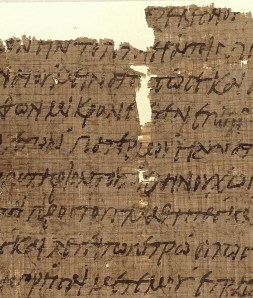
papyrusThe viral papyri attributed to an associate of Jesus and espousing sound theological views eventually became what we now call the “New Testament.” The other stuff — the classified documents, location-specific texts, and the ones written by that guy — predictably faded into obscurity.*

Okay, let’s go back to Marcion. Since there was no list (or “canon”) of authoritative texts, Marcion felt entitled to make one up that suited his own viewpoints. When he threw the Hebrew Scriptures and many of the viral papyri into the rubbish bin, the leaders of the Church said something to the effect of, “Hey, you can’t do that!” And Marcion shot back, “Too bad, suckers.”

At that point, those leaders decided that a list of their own would probably be a good idea. But, things moved slowly in the ancient world, so the top 27 texts were not finalized until the end of the fourth century (and even then, there was still some dispute between the Eastern and Western churches). But, I get ahead of myself. Let’s back up a bit.

With Marcion’s heresy forcing the Church to respond with its own canon of authoritative texts, scholars began compiling lists. Certain texts were shoe-ins. First and foremost, the Hebrew Scriptures (which became known as the “Old” Testament) were never in question because these texts were the Bible for the people who wrote the rest of the Bible. Second, the letters of Paul (the most virulent of all the viral papyri) and the three synoptic gospels, Matthew, Mark, and Luke, along with the Acts of the Apostles (which is sort of the Godfather II of Luke’s Gospel). The Gospel of John was on the bubble at times because some of the heretical groups loved it. But, it made the cut partly because its “high Christology” helped the Church’s position on the divinity of Christ.

Over time, the New Testament canon solidified with 27 texts.** The four accounts of the Gospel came first, as they narrated the reason why the rest of the texts exist. Then the Acts of the Apostles propels the canon into the letters of Paul (strangely enough, appearing in descending order by length). After Paul, Hebrews begins the section of various texts addressed to a wider audience (the “catholic” epistles). Appropriately, the Revelation to John ends the canon.

The compilation of the New Testament from viral papyri to authoritative text speaks to us today of the value of various viewpoints within a larger structure. Unlike Marcion, who depleted the message until it said only what he wanted it to say, the 27 canonical texts present myriad experiences that coalesce into the great message of the love and grace of God. From an early time, the Church valued several different expressions of the Gospel of Jesus Christ because it realized that one text could not contain such overwhelming truth and beauty. What is striking about the compilation of the canon is that the Church exhibited pretty startling ecumenism over a long period of time as the churches from both far-flung places and major cities shared their experience of the God made flesh in Jesus Christ.

I wonder when we Christians decided to stop valuing the experience of our fellows. The viral papyri tell a different story. Would that we could live that story again.

Footnotes

* Well, until a sensationalist media program digs up a “gnostic gospel” and decides that “everything we know about Christianity is about to change.” Honestly, give it a rest. That story lost the lead to the Battle of the Milvian Bridge.

** In the mid-1700s, an Italian named Ludovico Antonio Muratori stumbled upon an ancient fragment stuck in a book in a library in Milan. The “Muratorian fragment,” which could be dated anywhere from the second to the fourth centuries is the oldest extant list of the texts of the New Testament. What’s most interesting about the fragment is the short justifications it gives for why certain texts were either chosen or not.

Unmuddying the waters (Bible study #9)

I know I’ve said this before, but it bears repeating: the hardest thing to do when studying the Bible is to read the words on the page without the baggage of tradition lending a hand. For the purposes of this Bible study, “tradition” has a lowercase “t.” (While it rhymes wimusicmanth “p,” it does not stand for “pool.”) This tradition is everything from the writings of the church fathers to the texts of songs in our hymnals. Now, I’m not saying that reading with a knowledge of tradition is a bad thing — far from it. Sometimes, however, tradition serves to muddy the scriptural waters to the point that we can no longer see our soggy selves floating around.

The opening of the second chapter of Matthew, one of the choices for this Sunday’s Gospel text, illustrates just how murky the waters can get. This is the bit where the wise men from the East come to see King Herod, and he sends them on a reconnaissance mission to find the newborn “king of the Jews.” Until a dream notifies them, the wise men are unaware of Herod’s malicious plans. They bring the infant Jesus some gifts he has no practical use for (does myrrh clear up diaper rash?) and then go home by another road.

Okay, now let’s bring in tradition. For years and years we have smooshed the beginnings of Matthew and Luke together so much that we have trouble separating them, even when reading them independently of each other. But this independent reading is so important for seeing how each evangelist is setting up his account of the Gospel of Jesus Christ. If you let the “no place in the inn” bit of the story (from Luke) fall away, you’ll notice that it certainly looks like Joseph, Mary, and Jesus live in Bethlehem — they relocate to Nazareth after their jaunt in Egypt. Indeed, the wise men come to Mary’s house, not a stable. So, while Luke uses the census to get the holy family to Bethlehem and back, Matthew uses Herod’s slaughter of the infants to get the holy family out of Bethlehem and eventually to Nazareth. But that’s not how we usually tell the story.

Now, bring in that hymn about the kings and everything gets even murkier. First, the wise men are “magi,” not “kings” — yes, these are entirely different words in Greek. Second, we have no way of knowing how many there were: we surmise three, but that’s because of the gifts. Maybe a couple went halfsies on the frankincense.

I acknowledge that using “We three kings of Orient are…” is a bit of a cheap shot, but it sure gets my point across. While these are small things that end up being mere distractions from what the text says, there are pieces of our tradition that amount to much more. Here’s one: Martin Luther’s “law/grace” dichotomy has colored readings of Paul’s letters for five hundred years. Luther’s viewpoint is so thoroughly embedded in biblical scholarship that it has taken on its own scriptural aura. But his is not the only reading.

Here’s another: one segment of Christian tradition — let’s call it the “rapture dispensationalist” segment (please read the footnote if those words are unfamiliar)* — sees the book of Revelation** as a script for what is going to happen during the “end times” (cue ominous music). This has led people (who would most likely — and ironically — call themselves “biblical literalists”) to speculate that the dragons and locusts symbolize things like atomic weapons and AK-47s. This reading of Revelation as a blueprint for the future has leaked into Christian tradition over the last two hundred years — so much so that the waters of Revelation (already murky by the difficult imagery of the text) are muddied even more by futile searches for modern analogs to biblical images. A more productive reading sees Revelation as an early Christian warning against complacency and the errors of  “the world,” a warning that transcends the time in which it was written.

Tradition helps us float in our biblical waters. But when we study the Bible, we should always take one swim unsupported by inner tubes or those floaties you wear on your upper arms. Perhaps, when we peer into that clear water, we will encounter God in new and fresh ways. Then we can add our encounters to that long story that is our Christian tradition.

Footnotes

* These are people who believe that the world will end in seven years of really gruesome carnage and destruction. Depending on which flavor of rapture dispensationalism you subscribe to, you will be brought bodily to heaven either before, in the middle of, or after these seven years.*** Again, depending on your flavor, Jesus comes back at some point in this time frame as well. As you can probably tell from this explanation, I am not a rapture dispensationalist.

** Please, please, please don’t say “Revelations” when you talk about this biblical text. There is just no “s” anywhere in that word.

*** A footnote inside a footnote! One term for the “middle of” way of thinking is this: “Mid-tribulation rapture dispensationalism.” See how smart you can sound with silly church words!

Twenty questions (Bible study #8)

In the last Bible study, I talked about reading the Bible out loud as a way to focus our interpretive endeavor. When we read aloud, we are forced to make interpretive choices that silent reading misses. This is especially true when reading dialogue. In the Gospel, narrators set scenes, but most of the important information is conveyed through characters’ interactions with one another. The evangelists* present these interactions in various ways, but each uses dialogue as the main vehicle of communication.

When you study the Gospel, pay attention to how the writers structure their dialogue. What is said? What is not said? What are the speaker’s preconceived notions? What are his motivations? What is her background?

Here’s one example. Every time someone calls Jesus “teacher” in the Gospel according to Matthew, that someone is not on Jesus’ side. They are scribes and Pharisees and people asking Jesus questions to test him. On the flip side, Jesus’ disciples and those asking for healing always call Jesus “Lord.” In this way, Matthew shows that the former group doesn’t get that there is so much more going on than an eccentric teacher wandering around spouting eccentric ideas. While “teacher” is not necessarily pejorative, Matthew uses it to show Jesus’ opponents attempting to stifle the rumors of his messiah-ship. With this simple comparison of title, Matthew communicates the struggle for influence between the establishment and Jesus’ disciples.

Matthew does all that with two little words: “teacher” and “Lord.” Across the Gospel, there is very little extraneous information, so we rarely get an explicit statement of a character’s mood or bearing. Besides Mark’s use of “immediately,” adverbs are in short supply in the Gospel. The dramatic force of characters’ interactions is driven by the dialogue itself; this dialogue is charged with intent, meaning, and suggestion, so descriptors are distracting at worst and ancillary at best. Read through all four accounts of the Gospel, and I bet you could count the number of times someone’s mood is described on one hand. (Check John 11 for a couple).

The narrators do not need to intrude into conversations because the evangelists are pretty darn good writers. How would it be if the text said: The woman said flirtatiously, “How can you get that living water?” Jesus, feigning ignorance of her advance, responded dispassionately, “You drink of this water…”

I know. Not the best writing ever. Rather than infesting their conversations with adverbs, good writers develop dialogue that suggests what I stated explicitly in the above example. Here’s how John writes the conversation: The woman said to him, “Sir, you have no bucket, and the well is deep. Where do you get that living water? Are you greater than our ancestor Jacob, who gave us the well, and with his sons and his flocks drank from it?” Jesus said to her, “Everyone who drinks of this water will be thirsty again, but those who drink of the water that I will give them will never be thirsty. (John 4:11-14)

Of course, I’m making an interpretive choice when I read flirtation into this conversation, but John’s dialogue leads me there. Pay attention to what the characters in the Gospel say and don’t say, especially the ubiquitous dialogical motif of a speaker failing to answer the question that is asked.

Try this one on for size. At the beginning of the Gospel according to John, some priests and Levites come to question John. They ask him: “Who are you?” Here’s what he doesn’t say: “I’m John from over yonder a bit. My parents are Zechariah and Elizabeth. I’m the crazy guy who eats locusts and wild honey and wears uncomfortable shirts.” Instead, he says, “I am not the Messiah.”** Now, correct me if I’m wrong, but this does not even come close to answering their question. If sobreadboxmeone came up to me and said, “Who are you,” then responding, “Well, I’m not a toaster oven,” doesn’t really narrow it down.

But John and the Levites keep playing twenty questions: “Are you Elijah?” I am not. “Are you the prophet? Nope. Obviously, because of John’s recent activity, both he and the Levites know that this little game is about more than who John is. If it were that simple, my answer about uncomfortable shirts would have been enough. They want to know what his significance is in the history of the salvation of Israel. With this in mind, his leap to downplaying rumors of messianism makes more sense. Rather than asking him if he’s larger than a breadbox, they try a new version of their original question: “What do you have to say about yourself?” And again, John doesn’t answer their question. He speaks not about himself but about the one to whom he points: “I am the voice of one crying out in the wilderness, ‘Make straight the way of the Lord.’ ” Even here, when they ask him a direct question about himself, John points to Jesus.

By structuring a conversation in which John answers different questions than the ones asked, the evangelist offers us insight into both parties. Watch out for this kind of conversation in the Gospel (especially John’s account).

Okay, I’m approaching a thousand words about this topic, so I think I’ll stop soon. When you read the conversations in the Bible, be sensitive to how the writers put the words together. Focus on the dialogue and let it speak to you. And know that Jesus is not just talking to the woman at the well or the crowd beneath the mount. He is speaking to you and to me.

Footnotes

* This is a handy shorthand for Matthew, Mark, Luke, and John, the authorities behind the four canonical accounts of the Gospel.

** Actually, according to the narrator, “He confessed and did not deny it, but confessed…” This is one of those odd places where the narrator does inject description into conversation. But it’s so rare that these few words take up lots of pages in commentaries.

What is truth? — Pilate in three takes (take 3)

As mentioned in the footnote of the last Bible study (“Don’t just read it”), the following post is the last of three that explores different interpretations of Pilate’s question “What is truth.” Using the ancient Jewish practice of Midrash (in which scholars took the stories of scripture and expanded them to reach new insight and new interpretive depth), I have attempted to get into Pilate’s mind on that fateful day before the Passover. Think of these posts as “takes”  — a film director asking an actor for different emotions over the course of shooting a scene. These different angles help us interpret Pilate’s conversation with Jesus in John 18:33-38. After reading all three takes, decide which you think is persuasive. If none is, write your own!

Take Three

I shut the door behind me, and the noise of the crowd dies away. What do they expect me to do? They didn’t even offer an accusation, and they want this man dead. If they just wanted him dead, someone could have knifed him in the back. No, they don’t just want him dead. They want a spectacle. So they come to me. They think they can manipulate me into complying with the whims of their high priests. We’ll see about that.

I open the door again and motion for Jesus to be brought to me. He enters the chamber and immediately fills it with his presence. I feel the same way I do when my commander comes for an inspection. “Are you the king of the Jews?” I ask, and an ounce of wonder escapes my lips with the words.

He replies with his own question: “Do you ask this on your own, or did others tell you about me?”

I feel suddenly put on trial. I take a step back; indignation replaces wonder in my voice: “I am not a Jew, am I?”

He is really from a different kingdom, he says. His followers would be fighting if he were from here, he says. The nation I am governor of has no bearing on him, he says.

“So you are a king?” I am perplexed, but at the same time I am conscious that my office does not allow for vexation brought about by a local celebrity.

“You say that I am a king. For this I was born and for this I came into the world, to testify to the truth. Everyone who belongs to the truth listens to my voice.”

His words hold such power. They linger in the air, catching the morning light that is streaming in the window. I want to believe what he is saying, but a lifetime of orders and spears and pavement and paperwork and…holds me back.

He stands in front of me, hands clasped as if in silent prayer. I look into his eyes and they reflect the words, “Everyone who belongs to the truth listens to my voice.”

I slump down, back to my desk, knees bent. “What is truth?” I say. It is a plea more than a question. I bow my head, upset that I let my emotions show in front of this Jew. My vision begins to mist as tears build in the corners of my eyes.

Get a hold of yourself. You are the governor. You are in charge, not this delusional freak. I sling my head back and whack it on the desk. My head clears. The tears are gone. I look up and see a hand reaching down. My eyes narrow. I do not need your pity, I think. Knocking his arm away, I pull myself up and stalk out of the room, without a further glance back at those eyes or those hands.

What is truth? — Pilate in three takes (take 2)

As mentioned in the footnote of the last Bible study (“Don’t just read it”), the following post is the middle of three that explores different interpretations of Pilate’s question “What is truth.” Using the ancient Jewish practice of Midrash (in which scholars took the stories of scripture and expanded them to reach new insight and new interpretive depth), I have attempted to get into Pilate’s mind on that fateful day before the Passover. Think of these posts as “takes”  — a film director asking an actor for different emotions over the course of shooting a scene. These different angles help us interpret Pilate’s conversation with Jesus in John 18:33-38. After reading all three takes, decide which you think is persuasive. If none is, write your own!

Take Two

I slam the door open so hard that it crashes into the mantle, sending a vase toppling. I catch the vase in midair with both hands and look at my warped features in the curved, glazed surface. Red splotches have broken out on my cheeks and neck. I grit my teeth, spin, and fling the vase at the far wall. It shatters, satisfyingly.

My personal guard comes bolting into the room, sword drawn, at the sound of the crash. He stops and stands dumbly when he sees that I am alone. “Bring me the prisoner,” I say, chest heaving.

I stand with my back to the door. I lean with my knuckles on the desk, hands clenched in fists. I hear the door open slowly. Without turning, I say, “Are you the king of the Jews?” He answers insolently, questioning me when I am the one asking the questions.

“I am not a Jew, am I?” I say, half mocking, half enraged. I always have trouble with locals this time of year, but this is as bad as I’ve seen it. I feel justified in my rage and it feels good. When will they learn that we are in control? “Your own nation and the chief priests have handed you over to me. What have you done?”

I hear a sound and whip around to find Jesus bending over the broken vase. He is holding a flower. This is too perfect, I think, as my ire grows stronger. This dove thinks he can play with the lion. He has no idea who he is dealing with. I stride over to him, snatch the flower, and snap its head off. I can play with him and those meddlesome priests at the same time: I can expend my anger in sport.

Then he babbles something incoherent about his kingdom. “So you are a king,” I shout, throwing my hands in the air.

“You say that I am a king,” he says, quietly. His calmness threatens to diffuse my anger. I won’t let him. He continues, as I pace around him, stepping on the broken vase and flowers with each pass. “For this I was born and for this I came into the world, to testify to the truth. Everyone who belongs to the truth listens to my voice.”

He finishes. I grab him by the shoulder and spin him around, grasping his garment in my left hand and pulling him close. We are nose to nose. His expression is one of mild surprise. There is no fear, not even concern in his eyes. Why isn’t he afraid of me? Why is he so calm?

“What is truth?” I don’t shout it. I don’t scream in his face. It comes out as a bellow, almost a growl. I push him away and storm out of the room, slamming the door behind me.

What is truth? — Pilate in three takes (take 1)

As mentioned in the footnote of the last Bible study (“Don’t just read it”), the following post is the first of three that explores different interpretations of Pilate’s question “What is truth.” Using the ancient Jewish practice of Midrash (in which scholars took the stories of scripture and expanded them to reach new insight and new interpretive depth), I have attempted to get into Pilate’s mind on that fateful day before the Passover. Think of these posts as “takes”  — a film director asking an actor for different emotions over the course of shooting a scene. These different angles help us interpret Pilate’s conversation with Jesus in John 18:33-38. After reading all three takes, decide which you think is persuasive. If none is, write your own!

Take One

I beckon for Jesus to follow me inside, and then I ask him, “Are you the King of the Jews?” He won’t give a straight answer, but I can tell he believes what he says. There is no hint of fever or delusion, just honesty. But I have learned from long experience in the politics of the Empire that there is a difference between honesty and truth. “So you are a king?” I press.

He looks at me for a moment, considering his response. “You say that I am a king. For this I was born and for this I came into the world, to testify to the truth. Everyone who belongs to the truth listens to my voice.”

I lean back on my desk and cross my arms. This man really, honestly believes what he is saying. There is no trace of deception in his face. He is playing the game and playing it well; his answers are both vague and cryptic, but neither seditious nor treasonous. I try to keep my face from betraying my internal skepticism, but I am sure my right eyebrow rises.

“What is truth?” I say. I say it flatly, so that there is barely a question mark at the end of the phrase. I can’t help but add a bit of sneer to my raised eyebrow. What a ludicrous proposition. He thinks he is on a mission to testify—to die—for the truth?

The truth? I don’t even think there is such a thing as truth, let alone a singular, definite truth. There are too many lies masquerading as truths out there. There is a chain of command in this Empire and that means there is a chain of lies, as well. I can lie to everyone beneath me, and they have to believe what I say is truth. And I am sure my superiors lie to me, but what am I to do? Consider it truth: that’s all I can do. Yes, there are too many lies out there masquerading as truths to think I can nail down any one single Truth.

My skepticism leaks out of my raised eyebrow and my sneering mouth. He knows I couldn’t care less for his truth. I just need to make sure I still have a job tomorrow. Truth. Lies. These things don’t matter. Keeping my position and my head: those are my concerns.

Still, nothing he has said makes him guilty. I stand up straight, look Jesus in the eye for a long moment, and then sweep past him on my way to talk to the locals again.

Don’t just read it (Bible study #7)

If you take the vast sweep of Christian history into account, far fewer people have read the Bible than have heard it read. When the New Testament was still just a collection of letters and a few strange things called “Gospel” (say from about 50 to 325 CE), specially trained performers recited entire letters and books from memory during worship. In the middle ages, the majority of people never heard scripture read in a language they could understand and probably wouldn’t have recognized a book if it fell on them from a scriptorium window. Even as the Reformation gained steam and the printing press made vernacular versions of the Bible available, most people heard scripture, but never read it. The “family Bible” didn’t become fashionable until the 18th century, and even today churchgoers hear more scripture than they read (no matter the ubiquity of the Bible online and on store shelves).newsies

What’s this have to do with biblical interpretation? I’m glad you asked. The texts that make up the Bible were always meant to be read aloud. Acts 8 makes this quite clear: Philip approaches the Ethiopian eunuch and knows he’s reading the prophet Isaiah because he is reading out loud. To himself. Follow the eunuch’s example (no, not that example). Read your passage out loud. I know you are reading a translation, but the beauty and rhetorical power of the biblical text do not necessarily suffer in an English treatment. When you read aloud, you will notice oratorical patterns and cadences that the Biblical writers employed to make recitation easier and listening more captivating.

Try this one on for size: say the following two verses in your mind and then say them out loud. “For those whom he foreknew he also predestined to be conformed to the image of his Son, in order that he might be the firstborn within a large family. And those whom he predestined he also called; and those whom he called he also justified; and those whom he justified he also glorified” (Romans 8:29-30).

Notice the oratorical power in the repetitive cadence. This is called a “step argument”: each phrase builds on the previous one until the sentence climaxes on the word “glorified.” Paul obviously wrote this sentence to be spoken rather than read. So there’s no point in studying these verses as “written.”

Besides appreciating the oratorical flair of Biblical writers, reading aloud gives you the opportunity to engage the drama of the Bible. A good chunk of the text is narrative and a good chunk of the narrative is dialogue. Now, we have no audiovisual documentation of the conversations recorded in the narrative, so it falls to us to interpret how the dialogue sounds.

Let’s take Pilate’s response to Jesus as an example: “Jesus answered, ‘You say that I am a king. For this I was born, and for this I came into the world, to testify to the truth. Everyone who belongs to the truth listens to my voice.’ Pilate asked him, ‘What is truth?’ ” (John 18:37-38). How does Pilate say, “What is truth?” Is he angry? Is he skeptical? Is he desperate? Each of these readings offers a different insight into the mind of the Roman governor. If you take reading aloud seriously, the dialogue will force you to make interpretive choices of tone, emotion, and motive. I’m not going to lie. Practicing a text for performance is an awesome way to enter into an interpretive mindset.*

A trained musician may be able to “hear the music” when she looks at a score, but most of us cannot comprehend music’s beauty and power without hearing it played. Similarly, the Biblical text soars when it is read aloud. In Genesis, God speaks creation into being. When we read the Bible aloud, we access that creative voice within ourselves and use the breath and the bodies that God created.

So, read the Bible, yes. But don’t just read it. Speak it. And don’t just speak the Bible. Proclaim it.

Footnotes

* The next few posts on this blog will expand this discussion of exploring dialogue in the Bible by presenting a three part Midrash on Pilate’s statement “What is truth?” Stay tuned.

** I want to thank the writer of the first comment on this post. Reading scripture aloud during worship is the main way people are exposed to scripture. Knowing that, we’ve got to make sure our lectors are trained and know what they are reading ahead of time. Too often, (for various reasons) priests are running around five minutes before services looking for people to read. Reading scripture aloud is too important for that to be the norm.

Tabula rooster (Bible study #6)

For the first time in my life, a rooster woke me up this morning.

Before I go any further, let me say that I was none too pleased by this event. Everything I know about roosters comes from cartoons and various other early childhood media, and the aggregate sum of that knowledge boils down to two facts: (1) roosters are boy chickens and (2) roosters crow at sunrise. Now, according to the U.S. Naval Observatory Astronomical Applications Department, sunrise was at 7:09 this morning at longitude W80.0, latitude N38.7 where I happen to be on retreat. So, either the cartoons lied or the rooster was jet-lagged because that darn bird woke me up at 5:30.

As an aside, I’ve always thought clock-radios to be rather neutral devices, but the one in my room mocked me with its diabolical red numbers.

At first, I didn’t know what was making the noise. It was guttural, gravelly — like the rooster version of Tom Waits. Then, as sleep traitorously fled from me, I took stock of my position as it related to the unknown sound. I was in bed. I was in the middle of farm country. I was awake before I should be. The sound was not my alarm. Taking these four items into account, I deduced the encroaching noise was the call of a rooster — an overzealous rooster fiend — but a rooster, nonetheless.

So, what’s all this have to do with the Bible? Well, not much, in truth. I needed to vent. However, as I am writing this post, I realize that taking stock of my position helped me identify the rooster’s crow. In much the same way, taking stock of my position in relation to the various texts of the Bible facilitates a more authentic encounter with those texts.

Why does that one story make you angry? or sad? or joyful? or indifferent? What memories does that other story stir in your heart and mind? Maybe your grandmother recited the twenty-third Psalm to you every night as you fell asleep. Maybe that gesticulating street preacher quoted a verse at you while explaining that your bare legs condemned you to hell.  Maybe you were on the verge of mental collapse and you threw your Bible to the ground and it flopped open to Romans and you read and you were filled. Maybe you cannot read Paul because the slave owners justified their action with his words.*

Simply put, our positions, our baggage influence our readings of the text. None of us can achieve a state of Tabula Rasa when we open our Bibles; nor should we try. I don’t believe God wants blank slates to write words on. God wants us — in all our history and tragedy and comedy — wants to rearrange our baggage into those words of life. We bring ourselves to the texts of the Bible. All those positive and negative memories and emotions bubble up. Quelling them for the sake of “scholarship” or “study” makes no sense. The Bible should be too much a part of our lives to keep our lives from being a part of the Bible.

When you pick up the Bible, acknowledge that your position and your baggage do, in fact, influence your reading. Ironically, this acknowledgment will make you less biased in the long run because you will begin to see why a story strikes you a certain way and not just that it does. Chronicling your past associations with a particular text offers one way to chart your growth in your life of faith. The text does not change, but you do. What changes happened? How does the constancy of the text bring those changes to light?

Take stock of your position when you open the Bible.  Let the text encounter you — not the person you think you should be in order to be worthy of the Bible’s holiness nor the unobtainable Tabula Rasa, but the person you are in all your human particularity and messiness. Through the power of the Holy Spirit, the text will speak to this honest, baggage-ridden person. Where the text and your baggage intersect, you will have found your story in the Bible. You will know you aren’t alone in your experience for there are no new stories. There are just new people telling them, new combinations of baggage which add depth and innovation, new ways to proclaim that old, old story.

Who knows? Maybe the next time I read the Passion narrative and come to Peter’s denial of Jesus, I’ll think of that overzealous rooster fiend at longitude W80.0, latitude N38.7.

Footnotes

* In his wonderful and provoking book Jesus and the Disinherited, Howard Thurman speaks of this in his own family.

** In the 4th study in this series, I spoke of a dual reading of the text — once with your context and the historical context and once in the light of a “holy naivete.” I think this holy naivete is different from the blank slate mentality. In the former, you let go of your baggage in order to set it into sharper relief in your reading. In the latter, you delude yourself into thinking you have nothing to offer the encounter.

Getting lost in the stacks (Bible study #5)

One of the easiest missteps people make when sitting down to study the Bible is mistaking the Bible for a book. I know it looks like a book — it has folios stitched together and a cover enclosing the whole bound volume. But whatever its resemblance to a book, it is not one. It is many. The word “Bible” began its career as the Greek phrase ta Biblia which means “the books.” Therefore, the Bible — all visual cues to the contrary — is, in point of fact, a library.

Here’s what I mean. What we call the Bible is a collection of all sorts of writing: transcribed oral tradition, history, prophecy, poetry, gospel, correspondence, sermon, song, vision, law code, genealogy, novella, advice column, propaganda, shopping list, architectural schematic. And these are just the ones I could come up with off the top of my head. The history of how the particular collections of what I will from now on rather lamely refer to as “texts” came together to form our modern day “Bible” is beyond the scope of this post. Suffice to say that from history down to shopping list, each text somehow relates an encounter between God and God’s people. God’s people found the particular encounters that make up the texts revelatory and important, and they, in many a Spirit-filled decision, collected those texts together into the library that has become the Bible.

So, what’s all this have to do with studying the Bible? After picking your pericope, figuring out what type (or genre) of writing the passage comes from can help you begin to unpack it. You’d expect to find dialogue in a Gospel because the genre of Gospel is narrative.* You’d expect to find poetry in the collection of psalms because psalms were originally liturgical song. (Indeed, attached to many psalms are directions for the accompanying instrumentation.) But what if you found poetry in the Gospel. What would that tell you? Perhaps, the writer is reaching back to an earlier tradition and putting that liturgical song on the lips of a character. Check out Mary’s song in Luke 1, influenced clearly by Hannah’s song in 1 Samuel. Check out Jesus’ words from the cross in Matthew and Mark, which come from Psalm 22.

Being sensitive to the various genera found in the biblical library gives us the opportunity to compare the myriad ways biblical writers explored their encounters with the living God. One writer finds God in the proportions of architecture, another in correspondence with the churches he has founded, another in the list of the generations of God’s family going all the way back to Abraham and before. Putting these different experiences in conversation with each other shows us the wonderful range of expressions of the life of faith.

So delve into the library of the Bible. Get lost in the stacks of the Hebrew Scriptures. Run your fingers along the volumes of Paul’s letters. Find one of those rolling stepping stools and reach the dusty top shelf of Revelation. Be aware of the different kinds of writing in the Bible, the various encounters of the people of God. And remember that you, yourself, are part of the greater story still being written, still being added to those last, unfilled shelves.

Footnotes

* Actually, as far as scholars can tell the form of “Gospel” as narrative is unique to Christian literature. Other ancient texts call themselves “gospel” but they tend to be something closer to news reports about various glorious victories for the Roman Empire. The fact that Mark calls Jesus’ message “Gospel” could be an ironic coopting of Roman phraseology — a literary “nah-nah-na-nah-nah,” if you will.

Expect to be surprised (Bible study #4)

I wasn’t planning to write about this particular aspect of Bible study for a while yet, but a few days ago I broke the very direction I’m about to relate to you. Before I tell you what this direction is, I must say that failing to observe my own guidelines is an odd and humbling experience. You might say, “Adam, you made them up; you can get rid of them just as easily.” Well, I’ve never liked when presidents dump their own executive orders when they get inconvenient. So I better stick to my guidelines and remember that God’s greatest gift to me is slapping me upside the head with humility.

Incidentally, I wonder if police officers experience any humility or remorse when they speed by with nary a siren or light turned on. I doubt it. Anyways, back to the Bible. So, I was beginning my sermon prep and reading through this Sunday’s lessons in a book that has all three of them conveniently grouped together. I finished the short passage from Paul’s Letter to the Romans, and my eyes wandered down to the Gospel reading. “Matthew 16:13-20” said the bold headline. Right, I thought, that’s Peter’s confession of Jesus being the Messiah, keys to the kingdom and all that. Then I closed the book.

Yep, I closed the book. I closed the book WITHOUT READING THE GOSPEL LESSON. Take 30 seconds to mull over all the ways that’s just stupid before continuing to read this post………..right, let’s press on.

The next morning in the shower (I do all my best thinking in the shower), I was thinking about my sermon and realized I couldn’t remember what the Gospel text was for Sunday. I could, however, remember shutting the book after reading Romans. I took 30 seconds to mull over all the ways that’s just stupid. When I got to church, I pulled out my Bible, opened up to Matthew 16, and read it. And read it again. And read it again.

And I surprised myself so much that I threw my head back and laughed a manly laugh of triumph. Actually, I had an uncontrollable fit of giggles, but if Cameron Crowe ever makes my biopic, I hope he inaccurately portrays me so I seem less like a 12-year-old girl.

I giggled because I noticed something in the text I’ve never noticed before. I’ve read Matthew 16 a few dozen times over the years, but until Tuesday morning, I never saw that Jesus asks his disciples two different questions: “Who do people say that the Son of Man is?” and “Who do you say that I am?” I always saw the “those people/you disciples” distinction, but never the “Son of Man is/I am” one. My sermon is still percolating somewhere in the region of my belly, so I don’t know if this distinction will influence what I say on Sunday. But, the important thing is this: the text surprised me–this text that I thought I knew so well that I didn’t even need to read it to write a sermon about it surprised me with something new and exciting.

The title of this post is a bit of an oxymoron. If you’re expecting to be surprised, then will there really be a surprise? With birthday parties, No. With reading the Bible and living your life in God’s grace, Yes. God can and surely does surprise us when we are least expecting it. But we can also foster the faithful expectation that God’s sleeves are full of never-ending pocket handkerchiefs and affixed to God’s lapel is one of those flowers that squirts water and in God’s loving embrace await ever deeper and more beautiful surprises.*

When you read the Bible, practice expecting to be surprised, especially when you are studying the most familiar passages. And I do mean practice. Every reading will not yield some surprising event, but every expectant reading will cultivate an openness to the Holy Spirit, whose whole game plan is about surprising us with God’s grace and joy.

Here’s one exercise I find helpful. Read the passage twice, with a few minutes of silence in between. The first time, read as critically as you can, with all your past experience and knowledge of the historical context and history of tradition and understanding of ancient biblical languages and your kitchen sink. The second time, let all the baggage recede into your mind’s Green Room and read with the lightness of a holy naivete. Finally, have a conversation with yourself about how your two readings compared. What was the same/different? What was confusing/clear? What sprung from the page? As your intellect, curiosity, and hunger mingle with the Holy Spirit’s guidance, you will find something new and exciting. And you might just giggle like a 12-year-old girl.

Footnotes

*After the first comment on this post, I think I’ll qualify my clown imagery. I was going for the surprising things clowns do. If you’ve ever met me, you know clowns really freak me out, but it’s the painted smiles, not the gags. The clown therapy people who frequented the hospital at which I worked one summer wore white lab coats like doctors. It was weird.